We must become the change we want to see.- Mahatma Gandhi
What is Leadership?Leadership is the ability to: “express a vision, influence others to achieve results, empower others, encourage cooperation, and be an example.”
Successful leaders are committed to “creating a world to which people want to belong.” Successful leadership involves managing relationships and communicating within a team to move towards a specific goal.
Leadership is not the same thing as management. Management is “getting things done through others.”
Leadership is “getting others to want to do things.” Leadership is intimately tied up with motivating and influencing others.
A good deal of leadership can come from people who are not formal leaders.
Leading is the result of using one’s role and leadership ability to influence others in some way.
True leaders are not “bosses” or “commanders”. Instead of power, true leadership comes from influence and integrity.
Strengthening your leadership ability can help you improve your capacity to achieve results and reach personal or organizational outcomes.
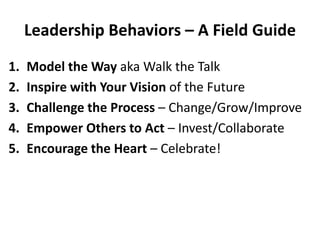
Leadership Field Guide Table of ContentsModel the Way aka Walk the TalkInspire with Your Vision of the FutureChallenge the Process – Change/Grow/ImproveEmpower Others to Act – Invest/CollaborateEncourage the Heart – Celebrate!
Model the Way First, find your voice by clarifying and communicating your personal valuesThen, set the example by aligning your actions with your valuesWalk the Talk!
Do What You SayBe consistent in how you handle critical incidents, how you spend your time, how you recognize and reward, and the stories you tell to build the culture.Model the Way
Model the WayBea Professional Be loyal to the organization, perform selfless service, take personal responsibility.
Be a professional who possess good character traits Honesty, competence, candor, commitment, integrity, courage, straightforwardness, imagination. Model the Way
Model the WayBe a professional who possess good character traits Integrity is measured by what you do when no one is watching you. Don’t compromise.No one can take your integrity—you have to give it away. Don’t –it’s your most prized possession.
Model the WayFocus on ExcellenceFocus on excellence and those around you will follow suit.
Model the WayFocus on ExcellenceLeaders have GRIT GutsResilienceIntensityTenacity
Model the WayFocus on ExcellenceWinners contribute to their surroundings; losers complain about them. Winners are problem solvers; losers are problem identifiers. Be a winner.
Model the WayFocus on ExcellenceWinners forget they’re in a race – they just love to run.Enthusiasm is like a rumor—it spreads fast.Don’t rationalize failure. “Can Do.”
Model the WayFocus on ExcellenceGreat leaders leave a legacy of excellence in the hearts, minds, and souls of the people they lead.They are trustworthy, earn our respect, and genuinely care about us.
Model the WayFocus on ExcellenceTheir legacy is the example of excellence that shapes us. They touch our souls. They never ask for anything in return. They embody what it means to be a leader.
Model the WayFocus on ExcellenceMany leaders get great results, but obtaining great results is not proof of great leadership. For the great leader, great results are merely a byproduct of bringing out the best in others. Such leaders are personal and national treasures. Cultivate them.
Model the WayTend your own gardenMake your functional area the best place it can possibly be. Focus your talents and energies on areas you can directly influence and control.
Model the WayTend your own gardenMake life better and more meaningful for those around you. Be committed to excellence in every facet of existence.Defeat the entitlement mindset.
Model the WayTend your own gardenPick your battles… Beyond our area of control is another area, the area of influence, which we do not control but which we can help shape. Events in the area of influence affect our gardens, but events we control in our gardens can also affect the area of influence.
Model the WayTend your own gardenThose who tend their gardens discover that excellence is infectious. People want to be on winning teams, and they want to make their teams winners. Engaging in petty rivalries and jealousies is counterproductive.
Model the WayBe an Expert in the BasicsGreat leaders are great teachers.Your mark on your profession is the quality of the junior leaders who follow you.
Model the WayBe an Expert in the BasicsPeople expect their leaders to be experts in the basics.
Model the WayBe an Expert in the BasicsWhen leaders coach, they generate confidence among their subordinates. Leaders learn a great deal about their peoples’ strengths and weaknesses while teaching the basics to them.
Model the WayBe an Expert in the BasicsAs the leader coaches, the employees get to understand the standards that the leader expects in daily operations.
Model the WayBe an Expert in the BasicsSet high standards and demand compliance. People appreciate high standards that are uniformly enforced.
Model the WayBe an Expert in the BasicsNever pass over a mistake.If you do, you have set a new standard.
Model the WayBe an Expert in the BasicsLeaders must be visible, share hardships, and be the best. Being with your employees sets a great example and demonstrates that you are a leader who cares.
Model the WayBe TrustworthyThe foundation of every healthy relationship is trust.
Model the WayBe TrustworthyRelationships usually fail because of an actual or perceived breach of trust.
Be TrustworthyA leader must earn trust. Good leaders are worthy of trust. Model the Way
Model the WayBe TrustworthyGood leaders earn trust through:Good character and professional competence Creating meaningful goals that generate excitement and coherent plans to meet those goals Sound and timely decisions Setting the exampleUplifting those around them to be betterCaring about others and treating them with respect Good Leaders do the right thing.
Model the WayBe TrustworthyTrust, which is the foundation of morale, is the first principle of leadership and the emotion that holds an organization together. Trust is the genesis of faith in oneself, one’s co-workers, one’s leaders, and one’s team.
Model the WayBe TrustworthyMutual trust fosters initiative and instills a greater sense of responsibility. People who trust one another share a bond of faith and understanding.
Model the WayBe TrustworthyLeaders who trust their subordinates can loosen the reins and unleash creative energies. Mutual trust in competence, discipline, character, and sound judgment is a requirement for independent initiative.
Model the WayBe TrustworthyThe best leaders use the principle of trust to guide their actions and decisions. Trustworthy leaders create high-performing units that have superb morale.
Model the WayGrow Through FeedbackFeedback is a dialogue among professionals to improve the organization. Good Leaders get feedback from subordinates.
Model the WayGrow Through FeedbackSubordinates will only tell you the full truth if:They know you are genuine They know disagreement does not equal disrespect They see you take action on their feedback They know that what they say is not going to be held against them
Model the WayGrow Through FeedbackGive feedback on subordinates’ feedback. Let them know when you implement one of their ideas, and tell them how the idea has improved the unit.
Model the WayGrow Through FeedbackA good leader has the courage and confidence to be humble, listen to others, set the example, and foster healthy disagreement and the exchange of ideas and insights.
Model the WayIn summary:Clarify & Communicate your Personal ValuesDo What You SayBea Professional Focus on ExcellenceTend your own GardenBe an Expert in the BasicsBe TrustworthyGrow Through Feedback
Inspire a Shared VisionEnvision the future by imagining exciting and inspiring possibilitiesA great Leader inspires excited and motivated people to reach for goals which they may not have even dared to dream about on their own.
Inspire a Shared VisionEnvision the future by imagining exciting and inspiring possibilitiesLeaders passionately believe that they can make a difference. They have a desire to make something happen, to change the way things are, to create something that’s never existed before.
Inspire a Shared VisionEnvision the future by imagining exciting and inspiring possibilitiesLeaders envision the future. A vision is a mental picture of what tomorrow will be like. It expresses our highest standards and values. It sets us apart and makes us feel special. It spans years of time and keeps us focused on the future. And, it must appeal to all who have a stake in it.
Inspire a Shared VisionEnlist support of others in a common vision by appealing to shared aspirationsHowever, having a vision of the future isn’t enough. Others must be able to see themselves in that future.
Enlist support of others in a common vision by appealing to shared aspirationsLeaders know what motivates their constituents. They forge a unity of purpose by showing constituents how the vision can meet their needs and serve the common good.
Enlist support of others in a common vision by appealing to shared aspirationsLeaders are personally convinced of the value of the vision and share it with genuine passion and conviction. Enthusiasm is catching. It uplifts people’s spirits.
Inspire a Shared Vision“The very essence of leadership is that you have to have a vision. It's got to be a vision you articulate clearly and forcefully on every occasion.” — Theodore Hesburgh, President of the University of Notre Dame
Inspire a Shared VisionIn SummaryEnvision the future by imagining exciting and inspiring possibilitiesEnlist support of others in a common vision by appealing to shared aspirations
Challenge the ProcessSearch for opportunities by seeking innovative ways to change, grow and improveExemplary leaders are proactive – they seize the initiative.
Challenge the ProcessSearch for opportunities by seeking innovative ways to change, grow and improveLeadership and innovation are nearly synonymous.
Challenge the ProcessSearch for opportunities by seeking innovative ways to change, grow and improveLeaders know that people will not change unless they can see how a new policy, process, or program fits with their personal needs. Leaders find ways to make the work of change intrinsically motivating to their constituents.
Challenge the ProcessSearch for opportunities by seeking innovative ways to change, grow and improveBecause new and innovative ideas often originate outside the organization – they come from customers, research labs, or other outside sources – leaders use their “outsight” – their ability to perceive external realities – to constantly survey the landscape of technology, politics, economics, demographics, art, religion, and society.
Challenge the ProcessSearch for opportunities by seeking innovative ways to change, grow and improveLeaders are open to receiving ideas from anyone and anywhere.
Challenge the ProcessSearch for opportunities by seeking innovative ways to change, grow and improve“Try harder” is a sure-fire way to get nowhere when people are doing their best under a prevailing paradigm. Instead of asking your people to try harder, how about asking them to think differently?
Challenge the ProcessSearch for opportunities by seeking innovative ways to change, grow and improveAllow people to think in different ways to improve performance, and then unleash them and see what happens.
Challenge the ProcessSearch for opportunities by seeking innovative ways to change, grow and improveLook for areas that need improvement, tell people what you want done and why, and then guide them.
Challenge the ProcessSearch for opportunities by seeking innovative ways to change, grow and improveThe trust and confidence given to others will be rewarded in their enthusiasm, ownership of standards, and excellence. People will amaze you with their ingenuity, and when they succeed, even partially, praise them in public.
Challenge the ProcessExperiment and take risks by constantly generating small wins and learning from mistakesA leader who promotes creativity and change must have the maturity to accept that not all will turn out well. There is no better way to bring improvement to a halt than to punish someone when honest innovation goes awry. Innovation rarely comes from a unit led by a screamer.
Challenge the ProcessExperiment and take risks by constantly generating small wins and learning from mistakesHumility and courage are complementary qualities and admitting mistakes takes courage. Few people have earned respect who have not admitted mistakes, accepted feedback, or listened to others.
Challenge the ProcessExperiment and take risks by constantly generating small wins and learning from mistakesLeaders must allow mistakes to teach and learn.They must never allow failure.
Challenge the ProcessExperiment and take risks by constantly generating small wins and learning from mistakesReal leaders promote the idea that disagreement does not equal disrespect. The best leaders revel in disagreement because they know that independent thinking is the only way to discover the best solutions to problems.
Challenge the ProcessExperiment and take risks by constantly generating small wins and learning from mistakesIndependent thinking cannot occur in an environment that demands blind obedience.The magic of exchanging ideas is getting to know what and how other people think.Having faith and confidence in each other’s performance in uncertain and ambiguous situations is the key to initiative.
In SummarySeek innovative ways to change, grow and improveExperiment and take risks by constantly generating small wins and learning from mistakes Challenge the Process
Empower Others to ActFoster collaboration by promoting cooperative goals and building trust“You can’t do it alone” is the mantra of exemplary leaders.You simply can’t get extraordinary things done by yourself.
Empower Others to ActFoster collaboration by promoting cooperative goals and building trustCollaboration is the master skill that enables teams, partnerships, and other alliances to function effectively. Leaders foster collaboration by promoting cooperative goals and building trust.
Empower Others to ActFoster collaboration by promoting cooperative goals and building trustAt the very heart of cooperation is trust. Leaders help create a trusting climate by the example they set and through active listening.
Empower Others to ActFoster collaboration by promoting cooperative goals and building trustCollaboration can be sustained only when leaders promote a sense of mutual reliance – the feeling that we’re all in this together.
Empower Others to ActStrengthen others by sharing power and discretionCreating a climate where people are involved and feel important is at the heart of strengthening others.
Empower Others to ActStrengthen others by sharing power and discretionIt’s essentially the process of turning constituents into leaders themselves – making people capable of acting on their own initiative.
Empower Others to ActStrengthen others by sharing power and discretionPeople must have the latitude to make their own decisions. They must work in an environment that both builds their ability to perform a task and promotes a sense of self-confidence.  They must experience a sense of personal accountability so that they can feel ownership for their achievements.
Define clear roles and responsibilitiesClear expectations produce good results. People generally want to do well. When leaders make expectations clear, people tend to rise to the occasion to meet them. Empower Others to Act
Empower Others to ActDefine clear roles and responsibilitiesWhen you analyze why an individual or unit failed to accomplish what you wanted, the reason is often unclear expectations and poor guidance. Few things are more demoralizing than to believe you have done a good job, only to be told that you have completely missed the mark.
Empower Others to ActDefine clear roles and responsibilitiesArticulate expectations and have subordinates read back (the guidance) for possible correction. If you work for someone who provides fuzzy expectations, read back for possible correction until you know what the person wants.
Empower Others to ActDefine clear roles and responsibilitiesClarifying expectations does not mean handholding or telling people how to do their jobs. Simply express what you want done and why and then unleash your subordinates’ creativity to accomplish the mission.
Empower Others to ActDefine clear roles and responsibilitiesHow much guidance you give depends on the amount of trust and confidence you have in one another.
Empower Others to ActDefine clear roles and responsibilitiesKnowing what to do is knowing the letter of the law; knowing why you do it is knowing its spirit. Making the “what and why” clear enables subordinates to take meaningful initiative, and they might even succeed beyond expectations.
Empower Others to ActDefine clear roles and responsibilitiesEnforcing standards and accountabilities demonstrates that what we say is important and what we do is consistent.Making policies that we do not enforce sends the message that standards are not important.
Empower Others to ActDefine clear roles and responsibilitiesIf discipline means doing what is right, then education is the critical component of discipline.Education helps promote ownership of standards. People will be far more willing to meet standards when they understand their importance and do not regard them as mere harassment.
Leave a LegacyGreat leaders leave a legacy of excellence for their unit by creating compellingly effective systems and leaving the systems in place when they, themselves, leave. Empower Others to Act
Empower Others to ActLeave a LegacyThe test of the systems’ excellence comes when a leader’s successor arrives. If the successor understands the logic and the effectiveness of the systems the previous leader has put in place and keeps those systems in place, the previous leader will have succeeded.
Empower Others to ActLeave a LegacyViable systems sustain predictability and balance, and because the best systems do not depend on a leader’s personality, units do not need to reinvent the wheel after every transition. A unit with sound systems in place can sustain excellence over a long period.
In SummaryFoster collaboration by promoting cooperative goals and building trustStrengthen others by sharing power and discretionDefine clear roles and responsibilitiesLeave a LegacyEmpower Others to Act
Encourage the HeartRecognize contributions by showing appreciation for individual excellenceAccomplishing extraordinary things in organizations is hard work. To keep hope and determination alive, leaders recognize contributions by showing appreciation for individual excellence.
Encourage the HeartRecognize contributions by showing appreciation for individual excellenceUse thank you notes, smiles, awards, and public praise to demonstrate your appreciation. Leaders love to boast about the achievements of others. They make others feel like winners.
Encourage the HeartRecognize contributions by showing appreciation for individual excellenceLeaders expect the best of people.Recognition is done in a context of high expectations and clear standards.
Encourage the HeartRecognize contributions by showing appreciation for individual excellenceBy paying attention, offering encouragement, personalizing appreciation, and maintaining a positive outlook, leaders stimulate, rekindle and focus people’s energies.
Encourage the HeartRecognize contributions by showing appreciation for individual excellenceCorrect and train people in private, reward them in public.
Encourage the HeartCelebrate the values and victories by creating a spirit of communityGive awards for small group’s successes, and publicize both the groups and their leaders.
Encourage the HeartCelebrate the values and victories by creating a spirit of communityTry something new and have the maturity to write off mistakes along the way.The road to excellence is not smooth; it is bumpy and full of high adventure; it is fun, painful, daunting, exciting, and rewarding.
Encourage the HeartCelebrate the values and victories by creating a spirit of communityWhen a project falters, praise the individual publicly for having the guts to try something new.Look for the golden nuggets in the effort that the unit can use, and take the time to see if the effort can be directed onto another area. Chances are you will see plenty of ways to use the innovations and ideas embedded in the project.
Show You CareCaring comes in myriad forms, including providing high-quality training, good tools and equipment, and a good quality of life for subordinates and their families.Encourage the Heart
Encourage the HeartShow You CareLeaders demonstrate that they care about people as individuals rather than as personnel or “human resources”.
Encourage the HeartShow You CareGreat leaders do not need to read from a three-by-five card to discuss subordinates’ accomplishments at a promotion, award, or farewell. They visit family members in the hospital. They write letters to spouses after subordinates get awards or promotions, explaining why the person is valuable to the unit and to the organization.
Encourage the HeartShow You CareWhen leaders demonstrate they truly care, bonds of trust and respect grow stronger. Employees and their families will have confidence that the leader cares.
Encourage the HeartShow You CareCaring takes time and effort, but then, anything worthwhile takes time and effort. Take the time and effort to show others they are valuable members of the team
Encourage the HeartTreat People With RespectRespect begins with the conviction that all members of the human race are created equal despite differences in appearance, aptitudes, and talents.
Encourage the HeartTreat People With RespectLeaders must understand the distinction between personal respect and professional respect. People who add more value to the organization deserve and earn more professional respect.
Encourage the HeartTreat People With RespectProfessional respect requires that we recognize and value the unique contribution of every individual in the organization. Certainly some people, given their talents and dedication, contribute more than others less able or less motivated.
Encourage the HeartTreat People With RespectTreating people with respect requires us to tell them when they fail to meet our standards. Not correcting a mistake or deficiency sends a subtle message that the individual is not worth our time because s/he is either incapable of meeting standards or not important enough to be bothered with.
Encourage the HeartTreat People With RespectRespect goes hand-in-hand with caring. When we show subordinates that we care about them, we demonstrate by our actions that we respect them, and we help them grow personally and professionally.
Encourage the HeartTreat People With RespectPeople want to be treated with respect as human beings and as contributors to the unit. They want to know that their contributions are meaningful and important. When they know they are contributing to the common good, they have a sense of fulfillment.
In SummaryRecognize contributions by showing appreciation for individual excellenceCelebrate the values and victories by creating a spirit of communityShow you CareTreat People with RespectEncourage the Heart
Leadership Behaviors – A Field GuideModel the Way aka Walk the TalkInspire with Your Vision of the FutureChallenge the Process – Change/Grow/ImproveEmpower Others to Act – Invest/CollaborateEncourage the Heart – Celebrate!

NA Sales Leadership

  • 1.
    We must becomethe change we want to see.- Mahatma Gandhi
  • 2.
    What is Leadership?Leadershipis the ability to: “express a vision, influence others to achieve results, empower others, encourage cooperation, and be an example.”
  • 3.
    Successful leaders arecommitted to “creating a world to which people want to belong.” Successful leadership involves managing relationships and communicating within a team to move towards a specific goal.
  • 4.
    Leadership is notthe same thing as management. Management is “getting things done through others.”
  • 5.
    Leadership is “gettingothers to want to do things.” Leadership is intimately tied up with motivating and influencing others.
  • 6.
    A good dealof leadership can come from people who are not formal leaders.
  • 7.
    Leading is theresult of using one’s role and leadership ability to influence others in some way.
  • 8.
    True leaders arenot “bosses” or “commanders”. Instead of power, true leadership comes from influence and integrity.
  • 9.
    Strengthening your leadershipability can help you improve your capacity to achieve results and reach personal or organizational outcomes.
  • 10.
    Leadership Field GuideTable of ContentsModel the Way aka Walk the TalkInspire with Your Vision of the FutureChallenge the Process – Change/Grow/ImproveEmpower Others to Act – Invest/CollaborateEncourage the Heart – Celebrate!
  • 11.
    Model the WayFirst, find your voice by clarifying and communicating your personal valuesThen, set the example by aligning your actions with your valuesWalk the Talk!
  • 12.
    Do What YouSayBe consistent in how you handle critical incidents, how you spend your time, how you recognize and reward, and the stories you tell to build the culture.Model the Way
  • 13.
    Model the WayBeaProfessional Be loyal to the organization, perform selfless service, take personal responsibility.
  • 14.
    Be a professionalwho possess good character traits Honesty, competence, candor, commitment, integrity, courage, straightforwardness, imagination. Model the Way
  • 15.
    Model the WayBea professional who possess good character traits Integrity is measured by what you do when no one is watching you. Don’t compromise.No one can take your integrity—you have to give it away. Don’t –it’s your most prized possession.
  • 16.
    Model the WayFocuson ExcellenceFocus on excellence and those around you will follow suit.
  • 17.
    Model the WayFocuson ExcellenceLeaders have GRIT GutsResilienceIntensityTenacity
  • 18.
    Model the WayFocuson ExcellenceWinners contribute to their surroundings; losers complain about them. Winners are problem solvers; losers are problem identifiers. Be a winner.
  • 19.
    Model the WayFocuson ExcellenceWinners forget they’re in a race – they just love to run.Enthusiasm is like a rumor—it spreads fast.Don’t rationalize failure. “Can Do.”
  • 20.
    Model the WayFocuson ExcellenceGreat leaders leave a legacy of excellence in the hearts, minds, and souls of the people they lead.They are trustworthy, earn our respect, and genuinely care about us.
  • 21.
    Model the WayFocuson ExcellenceTheir legacy is the example of excellence that shapes us. They touch our souls. They never ask for anything in return. They embody what it means to be a leader.
  • 22.
    Model the WayFocuson ExcellenceMany leaders get great results, but obtaining great results is not proof of great leadership. For the great leader, great results are merely a byproduct of bringing out the best in others. Such leaders are personal and national treasures. Cultivate them.
  • 23.
    Model the WayTendyour own gardenMake your functional area the best place it can possibly be. Focus your talents and energies on areas you can directly influence and control.
  • 24.
    Model the WayTendyour own gardenMake life better and more meaningful for those around you. Be committed to excellence in every facet of existence.Defeat the entitlement mindset.
  • 25.
    Model the WayTendyour own gardenPick your battles… Beyond our area of control is another area, the area of influence, which we do not control but which we can help shape. Events in the area of influence affect our gardens, but events we control in our gardens can also affect the area of influence.
  • 26.
    Model the WayTendyour own gardenThose who tend their gardens discover that excellence is infectious. People want to be on winning teams, and they want to make their teams winners. Engaging in petty rivalries and jealousies is counterproductive.
  • 27.
    Model the WayBean Expert in the BasicsGreat leaders are great teachers.Your mark on your profession is the quality of the junior leaders who follow you.
  • 28.
    Model the WayBean Expert in the BasicsPeople expect their leaders to be experts in the basics.
  • 29.
    Model the WayBean Expert in the BasicsWhen leaders coach, they generate confidence among their subordinates. Leaders learn a great deal about their peoples’ strengths and weaknesses while teaching the basics to them.
  • 30.
    Model the WayBean Expert in the BasicsAs the leader coaches, the employees get to understand the standards that the leader expects in daily operations.
  • 31.
    Model the WayBean Expert in the BasicsSet high standards and demand compliance. People appreciate high standards that are uniformly enforced.
  • 32.
    Model the WayBean Expert in the BasicsNever pass over a mistake.If you do, you have set a new standard.
  • 33.
    Model the WayBean Expert in the BasicsLeaders must be visible, share hardships, and be the best. Being with your employees sets a great example and demonstrates that you are a leader who cares.
  • 34.
    Model the WayBeTrustworthyThe foundation of every healthy relationship is trust.
  • 35.
    Model the WayBeTrustworthyRelationships usually fail because of an actual or perceived breach of trust.
  • 36.
    Be TrustworthyA leadermust earn trust. Good leaders are worthy of trust. Model the Way
  • 37.
    Model the WayBeTrustworthyGood leaders earn trust through:Good character and professional competence Creating meaningful goals that generate excitement and coherent plans to meet those goals Sound and timely decisions Setting the exampleUplifting those around them to be betterCaring about others and treating them with respect Good Leaders do the right thing.
  • 38.
    Model the WayBeTrustworthyTrust, which is the foundation of morale, is the first principle of leadership and the emotion that holds an organization together. Trust is the genesis of faith in oneself, one’s co-workers, one’s leaders, and one’s team.
  • 39.
    Model the WayBeTrustworthyMutual trust fosters initiative and instills a greater sense of responsibility. People who trust one another share a bond of faith and understanding.
  • 40.
    Model the WayBeTrustworthyLeaders who trust their subordinates can loosen the reins and unleash creative energies. Mutual trust in competence, discipline, character, and sound judgment is a requirement for independent initiative.
  • 41.
    Model the WayBeTrustworthyThe best leaders use the principle of trust to guide their actions and decisions. Trustworthy leaders create high-performing units that have superb morale.
  • 42.
    Model the WayGrowThrough FeedbackFeedback is a dialogue among professionals to improve the organization. Good Leaders get feedback from subordinates.
  • 43.
    Model the WayGrowThrough FeedbackSubordinates will only tell you the full truth if:They know you are genuine They know disagreement does not equal disrespect They see you take action on their feedback They know that what they say is not going to be held against them
  • 44.
    Model the WayGrowThrough FeedbackGive feedback on subordinates’ feedback. Let them know when you implement one of their ideas, and tell them how the idea has improved the unit.
  • 45.
    Model the WayGrowThrough FeedbackA good leader has the courage and confidence to be humble, listen to others, set the example, and foster healthy disagreement and the exchange of ideas and insights.
  • 46.
    Model the WayInsummary:Clarify & Communicate your Personal ValuesDo What You SayBea Professional Focus on ExcellenceTend your own GardenBe an Expert in the BasicsBe TrustworthyGrow Through Feedback
  • 47.
    Inspire a SharedVisionEnvision the future by imagining exciting and inspiring possibilitiesA great Leader inspires excited and motivated people to reach for goals which they may not have even dared to dream about on their own.
  • 48.
    Inspire a SharedVisionEnvision the future by imagining exciting and inspiring possibilitiesLeaders passionately believe that they can make a difference. They have a desire to make something happen, to change the way things are, to create something that’s never existed before.
  • 49.
    Inspire a SharedVisionEnvision the future by imagining exciting and inspiring possibilitiesLeaders envision the future. A vision is a mental picture of what tomorrow will be like. It expresses our highest standards and values. It sets us apart and makes us feel special. It spans years of time and keeps us focused on the future. And, it must appeal to all who have a stake in it.
  • 50.
    Inspire a SharedVisionEnlist support of others in a common vision by appealing to shared aspirationsHowever, having a vision of the future isn’t enough. Others must be able to see themselves in that future.
  • 51.
    Enlist support ofothers in a common vision by appealing to shared aspirationsLeaders know what motivates their constituents. They forge a unity of purpose by showing constituents how the vision can meet their needs and serve the common good.
  • 52.
    Enlist support ofothers in a common vision by appealing to shared aspirationsLeaders are personally convinced of the value of the vision and share it with genuine passion and conviction. Enthusiasm is catching. It uplifts people’s spirits.
  • 53.
    Inspire a SharedVision“The very essence of leadership is that you have to have a vision. It's got to be a vision you articulate clearly and forcefully on every occasion.” — Theodore Hesburgh, President of the University of Notre Dame
  • 54.
    Inspire a SharedVisionIn SummaryEnvision the future by imagining exciting and inspiring possibilitiesEnlist support of others in a common vision by appealing to shared aspirations
  • 55.
    Challenge the ProcessSearchfor opportunities by seeking innovative ways to change, grow and improveExemplary leaders are proactive – they seize the initiative.
  • 56.
    Challenge the ProcessSearchfor opportunities by seeking innovative ways to change, grow and improveLeadership and innovation are nearly synonymous.
  • 57.
    Challenge the ProcessSearchfor opportunities by seeking innovative ways to change, grow and improveLeaders know that people will not change unless they can see how a new policy, process, or program fits with their personal needs. Leaders find ways to make the work of change intrinsically motivating to their constituents.
  • 58.
    Challenge the ProcessSearchfor opportunities by seeking innovative ways to change, grow and improveBecause new and innovative ideas often originate outside the organization – they come from customers, research labs, or other outside sources – leaders use their “outsight” – their ability to perceive external realities – to constantly survey the landscape of technology, politics, economics, demographics, art, religion, and society.
  • 59.
    Challenge the ProcessSearchfor opportunities by seeking innovative ways to change, grow and improveLeaders are open to receiving ideas from anyone and anywhere.
  • 60.
    Challenge the ProcessSearchfor opportunities by seeking innovative ways to change, grow and improve“Try harder” is a sure-fire way to get nowhere when people are doing their best under a prevailing paradigm. Instead of asking your people to try harder, how about asking them to think differently?
  • 61.
    Challenge the ProcessSearchfor opportunities by seeking innovative ways to change, grow and improveAllow people to think in different ways to improve performance, and then unleash them and see what happens.
  • 62.
    Challenge the ProcessSearchfor opportunities by seeking innovative ways to change, grow and improveLook for areas that need improvement, tell people what you want done and why, and then guide them.
  • 63.
    Challenge the ProcessSearchfor opportunities by seeking innovative ways to change, grow and improveThe trust and confidence given to others will be rewarded in their enthusiasm, ownership of standards, and excellence. People will amaze you with their ingenuity, and when they succeed, even partially, praise them in public.
  • 64.
    Challenge the ProcessExperimentand take risks by constantly generating small wins and learning from mistakesA leader who promotes creativity and change must have the maturity to accept that not all will turn out well. There is no better way to bring improvement to a halt than to punish someone when honest innovation goes awry. Innovation rarely comes from a unit led by a screamer.
  • 65.
    Challenge the ProcessExperimentand take risks by constantly generating small wins and learning from mistakesHumility and courage are complementary qualities and admitting mistakes takes courage. Few people have earned respect who have not admitted mistakes, accepted feedback, or listened to others.
  • 66.
    Challenge the ProcessExperimentand take risks by constantly generating small wins and learning from mistakesLeaders must allow mistakes to teach and learn.They must never allow failure.
  • 67.
    Challenge the ProcessExperimentand take risks by constantly generating small wins and learning from mistakesReal leaders promote the idea that disagreement does not equal disrespect. The best leaders revel in disagreement because they know that independent thinking is the only way to discover the best solutions to problems.
  • 68.
    Challenge the ProcessExperimentand take risks by constantly generating small wins and learning from mistakesIndependent thinking cannot occur in an environment that demands blind obedience.The magic of exchanging ideas is getting to know what and how other people think.Having faith and confidence in each other’s performance in uncertain and ambiguous situations is the key to initiative.
  • 69.
    In SummarySeek innovativeways to change, grow and improveExperiment and take risks by constantly generating small wins and learning from mistakes Challenge the Process
  • 70.
    Empower Others toActFoster collaboration by promoting cooperative goals and building trust“You can’t do it alone” is the mantra of exemplary leaders.You simply can’t get extraordinary things done by yourself.
  • 71.
    Empower Others toActFoster collaboration by promoting cooperative goals and building trustCollaboration is the master skill that enables teams, partnerships, and other alliances to function effectively. Leaders foster collaboration by promoting cooperative goals and building trust.
  • 72.
    Empower Others toActFoster collaboration by promoting cooperative goals and building trustAt the very heart of cooperation is trust. Leaders help create a trusting climate by the example they set and through active listening.
  • 73.
    Empower Others toActFoster collaboration by promoting cooperative goals and building trustCollaboration can be sustained only when leaders promote a sense of mutual reliance – the feeling that we’re all in this together.
  • 74.
    Empower Others toActStrengthen others by sharing power and discretionCreating a climate where people are involved and feel important is at the heart of strengthening others.
  • 75.
    Empower Others toActStrengthen others by sharing power and discretionIt’s essentially the process of turning constituents into leaders themselves – making people capable of acting on their own initiative.
  • 76.
    Empower Others toActStrengthen others by sharing power and discretionPeople must have the latitude to make their own decisions. They must work in an environment that both builds their ability to perform a task and promotes a sense of self-confidence. They must experience a sense of personal accountability so that they can feel ownership for their achievements.
  • 77.
    Define clear rolesand responsibilitiesClear expectations produce good results. People generally want to do well. When leaders make expectations clear, people tend to rise to the occasion to meet them. Empower Others to Act
  • 78.
    Empower Others toActDefine clear roles and responsibilitiesWhen you analyze why an individual or unit failed to accomplish what you wanted, the reason is often unclear expectations and poor guidance. Few things are more demoralizing than to believe you have done a good job, only to be told that you have completely missed the mark.
  • 79.
    Empower Others toActDefine clear roles and responsibilitiesArticulate expectations and have subordinates read back (the guidance) for possible correction. If you work for someone who provides fuzzy expectations, read back for possible correction until you know what the person wants.
  • 80.
    Empower Others toActDefine clear roles and responsibilitiesClarifying expectations does not mean handholding or telling people how to do their jobs. Simply express what you want done and why and then unleash your subordinates’ creativity to accomplish the mission.
  • 81.
    Empower Others toActDefine clear roles and responsibilitiesHow much guidance you give depends on the amount of trust and confidence you have in one another.
  • 82.
    Empower Others toActDefine clear roles and responsibilitiesKnowing what to do is knowing the letter of the law; knowing why you do it is knowing its spirit. Making the “what and why” clear enables subordinates to take meaningful initiative, and they might even succeed beyond expectations.
  • 83.
    Empower Others toActDefine clear roles and responsibilitiesEnforcing standards and accountabilities demonstrates that what we say is important and what we do is consistent.Making policies that we do not enforce sends the message that standards are not important.
  • 84.
    Empower Others toActDefine clear roles and responsibilitiesIf discipline means doing what is right, then education is the critical component of discipline.Education helps promote ownership of standards. People will be far more willing to meet standards when they understand their importance and do not regard them as mere harassment.
  • 85.
    Leave a LegacyGreatleaders leave a legacy of excellence for their unit by creating compellingly effective systems and leaving the systems in place when they, themselves, leave. Empower Others to Act
  • 86.
    Empower Others toActLeave a LegacyThe test of the systems’ excellence comes when a leader’s successor arrives. If the successor understands the logic and the effectiveness of the systems the previous leader has put in place and keeps those systems in place, the previous leader will have succeeded.
  • 87.
    Empower Others toActLeave a LegacyViable systems sustain predictability and balance, and because the best systems do not depend on a leader’s personality, units do not need to reinvent the wheel after every transition. A unit with sound systems in place can sustain excellence over a long period.
  • 88.
    In SummaryFoster collaborationby promoting cooperative goals and building trustStrengthen others by sharing power and discretionDefine clear roles and responsibilitiesLeave a LegacyEmpower Others to Act
  • 89.
    Encourage the HeartRecognizecontributions by showing appreciation for individual excellenceAccomplishing extraordinary things in organizations is hard work. To keep hope and determination alive, leaders recognize contributions by showing appreciation for individual excellence.
  • 90.
    Encourage the HeartRecognizecontributions by showing appreciation for individual excellenceUse thank you notes, smiles, awards, and public praise to demonstrate your appreciation. Leaders love to boast about the achievements of others. They make others feel like winners.
  • 91.
    Encourage the HeartRecognizecontributions by showing appreciation for individual excellenceLeaders expect the best of people.Recognition is done in a context of high expectations and clear standards.
  • 92.
    Encourage the HeartRecognizecontributions by showing appreciation for individual excellenceBy paying attention, offering encouragement, personalizing appreciation, and maintaining a positive outlook, leaders stimulate, rekindle and focus people’s energies.
  • 93.
    Encourage the HeartRecognizecontributions by showing appreciation for individual excellenceCorrect and train people in private, reward them in public.
  • 94.
    Encourage the HeartCelebratethe values and victories by creating a spirit of communityGive awards for small group’s successes, and publicize both the groups and their leaders.
  • 95.
    Encourage the HeartCelebratethe values and victories by creating a spirit of communityTry something new and have the maturity to write off mistakes along the way.The road to excellence is not smooth; it is bumpy and full of high adventure; it is fun, painful, daunting, exciting, and rewarding.
  • 96.
    Encourage the HeartCelebratethe values and victories by creating a spirit of communityWhen a project falters, praise the individual publicly for having the guts to try something new.Look for the golden nuggets in the effort that the unit can use, and take the time to see if the effort can be directed onto another area. Chances are you will see plenty of ways to use the innovations and ideas embedded in the project.
  • 97.
    Show You CareCaringcomes in myriad forms, including providing high-quality training, good tools and equipment, and a good quality of life for subordinates and their families.Encourage the Heart
  • 98.
    Encourage the HeartShowYou CareLeaders demonstrate that they care about people as individuals rather than as personnel or “human resources”.
  • 99.
    Encourage the HeartShowYou CareGreat leaders do not need to read from a three-by-five card to discuss subordinates’ accomplishments at a promotion, award, or farewell. They visit family members in the hospital. They write letters to spouses after subordinates get awards or promotions, explaining why the person is valuable to the unit and to the organization.
  • 100.
    Encourage the HeartShowYou CareWhen leaders demonstrate they truly care, bonds of trust and respect grow stronger. Employees and their families will have confidence that the leader cares.
  • 101.
    Encourage the HeartShowYou CareCaring takes time and effort, but then, anything worthwhile takes time and effort. Take the time and effort to show others they are valuable members of the team
  • 102.
    Encourage the HeartTreatPeople With RespectRespect begins with the conviction that all members of the human race are created equal despite differences in appearance, aptitudes, and talents.
  • 103.
    Encourage the HeartTreatPeople With RespectLeaders must understand the distinction between personal respect and professional respect. People who add more value to the organization deserve and earn more professional respect.
  • 104.
    Encourage the HeartTreatPeople With RespectProfessional respect requires that we recognize and value the unique contribution of every individual in the organization. Certainly some people, given their talents and dedication, contribute more than others less able or less motivated.
  • 105.
    Encourage the HeartTreatPeople With RespectTreating people with respect requires us to tell them when they fail to meet our standards. Not correcting a mistake or deficiency sends a subtle message that the individual is not worth our time because s/he is either incapable of meeting standards or not important enough to be bothered with.
  • 106.
    Encourage the HeartTreatPeople With RespectRespect goes hand-in-hand with caring. When we show subordinates that we care about them, we demonstrate by our actions that we respect them, and we help them grow personally and professionally.
  • 107.
    Encourage the HeartTreatPeople With RespectPeople want to be treated with respect as human beings and as contributors to the unit. They want to know that their contributions are meaningful and important. When they know they are contributing to the common good, they have a sense of fulfillment.
  • 108.
    In SummaryRecognize contributionsby showing appreciation for individual excellenceCelebrate the values and victories by creating a spirit of communityShow you CareTreat People with RespectEncourage the Heart
  • 109.
    Leadership Behaviors –A Field GuideModel the Way aka Walk the TalkInspire with Your Vision of the FutureChallenge the Process – Change/Grow/ImproveEmpower Others to Act – Invest/CollaborateEncourage the Heart – Celebrate!