Servant leadership by Robert Kiefner GreenleafPresented by Celeste DosdosPA 205
Life of Robert Kiefner GreenleafBorn 1904 in Terre Haute, Indiana. Died 1990 (86)Spent most of his organizational life in the field of management, research, development, and education at AT&T (38 yrs)Founded Center for Applied Ethics in’64, renamed Robert K. Greenleaf Center in ‘85Taught at Dartmouth College and the University of Virginia‘70: The Servant as Leader‘72: The Institution as Servant‘72: Trustees as Servants
Servant LeadershipProposed in 1970Theoretical framework advocating service to others as primary motivation of a leaderGreatly inspired by Herman Hesse’sJourney to the East (mythical journey by a group of people on a spiritual quest) in the ‘60s
Concept of Servant Leadership Prior to GreenleafArthashastra: “The [leader] shall consider as good, not what pleases himself but what pleases his subjects.” (375 BC : ancient Indian treatise by Chāṇakya)Jesus Christ: “But the greatest among you shall be your servant.” (Matthew 23:11), “The one who is the greatest among you must become like the youngest, and the leader like the servant.” (Luke 22:26)
Some Servant-Leadership Experts after GreenleafLarry SpearsJames AutryJames HunterKen BlanchardStephen CoveyPeter SengeJim Collins
Definitions of servantOne who serves, or does services, voluntarily or on compulsionA person who is employed by another for menial offices, or for other labor, and is subject to his commandA person who labors or exerts himself for the benefit of another, his master or employerA subordinate helper
Definitions of ServiceAn act of assistance or benefit; a favorAn act of help, aidWork done by one person or group that benefits anotherThe performance of work or duties for a superior or as a servantBe of service or be useful
Definitions of LeaderA guiding or directing headOne that leadsOne who is in charge or in commandOne who has influence or power, especially of a political natureA person who inspires othersA person who is in front or goes firstA person who directs the work of others
Servant-Leadership as Defined by Greenleaf		“The servant-leader is servant first…  It begins with the natural  feeling that one wants to serve, to serve first.  Then conscious  choice brings one to aspire to lead.  That person is sharply different from one who is leader first, perhaps because of the need to assuage an unusual power drive or to acquire material possessions…The leader-first and the servant-first are two extreme types…The difference manifests itself in the care taken by the servant-first to make sure that other people’s highest priority needs are being served.		The best test, and difficult to administer, is: Do those served grow as persons? Do they, while being served, become healthier, wiser, freer,  more autonomous, more likely themselves to become servants? And, what is the effect on the least privileged in  society; will they benefit, or, at least, not be further deprived?”
Servant-Leadership as Defined by Larry Spears, Executive Director of the Robert K. Greenleaf Center for Servant-Leadership		“…A new kind of leadership model – a model which puts serving others as the number one priority. Servant-leadership emphasizes increased service to others; a holistic approach to work; promoting a sense of community; and the sharing of power in decision-making.” (1996, p. 33)
Ten Attributes of Servant-LeadershipListeningEmpathyHealingAwarenessPersuasionConceptualizationForesightStewardshipCommitment to the Growth of PeopleBuilding Community
Servant-Leadership Attribute # 1: Listening“Only a true natural servant automatically responds to any problem by listening first. (1970, p.10)
Critical communication tool
Active demonstration of respect for others
Together with regular reflection is essential for a servant leader
Active, not just passiveServant-Leadership Attribute # 2: Empathy“The servant always accepts & empathizes, never rejects.” (1970, p.12)
“Men grow taller when those who lead them empathize,& when they are accepted for who they are…” (1970, p.14)Servant-Leadership Attribute # 3: HealingHealing was defined as “to make whole.” (1970, p.27)Recognizes the shared human desire to find wholeness in one’s self & supports it in other peopleConsider their history
Servant-Leadership Attribute # 4: Awareness“We miss leadership opportunities” (1970, p.19) without awareness“Sharply awake and reasonably disturbed”Becoming conscious of one’s self and others (addressing needs & opportunities for improvement)
Servant-Leadership Attribute # 5: PersuasionEffective servant-leader builds group consensus through “gentle but clear and persistent persuasion,  and does not exert group compliance through position power”“A fresh look is being taken at the issues of power & authority, and people are beginning to learn, however haltingly, to relate to one another in less coercive and more creatively supporting ways.” (1970, pp. 3-4)Convince and build consensus – quickly
Servant-Leadership Attribute # 6: Conceptualization“The servant-leader can conceive solutions to problems that do not currently exist.” (1970, pp. 23-25)Thinking beyond day-to-day realities‘Dreaming great dreams’Taking time to strategize
Servant-Leadership Attribute # 7: Foresight“Prescience, or foresight, is a better than average guess about what is going to happen when in the future.” (1970, p. 16)Understanding lessons from the past, realities of the present & likely consequences of future decisions
Servant-Leadership Attribute # 8: Stewardship“Organizational stewards, or ‘trustees’ are concerned not only for the individual followers within the organization, but also the organization as a whole, and its impact on and relationship with all of society.” (1970, p. 31)Building on trust on other people & their capacity to perform their tasks in the organization
Servant-Leadership Attribute # 9: Commitment to the Growth of People“The secret of institution building is to be able to weld a team of such people by lifting them up to grow taller than they would otherwise be.” (1970, p. 14)Appreciating & encouraging others
Servant-Leadership Attribute # 10: Building Community“All that is needed to rebuild community as a viable life form…is for enough servant-leaders to show the way.” (1970, p. 30)Camaraderie
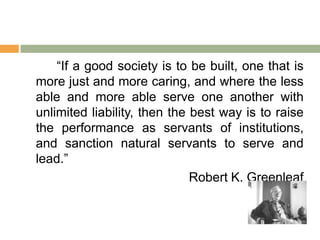
		“If a good society is to be built, one that is more just and more caring, and where the less able and more able serve one another with unlimited liability, then the best way is to raise the performance as servants of institutions, and sanction natural servants to serve and lead.”Robert K. Greenleaf
Reflection Point		In relation with the attributes of a servant-leader, do Filipinos manifest a form of servant leadership?
Some Paradoxes of Servant-LeadershipGreat Enough to be Without PrideTeam gets the credit, you get the blameCompassionate Enough to DisciplineMust not be soft – set high expectations and follow throughRight Enough to Say, “I’m Wrong”Leaders make mistakes too, admit you are humanWise Enough to Admit You Don’t KnowFind out quickly, but do not misleadBusy Enough to ListenBeware the busy manager – they do not leadConstantly seek opportunities for improvementNo job too big, no job too smallAll members of the organization make significant contributions
Critiques on Servant-LeadershipDue to its focus on the individual, gears toward unresolved cases of individual goals and values in conflict with the organizational goals and values >> Org. goals remaining unfulfilled owing to employees not giving the appropriate attention, priority or urgencyCommitment to team building by the servant-leader may be too interfering for some of the membersOrganizations with servant-leadership styles would fall down when market pressures force the organization to downsize
“If a leader must challenge the status quo to be a leader, it would not be inconsistent to imagine him challenging individuals also as any good coach would do. But can a servant challenge his master?” (McCrimmon)Management (guidance, supervision, administration) is different from leadership, and most of the functions of a manager is different from a leader. Given the term servant management, “What kind of role model for developing leaders is provided by a manager who is only a nurturer of others, a servant type?”
Reflection Point		Some critics argue that servant leadership is an end itself, not achieving other goals. Do you agree or disagree?
Reflection Point		What were your first thoughts on hearing the term servant leader? Were they validated or disproven after reading Greenleaf's concept of it? 
Greenleaf Center for Servant LeadershipLocated in Westfield, INMission & Vission:“The Greenleaf Center promotes the awareness, understanding, and practice of servant leadership by individuals and organizations.
Across our global community, servant leadership is embraced as a guiding principle, thus building a more just, caring, and sustainable world with hope and prosperity for future generations.”Programs & ServicesHosts annual conference & Leadership Instituite for Educators (LIFE) conference
Sponsors Speakers Bureau
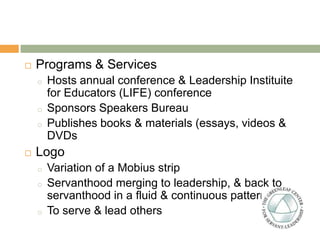
Publishes books & materials (essays, videos & DVDsLogoVariation of a Mobius strip
Servanthood merging to leadership, & back to servanthood in a fluid & continuous pattern
To serve & lead othersOrganizations Practicing Servant-Leadership

205 servant leadership by robert greenleaf

  • 1.
    Servant leadership byRobert Kiefner GreenleafPresented by Celeste DosdosPA 205
  • 2.
    Life of RobertKiefner GreenleafBorn 1904 in Terre Haute, Indiana. Died 1990 (86)Spent most of his organizational life in the field of management, research, development, and education at AT&T (38 yrs)Founded Center for Applied Ethics in’64, renamed Robert K. Greenleaf Center in ‘85Taught at Dartmouth College and the University of Virginia‘70: The Servant as Leader‘72: The Institution as Servant‘72: Trustees as Servants
  • 3.
    Servant LeadershipProposed in1970Theoretical framework advocating service to others as primary motivation of a leaderGreatly inspired by Herman Hesse’sJourney to the East (mythical journey by a group of people on a spiritual quest) in the ‘60s
  • 4.
    Concept of ServantLeadership Prior to GreenleafArthashastra: “The [leader] shall consider as good, not what pleases himself but what pleases his subjects.” (375 BC : ancient Indian treatise by Chāṇakya)Jesus Christ: “But the greatest among you shall be your servant.” (Matthew 23:11), “The one who is the greatest among you must become like the youngest, and the leader like the servant.” (Luke 22:26)
  • 5.
    Some Servant-Leadership Expertsafter GreenleafLarry SpearsJames AutryJames HunterKen BlanchardStephen CoveyPeter SengeJim Collins
  • 6.
    Definitions of servantOnewho serves, or does services, voluntarily or on compulsionA person who is employed by another for menial offices, or for other labor, and is subject to his commandA person who labors or exerts himself for the benefit of another, his master or employerA subordinate helper
  • 7.
    Definitions of ServiceAnact of assistance or benefit; a favorAn act of help, aidWork done by one person or group that benefits anotherThe performance of work or duties for a superior or as a servantBe of service or be useful
  • 8.
    Definitions of LeaderAguiding or directing headOne that leadsOne who is in charge or in commandOne who has influence or power, especially of a political natureA person who inspires othersA person who is in front or goes firstA person who directs the work of others
  • 9.
    Servant-Leadership as Definedby Greenleaf “The servant-leader is servant first… It begins with the natural feeling that one wants to serve, to serve first. Then conscious choice brings one to aspire to lead. That person is sharply different from one who is leader first, perhaps because of the need to assuage an unusual power drive or to acquire material possessions…The leader-first and the servant-first are two extreme types…The difference manifests itself in the care taken by the servant-first to make sure that other people’s highest priority needs are being served. The best test, and difficult to administer, is: Do those served grow as persons? Do they, while being served, become healthier, wiser, freer, more autonomous, more likely themselves to become servants? And, what is the effect on the least privileged in society; will they benefit, or, at least, not be further deprived?”
  • 10.
    Servant-Leadership as Definedby Larry Spears, Executive Director of the Robert K. Greenleaf Center for Servant-Leadership “…A new kind of leadership model – a model which puts serving others as the number one priority. Servant-leadership emphasizes increased service to others; a holistic approach to work; promoting a sense of community; and the sharing of power in decision-making.” (1996, p. 33)
  • 11.
    Ten Attributes ofServant-LeadershipListeningEmpathyHealingAwarenessPersuasionConceptualizationForesightStewardshipCommitment to the Growth of PeopleBuilding Community
  • 12.
    Servant-Leadership Attribute #1: Listening“Only a true natural servant automatically responds to any problem by listening first. (1970, p.10)
  • 13.
  • 14.
    Active demonstration ofrespect for others
  • 15.
    Together with regularreflection is essential for a servant leader
  • 16.
    Active, not justpassiveServant-Leadership Attribute # 2: Empathy“The servant always accepts & empathizes, never rejects.” (1970, p.12)
  • 17.
    “Men grow tallerwhen those who lead them empathize,& when they are accepted for who they are…” (1970, p.14)Servant-Leadership Attribute # 3: HealingHealing was defined as “to make whole.” (1970, p.27)Recognizes the shared human desire to find wholeness in one’s self & supports it in other peopleConsider their history
  • 18.
    Servant-Leadership Attribute #4: Awareness“We miss leadership opportunities” (1970, p.19) without awareness“Sharply awake and reasonably disturbed”Becoming conscious of one’s self and others (addressing needs & opportunities for improvement)
  • 19.
    Servant-Leadership Attribute #5: PersuasionEffective servant-leader builds group consensus through “gentle but clear and persistent persuasion, and does not exert group compliance through position power”“A fresh look is being taken at the issues of power & authority, and people are beginning to learn, however haltingly, to relate to one another in less coercive and more creatively supporting ways.” (1970, pp. 3-4)Convince and build consensus – quickly
  • 20.
    Servant-Leadership Attribute #6: Conceptualization“The servant-leader can conceive solutions to problems that do not currently exist.” (1970, pp. 23-25)Thinking beyond day-to-day realities‘Dreaming great dreams’Taking time to strategize
  • 21.
    Servant-Leadership Attribute #7: Foresight“Prescience, or foresight, is a better than average guess about what is going to happen when in the future.” (1970, p. 16)Understanding lessons from the past, realities of the present & likely consequences of future decisions
  • 22.
    Servant-Leadership Attribute #8: Stewardship“Organizational stewards, or ‘trustees’ are concerned not only for the individual followers within the organization, but also the organization as a whole, and its impact on and relationship with all of society.” (1970, p. 31)Building on trust on other people & their capacity to perform their tasks in the organization
  • 23.
    Servant-Leadership Attribute #9: Commitment to the Growth of People“The secret of institution building is to be able to weld a team of such people by lifting them up to grow taller than they would otherwise be.” (1970, p. 14)Appreciating & encouraging others
  • 24.
    Servant-Leadership Attribute #10: Building Community“All that is needed to rebuild community as a viable life form…is for enough servant-leaders to show the way.” (1970, p. 30)Camaraderie
  • 25.
    “If a goodsociety is to be built, one that is more just and more caring, and where the less able and more able serve one another with unlimited liability, then the best way is to raise the performance as servants of institutions, and sanction natural servants to serve and lead.”Robert K. Greenleaf
  • 26.
    Reflection Point In relationwith the attributes of a servant-leader, do Filipinos manifest a form of servant leadership?
  • 27.
    Some Paradoxes ofServant-LeadershipGreat Enough to be Without PrideTeam gets the credit, you get the blameCompassionate Enough to DisciplineMust not be soft – set high expectations and follow throughRight Enough to Say, “I’m Wrong”Leaders make mistakes too, admit you are humanWise Enough to Admit You Don’t KnowFind out quickly, but do not misleadBusy Enough to ListenBeware the busy manager – they do not leadConstantly seek opportunities for improvementNo job too big, no job too smallAll members of the organization make significant contributions
  • 28.
    Critiques on Servant-LeadershipDueto its focus on the individual, gears toward unresolved cases of individual goals and values in conflict with the organizational goals and values >> Org. goals remaining unfulfilled owing to employees not giving the appropriate attention, priority or urgencyCommitment to team building by the servant-leader may be too interfering for some of the membersOrganizations with servant-leadership styles would fall down when market pressures force the organization to downsize
  • 29.
    “If a leadermust challenge the status quo to be a leader, it would not be inconsistent to imagine him challenging individuals also as any good coach would do. But can a servant challenge his master?” (McCrimmon)Management (guidance, supervision, administration) is different from leadership, and most of the functions of a manager is different from a leader. Given the term servant management, “What kind of role model for developing leaders is provided by a manager who is only a nurturer of others, a servant type?”
  • 30.
    Reflection Point Some criticsargue that servant leadership is an end itself, not achieving other goals. Do you agree or disagree?
  • 31.
    Reflection Point What wereyour first thoughts on hearing the term servant leader? Were they validated or disproven after reading Greenleaf's concept of it? 
  • 32.
    Greenleaf Center forServant LeadershipLocated in Westfield, INMission & Vission:“The Greenleaf Center promotes the awareness, understanding, and practice of servant leadership by individuals and organizations.
  • 33.
    Across our globalcommunity, servant leadership is embraced as a guiding principle, thus building a more just, caring, and sustainable world with hope and prosperity for future generations.”Programs & ServicesHosts annual conference & Leadership Instituite for Educators (LIFE) conference
  • 34.
  • 35.
    Publishes books &materials (essays, videos & DVDsLogoVariation of a Mobius strip
  • 36.
    Servanthood merging toleadership, & back to servanthood in a fluid & continuous pattern
  • 37.
    To serve &lead othersOrganizations Practicing Servant-Leadership