Decline Curve Analysis
Learning Objectives of Lecture 8:
 Importance of decline curves
 Decline curve models
 Decline curve plots
 Applications
Decline Curve Analysis
Preliminaries:
 MBE analysis yields only G and Gp as a function of p
for gas reservoirs.
 Estimation of production rate specially as function of
time is also of great importance
 Under natural depletion, the rate normally declines with
recovery
 Majority of oil and gas reservoirs show natural
production rate decline according to standard trends
 Unless natural trend is interrupted (water injection, well
shut in) the natural decline trend is expected to
continue until abandonment
Decline Curve Analysis for Reserve
Estimation
Natural decline trend is dictated by natural drive, rock and
fluid properties well completion, and so on. Thus, a major
advantage of this decline trend analysis is implicit inclusion
of all production and operating conditions that would
influence the performance.
The standard declines ( observed in field cases and whose
mathematical forms are derived empirically) are
Exponential decline
Harmonic decline
Hyperbolic decline
Decline Curve Analysis
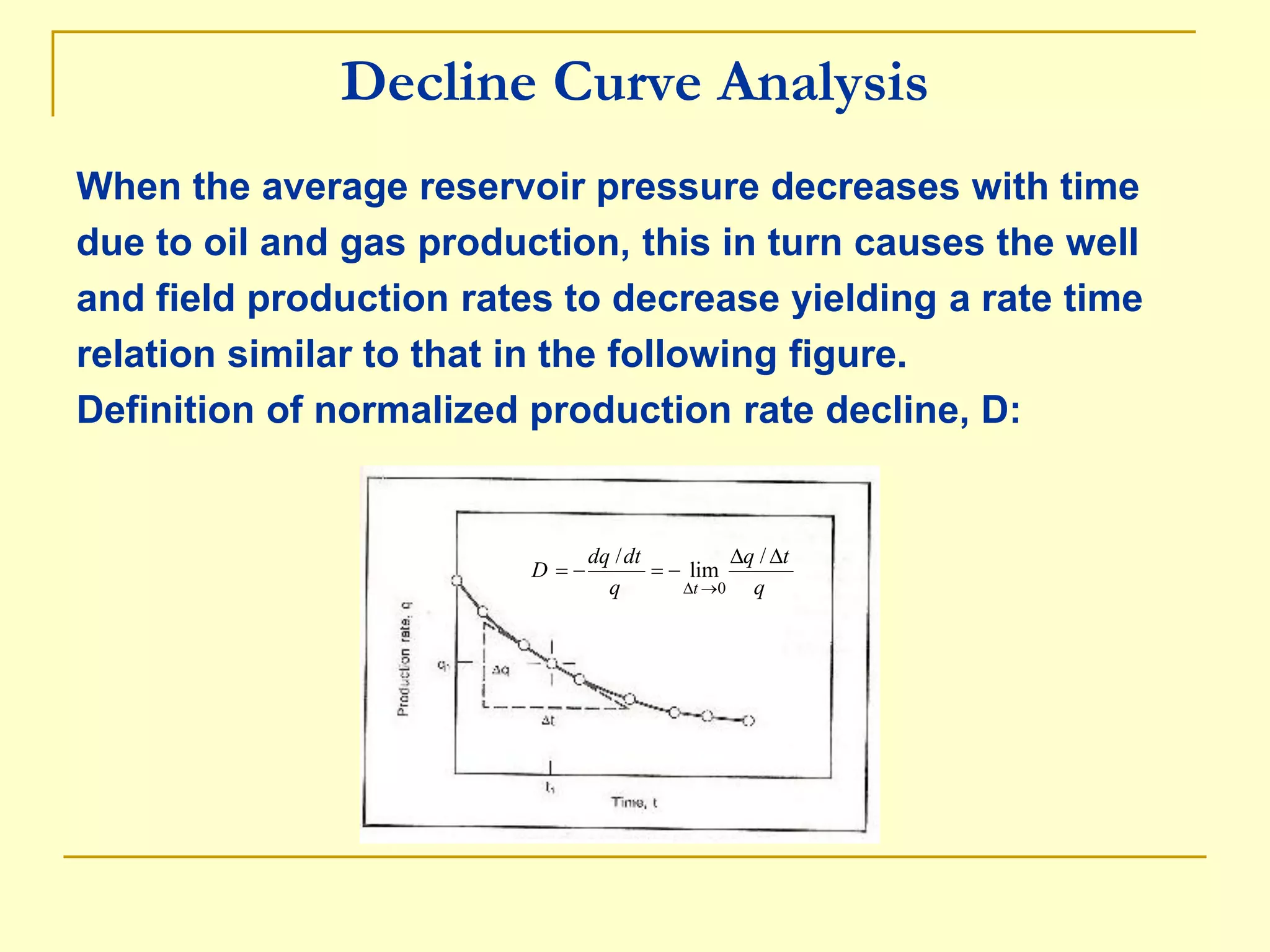
When the average reservoir pressure decreases with time
due to oil and gas production, this in turn causes the well
and field production rates to decrease yielding a rate time
relation similar to that in the following figure.
Definition of normalized production rate decline, D:
0
/ /
lim
t
dq dt q t
D
q q
 
 
   
Decline Curve Analysis
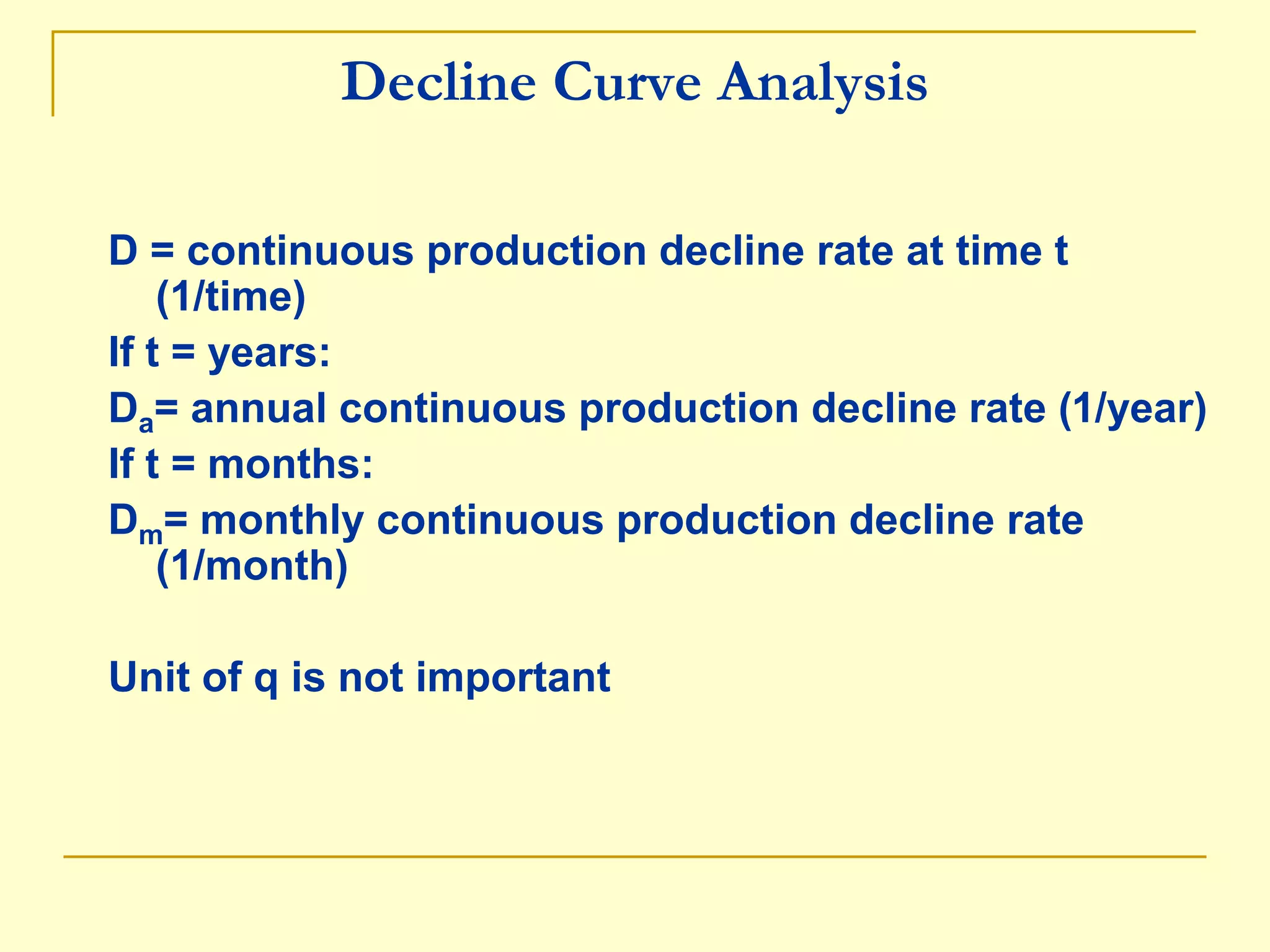
D = continuous production decline rate at time t
(1/time)
If t = years:
Da= annual continuous production decline rate (1/year)
If t = months:
Dm= monthly continuous production decline rate
(1/month)
Unit of q is not important
Decline curve models
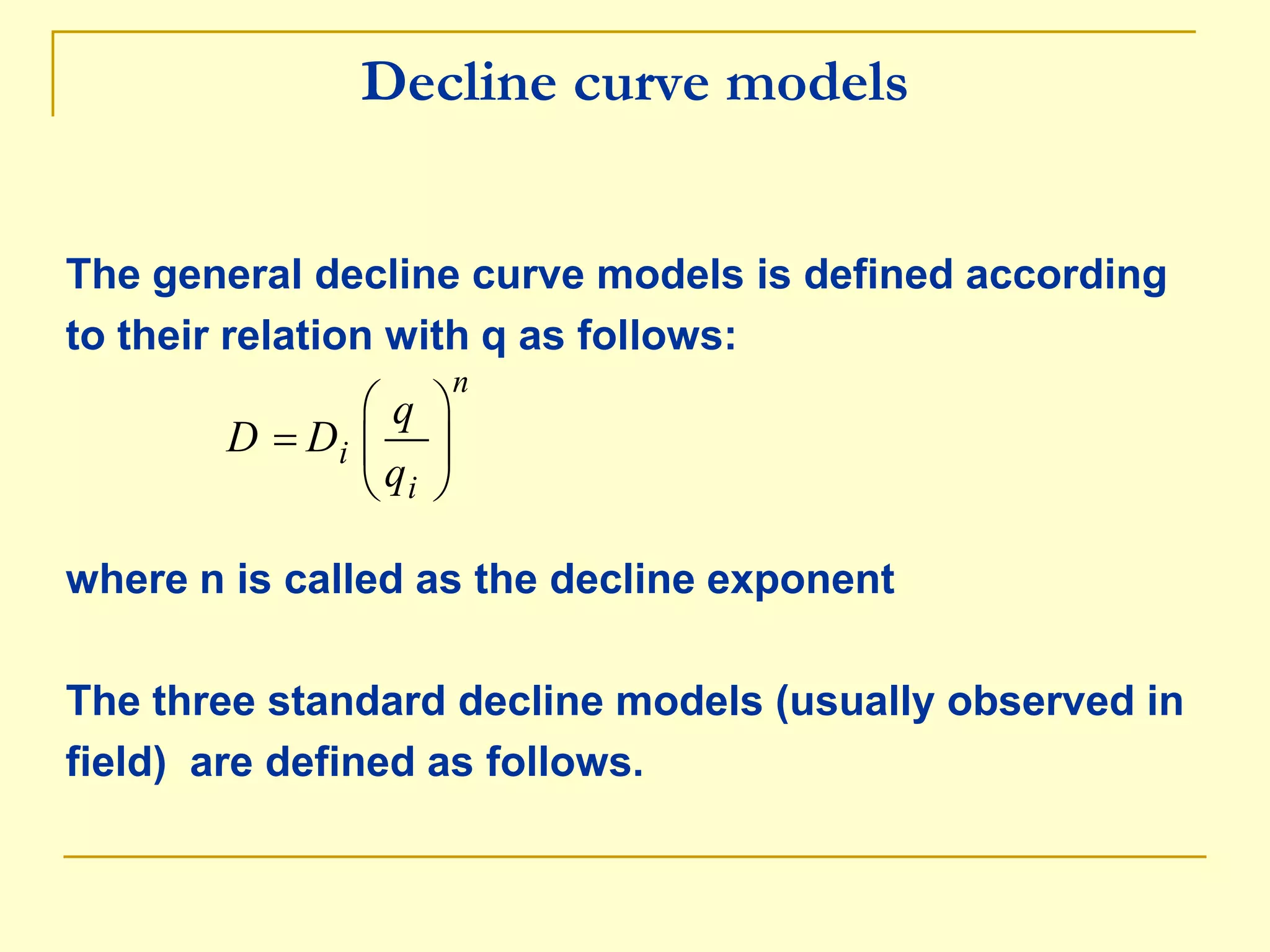
The general decline curve models is defined according
to their relation with q as follows:
where n is called as the decline exponent
The three standard decline models (usually observed in
field) are defined as follows.
n
i
i
q
D D
q
 
  
 
Decline curve models
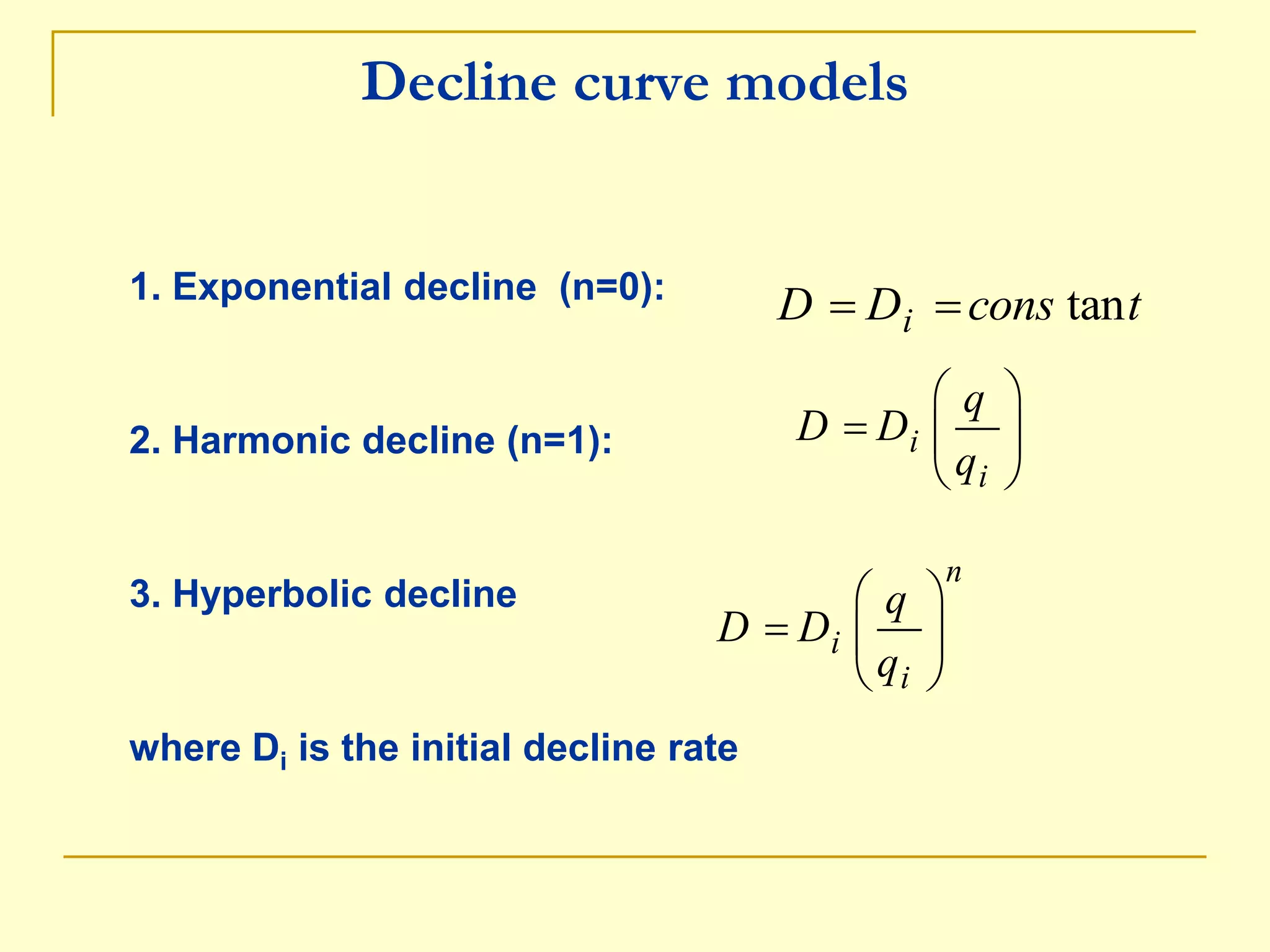
1. Exponential decline (n=0):
2. Harmonic decline (n=1):
3. Hyperbolic decline
where Di is the initial decline rate
i
i
q
D D
q
 
  
 
tan
i
D D cons t
 
n
i
i
q
D D
q
 
  
 
Decline curve models
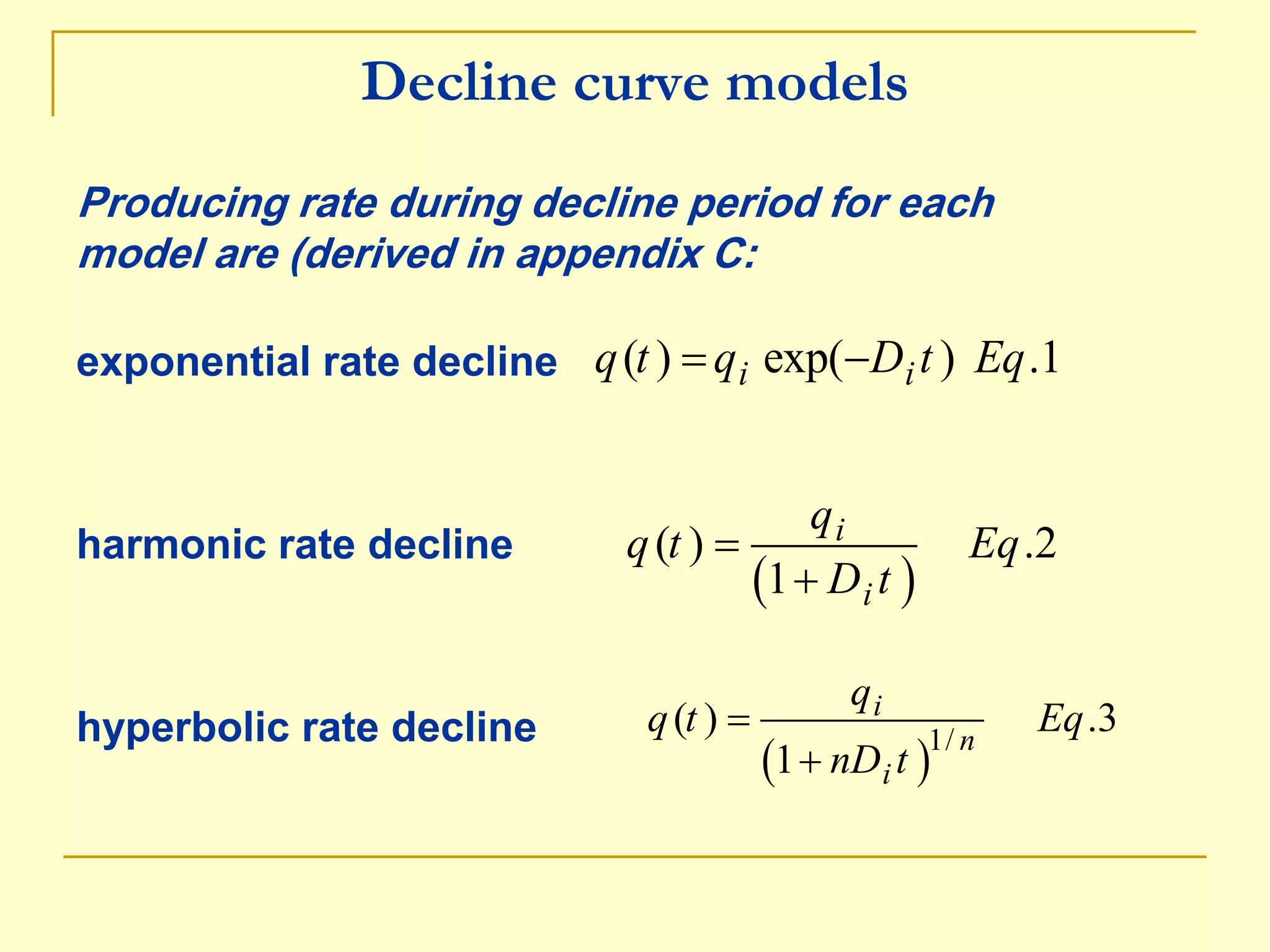
exponential rate decline
harmonic rate decline
hyperbolic rate decline
 1/
( ) .3
1
i
n
i
q
q t Eq
nD t


 
( ) .2
1
i
i
q
q t Eq
D t


( ) exp( ) .1
i i
q t q D t Eq
 
Producing rate during decline period for each
model are (derived in appendix C:
Decline curve models
Cumulative production as a function of q for each model
are determined as:
ln( / ) .5
i
p i
i
q
G q q Eq
D

.4
i
p
i
q q
G Eq
D


1 1
1 1
.6
(1 )
n
i
p n n
i i
q
G Eq
D n q q
 
 
 
 
 
  
exponential decline
harmonic decline
hyperbolic decline
Decline curve models
Time at abandonment:
If we define the economic limit when the production rate is
qa then the exponential, harmonic and hyperbolic declines
would have the following abandonment times respectively:
1
ln .7
i
a
i a
q
t Eq
D q
 
  
 
1
1 .8
i
a
i a
q
t Eq
D q
 
 
 
 
1
1 .9
n
i
a
i a
q
t Eq
nD q
 
 
 
 
 
 
 
 
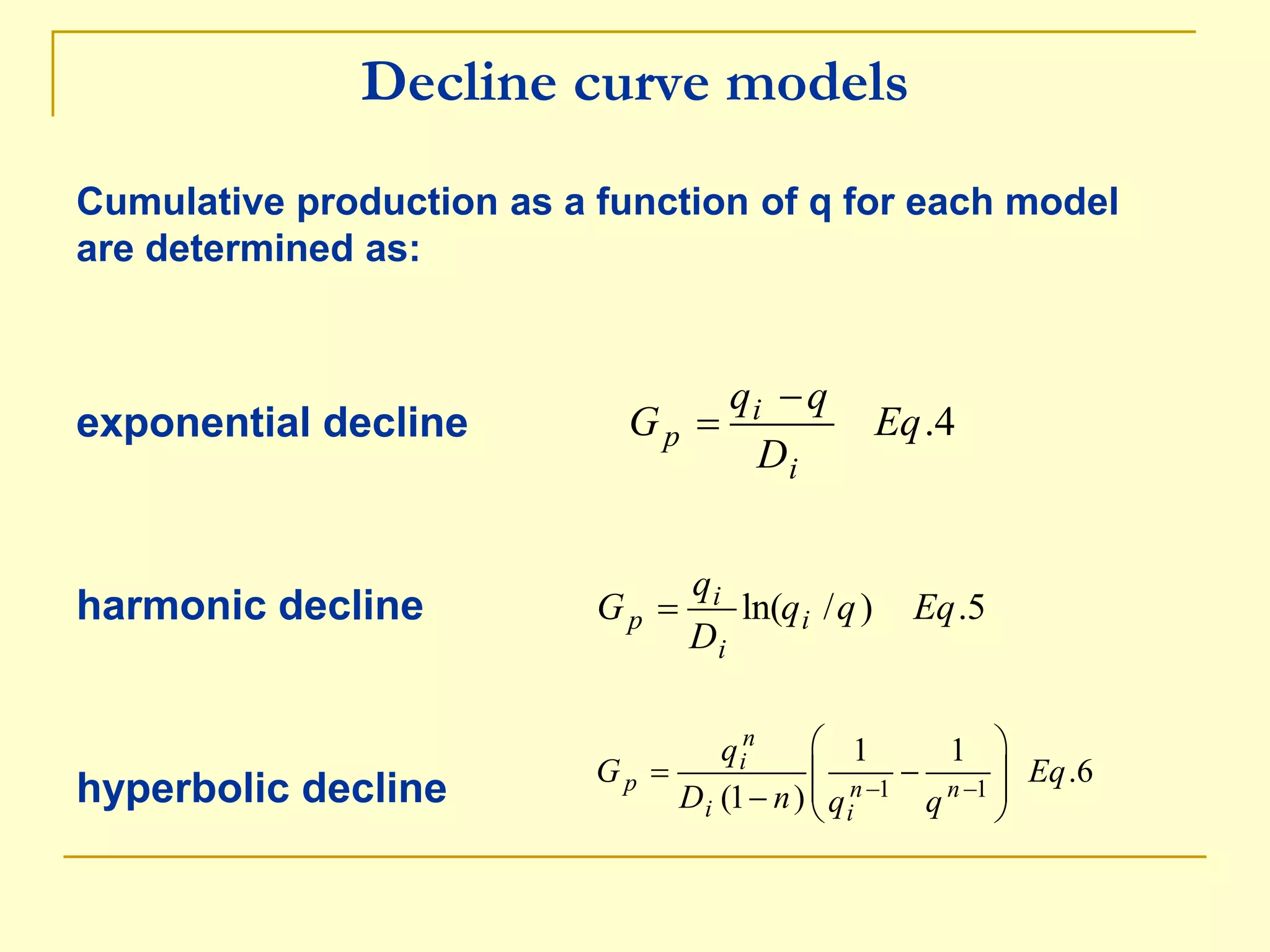
Graphical Features of Models
Cartesian plots yields
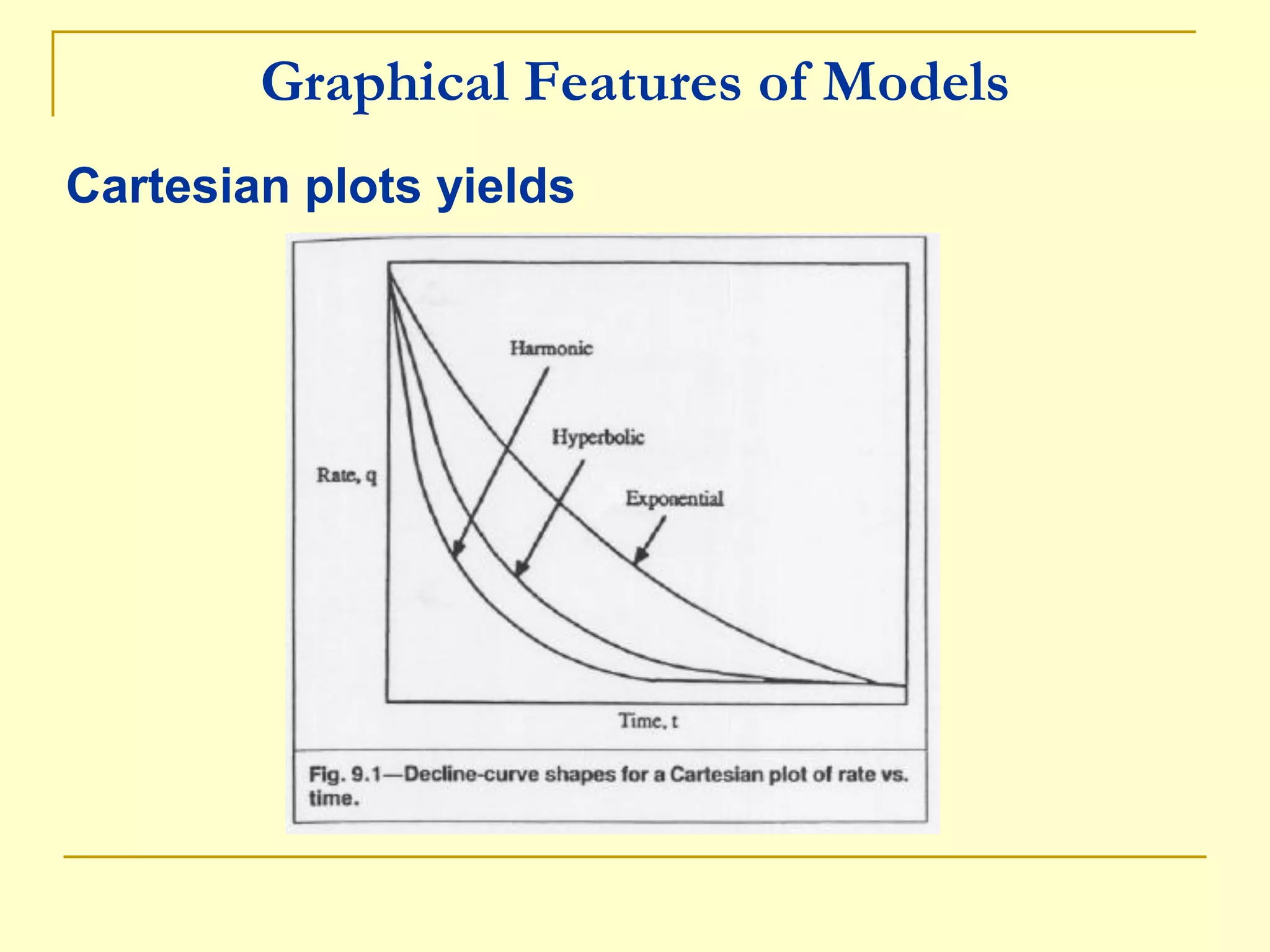
Graphical Features of Models
Seilog plots yield
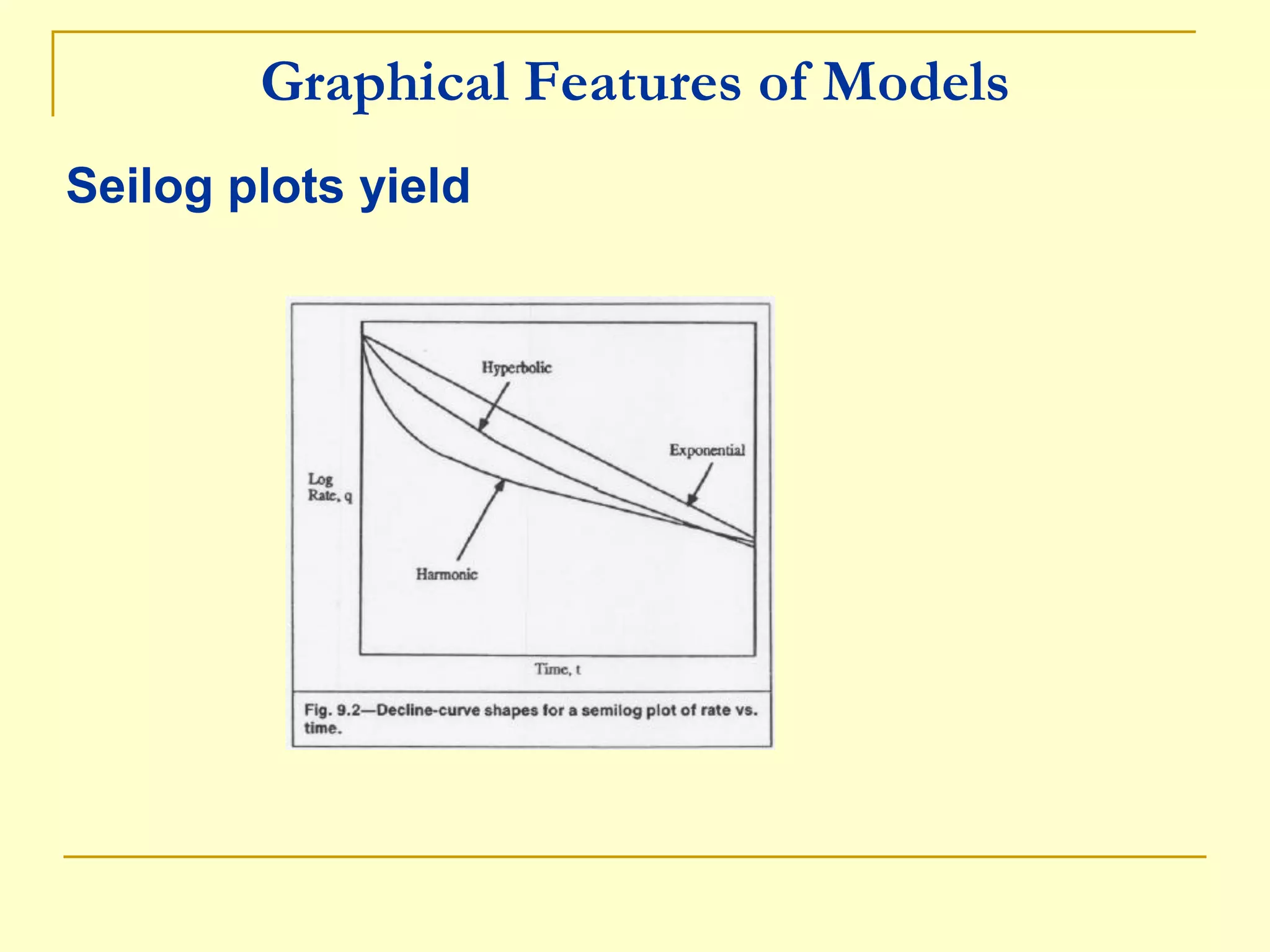
Graphical Features of Models
Cartesian q vs Gp plots yield
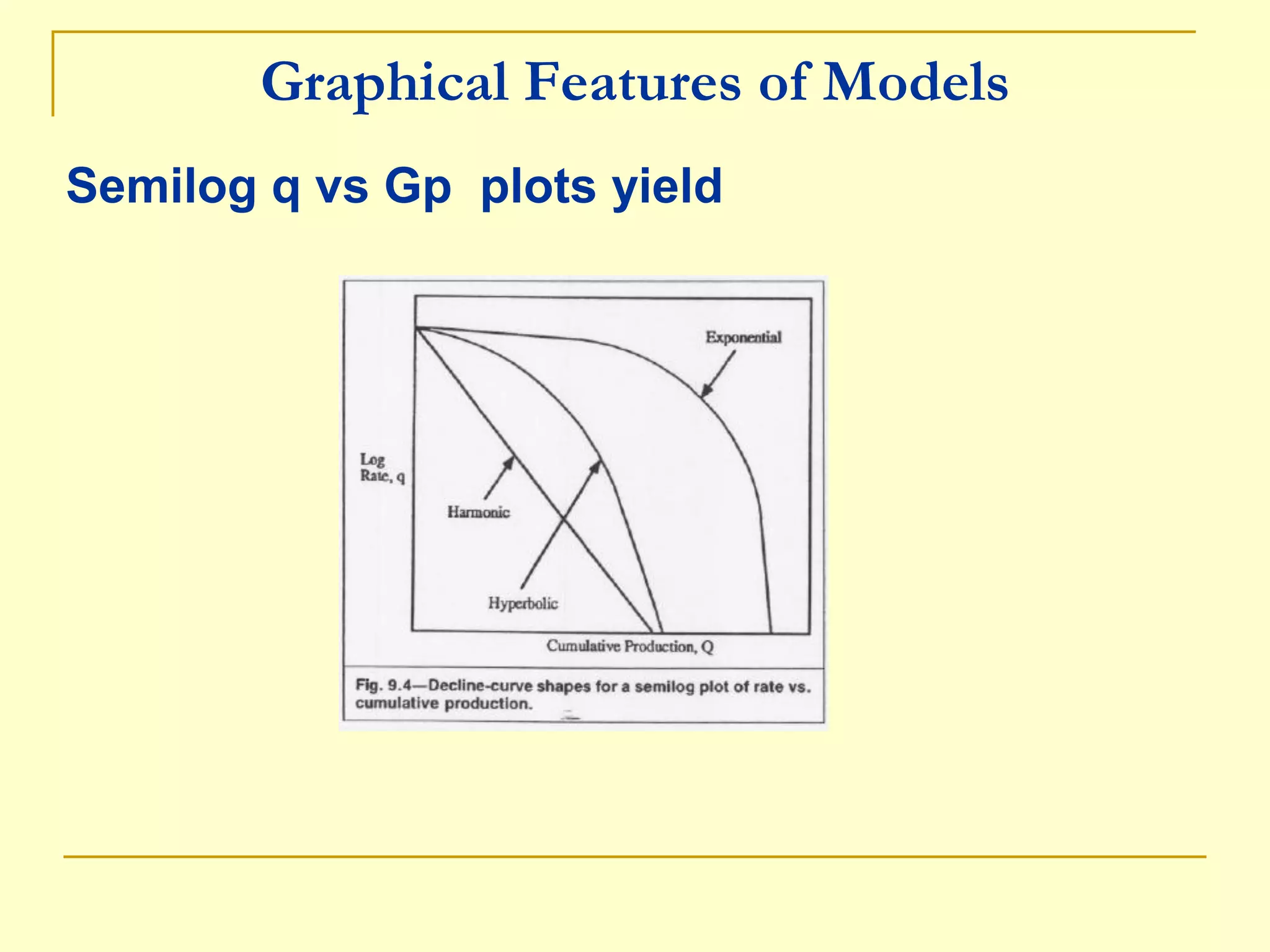
Graphical Features of Models
Semilog q vs Gp plots yield
Graphical Features of Models
For hyperbolic decline no immediate straight form
is obtained, therefore a linear plot which allows us
to determine two parameters namely Di and qi
simultaneously is not available.
In summary : The production plots allows us two
determine the nature of decline and then we can
obtain the decline model parameters.
Summary Production Plots
1. A plot of log(q) vs t is
 Linear if decline is exponential
 Concave upward if decline is hyperbolic (n>0) or harmonic
2. A plot of q vs Np is
 Linear if decline is exponential
 Concave upward if decline is hyperbolic(n>0) or harmonic
3. A plot of log(q) vs Np is
 Linear if decline is harmonic
 Concave downward if decline is hyperbolic (n<1) or exponential
 Concave upward if decline is hyperbolic with n>1.
4. A plot of 1/q vs t is
 Linear if decline is harmonic
 Concave downward if decline is hyperbolic (n<1) or exponential
 Concave upward if decline is hyperbolic with n>1.
Hyperbolic decline analysis
1. Since no wells have declines where n=0 or 1 exactly it is more
appropriate to use a regression technique to determine all
three parameters namley Di, qi and n simultaneously. Two
approaches are suggested by Towler:
 An iterative linear regression
 Nonlinear regression
Towler also pointed out that linear regression impose more weight
on smaller values of production rates as it involves logs of
variables. Furthermore, the two suggested procedures on linear
regression do not produce equivalent results.
Therefore, he suggests nonlinear regression as a method which
produces repeatable results, and weights the production rates
equally. The steps of regression on an excel sheet is also
provided in Appendix C.
Caution for applicability
 The emprical decline curve equations assume that the
well/field analyzed is produced at constant BHP. If the
BHP changes, the character of the well's decline
changes.
 They also assume that the well analyzed is producing
from an unchanging drainage area (i.e., fixed size) with
no-flow boundaries, If the size of the drainage area
changes (e.g., from relative changes in reservoir rates),
the character of the well's decline changes. If, for
example, water is entering the well's drainage area, the
character of the well's decline may change suddenly,
abruptly, and negatively.
Caution for applicability
 The equation assumes that the well analyzed
has constant permeability and skin factor. If
permeability decreases as pore pressure
decreases, or if skin factor changes because of
changing damage or deliberate stimulation, the
character of the well's decline changes.
 It must be applied only to boundary-dominated
(stabilized) flow data if we want to predict future
performance of even limited duration.
Decline Type Curves
 Prepare a report explaining Carter decline
curves
 Include the solution of exercise 9.5 from the
textbook

decline_curve_analysis-ppt.pdf

  • 1.
    Decline Curve Analysis LearningObjectives of Lecture 8:  Importance of decline curves  Decline curve models  Decline curve plots  Applications
  • 2.
    Decline Curve Analysis Preliminaries: MBE analysis yields only G and Gp as a function of p for gas reservoirs.  Estimation of production rate specially as function of time is also of great importance  Under natural depletion, the rate normally declines with recovery  Majority of oil and gas reservoirs show natural production rate decline according to standard trends  Unless natural trend is interrupted (water injection, well shut in) the natural decline trend is expected to continue until abandonment
  • 3.
    Decline Curve Analysisfor Reserve Estimation Natural decline trend is dictated by natural drive, rock and fluid properties well completion, and so on. Thus, a major advantage of this decline trend analysis is implicit inclusion of all production and operating conditions that would influence the performance. The standard declines ( observed in field cases and whose mathematical forms are derived empirically) are Exponential decline Harmonic decline Hyperbolic decline
  • 4.
    Decline Curve Analysis Whenthe average reservoir pressure decreases with time due to oil and gas production, this in turn causes the well and field production rates to decrease yielding a rate time relation similar to that in the following figure. Definition of normalized production rate decline, D: 0 / / lim t dq dt q t D q q        
  • 5.
    Decline Curve Analysis D= continuous production decline rate at time t (1/time) If t = years: Da= annual continuous production decline rate (1/year) If t = months: Dm= monthly continuous production decline rate (1/month) Unit of q is not important
  • 6.
    Decline curve models Thegeneral decline curve models is defined according to their relation with q as follows: where n is called as the decline exponent The three standard decline models (usually observed in field) are defined as follows. n i i q D D q       
  • 7.
    Decline curve models 1.Exponential decline (n=0): 2. Harmonic decline (n=1): 3. Hyperbolic decline where Di is the initial decline rate i i q D D q        tan i D D cons t   n i i q D D q       
  • 8.
    Decline curve models exponentialrate decline harmonic rate decline hyperbolic rate decline  1/ ( ) .3 1 i n i q q t Eq nD t     ( ) .2 1 i i q q t Eq D t   ( ) exp( ) .1 i i q t q D t Eq   Producing rate during decline period for each model are (derived in appendix C:
  • 9.
    Decline curve models Cumulativeproduction as a function of q for each model are determined as: ln( / ) .5 i p i i q G q q Eq D  .4 i p i q q G Eq D   1 1 1 1 .6 (1 ) n i p n n i i q G Eq D n q q              exponential decline harmonic decline hyperbolic decline
  • 10.
    Decline curve models Timeat abandonment: If we define the economic limit when the production rate is qa then the exponential, harmonic and hyperbolic declines would have the following abandonment times respectively: 1 ln .7 i a i a q t Eq D q        1 1 .8 i a i a q t Eq D q         1 1 .9 n i a i a q t Eq nD q                
  • 11.
    Graphical Features ofModels Cartesian plots yields
  • 12.
    Graphical Features ofModels Seilog plots yield
  • 13.
    Graphical Features ofModels Cartesian q vs Gp plots yield
  • 14.
    Graphical Features ofModels Semilog q vs Gp plots yield
  • 15.
    Graphical Features ofModels For hyperbolic decline no immediate straight form is obtained, therefore a linear plot which allows us to determine two parameters namely Di and qi simultaneously is not available. In summary : The production plots allows us two determine the nature of decline and then we can obtain the decline model parameters.
  • 16.
    Summary Production Plots 1.A plot of log(q) vs t is  Linear if decline is exponential  Concave upward if decline is hyperbolic (n>0) or harmonic 2. A plot of q vs Np is  Linear if decline is exponential  Concave upward if decline is hyperbolic(n>0) or harmonic 3. A plot of log(q) vs Np is  Linear if decline is harmonic  Concave downward if decline is hyperbolic (n<1) or exponential  Concave upward if decline is hyperbolic with n>1. 4. A plot of 1/q vs t is  Linear if decline is harmonic  Concave downward if decline is hyperbolic (n<1) or exponential  Concave upward if decline is hyperbolic with n>1.
  • 17.
    Hyperbolic decline analysis 1.Since no wells have declines where n=0 or 1 exactly it is more appropriate to use a regression technique to determine all three parameters namley Di, qi and n simultaneously. Two approaches are suggested by Towler:  An iterative linear regression  Nonlinear regression Towler also pointed out that linear regression impose more weight on smaller values of production rates as it involves logs of variables. Furthermore, the two suggested procedures on linear regression do not produce equivalent results. Therefore, he suggests nonlinear regression as a method which produces repeatable results, and weights the production rates equally. The steps of regression on an excel sheet is also provided in Appendix C.
  • 18.
    Caution for applicability The emprical decline curve equations assume that the well/field analyzed is produced at constant BHP. If the BHP changes, the character of the well's decline changes.  They also assume that the well analyzed is producing from an unchanging drainage area (i.e., fixed size) with no-flow boundaries, If the size of the drainage area changes (e.g., from relative changes in reservoir rates), the character of the well's decline changes. If, for example, water is entering the well's drainage area, the character of the well's decline may change suddenly, abruptly, and negatively.
  • 19.
    Caution for applicability The equation assumes that the well analyzed has constant permeability and skin factor. If permeability decreases as pore pressure decreases, or if skin factor changes because of changing damage or deliberate stimulation, the character of the well's decline changes.  It must be applied only to boundary-dominated (stabilized) flow data if we want to predict future performance of even limited duration.
  • 20.
    Decline Type Curves Prepare a report explaining Carter decline curves  Include the solution of exercise 9.5 from the textbook