Psydac: a Python IGA library for large-scale simulations
Ease of use and high performance in the open-source Python ecosystem
SFSCON 2023, Bozen, 10-11 November 2023
Yaman Güçlü1
1Numerical Methods in Plasma Physics Division, Max Planck Institute for Plasma Physics, Garching, Germany
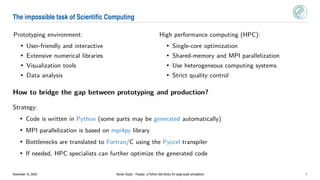
The impossible task of Scientific Computing
Prototyping environment:
• User-friendly and interactive
• Extensive numerical libraries
• Visualization tools
• Data analysis
High performance computing (HPC):
• Single-core optimization
• Shared-memory and MPI parallelization
• Use heterogeneous computing systems
• Strict quality control
How to bridge the gap between prototyping and production?
Strategy:
• Code is written in Python (some parts may be generated automatically)
• MPI parallelization is based on mpi4py library
• Bottlenecks are translated to Fortran/C using the Pyccel transpiler
• If needed, HPC specialists can further optimize the generated code
November 10, 2023 Yaman Güçlü – Psydac: a Python IGA library for large-scale simulations 1
Genesis of PSYDAC
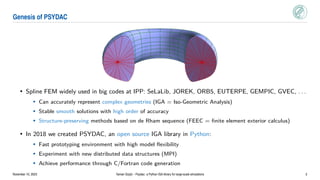
• Spline FEM widely used in big codes at IPP: SeLaLib, JOREK, ORB5, EUTERPE, GEMPIC, GVEC, . . .
• Can accurately represent complex geometries (IGA = Iso-Geometric Analysis)
• Stable smooth solutions with high order of accuracy
• Structure-preserving methods based on de Rham sequence (FEEC = finite element exterior calculus)
• In 2018 we created PSYDAC, an open source IGA library in Python:
• Fast prototyping environment with high model flexibility
• Experiment with new distributed data structures (MPI)
• Achieve performance through C/Fortran code generation
November 10, 2023 Yaman Güçlü – Psydac: a Python IGA library for large-scale simulations 2
Genesis of PSYDAC
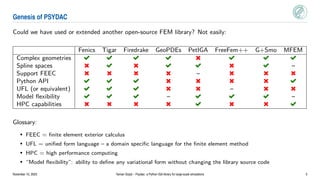
Could we have used or extended another open-source FEM library? Not easily:
Fenics Tigar Firedrake GeoPDEs PetIGA FreeFem++ G+Smo MFEM
Complex geometries Ë Ë Ë Ë é Ë Ë Ë
Spline spaces é Ë é Ë Ë é Ë –
Support FEEC é é é é – é é é
Python API Ë Ë Ë é é é é Ë
UFL (or equivalent) Ë Ë Ë é é – é é
Model flexibility Ë Ë Ë – Ë Ë Ë –
HPC capabilities é é é é Ë é é Ë
Glossary:
• FEEC = finite element exterior calculus
• UFL = unified form language – a domain specific language for the finite element method
• HPC = high performance computing
• “Model flexibility”: ability to define any variational form without changing the library source code
November 10, 2023 Yaman Güçlü – Psydac: a Python IGA library for large-scale simulations 3
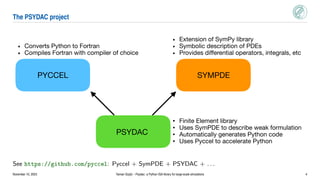
The PSYDAC project
PYCCEL SYMPDE
PSYDAC
• Finite Element library
• Uses SymPDE to describe weak formulation
• Automatically generates Python code
• Uses Pyccel to accelerate Python
• Converts Python to Fortran
• Compiles Fortran with compiler of choice
• Extension of SymPy library
• Symbolic description of PDEs
• Provides differential operators, integrals, etc
See https://github.com/pyccel: Pyccel + SymPDE + PSYDAC + . . .
November 10, 2023 Yaman Güçlü – Psydac: a Python IGA library for large-scale simulations 4
Simulation workflow
Geometry file
Main .py script
PSYDAC (online)
PSYDAC (offline)
HDF5 output file
Post-processing
.py script
VTK files
Paraview 3D visualization
• Psydac is MPI-parallel both in the online and offline phases
• Paraview installation on cluster is also MPI-parallel
November 10, 2023 Yaman Güçlü – Psydac: a Python IGA library for large-scale simulations 5
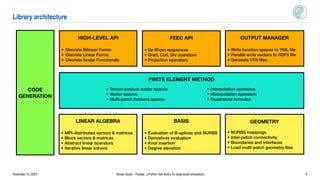
Library architecture
FINITE ELEMENT METHOD
HIGH-LEVEL API
• Discrete Bilinear Forms
• Discrete Linear Forms
• Discrete Scalar Functionals
FEEC API
• De Rham sequences
• Grad, Curl, Div operators
• Projection operators
OUTPUT MANAGER
• Write function spaces to YML file
• Parallel write vectors to HDF5 file
• Generate VTK files
LINEAR ALGEBRA
• MPI-distributed vectors & matrices
• Block vectors & matrices
• Abstract linear operators
• Iterative linear solvers
BASIS
• Evaluation of B-splines and NURBS
• Derivatives evaluation
• Knot insertion
• Degree elevation
GEOMETRY
• NURBS mappings
• Inter-patch connectivity
• Boundaries and interfaces
• Load multi-patch geometry files
• Interpolation operators
• Histopolation operators
• Quadrature formulas
• Tensor-product scalar spaces
• Vector spaces
• Multi-patch (broken) spaces
CODE
GENERATION
November 10, 2023 Yaman Güçlü – Psydac: a Python IGA library for large-scale simulations 6
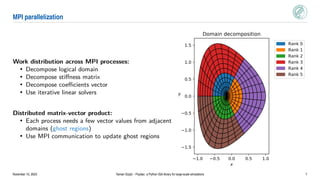
MPI parallelization
Work distribution across MPI processes:
• Decompose logical domain
• Decompose stiffness matrix
• Decompose coefficients vector
• Use iterative linear solvers
Distributed matrix-vector product:
• Each process needs a few vector values from adjacent
domains (ghost regions)
• Use MPI communication to update ghost regions
November 10, 2023 Yaman Güçlü – Psydac: a Python IGA library for large-scale simulations 7
Static compilation of computational kernels
Python kernels translated to Fortran (or C) using Pyccel:
• Evaluation of B-splines, NURBS, and their derivatives
• Matrix-vector (dot) product
• Vector-vector (inner) product
• Matrix transposition
• Matrix conversion to SciPy or PETSc sparse formats
• Assembly of matrices, vectors, and scalar functionals
Pyccel supports OpenMP pragmas:
• Corresponding OpenMP pragmas are printed in the Fortran/C code
• Bypass Python’s global interpreter lock (GIL) to achieve parallel multi-threading
November 10, 2023 Yaman Güçlü – Psydac: a Python IGA library for large-scale simulations 8
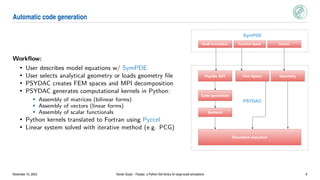
Automatic code generation
Workflow:
• User describes model equations w/ SymPDE
• User selects analytical geometry or loads geometry file
• PSYDAC creates FEM spaces and MPI decomposition
• PSYDAC generates computational kernels in Python:
• Assembly of matrices (bilinear forms)
• Assembly of vectors (linear forms)
• Assembly of scalar functionals
• Python kernels translated to Fortran using Pyccel
• Linear system solved with iterative method (e.g. PCG)
Psydac AST
Weak Formulation Function Space Domain
Fem Space Geometry
Code generation
Backend
Simulation execution
PSYDAC
SymPDE
November 10, 2023 Yaman Güçlü – Psydac: a Python IGA library for large-scale simulations 9
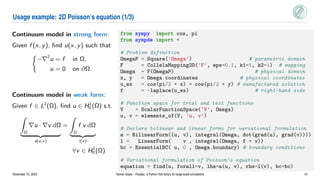
Usage example: 2D Poisson’s equation (1/3)
Continuum model in strong form:
Given f (x, y), find u(x, y) such that

−∇2
u = f in Ω,
u = 0 on ∂Ω.
Continuum model in weak form:
Given f ∈ L2
(Ω), find u ∈ H1
0 (Ω) s.t.
Z
Ω
∇u · ∇v dΩ
| {z }
a(u,v)
=
Z
Ω
f v dΩ
| {z }
l(v)
∀v ∈ H1
0 (Ω)
from sympy import cos, pi
from sympde import *
# Problem definition
OmegaP = Square('Omega') # parametric domain
F = CollelaMapping2D('F', eps=0.1, k1=1, k2=1) # mapping
Omega = F(OmegaP) # physical domain
x, y = Omega.coordinates # physical coordinates
u_ex = cos(pi/2 * x) * cos(pi/2 * y) # manufactured solution
f = -laplace(u_ex) # right-hand side
# Function space for trial and test functions
V = ScalarFunctionSpace('V', Omega)
u, v = elements_of(V, 'u, v')
# Declare bilinear and linear forms for variational formulation
a = BilinearForm((u, v), integral(Omega, dot(grad(u), grad(v))))
l = LinearForm( v , integral(Omega, f * v))
bc = EssentialBC( u, 0 , Omega.boundary) # boundary conditions
# Variational formulation of Poisson's equation
equation = find(u, forall=v, lhs=a(u, v), rhs=l(v), bc=bc)
November 10, 2023 Yaman Güçlü – Psydac: a Python IGA library for large-scale simulations 10
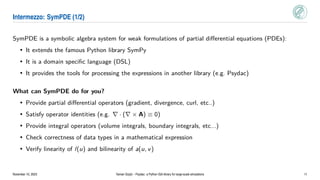
Intermezzo: SymPDE (1/2)
SymPDE is a symbolic algebra system for weak formulations of partial differential equations (PDEs):
• It extends the famous Python library SymPy
• It is a domain specific language (DSL)
• It provides the tools for processing the expressions in another library (e.g. Psydac)
What can SymPDE do for you?
• Provide partial differential operators (gradient, divergence, curl, etc..)
• Satisfy operator identities (e.g. ∇ · (∇ × A) ≡ 0)
• Provide integral operators (volume integrals, boundary integrals, etc...)
• Check correctness of data types in a mathematical expression
• Verify linearity of l(u) and bilinearity of a(u, v)
November 10, 2023 Yaman Güçlü – Psydac: a Python IGA library for large-scale simulations 11
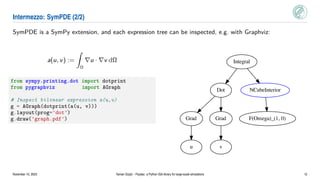
Intermezzo: SymPDE (2/2)
SymPDE is a SymPy extension, and each expression tree can be inspected, e.g. with Graphviz:
a(u, v) :=
Z
Ω
∇u · ∇v dΩ
from sympy.printing.dot import dotprint
from pygraphviz import AGraph
# Inspect bilinear expression a(u,v)
g = AGraph(dotprint(a(u, v)))
g.layout(prog='dot')
g.draw('graph.pdf')
Integral
Dot NCubeInterior
Grad Grad F(Omega)_(1, 0)
u v
November 10, 2023 Yaman Güçlü – Psydac: a Python IGA library for large-scale simulations 12
Usage example: 2D Poisson’s equation (2/3)
Galerkin method:
• Let uh ≈ u in finite dim. subspace Vh ⊂ H1
0
• Choose basis for Vh = span(ϕ1, ϕ2, . . . ϕN )
• Search for uh(x, y) =
P
k
wk ϕk (x, y)
• Choose test functions v = ϕk
• Linear PDE yields linear system A w = b
Given f ∈ L2
(Ω), find w ∈ RN
s.t.
N
X
j=1
Z
Ωh
∇ϕi · ∇ϕj dΩ

| {z }
Aij
wj =
Z
Ωh
f ϕi dΩ
| {z }
bi
,
for i = 1, . . . , N.
from mpi4py import MPI
from psydac import discretize
# Select MPI communicator (set to None for serial code)
comm = MPI.COMM_WORLD
# Create computational domain
Omega_h = discretize(Omega, ncells=(7, 7), comm=comm)
# Create finite element space (B-splines)
V_h = discretize(V, Omega_h, degree=(3, 3))
# Set up linear system: code generation
equation_h = discretize(equation, Omega_h, [Vh, Vh])
# Compute numerical solution:
# 1. assemble (distributed) sparse matrix A
# 2. assemble (distributed) dense vector b
# 3. solve linear system A w = b
# 4. create callable field u_h(x,y)
u_h = equation_h.solve()
November 10, 2023 Yaman Güçlü – Psydac: a Python IGA library for large-scale simulations 13
Usage example: 2D Poisson’s equation (3/3)
Domain: 7 × 7 cells
Spline degree: p = 3
- Left: numerical solution
- Right: numerical error
1.0 0.5 0.0 0.5 1.0
x
1.00
0.75
0.50
0.25
0.00
0.25
0.50
0.75
1.00
y
(x,y)
1.0 0.5 0.0 0.5 1.0
x
1.00
0.75
0.50
0.25
0.00
0.25
0.50
0.75
1.00
y
(x,y) ex(x,y)
0.000
0.125
0.250
0.375
0.500
0.625
0.750
0.875
1.000
0.0048
0.0036
0.0024
0.0012
0.0000
0.0012
0.0024
0.0036
0.0048
# Scalar error estimate (L2 norm)
l2norm = Norm(u - u_ex, Omega, kind='l2') # symbolic definition - SymPDE
l2norm_h = discretize(h2_norm, Omega_h, Vh) # code generation - PSYDAC
l2_error = l2norm_h.assemble(u=u_h) # computation
Running the whole thing in IPython:
In [1]: run poisson_2d.py
In [2]: print(l2_error)
Out[2]: 5.17e-03
November 10, 2023 Yaman Güçlü – Psydac: a Python IGA library for large-scale simulations 14
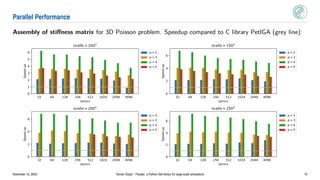
Parallel Performance
Assembly of stiffness matrix for 3D Poisson problem. Speedup compared to C library PetIGA (grey line):
32 64 128 256 512 1024 2048 4096
nprocs
0
1
2
3
4
5
6
Speed-up
ncells=1003
p=2
p=3
p=4
p=5
32 64 128 256 512 1024 2048 4096
nprocs
0
2
4
6
Speed-up
ncells=1503
p=2
p=3
p=4
p=5
32 64 128 256 512 1024 2048 4096
nprocs
0
2
4
6
Speed-up
ncells=2003
p=2
p=3
p=4
p=5
32 64 128 256 512 1024 2048 4096
nprocs
0
2
4
6
Speed-up
ncells=2503
p=2
p=3
p=4
p=5
November 10, 2023 Yaman Güçlü – Psydac: a Python IGA library for large-scale simulations 15
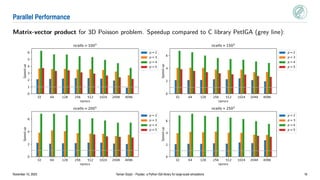
Parallel Performance
Matrix-vector product for 3D Poisson problem. Speedup compared to C library PetIGA (grey line):
32 64 128 256 512 1024 2048 4096
nprocs
0
1
2
3
4
5
6
Speed-up
ncells=1003
p=2
p=3
p=4
p=5
32 64 128 256 512 1024 2048 4096
nprocs
0
2
4
6
Speed-up
ncells=1503
p=2
p=3
p=4
p=5
32 64 128 256 512 1024 2048 4096
nprocs
0
2
4
6
Speed-up
ncells=2003
p=2
p=3
p=4
p=5
32 64 128 256 512 1024 2048 4096
nprocs
0
2
4
6
Speed-up
ncells=2503
p=2
p=3
p=4
p=5
November 10, 2023 Yaman Güçlü – Psydac: a Python IGA library for large-scale simulations 16
Conclusions
We can bridge the gap from prototype to production in scientific computing:
• Use Python to experiment low-level algorithms and high-level library design
• Achieve flexibility through: domain specific languages, semantic parsers, code generation
• Use Python accelerators (e.g. Pyccel) to get single-process performance:
• Statically compile the most computationally-intensive functions
• Achieve parallel multithreading with OpenMP (circumventing Python’s GIL)
• Future work: GPU offloading (with CUDA/HIP or OpenMP/OpenACC)
• Use MPI parallelization (through the mpi4py library) to distribute work on large machines
Thank you for your attention!
Psydac’s repository: https://github.com/pyccel/psydac
November 10, 2023 Yaman Güçlü – Psydac: a Python IGA library for large-scale simulations 17

SFSCON23 - Yaman Güçlü - Psydac a Python IGA library for large-scale simulations

  • 1.
    Psydac: a PythonIGA library for large-scale simulations Ease of use and high performance in the open-source Python ecosystem SFSCON 2023, Bozen, 10-11 November 2023 Yaman Güçlü1 1Numerical Methods in Plasma Physics Division, Max Planck Institute for Plasma Physics, Garching, Germany
  • 2.
    The impossible taskof Scientific Computing Prototyping environment: • User-friendly and interactive • Extensive numerical libraries • Visualization tools • Data analysis High performance computing (HPC): • Single-core optimization • Shared-memory and MPI parallelization • Use heterogeneous computing systems • Strict quality control How to bridge the gap between prototyping and production? Strategy: • Code is written in Python (some parts may be generated automatically) • MPI parallelization is based on mpi4py library • Bottlenecks are translated to Fortran/C using the Pyccel transpiler • If needed, HPC specialists can further optimize the generated code November 10, 2023 Yaman Güçlü – Psydac: a Python IGA library for large-scale simulations 1
  • 3.
    Genesis of PSYDAC •Spline FEM widely used in big codes at IPP: SeLaLib, JOREK, ORB5, EUTERPE, GEMPIC, GVEC, . . . • Can accurately represent complex geometries (IGA = Iso-Geometric Analysis) • Stable smooth solutions with high order of accuracy • Structure-preserving methods based on de Rham sequence (FEEC = finite element exterior calculus) • In 2018 we created PSYDAC, an open source IGA library in Python: • Fast prototyping environment with high model flexibility • Experiment with new distributed data structures (MPI) • Achieve performance through C/Fortran code generation November 10, 2023 Yaman Güçlü – Psydac: a Python IGA library for large-scale simulations 2
  • 4.
    Genesis of PSYDAC Couldwe have used or extended another open-source FEM library? Not easily: Fenics Tigar Firedrake GeoPDEs PetIGA FreeFem++ G+Smo MFEM Complex geometries Ë Ë Ë Ë é Ë Ë Ë Spline spaces é Ë é Ë Ë é Ë – Support FEEC é é é é – é é é Python API Ë Ë Ë é é é é Ë UFL (or equivalent) Ë Ë Ë é é – é é Model flexibility Ë Ë Ë – Ë Ë Ë – HPC capabilities é é é é Ë é é Ë Glossary: • FEEC = finite element exterior calculus • UFL = unified form language – a domain specific language for the finite element method • HPC = high performance computing • “Model flexibility”: ability to define any variational form without changing the library source code November 10, 2023 Yaman Güçlü – Psydac: a Python IGA library for large-scale simulations 3
  • 5.
    The PSYDAC project PYCCELSYMPDE PSYDAC • Finite Element library • Uses SymPDE to describe weak formulation • Automatically generates Python code • Uses Pyccel to accelerate Python • Converts Python to Fortran • Compiles Fortran with compiler of choice • Extension of SymPy library • Symbolic description of PDEs • Provides differential operators, integrals, etc See https://github.com/pyccel: Pyccel + SymPDE + PSYDAC + . . . November 10, 2023 Yaman Güçlü – Psydac: a Python IGA library for large-scale simulations 4
  • 6.
    Simulation workflow Geometry file Main.py script PSYDAC (online) PSYDAC (offline) HDF5 output file Post-processing .py script VTK files Paraview 3D visualization • Psydac is MPI-parallel both in the online and offline phases • Paraview installation on cluster is also MPI-parallel November 10, 2023 Yaman Güçlü – Psydac: a Python IGA library for large-scale simulations 5
  • 7.
    Library architecture FINITE ELEMENTMETHOD HIGH-LEVEL API • Discrete Bilinear Forms • Discrete Linear Forms • Discrete Scalar Functionals FEEC API • De Rham sequences • Grad, Curl, Div operators • Projection operators OUTPUT MANAGER • Write function spaces to YML file • Parallel write vectors to HDF5 file • Generate VTK files LINEAR ALGEBRA • MPI-distributed vectors & matrices • Block vectors & matrices • Abstract linear operators • Iterative linear solvers BASIS • Evaluation of B-splines and NURBS • Derivatives evaluation • Knot insertion • Degree elevation GEOMETRY • NURBS mappings • Inter-patch connectivity • Boundaries and interfaces • Load multi-patch geometry files • Interpolation operators • Histopolation operators • Quadrature formulas • Tensor-product scalar spaces • Vector spaces • Multi-patch (broken) spaces CODE GENERATION November 10, 2023 Yaman Güçlü – Psydac: a Python IGA library for large-scale simulations 6
  • 8.
    MPI parallelization Work distributionacross MPI processes: • Decompose logical domain • Decompose stiffness matrix • Decompose coefficients vector • Use iterative linear solvers Distributed matrix-vector product: • Each process needs a few vector values from adjacent domains (ghost regions) • Use MPI communication to update ghost regions November 10, 2023 Yaman Güçlü – Psydac: a Python IGA library for large-scale simulations 7
  • 9.
    Static compilation ofcomputational kernels Python kernels translated to Fortran (or C) using Pyccel: • Evaluation of B-splines, NURBS, and their derivatives • Matrix-vector (dot) product • Vector-vector (inner) product • Matrix transposition • Matrix conversion to SciPy or PETSc sparse formats • Assembly of matrices, vectors, and scalar functionals Pyccel supports OpenMP pragmas: • Corresponding OpenMP pragmas are printed in the Fortran/C code • Bypass Python’s global interpreter lock (GIL) to achieve parallel multi-threading November 10, 2023 Yaman Güçlü – Psydac: a Python IGA library for large-scale simulations 8
  • 10.
    Automatic code generation Workflow: •User describes model equations w/ SymPDE • User selects analytical geometry or loads geometry file • PSYDAC creates FEM spaces and MPI decomposition • PSYDAC generates computational kernels in Python: • Assembly of matrices (bilinear forms) • Assembly of vectors (linear forms) • Assembly of scalar functionals • Python kernels translated to Fortran using Pyccel • Linear system solved with iterative method (e.g. PCG) Psydac AST Weak Formulation Function Space Domain Fem Space Geometry Code generation Backend Simulation execution PSYDAC SymPDE November 10, 2023 Yaman Güçlü – Psydac: a Python IGA library for large-scale simulations 9
  • 11.
    Usage example: 2DPoisson’s equation (1/3) Continuum model in strong form: Given f (x, y), find u(x, y) such that −∇2 u = f in Ω, u = 0 on ∂Ω. Continuum model in weak form: Given f ∈ L2 (Ω), find u ∈ H1 0 (Ω) s.t. Z Ω ∇u · ∇v dΩ | {z } a(u,v) = Z Ω f v dΩ | {z } l(v) ∀v ∈ H1 0 (Ω) from sympy import cos, pi from sympde import * # Problem definition OmegaP = Square('Omega') # parametric domain F = CollelaMapping2D('F', eps=0.1, k1=1, k2=1) # mapping Omega = F(OmegaP) # physical domain x, y = Omega.coordinates # physical coordinates u_ex = cos(pi/2 * x) * cos(pi/2 * y) # manufactured solution f = -laplace(u_ex) # right-hand side # Function space for trial and test functions V = ScalarFunctionSpace('V', Omega) u, v = elements_of(V, 'u, v') # Declare bilinear and linear forms for variational formulation a = BilinearForm((u, v), integral(Omega, dot(grad(u), grad(v)))) l = LinearForm( v , integral(Omega, f * v)) bc = EssentialBC( u, 0 , Omega.boundary) # boundary conditions # Variational formulation of Poisson's equation equation = find(u, forall=v, lhs=a(u, v), rhs=l(v), bc=bc) November 10, 2023 Yaman Güçlü – Psydac: a Python IGA library for large-scale simulations 10
  • 12.
    Intermezzo: SymPDE (1/2) SymPDEis a symbolic algebra system for weak formulations of partial differential equations (PDEs): • It extends the famous Python library SymPy • It is a domain specific language (DSL) • It provides the tools for processing the expressions in another library (e.g. Psydac) What can SymPDE do for you? • Provide partial differential operators (gradient, divergence, curl, etc..) • Satisfy operator identities (e.g. ∇ · (∇ × A) ≡ 0) • Provide integral operators (volume integrals, boundary integrals, etc...) • Check correctness of data types in a mathematical expression • Verify linearity of l(u) and bilinearity of a(u, v) November 10, 2023 Yaman Güçlü – Psydac: a Python IGA library for large-scale simulations 11
  • 13.
    Intermezzo: SymPDE (2/2) SymPDEis a SymPy extension, and each expression tree can be inspected, e.g. with Graphviz: a(u, v) := Z Ω ∇u · ∇v dΩ from sympy.printing.dot import dotprint from pygraphviz import AGraph # Inspect bilinear expression a(u,v) g = AGraph(dotprint(a(u, v))) g.layout(prog='dot') g.draw('graph.pdf') Integral Dot NCubeInterior Grad Grad F(Omega)_(1, 0) u v November 10, 2023 Yaman Güçlü – Psydac: a Python IGA library for large-scale simulations 12
  • 14.
    Usage example: 2DPoisson’s equation (2/3) Galerkin method: • Let uh ≈ u in finite dim. subspace Vh ⊂ H1 0 • Choose basis for Vh = span(ϕ1, ϕ2, . . . ϕN ) • Search for uh(x, y) = P k wk ϕk (x, y) • Choose test functions v = ϕk • Linear PDE yields linear system A w = b Given f ∈ L2 (Ω), find w ∈ RN s.t. N X j=1 Z Ωh ∇ϕi · ∇ϕj dΩ | {z } Aij wj = Z Ωh f ϕi dΩ | {z } bi , for i = 1, . . . , N. from mpi4py import MPI from psydac import discretize # Select MPI communicator (set to None for serial code) comm = MPI.COMM_WORLD # Create computational domain Omega_h = discretize(Omega, ncells=(7, 7), comm=comm) # Create finite element space (B-splines) V_h = discretize(V, Omega_h, degree=(3, 3)) # Set up linear system: code generation equation_h = discretize(equation, Omega_h, [Vh, Vh]) # Compute numerical solution: # 1. assemble (distributed) sparse matrix A # 2. assemble (distributed) dense vector b # 3. solve linear system A w = b # 4. create callable field u_h(x,y) u_h = equation_h.solve() November 10, 2023 Yaman Güçlü – Psydac: a Python IGA library for large-scale simulations 13
  • 15.
    Usage example: 2DPoisson’s equation (3/3) Domain: 7 × 7 cells Spline degree: p = 3 - Left: numerical solution - Right: numerical error 1.0 0.5 0.0 0.5 1.0 x 1.00 0.75 0.50 0.25 0.00 0.25 0.50 0.75 1.00 y (x,y) 1.0 0.5 0.0 0.5 1.0 x 1.00 0.75 0.50 0.25 0.00 0.25 0.50 0.75 1.00 y (x,y) ex(x,y) 0.000 0.125 0.250 0.375 0.500 0.625 0.750 0.875 1.000 0.0048 0.0036 0.0024 0.0012 0.0000 0.0012 0.0024 0.0036 0.0048 # Scalar error estimate (L2 norm) l2norm = Norm(u - u_ex, Omega, kind='l2') # symbolic definition - SymPDE l2norm_h = discretize(h2_norm, Omega_h, Vh) # code generation - PSYDAC l2_error = l2norm_h.assemble(u=u_h) # computation Running the whole thing in IPython: In [1]: run poisson_2d.py In [2]: print(l2_error) Out[2]: 5.17e-03 November 10, 2023 Yaman Güçlü – Psydac: a Python IGA library for large-scale simulations 14
  • 16.
    Parallel Performance Assembly ofstiffness matrix for 3D Poisson problem. Speedup compared to C library PetIGA (grey line): 32 64 128 256 512 1024 2048 4096 nprocs 0 1 2 3 4 5 6 Speed-up ncells=1003 p=2 p=3 p=4 p=5 32 64 128 256 512 1024 2048 4096 nprocs 0 2 4 6 Speed-up ncells=1503 p=2 p=3 p=4 p=5 32 64 128 256 512 1024 2048 4096 nprocs 0 2 4 6 Speed-up ncells=2003 p=2 p=3 p=4 p=5 32 64 128 256 512 1024 2048 4096 nprocs 0 2 4 6 Speed-up ncells=2503 p=2 p=3 p=4 p=5 November 10, 2023 Yaman Güçlü – Psydac: a Python IGA library for large-scale simulations 15
  • 17.
    Parallel Performance Matrix-vector productfor 3D Poisson problem. Speedup compared to C library PetIGA (grey line): 32 64 128 256 512 1024 2048 4096 nprocs 0 1 2 3 4 5 6 Speed-up ncells=1003 p=2 p=3 p=4 p=5 32 64 128 256 512 1024 2048 4096 nprocs 0 2 4 6 Speed-up ncells=1503 p=2 p=3 p=4 p=5 32 64 128 256 512 1024 2048 4096 nprocs 0 2 4 6 Speed-up ncells=2003 p=2 p=3 p=4 p=5 32 64 128 256 512 1024 2048 4096 nprocs 0 2 4 6 Speed-up ncells=2503 p=2 p=3 p=4 p=5 November 10, 2023 Yaman Güçlü – Psydac: a Python IGA library for large-scale simulations 16
  • 18.
    Conclusions We can bridgethe gap from prototype to production in scientific computing: • Use Python to experiment low-level algorithms and high-level library design • Achieve flexibility through: domain specific languages, semantic parsers, code generation • Use Python accelerators (e.g. Pyccel) to get single-process performance: • Statically compile the most computationally-intensive functions • Achieve parallel multithreading with OpenMP (circumventing Python’s GIL) • Future work: GPU offloading (with CUDA/HIP or OpenMP/OpenACC) • Use MPI parallelization (through the mpi4py library) to distribute work on large machines Thank you for your attention! Psydac’s repository: https://github.com/pyccel/psydac November 10, 2023 Yaman Güçlü – Psydac: a Python IGA library for large-scale simulations 17