dekotec.com
dekotec.com22
1. Introduction
2. PVC (Polyvinyl Chloride)
3. PE (Polyethylene)
4. Bitumen - Complex Mix of Hydrocarbons
Polymer Modified Bitumen (PMB)
5. Butyl-Rubber
6. Conclusions
12.11.2020
dekotec.com3312.11.2020
dekotec.com44
▪ To understand and to compare the chemistry and the basic
properties of each material:
• PVC (Polyvinyl Chloride)
• PE (Polyethylene)
• Bitumen-Complex Mix of Hydrocarbons/
Polymer Modified Bitumen (PMB)
• Butyl-Rubber
▪ Special focus:
Suitability for use in Corrosion Prevention Tapes
12.11.2020
dekotec.com5512.11.2020
Year 1900 1920 1940 1960 1980 2000 2020
Greases/
Asphalt
Coal Tar
Enamel
PVC-Bitumen Limited Use
PE-Butyl-Rubber
1926: Plasticize PVC
1953: Catalysts - HDPE
dekotec.com66
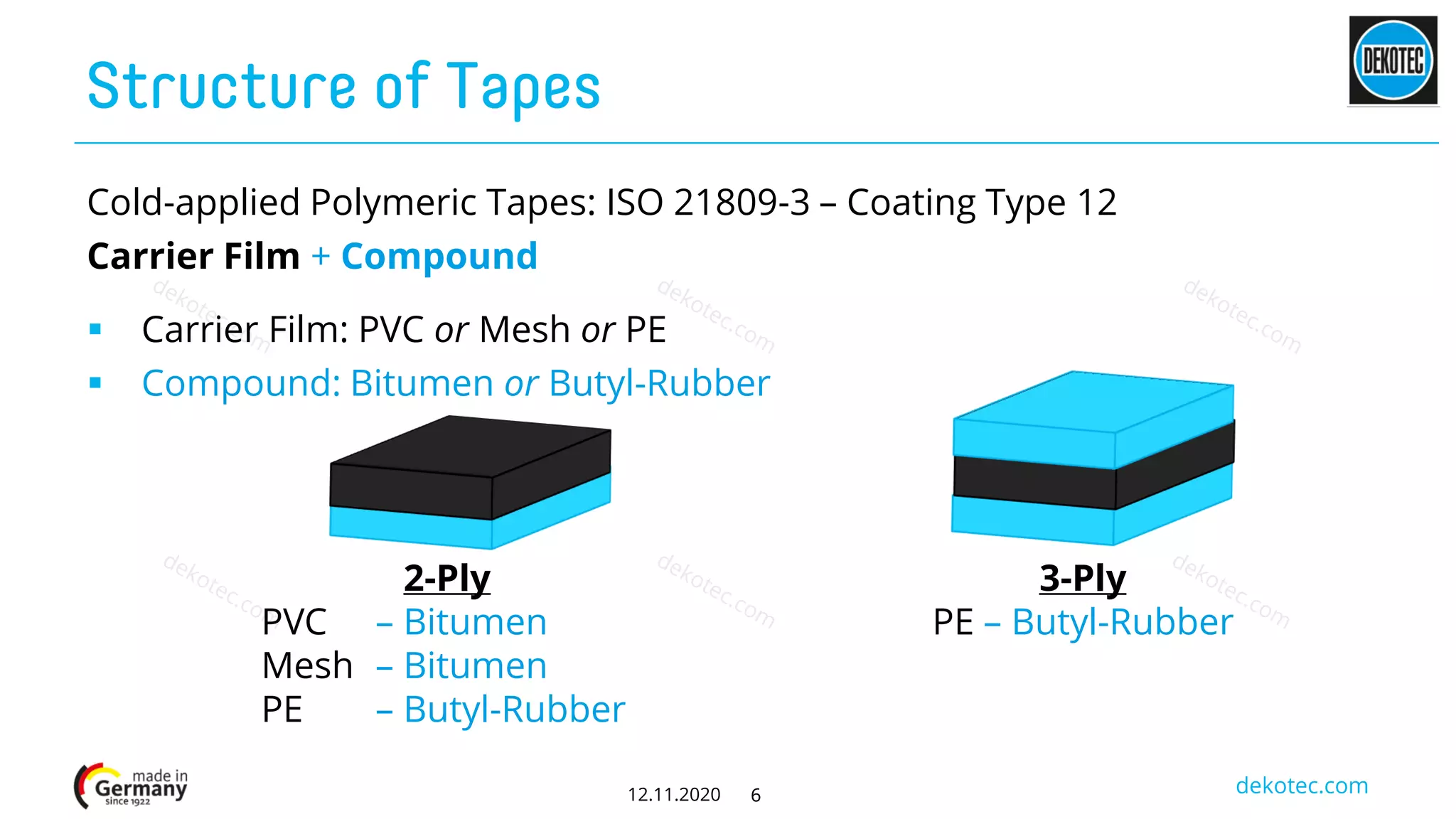
Cold-applied Polymeric Tapes: ISO 21809-3 – Coating Type 12
Carrier Film + Compound
▪ Carrier Film: PVC or Mesh or PE
▪ Compound: Bitumen or Butyl-Rubber
12.11.2020
2-Ply
PVC – Bitumen
Mesh – Bitumen
PE – Butyl-Rubber
3-Ply
PE – Butyl-Rubber
dekotec.com7712.11.2020
dekotec.com88 dekotec.comdekotec.com
▪ 1835 (France): Henri Victor Regnault accidentally synthesized Vinyl Chloride. With
the exposure to UV, a white solid (powder) developed: Polyvinyl Chloride.
(Regnault was not aware of his discovery).
▪ 1912 (Germany): Fritz Klatte synthesized Vinyl Chloride from Ethine and Hydrogen
Chloride and laid the foundation for the production of PVC.
(No products were successfully market at that time).
▪ Due to lack of raw materials as a result of World War I, production of PVC started
in the USA and Germany.
▪ 1926 (USA): Plasticize PVC by blending it with various additives –
Essential for application of tapes!
12.11.2020
dekotec.com99
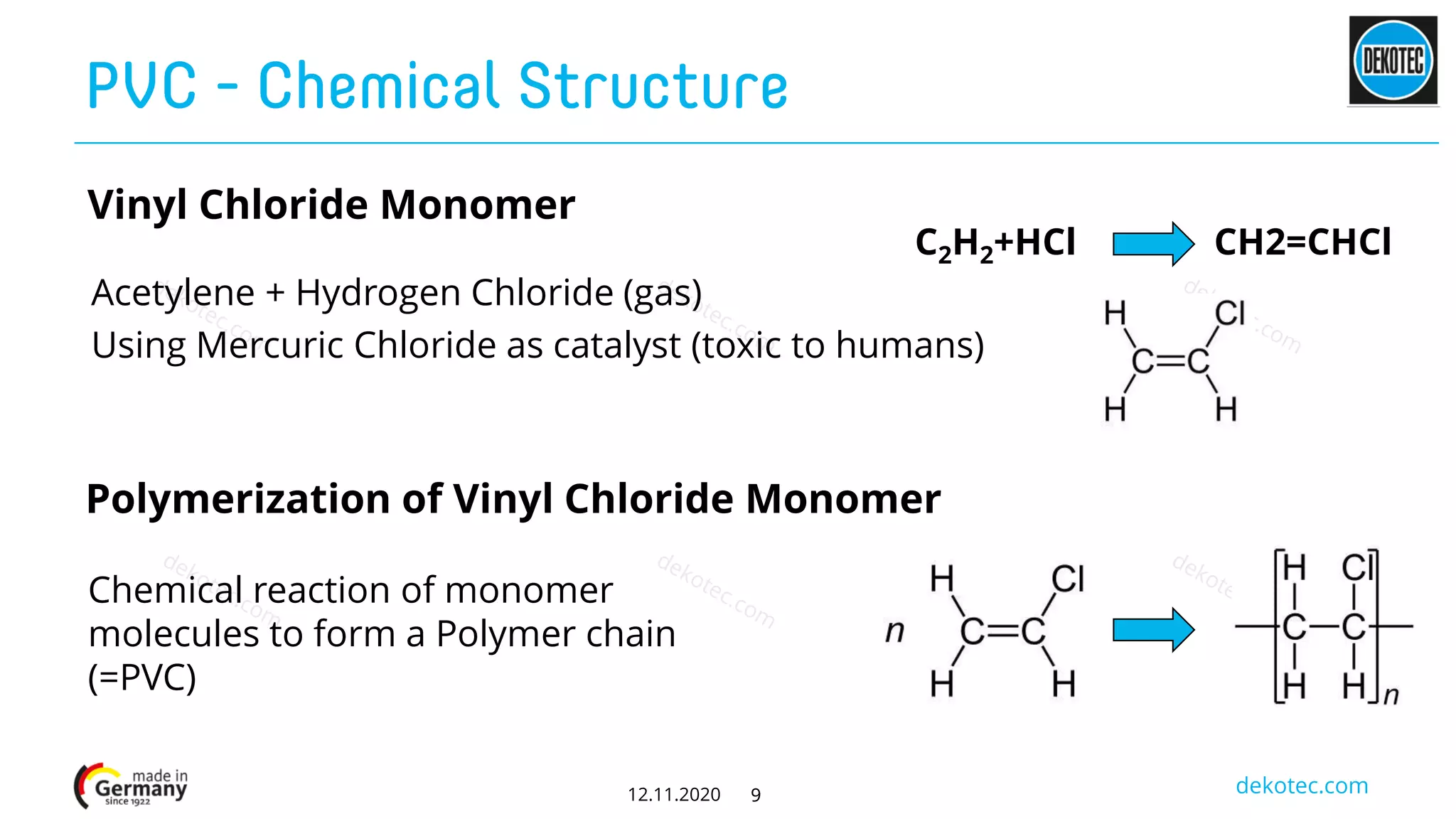
C2H2+HCl CH2=CHCl
12.11.2020
Vinyl Chloride Monomer
Acetylene + Hydrogen Chloride (gas)
Using Mercuric Chloride as catalyst (toxic to humans)
Polymerization of Vinyl Chloride Monomer
Chemical reaction of monomer
molecules to form a Polymer chain
(=PVC)
dekotec.com1010 dekotec.comdekotec.com
Various processing aids are needed:
▪ Impact modifiers - Thermal modifiers
▪ Fillers
▪ Biocides
▪ Pigments
▪ Plasticizers
▪ Heat Stabilizers - UV stabilizers
12.11.2020
dekotec.com1111
Plasticizers (up to 40%) make PVC flexible, but only at -18°C and higher
Exudation – “Sweating Effect”:
Plasticizers are not stable and migrate to:
▪ Environment: Groundwater Pollution
▪ Adhesive (Bitumen)
• Backing stiffness embrittlement: Cracking’s
• Adhesive plasticizing: Gummy with poor Lap Shear
Plasticizers are suspected to cause Cancer
12.11.2020
dekotec.com1212
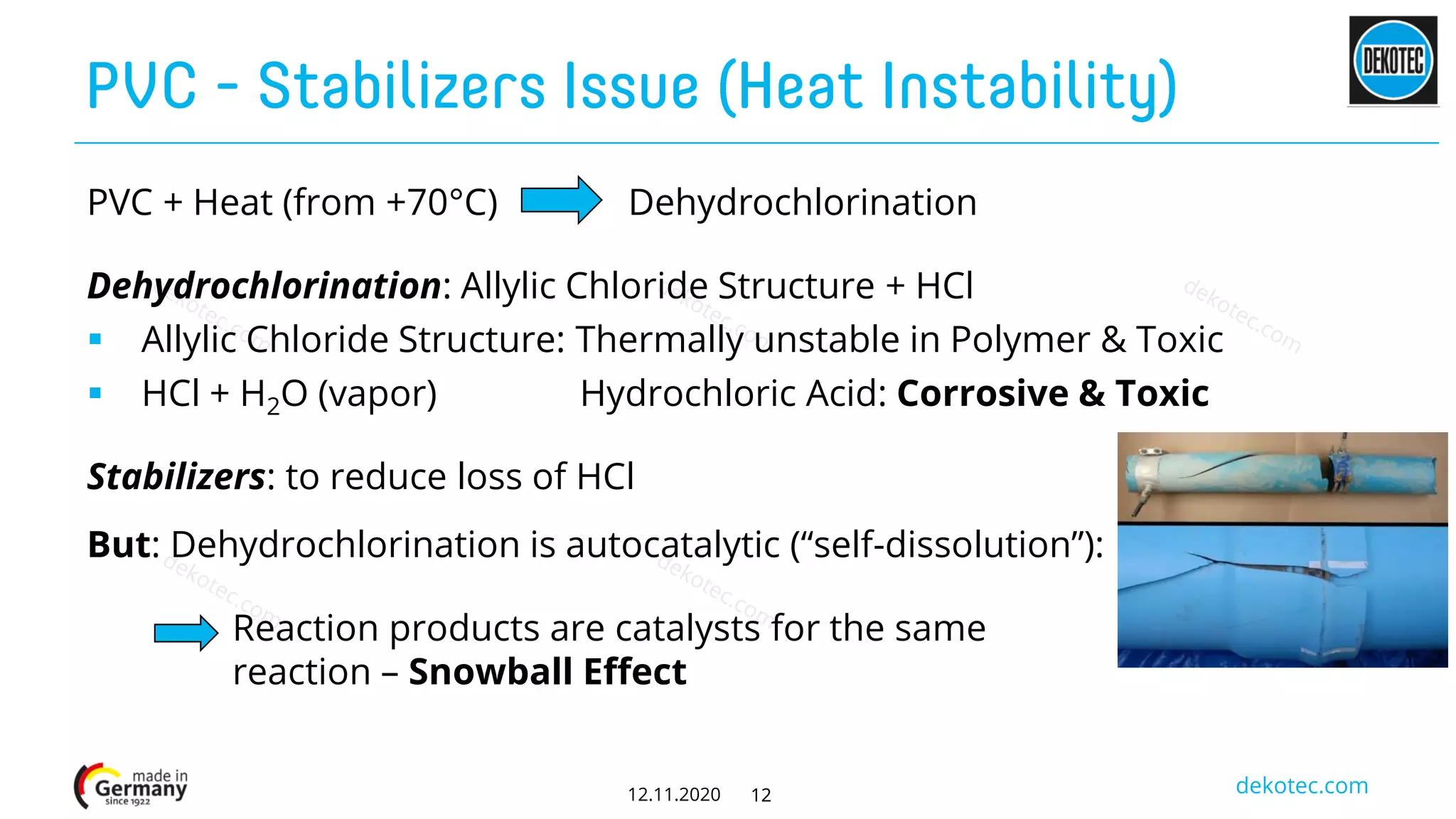
PVC + Heat (from +70°C)
Dehydrochlorination: Allylic Chloride Structure + HCl
▪ Allylic Chloride Structure: Thermally unstable in Polymer & Toxic
▪ HCl + H2O (vapor) Hydrochloric Acid: Corrosive & Toxic
Stabilizers: to reduce loss of HCl
But: Dehydrochlorination is autocatalytic (“self-dissolution”):
Reaction products are catalysts for the same
reaction – Snowball Effect
12.11.2020
Dehydrochlorination
dekotec.com131312.11.2020
dekotec.com1414
▪ 1898 (Germany): White waxy substance was accidentally synthesized by Hans von
Pechmann. (no practical use at that time)
▪ 1933 (UK): Eric Fawcett & Reginald Gibson “accidentally” synthesized in industrial
manner a white, waxy material. Later Michael Wilcox Perrin produced in a high-
pressure synthesis Polyethylene.
▪ 1944 (USA): Bakelite Corp. & DuPont started commercial production.
▪ 1951 (USA) and 1953 (Germany):
Milestone success: catalysts + mild temperature & pressure + Ethylene
➢ LDPE (Low Density PE) &
➢ HDPE (High Density PE).
12.11.2020
LDPE
dekotec.com1515
Chemical Reaction: Catalyst + monomer molecules to form Polyethylene chains
Monomer molecules: Ethylene (simplest Alkene)
Similar chemical composition as Candles or Chewing-Gum
12.11.2020
Catalyst + n
dekotec.com1616
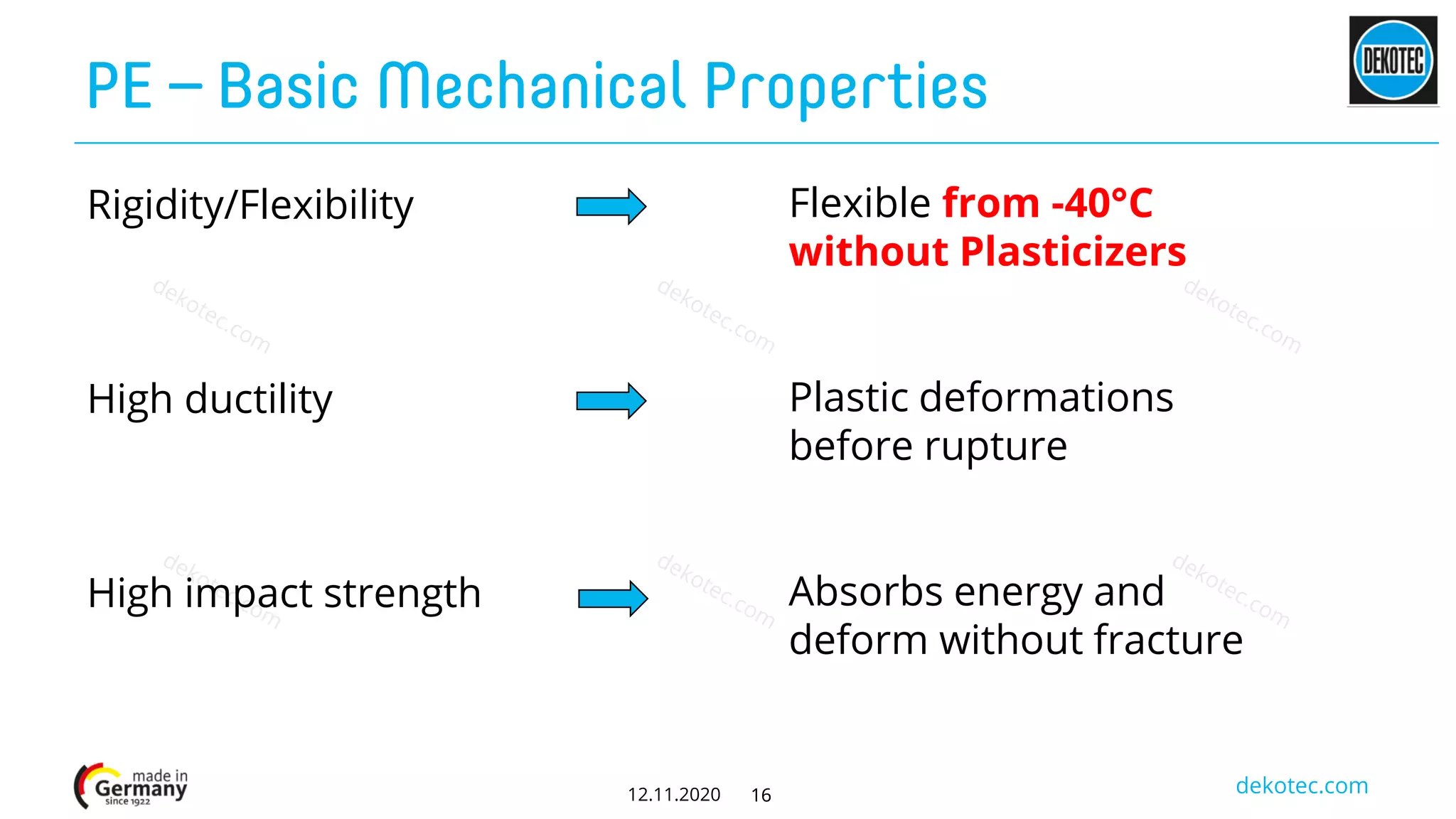
Rigidity/Flexibility
High ductility
High impact strength
12.11.2020
Flexible from -40°C
without Plasticizers
Plastic deformations
before rupture
Absorbs energy and
deform without fracture
dekotec.com1717
No Dehydrochlorination
Melting Point (HDPE)
Melting Point (PVC)
12.11.2020
No heat stabilizers
Good Thermal stability
120°C – 180°C
77°C – 88°C
dekotec.com1818
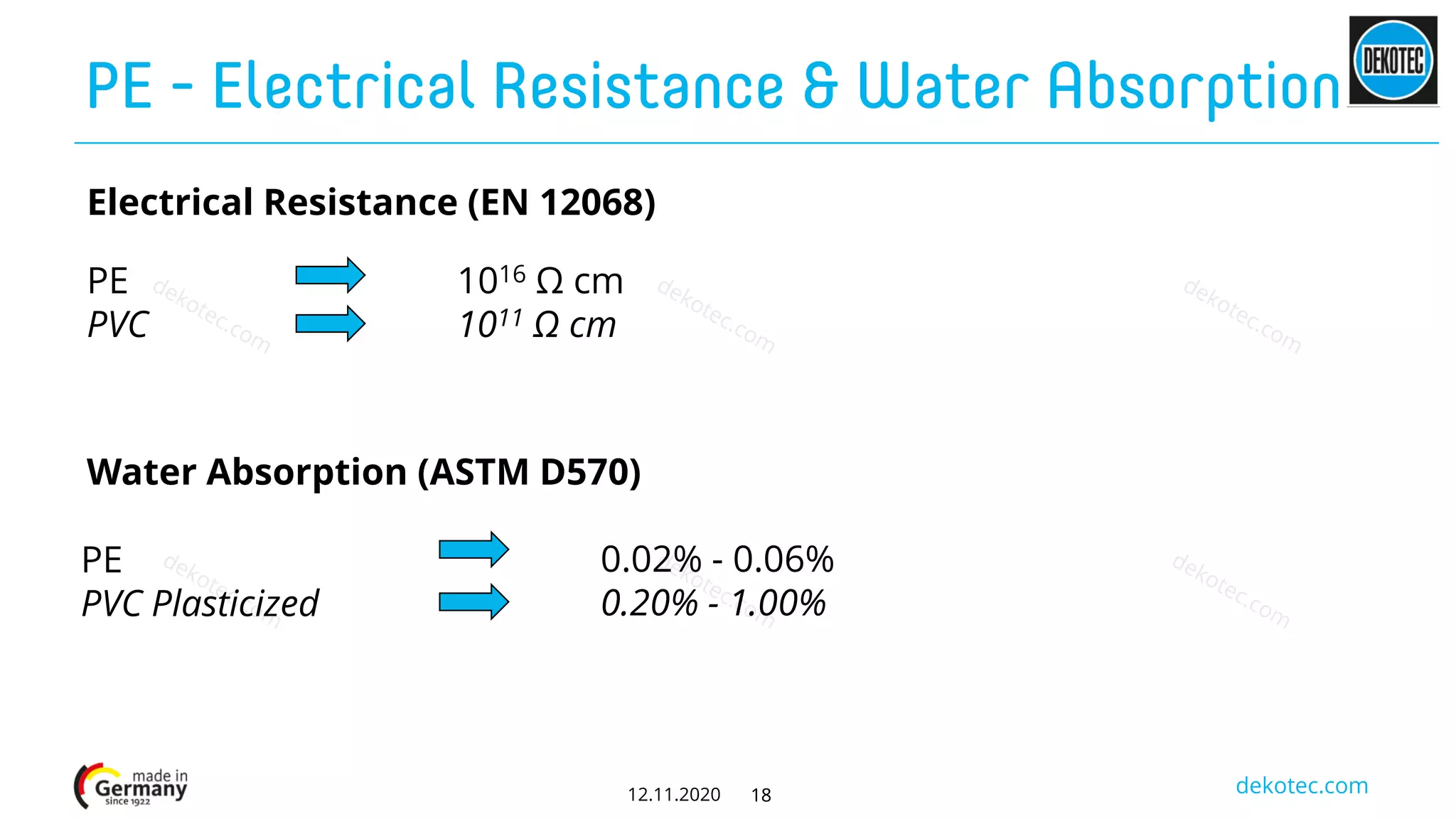
Electrical Resistance (EN 12068)
12.11.2020
PE
PVC
1016 Ω cm
1011 Ω cm
Water Absorption (ASTM D570)
PE
PVC Plasticized
0.02% - 0.06%
0.20% - 1.00%
dekotec.com1919 dekotec.comdekotec.com
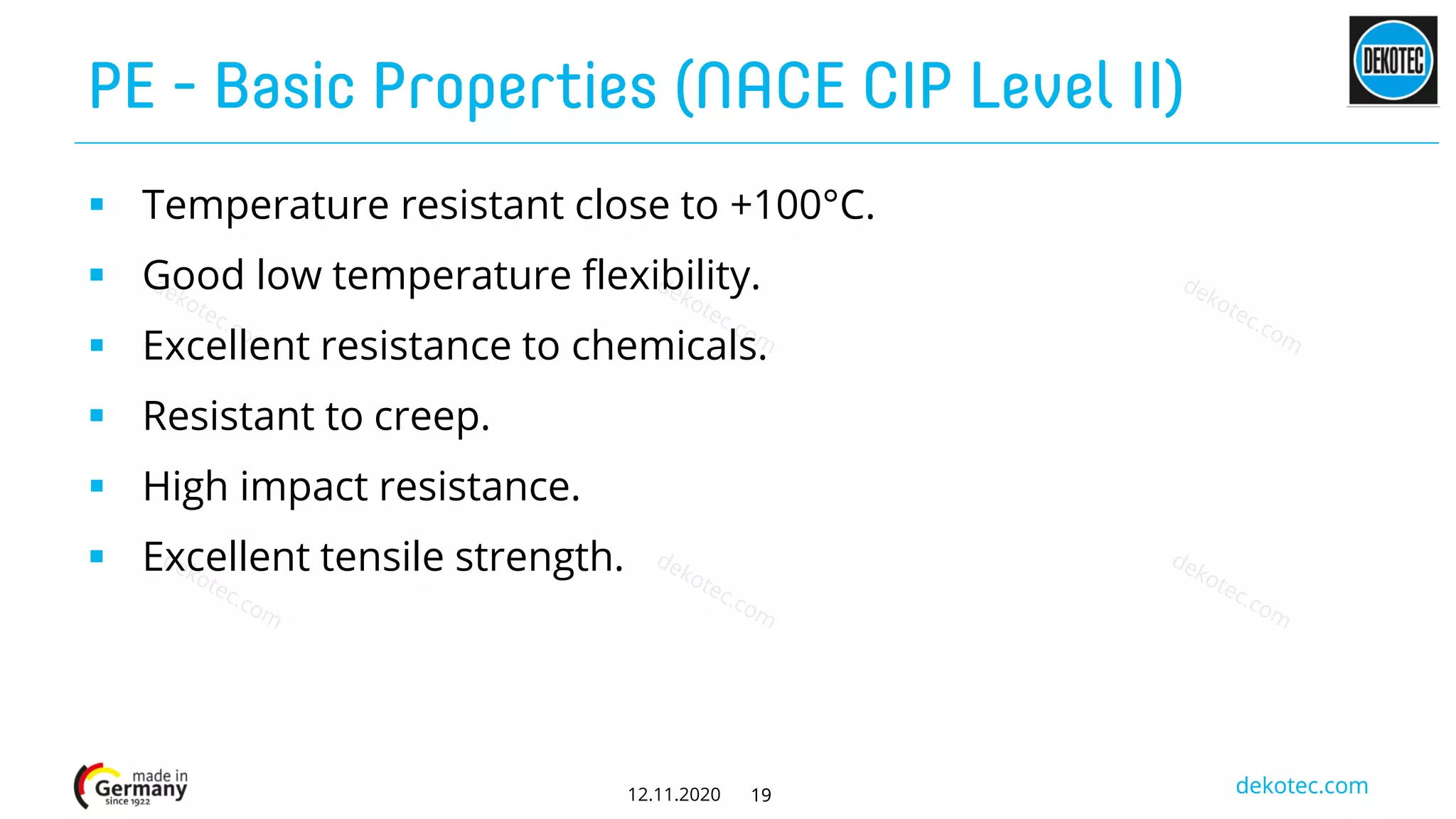
▪ Temperature resistant close to +100°C.
▪ Good low temperature flexibility.
▪ Excellent resistance to chemicals.
▪ Resistant to creep.
▪ High impact resistance.
▪ Excellent tensile strength.
12.11.2020
dekotec.com2020 dekotec.comdekotec.com
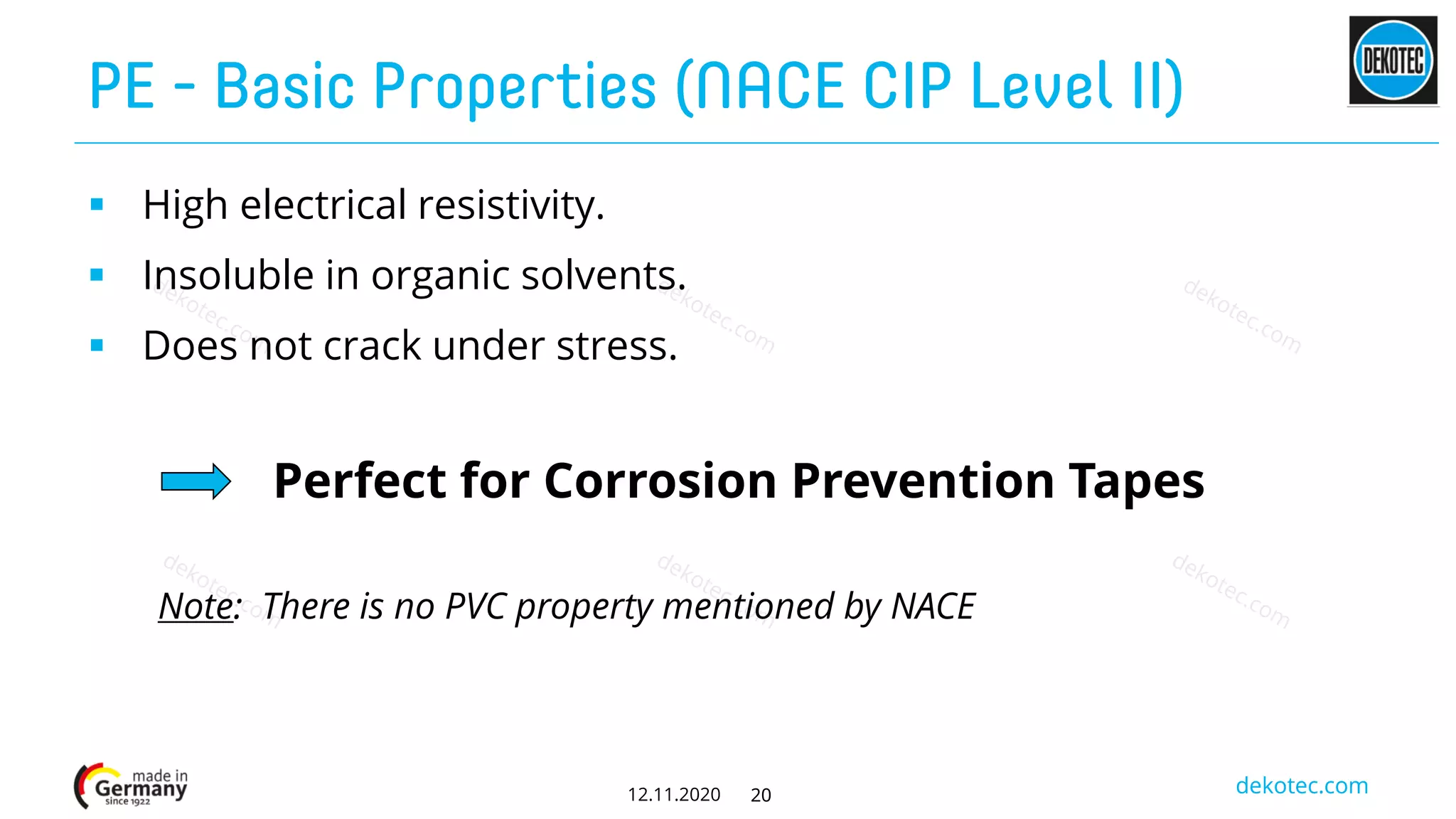
▪ High electrical resistivity.
▪ Insoluble in organic solvents.
▪ Does not crack under stress.
12.11.2020
Perfect for Corrosion Prevention Tapes
Note: There is no PVC property mentioned by NACE
dekotec.com212112.11.2020
dekotec.com2222 dekotec.comdekotec.com
▪ Complex Hydrocarbons (CnHm) Mixture
▪ Natural:
▪ Refined: Crude Oil Distillation
• 1500 Crude Oil types, but:
• only 7% are suitable for qualitative Bitumen
• Quality issue – No defined composition
12.11.2020
dekotec.com2323 dekotec.comdekotec.com
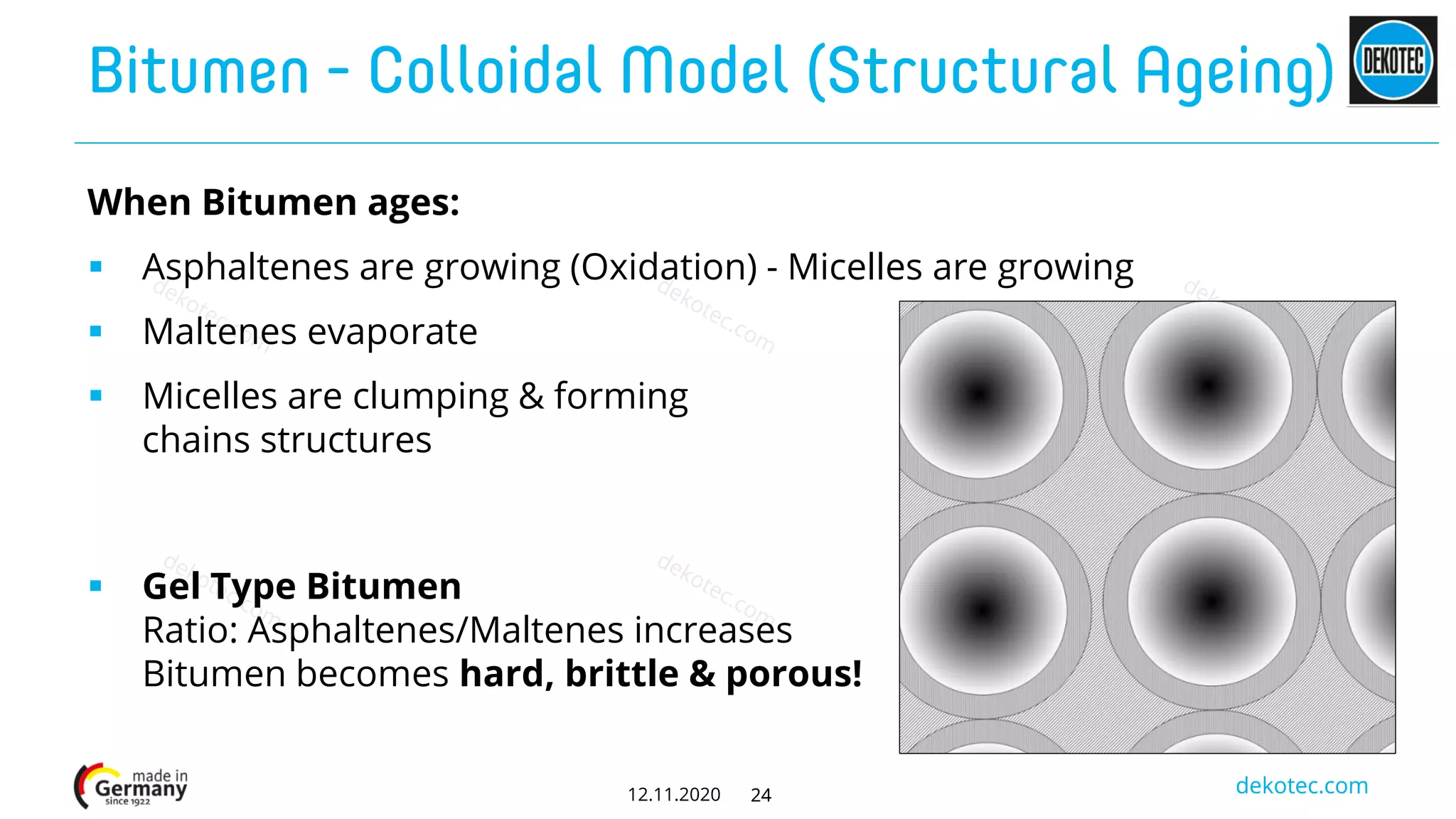
This model explains the aging behavior of Bitumen
▪ Non-soluble Solid Asphaltenes - radius in nm (10-9 m)
▪ Asphaltenes are coated by soluble Resins
▪ Asphaltenes + Resins
= Solid Micelles
▪ Oily Liquid matrix: Maltenes
Temperature sensitive
▪ Sol Type Bitumen
Asphaltenes Micelles are fully
dispersed & non-interactive
12.11.2020
dekotec.com2424 dekotec.comdekotec.com
When Bitumen ages:
▪ Asphaltenes are growing (Oxidation) - Micelles are growing
▪ Maltenes evaporate
▪ Micelles are clumping & forming
chains structures
▪ Gel Type Bitumen
Ratio: Asphaltenes/Maltenes increases
Bitumen becomes hard, brittle & porous!
12.11.2020
dekotec.com2525 dekotec.comdekotec.com
Rolling Thin Film Oven Test (RTFOT) – ASTM-D1754 & EN 12607
Asphaltene expansion rate:
▪ Depends on Crude Oil origin & temperature
▪ Is linear with time
12.11.2020
The proportion of
Asphaltenes is
considerably
growing after only
340 min.
dekotec.com2626 dekotec.comdekotec.com
Structural Ageing is the weak point of Bitumen !
▪ Oxidation is the most influential factor.
▪ Ageing is a process that can not be interrupted.
Ageing speed depends on:
▪ Crude Oil Origins & temperature
▪ Bitumen mixture (Polymers can only reduce
ageing speed).
Ageing Result:
Bitumen becomes hard, brittle & porous!
12.11.2020
dekotec.com2727 dekotec.comdekotec.com
Bitumen becomes
hard, brittle & porous
12.11.2020
dekotec.com2828 dekotec.comdekotec.com
Polymer Modified Bitumen (PMB)
Polymers (ex: SBS, SBE, EVA, EBA) are added:
▪ …to make the mixture sticky (adhesion).
▪ …to increase plasticity window temperatures (breaking-softening).
BUT:
▪ Cheap Polymers don´t reduce ageing speed.
▪ Non-homogeneous mixture
(Polymer chains are not broken during mixing) .
▪ Ex: Problems with storage conditions!
12.11.2020
dekotec.com2929 dekotec.comdekotec.com
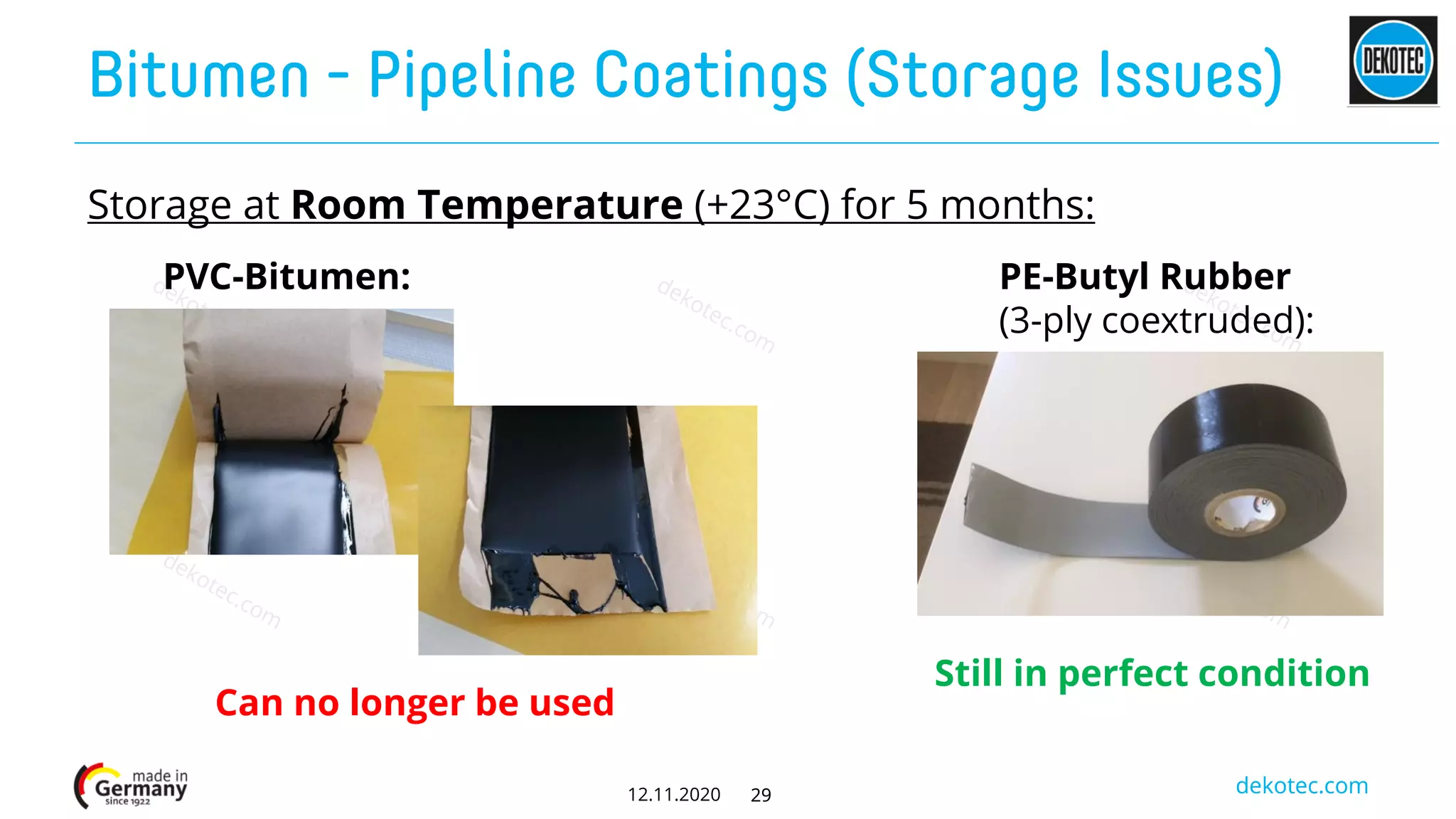
Storage at Room Temperature (+23°C) for 5 months:
12.11.2020
PE-Butyl Rubber
(3-ply coextruded):
PVC-Bitumen:
Can no longer be used
Still in perfect condition
dekotec.com3030 dekotec.comdekotec.com
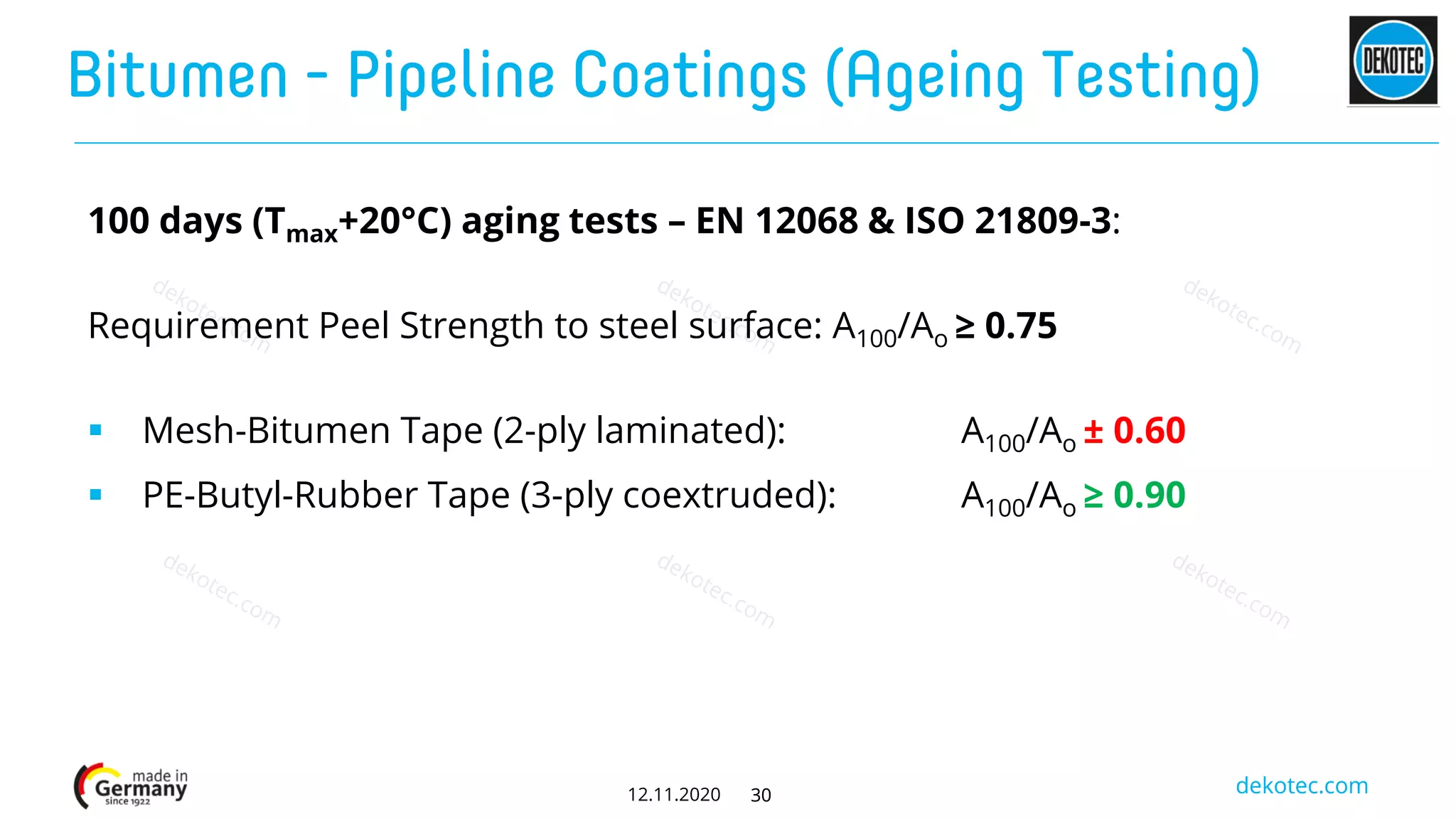
100 days (Tmax+20°C) aging tests – EN 12068 & ISO 21809-3:
Requirement Peel Strength to steel surface: A100/Ao ≥ 0.75
▪ Mesh-Bitumen Tape (2-ply laminated): A100/Ao ± 0.60
▪ PE-Butyl-Rubber Tape (3-ply coextruded): A100/Ao ≥ 0.90
12.11.2020
dekotec.com3131 dekotec.comdekotec.com
Hot Water Immersion (HWI) Tests – ISO 21809-3:
Requirement Peel Strength to steel surface:
Requirement Peel Strength to steel surface
after 28 days HWI:
Initial After HWI
▪ Mesh-Bitumen Tape (2-ply laminated): > 1.0 N/mm – 0.2 - 0.4 N/mm
▪ PE-Butyl-Rubber Tape (3-ply coextruded): > 3.0 N/mm – > 3.0 N/mm
12.11.2020
≥ 1N/mm
≥ 0.4N/mm
dekotec.com3232 dekotec.comdekotec.com
High Porosity = high Cathodic Protection (CP) current demand
ISO 15589-1:2015 – Cathodic Protection onshore Pipelines.
§ 8.4. Cathodic Protection Current Demand
§ 8.4.2 - Coating Breakdown Factors (ff)
Itot= πD x L x k x j x ff
Itot: total current demand
k: contingency factor - non uniform distribution (≥ 1.25)
j: design current density (100mA/m² - 1A/m²)
ff: High Coating Breakdown Factor = High CP current demand
12.11.2020
dekotec.com3333 dekotec.comdekotec.com
ff = fi + (∆f x tdl)
12.11.2020
Coal Tar and Bitumen are very similar materials
with comparable properties
Coating Breakdown Factors after 10 years
3LPE Bitumen
Years
ff
fi: initial ff
∆f: Avg yearly increase of ff
tdl: design life (years)
dekotec.com3434 dekotec.comdekotec.com
§ 8.4.3 – Current density
Itot = πD x L x k x j x Jc
k: contingency factor - non uniform distribution (≥ 1.25)
jc: design current density (Table 3)
12.11.2020
dekotec.com353512.11.2020
dekotec.com3636
▪ 1825 (UK): Michael Faraday (better known for discovery of electromagnetic
induction, diamagnetism and electrolysis) discovered Isobutylene.
▪ 1931 (Germany): BASF developed Polyisobutylene (PIB), which was sold under
the trade name Oppanol B.
▪ 1937 (USA): Development into Butyl-Rubber by Standard Oil laboratory.
▪ Today, the majority of the global supply of Butyl-Rubber is produced by:
- ExxonMobil (USA), one of the descendant of Standard Oil (USA).
- LANXESS AG (Germany), Bayer AG bought Polysar Rubber (Canada) in 1990.
12.11.2020
dekotec.com3737
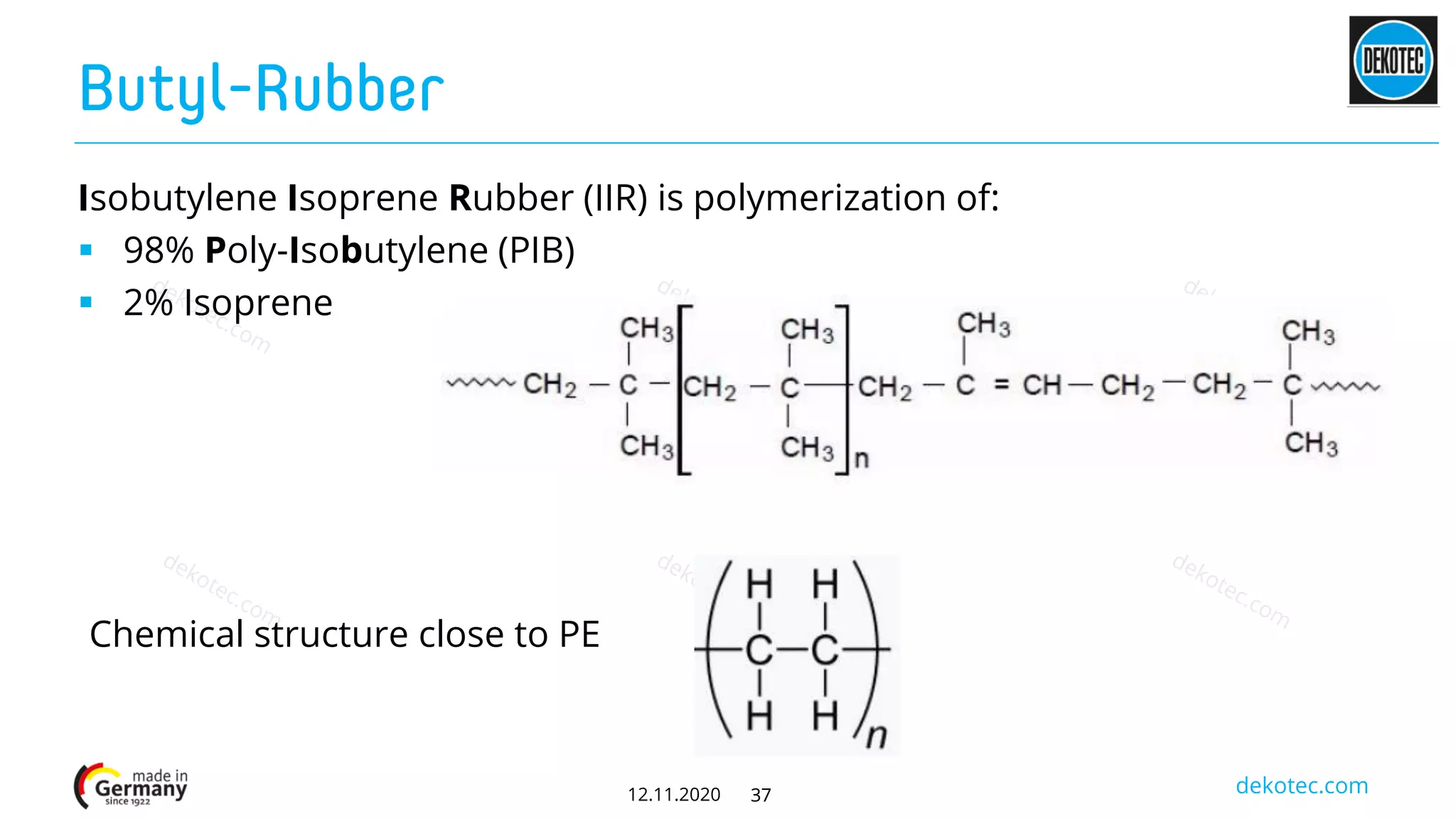
Isobutylene Isoprene Rubber (IIR) is polymerization of:
▪ 98% Poly-Isobutylene (PIB)
▪ 2% Isoprene
12.11.2020
Chemical structure close to PE
dekotec.com3838 dekotec.comdekotec.com
Basic Properties
▪ Low permeability to air, gases & moisture (tire profile and tubes).
▪ Glass transition temperature: -67°C.
▪ Maximum temperature: +100°C (+150°C if vulcanized with sulfur).
▪ Resistant to ageing & weathering (stable).
▪ Hardness & tensile strength properties.
▪ Low filler content.
▪ Safe (chewing-gum effect).
12.11.2020
Perfect for Corrosion Prevention Tapes
dekotec.com3939 dekotec.comdekotec.com
▪ Temperatures resistant close to +100°C.
▪ Pliable and moldable material.
▪ Typical use: mastics, adhesives, sealants.
▪ Excellent resistance to acids.
12.11.2020
Note: No Bitumen property is mentioned by NACE
Perfect for Corrosion Prevention Tapes
dekotec.com4040 dekotec.comdekotec.com
PE-Butyl-Rubber Tape after 40 years of operation
exceeds current requirements
12.11.2020
dekotec.com414112.11.2020
dekotec.com4242 dekotec.comdekotec.com12.11.2020
Properties PVC Bitumen PE Butyl-Rubber
Low Temperature -18°C -50°C -40°C -67°C
Melting Point Temp. +77°C +80°C +120°C +100°C
Electrical Resistance 1011 Ω cm 1016 Ω cm
Water absorption 0.2% - 1.0% 0.02% - 0.06%
Ageing Poor Poor Stable Stable
Cracks Porous HWI & Ageing tests
dekotec.com4343 dekotec.comdekotec.com
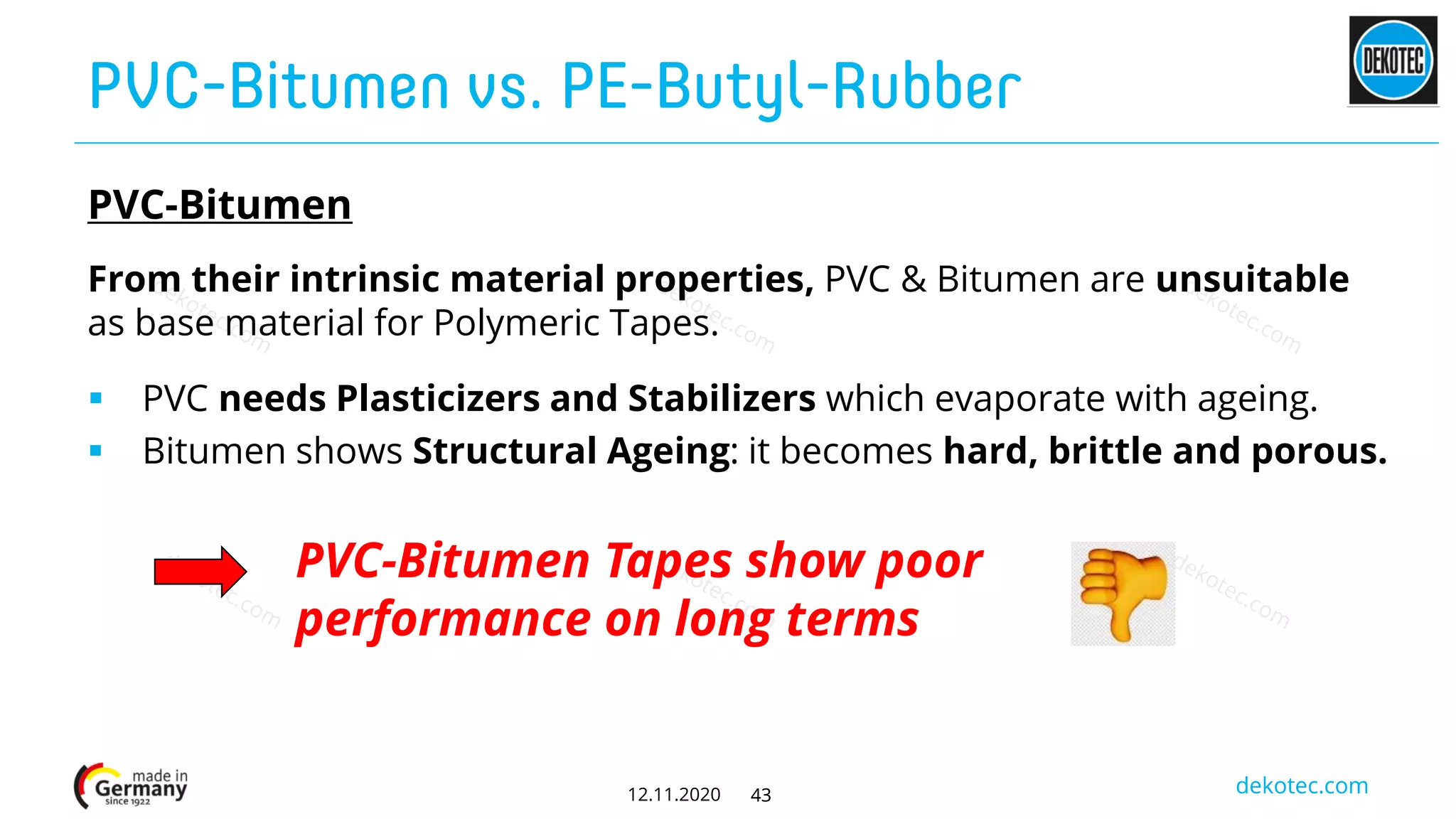
PVC-Bitumen
From their intrinsic material properties, PVC & Bitumen are unsuitable
as base material for Polymeric Tapes.
▪ PVC needs Plasticizers and Stabilizers which evaporate with ageing.
▪ Bitumen shows Structural Ageing: it becomes hard, brittle and porous.
12.11.2020
PVC-Bitumen Tapes show poor
performance on long terms
dekotec.com4444 dekotec.comdekotec.com
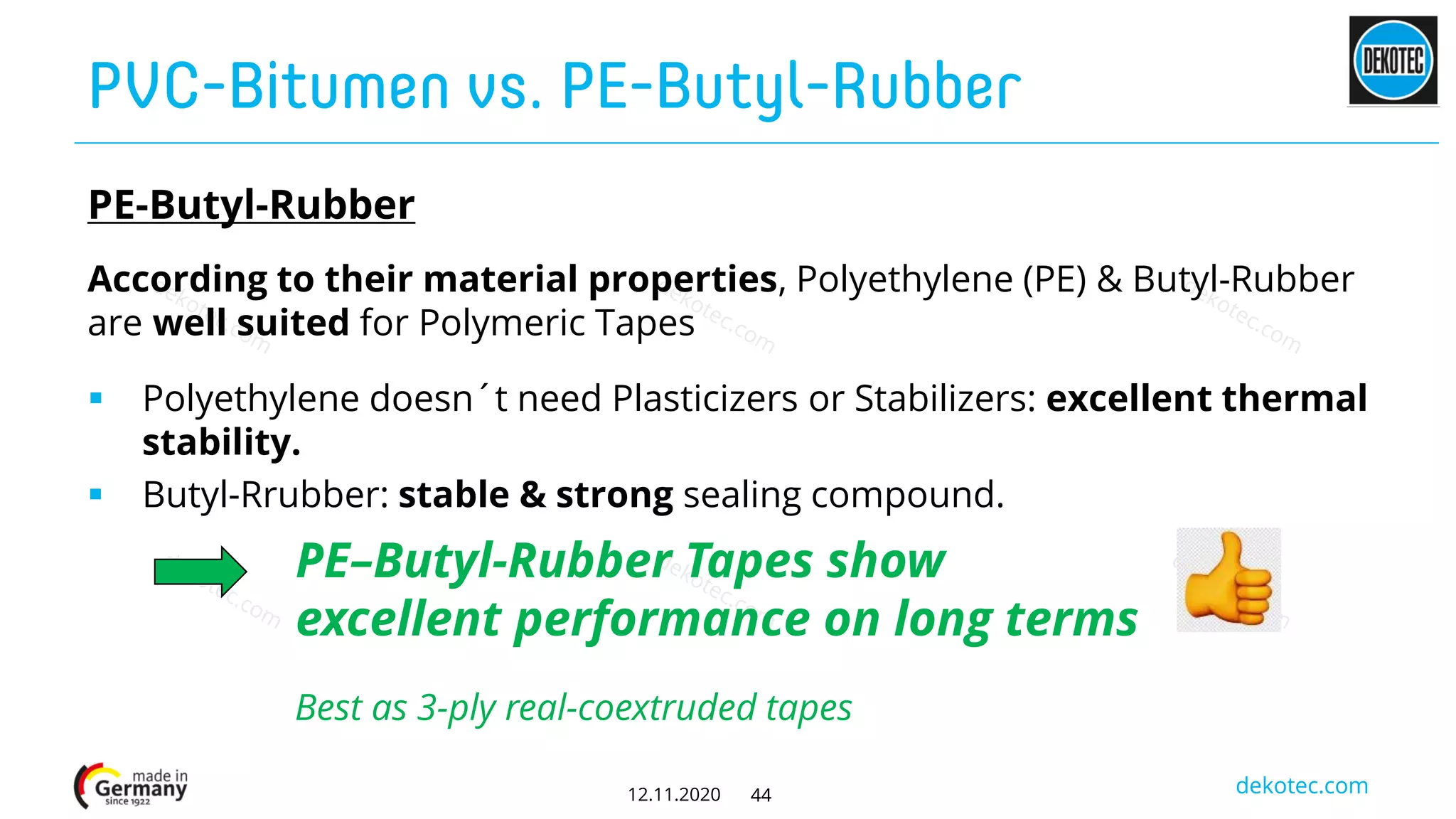
PE-Butyl-Rubber
According to their material properties, Polyethylene (PE) & Butyl-Rubber
are well suited for Polymeric Tapes
▪ Polyethylene doesn´t need Plasticizers or Stabilizers: excellent thermal
stability.
▪ Butyl-Rrubber: stable & strong sealing compound.
12.11.2020
PE–Butyl-Rubber Tapes show
excellent performance on long terms
Best as 3-ply real-coextruded tapes
dekotec.com4545 dekotec.comdekotec.com
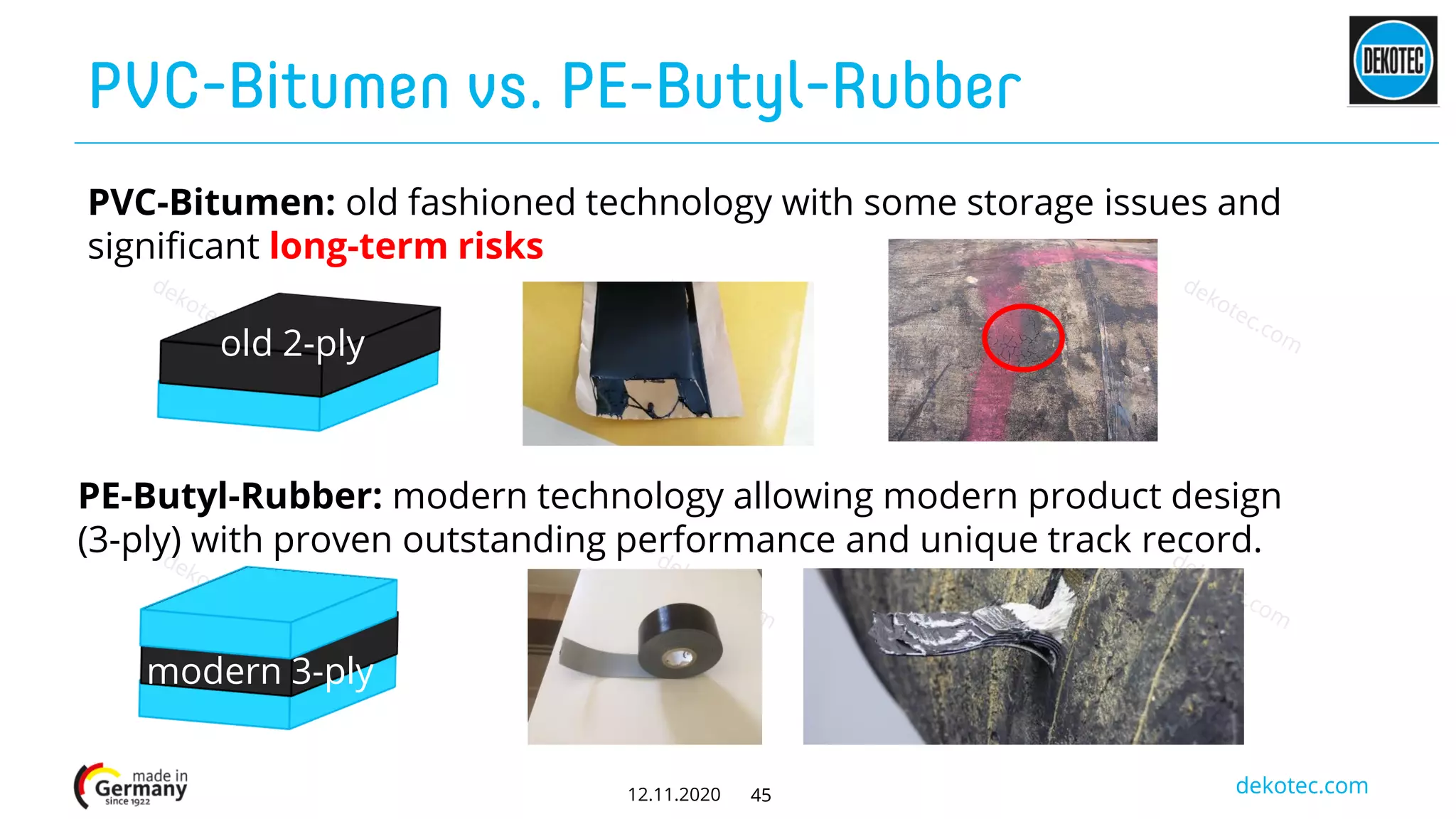
PVC-Bitumen: old fashioned technology with some storage issues and
significant long-term risks
12.11.2020
old 2-ply
PE-Butyl-Rubber: modern technology allowing modern product design
(3-ply) with proven outstanding performance and unique track record.
modern 3-ply
dekotec.com
dekotec.com474712.11.2020
dekotec.com4848
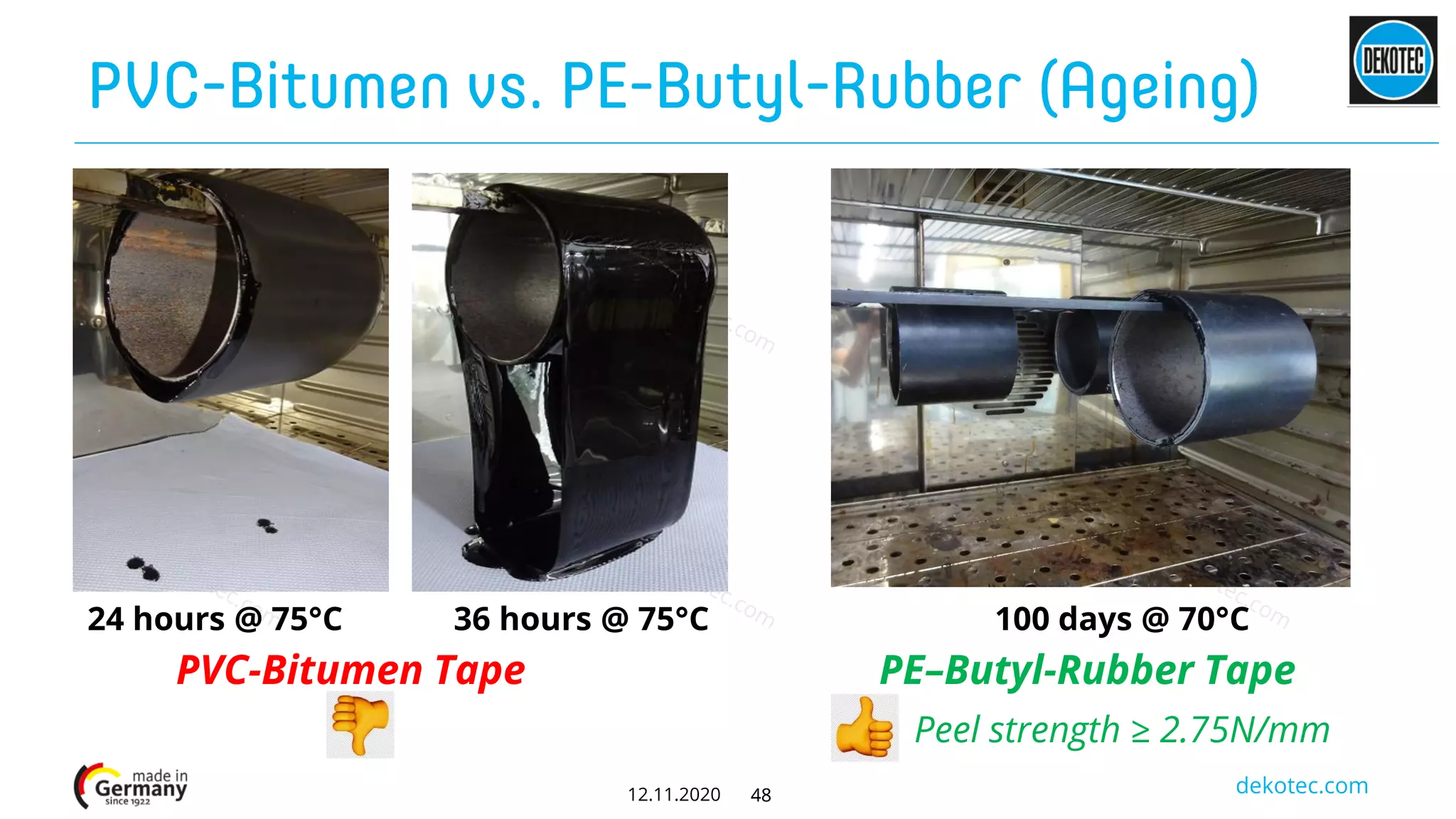
24 hours @ 75°C 36 hours @ 75°C 100 days @ 70°C
PVC-Bitumen Tape PE–Butyl-Rubber Tape
Peel strength ≥ 2.75N/mm
12.11.2020

Polymeric tapes: What are the differences of PVC – Bitumen and PE – Butyl Rubber?

  • 1.
  • 2.
    dekotec.com22 1. Introduction 2. PVC(Polyvinyl Chloride) 3. PE (Polyethylene) 4. Bitumen - Complex Mix of Hydrocarbons Polymer Modified Bitumen (PMB) 5. Butyl-Rubber 6. Conclusions 12.11.2020
  • 3.
  • 4.
    dekotec.com44 ▪ To understandand to compare the chemistry and the basic properties of each material: • PVC (Polyvinyl Chloride) • PE (Polyethylene) • Bitumen-Complex Mix of Hydrocarbons/ Polymer Modified Bitumen (PMB) • Butyl-Rubber ▪ Special focus: Suitability for use in Corrosion Prevention Tapes 12.11.2020
  • 5.
    dekotec.com5512.11.2020 Year 1900 19201940 1960 1980 2000 2020 Greases/ Asphalt Coal Tar Enamel PVC-Bitumen Limited Use PE-Butyl-Rubber 1926: Plasticize PVC 1953: Catalysts - HDPE
  • 6.
    dekotec.com66 Cold-applied Polymeric Tapes:ISO 21809-3 – Coating Type 12 Carrier Film + Compound ▪ Carrier Film: PVC or Mesh or PE ▪ Compound: Bitumen or Butyl-Rubber 12.11.2020 2-Ply PVC – Bitumen Mesh – Bitumen PE – Butyl-Rubber 3-Ply PE – Butyl-Rubber
  • 7.
  • 8.
    dekotec.com88 dekotec.comdekotec.com ▪ 1835(France): Henri Victor Regnault accidentally synthesized Vinyl Chloride. With the exposure to UV, a white solid (powder) developed: Polyvinyl Chloride. (Regnault was not aware of his discovery). ▪ 1912 (Germany): Fritz Klatte synthesized Vinyl Chloride from Ethine and Hydrogen Chloride and laid the foundation for the production of PVC. (No products were successfully market at that time). ▪ Due to lack of raw materials as a result of World War I, production of PVC started in the USA and Germany. ▪ 1926 (USA): Plasticize PVC by blending it with various additives – Essential for application of tapes! 12.11.2020
  • 9.
    dekotec.com99 C2H2+HCl CH2=CHCl 12.11.2020 Vinyl ChlorideMonomer Acetylene + Hydrogen Chloride (gas) Using Mercuric Chloride as catalyst (toxic to humans) Polymerization of Vinyl Chloride Monomer Chemical reaction of monomer molecules to form a Polymer chain (=PVC)
  • 10.
    dekotec.com1010 dekotec.comdekotec.com Various processingaids are needed: ▪ Impact modifiers - Thermal modifiers ▪ Fillers ▪ Biocides ▪ Pigments ▪ Plasticizers ▪ Heat Stabilizers - UV stabilizers 12.11.2020
  • 11.
    dekotec.com1111 Plasticizers (up to40%) make PVC flexible, but only at -18°C and higher Exudation – “Sweating Effect”: Plasticizers are not stable and migrate to: ▪ Environment: Groundwater Pollution ▪ Adhesive (Bitumen) • Backing stiffness embrittlement: Cracking’s • Adhesive plasticizing: Gummy with poor Lap Shear Plasticizers are suspected to cause Cancer 12.11.2020
  • 12.
    dekotec.com1212 PVC + Heat(from +70°C) Dehydrochlorination: Allylic Chloride Structure + HCl ▪ Allylic Chloride Structure: Thermally unstable in Polymer & Toxic ▪ HCl + H2O (vapor) Hydrochloric Acid: Corrosive & Toxic Stabilizers: to reduce loss of HCl But: Dehydrochlorination is autocatalytic (“self-dissolution”): Reaction products are catalysts for the same reaction – Snowball Effect 12.11.2020 Dehydrochlorination
  • 13.
  • 14.
    dekotec.com1414 ▪ 1898 (Germany):White waxy substance was accidentally synthesized by Hans von Pechmann. (no practical use at that time) ▪ 1933 (UK): Eric Fawcett & Reginald Gibson “accidentally” synthesized in industrial manner a white, waxy material. Later Michael Wilcox Perrin produced in a high- pressure synthesis Polyethylene. ▪ 1944 (USA): Bakelite Corp. & DuPont started commercial production. ▪ 1951 (USA) and 1953 (Germany): Milestone success: catalysts + mild temperature & pressure + Ethylene ➢ LDPE (Low Density PE) & ➢ HDPE (High Density PE). 12.11.2020 LDPE
  • 15.
    dekotec.com1515 Chemical Reaction: Catalyst+ monomer molecules to form Polyethylene chains Monomer molecules: Ethylene (simplest Alkene) Similar chemical composition as Candles or Chewing-Gum 12.11.2020 Catalyst + n
  • 16.
    dekotec.com1616 Rigidity/Flexibility High ductility High impactstrength 12.11.2020 Flexible from -40°C without Plasticizers Plastic deformations before rupture Absorbs energy and deform without fracture
  • 17.
    dekotec.com1717 No Dehydrochlorination Melting Point(HDPE) Melting Point (PVC) 12.11.2020 No heat stabilizers Good Thermal stability 120°C – 180°C 77°C – 88°C
  • 18.
    dekotec.com1818 Electrical Resistance (EN12068) 12.11.2020 PE PVC 1016 Ω cm 1011 Ω cm Water Absorption (ASTM D570) PE PVC Plasticized 0.02% - 0.06% 0.20% - 1.00%
  • 19.
    dekotec.com1919 dekotec.comdekotec.com ▪ Temperatureresistant close to +100°C. ▪ Good low temperature flexibility. ▪ Excellent resistance to chemicals. ▪ Resistant to creep. ▪ High impact resistance. ▪ Excellent tensile strength. 12.11.2020
  • 20.
    dekotec.com2020 dekotec.comdekotec.com ▪ Highelectrical resistivity. ▪ Insoluble in organic solvents. ▪ Does not crack under stress. 12.11.2020 Perfect for Corrosion Prevention Tapes Note: There is no PVC property mentioned by NACE
  • 21.
  • 22.
    dekotec.com2222 dekotec.comdekotec.com ▪ ComplexHydrocarbons (CnHm) Mixture ▪ Natural: ▪ Refined: Crude Oil Distillation • 1500 Crude Oil types, but: • only 7% are suitable for qualitative Bitumen • Quality issue – No defined composition 12.11.2020
  • 23.
    dekotec.com2323 dekotec.comdekotec.com This modelexplains the aging behavior of Bitumen ▪ Non-soluble Solid Asphaltenes - radius in nm (10-9 m) ▪ Asphaltenes are coated by soluble Resins ▪ Asphaltenes + Resins = Solid Micelles ▪ Oily Liquid matrix: Maltenes Temperature sensitive ▪ Sol Type Bitumen Asphaltenes Micelles are fully dispersed & non-interactive 12.11.2020
  • 24.
    dekotec.com2424 dekotec.comdekotec.com When Bitumenages: ▪ Asphaltenes are growing (Oxidation) - Micelles are growing ▪ Maltenes evaporate ▪ Micelles are clumping & forming chains structures ▪ Gel Type Bitumen Ratio: Asphaltenes/Maltenes increases Bitumen becomes hard, brittle & porous! 12.11.2020
  • 25.
    dekotec.com2525 dekotec.comdekotec.com Rolling ThinFilm Oven Test (RTFOT) – ASTM-D1754 & EN 12607 Asphaltene expansion rate: ▪ Depends on Crude Oil origin & temperature ▪ Is linear with time 12.11.2020 The proportion of Asphaltenes is considerably growing after only 340 min.
  • 26.
    dekotec.com2626 dekotec.comdekotec.com Structural Ageingis the weak point of Bitumen ! ▪ Oxidation is the most influential factor. ▪ Ageing is a process that can not be interrupted. Ageing speed depends on: ▪ Crude Oil Origins & temperature ▪ Bitumen mixture (Polymers can only reduce ageing speed). Ageing Result: Bitumen becomes hard, brittle & porous! 12.11.2020
  • 27.
  • 28.
    dekotec.com2828 dekotec.comdekotec.com Polymer ModifiedBitumen (PMB) Polymers (ex: SBS, SBE, EVA, EBA) are added: ▪ …to make the mixture sticky (adhesion). ▪ …to increase plasticity window temperatures (breaking-softening). BUT: ▪ Cheap Polymers don´t reduce ageing speed. ▪ Non-homogeneous mixture (Polymer chains are not broken during mixing) . ▪ Ex: Problems with storage conditions! 12.11.2020
  • 29.
    dekotec.com2929 dekotec.comdekotec.com Storage atRoom Temperature (+23°C) for 5 months: 12.11.2020 PE-Butyl Rubber (3-ply coextruded): PVC-Bitumen: Can no longer be used Still in perfect condition
  • 30.
    dekotec.com3030 dekotec.comdekotec.com 100 days(Tmax+20°C) aging tests – EN 12068 & ISO 21809-3: Requirement Peel Strength to steel surface: A100/Ao ≥ 0.75 ▪ Mesh-Bitumen Tape (2-ply laminated): A100/Ao ± 0.60 ▪ PE-Butyl-Rubber Tape (3-ply coextruded): A100/Ao ≥ 0.90 12.11.2020
  • 31.
    dekotec.com3131 dekotec.comdekotec.com Hot WaterImmersion (HWI) Tests – ISO 21809-3: Requirement Peel Strength to steel surface: Requirement Peel Strength to steel surface after 28 days HWI: Initial After HWI ▪ Mesh-Bitumen Tape (2-ply laminated): > 1.0 N/mm – 0.2 - 0.4 N/mm ▪ PE-Butyl-Rubber Tape (3-ply coextruded): > 3.0 N/mm – > 3.0 N/mm 12.11.2020 ≥ 1N/mm ≥ 0.4N/mm
  • 32.
    dekotec.com3232 dekotec.comdekotec.com High Porosity= high Cathodic Protection (CP) current demand ISO 15589-1:2015 – Cathodic Protection onshore Pipelines. § 8.4. Cathodic Protection Current Demand § 8.4.2 - Coating Breakdown Factors (ff) Itot= πD x L x k x j x ff Itot: total current demand k: contingency factor - non uniform distribution (≥ 1.25) j: design current density (100mA/m² - 1A/m²) ff: High Coating Breakdown Factor = High CP current demand 12.11.2020
  • 33.
    dekotec.com3333 dekotec.comdekotec.com ff =fi + (∆f x tdl) 12.11.2020 Coal Tar and Bitumen are very similar materials with comparable properties Coating Breakdown Factors after 10 years 3LPE Bitumen Years ff fi: initial ff ∆f: Avg yearly increase of ff tdl: design life (years)
  • 34.
    dekotec.com3434 dekotec.comdekotec.com § 8.4.3– Current density Itot = πD x L x k x j x Jc k: contingency factor - non uniform distribution (≥ 1.25) jc: design current density (Table 3) 12.11.2020
  • 35.
  • 36.
    dekotec.com3636 ▪ 1825 (UK):Michael Faraday (better known for discovery of electromagnetic induction, diamagnetism and electrolysis) discovered Isobutylene. ▪ 1931 (Germany): BASF developed Polyisobutylene (PIB), which was sold under the trade name Oppanol B. ▪ 1937 (USA): Development into Butyl-Rubber by Standard Oil laboratory. ▪ Today, the majority of the global supply of Butyl-Rubber is produced by: - ExxonMobil (USA), one of the descendant of Standard Oil (USA). - LANXESS AG (Germany), Bayer AG bought Polysar Rubber (Canada) in 1990. 12.11.2020
  • 37.
    dekotec.com3737 Isobutylene Isoprene Rubber(IIR) is polymerization of: ▪ 98% Poly-Isobutylene (PIB) ▪ 2% Isoprene 12.11.2020 Chemical structure close to PE
  • 38.
    dekotec.com3838 dekotec.comdekotec.com Basic Properties ▪Low permeability to air, gases & moisture (tire profile and tubes). ▪ Glass transition temperature: -67°C. ▪ Maximum temperature: +100°C (+150°C if vulcanized with sulfur). ▪ Resistant to ageing & weathering (stable). ▪ Hardness & tensile strength properties. ▪ Low filler content. ▪ Safe (chewing-gum effect). 12.11.2020 Perfect for Corrosion Prevention Tapes
  • 39.
    dekotec.com3939 dekotec.comdekotec.com ▪ Temperaturesresistant close to +100°C. ▪ Pliable and moldable material. ▪ Typical use: mastics, adhesives, sealants. ▪ Excellent resistance to acids. 12.11.2020 Note: No Bitumen property is mentioned by NACE Perfect for Corrosion Prevention Tapes
  • 40.
    dekotec.com4040 dekotec.comdekotec.com PE-Butyl-Rubber Tapeafter 40 years of operation exceeds current requirements 12.11.2020
  • 41.
  • 42.
    dekotec.com4242 dekotec.comdekotec.com12.11.2020 Properties PVCBitumen PE Butyl-Rubber Low Temperature -18°C -50°C -40°C -67°C Melting Point Temp. +77°C +80°C +120°C +100°C Electrical Resistance 1011 Ω cm 1016 Ω cm Water absorption 0.2% - 1.0% 0.02% - 0.06% Ageing Poor Poor Stable Stable Cracks Porous HWI & Ageing tests
  • 43.
    dekotec.com4343 dekotec.comdekotec.com PVC-Bitumen From theirintrinsic material properties, PVC & Bitumen are unsuitable as base material for Polymeric Tapes. ▪ PVC needs Plasticizers and Stabilizers which evaporate with ageing. ▪ Bitumen shows Structural Ageing: it becomes hard, brittle and porous. 12.11.2020 PVC-Bitumen Tapes show poor performance on long terms
  • 44.
    dekotec.com4444 dekotec.comdekotec.com PE-Butyl-Rubber According totheir material properties, Polyethylene (PE) & Butyl-Rubber are well suited for Polymeric Tapes ▪ Polyethylene doesn´t need Plasticizers or Stabilizers: excellent thermal stability. ▪ Butyl-Rrubber: stable & strong sealing compound. 12.11.2020 PE–Butyl-Rubber Tapes show excellent performance on long terms Best as 3-ply real-coextruded tapes
  • 45.
    dekotec.com4545 dekotec.comdekotec.com PVC-Bitumen: oldfashioned technology with some storage issues and significant long-term risks 12.11.2020 old 2-ply PE-Butyl-Rubber: modern technology allowing modern product design (3-ply) with proven outstanding performance and unique track record. modern 3-ply
  • 46.
  • 47.
  • 48.
    dekotec.com4848 24 hours @75°C 36 hours @ 75°C 100 days @ 70°C PVC-Bitumen Tape PE–Butyl-Rubber Tape Peel strength ≥ 2.75N/mm 12.11.2020