PVC, UPVC, FRP
Types of plastic
High density polyethylene (hdpe)
low density polyethylene (ldpe) polypropylene (pp)
Polystyrene (ps)
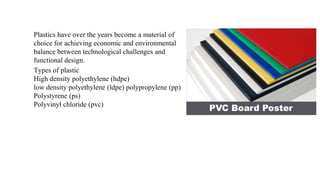
Polyvinyl chloride (pvc)
Plastics have over the years become a material of
choice for achieving economic and environmental
balance between technological challenges and
functional design.
Polyvinyl chloride - the world's third most widely produced synthetic plastic polymer, after polyethylene and
polypropylene.
PVC – a thermoplastic made of 57% chlorine (derived from industrial grade salt) and 43% carbon (derived
predominantly from oil / gas via ethylene).
PVC comes in two basic forms - rigid and flexible.
It can be made softer and more flexible by the addition of plasticizers.
Pure polyvinyl chloride is a white solid.
The rigid form of PVC is used in construction for pipe, doors and windows.
The flexible form of PVC used in plumbing, electrical cable inflatable products, and many applications where it
replaces rubber.
The thermal resistance of raw PVC is very poor, so the addition of a heat stabilizer during the process is necessary in
order to ensure the product's mechanical properties.
PVC is a polymer with good insulation properties. Generally suitable for medium or low voltage and low frequency
insulation materials.
It is chemically resistant to acids, salts, bases, fats, and alcohols.
It is also resistant to the corrosive effects of sewage hence extensively utilized in sewer piping systems.
It has excellent transparency, chemical resistance, long term stability, good weather ability and stable electrical
properties.
Refer this link for section sizes - https://plasopan.com/pvc-doors/
uPVC CASEMENT DOORS
If no plasticizers are used in PVC they are known as Unplasticized Poly Vinyl Chloride .
“UPVC or Rigid PVC is often used in the building industry as a low-maintenance material.
The material comes in a range of colours and finishes, including a photo-effect wood finish, and is used as a
substitute for painted wood, mostly for window frames and sills when installing double glazing in new
buildings, or to replace older single glazed windows.
Very durable
PROPERTIES:
uPVC products are very durable and since they require very low maintenance, they look as good as new for
decades. Lifespan of uPVC windows is over 50+ years, therefore, leave a very low impact on the environment.
Termite free
Unlike wooden windows and doors, uPVC profiles remain free from termite infestation in all climates.
Pollution resistant
Environment-friendly and 100% lead-free uPVC profiles meet the greenline norms
If no plasticizers are used in PVC they
are known as Unplasticized Poly Vinyl
Chloride .
Detail of UPVC DOUBLE GLAZED
WINDOW WITH MAIN FRAME ON
ALL FOUR SIDES with different kind
of profile.
CASEMENT WINDOW Vs CASEMENT
DOOR .
The Profiles are similar in both, Just the size
increases . It is shown as double glazed
window here with gasket in the middle.
Note that the main frame is on all 4 sides in
door.
There can be upvc door with frame on 3
sides only and with sill profile at bottom .
While fixing the door, silicon gel should be
used for sealing the gaps to avoid water
leakage. Watch the video in the link given
in the last slide.
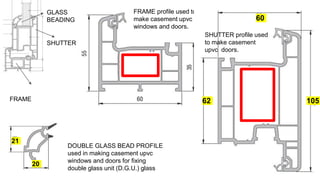
DOUBLE GLASS BEAD PROFILE
used in making casement upvc
windows and doors for fixing
double glass unit (D.G.U.) glass
21
20
FRAME
SHUTTER
GLASS
BEADING
FRAME profile used to
make casement upvc
windows and doors.
SHUTTER profile used
to make casement
upvc doors.
105
62
60
FRAME
SHUTTER
GLASS
BEADING
PLAN
PARTS OF
UPVC
WINDOWS
HARDWARES USED
LOCK WITH LOCK RAIL
While installing the door at site - All the hardwares are brought to the site and installed
once the main frame is fixed.
● https://www.youtube.com/watch?v=_2rbmXqirGA - UNDERSTANDING DIFFERENT PROFILES OF
UPVC WINDOWS
● https://www.youtube.com/watch?v=zgSf4Jrrfg0&t=1s&pbjreload=10 - TYPES OF PROFILES
● https://www.youtube.com/watch?v=5jJFjL5JVhU - Installing vertical windows
● https://www.youtube.com/watch?v=rtkgIe1ryWU - HOW TWO CHANNELS ARE WELDED
● https://upvcwindowmaking.net/guide-to-casement-upvc-windows-doors/ - CASEMNET WINDOW
DETAILS
● https://upvcwindowmaking.net/about/ - WHY USE GI REINFORCEMENT IN UPVC WINDOWS AND
DOORS & EVERYTHING ELSE
● https://www.youtube.com/watch?v=XTPZ8Lx68S8 – ENTIRE PROCESS OF UPVC WINDOW/DOOR
MAKING
● https://www.youtube.com/watch?v=mV89IYla7sc – ASSEMBLING UPVC PROFILES FOR DOOR
● https://youtu.be/q8OlttHUZwM - ASSEMBLY OF PROFILES
LINKS FOR VIDEO AND CATALOGS
● https://www.youtube.com/watch?v=80C4IA4n_QI - HOW TO FIT THE CILL WHILE
REPLACING AND OLD DOOR WITH NEW UPVC DOOR
● https://www.youtube.com/watch?v=zB-0kyCn3LU - FIXING HARDWARE TO
DOORS
● https://www.youtube.com/watch?v=84_U-JIVAVY FIXING CILL AND DOOR .
● https://berightbuild.com/index.php/upvc-windows-door-hardware/ - hardwares
● https://upvcwindowmaking.net/guide-to-casement-upvc-windows-doors/ - MUST
READ
● https://www.koemmerling.co.in/products/casement-door/
Draw Key plan and key elevation for a upvc casement door of width 1m and ht 2.1m along with
following details.
1. PLAN - 1:10
2. SECTION - 1:10
3. DETAILS OF ALL PROFILES IN 1:2 OR 1:5
4. DETAILS OF HARDWARES USED - SPECIFY THE KIND OF HINGE USED
5. VIEWS.
Fibre reinforced plastic or polymer is a composite material made of a polymer matrix reinforced with fibres.
It represents a class of materials that fall into a category referred to as composite materials.
Composite materials are made by dispersing particles of one or more materials in another material, which forms a
continuous network around them.
These materials have a high ratio of strength to density, exceptional corrosion resistance and convenient electrical,
magnetic and thermal properties.
They are brittle and their mechanical properties may be affected by the rate of loading, temperature and
environmental conditions.
The primary function of fibre reinforcement is to carry the load along the length of the fiber and to provide
strength and stiffness in one direction.
FIBRE REINFORCED PLASIC OR FRP
The fibres are
usually glass (in fibreglass), carbon (in c
arbon fiber reinforced polymer), aramid,
or basalt.
The composite is often named by the
reinforcing fibre, for instance, CFRP for
Carbon Fibre Reinforced Polymer.
TYPES OF FIBRE REINFORCED
POLYMER
Carbon Fibre Reinforced Polymer (GFRP)
Carbon fibres do not absorb water and are resistant to
many chemical solutions. They withstand fatigue
excellently and neither corrode nor show any creep or
relaxation.
Carbon fibre reinforced polymers are used to
manufacture underwater pipes for great depth because it
provides a significantly increased buoyancy (due to its
low density) compared to steel.
TYPES OF FIBRE REINFORCED
POLYMER
Glass Fibre Reinforced Polymer (GFRP)
Glass fibres are basically made by mixing silica sand,
limestone, folic acid and other minor ingredients
which is heated to 1260 c.
The molten glass is then allowed to flow through fine
holes in a platinum plate and then cooled.
Glass fibres have excellent characteristics equal to or
better than steel in certain forms.
FIBRE REINFORCED PLASIC OR FRP
The fibres are
usually glass (in fibreglass), carbon (in carb
on fiber reinforced polymer), aramid,
or basalt.
The composite is often named by the
reinforcing fibre, for instance, CFRP for
Carbon Fibre Reinforced Polymer.

pvc

  • 1.
  • 2.
    Types of plastic Highdensity polyethylene (hdpe) low density polyethylene (ldpe) polypropylene (pp) Polystyrene (ps) Polyvinyl chloride (pvc) Plastics have over the years become a material of choice for achieving economic and environmental balance between technological challenges and functional design.
  • 3.
    Polyvinyl chloride -the world's third most widely produced synthetic plastic polymer, after polyethylene and polypropylene. PVC – a thermoplastic made of 57% chlorine (derived from industrial grade salt) and 43% carbon (derived predominantly from oil / gas via ethylene). PVC comes in two basic forms - rigid and flexible. It can be made softer and more flexible by the addition of plasticizers. Pure polyvinyl chloride is a white solid. The rigid form of PVC is used in construction for pipe, doors and windows. The flexible form of PVC used in plumbing, electrical cable inflatable products, and many applications where it replaces rubber. The thermal resistance of raw PVC is very poor, so the addition of a heat stabilizer during the process is necessary in order to ensure the product's mechanical properties. PVC is a polymer with good insulation properties. Generally suitable for medium or low voltage and low frequency insulation materials. It is chemically resistant to acids, salts, bases, fats, and alcohols. It is also resistant to the corrosive effects of sewage hence extensively utilized in sewer piping systems. It has excellent transparency, chemical resistance, long term stability, good weather ability and stable electrical properties.
  • 5.
    Refer this linkfor section sizes - https://plasopan.com/pvc-doors/
  • 7.
  • 8.
    If no plasticizersare used in PVC they are known as Unplasticized Poly Vinyl Chloride . “UPVC or Rigid PVC is often used in the building industry as a low-maintenance material. The material comes in a range of colours and finishes, including a photo-effect wood finish, and is used as a substitute for painted wood, mostly for window frames and sills when installing double glazing in new buildings, or to replace older single glazed windows. Very durable PROPERTIES: uPVC products are very durable and since they require very low maintenance, they look as good as new for decades. Lifespan of uPVC windows is over 50+ years, therefore, leave a very low impact on the environment. Termite free Unlike wooden windows and doors, uPVC profiles remain free from termite infestation in all climates. Pollution resistant Environment-friendly and 100% lead-free uPVC profiles meet the greenline norms
  • 9.
    If no plasticizersare used in PVC they are known as Unplasticized Poly Vinyl Chloride .
  • 10.
    Detail of UPVCDOUBLE GLAZED WINDOW WITH MAIN FRAME ON ALL FOUR SIDES with different kind of profile.
  • 11.
    CASEMENT WINDOW VsCASEMENT DOOR . The Profiles are similar in both, Just the size increases . It is shown as double glazed window here with gasket in the middle. Note that the main frame is on all 4 sides in door. There can be upvc door with frame on 3 sides only and with sill profile at bottom . While fixing the door, silicon gel should be used for sealing the gaps to avoid water leakage. Watch the video in the link given in the last slide.
  • 12.
    DOUBLE GLASS BEADPROFILE used in making casement upvc windows and doors for fixing double glass unit (D.G.U.) glass 21 20 FRAME SHUTTER GLASS BEADING FRAME profile used to make casement upvc windows and doors. SHUTTER profile used to make casement upvc doors. 105 62 60
  • 13.
  • 14.
  • 15.
    HARDWARES USED LOCK WITHLOCK RAIL While installing the door at site - All the hardwares are brought to the site and installed once the main frame is fixed.
  • 16.
    ● https://www.youtube.com/watch?v=_2rbmXqirGA -UNDERSTANDING DIFFERENT PROFILES OF UPVC WINDOWS ● https://www.youtube.com/watch?v=zgSf4Jrrfg0&t=1s&pbjreload=10 - TYPES OF PROFILES ● https://www.youtube.com/watch?v=5jJFjL5JVhU - Installing vertical windows ● https://www.youtube.com/watch?v=rtkgIe1ryWU - HOW TWO CHANNELS ARE WELDED ● https://upvcwindowmaking.net/guide-to-casement-upvc-windows-doors/ - CASEMNET WINDOW DETAILS ● https://upvcwindowmaking.net/about/ - WHY USE GI REINFORCEMENT IN UPVC WINDOWS AND DOORS & EVERYTHING ELSE ● https://www.youtube.com/watch?v=XTPZ8Lx68S8 – ENTIRE PROCESS OF UPVC WINDOW/DOOR MAKING ● https://www.youtube.com/watch?v=mV89IYla7sc – ASSEMBLING UPVC PROFILES FOR DOOR ● https://youtu.be/q8OlttHUZwM - ASSEMBLY OF PROFILES
  • 17.
    LINKS FOR VIDEOAND CATALOGS ● https://www.youtube.com/watch?v=80C4IA4n_QI - HOW TO FIT THE CILL WHILE REPLACING AND OLD DOOR WITH NEW UPVC DOOR ● https://www.youtube.com/watch?v=zB-0kyCn3LU - FIXING HARDWARE TO DOORS ● https://www.youtube.com/watch?v=84_U-JIVAVY FIXING CILL AND DOOR . ● https://berightbuild.com/index.php/upvc-windows-door-hardware/ - hardwares ● https://upvcwindowmaking.net/guide-to-casement-upvc-windows-doors/ - MUST READ ● https://www.koemmerling.co.in/products/casement-door/ Draw Key plan and key elevation for a upvc casement door of width 1m and ht 2.1m along with following details. 1. PLAN - 1:10 2. SECTION - 1:10 3. DETAILS OF ALL PROFILES IN 1:2 OR 1:5 4. DETAILS OF HARDWARES USED - SPECIFY THE KIND OF HINGE USED 5. VIEWS.
  • 18.
    Fibre reinforced plasticor polymer is a composite material made of a polymer matrix reinforced with fibres. It represents a class of materials that fall into a category referred to as composite materials. Composite materials are made by dispersing particles of one or more materials in another material, which forms a continuous network around them. These materials have a high ratio of strength to density, exceptional corrosion resistance and convenient electrical, magnetic and thermal properties. They are brittle and their mechanical properties may be affected by the rate of loading, temperature and environmental conditions. The primary function of fibre reinforcement is to carry the load along the length of the fiber and to provide strength and stiffness in one direction. FIBRE REINFORCED PLASIC OR FRP
  • 19.
    The fibres are usuallyglass (in fibreglass), carbon (in c arbon fiber reinforced polymer), aramid, or basalt. The composite is often named by the reinforcing fibre, for instance, CFRP for Carbon Fibre Reinforced Polymer.
  • 20.
    TYPES OF FIBREREINFORCED POLYMER Carbon Fibre Reinforced Polymer (GFRP) Carbon fibres do not absorb water and are resistant to many chemical solutions. They withstand fatigue excellently and neither corrode nor show any creep or relaxation. Carbon fibre reinforced polymers are used to manufacture underwater pipes for great depth because it provides a significantly increased buoyancy (due to its low density) compared to steel.
  • 21.
    TYPES OF FIBREREINFORCED POLYMER Glass Fibre Reinforced Polymer (GFRP) Glass fibres are basically made by mixing silica sand, limestone, folic acid and other minor ingredients which is heated to 1260 c. The molten glass is then allowed to flow through fine holes in a platinum plate and then cooled. Glass fibres have excellent characteristics equal to or better than steel in certain forms.
  • 22.
    FIBRE REINFORCED PLASICOR FRP The fibres are usually glass (in fibreglass), carbon (in carb on fiber reinforced polymer), aramid, or basalt. The composite is often named by the reinforcing fibre, for instance, CFRP for Carbon Fibre Reinforced Polymer.