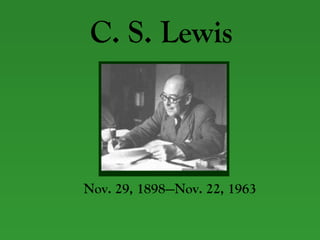
C. S. Lewis Nov. 29, 1898—Nov. 22, 1963 Ajdsgljas;jg
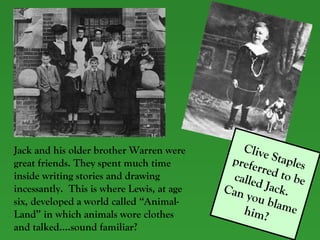
Clive Staples preferred to be called Jack.  Can you blame him? Jack and his older brother Warren were great friends. They spent much time inside writing stories and drawing incessantly.  This is where Lewis, at age six, developed a world called “Animal-Land” in which animals wore clothes and talked….sound familiar?
The New House is  almost a major  character in my  story. I am a  product of long  corridors, empty  sunlit rooms,  upstairs indoor  silences, attics  explored in  solitude…Also, of endless books…There were books in the study, books in the drawing room, books in the cloakroom, books (two deep) in the great bookcase on the landing, books in a bedroom, books piled as high as my shoulder in the cistern attic, books of all kinds… Surprised by Joy Little Leas in Belfast, Ireland
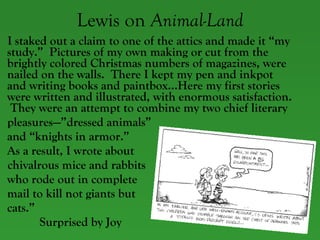
Lewis on  Animal-Land I staked out a claim to one of the attics and made it “my study.”  Pictures of my own making or cut from the brightly colored Christmas numbers of magazines, were nailed on the walls.  There I kept my pen and inkpot and writing books and paintbox…Here my first stories were written and illustrated, with enormous satisfaction.  They were an attempt to combine my two chief literary pleasures—”dressed animals” and “knights in armor.”  As a result, I wrote about  chivalrous mice and rabbits  who rode out in complete  mail to kill not giants but  cats.”    Surprised by Joy
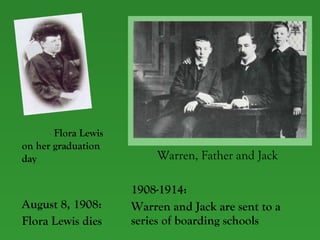
Warren, Father and Jack 1908-1914: Warren and Jack are sent to a series of boarding schools Flora Lewis on her graduation day August 8, 1908: Flora Lewis dies
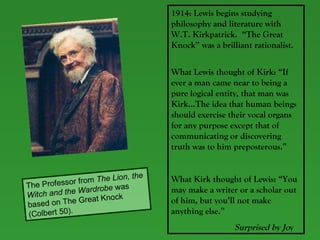
1914: Lewis begins studying philosophy and literature with W.T. Kirkpatrick.  “The Great Knock” was a brilliant rationalist.  What Lewis thought of Kirk: “If ever a man came near to being a pure logical entity, that man was Kirk…The idea that human beings should exercise their vocal organs for any purpose except that of communicating or discovering truth was to him preposterous.” What Kirk thought of Lewis: “You may make a writer or a scholar out of him, but you’ll not make anything else.”    Surprised by Jo y The Professor from  The Lion, the Witch and the Wardrobe  was based on The Great Knock (Colbert 50).
Growing Up April, 1917 Lewis attends University; His roommate is Paddy Moore Nov. 1917 Sent to France as part of the British Army  Feb. 1918 Lewis is hospitalized with trench fever March 1918 Paddy Moore reported missing April 1918  Lewis wounded by a British shell Sep. 1918 Paddy Moore officially declared killed  1924 Completes his studies at University 1925 Lewis accepts a position at Magdalen College, Oxford 1931 Warren becomes a Christian
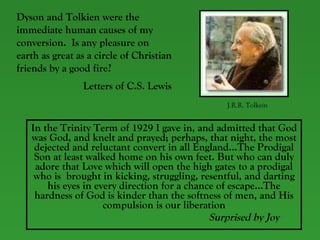
In the Trinity Term of 1929 I gave in, and admitted that God was God, and knelt and prayed; perhaps, that night, the most dejected and reluctant convert in all England…The Prodigal Son at least walked home on his own feet. But who can duly adore that Love which will open the high gates to a prodigal who is  brought in kicking, struggling, resentful, and darting his eyes in every direction for a chance of escape…The hardness of God is kinder than the softness of men, and His compulsion is our liberation Surprised by Joy Dsj;lkgj Dyson and Tolkien were the immediate human causes of my conversion.  Is any pleasure on earth as great as a circle of Christian friends by a good fire?    Letters of C.S. Lewis   J.R.R. Tolkein
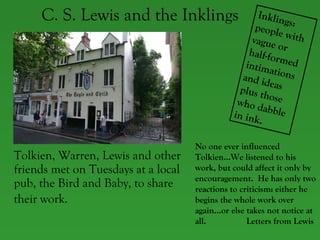
C. S. Lewis and the Inklings Tolkien, Warren, Lewis and other friends met on Tuesdays at a local pub, the Bird and Baby, to share their work.   Inklings: people with vague or half-formed intimations and ideas plus those who dabble in ink. No one ever influenced Tolkien…We listened to his work, but could affect it only by encouragement.  He has only two reactions to criticism: either he begins the whole work over again…or else takes not notice at all.  Letters from Lewis
Letter from Lewis  in 1931 Now what Dyson and Tolkien showed me was this: that if I met the idea of sacrifice in a Pagan story, I didn’t mind it at all: and if I met the idea of a God sacrificing himself to himself…I liked it very much and was mysteriously moved by it…Now the story of Christ is simply a true myth: a myth working on us in the same way as the others, but with this tremendous difference that it really happened: and one must be content to accept it in the same way, remembering that it is God’s myth where the others are men’s myths: i.e. the Pagan stories are God expressing Himself through the minds of poets using such images as He found there, while Christianity is God expressing Himself through what we call “real things”…At any rate, I am now certain (a) that this Christian story is to be approached, in a sense, as I approach other myths.  (b.) That it is the most important and full of meaning.  I am also nearly certain that it really happened.
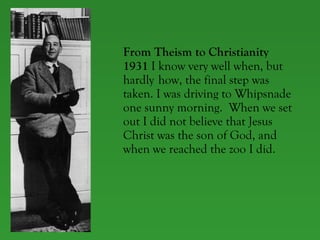
From Theism to Christianity 1931  I know very well when, but  hardly  how, the final step was  taken. I was driving to Whipsnade  one sunny morning.  When we set  out I did not believe that Jesus  Christ was the son of God, and  when we reached the zoo I did.
The England Lewis Wrote In Modernism : Truth is known  through reason and observations;  through the sciences, mankind  can improve the quality of life. Agnosticism : we cannot know if  God exists. Therefore, it doesn’t  matter if He does. (Freud, Darwin, Nietzsche, Marx) Virginia Wolf: I mean, there’s  something obscene in a living person sitting by the fire and believing in God. In England, the goal of many theologians was to make Christianity compatible with modernism. Christianity was scorned by intellectuals.
Relativism We know truth through  our experiences. Therefore, our truth is relative to our  experiences.  There is no absolute  truth; if there happens  to be absolute truth, nobody can know it because everybody has different experiences.  Rationalism A theory "in which the criterion of truth is not sensory but intellectual and deductive." (Bourke 263).  Reason is used to attain knowledge and to justify actions. Truth can be found through reason
Lewis becomes a Theologian and an Apologist Theology : The study of God Apologetics : defending or arguing for a belief “… a friend came into the room in a state of high excitement.  I say, said the newcomer, do you know what’s going on with Lewis?  So and so tells me he happened to see Lewis in the college chapel the other day, and, being amazed and making enquiries, discovered that he has been going there for weeks without anyone’s knowing anything about it. This brought out one of Eliot’s sly little sarcastic digs: It’s quite apparent that if anybody in an Oxford college wishes to escape detection, the one place  for him to go to is the chapel.”    From on of Lewis’  colleagues to another
In a speech to Welsh Clergymen, Lewis said: “ Christianity is a statement which, if false, is of no  importance, and, if true, of infinite importance.  The  one thing it cannot be is moderately important….the  truth we need most is hidden precisely in the  doctrines you least like and least understand.” He  goes on to give the example of the scientists.  They  make progress only because they look at perplexing  and troubling problems to understand them. Lewis’ Response to Modernism
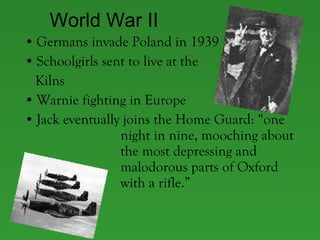
World War II Germans invade Poland in 1939  Schoolgirls sent to live at the  Kilns Warnie fighting in Europe Jack eventually joins the Home Guard: “one  night in nine, mooching about  the most depressing and  malodorous parts of Oxford  with a rifle.”
BBC and RAF Lewis becomes more and more known throughout Australia, New Zealand, and Britain as a great orator.  He gives a series  of speeches on the BBC and to the Royal  Air Force. He continues to publish many  works and preaches many sermons.  On his first talks to the RAF in 1941:  “ As far as I can judge, they were a complete failure…One must take comfort in remembering that God used an ass to  convert the prophet” He is asked to return to the RAF in 1942.  In response to the invitation, he writes: “I’m a little surprised…at the size of the audience you expect.  You mean a voluntary one, I trust?  I shouldn’t like to address an audience that has been …coerced. This means, of course, that I am prepared to risk getting no audience: which, indeed, has often happened to me.”
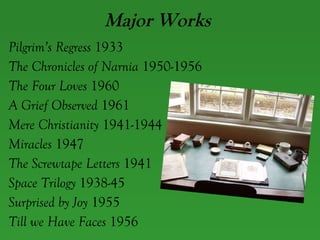
Major Works Pilgrim’s Regress  1933 The Chronicles of Narnia  1950-1956 The Four Loves  1960 A Grief Observed  1961 Mere Christianity  1941-1944 Miracles  1947 The Screwtape Letters  1941 Space Trilogy  1938-45 Surprised by Joy  1955 Till we Have Faces  1956
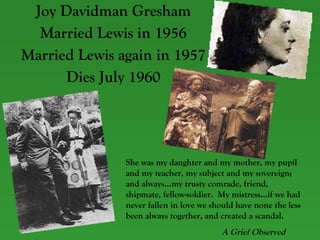
Joy Davidman Gresham Married Lewis in 1956 Married Lewis again in 1957 Dies July 1960 She was my daughter and my mother, my pupil and my teacher, my subject and my sovereign; and always…my trusty comrade, friend, shipmate, fellow-soldier.  My mistress…if we had never fallen in love we should have none the less been always together, and created a scandal.  A Grief Observed
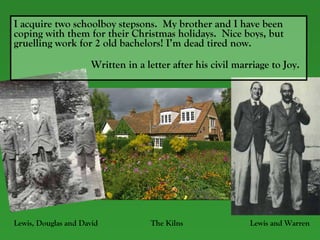
I acquire two schoolboy stepsons.  My brother and I have been coping with them for their Christmas holidays.  Nice boys, but gruelling work for 2 old bachelors! I’m dead tired now.    Written in a letter after his civil marriage to Joy. Lewis, Douglas and David  The Kilns  Lewis and Warren
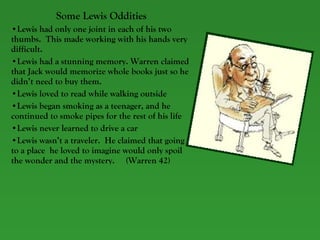
Some Lewis Oddities Lewis had only one joint in each of his two thumbs.  This made working with his hands very difficult. Lewis had a stunning memory. Warren claimed that Jack would memorize whole books just so he didn’t need to buy them. Lewis loved to read while walking outside Lewis began smoking as a teenager, and he continued to smoke pipes for the rest of his life Lewis never learned to drive a car Lewis wasn’t a traveler.  He claimed that going to a place  he loved to imagine would only spoil the wonder and the mystery.  (Warren 42)
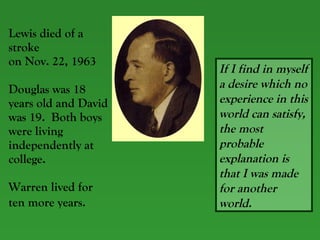
Lewis died of a stroke  on Nov. 22, 1963 Douglas was 18 years old and David was 19.  Both boys were living independently at college. Warren lived for ten more years.   If I find in myself a desire which no experience in this world can satisfy, the most probable explanation is that I was made for another world.
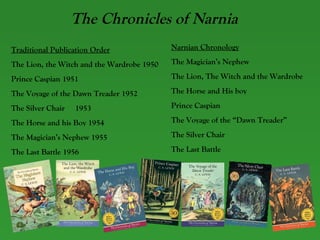
The Chronicles of Narnia   Traditional Publication Order The Lion, the Witch and the Wardrobe 1950 Prince Caspian 1951 The Voyage of the Dawn Treader 1952 The Silver Chair 1953 The Horse and his Boy 1954 The Magician’s Nephew 1955 The Last Battle 1956 Narnian Chronology The Magician’s Nephew The Lion, The Witch and the Wardrobe The Horse and His boy Prince Caspian The Voyage of the “Dawn Treader” The Silver Chair The Last Battle
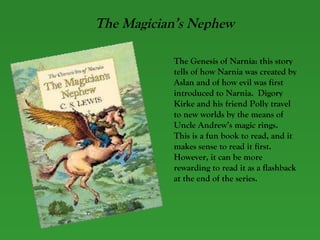
The Magician’s Nephew The Genesis of Narnia: this story tells of how Narnia was created by Aslan and of how evil was first introduced to Narnia.  Digory Kirke and his friend Polly travel to new worlds by the means of Uncle Andrew’s magic rings.  This is a fun book to read, and it makes sense to read it first.  However, it can be more rewarding to read it as a flashback at the end of the series.
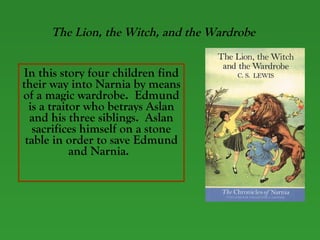
The Lion, the Witch, and the Wardrobe In this story four children find their way into Narnia by means of a magic wardrobe.  Edmund is a traitor who betrays Aslan and his three siblings.  Aslan sacrifices himself on a stone table in order to save Edmund and Narnia.
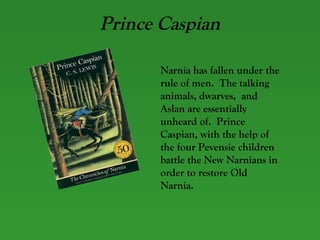
Prince Caspian Narnia has fallen under the rule of men.  The talking animals, dwarves,  and Aslan are essentially unheard of.  Prince Caspian, with the help of the four Pevensie children battle the New Narnians in order to restore Old Narnia.
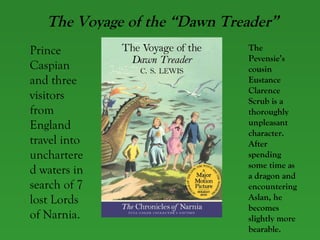
The Voyage of the “Dawn Treader” Prince Caspian and three visitors from England travel into unchartered waters in search of 7 lost Lords of Narnia.  The Pevensie’s cousin Eustance Clarence Scrub is a thoroughly unpleasant character. After spending some time as a dragon and encountering Aslan, he becomes slightly more bearable.
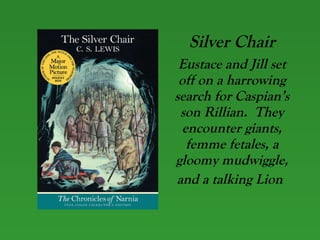
Silver Chair Eustace and Jill set off on a harrowing search for Caspian’s son Rillian.  They encounter giants, femme fetales, a gloomy mudwiggle, and a talking Lion
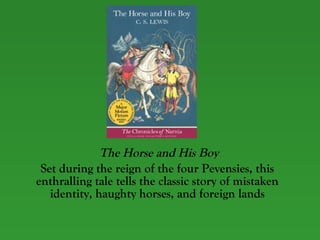
The Horse and His Boy Set during the reign of the four Pevensies, this enthralling tale tells the classic story of mistaken identity, haughty horses, and foreign lands
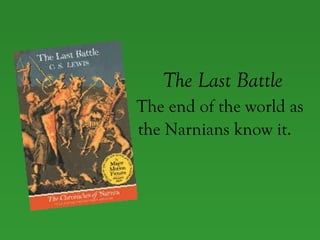
The Last Battle The end of the world as the Narnians know it.
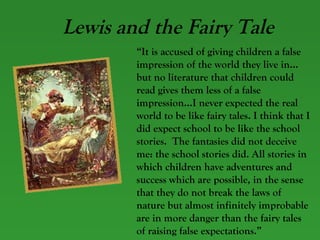
Lewis and the Fairy Tale “ It is accused of giving children a false impression of the world they live in…but no literature that children could read gives them less of a false impression…I never expected the real world to be like fairy tales. I think that I did expect school to be like the school stories.  The fantasies did not deceive me: the school stories did. All stories in which children have adventures and success which are possible, in the sense that they do not break the laws of nature but almost infinitely improbable are in more danger than the fairy tales of raising false expectations.”
“ We long to go through the looking glass to reach fairy land.  We also long to be the immensely popular schoolboy or schoolgirl, or the lucky boy or girl who discovers the spy’s plot or rides the horse that none of the cowboys can manage. But the two longings are very different… we run to it (the school story) from the disappointments and humiliations of the real world: it sends us back to the real world undivinely discontented…the pleasure consists of picturing oneself the object of admiration… The other longing, that for fairy land, is very different.  In a sense a child does not long for fairy land…does anyone suppose he really…longs for the dangers and discomforts of the fairy tale?—really wants dragons in contemporary England?  It is not so..”
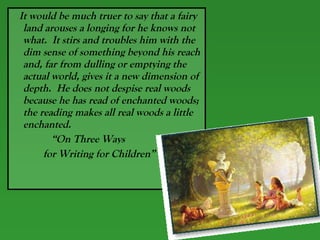
It would be much truer to say that a fairy land arouses a longing for he knows not what.  It stirs and troubles him with the dim sense of something beyond his reach and, far from dulling or emptying the actual world, gives it a new dimension of depth.  He does not despise real woods because he has read of enchanted woods; the reading makes all real woods a little enchanted. “ On Three Ways for Writing for Children”
Works Cited Arthur, Sarah.  Walking Through the Wardrobe . Illinois: Tyndale House. 2004. Colbert, David.  The Magical Worlds of Narnia .  New York: Berkley Books.  2005. Hooper, Walter.  C.S. Lewis: Companion and Guide .  New York: HarperCollins. 1996. Lewis, C.S.  Surprised by Joy .  USA: PTE Limited.  1955  Wagner, Richard.  C.S. Lewis & Narnia for Dummies.   Indianapolis: Wiley. 2005.

C.s.lewis

  • 1.
    C. S. LewisNov. 29, 1898—Nov. 22, 1963 Ajdsgljas;jg
  • 2.
    Clive Staples preferredto be called Jack. Can you blame him? Jack and his older brother Warren were great friends. They spent much time inside writing stories and drawing incessantly. This is where Lewis, at age six, developed a world called “Animal-Land” in which animals wore clothes and talked….sound familiar?
  • 3.
    The New Houseis almost a major character in my story. I am a product of long corridors, empty sunlit rooms, upstairs indoor silences, attics explored in solitude…Also, of endless books…There were books in the study, books in the drawing room, books in the cloakroom, books (two deep) in the great bookcase on the landing, books in a bedroom, books piled as high as my shoulder in the cistern attic, books of all kinds… Surprised by Joy Little Leas in Belfast, Ireland
  • 4.
    Lewis on Animal-Land I staked out a claim to one of the attics and made it “my study.” Pictures of my own making or cut from the brightly colored Christmas numbers of magazines, were nailed on the walls. There I kept my pen and inkpot and writing books and paintbox…Here my first stories were written and illustrated, with enormous satisfaction. They were an attempt to combine my two chief literary pleasures—”dressed animals” and “knights in armor.” As a result, I wrote about chivalrous mice and rabbits who rode out in complete mail to kill not giants but cats.” Surprised by Joy
  • 5.
    Warren, Father andJack 1908-1914: Warren and Jack are sent to a series of boarding schools Flora Lewis on her graduation day August 8, 1908: Flora Lewis dies
  • 6.
    1914: Lewis beginsstudying philosophy and literature with W.T. Kirkpatrick. “The Great Knock” was a brilliant rationalist. What Lewis thought of Kirk: “If ever a man came near to being a pure logical entity, that man was Kirk…The idea that human beings should exercise their vocal organs for any purpose except that of communicating or discovering truth was to him preposterous.” What Kirk thought of Lewis: “You may make a writer or a scholar out of him, but you’ll not make anything else.” Surprised by Jo y The Professor from The Lion, the Witch and the Wardrobe was based on The Great Knock (Colbert 50).
  • 7.
    Growing Up April,1917 Lewis attends University; His roommate is Paddy Moore Nov. 1917 Sent to France as part of the British Army Feb. 1918 Lewis is hospitalized with trench fever March 1918 Paddy Moore reported missing April 1918 Lewis wounded by a British shell Sep. 1918 Paddy Moore officially declared killed 1924 Completes his studies at University 1925 Lewis accepts a position at Magdalen College, Oxford 1931 Warren becomes a Christian
  • 8.
    In the TrinityTerm of 1929 I gave in, and admitted that God was God, and knelt and prayed; perhaps, that night, the most dejected and reluctant convert in all England…The Prodigal Son at least walked home on his own feet. But who can duly adore that Love which will open the high gates to a prodigal who is brought in kicking, struggling, resentful, and darting his eyes in every direction for a chance of escape…The hardness of God is kinder than the softness of men, and His compulsion is our liberation Surprised by Joy Dsj;lkgj Dyson and Tolkien were the immediate human causes of my conversion. Is any pleasure on earth as great as a circle of Christian friends by a good fire? Letters of C.S. Lewis J.R.R. Tolkein
  • 9.
    C. S. Lewisand the Inklings Tolkien, Warren, Lewis and other friends met on Tuesdays at a local pub, the Bird and Baby, to share their work. Inklings: people with vague or half-formed intimations and ideas plus those who dabble in ink. No one ever influenced Tolkien…We listened to his work, but could affect it only by encouragement. He has only two reactions to criticism: either he begins the whole work over again…or else takes not notice at all. Letters from Lewis
  • 10.
    Letter from Lewis in 1931 Now what Dyson and Tolkien showed me was this: that if I met the idea of sacrifice in a Pagan story, I didn’t mind it at all: and if I met the idea of a God sacrificing himself to himself…I liked it very much and was mysteriously moved by it…Now the story of Christ is simply a true myth: a myth working on us in the same way as the others, but with this tremendous difference that it really happened: and one must be content to accept it in the same way, remembering that it is God’s myth where the others are men’s myths: i.e. the Pagan stories are God expressing Himself through the minds of poets using such images as He found there, while Christianity is God expressing Himself through what we call “real things”…At any rate, I am now certain (a) that this Christian story is to be approached, in a sense, as I approach other myths. (b.) That it is the most important and full of meaning. I am also nearly certain that it really happened.
  • 11.
    From Theism toChristianity 1931 I know very well when, but hardly how, the final step was taken. I was driving to Whipsnade one sunny morning. When we set out I did not believe that Jesus Christ was the son of God, and when we reached the zoo I did.
  • 12.
    The England LewisWrote In Modernism : Truth is known through reason and observations; through the sciences, mankind can improve the quality of life. Agnosticism : we cannot know if God exists. Therefore, it doesn’t matter if He does. (Freud, Darwin, Nietzsche, Marx) Virginia Wolf: I mean, there’s something obscene in a living person sitting by the fire and believing in God. In England, the goal of many theologians was to make Christianity compatible with modernism. Christianity was scorned by intellectuals.
  • 13.
    Relativism We knowtruth through our experiences. Therefore, our truth is relative to our experiences. There is no absolute truth; if there happens to be absolute truth, nobody can know it because everybody has different experiences. Rationalism A theory "in which the criterion of truth is not sensory but intellectual and deductive." (Bourke 263). Reason is used to attain knowledge and to justify actions. Truth can be found through reason
  • 14.
    Lewis becomes aTheologian and an Apologist Theology : The study of God Apologetics : defending or arguing for a belief “… a friend came into the room in a state of high excitement. I say, said the newcomer, do you know what’s going on with Lewis? So and so tells me he happened to see Lewis in the college chapel the other day, and, being amazed and making enquiries, discovered that he has been going there for weeks without anyone’s knowing anything about it. This brought out one of Eliot’s sly little sarcastic digs: It’s quite apparent that if anybody in an Oxford college wishes to escape detection, the one place for him to go to is the chapel.” From on of Lewis’ colleagues to another
  • 15.
    In a speechto Welsh Clergymen, Lewis said: “ Christianity is a statement which, if false, is of no importance, and, if true, of infinite importance. The one thing it cannot be is moderately important….the truth we need most is hidden precisely in the doctrines you least like and least understand.” He goes on to give the example of the scientists. They make progress only because they look at perplexing and troubling problems to understand them. Lewis’ Response to Modernism
  • 16.
    World War IIGermans invade Poland in 1939 Schoolgirls sent to live at the Kilns Warnie fighting in Europe Jack eventually joins the Home Guard: “one night in nine, mooching about the most depressing and malodorous parts of Oxford with a rifle.”
  • 17.
    BBC and RAFLewis becomes more and more known throughout Australia, New Zealand, and Britain as a great orator. He gives a series of speeches on the BBC and to the Royal Air Force. He continues to publish many works and preaches many sermons. On his first talks to the RAF in 1941: “ As far as I can judge, they were a complete failure…One must take comfort in remembering that God used an ass to convert the prophet” He is asked to return to the RAF in 1942. In response to the invitation, he writes: “I’m a little surprised…at the size of the audience you expect. You mean a voluntary one, I trust? I shouldn’t like to address an audience that has been …coerced. This means, of course, that I am prepared to risk getting no audience: which, indeed, has often happened to me.”
  • 18.
    Major Works Pilgrim’sRegress 1933 The Chronicles of Narnia 1950-1956 The Four Loves 1960 A Grief Observed 1961 Mere Christianity 1941-1944 Miracles 1947 The Screwtape Letters 1941 Space Trilogy 1938-45 Surprised by Joy 1955 Till we Have Faces 1956
  • 19.
    Joy Davidman GreshamMarried Lewis in 1956 Married Lewis again in 1957 Dies July 1960 She was my daughter and my mother, my pupil and my teacher, my subject and my sovereign; and always…my trusty comrade, friend, shipmate, fellow-soldier. My mistress…if we had never fallen in love we should have none the less been always together, and created a scandal. A Grief Observed
  • 20.
    I acquire twoschoolboy stepsons. My brother and I have been coping with them for their Christmas holidays. Nice boys, but gruelling work for 2 old bachelors! I’m dead tired now. Written in a letter after his civil marriage to Joy. Lewis, Douglas and David The Kilns Lewis and Warren
  • 21.
    Some Lewis OdditiesLewis had only one joint in each of his two thumbs. This made working with his hands very difficult. Lewis had a stunning memory. Warren claimed that Jack would memorize whole books just so he didn’t need to buy them. Lewis loved to read while walking outside Lewis began smoking as a teenager, and he continued to smoke pipes for the rest of his life Lewis never learned to drive a car Lewis wasn’t a traveler. He claimed that going to a place he loved to imagine would only spoil the wonder and the mystery. (Warren 42)
  • 22.
    Lewis died ofa stroke on Nov. 22, 1963 Douglas was 18 years old and David was 19. Both boys were living independently at college. Warren lived for ten more years. If I find in myself a desire which no experience in this world can satisfy, the most probable explanation is that I was made for another world.
  • 23.
    The Chronicles ofNarnia Traditional Publication Order The Lion, the Witch and the Wardrobe 1950 Prince Caspian 1951 The Voyage of the Dawn Treader 1952 The Silver Chair 1953 The Horse and his Boy 1954 The Magician’s Nephew 1955 The Last Battle 1956 Narnian Chronology The Magician’s Nephew The Lion, The Witch and the Wardrobe The Horse and His boy Prince Caspian The Voyage of the “Dawn Treader” The Silver Chair The Last Battle
  • 24.
    The Magician’s NephewThe Genesis of Narnia: this story tells of how Narnia was created by Aslan and of how evil was first introduced to Narnia. Digory Kirke and his friend Polly travel to new worlds by the means of Uncle Andrew’s magic rings. This is a fun book to read, and it makes sense to read it first. However, it can be more rewarding to read it as a flashback at the end of the series.
  • 25.
    The Lion, theWitch, and the Wardrobe In this story four children find their way into Narnia by means of a magic wardrobe. Edmund is a traitor who betrays Aslan and his three siblings. Aslan sacrifices himself on a stone table in order to save Edmund and Narnia.
  • 26.
    Prince Caspian Narniahas fallen under the rule of men. The talking animals, dwarves, and Aslan are essentially unheard of. Prince Caspian, with the help of the four Pevensie children battle the New Narnians in order to restore Old Narnia.
  • 27.
    The Voyage ofthe “Dawn Treader” Prince Caspian and three visitors from England travel into unchartered waters in search of 7 lost Lords of Narnia. The Pevensie’s cousin Eustance Clarence Scrub is a thoroughly unpleasant character. After spending some time as a dragon and encountering Aslan, he becomes slightly more bearable.
  • 28.
    Silver Chair Eustaceand Jill set off on a harrowing search for Caspian’s son Rillian. They encounter giants, femme fetales, a gloomy mudwiggle, and a talking Lion
  • 29.
    The Horse andHis Boy Set during the reign of the four Pevensies, this enthralling tale tells the classic story of mistaken identity, haughty horses, and foreign lands
  • 30.
    The Last BattleThe end of the world as the Narnians know it.
  • 31.
    Lewis and theFairy Tale “ It is accused of giving children a false impression of the world they live in…but no literature that children could read gives them less of a false impression…I never expected the real world to be like fairy tales. I think that I did expect school to be like the school stories. The fantasies did not deceive me: the school stories did. All stories in which children have adventures and success which are possible, in the sense that they do not break the laws of nature but almost infinitely improbable are in more danger than the fairy tales of raising false expectations.”
  • 32.
    “ We longto go through the looking glass to reach fairy land. We also long to be the immensely popular schoolboy or schoolgirl, or the lucky boy or girl who discovers the spy’s plot or rides the horse that none of the cowboys can manage. But the two longings are very different… we run to it (the school story) from the disappointments and humiliations of the real world: it sends us back to the real world undivinely discontented…the pleasure consists of picturing oneself the object of admiration… The other longing, that for fairy land, is very different. In a sense a child does not long for fairy land…does anyone suppose he really…longs for the dangers and discomforts of the fairy tale?—really wants dragons in contemporary England? It is not so..”
  • 33.
    It would bemuch truer to say that a fairy land arouses a longing for he knows not what. It stirs and troubles him with the dim sense of something beyond his reach and, far from dulling or emptying the actual world, gives it a new dimension of depth. He does not despise real woods because he has read of enchanted woods; the reading makes all real woods a little enchanted. “ On Three Ways for Writing for Children”
  • 34.
    Works Cited Arthur,Sarah. Walking Through the Wardrobe . Illinois: Tyndale House. 2004. Colbert, David. The Magical Worlds of Narnia . New York: Berkley Books. 2005. Hooper, Walter. C.S. Lewis: Companion and Guide . New York: HarperCollins. 1996. Lewis, C.S. Surprised by Joy . USA: PTE Limited. 1955 Wagner, Richard. C.S. Lewis & Narnia for Dummies. Indianapolis: Wiley. 2005.