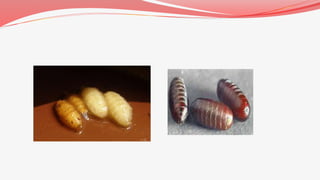
What is pupa ???
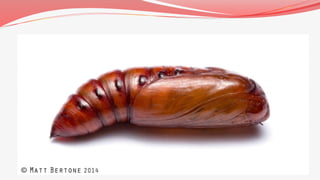
Pupa is a non feeding and inactive Stage of insect
between the larva and adult with complete metamorphosis
Pupa, name for the third stage in the life of insects that
undergoes Complete metamorphosis, i.e., develops from
the egg through the larva and the pupa stages to the
adult.
Position in life cycle
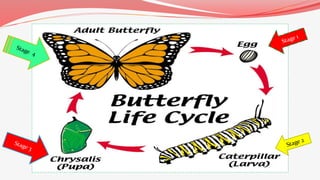
 The pupal stage follows the larval stage and precedes
adulthood (imago) in insects with complete metamorphosis.
 The pupa is a non-feeding,usually sessile(motionless) stage.
 It is during pupation that the adult structures of the insect are
formed while the larval structures are broken down.
 The adult structures grow from imaginal discs.
Emergence
 Insects emerge (eclose) from pupae by splitting the pupal
case.
 Most butterflies emerge in the morning.
 In mosquitoes the emergence is in the evening or night.
 Prior to emergence, the adult inside the pupal exoskeleton
is termed pharate.
 Once the pharate adult has eclosed from the pupa, the
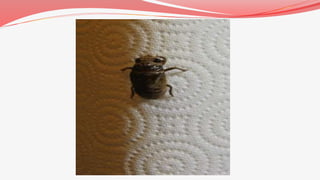
empty pupal exoskeleton is called an exuvia.
 In most hymenopterans (ants, bees and wasps) them exuvia
is so thin and membranous that it becomes "crumpled" as it
is shed.
Duration
 Pupation may last weeks, months or even years.
This depends on temperature and the species of insect.
 For example, pupation lasts eight to fifteen days in
monarch butterflies.
The pupa may enter dormancy until the appropriate
season to emerge as an adult insect.
Types
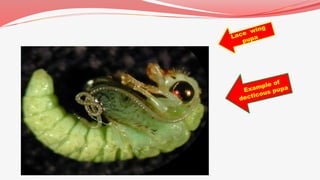
 Decticous Pupa:
 In this type of pupa, more or less fully formed adult,
within the pupal case has relatively powerful sclerotized
mandibles by means of which it comes out from the pupa.
 This type of pupa is always execrated (free) type
 e.g. Lace wing, Scorpion flies
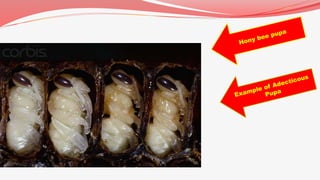
2. Adecticous Pupa:
 In this type of pupa, the adult developed within pupal
case
 Often possess reduced and non articulating mandibles
 which are not utilized for escaping from the pupal case.
 Example : Honey bee
Two main types of adecticous
pupae
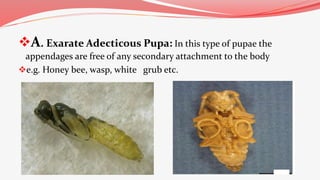
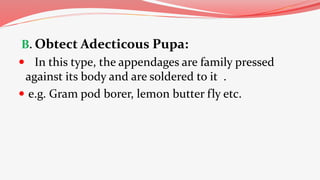
A. Exarate Adecticous Pupa: In this type of pupae the
appendages are free of any secondary attachment to the body
e.g. Honey bee, wasp, white grub etc.
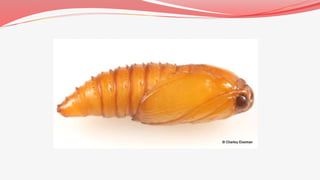
B. Obtect Adecticous Pupa:
 In this type, the appendages are family pressed
against its body and are soldered to it .
 e.g. Gram pod borer, lemon butter fly etc.
3: Coarctate Pupa: In this type, the appendages are
not visible. The pupa is enclosed in a puparium, formed
from the last larval skin.
 This is clearly adecticous exarate pupa
 e.g. House fly, fruit fly etc.
what is pupa.?
what is pupa.?

what is pupa.?

  • 3.
    What is pupa??? Pupa is a non feeding and inactive Stage of insect between the larva and adult with complete metamorphosis Pupa, name for the third stage in the life of insects that undergoes Complete metamorphosis, i.e., develops from the egg through the larva and the pupa stages to the adult.
  • 5.
    Position in lifecycle  The pupal stage follows the larval stage and precedes adulthood (imago) in insects with complete metamorphosis.  The pupa is a non-feeding,usually sessile(motionless) stage.  It is during pupation that the adult structures of the insect are formed while the larval structures are broken down.  The adult structures grow from imaginal discs.
  • 7.
    Emergence  Insects emerge(eclose) from pupae by splitting the pupal case.  Most butterflies emerge in the morning.  In mosquitoes the emergence is in the evening or night.  Prior to emergence, the adult inside the pupal exoskeleton is termed pharate.
  • 8.
     Once thepharate adult has eclosed from the pupa, the empty pupal exoskeleton is called an exuvia.  In most hymenopterans (ants, bees and wasps) them exuvia is so thin and membranous that it becomes "crumpled" as it is shed.
  • 10.
    Duration  Pupation maylast weeks, months or even years. This depends on temperature and the species of insect.  For example, pupation lasts eight to fifteen days in monarch butterflies. The pupa may enter dormancy until the appropriate season to emerge as an adult insect.
  • 11.
    Types  Decticous Pupa: In this type of pupa, more or less fully formed adult, within the pupal case has relatively powerful sclerotized mandibles by means of which it comes out from the pupa.  This type of pupa is always execrated (free) type  e.g. Lace wing, Scorpion flies
  • 13.
    2. Adecticous Pupa: In this type of pupa, the adult developed within pupal case  Often possess reduced and non articulating mandibles  which are not utilized for escaping from the pupal case.  Example : Honey bee
  • 15.
    Two main typesof adecticous pupae
  • 16.
    A. Exarate AdecticousPupa: In this type of pupae the appendages are free of any secondary attachment to the body e.g. Honey bee, wasp, white grub etc.
  • 17.
    B. Obtect AdecticousPupa:  In this type, the appendages are family pressed against its body and are soldered to it .  e.g. Gram pod borer, lemon butter fly etc.
  • 19.
    3: Coarctate Pupa:In this type, the appendages are not visible. The pupa is enclosed in a puparium, formed from the last larval skin.  This is clearly adecticous exarate pupa  e.g. House fly, fruit fly etc.