FEVER of UNKNOWN ORIGIN(FUO)
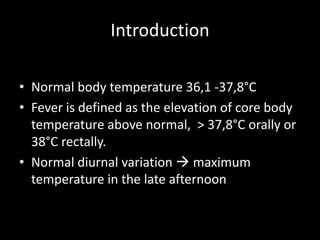
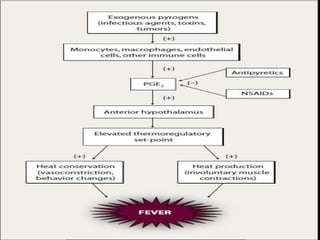
IntroductionNormal body temperature 36,1 -37,8°C Fever is defined as the elevation of core body temperature above normal,  > 37,8°C orally or 38°C rectally.Normal diurnal variation  maximum temperature in the late afternoon
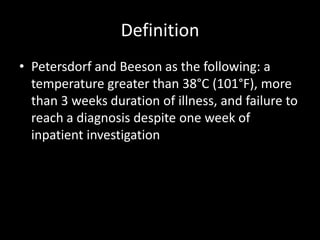
DefinitionPetersdorf and Beeson as the following: a temperature greater than 38°C (101°F), more than 3 weeks duration of illness, and failure to reach a diagnosis despite one week of inpatient investigation
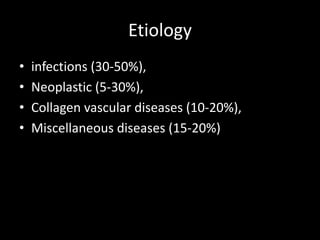
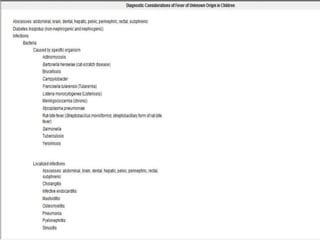
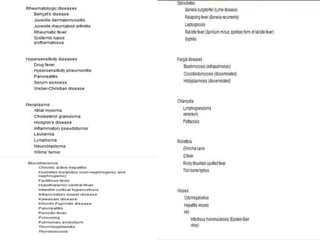
Etiologyinfections (30-50%), Neoplastic (5-30%), Collagen vascular diseases (10-20%), Miscellaneous diseases (15-20%)
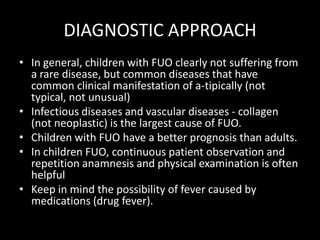
DIAGNOSTIC APPROACHIn general, children with FUO clearly not suffering from a rare disease, but common diseases that have common clinical manifestation of a-tipically (not typical, not unusual)Infectious diseases and vascular diseases - collagen (not neoplastic) is the largest cause of FUO.Children with FUO have a better prognosis than adults.In children FUO, continuous patient observation and repetition anamnesis and physical examination is often helpfulKeep in mind the possibility of fever caused by medications (drug fever).
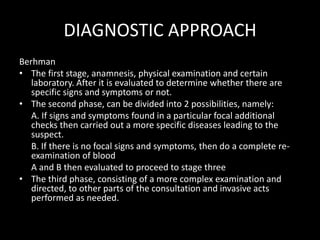
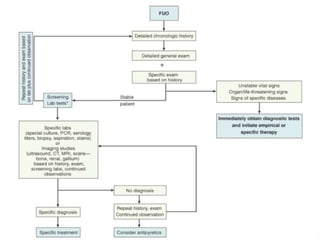
DIAGNOSTIC APPROACHBerhmanThe first stage, anamnesis, physical examination and certain laboratory. After it is evaluated to determine whether there are specific signs and symptoms or not.The second phase, can be divided into 2 possibilities, namely:	A. If signs and symptoms found in a particular focal additional checks then carried out a more specific diseases leading to the suspect.	B. If there is no focal signs and symptoms, then do a complete re-examination of blood	A and B then evaluated to proceed to stage threeThe third phase, consisting of a more complex examination and directed, to other parts of the consultation and invasive acts performed as needed.
HistoryAgeSymptoms & Fever TypeEpydemiology History :A history of exposure to wild or domestic animals . A history of travelMedication historyThe genetic background
PHYSICAL EXAMINATIONDefinitive documentation of fever.Measure the fever more than once to exclude manipulation of thermometers.Repeat a regular physical examination daily while the patient is hospitalized. Pay special attention to rashes, cardiac murmurs, signs of arthritis, abdominal tenderness or rigidity, lymph node enlargement, funduscopic changes, and neurologic deficits.
LABORATORYComplete blood cell count with a differential WBC, urinalysis, Erythrocyte sedimentation rate (ESR), C-reactive proteinRadiographic examinationExamination of the bone marrowRadionuclide scansTotal body CT or MRIBiopsy
TreatmentAntimicrobial agents should not be used as antipyretics.Empirical trials of medication should generally be avoided. An exception may be the use of antituberculous treatment in critically ill children with suspected disseminated tuberculosis. Empirical trials of other antimicrobial agents may be dangerous and can obscure the diagnosis of infective endocarditis, meningitis, parameningeal infection, or osteomyelitis. After a complete evaluation, antipyretics may be indicated to control fever and for symptomatic relief .
PROGNOSISChildren with FUO have a better prognosis than do adults.The outcome in a child is dependent on the primary disease process, which is usually an atypical presentation of a common childhood illness. In many cases, no diagnosis can be established and fever abates spontaneously. In as many as 25% of cases in which fever persists, the cause of the fever remains unclear, even after thorough evaluation.
THANK YOU FOR YOUR ATTENTION

Fever of unknown origin

  • 1.
    FEVER of UNKNOWNORIGIN(FUO)
  • 2.
    IntroductionNormal body temperature36,1 -37,8°C Fever is defined as the elevation of core body temperature above normal, > 37,8°C orally or 38°C rectally.Normal diurnal variation  maximum temperature in the late afternoon
  • 4.
    DefinitionPetersdorf and Beesonas the following: a temperature greater than 38°C (101°F), more than 3 weeks duration of illness, and failure to reach a diagnosis despite one week of inpatient investigation
  • 5.
    Etiologyinfections (30-50%), Neoplastic(5-30%), Collagen vascular diseases (10-20%), Miscellaneous diseases (15-20%)
  • 8.
    DIAGNOSTIC APPROACHIn general,children with FUO clearly not suffering from a rare disease, but common diseases that have common clinical manifestation of a-tipically (not typical, not unusual)Infectious diseases and vascular diseases - collagen (not neoplastic) is the largest cause of FUO.Children with FUO have a better prognosis than adults.In children FUO, continuous patient observation and repetition anamnesis and physical examination is often helpfulKeep in mind the possibility of fever caused by medications (drug fever).
  • 9.
    DIAGNOSTIC APPROACHBerhmanThe firststage, anamnesis, physical examination and certain laboratory. After it is evaluated to determine whether there are specific signs and symptoms or not.The second phase, can be divided into 2 possibilities, namely: A. If signs and symptoms found in a particular focal additional checks then carried out a more specific diseases leading to the suspect. B. If there is no focal signs and symptoms, then do a complete re-examination of blood A and B then evaluated to proceed to stage threeThe third phase, consisting of a more complex examination and directed, to other parts of the consultation and invasive acts performed as needed.
  • 11.
    HistoryAgeSymptoms & FeverTypeEpydemiology History :A history of exposure to wild or domestic animals . A history of travelMedication historyThe genetic background
  • 12.
    PHYSICAL EXAMINATIONDefinitive documentationof fever.Measure the fever more than once to exclude manipulation of thermometers.Repeat a regular physical examination daily while the patient is hospitalized. Pay special attention to rashes, cardiac murmurs, signs of arthritis, abdominal tenderness or rigidity, lymph node enlargement, funduscopic changes, and neurologic deficits.
  • 13.
    LABORATORYComplete blood cellcount with a differential WBC, urinalysis, Erythrocyte sedimentation rate (ESR), C-reactive proteinRadiographic examinationExamination of the bone marrowRadionuclide scansTotal body CT or MRIBiopsy
  • 14.
    TreatmentAntimicrobial agents shouldnot be used as antipyretics.Empirical trials of medication should generally be avoided. An exception may be the use of antituberculous treatment in critically ill children with suspected disseminated tuberculosis. Empirical trials of other antimicrobial agents may be dangerous and can obscure the diagnosis of infective endocarditis, meningitis, parameningeal infection, or osteomyelitis. After a complete evaluation, antipyretics may be indicated to control fever and for symptomatic relief .
  • 15.
    PROGNOSISChildren with FUOhave a better prognosis than do adults.The outcome in a child is dependent on the primary disease process, which is usually an atypical presentation of a common childhood illness. In many cases, no diagnosis can be established and fever abates spontaneously. In as many as 25% of cases in which fever persists, the cause of the fever remains unclear, even after thorough evaluation.
  • 16.
    THANK YOU FORYOUR ATTENTION