PUNCTUATION
Sir. Amanullah Sherzai
ihsasaman0@gmail.com
0093780036935
WHAT IS PUNCTUATION?
• Punctuation is the act or process of placing either
principle symbols or supplementary symbols in
different writing segments.
• the marks, such as full stop, comma, and brackets,
used in writing to separate sentences and their
elements and to clarify meaning.
THE IMPORTANCE OF PUNCTUATION
• The biggest and significant importance of punctuation is that it
prevents Mis-communication or Mis-understanding.
• primarily helps to indicate the pauses and
the emphasis on certain ideas or thoughts that are discussed in
the text.
SYMBOLS OF PUNCTUATION
•Principle symbols of punctuation
•Supplementary symbols of punctuation
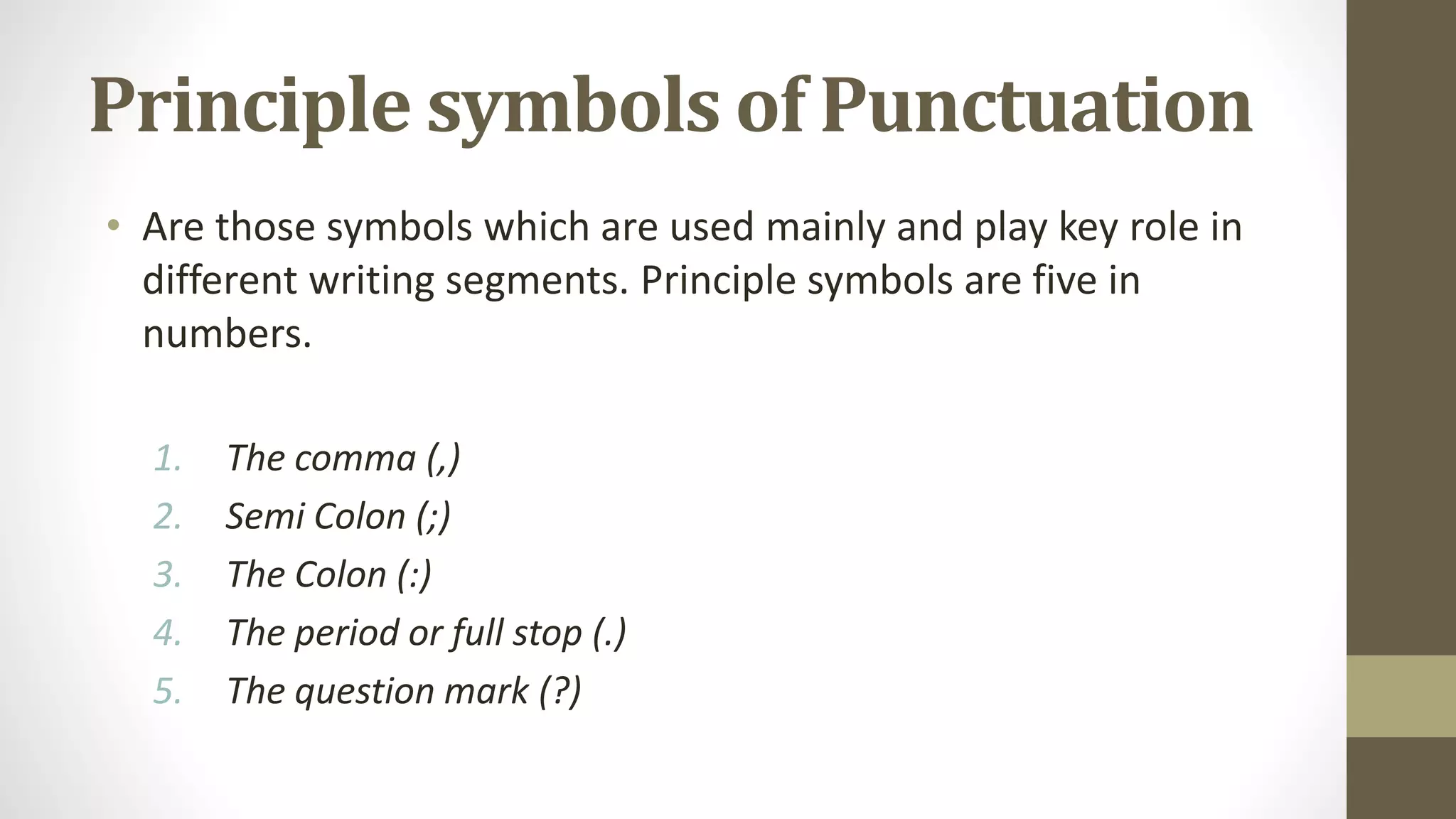
Principle symbols of Punctuation
• Are those symbols which are used mainly and play key role in
different writing segments. Principle symbols are five in
numbers.
1. The comma (,)
2. Semi Colon (;)
3. The Colon (:)
4. The period or full stop (.)
5. The question mark (?)
Supplementarysymbolsof punctuations
• Are those symbols which have supplementary functions in
different writing segments. Supplementary symbols are
listed here.
1. The exclamation point (!)
2. The parentheses ( )
3. The Quotation mark (“”)
4. The dash (----)
5. The apostrophe (‘)
6. Hyphen (-)
7. Slash (/)
Principle Symbols
PS
• COMMA: Comma is one of the principle symbols
of punctuation used mainly for the sake of
separation and creating pause in writing.
Where to use comma?
• Comma is used in the following cases:
1. To set off noun direct address.
• Exp: My dear Madam, It is importantly stated that……..
N Direct Address
My dear brother, I would like to call your attention.
N Direct address
Dear Sir, would please tell us about the ceremony?
N Direct address
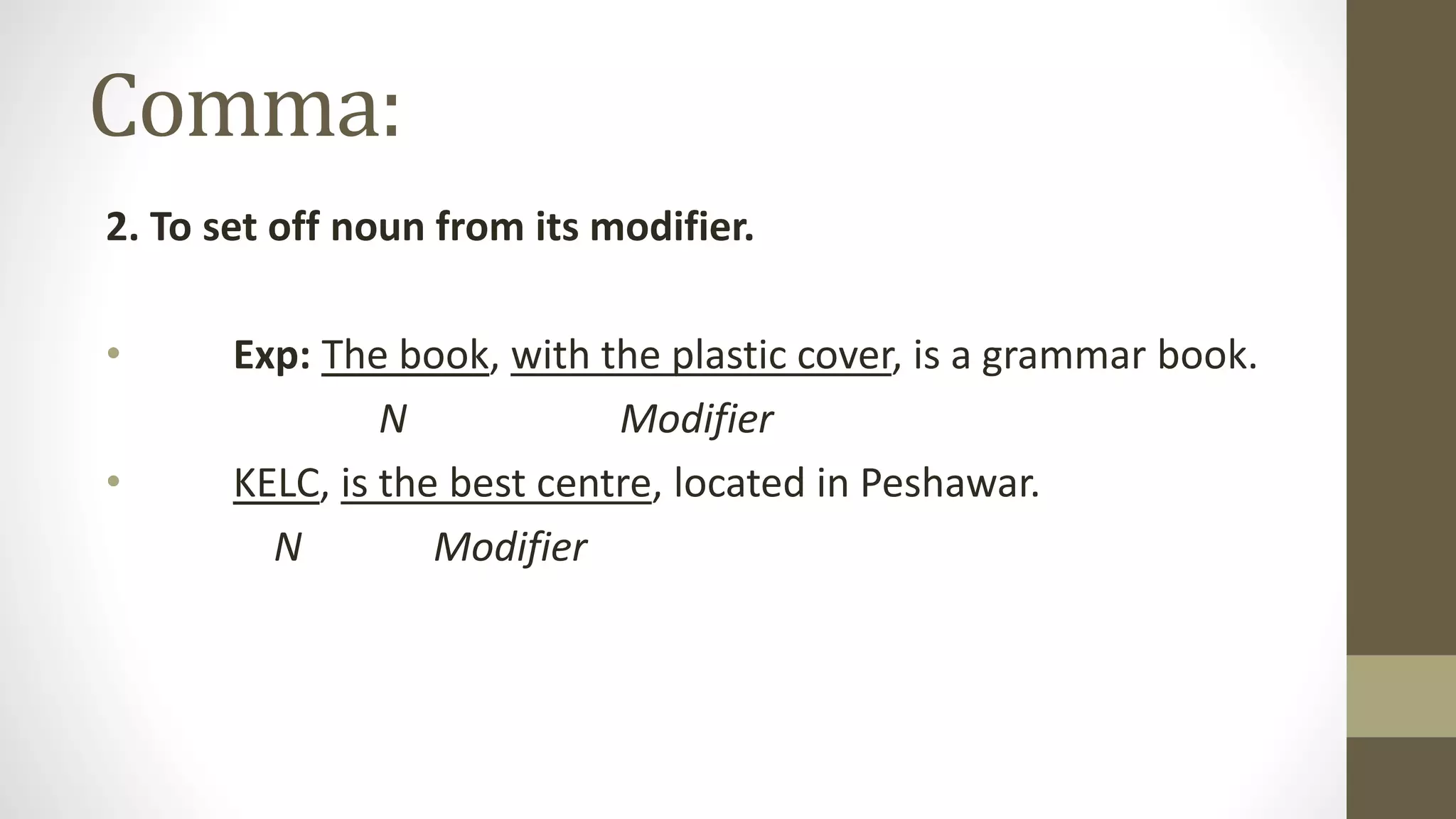
Comma:
2. To set off noun from its modifier.
• Exp: The book, with the plastic cover, is a grammar book.
N Modifier
• KELC, is the best centre, located in Peshawar.
N Modifier
Comma:
3. Comma is also used with two clauses connected with linkers or
transitions.
Exp: He worked very hard. Therefore, he earned much money.
Clause Transition Clause
4. Comma is also used to overcome confusion in different writing segments.
Examples:
Ali, go to school.
He who is, is nobody business.
He plays, playing makes him tired.
Comma:
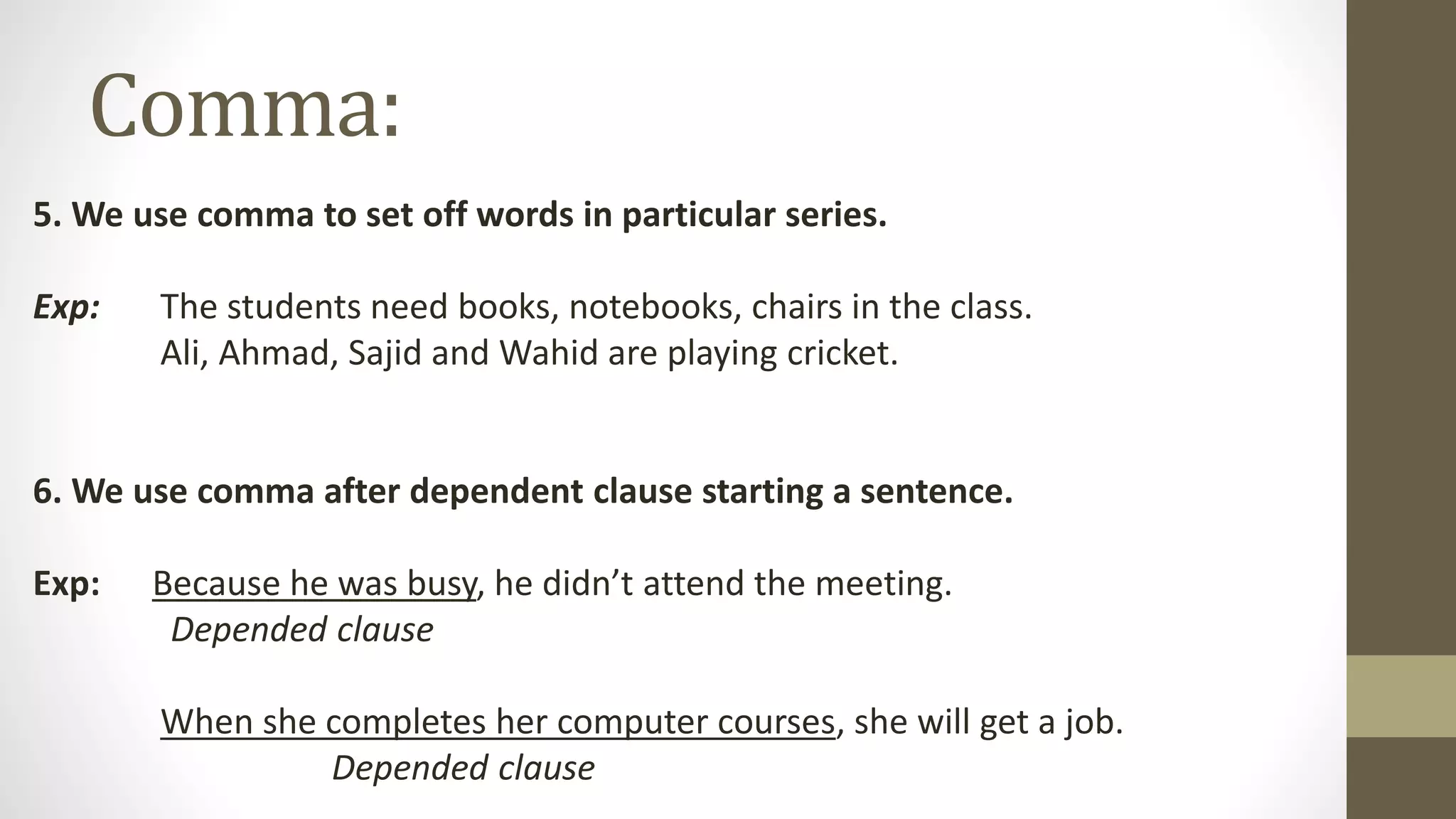
5. We use comma to set off words in particular series.
Exp: The students need books, notebooks, chairs in the class.
Ali, Ahmad, Sajid and Wahid are playing cricket.
6. We use comma after dependent clause starting a sentence.
Exp: Because he was busy, he didn’t attend the meeting.
Depended clause
When she completes her computer courses, she will get a job.
Depended clause
Comma:
7. We usually use comma before coordinating conjunctions (but, and,
yet, for, so)
Exp: The students attended the class, but they didn’t have books.
She was very tired, so she slept early last night.
He was really sick, yet he attended the class.
8. We use comma before direct quotation.
Exp: Ali said, “I watch T.V daily.”
Direct quotation
Comma:
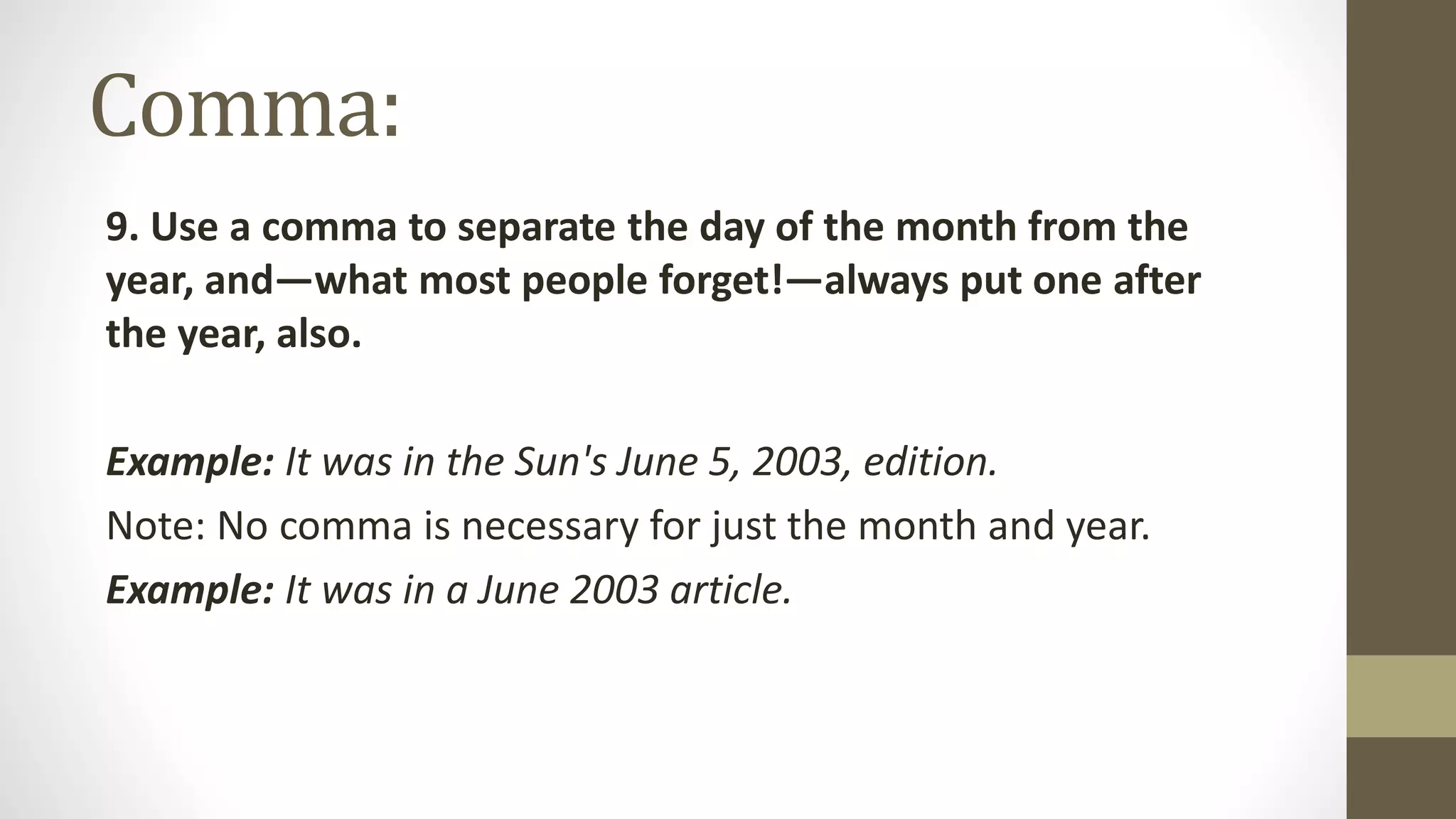
9. Use a comma to separate the day of the month from the
year, and—what most people forget!—always put one after
the year, also.
Example: It was in the Sun's June 5, 2003, edition.
Note: No comma is necessary for just the month and year.
Example: It was in a June 2003 article.
Comma:
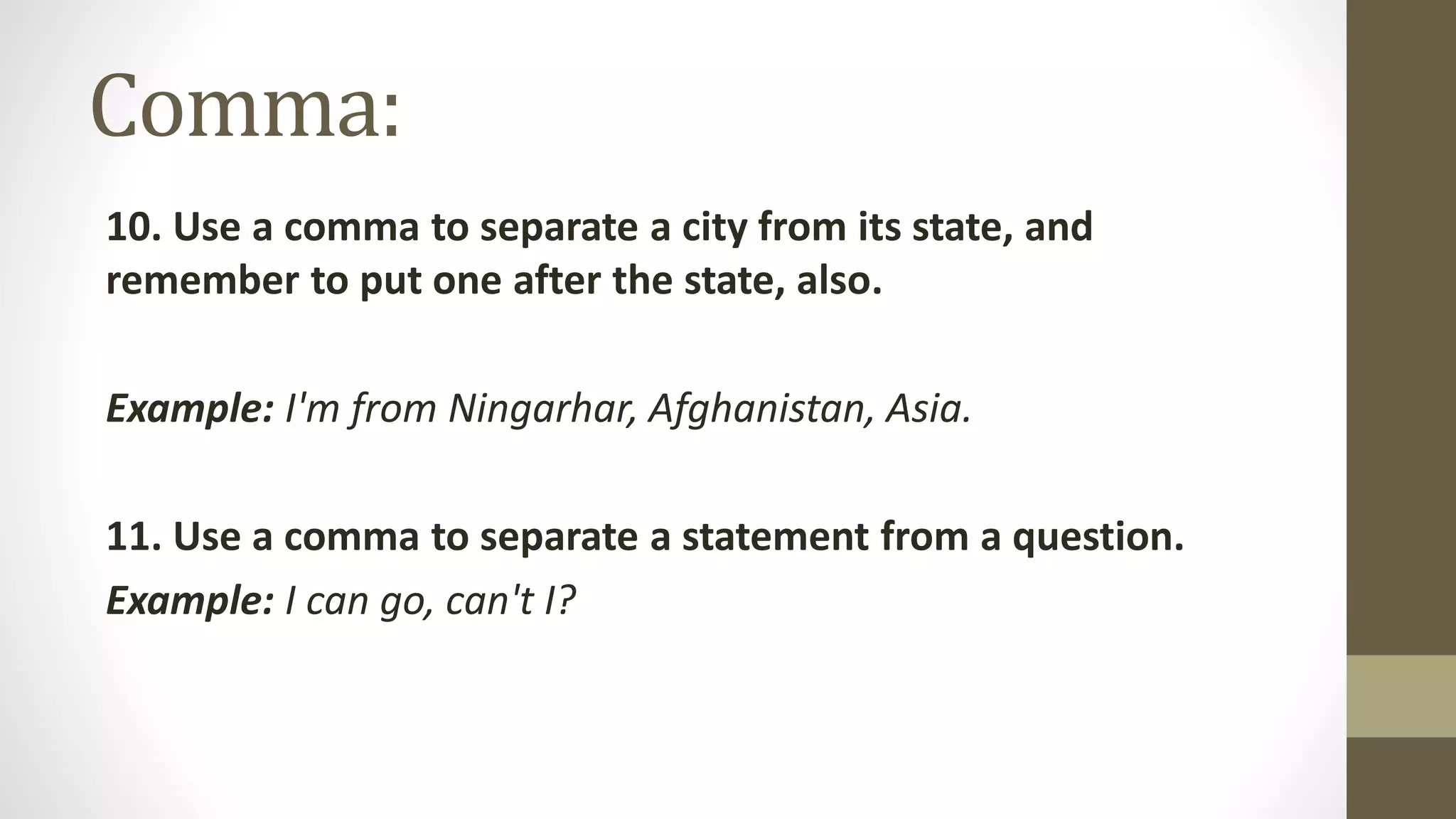
10. Use a comma to separate a city from its state, and
remember to put one after the state, also.
Example: I'm from Ningarhar, Afghanistan, Asia.
11. Use a comma to separate a statement from a question.
Example: I can go, can't I?
Comma:
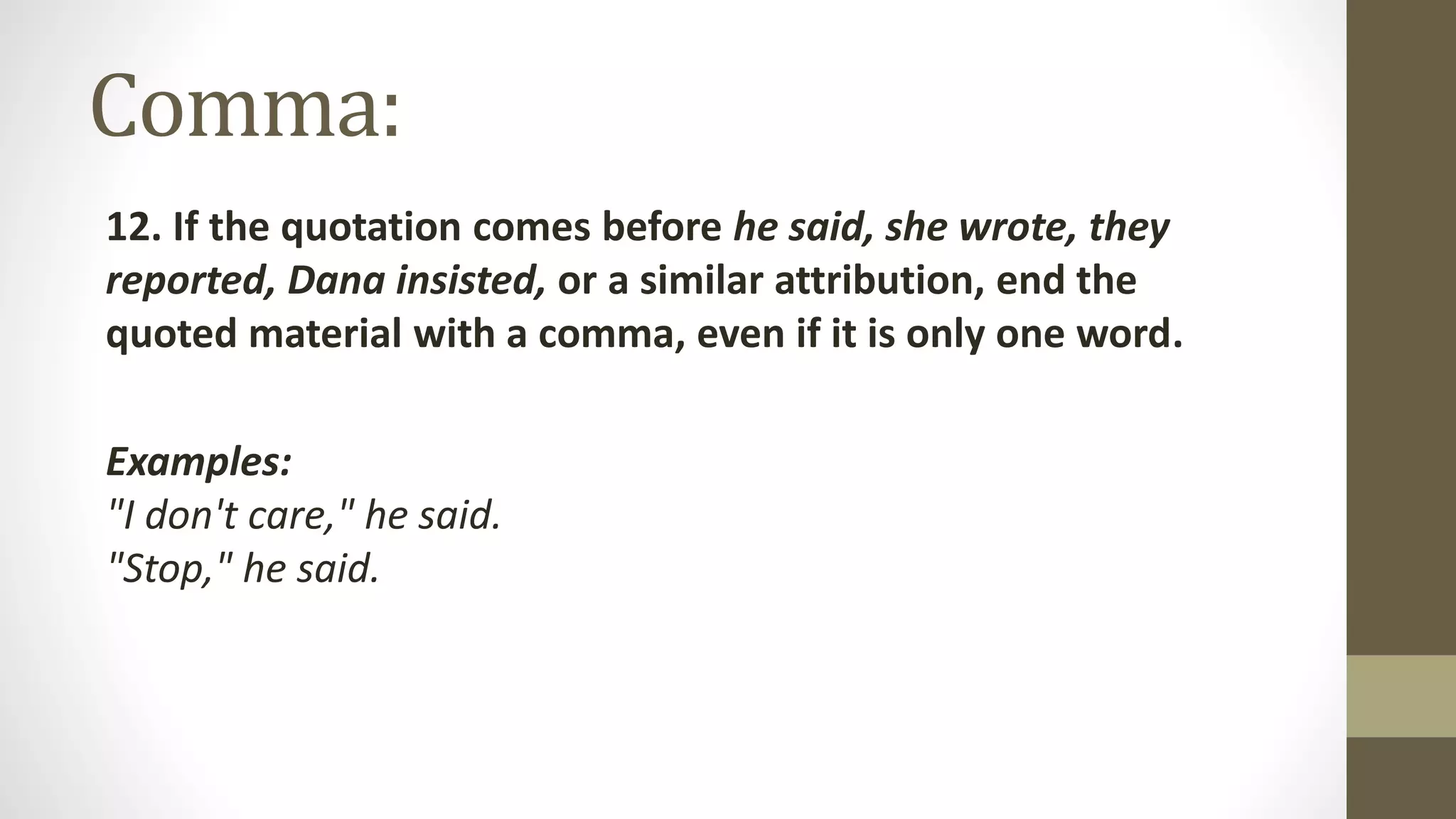
12. If the quotation comes before he said, she wrote, they
reported, Dana insisted, or a similar attribution, end the
quoted material with a comma, even if it is only one word.
Examples:
"I don't care," he said.
"Stop," he said.
Thanks

Punctuations

  • 1.
  • 2.
    WHAT IS PUNCTUATION? •Punctuation is the act or process of placing either principle symbols or supplementary symbols in different writing segments. • the marks, such as full stop, comma, and brackets, used in writing to separate sentences and their elements and to clarify meaning.
  • 3.
    THE IMPORTANCE OFPUNCTUATION • The biggest and significant importance of punctuation is that it prevents Mis-communication or Mis-understanding. • primarily helps to indicate the pauses and the emphasis on certain ideas or thoughts that are discussed in the text.
  • 4.
    SYMBOLS OF PUNCTUATION •Principlesymbols of punctuation •Supplementary symbols of punctuation
  • 5.
    Principle symbols ofPunctuation • Are those symbols which are used mainly and play key role in different writing segments. Principle symbols are five in numbers. 1. The comma (,) 2. Semi Colon (;) 3. The Colon (:) 4. The period or full stop (.) 5. The question mark (?)
  • 6.
    Supplementarysymbolsof punctuations • Arethose symbols which have supplementary functions in different writing segments. Supplementary symbols are listed here. 1. The exclamation point (!) 2. The parentheses ( ) 3. The Quotation mark (“”) 4. The dash (----) 5. The apostrophe (‘) 6. Hyphen (-) 7. Slash (/)
  • 7.
  • 8.
    PS • COMMA: Commais one of the principle symbols of punctuation used mainly for the sake of separation and creating pause in writing.
  • 9.
    Where to usecomma? • Comma is used in the following cases: 1. To set off noun direct address. • Exp: My dear Madam, It is importantly stated that…….. N Direct Address My dear brother, I would like to call your attention. N Direct address Dear Sir, would please tell us about the ceremony? N Direct address
  • 10.
    Comma: 2. To setoff noun from its modifier. • Exp: The book, with the plastic cover, is a grammar book. N Modifier • KELC, is the best centre, located in Peshawar. N Modifier
  • 11.
    Comma: 3. Comma isalso used with two clauses connected with linkers or transitions. Exp: He worked very hard. Therefore, he earned much money. Clause Transition Clause 4. Comma is also used to overcome confusion in different writing segments. Examples: Ali, go to school. He who is, is nobody business. He plays, playing makes him tired.
  • 12.
    Comma: 5. We usecomma to set off words in particular series. Exp: The students need books, notebooks, chairs in the class. Ali, Ahmad, Sajid and Wahid are playing cricket. 6. We use comma after dependent clause starting a sentence. Exp: Because he was busy, he didn’t attend the meeting. Depended clause When she completes her computer courses, she will get a job. Depended clause
  • 13.
    Comma: 7. We usuallyuse comma before coordinating conjunctions (but, and, yet, for, so) Exp: The students attended the class, but they didn’t have books. She was very tired, so she slept early last night. He was really sick, yet he attended the class. 8. We use comma before direct quotation. Exp: Ali said, “I watch T.V daily.” Direct quotation
  • 14.
    Comma: 9. Use acomma to separate the day of the month from the year, and—what most people forget!—always put one after the year, also. Example: It was in the Sun's June 5, 2003, edition. Note: No comma is necessary for just the month and year. Example: It was in a June 2003 article.
  • 15.
    Comma: 10. Use acomma to separate a city from its state, and remember to put one after the state, also. Example: I'm from Ningarhar, Afghanistan, Asia. 11. Use a comma to separate a statement from a question. Example: I can go, can't I?
  • 16.
    Comma: 12. If thequotation comes before he said, she wrote, they reported, Dana insisted, or a similar attribution, end the quoted material with a comma, even if it is only one word. Examples: "I don't care," he said. "Stop," he said.
  • 17.