CENTRIFUGAL PUMPS
CENTRIFUGAL PUMPS
GS 건설
플랜트 사업본부
기계 팀
김병호 과장
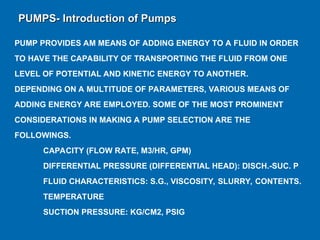
PUMP PROVIDES AM MEANS OF ADDING ENERGY TO A FLUID IN ORDER
TO HAVE THE CAPABILITY OF TRANSPORTING THE FLUID FROM ONE
LEVEL OF POTENTIAL AND KINETIC ENERGY TO ANOTHER.
DEPENDING ON A MULTITUDE OF PARAMETERS, VARIOUS MEANS OF
ADDING ENERGY ARE EMPLOYED. SOME OF THE MOST PROMINENT
CONSIDERATIONS IN MAKING A PUMP SELECTION ARE THE
FOLLOWINGS.
­ CAPACITY (FLOW RATE, M3/HR, GPM)
­ DIFFERENTIAL PRESSURE (DIFFERENTIAL HEAD): DISCH.-SUC. P
­ FLUID CHARACTERISTICS: S.G., VISCOSITY, SLURRY, CONTENTS.
­ TEMPERATURE
­ SUCTION PRESSURE: KG/CM2, PSIG
PUMPS- Introduction of Pumps
3
3
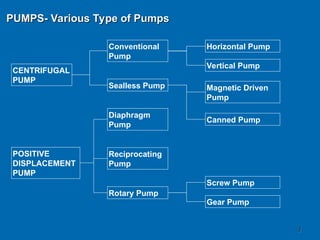
CENTRIFUGAL
PUMP
PUMPS- Various Type of Pumps
Conventional
Pump
Sealless Pump
Diaphragm
Pump
Reciprocating
Pump
Rotary Pump
POSITIVE
DISPLACEMENT
PUMP
Vertical Pump
Magnetic Driven
Pump
Horizontal Pump
Canned Pump
Screw Pump
Gear Pump
4
4
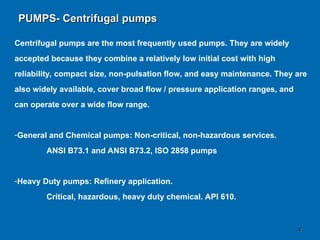
Centrifugal pumps are the most frequently used pumps. They are widely
accepted because they combine a relatively low initial cost with high
reliability, compact size, non-pulsation flow, and easy maintenance. They are
also widely available, cover broad flow / pressure application ranges, and
can operate over a wide flow range.
-General and Chemical pumps: Non-critical, non-hazardous services.
ANSI B73.1 and ANSI B73.2, ISO 2858 pumps
-Heavy Duty pumps: Refinery application.
Critical, hazardous, heavy duty chemical. API 610.
PUMPS- Centrifugal pumps
PUMPS- Various Type of Pumps
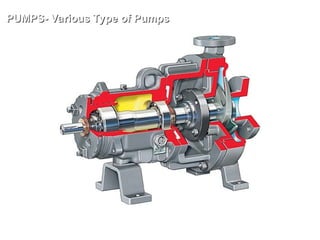
OH1 : Single stage Overhung Impeller
ANSI or ISO
END SUCTION
TOP DISCHARGE
6
PUMPS- Various Type of Pumps
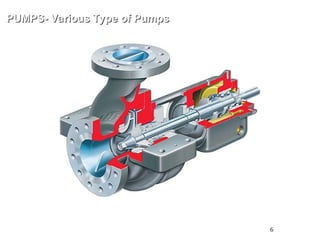
OH2 : Single stage Overhung Impeller
API 610
7
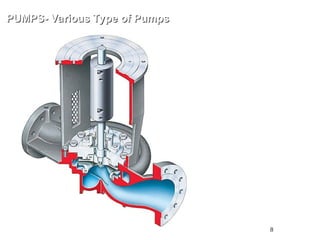
PUMPS- Various Type of Pumps
OH3 : Single stage Overhung
Impeller, Vertical In-Line
Separate Bearing Bracket
API 610
8
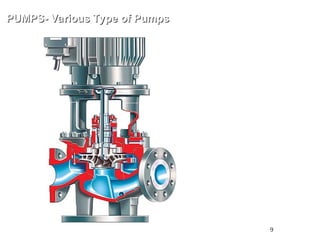
PUMPS- Various Type of Pumps
OH4 : Single stage Overhung
Impeller, Vertical In-Line
Rigidly Coupled
API 610
9
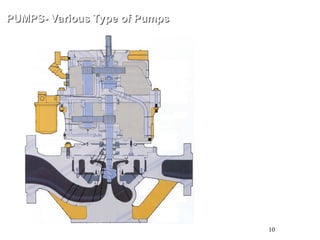
PUMPS- Various Type of Pumps
OH5 : Single stage Overhung
Impeller, Vertical In-Line
Closed Coupled
(Motor Shaft = Pump Shaft)
API 610
10
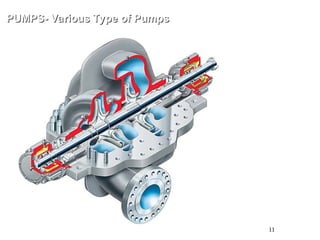
PUMPS- Various Type of Pumps
OH6 : Single stage Overhung
Impeller, Vertical In-Line
High Speed Integrally Geared
So Called “Sundyne Pump”
API 610
11
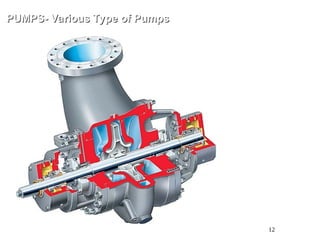
PUMPS- Various Type of Pumps
BB1 : Axially Split Between
Bearing 1 or 2 Stage Pump
API 610
12
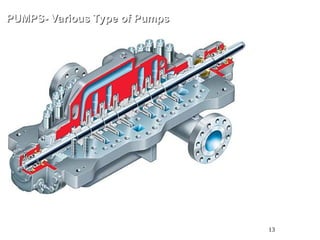
PUMPS- Various Type of Pumps
BB2 : Radially Split Between
Bearing 1 or 2 Stage Pump
API 610
13
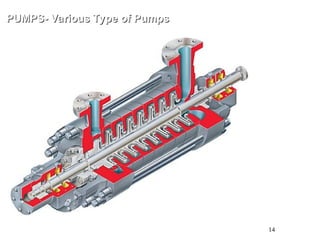
PUMPS- Various Type of Pumps
BB3 : Axially Split Between
Bearing Multi-Stage Pump
API 610
14
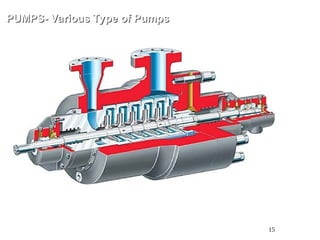
PUMPS- Various Type of Pumps
BB4 : Radially Split Between
Bearing Multi-Stage Pump
So Called “Ring Section Pum
p”
API 610
15
PUMPS- Various Type of Pumps
BB5 : Radially Split Between
Bearing Multi-Stage Pump
So Called “Double Casing Pump”
API 610
16
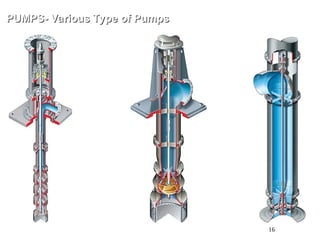
PUMPS- Various Type of Pumps
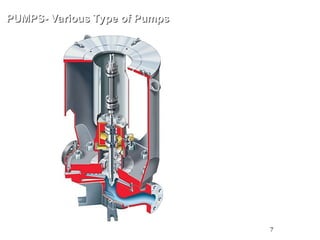
VS2 (Right)
Wet Pit, Vertically
Suspended Single Casing
Volute with Discharge
through the Column
VS1 (Left)
Wet Pit, Vertically
Suspended Single Casing
Diffuser with Discharge
through the Column
VS3 (Right)
Wet Pit, Vertically
Suspended Single
Casing Axial Flow
with Discharge
through the Column
17
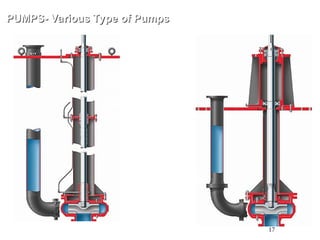
PUMPS- Various Type of Pumps
VS5 (Right)
Vertically Suspended
Cantilever Sump Pump
VS4 (Left)
Vertically Suspended
Single Casing Volute
Line-Shaft Driven
Sump Pump
18
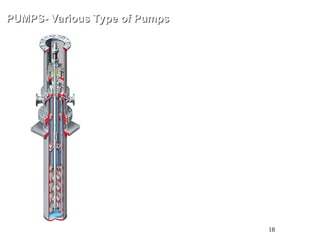
PUMPS- Various Type of Pumps
VS6 (Left)
Vertically Suspended Double Casing Diffuser w
ith Discharge through the Column Suitable for
Extremely Low NPSHa
19
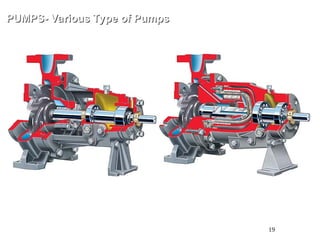
PUMPS- Various Type of Pumps
Conventional Pump VS Magnetic Driven Pump
20
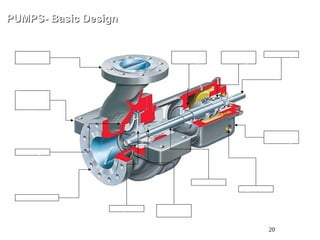
PUMPS- Basic Design
PUMPS- Basic Design
Suction Nozzle
Discharge
Nozzle
Impeller Mechanical
Seal
Radial
Bearing
Thrust
Bearing
Shaft
Bearing
Housing
Sight Glass
Casing
Centerline
Mounted
Support
Shaft Key
21
22
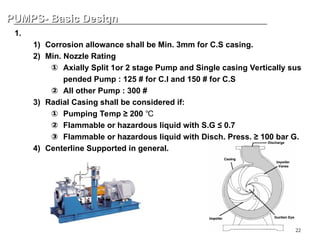
PUMPS- Basic Design
PUMPS- Basic Design
1. Casing
1) Corrosion allowance shall be Min. 3mm for C.S casing.
2) Min. Nozzle Rating
① Axially Split 1or 2 stage Pump and Single casing Vertically sus
pended Pump : 125 # for C.I and 150 # for C.S
② All other Pump : 300 #
3) Radial Casing shall be considered if:
① Pumping Temp ≥ 200 ℃
② Flammable or hazardous liquid with S.G ≤ 0.7
③ Flammable or hazardous liquid with Disch. Press. ≥ 100 bar G.
4) Centerline Supported in general.
23
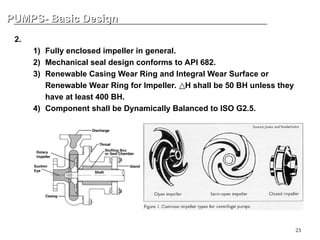
PUMPS- Basic Design
PUMPS- Basic Design
2. Rotor
1) Fully enclosed impeller in general.
2) Mechanical seal design conforms to API 682.
3) Renewable Casing Wear Ring and Integral Wear Surface or
Renewable Wear Ring for Impeller. H shall be 50 BH unless they
△
have at least 400 BH.
4) Component shall be Dynamically Balanced to ISO G2.5.
24
PUMPS- Basic Design
PUMPS- Basic Design
3. Bearing
Condition Bearing type and arrangement
Radial and thrust bearing speed and life within limits for
rolling element bearings and Pump energy density
below limit
Rolling-element radial and thrust
Radial bearing speed or life outside limits for rolling-
element bearings and Thrust bearing speed and life
within limits And Pump energy density below limit
Hydrodynamic radial and rolling-element thrust
or
Hydrodynamic radial and thrust
Radial bearing speed or life outside limits for rolling-
element bearings and Thrust bearing speed and life
within limits And Pump energy density above limit
Hydrodynamic radial and thrust
Limits are as follows.
a) Rolling-element bearing speed: Factor, n.dm shall not exceed 500 000 where
dm is the mean bearing diameter [(d + D)/2)], expressed in millimetres;
n is the rotational speed, expressed in revolutions per minute.
b) Rolling-element bearing life: basic rating life, L10, in accordance with ISO 281, equivalent to at
least 25 000 h with continuous operation at rated conditions, and at least 16 000 h at maximum
radial and axial loads and rated speed.
c) Hydrodynamic radial and thrust bearings shall be used if the energy density [i.e. the product of
pump rated power, kW (hp), and rated speed, r/min] is 4,0 × 10⁶
kW/min (5,4 × 10⁶
hp/min) or
greater.
25
PUMPS- Basic Design
PUMPS- Basic Design
3. Bearing
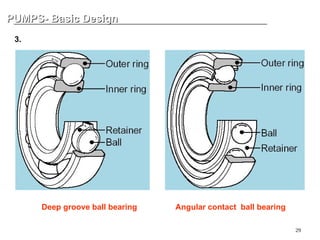
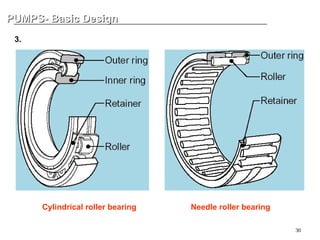
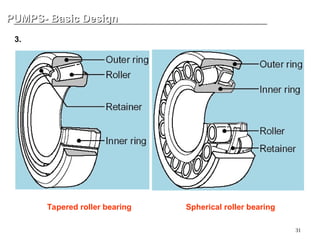
Most rolling bearings consist of rings with raceways (an inner ring and an outer ring), rolling elements (e
ither balls or rollers) and a rolling element retainer.
The retainer separates the rolling elements at regular intervals, holds them in place within the inner and
outer raceways, and allows them to rotate freely.
Rolling elements come in two general shapes: ball or rollers. Rollers come in four basic styles: cylindric
al, needle, tapered, and spherical.
Balls geometrically contact the raceway surfaces of the inner and outer rings at “points”, while the cont
act surface of rollers is a “line” contact.
Theoretically, rolling bearings are so constructed as to allow the rolling elements to rotate orbitally whil
e also rotating on their own axes at the same time.
While the rolling elements and the bearing rings take any load applied to the bearings (at the contact poi
nt between the rolling elements and raceway surfaces), the retainer takes no direct load.
The retainer only serves to hold the rolling elements at equal distances from each other and prevent the
m from falling out.
26
PUMPS- Basic Design
PUMPS- Basic Design
3. Bearing - Rolling Element
Rolling bearings come in many shapes and varieties, each with its own distinctive
features. However, when compared with sliding bearings, rolling bearings all have the
followings advantages:
(1) The starting friction coefficient is lower and only a little difference between this
and the dynamic friction coefficient is produced.
(2) They are internationally standardized, interchangeable and readily obtainable.
(3) Ease of lubrication and low lubricant consumption.
(4) As a general rule, one bearing can carry both radial and axial loads at the
same time.
(5) May be used in either high or low temperature applications.
(6) Bearing rigidity can be improved by preloading.
27
PUMPS- Basic Design
PUMPS- Basic Design
3. Bearing - Ball versus Roller
Generally speaking, when comparing ball and roller bearings of the same
dimensions, ball bearings exhibit a lower frictional resistance and lower face run-
out in rotation than roller bearings.
This makes them more suitable for use in applications which require high speed,
high precision, low torque and low vibration.
Conversely, roller bearings have a larger load carrying capacity which makes them
more suitable for applications requiring long life and endurance for heavy loads
and shock loads.
28
PUMPS- Basic Design
PUMPS- Basic Design
3. Bearing - Radial and Thrust
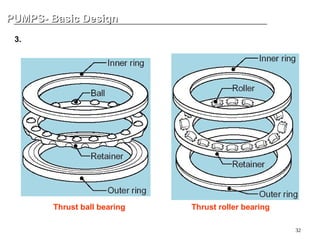
Almost all types of rolling bearings can carry both radial and axial loads at the
same time.
Generally, bearings with a contact angle of less than 45° have a much greater
radial load capacity and are classed as radial bearings; whereas bearings which
have a contact angle over 45° have a greater axial load capacity and are classed as
thrust bearings.
There are also bearings classed as complex bearings which combine the loading
characteristics of both radial and thrust bearings.
29
PUMPS- Basic Design
PUMPS- Basic Design
3. Bearing - Rolling Element
Deep groove ball bearing Angular contact ball bearing
30
PUMPS- Basic Design
PUMPS- Basic Design
3. Bearing - Rolling Element
Cylindrical roller bearing Needle roller bearing
31
PUMPS- Basic Design
PUMPS- Basic Design
3. Bearing - Rolling Element
Tapered roller bearing Spherical roller bearing
32
PUMPS- Basic Design
PUMPS- Basic Design
3. Bearing - Rolling Element
Thrust ball bearing Thrust roller bearing
33
PUMPS- Basic Design
PUMPS- Basic Design
4. Lubrication
1) Unless otherwise specified, bearings and bearing housings shall be
designed for oil lubrication using a mineral (hydrocarbon) oil.
2) Pressurized Lube oil system may be required if High Energy shall be
supported by the bearing.
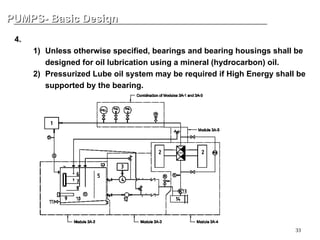
1 rotating equipment
2 filter
3 electric motor
4 pump
5 internal baffle
6 max. operating level
7 min. operating level
8 pump suction level
9 heater (optional)
10 sloped bottom
11 drain
12 shaft-driven oil pump with
integral pressure relief
13 TCV (optional)
14 cooler
34
PUMPS- Basic Design
PUMPS- Basic Design
5. Driver
1) It can be electrical motor and/or general purpose steam turbine.
2) For electrical motor, following information shall be issued by the
purchaser.
① Area classification
② Voltage / Phase / Hertz
③ Ambient temp / Elevation
④ Explosion Proof Grade, Weather Proof Grade
3) Driver shall have the margin as defined in API 610 as minimum. It
shall be sized to accommodate all specified process variation such
as changes in capacity, differential pressure, S.G and viscosity.
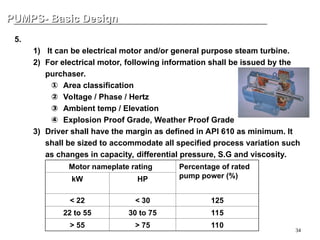
Motor nameplate rating Percentage of rated
pump power (%)
kW HP
< 22 < 30 125
22 to 55 30 to 75 115
> 55 > 75 110
35
PUMPS- Basic Design
PUMPS- Basic Design
6. Coupling
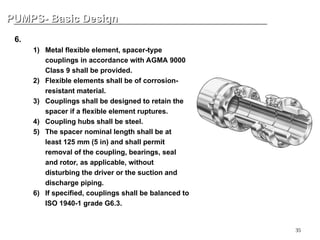
1) Metal flexible element, spacer-type
couplings in accordance with AGMA 9000
Class 9 shall be provided.
2) Flexible elements shall be of corrosion-
resistant material.
3) Couplings shall be designed to retain the
spacer if a flexible element ruptures.
4) Coupling hubs shall be steel.
5) The spacer nominal length shall be at
least 125 mm (5 in) and shall permit
removal of the coupling, bearings, seal
and rotor, as applicable, without
disturbing the driver or the suction and
discharge piping.
6) If specified, couplings shall be balanced to
ISO 1940-1 grade G6.3.
36
PUMPS- Basic Design
PUMPS- Basic Design
7. Materials – Pump Parts
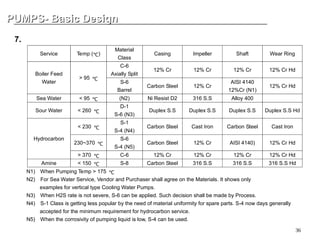
Service Temp (℃)
Material
Class
Casing Impeller Shaft Wear Ring
C-6
Axially Split
12% Cr 12% Cr 12% Cr 12% Cr Hd
Boiler Feed
Water
> 95 ℃
S-6
Barrel
Carbon Steel 12% Cr
AISI 4140
12%Cr (N1)
12% Cr Hd
Sea Water < 95 ℃ (N2) Ni Resist D2 316 S.S Alloy 400
Sour Water < 260 ℃
D-1
S-6 (N3)
Duplex S.S Duplex S.S Duplex S.S Duplex S.S Hd
< 230 ℃
S-1
S-4 (N4)
Carbon Steel Cast Iron Carbon Steel Cast Iron
230~370 ℃
S-6
S-4 (N5)
Carbon Steel 12% Cr AISI 4140) 12% Cr Hd
Hydrocarbon
> 370 ℃ C-6 12% Cr 12% Cr 12% Cr 12% Cr Hd
Amine < 150 ℃ S-8 Carbon Steel 316 S.S 316 S.S 316 S.S Hd
N1) When Pumping Temp > 175 ℃
N2) For Sea Water Service, Vendor and Purchaser shall agree on the Materials. It shows only
examples for vertical type Cooling Water Pumps.
N3) When H2S rate is not severe, S-6 can be applied. Such decision shall be made by Process.
N4) S-1 Class is getting less popular by the need of material uniformity for spare parts. S-4 now days generally
accepted for the minimum requirement for hydrocarbon service.
N5) When the corrosivity of pumping liquid is low, S-4 can be used.
37
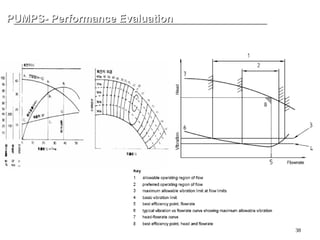
PUMPS- Performance Evaluation
-Pressure
ATM (Atmospheric Pressure): 대기압 , 대기에 의한 압력
Gauge Pressure: 대기압을 기준으로 + 방향으로 측정된 압력
Vacuum Pressure
Absolute Pressure: 완전 진공을 기준으로 측정된 압력 .
-Head: m = {10 x Pressure (kg/cm2)} / S.G
-Specific Gravity (S.G.): 비중 , 대기압 하에서 4 도씨 물의 밀도에 대한 비
-Power (kw)
kw = { 비중량 (kgf/m3) x Total head (m) x flowrate (m3/h) } / 102
BHP: pump 운전을 위한 motor 에서 pump 까지의 모든 기계적 손실을 고려한
동력
-Efficiency
38
PUMPS- Performance Evaluation
39
PUMPS- Performance Evaluation
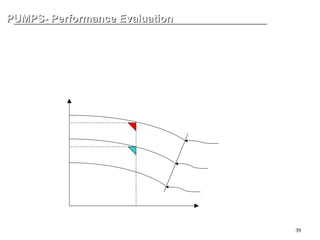
HEAD INCREASE
Pumps shall be capable of at least a 5 % head increase at rated conditions
by replacement of the impeller(s) with one(s) of larger diameter or different
hydraulic design, variable-speed capability or use of a blank stage.
Q
H
Min. Impeller
Max. Impeller
Rated Impeller
Rated Capacity
Rated Head
Head @ Max.
Impeller
Head @ Max. Impeller
Head Increase = ------------------------------
Rated Head
40
PUMPS- Performance Evaluation
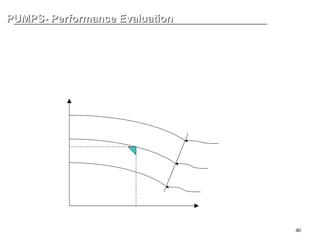
HEAD RISE
Pumps that have the continuous head rise to shutoff are preferred for all applications
and are required if parallel operation is specified. If parallel operation is specified, the
head rise from rated point to shutoff shall be at least 10 %. If a discharge orifice is
used as a means of providing a continuous rise to shutoff, this use shall be stated in
the proposal.
Q
H
Min. Impeller
Max. Impeller
Rated Impeller
Rated Capacity
Rated Head
Shutoff Head
Shutoff Head
Head Rise = ------------------
Rated Head
41
PUMPS- Performance Evaluation
NPSH Margin
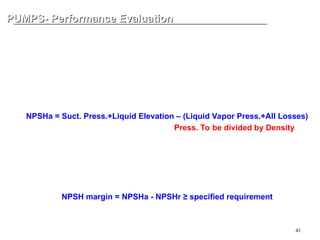
NPSHa = Net Positive Suction Head Available
This is the pure suction head (or pressure) that system can give to the pump
after extracting all and any losses. It shall be calculated by the system desig
ner.
NPSHa = Suct. Press.+Liquid Elevation – (Liquid Vapor Press.+All Losses)
To match the unit to Head (length), Press. To be divided by Density
NPSHr = Net Positive Suction Head Required
This is the pure suction head (or pressure) that pump needs from the syste
m. It is peculiar of each model of pump, hence, it shall be proposed by pump
vendor.
NPSH margin = NPSHa - NPSHr ≥ specified requirement
42
PUMPS- Performance Evaluation
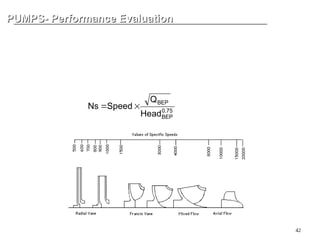
SPECIFIC SPEED
The best way to describe the shape of an impeller is to use its specific
speed number. Specific speed is calculated for the pump’s performance at
best efficiency point with the maximum diameter impeller. This is a
dimensionless number that was generated by the formula :
0.75
BEP
BEP
Head
Q
Speed
Ns 

43
PUMPS- Performance Evaluation
SUCTION SPECIFIC SPEED
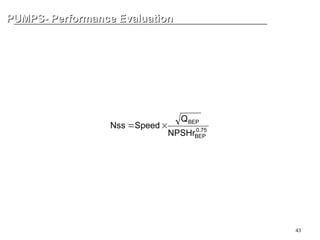
Suction-specific speed is calculated for the pump’s performance at best
efficiency point with the maximum diameter impeller and provides an
assessment of a pump’s susceptibility to internal recirculation. It is
expressed mathematically by the following equation:
75
.
0
BEP
BEP
NPSHr
Q
Speed
Nss 

44
PUMPS- Performance Evaluation
MINIMUM FLOW
-Minimum Continuous Stable Flow (MCF)
Shaft, Bearing 의 수명 및 pump vibration, noise 를 발생시키지 않고
기계적으로 안정되게 운전될 수 있는 최소한의 유량 ( 약 BEP 의 10% 정도 )
-Minimum Thermal Flow (MTF)
급격한 온도의 상승으로 인한 유체의 특성변화나 유체의 증발현상이 없이
안정적으로 운전될 수 있는 최소한의 유량
45
PUMPS- Performance Evaluation
CAVIATION
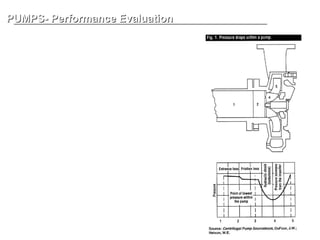
The pressure of the liquid in a centrifugal pump drops as it flow
s from the suction flange through the suction nozzle and into th
e impeller. The amount of pressure drop is a function of many fa
ctors, including pump geometry, rotational speed, frictional and
hydraulic shock losses, and flowrate. If the pressure at any poin
t within the pump falls below the vapor pressure of the liquid bei
ng pumped, vaporization or cavitation will occur.
HOW TO DETERMINE NPSHr
The pump manufacturer determines the NPSHr of an impeller pa
ttern by conducting a suppression test using water as the pump
ed fluid. These tests are usually only made on the first casting f
or an impeller pattern, not on individual pumps.
Normally, the NPSHr plotted on the traditional pump curve is ba
sed on a 3% head loss due to cavitation, a convention establish
ed many years ago in the Hydraulic Institute Standards. Permitti
ng this large a head loss means that cavitation would already ha
ve been occurring, at some higher flow condition, before perfor
mance loss was noticed.
46
PUMPS- Performance Evaluation
CLASSIC CAVIATION
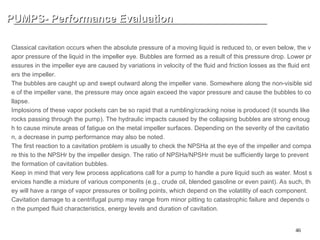
Classical cavitation occurs when the absolute pressure of a moving liquid is reduced to, or even below, the v
apor pressure of the liquid in the impeller eye. Bubbles are formed as a result of this pressure drop. Lower pr
essures in the impeller eye are caused by variations in velocity of the fluid and friction losses as the fluid ent
ers the impeller.
The bubbles are caught up and swept outward along the impeller vane. Somewhere along the non-visible sid
e of the impeller vane, the pressure may once again exceed the vapor pressure and cause the bubbles to co
llapse.
Implosions of these vapor pockets can be so rapid that a rumbling/cracking noise is produced (it sounds like
rocks passing through the pump). The hydraulic impacts caused by the collapsing bubbles are strong enoug
h to cause minute areas of fatigue on the metal impeller surfaces. Depending on the severity of the cavitatio
n, a decrease in pump performance may also be noted.
The first reaction to a cavitation problem is usually to check the NPSHa at the eye of the impeller and compa
re this to the NPSHr by the impeller design. The ratio of NPSHa/NPSHr must be sufficiently large to prevent
the formation of cavitation bubbles.
Keep in mind that very few process applications call for a pump to handle a pure liquid such as water. Most s
ervices handle a mixture of various components (e.g., crude oil, blended gasoline or even paint). As such, th
ey will have a range of vapor pressures or boiling points, which depend on the volatility of each component.
Cavitation damage to a centrifugal pump may range from minor pitting to catastrophic failure and depends o
n the pumped fluid characteristics, energy levels and duration of cavitation.
47
PUMPS- Performance Evaluation
INTERNAL RECIRCULATION CAVIATION (1)
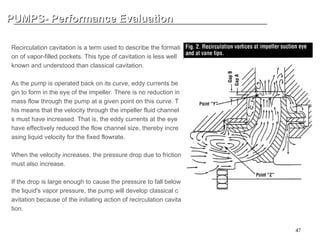
Recirculation cavitation is a term used to describe the formati
on of vapor-filled pockets. This type of cavitation is less well
known and understood than classical cavitation.
As the pump is operated back on its curve, eddy currents be
gin to form in the eye of the impeller. There is no reduction in
mass flow through the pump at a given point on this curve. T
his means that the velocity through the impeller fluid channel
s must have increased. That is, the eddy currents at the eye
have effectively reduced the flow channel size, thereby incre
asing liquid velocity for the fixed flowrate.
When the velocity increases, the pressure drop due to friction
must also increase.
If the drop is large enough to cause the pressure to fall below
the liquid's vapor pressure, the pump will develop classical c
avitation because of the initiating action of recirculation cavita
tion.
48
PUMPS- Performance Evaluation
INTERNAL RECIRCULATION CAVIATION (2)
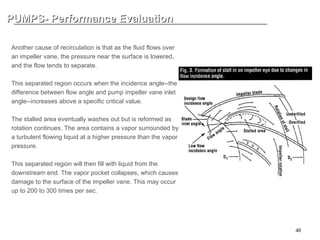
Another cause of recirculation is that as the fluid flows over
an impeller vane, the pressure near the surface is lowered,
and the flow tends to separate.
This separated region occurs when the incidence angle--the
difference between flow angle and pump impeller vane inlet
angle--increases above a specific critical value.
The stalled area eventually washes out but is reformed as
rotation continues. The area contains a vapor surrounded by
a turbulent flowing liquid at a higher pressure than the vapor
pressure.
This separated region will then fill with liquid from the
downstream end. The vapor pocket collapses, which causes
damage to the surface of the impeller vane. This may occur
up to 200 to 300 times per sec.
49
PUMPS- Performance Evaluation
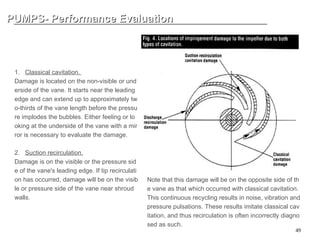
HOW TO IDENTIFY CLASSIC CA
VIATION AND INTERNAL RECIR
CULATION CAVITATION
1. Classical cavitation.
Damage is located on the non-visible or und
erside of the vane. It starts near the leading
edge and can extend up to approximately tw
o-thirds of the vane length before the pressu
re implodes the bubbles. Either feeling or lo
oking at the underside of the vane with a mir
ror is necessary to evaluate the damage.
2. Suction recirculation.
Damage is on the visible or the pressure sid
e of the vane's leading edge. If tip recirculati
on has occurred, damage will be on the visib
le or pressure side of the vane near shroud
walls.
Note that this damage will be on the opposite side of th
e vane as that which occurred with classical cavitation.
This continuous recycling results in noise, vibration and
pressure pulsations. These results imitate classical cav
itation, and thus recirculation is often incorrectly diagno
sed as such.

Basic Centrifugal Pump Training presentation

  • 1.
    CENTRIFUGAL PUMPS CENTRIFUGAL PUMPS GS건설 플랜트 사업본부 기계 팀 김병호 과장
  • 2.
    PUMP PROVIDES AMMEANS OF ADDING ENERGY TO A FLUID IN ORDER TO HAVE THE CAPABILITY OF TRANSPORTING THE FLUID FROM ONE LEVEL OF POTENTIAL AND KINETIC ENERGY TO ANOTHER. DEPENDING ON A MULTITUDE OF PARAMETERS, VARIOUS MEANS OF ADDING ENERGY ARE EMPLOYED. SOME OF THE MOST PROMINENT CONSIDERATIONS IN MAKING A PUMP SELECTION ARE THE FOLLOWINGS. ­ CAPACITY (FLOW RATE, M3/HR, GPM) ­ DIFFERENTIAL PRESSURE (DIFFERENTIAL HEAD): DISCH.-SUC. P ­ FLUID CHARACTERISTICS: S.G., VISCOSITY, SLURRY, CONTENTS. ­ TEMPERATURE ­ SUCTION PRESSURE: KG/CM2, PSIG PUMPS- Introduction of Pumps PUMPS- Introduction of Pumps
  • 3.
    3 3 CENTRIFUGAL PUMP PUMPS- Various Typeof Pumps PUMPS- Various Type of Pumps Conventional Pump Sealless Pump Diaphragm Pump Reciprocating Pump Rotary Pump POSITIVE DISPLACEMENT PUMP Vertical Pump Magnetic Driven Pump Horizontal Pump Canned Pump Screw Pump Gear Pump
  • 4.
    4 4 Centrifugal pumps arethe most frequently used pumps. They are widely accepted because they combine a relatively low initial cost with high reliability, compact size, non-pulsation flow, and easy maintenance. They are also widely available, cover broad flow / pressure application ranges, and can operate over a wide flow range. -General and Chemical pumps: Non-critical, non-hazardous services. ANSI B73.1 and ANSI B73.2, ISO 2858 pumps -Heavy Duty pumps: Refinery application. Critical, hazardous, heavy duty chemical. API 610. PUMPS- Centrifugal pumps PUMPS- Centrifugal pumps
  • 5.
    PUMPS- Various Typeof Pumps PUMPS- Various Type of Pumps OH1 : Single stage Overhung Impeller ANSI or ISO END SUCTION TOP DISCHARGE
  • 6.
    6 PUMPS- Various Typeof Pumps PUMPS- Various Type of Pumps OH2 : Single stage Overhung Impeller API 610
  • 7.
    7 PUMPS- Various Typeof Pumps PUMPS- Various Type of Pumps OH3 : Single stage Overhung Impeller, Vertical In-Line Separate Bearing Bracket API 610
  • 8.
    8 PUMPS- Various Typeof Pumps PUMPS- Various Type of Pumps OH4 : Single stage Overhung Impeller, Vertical In-Line Rigidly Coupled API 610
  • 9.
    9 PUMPS- Various Typeof Pumps PUMPS- Various Type of Pumps OH5 : Single stage Overhung Impeller, Vertical In-Line Closed Coupled (Motor Shaft = Pump Shaft) API 610
  • 10.
    10 PUMPS- Various Typeof Pumps PUMPS- Various Type of Pumps OH6 : Single stage Overhung Impeller, Vertical In-Line High Speed Integrally Geared So Called “Sundyne Pump” API 610
  • 11.
    11 PUMPS- Various Typeof Pumps PUMPS- Various Type of Pumps BB1 : Axially Split Between Bearing 1 or 2 Stage Pump API 610
  • 12.
    12 PUMPS- Various Typeof Pumps PUMPS- Various Type of Pumps BB2 : Radially Split Between Bearing 1 or 2 Stage Pump API 610
  • 13.
    13 PUMPS- Various Typeof Pumps PUMPS- Various Type of Pumps BB3 : Axially Split Between Bearing Multi-Stage Pump API 610
  • 14.
    14 PUMPS- Various Typeof Pumps PUMPS- Various Type of Pumps BB4 : Radially Split Between Bearing Multi-Stage Pump So Called “Ring Section Pum p” API 610
  • 15.
    15 PUMPS- Various Typeof Pumps PUMPS- Various Type of Pumps BB5 : Radially Split Between Bearing Multi-Stage Pump So Called “Double Casing Pump” API 610
  • 16.
    16 PUMPS- Various Typeof Pumps PUMPS- Various Type of Pumps VS2 (Right) Wet Pit, Vertically Suspended Single Casing Volute with Discharge through the Column VS1 (Left) Wet Pit, Vertically Suspended Single Casing Diffuser with Discharge through the Column VS3 (Right) Wet Pit, Vertically Suspended Single Casing Axial Flow with Discharge through the Column
  • 17.
    17 PUMPS- Various Typeof Pumps PUMPS- Various Type of Pumps VS5 (Right) Vertically Suspended Cantilever Sump Pump VS4 (Left) Vertically Suspended Single Casing Volute Line-Shaft Driven Sump Pump
  • 18.
    18 PUMPS- Various Typeof Pumps PUMPS- Various Type of Pumps VS6 (Left) Vertically Suspended Double Casing Diffuser w ith Discharge through the Column Suitable for Extremely Low NPSHa
  • 19.
    19 PUMPS- Various Typeof Pumps PUMPS- Various Type of Pumps Conventional Pump VS Magnetic Driven Pump
  • 20.
    20 PUMPS- Basic Design PUMPS-Basic Design Suction Nozzle Discharge Nozzle Impeller Mechanical Seal Radial Bearing Thrust Bearing Shaft Bearing Housing Sight Glass Casing Centerline Mounted Support Shaft Key
  • 21.
  • 22.
    22 PUMPS- Basic Design PUMPS-Basic Design 1. Casing 1) Corrosion allowance shall be Min. 3mm for C.S casing. 2) Min. Nozzle Rating ① Axially Split 1or 2 stage Pump and Single casing Vertically sus pended Pump : 125 # for C.I and 150 # for C.S ② All other Pump : 300 # 3) Radial Casing shall be considered if: ① Pumping Temp ≥ 200 ℃ ② Flammable or hazardous liquid with S.G ≤ 0.7 ③ Flammable or hazardous liquid with Disch. Press. ≥ 100 bar G. 4) Centerline Supported in general.
  • 23.
    23 PUMPS- Basic Design PUMPS-Basic Design 2. Rotor 1) Fully enclosed impeller in general. 2) Mechanical seal design conforms to API 682. 3) Renewable Casing Wear Ring and Integral Wear Surface or Renewable Wear Ring for Impeller. H shall be 50 BH unless they △ have at least 400 BH. 4) Component shall be Dynamically Balanced to ISO G2.5.
  • 24.
    24 PUMPS- Basic Design PUMPS-Basic Design 3. Bearing Condition Bearing type and arrangement Radial and thrust bearing speed and life within limits for rolling element bearings and Pump energy density below limit Rolling-element radial and thrust Radial bearing speed or life outside limits for rolling- element bearings and Thrust bearing speed and life within limits And Pump energy density below limit Hydrodynamic radial and rolling-element thrust or Hydrodynamic radial and thrust Radial bearing speed or life outside limits for rolling- element bearings and Thrust bearing speed and life within limits And Pump energy density above limit Hydrodynamic radial and thrust Limits are as follows. a) Rolling-element bearing speed: Factor, n.dm shall not exceed 500 000 where dm is the mean bearing diameter [(d + D)/2)], expressed in millimetres; n is the rotational speed, expressed in revolutions per minute. b) Rolling-element bearing life: basic rating life, L10, in accordance with ISO 281, equivalent to at least 25 000 h with continuous operation at rated conditions, and at least 16 000 h at maximum radial and axial loads and rated speed. c) Hydrodynamic radial and thrust bearings shall be used if the energy density [i.e. the product of pump rated power, kW (hp), and rated speed, r/min] is 4,0 × 10⁶ kW/min (5,4 × 10⁶ hp/min) or greater.
  • 25.
    25 PUMPS- Basic Design PUMPS-Basic Design 3. Bearing Most rolling bearings consist of rings with raceways (an inner ring and an outer ring), rolling elements (e ither balls or rollers) and a rolling element retainer. The retainer separates the rolling elements at regular intervals, holds them in place within the inner and outer raceways, and allows them to rotate freely. Rolling elements come in two general shapes: ball or rollers. Rollers come in four basic styles: cylindric al, needle, tapered, and spherical. Balls geometrically contact the raceway surfaces of the inner and outer rings at “points”, while the cont act surface of rollers is a “line” contact. Theoretically, rolling bearings are so constructed as to allow the rolling elements to rotate orbitally whil e also rotating on their own axes at the same time. While the rolling elements and the bearing rings take any load applied to the bearings (at the contact poi nt between the rolling elements and raceway surfaces), the retainer takes no direct load. The retainer only serves to hold the rolling elements at equal distances from each other and prevent the m from falling out.
  • 26.
    26 PUMPS- Basic Design PUMPS-Basic Design 3. Bearing - Rolling Element Rolling bearings come in many shapes and varieties, each with its own distinctive features. However, when compared with sliding bearings, rolling bearings all have the followings advantages: (1) The starting friction coefficient is lower and only a little difference between this and the dynamic friction coefficient is produced. (2) They are internationally standardized, interchangeable and readily obtainable. (3) Ease of lubrication and low lubricant consumption. (4) As a general rule, one bearing can carry both radial and axial loads at the same time. (5) May be used in either high or low temperature applications. (6) Bearing rigidity can be improved by preloading.
  • 27.
    27 PUMPS- Basic Design PUMPS-Basic Design 3. Bearing - Ball versus Roller Generally speaking, when comparing ball and roller bearings of the same dimensions, ball bearings exhibit a lower frictional resistance and lower face run- out in rotation than roller bearings. This makes them more suitable for use in applications which require high speed, high precision, low torque and low vibration. Conversely, roller bearings have a larger load carrying capacity which makes them more suitable for applications requiring long life and endurance for heavy loads and shock loads.
  • 28.
    28 PUMPS- Basic Design PUMPS-Basic Design 3. Bearing - Radial and Thrust Almost all types of rolling bearings can carry both radial and axial loads at the same time. Generally, bearings with a contact angle of less than 45° have a much greater radial load capacity and are classed as radial bearings; whereas bearings which have a contact angle over 45° have a greater axial load capacity and are classed as thrust bearings. There are also bearings classed as complex bearings which combine the loading characteristics of both radial and thrust bearings.
  • 29.
    29 PUMPS- Basic Design PUMPS-Basic Design 3. Bearing - Rolling Element Deep groove ball bearing Angular contact ball bearing
  • 30.
    30 PUMPS- Basic Design PUMPS-Basic Design 3. Bearing - Rolling Element Cylindrical roller bearing Needle roller bearing
  • 31.
    31 PUMPS- Basic Design PUMPS-Basic Design 3. Bearing - Rolling Element Tapered roller bearing Spherical roller bearing
  • 32.
    32 PUMPS- Basic Design PUMPS-Basic Design 3. Bearing - Rolling Element Thrust ball bearing Thrust roller bearing
  • 33.
    33 PUMPS- Basic Design PUMPS-Basic Design 4. Lubrication 1) Unless otherwise specified, bearings and bearing housings shall be designed for oil lubrication using a mineral (hydrocarbon) oil. 2) Pressurized Lube oil system may be required if High Energy shall be supported by the bearing. 1 rotating equipment 2 filter 3 electric motor 4 pump 5 internal baffle 6 max. operating level 7 min. operating level 8 pump suction level 9 heater (optional) 10 sloped bottom 11 drain 12 shaft-driven oil pump with integral pressure relief 13 TCV (optional) 14 cooler
  • 34.
    34 PUMPS- Basic Design PUMPS-Basic Design 5. Driver 1) It can be electrical motor and/or general purpose steam turbine. 2) For electrical motor, following information shall be issued by the purchaser. ① Area classification ② Voltage / Phase / Hertz ③ Ambient temp / Elevation ④ Explosion Proof Grade, Weather Proof Grade 3) Driver shall have the margin as defined in API 610 as minimum. It shall be sized to accommodate all specified process variation such as changes in capacity, differential pressure, S.G and viscosity. Motor nameplate rating Percentage of rated pump power (%) kW HP < 22 < 30 125 22 to 55 30 to 75 115 > 55 > 75 110
  • 35.
    35 PUMPS- Basic Design PUMPS-Basic Design 6. Coupling 1) Metal flexible element, spacer-type couplings in accordance with AGMA 9000 Class 9 shall be provided. 2) Flexible elements shall be of corrosion- resistant material. 3) Couplings shall be designed to retain the spacer if a flexible element ruptures. 4) Coupling hubs shall be steel. 5) The spacer nominal length shall be at least 125 mm (5 in) and shall permit removal of the coupling, bearings, seal and rotor, as applicable, without disturbing the driver or the suction and discharge piping. 6) If specified, couplings shall be balanced to ISO 1940-1 grade G6.3.
  • 36.
    36 PUMPS- Basic Design PUMPS-Basic Design 7. Materials – Pump Parts Service Temp (℃) Material Class Casing Impeller Shaft Wear Ring C-6 Axially Split 12% Cr 12% Cr 12% Cr 12% Cr Hd Boiler Feed Water > 95 ℃ S-6 Barrel Carbon Steel 12% Cr AISI 4140 12%Cr (N1) 12% Cr Hd Sea Water < 95 ℃ (N2) Ni Resist D2 316 S.S Alloy 400 Sour Water < 260 ℃ D-1 S-6 (N3) Duplex S.S Duplex S.S Duplex S.S Duplex S.S Hd < 230 ℃ S-1 S-4 (N4) Carbon Steel Cast Iron Carbon Steel Cast Iron 230~370 ℃ S-6 S-4 (N5) Carbon Steel 12% Cr AISI 4140) 12% Cr Hd Hydrocarbon > 370 ℃ C-6 12% Cr 12% Cr 12% Cr 12% Cr Hd Amine < 150 ℃ S-8 Carbon Steel 316 S.S 316 S.S 316 S.S Hd N1) When Pumping Temp > 175 ℃ N2) For Sea Water Service, Vendor and Purchaser shall agree on the Materials. It shows only examples for vertical type Cooling Water Pumps. N3) When H2S rate is not severe, S-6 can be applied. Such decision shall be made by Process. N4) S-1 Class is getting less popular by the need of material uniformity for spare parts. S-4 now days generally accepted for the minimum requirement for hydrocarbon service. N5) When the corrosivity of pumping liquid is low, S-4 can be used.
  • 37.
    37 PUMPS- Performance Evaluation PUMPS-Performance Evaluation -Pressure ATM (Atmospheric Pressure): 대기압 , 대기에 의한 압력 Gauge Pressure: 대기압을 기준으로 + 방향으로 측정된 압력 Vacuum Pressure Absolute Pressure: 완전 진공을 기준으로 측정된 압력 . -Head: m = {10 x Pressure (kg/cm2)} / S.G -Specific Gravity (S.G.): 비중 , 대기압 하에서 4 도씨 물의 밀도에 대한 비 -Power (kw) kw = { 비중량 (kgf/m3) x Total head (m) x flowrate (m3/h) } / 102 BHP: pump 운전을 위한 motor 에서 pump 까지의 모든 기계적 손실을 고려한 동력 -Efficiency
  • 38.
  • 39.
    39 PUMPS- Performance Evaluation PUMPS-Performance Evaluation HEAD INCREASE Pumps shall be capable of at least a 5 % head increase at rated conditions by replacement of the impeller(s) with one(s) of larger diameter or different hydraulic design, variable-speed capability or use of a blank stage. Q H Min. Impeller Max. Impeller Rated Impeller Rated Capacity Rated Head Head @ Max. Impeller Head @ Max. Impeller Head Increase = ------------------------------ Rated Head
  • 40.
    40 PUMPS- Performance Evaluation PUMPS-Performance Evaluation HEAD RISE Pumps that have the continuous head rise to shutoff are preferred for all applications and are required if parallel operation is specified. If parallel operation is specified, the head rise from rated point to shutoff shall be at least 10 %. If a discharge orifice is used as a means of providing a continuous rise to shutoff, this use shall be stated in the proposal. Q H Min. Impeller Max. Impeller Rated Impeller Rated Capacity Rated Head Shutoff Head Shutoff Head Head Rise = ------------------ Rated Head
  • 41.
    41 PUMPS- Performance Evaluation PUMPS-Performance Evaluation NPSH Margin NPSHa = Net Positive Suction Head Available This is the pure suction head (or pressure) that system can give to the pump after extracting all and any losses. It shall be calculated by the system desig ner. NPSHa = Suct. Press.+Liquid Elevation – (Liquid Vapor Press.+All Losses) To match the unit to Head (length), Press. To be divided by Density NPSHr = Net Positive Suction Head Required This is the pure suction head (or pressure) that pump needs from the syste m. It is peculiar of each model of pump, hence, it shall be proposed by pump vendor. NPSH margin = NPSHa - NPSHr ≥ specified requirement
  • 42.
    42 PUMPS- Performance Evaluation PUMPS-Performance Evaluation SPECIFIC SPEED The best way to describe the shape of an impeller is to use its specific speed number. Specific speed is calculated for the pump’s performance at best efficiency point with the maximum diameter impeller. This is a dimensionless number that was generated by the formula : 0.75 BEP BEP Head Q Speed Ns  
  • 43.
    43 PUMPS- Performance Evaluation PUMPS-Performance Evaluation SUCTION SPECIFIC SPEED Suction-specific speed is calculated for the pump’s performance at best efficiency point with the maximum diameter impeller and provides an assessment of a pump’s susceptibility to internal recirculation. It is expressed mathematically by the following equation: 75 . 0 BEP BEP NPSHr Q Speed Nss  
  • 44.
    44 PUMPS- Performance Evaluation PUMPS-Performance Evaluation MINIMUM FLOW -Minimum Continuous Stable Flow (MCF) Shaft, Bearing 의 수명 및 pump vibration, noise 를 발생시키지 않고 기계적으로 안정되게 운전될 수 있는 최소한의 유량 ( 약 BEP 의 10% 정도 ) -Minimum Thermal Flow (MTF) 급격한 온도의 상승으로 인한 유체의 특성변화나 유체의 증발현상이 없이 안정적으로 운전될 수 있는 최소한의 유량
  • 45.
    45 PUMPS- Performance Evaluation PUMPS-Performance Evaluation CAVIATION The pressure of the liquid in a centrifugal pump drops as it flow s from the suction flange through the suction nozzle and into th e impeller. The amount of pressure drop is a function of many fa ctors, including pump geometry, rotational speed, frictional and hydraulic shock losses, and flowrate. If the pressure at any poin t within the pump falls below the vapor pressure of the liquid bei ng pumped, vaporization or cavitation will occur. HOW TO DETERMINE NPSHr The pump manufacturer determines the NPSHr of an impeller pa ttern by conducting a suppression test using water as the pump ed fluid. These tests are usually only made on the first casting f or an impeller pattern, not on individual pumps. Normally, the NPSHr plotted on the traditional pump curve is ba sed on a 3% head loss due to cavitation, a convention establish ed many years ago in the Hydraulic Institute Standards. Permitti ng this large a head loss means that cavitation would already ha ve been occurring, at some higher flow condition, before perfor mance loss was noticed.
  • 46.
    46 PUMPS- Performance Evaluation PUMPS-Performance Evaluation CLASSIC CAVIATION Classical cavitation occurs when the absolute pressure of a moving liquid is reduced to, or even below, the v apor pressure of the liquid in the impeller eye. Bubbles are formed as a result of this pressure drop. Lower pr essures in the impeller eye are caused by variations in velocity of the fluid and friction losses as the fluid ent ers the impeller. The bubbles are caught up and swept outward along the impeller vane. Somewhere along the non-visible sid e of the impeller vane, the pressure may once again exceed the vapor pressure and cause the bubbles to co llapse. Implosions of these vapor pockets can be so rapid that a rumbling/cracking noise is produced (it sounds like rocks passing through the pump). The hydraulic impacts caused by the collapsing bubbles are strong enoug h to cause minute areas of fatigue on the metal impeller surfaces. Depending on the severity of the cavitatio n, a decrease in pump performance may also be noted. The first reaction to a cavitation problem is usually to check the NPSHa at the eye of the impeller and compa re this to the NPSHr by the impeller design. The ratio of NPSHa/NPSHr must be sufficiently large to prevent the formation of cavitation bubbles. Keep in mind that very few process applications call for a pump to handle a pure liquid such as water. Most s ervices handle a mixture of various components (e.g., crude oil, blended gasoline or even paint). As such, th ey will have a range of vapor pressures or boiling points, which depend on the volatility of each component. Cavitation damage to a centrifugal pump may range from minor pitting to catastrophic failure and depends o n the pumped fluid characteristics, energy levels and duration of cavitation.
  • 47.
    47 PUMPS- Performance Evaluation PUMPS-Performance Evaluation INTERNAL RECIRCULATION CAVIATION (1) Recirculation cavitation is a term used to describe the formati on of vapor-filled pockets. This type of cavitation is less well known and understood than classical cavitation. As the pump is operated back on its curve, eddy currents be gin to form in the eye of the impeller. There is no reduction in mass flow through the pump at a given point on this curve. T his means that the velocity through the impeller fluid channel s must have increased. That is, the eddy currents at the eye have effectively reduced the flow channel size, thereby incre asing liquid velocity for the fixed flowrate. When the velocity increases, the pressure drop due to friction must also increase. If the drop is large enough to cause the pressure to fall below the liquid's vapor pressure, the pump will develop classical c avitation because of the initiating action of recirculation cavita tion.
  • 48.
    48 PUMPS- Performance Evaluation PUMPS-Performance Evaluation INTERNAL RECIRCULATION CAVIATION (2) Another cause of recirculation is that as the fluid flows over an impeller vane, the pressure near the surface is lowered, and the flow tends to separate. This separated region occurs when the incidence angle--the difference between flow angle and pump impeller vane inlet angle--increases above a specific critical value. The stalled area eventually washes out but is reformed as rotation continues. The area contains a vapor surrounded by a turbulent flowing liquid at a higher pressure than the vapor pressure. This separated region will then fill with liquid from the downstream end. The vapor pocket collapses, which causes damage to the surface of the impeller vane. This may occur up to 200 to 300 times per sec.
  • 49.
    49 PUMPS- Performance Evaluation PUMPS-Performance Evaluation HOW TO IDENTIFY CLASSIC CA VIATION AND INTERNAL RECIR CULATION CAVITATION 1. Classical cavitation. Damage is located on the non-visible or und erside of the vane. It starts near the leading edge and can extend up to approximately tw o-thirds of the vane length before the pressu re implodes the bubbles. Either feeling or lo oking at the underside of the vane with a mir ror is necessary to evaluate the damage. 2. Suction recirculation. Damage is on the visible or the pressure sid e of the vane's leading edge. If tip recirculati on has occurred, damage will be on the visib le or pressure side of the vane near shroud walls. Note that this damage will be on the opposite side of th e vane as that which occurred with classical cavitation. This continuous recycling results in noise, vibration and pressure pulsations. These results imitate classical cav itation, and thus recirculation is often incorrectly diagno sed as such.