PUMPS
Mahendra Prabhu SUBRAMANI
Rotating Equipment Engineer - TechnipFMC
2
Table of contents
1. History of Pumps
2. Energy
3. Types of Pumps and selection chart
4. Terminologies,Performance and system resistance curve of Centrifugal Pump
5. Centrifugal pump Components and Driver types
6. API Classification of Centrifugal Pumps
7. Reciprocating Pumps
8. Special Pumps
9. Codes and Standards used for pump design
3
1. History of Pumps
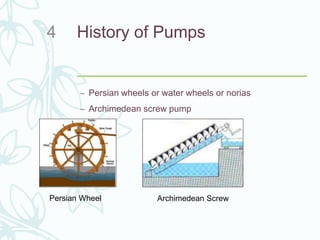
History of Pumps
– Persian wheels or water wheels or norias
– Archimedean screw pump
4
Archimedean ScrewPersian Wheel
5
2. Energy Concept
of Pump
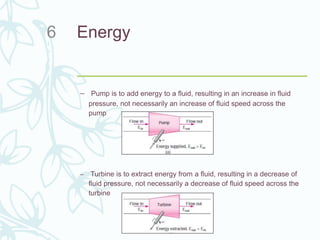
Energy
– Pump is to add energy to a fluid, resulting in an increase in fluid
pressure, not necessarily an increase of fluid speed across the
pump
– Turbine is to extract energy from a fluid, resulting in a decrease of
fluid pressure, not necessarily a decrease of fluid speed across the
turbine
6
Cont.7
8
3. Types of Pumps
and Selection Chart
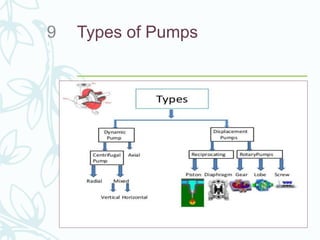
Types of Pumps9
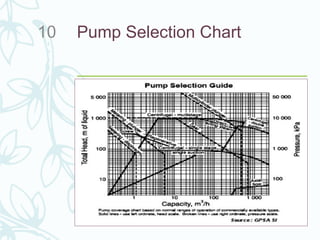
Pump Selection Chart10
11
4. Pump performance
Curve and System
resistance curve
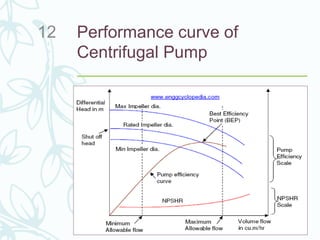
Performance curve of
Centrifugal Pump
12
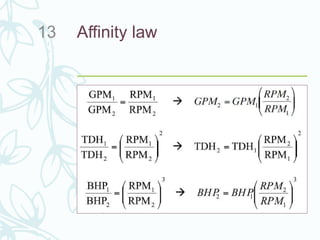
Affinity law13
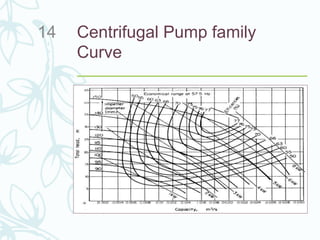
Centrifugal Pump family
Curve
14
Terminologies used in Centrifugal Pump
– NPSHr
– NPSHa
– Flow rate
– Differential head
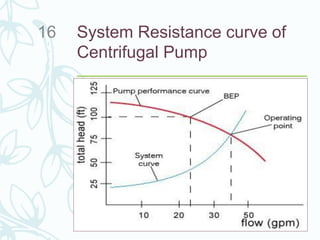
– Best efficiency point
– Allowable operating region (70 to 120 % of Best efficiency point)
– Preferred operating region (80 to 110% of Best efficiency point)
15
System Resistance curve of
Centrifugal Pump
16
17
5. Centrifugal Pump
Components and
drive systems
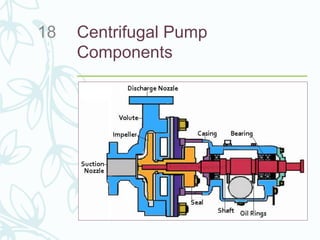
Centrifugal Pump
Components
18
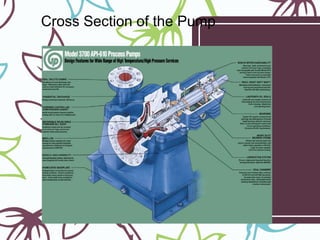
Cross Section of the Pump
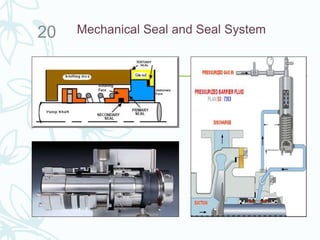
Mechanical Seal and Seal System20
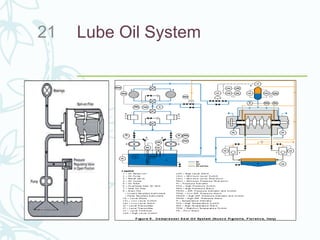
Lube Oil System21
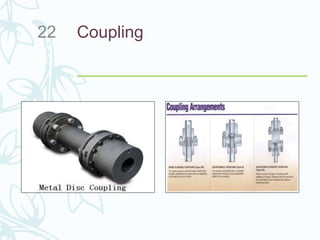
Coupling22
Drivers of Centrifugal Pump
– Electric motor
– Engines
– Steam Turbine
– Hydraulic drives
23
24
6. API Classification
of Centrifugal Pumps
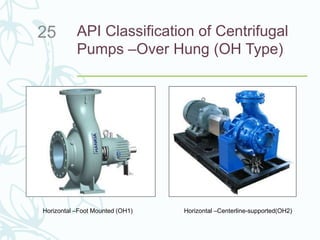
API Classification of Centrifugal
Pumps –Over Hung (OH Type)
25
Horizontal –Foot Mounted (OH1) Horizontal –Centerline-supported(OH2)
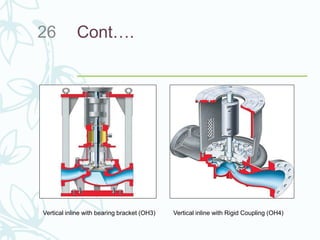
Cont….26
Vertical inline with bearing bracket (OH3) Vertical inline with Rigid Coupling (OH4)
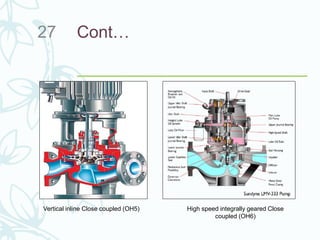
Cont…27
Vertical inline Close coupled (OH5) High speed integrally geared Close
coupled (OH6)
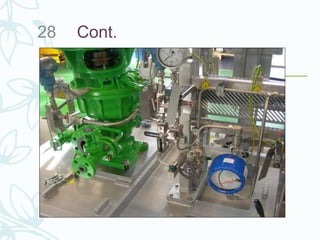
Cont.28
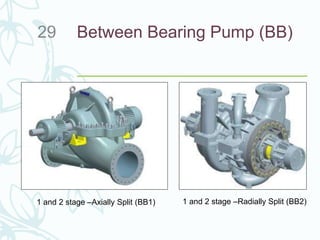
Between Bearing Pump (BB)29
1 and 2 stage –Axially Split (BB1) 1 and 2 stage –Radially Split (BB2)
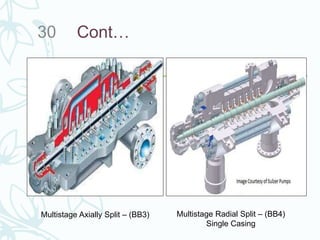
Cont…30
Multistage Axially Split – (BB3) Multistage Radial Split – (BB4)
Single Casing
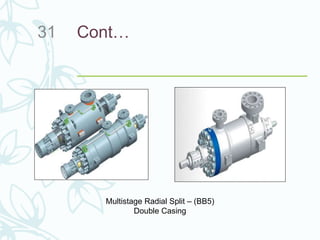
Cont…31
Multistage Radial Split – (BB5)
Double Casing
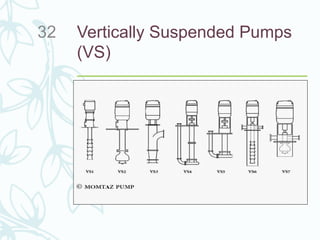
Vertically Suspended Pumps
(VS)
32
33
7. Reciprocating
Pumps
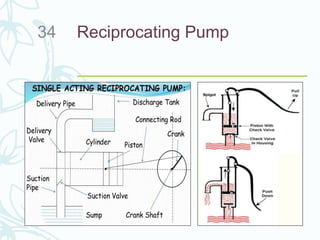
Reciprocating Pump34
Reciprocating Pump performance35
- Generate pressure in the range of
2700 barg
- Flow rate in the range of 1000 m3/h
- Used to pump high viscosity fluids,
oils, blow out preventers, subsea
applications
36
8. Special Pumps
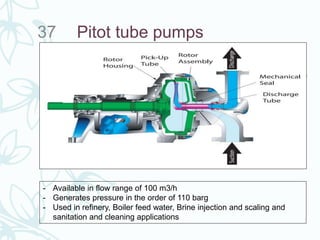
Pitot tube pumps37
- Available in flow range of 100 m3/h
- Generates pressure in the order of 110 barg
- Used in refinery, Boiler feed water, Brine injection and scaling and
sanitation and cleaning applications
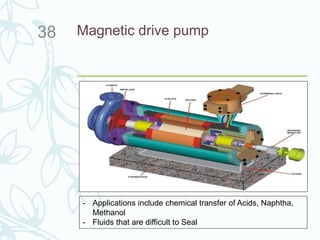
Magnetic drive pump38
- Applications include chemical transfer of Acids, Naphtha,
Methanol
- Fluids that are difficult to Seal
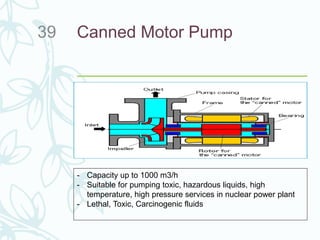
Canned Motor Pump39
- Capacity up to 1000 m3/h
- Suitable for pumping toxic, hazardous liquids, high
temperature, high pressure services in nuclear power plant
- Lethal, Toxic, Carcinogenic fluids
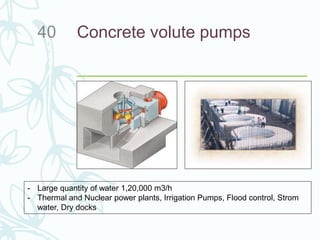
Concrete volute pumps40
- Large quantity of water 1,20,000 m3/h
- Thermal and Nuclear power plants, Irrigation Pumps, Flood control, Strom
water, Dry docks
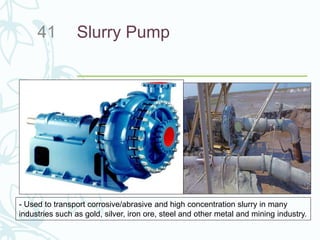
Slurry Pump41
- Used to transport corrosive/abrasive and high concentration slurry in many
industries such as gold, silver, iron ore, steel and other metal and mining industry.
Axial Flow Pump (or Propeller
pumps)
42
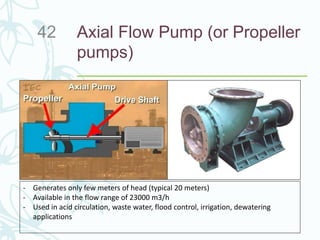
- Generates only few meters of head (typical 20 meters)
- Available in the flow range of 23000 m3/h
- Used in acid circulation, waste water, flood control, irrigation, dewatering
applications
Diaphragm Pumps
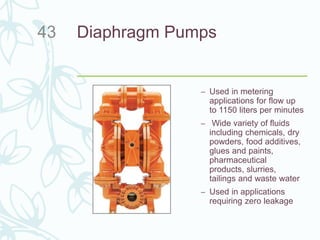
– Used in metering
applications for flow up
to 1150 liters per minutes
– Wide variety of fluids
including chemicals, dry
powders, food additives,
glues and paints,
pharmaceutical
products, slurries,
tailings and waste water
– Used in applications
requiring zero leakage
43
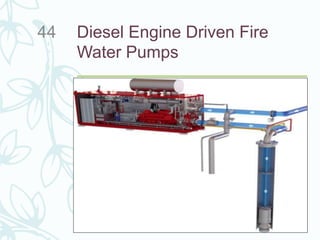
Diesel Engine Driven Fire
Water Pumps
44
45
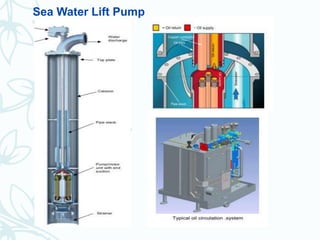
Sea Water Lift Pump
46
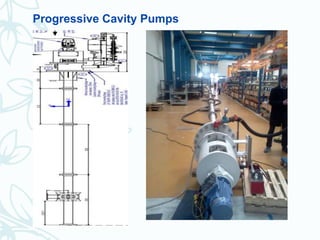
Progressive Cavity Pumps
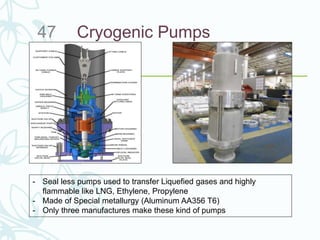
Cryogenic Pumps47
- Seal less pumps used to transfer Liquefied gases and highly
flammable like LNG, Ethylene, Propylene
- Made of Special metallurgy (Aluminum AA356 T6)
- Only three manufactures make these kind of pumps
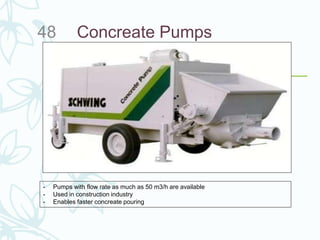
Concreate Pumps48
- Pumps with flow rate as much as 50 m3/h are available
- Used in construction industry
- Enables faster concreate pouring
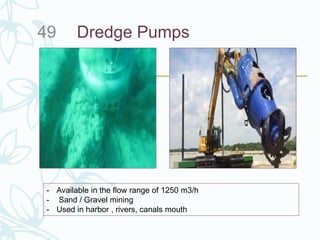
Dredge Pumps49
- Available in the flow range of 1250 m3/h
- Sand / Gravel mining
- Used in harbor , rivers, canals mouth
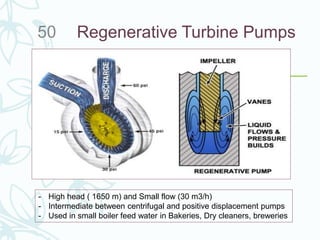
Regenerative Turbine Pumps50
- High head ( 1650 m) and Small flow (30 m3/h)
- Intermediate between centrifugal and positive displacement pumps
- Used in small boiler feed water in Bakeries, Dry cleaners, breweries
51
9. Codes and
Standards used for
Pump design
Codes and Standards used
pump design
– API 610 – Centrifugal Pumps
– API 674 – Controlled reciprocating pumps
– API 675 – Controlled volume metering pumps
– API 676 – Controlled volume rotary pumps
– API 685 – Sealless centrifugal pumps
– API 682 - Mechanical Seal and Sealing Standard
– ISO 5199
– ANSI B73.1, ANSI B73.2
– GOST R 52743
52
Thank you

Pumps