By Sebastian
How it works
• Pumped storage reservoirs aren't really a
means of generating electrical power.
They're a way of storing energy so that we
can release it quickly when we need it.
Diagram
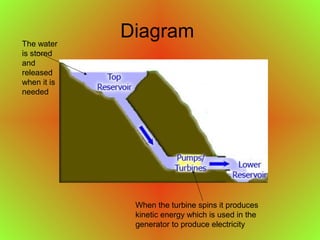
When the turbine spins it produces
kinetic energy which is used in the
generator to produce electricity
The water
is stored
and
released
when it is
needed
Advantages
• Without some means of storing energy for
quick release, we'd be in trouble.
• Little effect on the landscape.
No pollution or waste
• Its renewable
Disadvantages
• Expensive to build.
• Once it's used, you can't use it again until
you've pumped the water back up.
But the industry is very good at predicting
when the surges in power demand will
happen, so good planning can get around
this problem
Reliability
• It is very reliable because we can release
the water to make energy when we need
it.
Dinorwig
• It is a place where there is a pumped storage
stations. When water is pumped up to the top
reservoir (called "Marchlyn Mawr") we are
storing gravitational potential energy in it. The
greater the height, the more energy is stored.
The water falls 600 metres on its way to the
turbines, so it's under a great deal of pressure
when it arrives. For this reason, the tunnels are
lined with steel at the bottom end. It is a good
place because there is a lot of high ground.
Hydroelectricity improves the air we
breathe
• Hydroelectric power plants don't release
pollutants into the air. They very frequently
substitute the generation from fossil fuels,
thus reducing acid rain and smog. In
addition to this, hydroelectric
developments don't generate toxic by-
products.
Hydroelectricity offers a significant
contribution to development.
Hydroelectric installations bring electricity,
highways, industry and commerce to
communities, thus developing the
economy, expanding access to health and
education, and improving the quality of
life. Hydroelectricity is a technology that
has been known and proven for more than
a century.
Hydroelectricity offers a significant
contribution to development.
Hydroelectric installations bring electricity,
highways, industry and commerce to
communities, thus developing the
economy, expanding access to health and
education, and improving the quality of
life. Hydroelectricity is a technology that
has been known and proven for more than
a century.

Pumped Storage Hydroelectric Power

  • 1.
  • 2.
    How it works •Pumped storage reservoirs aren't really a means of generating electrical power. They're a way of storing energy so that we can release it quickly when we need it.
  • 3.
    Diagram When the turbinespins it produces kinetic energy which is used in the generator to produce electricity The water is stored and released when it is needed
  • 4.
    Advantages • Without somemeans of storing energy for quick release, we'd be in trouble. • Little effect on the landscape. No pollution or waste • Its renewable
  • 5.
    Disadvantages • Expensive tobuild. • Once it's used, you can't use it again until you've pumped the water back up. But the industry is very good at predicting when the surges in power demand will happen, so good planning can get around this problem
  • 6.
    Reliability • It isvery reliable because we can release the water to make energy when we need it.
  • 7.
    Dinorwig • It isa place where there is a pumped storage stations. When water is pumped up to the top reservoir (called "Marchlyn Mawr") we are storing gravitational potential energy in it. The greater the height, the more energy is stored. The water falls 600 metres on its way to the turbines, so it's under a great deal of pressure when it arrives. For this reason, the tunnels are lined with steel at the bottom end. It is a good place because there is a lot of high ground.
  • 8.
    Hydroelectricity improves theair we breathe • Hydroelectric power plants don't release pollutants into the air. They very frequently substitute the generation from fossil fuels, thus reducing acid rain and smog. In addition to this, hydroelectric developments don't generate toxic by- products.
  • 9.
    Hydroelectricity offers asignificant contribution to development. Hydroelectric installations bring electricity, highways, industry and commerce to communities, thus developing the economy, expanding access to health and education, and improving the quality of life. Hydroelectricity is a technology that has been known and proven for more than a century.
  • 10.
    Hydroelectricity offers asignificant contribution to development. Hydroelectric installations bring electricity, highways, industry and commerce to communities, thus developing the economy, expanding access to health and education, and improving the quality of life. Hydroelectricity is a technology that has been known and proven for more than a century.