ROBOTICS
HYDROELECTRIC DAM:
Harnessing nature’s Power
An overview of hydroelectricity Generation
Hydroelectricity
Hydroelectric energy, also called hydroelectric power or
hydroelectricity, is a form of energy that harnesses the power of water in
motion—such as water flowing over a waterfall—to generate electricity.
Renewable energy sources are crucial for several reasons:
Environmental Benefits: They produce minimal greenhouse gas emissions, reducing air and
water pollution and mitigating climate change.
Energy Security: Unlike fossil fuels, renewable sources like sunlight, wind, and water are
abundant and inexhaustible, reducing dependency on imported fuels and vulnerability to
supply disruptions.
Economic Growth: Investing in renewable energy stimulates job creation, technological
innovation, and economic development, fostering a more sustainable and resilient economy.
Public Health: By reducing pollution from fossil fuels, renewable energy sources improve
public health outcomes by decreasing respiratory and cardiovascular diseases associated
with air pollution.
Energy Access: In remote or rural areas with limited access to traditional energy sources,
renewable energy provides a viable and often more affordable solution, helping to bridge the
energy access gap.
Long-Term Sustainability: Unlike finite fossil fuels, renewable energy sources offer long-term
sustainability, ensuring energy availability for future generations without compromising
environmental integrity.
Central idea
Everything is made of matter,
which can
neither be created nor
destroyed, but
can be changed.”
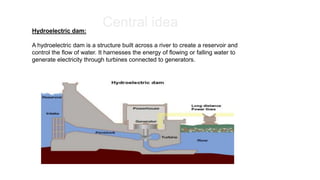
Hydroelectric dam:
A hydroelectric dam is a structure built across a river to create a reservoir and
control the flow of water. It harnesses the energy of flowing or falling water to
generate electricity through turbines connected to generators.
working of Hydroelectric Dam:
Hydroelectric dams work by harnessing the energy of flowing water to generate electricity. :
Water Intake: Dams are built across rivers to create reservoirs, which store water. Water is
then allowed to flow through intakes into the dam.
Turbines: Inside the dam, there are turbines connected to generators. The flowing water
causes the turbines to spin.
Electricity Generation: As the turbines spin, they turn the generators, which convert
mechanical energy into electrical energy.
Transmission: The electricity generated is then transmitted through power lines to homes,
businesses, and industries.
Control: Dams have systems to control the flow of water, allowing them to manage
electricity production based on demand and other factors.
Types of hydroelectric dams
Hydroelectric dams can be categorized based on size and design:
Size-based Classification:
Large-scale Dams: These are massive structures designed to generate
significant amounts of electricity. They typically have reservoirs covering
large areas and high power generation capacities.
Small-scale Dams: These dams are smaller in size and are often used to
power local communities or industries. They may not have large reservoirs
and generate relatively lower amounts of electricity.
Types of hydroelectric Dams (cont)
Design-based Classification:
Conventional Dams:These dams are the most common type and are built across rivers to create
reservoirs. Water is then released through turbines to generate electricity.
Pumped-storage Dams: These dams have two reservoirs at different elevations. During times of
low electricity demand, water is pumped from the lower reservoir to the upper one. When demand is
high, water is released back down to generate electricity.
Run-of-the-river Dams: Unlike conventional dams, run-of-the-river dams don't create large
reservoirs. Instead, they divert a portion of the river's flow through turbines to generate electricity. They
have less environmental impact but may not generate as much power.
Diversionary Dams: These dams divert a portion of the river's flow through a canal or tunnel to
generate electricity without creating a large reservoir.
Advantages of hydroelectric Dam:
1. Renewable Energy: Hydroelectric dams harness the power of flowing water to
generate electricity, making it a renewable energy source.
2. Low Operating Costs: Once a dam is built, the operational costs are relatively low
compared to other energy sources, as water is free and abundant.
3. Clean Energy: Hydroelectric power produces minimal greenhouse gas emissions,
making it environmentally friendly compared to fossil fuels.
4. Flood Control: Dams can regulate water flow, helping to prevent flooding in
downstream areas during periods of heavy rainfall.
5. Water Supply: Dams can also provide a reliable source of water for irrigation, drinking,
and industrial use.
6. Reliable Power Generation: Hydroelectric power plants can provide consistent and
reliable electricity generation, helping to stabilize the grid.
Disadvantages of hydroelectric dams
1. Environmental Impact: Dams can disrupt ecosystems, alter river flows, and harm aquatic
habitats, leading to loss of biodiversity and disruption of natural processes.
2. Habitat Destruction: The creation of reservoirs behind dams can inundate large areas of
land, displacing wildlife and destroying habitats, sometimes leading to the extinction of
species.
3. Displacement of Communities: The construction of dams can result in the displacement of
communities living in the affected areas, leading to social and cultural disruptions.
4. Sedimentation: Dams can trap sediment, leading to downstream erosion, reduced fertility of
agricultural land, and changes in river morphology.
5. Methane Emissions: In some cases, reservoirs behind dams can produce methane, a potent
greenhouse gas, due to the decomposition of organic matter in the flooded area.
6. Risk of Failure: Dams pose the risk of catastrophic failure, which can result in flooding, loss
of life, and property damage downstream.
TUNING IN
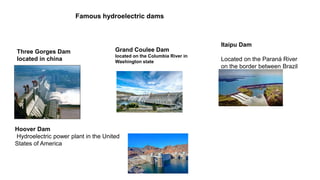
Famous hydroelectric dams
Three Gorges Dam
located in china
Grand Coulee Dam
located on the Columbia River in
Washington state
Itaipu Dam
Located on the Paraná River
on the border between Brazil
and Paraguay
Hoover Dam
Hydroelectric power plant in the United
States of America
FINDING OUT
Economic impacts:
Hydroelectric plants can have significant economic impacts:
Job Creation: They create jobs during construction, operation, and maintenance,
benefiting local economies.
Energy Production: They generate electricity, reducing dependence on expensive fossil
fuels and stabilizing energy prices.
Revenue Generation: Hydroelectricity can be sold to utilities, providing revenue for the
plant owners and potentially lowering electricity costs for consumers.
Tourism and Recreation: Reservoirs created by hydroelectric dams can attract tourists for
activities like boating, fishing, and sightseeing, boosting local businesses.
Flood Control: They can mitigate flood risks, preventing damage to property and
infrastructure, which saves money in disaster recovery and insurance costs.
Environmental Impacts While they have environmental costs, such as habitat disruption,
they can also provide benefits like reduced greenhouse gas emissions compared to fossil
fuel-based energy sources.
Introduction:
Electrical generator is a machine
used to produce electricity. It
converts mechanical energy into
electrical energy.
Future outlook for hydroelectric plant
Modernization and Efficiency: Many existing hydroelectric plants are being modernized to improve
efficiency and capacity, extending their lifespan.
Small-Scale Hydro: There's growing interest in small-scale hydroelectric projects, which have lower
environmental impacts and can be integrated into existing infrastructure more easily.
Pumped Storage Hydro: These facilities, which store energy by pumping water uphill and releasing it
when needed, are becoming more important for balancing the grid with increasing renewable energy
sources.
Environmental Concerns: Despite their benefits, new hydroelectric projects face opposition due to
environmental concerns, particularly regarding habitat disruption and impacts on fish populations.
Climate Change Resilience: Hydroelectricity's role in providing reliable, renewable energy makes it
crucial for climate change resilience, as it can help mitigate the effects of extreme weather events and
reduce greenhouse gas emissions.
Technological Innovations: Advances in turbine design, materials, and monitoring systems are
improving the efficiency and environmental performance of hydroelectric plants.
Integration with Other Renewables: Hydroelectricity will likely play a key role in integrated energy
systems alongside other renewables like solar and wind, providing stability and grid flexibility

Electric damm Presentation electricity Production.pptx

  • 1.
  • 2.
    HYDROELECTRIC DAM: Harnessing nature’sPower An overview of hydroelectricity Generation
  • 3.
    Hydroelectricity Hydroelectric energy, alsocalled hydroelectric power or hydroelectricity, is a form of energy that harnesses the power of water in motion—such as water flowing over a waterfall—to generate electricity.
  • 4.
    Renewable energy sourcesare crucial for several reasons: Environmental Benefits: They produce minimal greenhouse gas emissions, reducing air and water pollution and mitigating climate change. Energy Security: Unlike fossil fuels, renewable sources like sunlight, wind, and water are abundant and inexhaustible, reducing dependency on imported fuels and vulnerability to supply disruptions. Economic Growth: Investing in renewable energy stimulates job creation, technological innovation, and economic development, fostering a more sustainable and resilient economy. Public Health: By reducing pollution from fossil fuels, renewable energy sources improve public health outcomes by decreasing respiratory and cardiovascular diseases associated with air pollution. Energy Access: In remote or rural areas with limited access to traditional energy sources, renewable energy provides a viable and often more affordable solution, helping to bridge the energy access gap. Long-Term Sustainability: Unlike finite fossil fuels, renewable energy sources offer long-term sustainability, ensuring energy availability for future generations without compromising environmental integrity.
  • 5.
    Central idea Everything ismade of matter, which can neither be created nor destroyed, but can be changed.” Hydroelectric dam: A hydroelectric dam is a structure built across a river to create a reservoir and control the flow of water. It harnesses the energy of flowing or falling water to generate electricity through turbines connected to generators.
  • 6.
    working of HydroelectricDam: Hydroelectric dams work by harnessing the energy of flowing water to generate electricity. : Water Intake: Dams are built across rivers to create reservoirs, which store water. Water is then allowed to flow through intakes into the dam. Turbines: Inside the dam, there are turbines connected to generators. The flowing water causes the turbines to spin. Electricity Generation: As the turbines spin, they turn the generators, which convert mechanical energy into electrical energy. Transmission: The electricity generated is then transmitted through power lines to homes, businesses, and industries. Control: Dams have systems to control the flow of water, allowing them to manage electricity production based on demand and other factors.
  • 7.
    Types of hydroelectricdams Hydroelectric dams can be categorized based on size and design: Size-based Classification: Large-scale Dams: These are massive structures designed to generate significant amounts of electricity. They typically have reservoirs covering large areas and high power generation capacities. Small-scale Dams: These dams are smaller in size and are often used to power local communities or industries. They may not have large reservoirs and generate relatively lower amounts of electricity.
  • 8.
    Types of hydroelectricDams (cont) Design-based Classification: Conventional Dams:These dams are the most common type and are built across rivers to create reservoirs. Water is then released through turbines to generate electricity. Pumped-storage Dams: These dams have two reservoirs at different elevations. During times of low electricity demand, water is pumped from the lower reservoir to the upper one. When demand is high, water is released back down to generate electricity. Run-of-the-river Dams: Unlike conventional dams, run-of-the-river dams don't create large reservoirs. Instead, they divert a portion of the river's flow through turbines to generate electricity. They have less environmental impact but may not generate as much power. Diversionary Dams: These dams divert a portion of the river's flow through a canal or tunnel to generate electricity without creating a large reservoir.
  • 9.
    Advantages of hydroelectricDam: 1. Renewable Energy: Hydroelectric dams harness the power of flowing water to generate electricity, making it a renewable energy source. 2. Low Operating Costs: Once a dam is built, the operational costs are relatively low compared to other energy sources, as water is free and abundant. 3. Clean Energy: Hydroelectric power produces minimal greenhouse gas emissions, making it environmentally friendly compared to fossil fuels. 4. Flood Control: Dams can regulate water flow, helping to prevent flooding in downstream areas during periods of heavy rainfall. 5. Water Supply: Dams can also provide a reliable source of water for irrigation, drinking, and industrial use. 6. Reliable Power Generation: Hydroelectric power plants can provide consistent and reliable electricity generation, helping to stabilize the grid.
  • 10.
    Disadvantages of hydroelectricdams 1. Environmental Impact: Dams can disrupt ecosystems, alter river flows, and harm aquatic habitats, leading to loss of biodiversity and disruption of natural processes. 2. Habitat Destruction: The creation of reservoirs behind dams can inundate large areas of land, displacing wildlife and destroying habitats, sometimes leading to the extinction of species. 3. Displacement of Communities: The construction of dams can result in the displacement of communities living in the affected areas, leading to social and cultural disruptions. 4. Sedimentation: Dams can trap sediment, leading to downstream erosion, reduced fertility of agricultural land, and changes in river morphology. 5. Methane Emissions: In some cases, reservoirs behind dams can produce methane, a potent greenhouse gas, due to the decomposition of organic matter in the flooded area. 6. Risk of Failure: Dams pose the risk of catastrophic failure, which can result in flooding, loss of life, and property damage downstream.
  • 11.
    TUNING IN Famous hydroelectricdams Three Gorges Dam located in china Grand Coulee Dam located on the Columbia River in Washington state Itaipu Dam Located on the Paraná River on the border between Brazil and Paraguay Hoover Dam Hydroelectric power plant in the United States of America
  • 12.
    FINDING OUT Economic impacts: Hydroelectricplants can have significant economic impacts: Job Creation: They create jobs during construction, operation, and maintenance, benefiting local economies. Energy Production: They generate electricity, reducing dependence on expensive fossil fuels and stabilizing energy prices. Revenue Generation: Hydroelectricity can be sold to utilities, providing revenue for the plant owners and potentially lowering electricity costs for consumers. Tourism and Recreation: Reservoirs created by hydroelectric dams can attract tourists for activities like boating, fishing, and sightseeing, boosting local businesses. Flood Control: They can mitigate flood risks, preventing damage to property and infrastructure, which saves money in disaster recovery and insurance costs. Environmental Impacts While they have environmental costs, such as habitat disruption, they can also provide benefits like reduced greenhouse gas emissions compared to fossil fuel-based energy sources.
  • 13.
    Introduction: Electrical generator isa machine used to produce electricity. It converts mechanical energy into electrical energy. Future outlook for hydroelectric plant Modernization and Efficiency: Many existing hydroelectric plants are being modernized to improve efficiency and capacity, extending their lifespan. Small-Scale Hydro: There's growing interest in small-scale hydroelectric projects, which have lower environmental impacts and can be integrated into existing infrastructure more easily. Pumped Storage Hydro: These facilities, which store energy by pumping water uphill and releasing it when needed, are becoming more important for balancing the grid with increasing renewable energy sources. Environmental Concerns: Despite their benefits, new hydroelectric projects face opposition due to environmental concerns, particularly regarding habitat disruption and impacts on fish populations. Climate Change Resilience: Hydroelectricity's role in providing reliable, renewable energy makes it crucial for climate change resilience, as it can help mitigate the effects of extreme weather events and reduce greenhouse gas emissions. Technological Innovations: Advances in turbine design, materials, and monitoring systems are improving the efficiency and environmental performance of hydroelectric plants. Integration with Other Renewables: Hydroelectricity will likely play a key role in integrated energy systems alongside other renewables like solar and wind, providing stability and grid flexibility