PUMP-OUT TESTS IN
ALLUVIAL SANDS
– A CASE STUDY
Sorabh Gupta, Sanjay Gupta & Ravi Sundaram
Cengrs Geotechnica Pvt. Ltd.
1
PUMP-OUT TESTS IN
ALLUVIAL SANDS
– A CASE STUDY
Sorabh Gupta, Sanjay Gupta & Ravi Sundaram
Cengrs Geotechnica Pvt. Ltd.
1
The Need
2
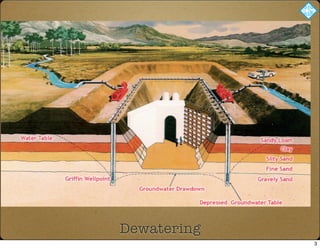
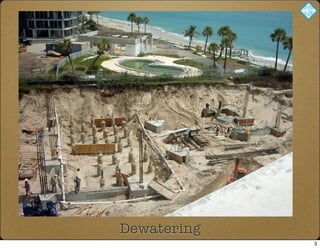
Dewatering
3
Dewatering
3
The Challenge
Effective Design of Dewatering Systems for
construction sites requires precise estimates of
hydrogeological parameters of the aquifer,
such as hydraulic conductivity / permeability,
etc.
4
The Challenge
Effective Design of Dewatering Systems for
construction sites requires precise estimates of
hydrogeological parameters of the aquifer,
such as hydraulic conductivity / permeability,
etc.
..particularly on sites where alluvial sands are
encountered
4
Definitions
1. Hydraulic Conductivity (K), m/sec
Volume of water (m3) through unit section of soil (m2) in unit
time (s) under unit hydraulic gradient.
2. Transmissivity (T), m2/day (Productivity of an aquifer)
Water capacity which flows per unit length through an
aquifer under hydraulic gradient
3. Storage coefficient (%)
Volume of water it takes / releases per unit surface area of
aquifer under unit change of head.
4. Specific capacity
Discharge for unit time for unit draw down
c = Q / s
5
Laboratory Permeability Tests (Falling Head,
Constant Head)
Tracer Tests
Borehole Tests
Falling Head in Soils
Packer Tests in Rock
Full Scale Pump Out / Aquifer Tests
Geotechnical Investigations
6
Laboratory Permeability Tests (Falling Head,
Constant Head)
Tracer Tests
Borehole Tests
Falling Head in Soils
Packer Tests in Rock
Full Scale Pump Out / Aquifer Tests
Geotechnical Investigations
6
Pump Out / Aquifer Test
Advantages
Determine hydraulic parameters on global scale
Results directly used for design of dewatering
systems
Design the test as per site/project requirements
7
Case Study 1 : Mall at Noida
8
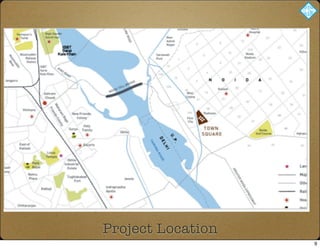
Project Location
9
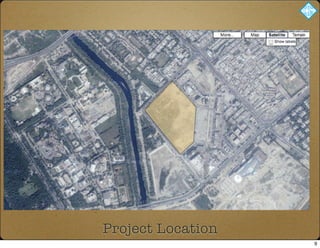
Project Location
9
Project Overview
Located in a densely populated area
As per Initial Planning:
G+5, 3 basements
Foundation Level = 18 m below OGL
10
Site Conditions
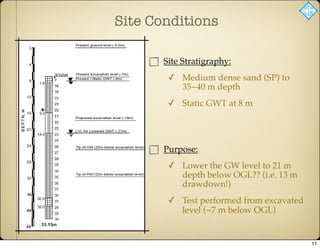
Site Stratigraphy:
✓ Medium dense sand (SP) to
35~40 m depth
✓ Static GWT at 8 m
Purpose:
✓ Lower the GW level to 21 m
depth below OGL?? (i.e. 13 m
drawdown!)
✓ Test performed from excavated
level (~7 m below OGL)
11
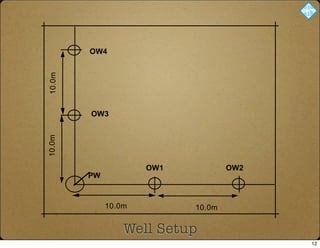
10.0m10.0m
PW
OW1 OW2
OW3
OW410.0m10.0m
Well Setup
12
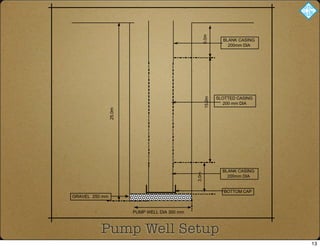
Pump Well Setup
13
Pump Well Setup
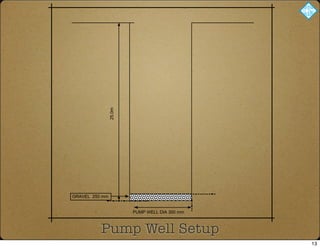
25.0m
PUMP WELL DIA 300 mm
GRAVEL 250 mm
13
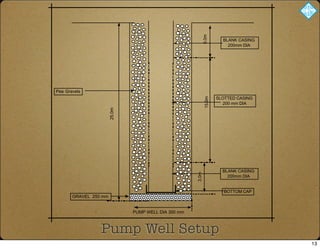
Pump Well Setup
6.0m
3.0m
15.0m
BLANK CASING
200mm DIA
BLANK CASING
200mm DIA
SLOTTED CASING
200 mm DIA
BOTTOM CAP
25.0m
PUMP WELL DIA 300 mm
GRAVEL 250 mm
13
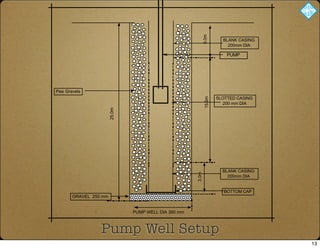
Pump Well Setup
6.0m
3.0m
15.0m
BLANK CASING
200mm DIA
BLANK CASING
200mm DIA
SLOTTED CASING
200 mm DIA
BOTTOM CAP
Pea Gravels
25.0m
PUMP WELL DIA 300 mm
GRAVEL 250 mm
13
Pump Well Setup
6.0m
3.0m
15.0m
BLANK CASING
200mm DIA
BLANK CASING
200mm DIA
SLOTTED CASING
200 mm DIA
BOTTOM CAP
Pea Gravels
PUMP
25.0m
PUMP WELL DIA 300 mm
GRAVEL 250 mm
13
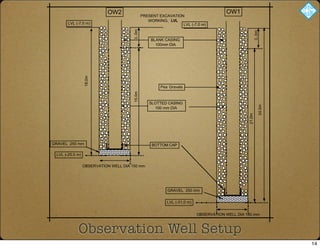
LVL (-7.0 m)
3..0m
PRESENT EXCAVATION
WORKING, LVL
OBSERVATION WELL DIA 150 mm
GRAVEL 250 mm
SLOTTED CASING
100 mm DIA
BLANK CASING
100mm DIA
18.0m
LVL (-25.0 m)
15.0m
OW2
BOTTOM CAP
3..0m
LVL (-7.0 m)
GRAVEL 250 mm
LVL (-31.0 m)
OW1
OBSERVATION WELL DIA 150 mm
21.0m
24.0m
Pea Gravels
Observation Well Setup
14
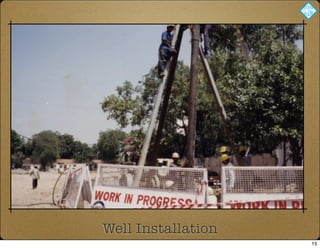
Well Installation
15
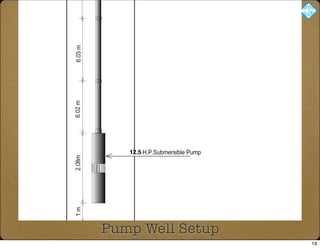
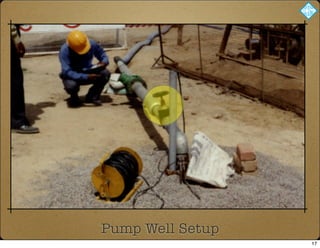
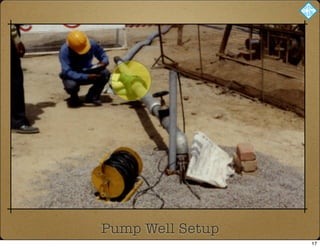
Pump Well Setup
12.5
16
Pump Well Setup
16
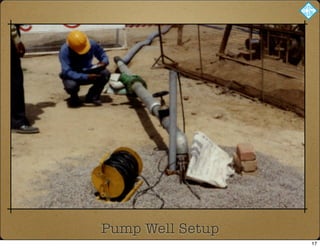
Pump Well Setup
17
Pump Well Setup
17
Pump Well Setup
17
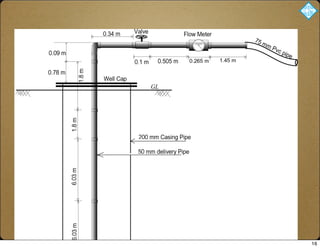
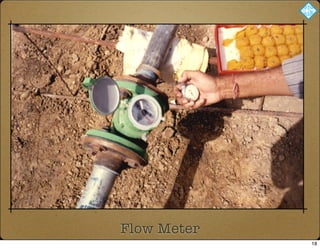
Flow Meter
18
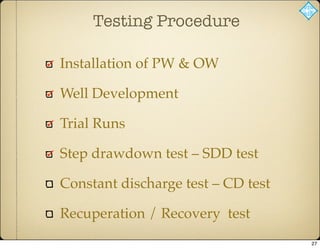
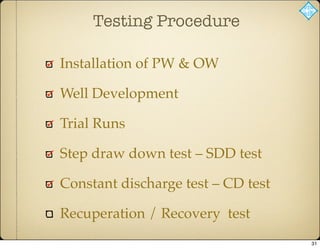
Testing Procedure
Installation of PW & OW
Well Development
Trial Runs
Step drawdown test – SDD test
Constant discharge test – CD test
Recuperation / Recovery test
19
Testing Procedure
Installation of PW & OW
Well Development
Trial Runs
Step drawdown test – SDD test
Constant discharge test – CD test
Recuperation / Recovery test
19
Testing Procedure
Installation of PW & OW
Well Development
Trial Runs
Step drawdown test – SDD test
Constant discharge test – CD test
Recuperation / Recovery test
20
Testing Procedure
Installation of PW & OW
Well Development
Trial Runs
Step drawdown test – SDD test
Constant discharge test – CD test
Recuperation / Recovery test
20
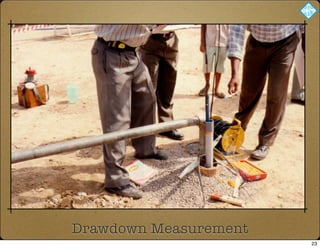
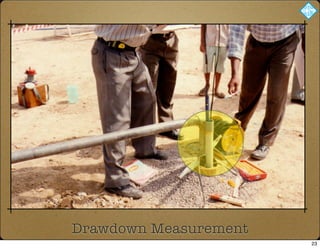
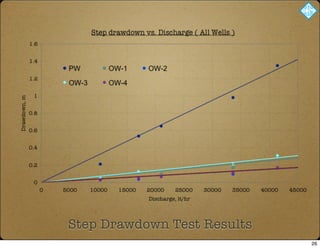
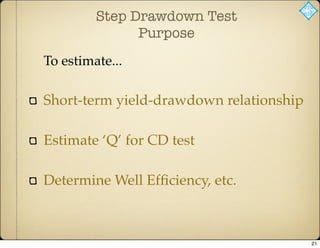
Step Drawdown Test
Purpose
To estimate...
Short-term yield-drawdown relationship
Estimate ‘Q’ for CD test
Determine Well Efficiency, etc.
21
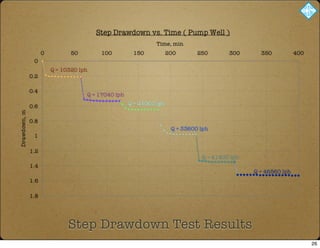
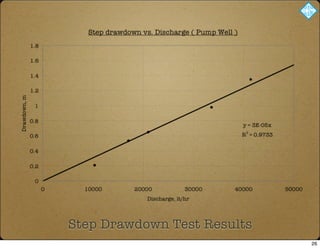
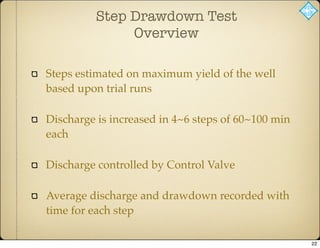
Step Drawdown Test
Overview
Steps estimated on maximum yield of the well
based upon trial runs
Discharge is increased in 4~6 steps of 60~100 min
each
Discharge controlled by Control Valve
Average discharge and drawdown recorded with
time for each step
22
Step Drawdown Test
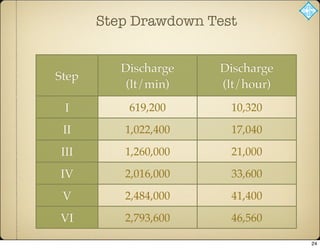
Step
Discharge
(lt/min)
Discharge
(lt/hour)
I
II
III
IV
V
VI
619,200 10,320
1,022,400 17,040
1,260,000 21,000
2,016,000 33,600
2,484,000 41,400
2,793,600 46,560
24
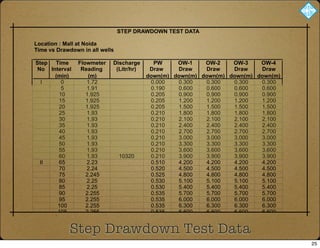
Location : Mall at Noida
Time vs Drawdown in all wells
Step Time Flowmeter Discharge PW OW-1 OW-2 OW-3 OW-4
No Interval Reading (Litr/hr) Draw Draw Draw Draw Draw
(min) (m) down(m) down(m) down(m) down(m) down(m)
I 0 1.72 0.000 0.300 0.300 0.300 0.300
5 1.91 0.190 0.600 0.600 0.600 0.600
10 1.925 0.205 0.900 0.900 0.900 0.900
15 1.925 0.205 1.200 1.200 1.200 1.200
20 1.925 0.205 1.500 1.500 1.500 1.500
25 1.93 0.210 1.800 1.800 1.800 1.800
30 1.93 0.210 2.100 2.100 2.100 2.100
35 1.93 0.210 2.400 2.400 2.400 2.400
40 1.93 0.210 2.700 2.700 2.700 2.700
45 1.93 0.210 3.000 3.000 3.000 3.000
50 1.93 0.210 3.300 3.300 3.300 3.300
55 1.93 0.210 3.600 3.600 3.600 3.600
60 1.93 10320 0.210 3.900 3.900 3.900 3.900
II 65 2.23 0.510 4.200 4.200 4.200 4.200
70 2.24 0.520 4.500 4.500 4.500 4.500
75 2.245 0.525 4.800 4.800 4.800 4.800
80 2.25 0.530 5.100 5.100 5.100 5.100
85 2.25 0.530 5.400 5.400 5.400 5.400
90 2.255 0.535 5.700 5.700 5.700 5.700
95 2.255 0.535 6.000 6.000 6.000 6.000
100 2.255 0.535 6.300 6.300 6.300 6.300
105 2.255 0.535 6.600 6.600 6.600 6.600
110 2.255 0.535 6.900 6.900 6.900 6.900
115 2.255 0.535 7.200 7.200 7.200 7.200
120 2.255 17040 0.535 7.500 7.450 7.500 7.500
III 125 2.3 0.580 7.800 7.750 7.800 7.800
130 2.35 0.630 8.100 8.080 8.080 8.100
STEP DRAWDOWN TEST DATA
Step Drawdown Test Data
25
Drawdown Measurement
23
Drawdown Measurement
23
Step Drawdown Test Results
26
Step Drawdown Test Results
26
Step Drawdown Test Results
26
Testing Procedure
Installation of PW & OW
Well Development
Trial Runs
Step drawdown test – SDD test
Constant discharge test – CD test
Recuperation / Recovery test
27
Testing Procedure
Installation of PW & OW
Well Development
Trial Runs
Step drawdown test – SDD test
Constant discharge test – CD test
Recuperation / Recovery test
27
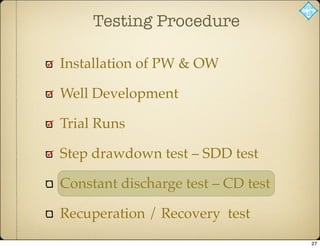
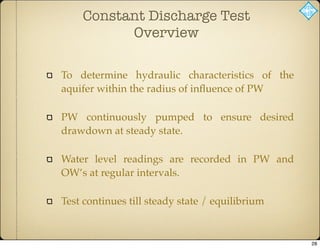
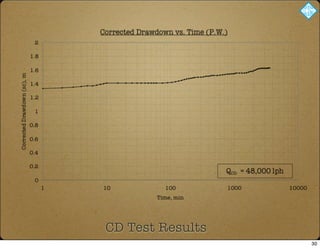
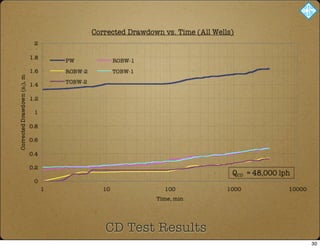
Constant Discharge Test
Overview
To determine hydraulic characteristics of the
aquifer within the radius of influence of PW
PW continuously pumped to ensure desired
drawdown at steady state.
Water level readings are recorded in PW and
OW’s at regular intervals.
Test continues till steady state / equilibrium
28
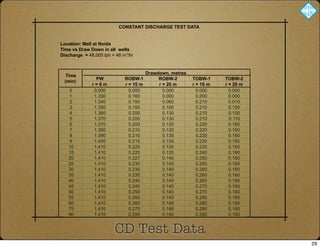
CONSTANT DISCHARGE TEST DATA
Location: Mall at Noida
Time vs Draw Down in all wells
Discharge = 48,000 lph = 48 m3
/hr
PW ROBW-1 ROBW-2 TOBW-1 TOBW-2
r = 0 m r = 10 m r = 20 m r = 10 m r = 20 m
0 0.000 0.000 0.000 0.000 0.000
1 1.330 0.160 0.000 0.200 0.000
2 1.340 0.190 0.060 0.210 0.010
3 1.350 0.195 0.100 0.210 0.100
4 1.360 0.200 0.130 0.210 0.100
5 1.370 0.200 0.130 0.210 0.110
6 1.370 0.200 0.130 0.220 0.160
7 1.380 0.210 0.130 0.220 0.160
8 1.390 0.210 0.130 0.220 0.160
9 1.400 0.215 0.130 0.230 0.160
10 1.410 0.220 0.130 0.230 0.160
15 1.410 0.225 0.135 0.240 0.160
20 1.410 0.227 0.140 0.250 0.160
25 1.410 0.230 0.140 0.250 0.160
30 1.410 0.230 0.140 0.260 0.160
35 1.410 0.235 0.140 0.260 0.160
40 1.410 0.240 0.140 0.260 0.160
45 1.410 0.245 0.140 0.270 0.160
50 1.410 0.250 0.140 0.270 0.160
55 1.410 0.260 0.140 0.280 0.160
60 1.410 0.260 0.140 0.280 0.160
75 1.410 0.270 0.140 0.280 0.160
90 1.415 0.290 0.140 0.290 0.160
105 1.420 0.320 0.150 0.290 0.165
120 1.430 0.320 0.160 0.290 0.170
135 1.440 0.320 0.170 0.300 0.175
150 1.450 0.325 0.175 0.305 0.175
165 1.460 0.330 0.180 0.320 0.180
Time
(min)
Drawdown, metres
CD Test Data
29
CD Test Results
30
CD Test Results
30
Testing Procedure
Installation of PW & OW
Well Development
Trial Runs
Step draw down test – SDD test
Constant discharge test – CD test
Recuperation / Recovery test
31
Testing Procedure
Installation of PW & OW
Well Development
Trial Runs
Step draw down test – SDD test
Constant discharge test – CD test
Recuperation / Recovery test
31
Recuperation / Recovery Test
After CD test is complete, Pump is stopped
Take water level readings in same sequence
as for CD
Test continues till water level rises up to
static level
Provides independent check of CD Results
32
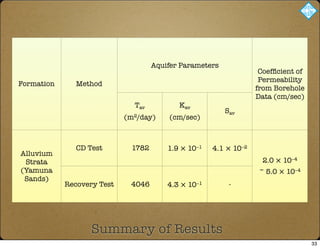
Formation Method
Aquifer Parameters
Coefficient of
Permeability
from Borehole
Data (cm/sec)
Tav
(m2/day)
Kav
(cm/sec)
Sav
Alluvium
Strata
(Yamuna
Sands)
CD Test 1782 1.9 × 10⁻¹ 4.1 × 10⁻²
2.0 × 10⁻⁴
~ 5.0 × 10⁻⁴
Recovery Test 4046 4.3 × 10⁻¹ -
Summary of Results
33
Formation Method
Aquifer Parameters
Coefficient of
Permeability
from Borehole
Data (cm/sec)
Tav
(m2/day)
Kav
(cm/sec)
Sav
Alluvium
Strata
(Yamuna
Sands)
CD Test 1782 1.9 × 10⁻¹ 4.1 × 10⁻²
2.0 × 10⁻⁴
~ 5.0 × 10⁻⁴
Recovery Test 4046 4.3 × 10⁻¹ -
Summary of Results
33
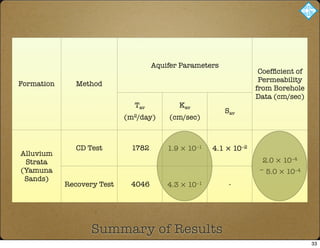
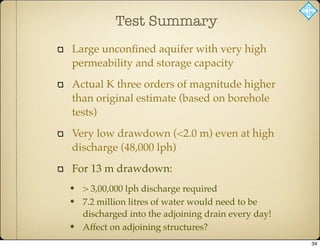
Test Summary
Large unconfined aquifer with very high
permeability and storage capacity
Actual K three orders of magnitude higher
than original estimate (based on borehole
tests)
Very low drawdown (<2.0 m) even at high
discharge (48,000 lph)
For 13 m drawdown:
• > 3,00,000 lph discharge required
• 7.2 million litres of water would need to be
discharged into the adjoining drain every day!
• Affect on adjoining structures?
34
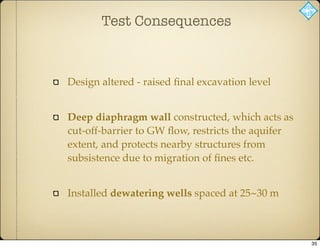
Test Consequences
Design altered - raised final excavation level
Deep diaphragm wall constructed, which acts as
cut-off-barrier to GW flow, restricts the aquifer
extent, and protects nearby structures from
subsistence due to migration of fines etc.
Installed dewatering wells spaced at 25~30 m
35
Geotechnical Engineering is a Science,
But its Practice, an Art...
36

Pump out tests in alluvial sands – a case study

  • 1.
    PUMP-OUT TESTS IN ALLUVIALSANDS – A CASE STUDY Sorabh Gupta, Sanjay Gupta & Ravi Sundaram Cengrs Geotechnica Pvt. Ltd. 1
  • 2.
    PUMP-OUT TESTS IN ALLUVIALSANDS – A CASE STUDY Sorabh Gupta, Sanjay Gupta & Ravi Sundaram Cengrs Geotechnica Pvt. Ltd. 1
  • 3.
  • 4.
  • 5.
  • 6.
    The Challenge Effective Designof Dewatering Systems for construction sites requires precise estimates of hydrogeological parameters of the aquifer, such as hydraulic conductivity / permeability, etc. 4
  • 7.
    The Challenge Effective Designof Dewatering Systems for construction sites requires precise estimates of hydrogeological parameters of the aquifer, such as hydraulic conductivity / permeability, etc. ..particularly on sites where alluvial sands are encountered 4
  • 8.
    Definitions 1. Hydraulic Conductivity(K), m/sec Volume of water (m3) through unit section of soil (m2) in unit time (s) under unit hydraulic gradient. 2. Transmissivity (T), m2/day (Productivity of an aquifer) Water capacity which flows per unit length through an aquifer under hydraulic gradient 3. Storage coefficient (%) Volume of water it takes / releases per unit surface area of aquifer under unit change of head. 4. Specific capacity Discharge for unit time for unit draw down c = Q / s 5
  • 9.
    Laboratory Permeability Tests(Falling Head, Constant Head) Tracer Tests Borehole Tests Falling Head in Soils Packer Tests in Rock Full Scale Pump Out / Aquifer Tests Geotechnical Investigations 6
  • 10.
    Laboratory Permeability Tests(Falling Head, Constant Head) Tracer Tests Borehole Tests Falling Head in Soils Packer Tests in Rock Full Scale Pump Out / Aquifer Tests Geotechnical Investigations 6
  • 11.
    Pump Out /Aquifer Test Advantages Determine hydraulic parameters on global scale Results directly used for design of dewatering systems Design the test as per site/project requirements 7
  • 12.
    Case Study 1: Mall at Noida 8
  • 13.
  • 14.
  • 15.
    Project Overview Located ina densely populated area As per Initial Planning: G+5, 3 basements Foundation Level = 18 m below OGL 10
  • 16.
    Site Conditions Site Stratigraphy: ✓Medium dense sand (SP) to 35~40 m depth ✓ Static GWT at 8 m Purpose: ✓ Lower the GW level to 21 m depth below OGL?? (i.e. 13 m drawdown!) ✓ Test performed from excavated level (~7 m below OGL) 11
  • 17.
  • 18.
  • 19.
    Pump Well Setup 25.0m PUMPWELL DIA 300 mm GRAVEL 250 mm 13
  • 20.
    Pump Well Setup 6.0m 3.0m 15.0m BLANKCASING 200mm DIA BLANK CASING 200mm DIA SLOTTED CASING 200 mm DIA BOTTOM CAP 25.0m PUMP WELL DIA 300 mm GRAVEL 250 mm 13
  • 21.
    Pump Well Setup 6.0m 3.0m 15.0m BLANKCASING 200mm DIA BLANK CASING 200mm DIA SLOTTED CASING 200 mm DIA BOTTOM CAP Pea Gravels 25.0m PUMP WELL DIA 300 mm GRAVEL 250 mm 13
  • 22.
    Pump Well Setup 6.0m 3.0m 15.0m BLANKCASING 200mm DIA BLANK CASING 200mm DIA SLOTTED CASING 200 mm DIA BOTTOM CAP Pea Gravels PUMP 25.0m PUMP WELL DIA 300 mm GRAVEL 250 mm 13
  • 23.
    LVL (-7.0 m) 3..0m PRESENTEXCAVATION WORKING, LVL OBSERVATION WELL DIA 150 mm GRAVEL 250 mm SLOTTED CASING 100 mm DIA BLANK CASING 100mm DIA 18.0m LVL (-25.0 m) 15.0m OW2 BOTTOM CAP 3..0m LVL (-7.0 m) GRAVEL 250 mm LVL (-31.0 m) OW1 OBSERVATION WELL DIA 150 mm 21.0m 24.0m Pea Gravels Observation Well Setup 14
  • 24.
  • 25.
  • 26.
  • 27.
  • 28.
  • 29.
  • 30.
  • 31.
    Testing Procedure Installation ofPW & OW Well Development Trial Runs Step drawdown test – SDD test Constant discharge test – CD test Recuperation / Recovery test 19
  • 32.
    Testing Procedure Installation ofPW & OW Well Development Trial Runs Step drawdown test – SDD test Constant discharge test – CD test Recuperation / Recovery test 19
  • 33.
    Testing Procedure Installation ofPW & OW Well Development Trial Runs Step drawdown test – SDD test Constant discharge test – CD test Recuperation / Recovery test 20
  • 34.
    Testing Procedure Installation ofPW & OW Well Development Trial Runs Step drawdown test – SDD test Constant discharge test – CD test Recuperation / Recovery test 20
  • 35.
    Step Drawdown Test Purpose Toestimate... Short-term yield-drawdown relationship Estimate ‘Q’ for CD test Determine Well Efficiency, etc. 21
  • 36.
    Step Drawdown Test Overview Stepsestimated on maximum yield of the well based upon trial runs Discharge is increased in 4~6 steps of 60~100 min each Discharge controlled by Control Valve Average discharge and drawdown recorded with time for each step 22
  • 37.
    Step Drawdown Test Step Discharge (lt/min) Discharge (lt/hour) I II III IV V VI 619,20010,320 1,022,400 17,040 1,260,000 21,000 2,016,000 33,600 2,484,000 41,400 2,793,600 46,560 24
  • 38.
    Location : Mallat Noida Time vs Drawdown in all wells Step Time Flowmeter Discharge PW OW-1 OW-2 OW-3 OW-4 No Interval Reading (Litr/hr) Draw Draw Draw Draw Draw (min) (m) down(m) down(m) down(m) down(m) down(m) I 0 1.72 0.000 0.300 0.300 0.300 0.300 5 1.91 0.190 0.600 0.600 0.600 0.600 10 1.925 0.205 0.900 0.900 0.900 0.900 15 1.925 0.205 1.200 1.200 1.200 1.200 20 1.925 0.205 1.500 1.500 1.500 1.500 25 1.93 0.210 1.800 1.800 1.800 1.800 30 1.93 0.210 2.100 2.100 2.100 2.100 35 1.93 0.210 2.400 2.400 2.400 2.400 40 1.93 0.210 2.700 2.700 2.700 2.700 45 1.93 0.210 3.000 3.000 3.000 3.000 50 1.93 0.210 3.300 3.300 3.300 3.300 55 1.93 0.210 3.600 3.600 3.600 3.600 60 1.93 10320 0.210 3.900 3.900 3.900 3.900 II 65 2.23 0.510 4.200 4.200 4.200 4.200 70 2.24 0.520 4.500 4.500 4.500 4.500 75 2.245 0.525 4.800 4.800 4.800 4.800 80 2.25 0.530 5.100 5.100 5.100 5.100 85 2.25 0.530 5.400 5.400 5.400 5.400 90 2.255 0.535 5.700 5.700 5.700 5.700 95 2.255 0.535 6.000 6.000 6.000 6.000 100 2.255 0.535 6.300 6.300 6.300 6.300 105 2.255 0.535 6.600 6.600 6.600 6.600 110 2.255 0.535 6.900 6.900 6.900 6.900 115 2.255 0.535 7.200 7.200 7.200 7.200 120 2.255 17040 0.535 7.500 7.450 7.500 7.500 III 125 2.3 0.580 7.800 7.750 7.800 7.800 130 2.35 0.630 8.100 8.080 8.080 8.100 STEP DRAWDOWN TEST DATA Step Drawdown Test Data 25
  • 39.
  • 40.
  • 41.
  • 42.
  • 43.
  • 44.
    Testing Procedure Installation ofPW & OW Well Development Trial Runs Step drawdown test – SDD test Constant discharge test – CD test Recuperation / Recovery test 27
  • 45.
    Testing Procedure Installation ofPW & OW Well Development Trial Runs Step drawdown test – SDD test Constant discharge test – CD test Recuperation / Recovery test 27
  • 46.
    Constant Discharge Test Overview Todetermine hydraulic characteristics of the aquifer within the radius of influence of PW PW continuously pumped to ensure desired drawdown at steady state. Water level readings are recorded in PW and OW’s at regular intervals. Test continues till steady state / equilibrium 28
  • 47.
    CONSTANT DISCHARGE TESTDATA Location: Mall at Noida Time vs Draw Down in all wells Discharge = 48,000 lph = 48 m3 /hr PW ROBW-1 ROBW-2 TOBW-1 TOBW-2 r = 0 m r = 10 m r = 20 m r = 10 m r = 20 m 0 0.000 0.000 0.000 0.000 0.000 1 1.330 0.160 0.000 0.200 0.000 2 1.340 0.190 0.060 0.210 0.010 3 1.350 0.195 0.100 0.210 0.100 4 1.360 0.200 0.130 0.210 0.100 5 1.370 0.200 0.130 0.210 0.110 6 1.370 0.200 0.130 0.220 0.160 7 1.380 0.210 0.130 0.220 0.160 8 1.390 0.210 0.130 0.220 0.160 9 1.400 0.215 0.130 0.230 0.160 10 1.410 0.220 0.130 0.230 0.160 15 1.410 0.225 0.135 0.240 0.160 20 1.410 0.227 0.140 0.250 0.160 25 1.410 0.230 0.140 0.250 0.160 30 1.410 0.230 0.140 0.260 0.160 35 1.410 0.235 0.140 0.260 0.160 40 1.410 0.240 0.140 0.260 0.160 45 1.410 0.245 0.140 0.270 0.160 50 1.410 0.250 0.140 0.270 0.160 55 1.410 0.260 0.140 0.280 0.160 60 1.410 0.260 0.140 0.280 0.160 75 1.410 0.270 0.140 0.280 0.160 90 1.415 0.290 0.140 0.290 0.160 105 1.420 0.320 0.150 0.290 0.165 120 1.430 0.320 0.160 0.290 0.170 135 1.440 0.320 0.170 0.300 0.175 150 1.450 0.325 0.175 0.305 0.175 165 1.460 0.330 0.180 0.320 0.180 Time (min) Drawdown, metres CD Test Data 29
  • 48.
  • 49.
  • 50.
    Testing Procedure Installation ofPW & OW Well Development Trial Runs Step draw down test – SDD test Constant discharge test – CD test Recuperation / Recovery test 31
  • 51.
    Testing Procedure Installation ofPW & OW Well Development Trial Runs Step draw down test – SDD test Constant discharge test – CD test Recuperation / Recovery test 31
  • 52.
    Recuperation / RecoveryTest After CD test is complete, Pump is stopped Take water level readings in same sequence as for CD Test continues till water level rises up to static level Provides independent check of CD Results 32
  • 53.
    Formation Method Aquifer Parameters Coefficientof Permeability from Borehole Data (cm/sec) Tav (m2/day) Kav (cm/sec) Sav Alluvium Strata (Yamuna Sands) CD Test 1782 1.9 × 10⁻¹ 4.1 × 10⁻² 2.0 × 10⁻⁴ ~ 5.0 × 10⁻⁴ Recovery Test 4046 4.3 × 10⁻¹ - Summary of Results 33
  • 54.
    Formation Method Aquifer Parameters Coefficientof Permeability from Borehole Data (cm/sec) Tav (m2/day) Kav (cm/sec) Sav Alluvium Strata (Yamuna Sands) CD Test 1782 1.9 × 10⁻¹ 4.1 × 10⁻² 2.0 × 10⁻⁴ ~ 5.0 × 10⁻⁴ Recovery Test 4046 4.3 × 10⁻¹ - Summary of Results 33
  • 55.
    Test Summary Large unconfinedaquifer with very high permeability and storage capacity Actual K three orders of magnitude higher than original estimate (based on borehole tests) Very low drawdown (<2.0 m) even at high discharge (48,000 lph) For 13 m drawdown: • > 3,00,000 lph discharge required • 7.2 million litres of water would need to be discharged into the adjoining drain every day! • Affect on adjoining structures? 34
  • 56.
    Test Consequences Design altered- raised final excavation level Deep diaphragm wall constructed, which acts as cut-off-barrier to GW flow, restricts the aquifer extent, and protects nearby structures from subsistence due to migration of fines etc. Installed dewatering wells spaced at 25~30 m 35
  • 57.
    Geotechnical Engineering isa Science, But its Practice, an Art... 36