1
PULSE RATE
MEASUREMENT
PULSE
• When heart muscle contracts, blood is ejected from the ventricles and a pulse of
pressure is transmitted through the circulatory system.
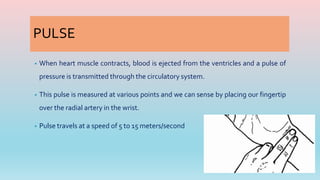
• This pulse is measured at various points and we can sense by placing our fingertip
over the radial artery in the wrist.
• Pulse travels at a speed of 5 to 15 meters/second
2
PULSE
• The apical pulse is a central pulse; that is, it is located at the apex of the
heart.
• It is also referred to as the point of maximal impulse (PMI).
• The rate of the pulse is expressed in beats per minute (BPM).
3
FACTORS AFFECTINGTHE PULSE
• Age -As age increases, the pulse rate gradually decreases overall.
• Gender -The average male’s pulse rate is slightly lower than the female’s.
• Exercise -The pulse rate normally increases with activity.
• Medications - Some medications decrease the pulse rate, and others increase it
• Fever -The pulse rate increases
4
CONTINUED . . .
• Hypovolemia - Loss of blood from the vascular system normally increases pulse
rate.
• Stress - In response to stress, sympathetic nervous stimulation increases the
overall activity of the heart.
• Pathology - Certain diseases such as some heart conditions or those that impair
oxygenation can alter the resting pulse rate.
5
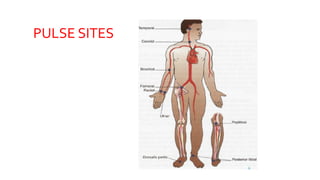
PULSE SITES
6
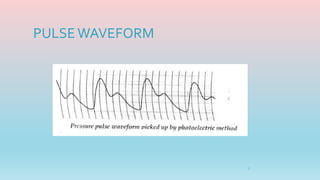
PULSEWAVEFORM
7
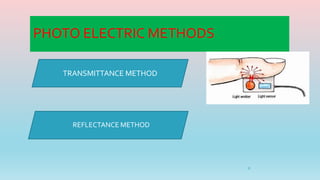
PHOTO ELECTRIC METHODS
8
TRANSMITTANCE METHOD
• REFLECTANCE METHOD
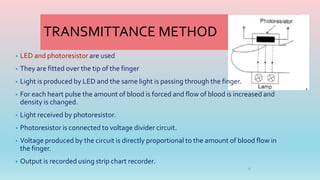
TRANSMITTANCE METHOD
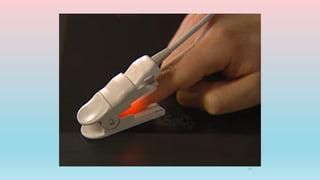
• LED and photoresistor are used
• They are fitted over the tip of the finger
• Light is produced by LED and the same light is passing through the finger.
• For each heart pulse the amount of blood is forced and flow of blood is increased and
density is changed.
• Light received by photoresistor.
• Photoresistor is connected to voltage divider circuit.
• Voltage produced by the circuit is directly proportional to the amount of blood flow in
the finger.
• Output is recorded using strip chart recorder.
9
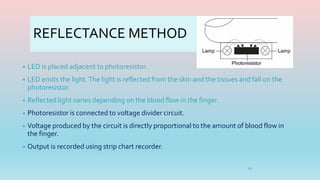
REFLECTANCE METHOD
• LED is placed adjacent to photoresistor.
• LED emits the light.The light is reflected from the skin and the tissues and fall on the
photoresistor.
• Reflected light varies depending on the blood flow in the finger.
• Photoresistor is connected to voltage divider circuit.
• Voltage produced by the circuit is directly proportional to the amount of blood flow in
the finger.
• Output is recorded using strip chart recorder.
10
11
12
TRY TO ACHIEVE YOUR DAILY GOAL . . .
YOU CAN ACHIEVE YOUR LONG TERM GOAL . . .

Pulse rate measurement

  • 1.
  • 2.
    PULSE • When heartmuscle contracts, blood is ejected from the ventricles and a pulse of pressure is transmitted through the circulatory system. • This pulse is measured at various points and we can sense by placing our fingertip over the radial artery in the wrist. • Pulse travels at a speed of 5 to 15 meters/second 2
  • 3.
    PULSE • The apicalpulse is a central pulse; that is, it is located at the apex of the heart. • It is also referred to as the point of maximal impulse (PMI). • The rate of the pulse is expressed in beats per minute (BPM). 3
  • 4.
    FACTORS AFFECTINGTHE PULSE •Age -As age increases, the pulse rate gradually decreases overall. • Gender -The average male’s pulse rate is slightly lower than the female’s. • Exercise -The pulse rate normally increases with activity. • Medications - Some medications decrease the pulse rate, and others increase it • Fever -The pulse rate increases 4
  • 5.
    CONTINUED . .. • Hypovolemia - Loss of blood from the vascular system normally increases pulse rate. • Stress - In response to stress, sympathetic nervous stimulation increases the overall activity of the heart. • Pathology - Certain diseases such as some heart conditions or those that impair oxygenation can alter the resting pulse rate. 5
  • 6.
  • 7.
  • 8.
    PHOTO ELECTRIC METHODS 8 TRANSMITTANCEMETHOD • REFLECTANCE METHOD
  • 9.
    TRANSMITTANCE METHOD • LEDand photoresistor are used • They are fitted over the tip of the finger • Light is produced by LED and the same light is passing through the finger. • For each heart pulse the amount of blood is forced and flow of blood is increased and density is changed. • Light received by photoresistor. • Photoresistor is connected to voltage divider circuit. • Voltage produced by the circuit is directly proportional to the amount of blood flow in the finger. • Output is recorded using strip chart recorder. 9
  • 10.
    REFLECTANCE METHOD • LEDis placed adjacent to photoresistor. • LED emits the light.The light is reflected from the skin and the tissues and fall on the photoresistor. • Reflected light varies depending on the blood flow in the finger. • Photoresistor is connected to voltage divider circuit. • Voltage produced by the circuit is directly proportional to the amount of blood flow in the finger. • Output is recorded using strip chart recorder. 10
  • 11.
  • 12.
    12 TRY TO ACHIEVEYOUR DAILY GOAL . . . YOU CAN ACHIEVE YOUR LONG TERM GOAL . . .