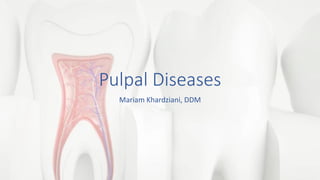
Pulpal Diseases
Mariam Khardziani, DDM
Classification of pulpal diseases
• The objective and subjective findings are used to classify the
suspected pathosis, with the assigned designations merely
representing the presence of healthy or diseased tissue.
• The terminology and classifications that follow are based on those
suggested by the American Association of Endodontists in 2016
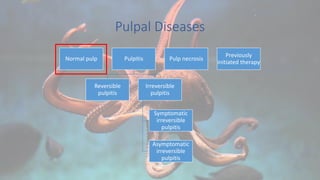
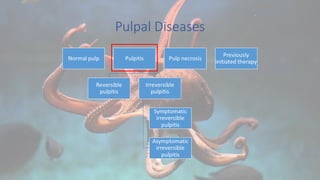
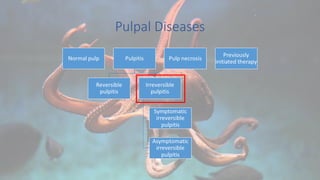
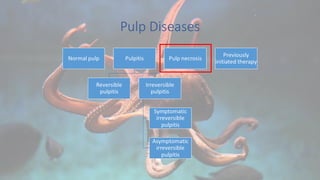
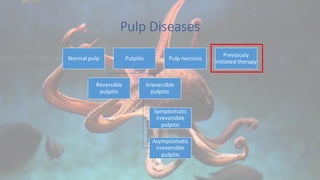
Pulpal Diseases
Normal pulp Pulpitis
Reversible
pulpitis
Irreversible
pulpitis
Symptomatic
irreversible
pulpitis
Asymptomatic
irreversible
pulpitis
Pulp necrosis
Previously
initiated therapy
Normal pulp
The pulp is symptom-free
It responses normally to pulp testing
Radiographically, there may be varying degrees of pulpal calcification but no
evidence of resorption, caries, or mechanical pulp exposure.
No endodontic treatment is indicated for these teeth.
Pulpal Diseases
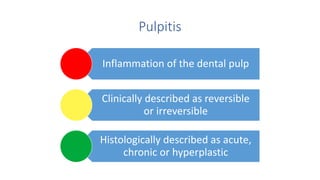
Pulpitis
Inflammation of the dental pulp
Clinically described as reversible
or irreversible
Histologically described as acute,
chronic or hyperplastic
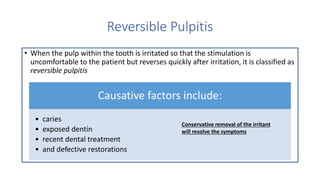
Reversible Pulpitis
• When the pulp within the tooth is irritated so that the stimulation is
uncomfortable to the patient but reverses quickly after irritation, it is classified as
reversible pulpitis
Causative factors include:
• caries
• exposed dentin
• recent dental treatment
• and defective restorations
Conservative removal of the irritant
will resolve the symptoms
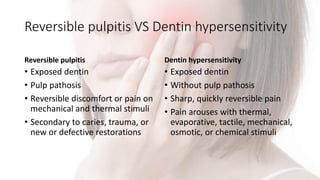
Reversible pulpitis VS Dentin hypersensitivity
Reversible pulpitis
• Exposed dentin
• Pulp pathosis
• Reversible discomfort or pain on
mechanical and thermal stimuli
• Secondary to caries, trauma, or
new or defective restorations
Dentin hypersensitivity
• Exposed dentin
• Without pulp pathosis
• Sharp, quickly reversible pain
• Pain arouses with thermal,
evaporative, tactile, mechanical,
osmotic, or chemical stimuli
Pulpal Diseases
Irreversible Pulpitis
As the disease state of the pulp progresses, the inflammatory
condition of the pulp can change to irreversible pulpitis.
At this stage, treatment to remove the diseased pulp will be
necessary.
This condition can be divided into the subcategories of
symptomatic and asymptomatic irreversible pulpitis.
Symptomatic Irreversible Pulpitis
At this state, the vital inflamed pulp is incapable of healing
Teeth that are classified as having symptomatic irreversible pulpitis exhibit intermittent or
spontaneous pain
Rapid exposure to dramatic temperature changes (especially to cold stimuli) will elicit heightened
and prolonged episodes of pain even after the thermal stimulus has been removed.
The pain may be sharp or dull, localized, diffuse, or referred.
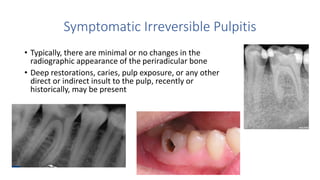
Symptomatic Irreversible Pulpitis
• Typically, there are minimal or no changes in the
radiographic appearance of the periradicular bone
• Deep restorations, caries, pulp exposure, or any other
direct or indirect insult to the pulp, recently or
historically, may be present
Asymptomatic Irreversible Pulpitis
• The vital inflamed pulp is incapable of healing
• Patient does not complain of any symptoms
• Left untreated, the tooth may become symptomatic or the pulp will
become necrotic
• Endodontic treatment should be performed as soon as possible
Pulp Diseases
Pulp Necrosis
• The pulp is nonvital
• This condition is subsequent to symptomatic or asymptomatic
irreversible pulpitis
• The pulp is usually nonresponsive to pulp testing
• The tooth will usually not respond to electric pulp tests or to cold
stimulation
Pulp Necrosis
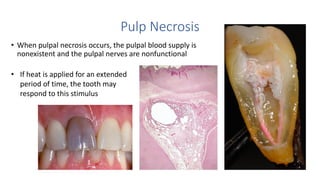
• When pulpal necrosis occurs, the pulpal blood supply is
nonexistent and the pulpal nerves are nonfunctional
• If heat is applied for an extended
period of time, the tooth may
respond to this stimulus
Pulp Necrosis
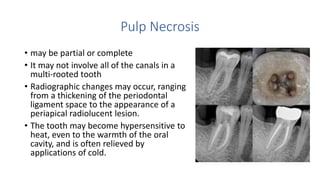
• may be partial or complete
• It may not involve all of the canals in a
multi-rooted tooth
• Radiographic changes may occur, ranging
from a thickening of the periodontal
ligament space to the appearance of a
periapical radiolucent lesion.
• The tooth may become hypersensitive to
heat, even to the warmth of the oral
cavity, and is often relieved by
applications of cold.
Pulp Diseases
Previously Initiated Therapy
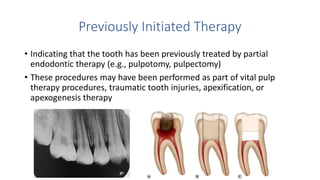
• Indicating that the tooth has been previously treated by partial
endodontic therapy (e.g., pulpotomy, pulpectomy)
• These procedures may have been performed as part of vital pulp
therapy procedures, traumatic tooth injuries, apexification, or
apexogenesis therapy
Mariam.khardziani@tsu.ge

2. pulpitis, DENTAL PULP, PULP CHARACTHERISTICS

  • 1.
  • 2.
    Classification of pulpaldiseases • The objective and subjective findings are used to classify the suspected pathosis, with the assigned designations merely representing the presence of healthy or diseased tissue. • The terminology and classifications that follow are based on those suggested by the American Association of Endodontists in 2016
  • 3.
    Pulpal Diseases Normal pulpPulpitis Reversible pulpitis Irreversible pulpitis Symptomatic irreversible pulpitis Asymptomatic irreversible pulpitis Pulp necrosis Previously initiated therapy
  • 4.
    Normal pulp The pulpis symptom-free It responses normally to pulp testing Radiographically, there may be varying degrees of pulpal calcification but no evidence of resorption, caries, or mechanical pulp exposure. No endodontic treatment is indicated for these teeth.
  • 5.
  • 6.
    Pulpitis Inflammation of thedental pulp Clinically described as reversible or irreversible Histologically described as acute, chronic or hyperplastic
  • 7.
    Reversible Pulpitis • Whenthe pulp within the tooth is irritated so that the stimulation is uncomfortable to the patient but reverses quickly after irritation, it is classified as reversible pulpitis Causative factors include: • caries • exposed dentin • recent dental treatment • and defective restorations Conservative removal of the irritant will resolve the symptoms
  • 8.
    Reversible pulpitis VSDentin hypersensitivity Reversible pulpitis • Exposed dentin • Pulp pathosis • Reversible discomfort or pain on mechanical and thermal stimuli • Secondary to caries, trauma, or new or defective restorations Dentin hypersensitivity • Exposed dentin • Without pulp pathosis • Sharp, quickly reversible pain • Pain arouses with thermal, evaporative, tactile, mechanical, osmotic, or chemical stimuli
  • 9.
  • 10.
    Irreversible Pulpitis As thedisease state of the pulp progresses, the inflammatory condition of the pulp can change to irreversible pulpitis. At this stage, treatment to remove the diseased pulp will be necessary. This condition can be divided into the subcategories of symptomatic and asymptomatic irreversible pulpitis.
  • 11.
    Symptomatic Irreversible Pulpitis Atthis state, the vital inflamed pulp is incapable of healing Teeth that are classified as having symptomatic irreversible pulpitis exhibit intermittent or spontaneous pain Rapid exposure to dramatic temperature changes (especially to cold stimuli) will elicit heightened and prolonged episodes of pain even after the thermal stimulus has been removed. The pain may be sharp or dull, localized, diffuse, or referred.
  • 12.
    Symptomatic Irreversible Pulpitis •Typically, there are minimal or no changes in the radiographic appearance of the periradicular bone • Deep restorations, caries, pulp exposure, or any other direct or indirect insult to the pulp, recently or historically, may be present
  • 13.
    Asymptomatic Irreversible Pulpitis •The vital inflamed pulp is incapable of healing • Patient does not complain of any symptoms • Left untreated, the tooth may become symptomatic or the pulp will become necrotic • Endodontic treatment should be performed as soon as possible
  • 14.
  • 15.
    Pulp Necrosis • Thepulp is nonvital • This condition is subsequent to symptomatic or asymptomatic irreversible pulpitis • The pulp is usually nonresponsive to pulp testing • The tooth will usually not respond to electric pulp tests or to cold stimulation
  • 16.
    Pulp Necrosis • Whenpulpal necrosis occurs, the pulpal blood supply is nonexistent and the pulpal nerves are nonfunctional • If heat is applied for an extended period of time, the tooth may respond to this stimulus
  • 17.
    Pulp Necrosis • maybe partial or complete • It may not involve all of the canals in a multi-rooted tooth • Radiographic changes may occur, ranging from a thickening of the periodontal ligament space to the appearance of a periapical radiolucent lesion. • The tooth may become hypersensitive to heat, even to the warmth of the oral cavity, and is often relieved by applications of cold.
  • 18.
  • 19.
    Previously Initiated Therapy •Indicating that the tooth has been previously treated by partial endodontic therapy (e.g., pulpotomy, pulpectomy) • These procedures may have been performed as part of vital pulp therapy procedures, traumatic tooth injuries, apexification, or apexogenesis therapy
  • 20.