RESTORATIVE MATERIALS IN
PEDIATRIC DENTISTRY
DR.VIGNESH R, BDS
DEFINITION
• Synthetic components that can be used to
repair or replace tooth structure
(ANUSAVICE)
IDEAL REQUISITES
• Be biocompatible
• Should restore aesthetics
• Maintain the physical strength of crown
• Preserve the occlusal anatomy and intercuspal
relation
• Prevent micro leakage
• Bond permanently to tooth
• Be capable of initiating tissue repair and
regeneration
Materials Used
• Temporary restorative materials
• Glass Ionomer cements & modifications of GIC
• Silver Amalgam
• Compomer
• Composite resin
• Pit and fissure sealants
• Resin-strip crowns with composite resins
• Stainless steel crowns
Base materials
• Zinc Oxide-Eugenol Cement
• Calcium hydroxide
• Zinc phosphate cement
• Glass Ionomer
Selection criteria
• Age of the child
• Caries risk
• Type of tooth
• Size and shape of cavity
• Nature of the child
Amalgam
Advantages
• Simple
• Quick
• Economic
• Technique sensitive
• Durable
Silver Amalgam
Disadvantages
• Not adhesive
• Requires mechanical
retention
• Loss of sound tooth
structure
• Environmental and
occupational hazards
INDICATIONS OF SA IN PEDIATRIC
DENTISTRY
• Restoration of primary
posterior teeth (Class II)
• Children at moderate
caries risk and not
totally cooperative
• Limited indication in
Class I
• Restoration of young
permanent posterior
teeth
Composite resin
Merits
• Adhesive
• Aesthetic
• Reasonable wear
properties
• Command set
Composite Resin(Bowen 1963)
Demerits
• Technique sensitive
• Rubber dam
• Expensive
• Polymerization
shrinkage
INDICATIONS OF COMPOSITES
• Restoration of primary
molar (Class I)
• Moderately durable in
Class II
• Restoration of young
permanent anterior teeth.
Glass Ionomer Cement
(Wilson & Kent 1972)
GIC
Merits
• Adhesive
• Aesthetic
• Fluoride leaching
• Minimal cavity preparation
• Biocompatible
• Act as fluoride reservoir
• Modifications available for
every specific purpose
GIC
Demerits
• Brittle
• Susceptible to wear and
erosion
• Technique sensitive
• Reduced compressive
strength
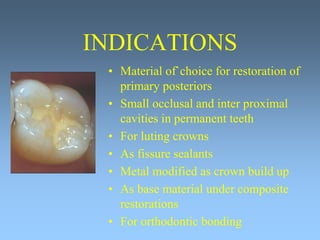
INDICATIONS
• Material of`choice for restoration of
primary posteriors
• Small occlusal and inter proximal
cavities in permanent teeth
• For luting crowns
• As fissure sealants
• Metal modified as crown build up
• As base material under composite
restorations
• For orthodontic bonding
Resin-modified GIC
Merits
• Adhesive
• Aesthetic
• Command set
• Simple to handle
Demerits
• Water adsorption
• Significant wear
Resin modified GIC -Indications
Compomer
Merits
• Adhesive
• Aesthetic
• Command set
• Simple to handle
• Radio-opacity
Demerits
• Technique sensitive
• Less fluoride release
Compomer -Indications
Pit and Fissure sealants
Pit and fissure sealants
Stainless steel crowns
Merits
• Very durable
• Protect and support
Demerits
• Extensive tooth prep
• Patient cooperation
• Unaesthetic
INDICATIONS OF SS CROWNS
• Grossly broken-down
teeth
• Primary molars that have
undergone pulp therapy
• Hypo plastic primary or
permanent teeth
• Dentitions of children at
high risk of caries,
particularly those having
treatment under G.A
RESIN-STRIP CROWNS
• Material of choice for primary anterior
teeth
•Strip crown + Composite = Aesthetics
Thank you!

RESTORATIVE MATERIALS