T O E N G A G E Y O U R A U D I E N C E
T Y P E S O F P A U S E
43
21
T h e v i t a l
i n f o r m a t i o n
P a u s e
Use a pause  to give your
listeners a moment for the
vital information you just
delivered to sink in.
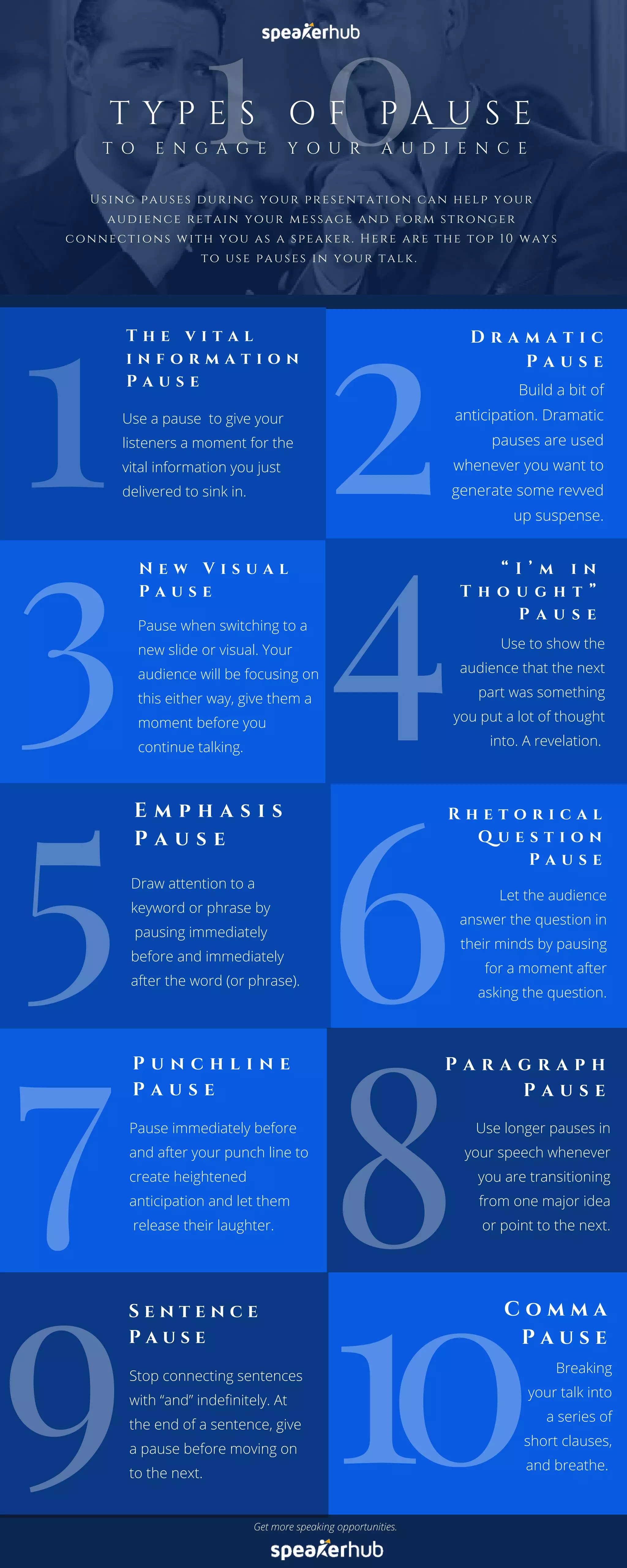
Using pauses during your presentation can help your audience retain
your message and form stronger connections with you as a speaker.
Here are the top 10 ways to use pauses in your talk. 
P u n c h l i n e
P a u s e
N e w V i s u a l
P a u s e
Pause when switching to a
new slide or visual. Your
audience will be focusing on
this either way, give them a
moment before you
continue talking. 
5
E m p h a s i s
P a u s e
Draw attention to a
keyword or phrase by
 pausing immediately
before and immediately
after the word (or phrase).
S e n t e n c e
P a u s e
Stop connecting sentences
with “and” indefinitely. At
the end of a sentence, give
a pause before moving on
to the next. 
Get more speaking opportunities. 
6
D r a m a t i c
P a u s e
Build a bit of
anticipation. Dramatic
pauses are used
whenever you want to
generate some revved
up suspense.
“ I ’ m i n
T h o u g h t ”
P a u s e
Use to show the
audience that the next
part was something
you put a lot of thought
into. A revelation. 
Pause immediately before
and after your punch line to
create heightened
anticipation and let them
 release their laughter.
R h e t o r i c a l
Q u e s t i o n
P a u s e
7 8
P a r a g r a p h
P a u s e
9
C o m m a
P a u s e
Let the audience
answer the question in
their minds by pausing
for a moment after
asking the question.
Use longer pauses in
your speech whenever
you are transitioning
from one major idea
or point to the next.
Breaking
your talk into
a series of
short clauses,
and breathe. 
10
10

Public Speakers: 10 Types of pauses and when to use them

  • 1.
    T O EN G A G E Y O U R A U D I E N C E T Y P E S O F P A U S E 43 21 T h e v i t a l i n f o r m a t i o n P a u s e Use a pause  to give your listeners a moment for the vital information you just delivered to sink in. Using pauses during your presentation can help your audience retain your message and form stronger connections with you as a speaker. Here are the top 10 ways to use pauses in your talk.  P u n c h l i n e P a u s e N e w V i s u a l P a u s e Pause when switching to a new slide or visual. Your audience will be focusing on this either way, give them a moment before you continue talking.  5 E m p h a s i s P a u s e Draw attention to a keyword or phrase by  pausing immediately before and immediately after the word (or phrase). S e n t e n c e P a u s e Stop connecting sentences with “and” indefinitely. At the end of a sentence, give a pause before moving on to the next.  Get more speaking opportunities.  6 D r a m a t i c P a u s e Build a bit of anticipation. Dramatic pauses are used whenever you want to generate some revved up suspense. “ I ’ m i n T h o u g h t ” P a u s e Use to show the audience that the next part was something you put a lot of thought into. A revelation.  Pause immediately before and after your punch line to create heightened anticipation and let them  release their laughter. R h e t o r i c a l Q u e s t i o n P a u s e 7 8 P a r a g r a p h P a u s e 9 C o m m a P a u s e Let the audience answer the question in their minds by pausing for a moment after asking the question. Use longer pauses in your speech whenever you are transitioning from one major idea or point to the next. Breaking your talk into a series of short clauses, and breathe.  10 10