Lesson 2: The
Tools Needed
in
Critical/Creativ
e Reports
Lesson 2:
The Tools
Needed in
Critical/Cr
eative
Reports
In today's day and age, everyone is
expected to be able to give crifical and
creative reports. This includes lawyers,
engineers, and government employees,
not just those who are moorking in the
fields of multimedia and the arts. Modern
technology has made it easier for people
to complement their reports with
arresting visual aids and helpful videos.
and it has helped tremendously in the
spread of all kinds of information. To
succeed in one's academic and
professional life, one should be able to
master the report.
Lesson
Objectives
:
By the end of this lesson, you
should be able to:
1. create a credible, logical report
that is thoroughly researched and
fact-checked;
2. deliver a report using effective
verbal and non-verbal
communication and
3. augment the report with
relevant and eye-catching visual
aids.
Best Practices
of Public
Speaking
Introduction
. What makes a speech electric? What makes a speech so effective it can
make the audience have goosebumps or make them flush in rage or joy?
Some speeches can be so effective they trigger adrenaline, while other
speeches, just as effective, frigger a sense of peace and calm in the
midst of chaos. Great speakers have been called hypnotic, magnetic, and
charismatic, and this is not just because they have a compelling
message, but because of the captivating manner they deliver these
speeches, as well.
Performance
Speeches are performances, and they are delivered
best when they have the feel of authenticity and
earnestness. People respond when they think that
the one speaking is being honest and sincere. and
they respond even more strongly when they feel
that they can relate to the speaker in question.
Because of this, a sense of humor helps break the
ice, and strategic shows of vulnerability and concern
can make an audience feel closer to the speaker.
Plan the Speech
It is important to express oneself in an expressive
and articulate manner. It is best to choose one's
words carefully, and to ensure that one's speech
builds on the foundations of logos, pathos, and
ethos. Jo come across as articulate, one must also
nurture a speaking style that is effective, and this
style varies from one person to another.
One way of coming across as authentic is the ability to make good eye
contact with the audience, and to speak in a manner that touches them.
It is important to engage the audience, and eye contact helps in doing
that. Some people, however, have a hard time making eye contact.
Should this be the case, it would help to pick out three people from the
audience, placed in a mental triangle from one's position, and try to
make eye contact with them instead of the rest of the people in the
room. If one is truly hesitant to look at people's eyes. one may look at
their foreheads instead; this creates the illusion of making eye contact
with people without actually doing it. On the other hand, if one is
comfortable making eye contact, it would help to pick out people who
seem to be friendly or accommodating to look at, so that when one
speaks, one feels confident and at ease.
Eye Contact
Speaking Style
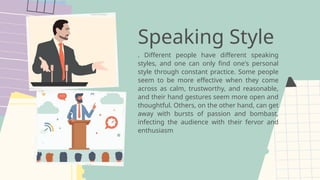
. Different people have different speaking
styles, and one can only find one's personal
style through constant practice. Some people
seem to be more effective when they come
across as calm, trustworthy, and reasonable,
and their hand gestures seem more open and
thoughtful. Others, on the other hand, can get
away with bursts of passion and bombast,
infecting the audience with their fervor and
enthusiasm
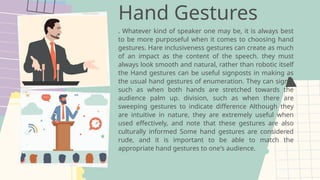
Hand Gestures
. Whatever kind of speaker one may be, it is always best
to be more purposeful when it comes to choosing hand
gestures. Hare inclusiveness gestures can create as much
of an impact as the content of the speech. they must
always look smooth and natural, rather than robotic itself
the Hand gestures can be useful signposts in making as
the usual hand gestures of enumeration. They can signal
such as when both hands are stretched towards the
audience palm up. division, such as when there are
sweeping gestures to indicate difference Although they
are intuitive in nature, they are extremely useful when
used effectively, and note that these gestures are also
culturally informed Some hand gestures are considered
rude, and it is important to be able to match the
appropriate hand gestures to one's audience.
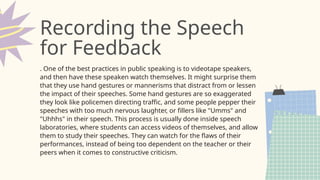
. One of the best practices in public speaking is to videotape speakers,
and then have these speaken watch themselves. It might surprise them
that they use hand gestures or mannerisms that distract from or lessen
the impact of their speeches. Some hand gestures are so exaggerated
they look like policemen directing traffic, and some people pepper their
speeches with too much nervous laughter, or fillers like "Umms" and
"Uhhhs" in their speech. This process is usually done inside speech
laboratories, where students can access videos of themselves, and allow
them to study their speeches. They can watch for the flaws of their
performances, instead of being too dependent on the teacher or their
peers when it comes to constructive criticism.
Recording the Speech
for Feedback
. Unfortunately, not all schools have the means to record their students'
speeches. Should this be the case, it is important to have discerning
teachers, coaches, or peers to provide feedback when it comes to the
effectivity of one's speech. It is not enough to be given a grade for the
speech, or just be accorded high praise. Feedback from people is
important, and this will be a great tool in improving one's speech and
one's speaking style in general. Observations can range from the
speaker's posture, one's facial expressions, and one's general
appearance. This can also be done alone with the speaker rehearsing
their speech in front of a mirror.
Peer Evaluation
Appearan
ce
. When it comes to appearance, it is
important to look credible and
worthy of respect. in the real
world, this depends a lot on one's
audience, as the way one's dresses
should match the kind of audience
one wants to impress. Whether
one's audience are corporate
clients or creative directors, this
should have an influence on the
appearance
Clothing
Traditional audiences often call for
more formal clothing. For men,
this would mean donning a suit
and tie at the most formal level, or
at the very least, the use of long-
sleeved button-down shirts, slacks,
and leather shoes. In the
Philippines, the use of a barong
and slacks is acceptable. For the
women, a pantsuit or a formal coat
and skirt ensemble should suffice.
In less formal instances, a dress or
blouse and skirt (or slacks)
outfit should do as well.
Good
Grooming
.
In addition, good grooming is a
must, and that extends to one's
hair to one's nails. As long as one
looks neat and clean. that should
be enough to satisfy most
audience's requirements. Some
audiences, however, may require
women to wear more (or tess)
make- up, don a hijab, or wear
high heels - in these instances, it is
always best to
know the cultural expectations of
the audience and the venue.
Visual
Aids
Since we live in a world that is
more dependent on information
technology, it has become de
rigueur for audiences to expect
speeches to be accompanied with
visual aids, such as PowerPoint
presentations, video or audio clips,
and infographics. Any of these are
acceptable, and in most cases,
commendable, as long as they are
relevant to the topic at hand.
PowerPoint
Presentations
When it comes to the use of
PowerPoint, one should ensure that
the font size of the text is not too
small. An acceptable size font would
be type 24 or larger, and the text
should be in dark colors for easier
reading. The best PowerPoint
presentations are not text-heavy;
instead, they are visually oriented,
which is why the use of photographs,
illustrations, charts, and the like
would better serve one's use of the
medium. Video clips may or may not
be embedded in the presentation, as
well as audio clips and animation.
Handouts
It would be best to have handouts
ready for one's audience, so that
members of the audience will not
have to scramble when taking
notes during the presentation.
These should be written succinctly,
and should have appropriate
citations.
Although the speech is a performance, it is also one where its audience
can participate, often by the speaker asking rhetorical or directing actual
questions to the audience. It is always good to read the verbal and non-
verbal cues from the audience, such as whether they agree with what
one is saying or whether they are resisting to certain ideas, mirrored by
their use of body language. The speaker is seen as more responsive and
sympathetic to the audience when they modify their speeches to match
the audience's visual cues
Feedback
. In the end, public speaking is a dynamic performance that is meant to
disseminate information, create greater awareness. and evoke emotions
in the audience. It is utilized by teachers, lawyers. politicians, and the like.
It has been used effectively to promote human rights on the street and
to create policies in government. Although it is a performance, the most
important speeches in the world have had material effects, such as the
speeches of Abraham Lincoln, Susan B. Anthony, and Martin Luther King,
Jr., and these still affect the world today, long after their speakers have
already been long gone.
Conclusion
Thank you
for listening!

purposive com Lesson 2mdkkdkkdmdnkckf.pptx

  • 1.
    Lesson 2: The ToolsNeeded in Critical/Creativ e Reports
  • 2.
    Lesson 2: The Tools Neededin Critical/Cr eative Reports In today's day and age, everyone is expected to be able to give crifical and creative reports. This includes lawyers, engineers, and government employees, not just those who are moorking in the fields of multimedia and the arts. Modern technology has made it easier for people to complement their reports with arresting visual aids and helpful videos. and it has helped tremendously in the spread of all kinds of information. To succeed in one's academic and professional life, one should be able to master the report.
  • 3.
    Lesson Objectives : By the endof this lesson, you should be able to: 1. create a credible, logical report that is thoroughly researched and fact-checked; 2. deliver a report using effective verbal and non-verbal communication and 3. augment the report with relevant and eye-catching visual aids.
  • 4.
    Best Practices of Public Speaking Introduction .What makes a speech electric? What makes a speech so effective it can make the audience have goosebumps or make them flush in rage or joy? Some speeches can be so effective they trigger adrenaline, while other speeches, just as effective, frigger a sense of peace and calm in the midst of chaos. Great speakers have been called hypnotic, magnetic, and charismatic, and this is not just because they have a compelling message, but because of the captivating manner they deliver these speeches, as well.
  • 5.
    Performance Speeches are performances,and they are delivered best when they have the feel of authenticity and earnestness. People respond when they think that the one speaking is being honest and sincere. and they respond even more strongly when they feel that they can relate to the speaker in question. Because of this, a sense of humor helps break the ice, and strategic shows of vulnerability and concern can make an audience feel closer to the speaker.
  • 6.
    Plan the Speech Itis important to express oneself in an expressive and articulate manner. It is best to choose one's words carefully, and to ensure that one's speech builds on the foundations of logos, pathos, and ethos. Jo come across as articulate, one must also nurture a speaking style that is effective, and this style varies from one person to another.
  • 7.
    One way ofcoming across as authentic is the ability to make good eye contact with the audience, and to speak in a manner that touches them. It is important to engage the audience, and eye contact helps in doing that. Some people, however, have a hard time making eye contact. Should this be the case, it would help to pick out three people from the audience, placed in a mental triangle from one's position, and try to make eye contact with them instead of the rest of the people in the room. If one is truly hesitant to look at people's eyes. one may look at their foreheads instead; this creates the illusion of making eye contact with people without actually doing it. On the other hand, if one is comfortable making eye contact, it would help to pick out people who seem to be friendly or accommodating to look at, so that when one speaks, one feels confident and at ease. Eye Contact
  • 8.
    Speaking Style . Differentpeople have different speaking styles, and one can only find one's personal style through constant practice. Some people seem to be more effective when they come across as calm, trustworthy, and reasonable, and their hand gestures seem more open and thoughtful. Others, on the other hand, can get away with bursts of passion and bombast, infecting the audience with their fervor and enthusiasm
  • 9.
    Hand Gestures . Whateverkind of speaker one may be, it is always best to be more purposeful when it comes to choosing hand gestures. Hare inclusiveness gestures can create as much of an impact as the content of the speech. they must always look smooth and natural, rather than robotic itself the Hand gestures can be useful signposts in making as the usual hand gestures of enumeration. They can signal such as when both hands are stretched towards the audience palm up. division, such as when there are sweeping gestures to indicate difference Although they are intuitive in nature, they are extremely useful when used effectively, and note that these gestures are also culturally informed Some hand gestures are considered rude, and it is important to be able to match the appropriate hand gestures to one's audience.
  • 10.
    . One ofthe best practices in public speaking is to videotape speakers, and then have these speaken watch themselves. It might surprise them that they use hand gestures or mannerisms that distract from or lessen the impact of their speeches. Some hand gestures are so exaggerated they look like policemen directing traffic, and some people pepper their speeches with too much nervous laughter, or fillers like "Umms" and "Uhhhs" in their speech. This process is usually done inside speech laboratories, where students can access videos of themselves, and allow them to study their speeches. They can watch for the flaws of their performances, instead of being too dependent on the teacher or their peers when it comes to constructive criticism. Recording the Speech for Feedback
  • 11.
    . Unfortunately, notall schools have the means to record their students' speeches. Should this be the case, it is important to have discerning teachers, coaches, or peers to provide feedback when it comes to the effectivity of one's speech. It is not enough to be given a grade for the speech, or just be accorded high praise. Feedback from people is important, and this will be a great tool in improving one's speech and one's speaking style in general. Observations can range from the speaker's posture, one's facial expressions, and one's general appearance. This can also be done alone with the speaker rehearsing their speech in front of a mirror. Peer Evaluation
  • 12.
    Appearan ce . When itcomes to appearance, it is important to look credible and worthy of respect. in the real world, this depends a lot on one's audience, as the way one's dresses should match the kind of audience one wants to impress. Whether one's audience are corporate clients or creative directors, this should have an influence on the appearance
  • 13.
    Clothing Traditional audiences oftencall for more formal clothing. For men, this would mean donning a suit and tie at the most formal level, or at the very least, the use of long- sleeved button-down shirts, slacks, and leather shoes. In the Philippines, the use of a barong and slacks is acceptable. For the women, a pantsuit or a formal coat and skirt ensemble should suffice. In less formal instances, a dress or blouse and skirt (or slacks) outfit should do as well.
  • 14.
    Good Grooming . In addition, goodgrooming is a must, and that extends to one's hair to one's nails. As long as one looks neat and clean. that should be enough to satisfy most audience's requirements. Some audiences, however, may require women to wear more (or tess) make- up, don a hijab, or wear high heels - in these instances, it is always best to know the cultural expectations of the audience and the venue.
  • 15.
    Visual Aids Since we livein a world that is more dependent on information technology, it has become de rigueur for audiences to expect speeches to be accompanied with visual aids, such as PowerPoint presentations, video or audio clips, and infographics. Any of these are acceptable, and in most cases, commendable, as long as they are relevant to the topic at hand.
  • 16.
    PowerPoint Presentations When it comesto the use of PowerPoint, one should ensure that the font size of the text is not too small. An acceptable size font would be type 24 or larger, and the text should be in dark colors for easier reading. The best PowerPoint presentations are not text-heavy; instead, they are visually oriented, which is why the use of photographs, illustrations, charts, and the like would better serve one's use of the medium. Video clips may or may not be embedded in the presentation, as well as audio clips and animation.
  • 17.
    Handouts It would bebest to have handouts ready for one's audience, so that members of the audience will not have to scramble when taking notes during the presentation. These should be written succinctly, and should have appropriate citations.
  • 18.
    Although the speechis a performance, it is also one where its audience can participate, often by the speaker asking rhetorical or directing actual questions to the audience. It is always good to read the verbal and non- verbal cues from the audience, such as whether they agree with what one is saying or whether they are resisting to certain ideas, mirrored by their use of body language. The speaker is seen as more responsive and sympathetic to the audience when they modify their speeches to match the audience's visual cues Feedback
  • 19.
    . In theend, public speaking is a dynamic performance that is meant to disseminate information, create greater awareness. and evoke emotions in the audience. It is utilized by teachers, lawyers. politicians, and the like. It has been used effectively to promote human rights on the street and to create policies in government. Although it is a performance, the most important speeches in the world have had material effects, such as the speeches of Abraham Lincoln, Susan B. Anthony, and Martin Luther King, Jr., and these still affect the world today, long after their speakers have already been long gone. Conclusion
  • 20.