Public Relations, Journalism & the Internet: a Game-Changer?By Alyssa Pallotti, Megan Rutkowski & Ali Tager
What is public relations?The business of inducing the public to have understanding for and goodwill toward a person, firm, or institutionMerriam Webster Dictionary
The evolution of pr: Last 50 yearsEdward Bernays & Ivy Lee first coined the term “public relations”Originally used to promote wars, politics, religion, and productshttp://www.dipity.com/SEUPRclass/The_history_of_public_relations_in_the_U_S/We will view the interactive timeline above.
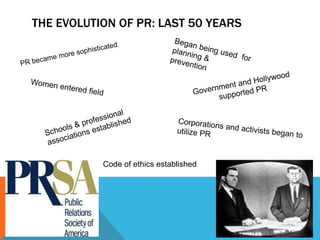
The evolution of pr: Last 50 yearsBegan being usedfor planning & preventionreventionPR became more sophisticated Government and Hollywood supported PRWomen entered fieldSchools & professional associations establishedCorporations and activists began to utilize PRCode of ethics established
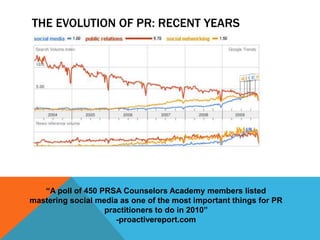
The evolution of Pr: Recent years“A poll of 450 PRSA Counselors Academy members listed mastering social media as one of the most important things for PR practitioners to do in 2010”-proactivereport.com
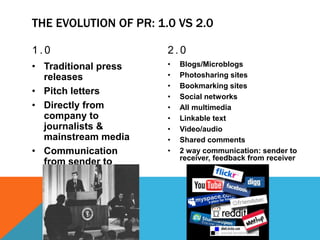
The evolution of pr: 1.0 vs 2.01.0Traditional press releases
Pitch letters
Directly from company to journalists & mainstream media
Communication from sender to receiver only2.0Blogs/Microblogs
Photosharing sites
Bookmarking sites
Social networks
All multimedia
Linkable text
Video/audio
Shared comments
2 way communication: sender to receiver, feedback from receiverWHAT are people saying about the current environment?PR has taken a lead in strategic communications due to its ability to adapt to consumers’ changing valuesThe internet and cell phone technology have led to two way dialogues between consumers and companies“Because of the way we all connect these days - ideas and news - good and bad – spread far faster than the word of mouth PR sought to create in the good old days”- The Nation
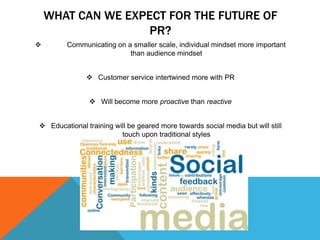
What can we expect for the future of pr?	Communicating on a smaller scale, individual mindset more important than audience mindset
Customer service intertwined more with PR
Will become more proactive than reactive
Educational training will be geared more towards social media but will still touch upon traditional stylesWhat are people saying about Traditional tools?DEADPress releases are nearly useless
Journalists can write stories just based on snippets from PR practitioners
The need for “Tweets” has surpassed the need for press releases
It is said that the press release died in Summer 2010ALIVENearly 75% of journalists enjoy email press releases if content is “high quality & well-targeted” (750 journalists in 15 countries)
Can use social media releases and traditional releases to complement each other
Stakeholders & investors still need information through press releases
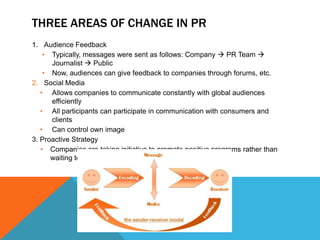
Not everyone is on Twitter!Three areas of change in prAudience FeedbackTypically, messages were sent as follows: Company  PR Team  Journalist  Public
Now, audiences can give feedback to companies through forums, etc.Social MediaAllows companies to communicate constantly with global audiences efficiently
All participants can participate in communication with consumers and clients

Public Relations, Journalism & the Internet: A Game-changer?

  • 1.
    Public Relations, Journalism& the Internet: a Game-Changer?By Alyssa Pallotti, Megan Rutkowski & Ali Tager
  • 2.
    What is publicrelations?The business of inducing the public to have understanding for and goodwill toward a person, firm, or institutionMerriam Webster Dictionary
  • 3.
    The evolution ofpr: Last 50 yearsEdward Bernays & Ivy Lee first coined the term “public relations”Originally used to promote wars, politics, religion, and productshttp://www.dipity.com/SEUPRclass/The_history_of_public_relations_in_the_U_S/We will view the interactive timeline above.
  • 4.
    The evolution ofpr: Last 50 yearsBegan being usedfor planning & preventionreventionPR became more sophisticated Government and Hollywood supported PRWomen entered fieldSchools & professional associations establishedCorporations and activists began to utilize PRCode of ethics established
  • 5.
    The evolution ofPr: Recent years“A poll of 450 PRSA Counselors Academy members listed mastering social media as one of the most important things for PR practitioners to do in 2010”-proactivereport.com
  • 6.
    The evolution ofpr: 1.0 vs 2.01.0Traditional press releases
  • 7.
  • 8.
    Directly from companyto journalists & mainstream media
  • 9.
    Communication from senderto receiver only2.0Blogs/Microblogs
  • 10.
  • 11.
  • 12.
  • 13.
  • 14.
  • 15.
  • 16.
  • 17.
    2 way communication:sender to receiver, feedback from receiverWHAT are people saying about the current environment?PR has taken a lead in strategic communications due to its ability to adapt to consumers’ changing valuesThe internet and cell phone technology have led to two way dialogues between consumers and companies“Because of the way we all connect these days - ideas and news - good and bad – spread far faster than the word of mouth PR sought to create in the good old days”- The Nation
  • 18.
    What can weexpect for the future of pr? Communicating on a smaller scale, individual mindset more important than audience mindset
  • 19.
  • 20.
    Will become moreproactive than reactive
  • 21.
    Educational training willbe geared more towards social media but will still touch upon traditional stylesWhat are people saying about Traditional tools?DEADPress releases are nearly useless
  • 22.
    Journalists can writestories just based on snippets from PR practitioners
  • 23.
    The need for“Tweets” has surpassed the need for press releases
  • 24.
    It is saidthat the press release died in Summer 2010ALIVENearly 75% of journalists enjoy email press releases if content is “high quality & well-targeted” (750 journalists in 15 countries)
  • 25.
    Can use socialmedia releases and traditional releases to complement each other
  • 26.
    Stakeholders & investorsstill need information through press releases
  • 27.
    Not everyone ison Twitter!Three areas of change in prAudience FeedbackTypically, messages were sent as follows: Company  PR Team  Journalist  Public
  • 28.
    Now, audiences cangive feedback to companies through forums, etc.Social MediaAllows companies to communicate constantly with global audiences efficiently
  • 29.
    All participants canparticipate in communication with consumers and clients

Editor's Notes

  • #18 Collective action intelligent distributed and dispersed groups together
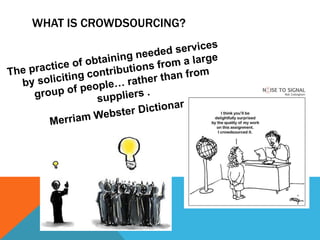
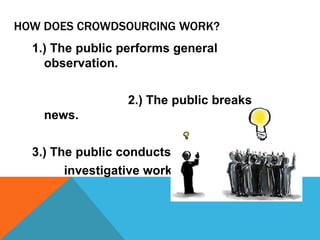
  • #19 This involves collecting data from people about things they come across in their daily life, and then aggregate the information.breaking news. In this case, newsrooms ask audiences to send in their photos, video or eye-witness accounts, usually in cases of breaking news.The third is investigative work. Here, a journalist enlists the help of  readers analyze information, crunch numbers or pore over documents.In news, crowdsourcing allows journalists to steer the audience by asking for data, analysis or help to cover events or issues.