Social/Mobile Media
and
Citizen Journalism
BY Group 2
● Wang Xin ● Jiang Chunyu ● Jiang Shiran
AGENDA
Introduction01
Definition | History | Channels |
Characteristics
02 Impact
Impact on professional journalism |
Social impact in Chinese context
03 Conclusion
Looking towards the future
DEFINITION
What is citizen journalism?
What is
Citizen Journalism?
Citizen Journalism, also referred to as
“grass-roots journalism” and “participatory journalism”, is “the act of a
citizen, or group of citizens, playing an active role in the process of
collecting, reporting, analyzing and disseminating news and
information.
---
Bowman and Willis,
“We Media: How Audiences Are Shaping the Future of News and Information”
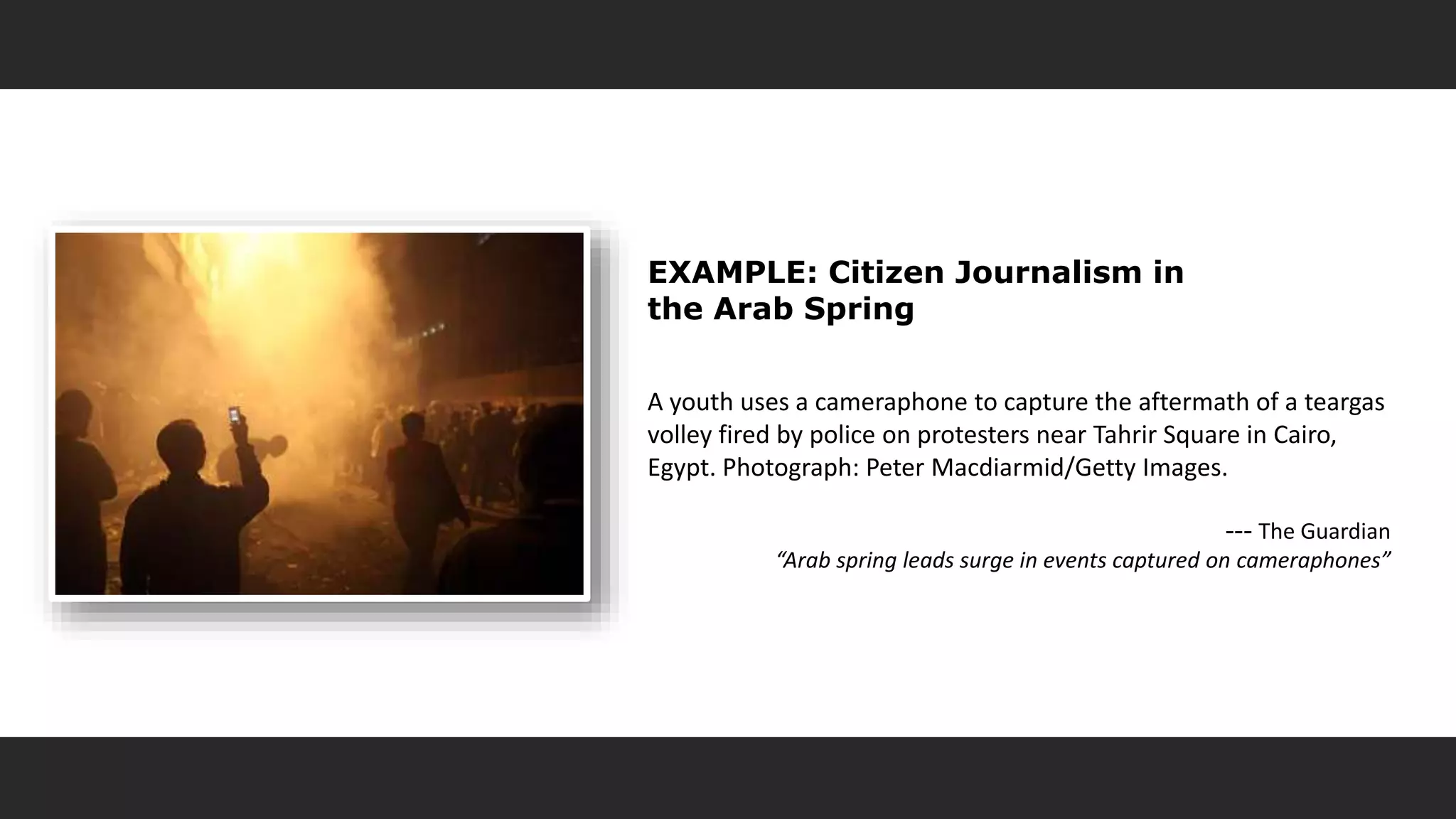
EXAMPLE: Citizen Journalism in
the Arab Spring
A youth uses a cameraphone to capture the aftermath of a teargas
volley fired by police on protesters near Tahrir Square in Cairo,
Egypt. Photograph: Peter Macdiarmid/Getty Images.
--- The Guardian
“Arab spring leads surge in events captured on cameraphones”
A screenshot of the RNN
Facebook wall during the 2011
Cairo uprising
RNN:
Cairo’s Rassd News Network, one of the
biggest citizen journalism projects of today.
HISTORY
When did it begin?
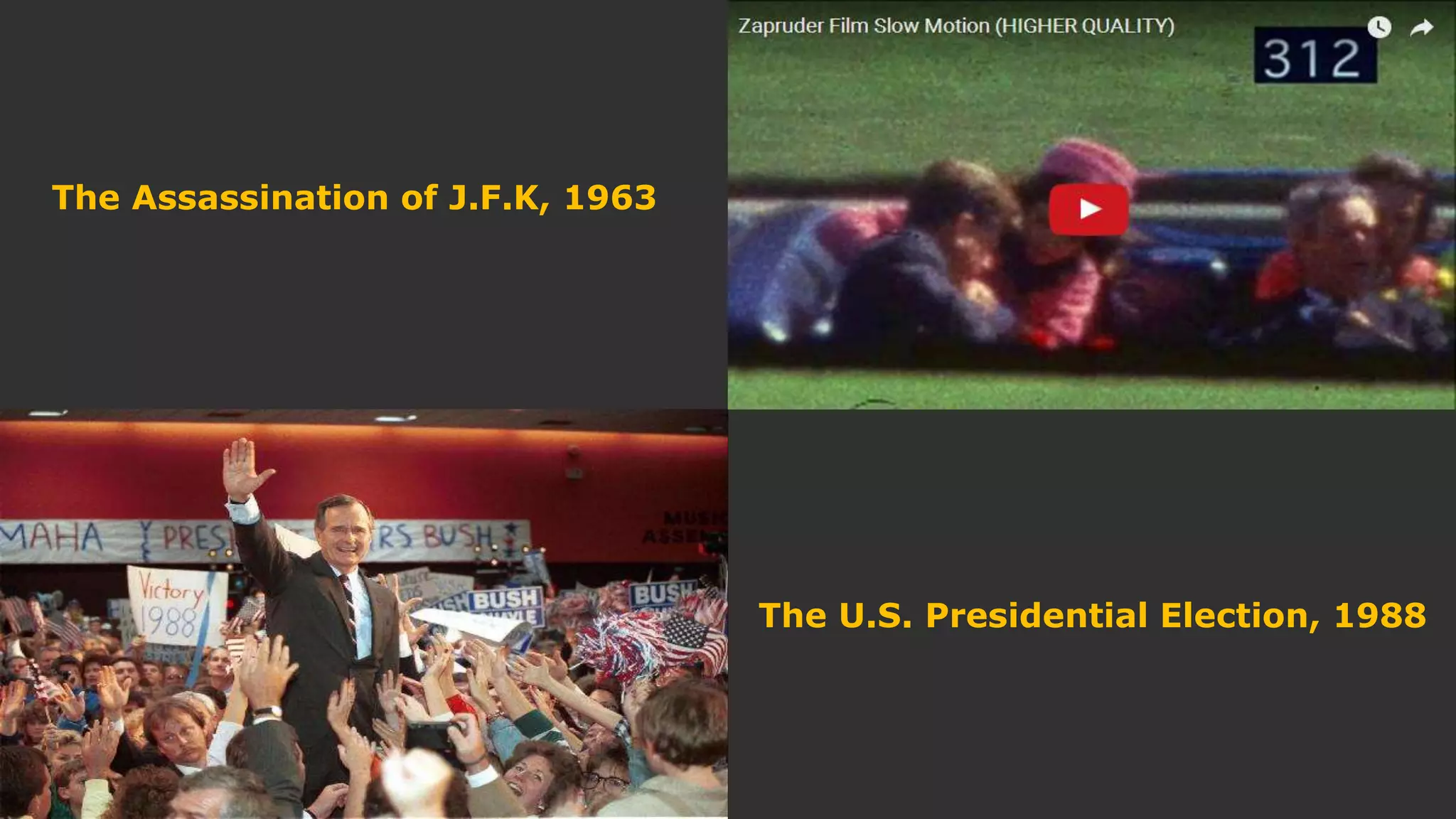
The Assassination of J.F.K, 1963
The U.S. Presidential Election, 1988
Citizen Journalism:
More noticeable with the rise of social media and the
online world, and more prevalent with the rise of Web
2.0.
Channels and Platforms
Through which channels
do citizen journalists report?
Channels and Platforms
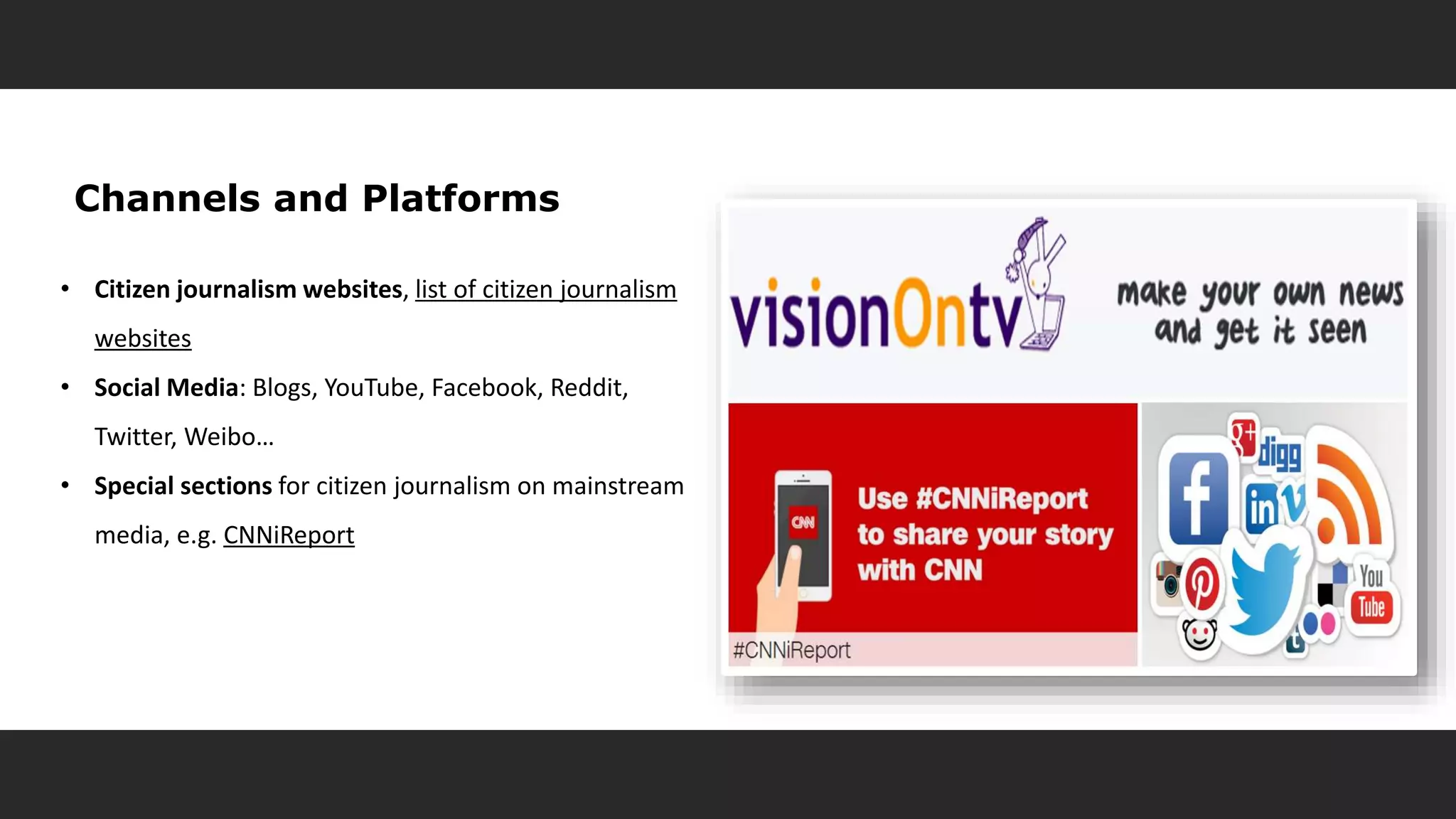
• Citizen journalism websites, list of citizen journalism
websites
• Social Media: Blogs, YouTube, Facebook, Reddit,
Twitter, Weibo…
• Special sections for citizen journalism on mainstream
media, e.g. CNNiReport
Characteristics
What advantages and disadvantages
does citizen journalism have?
ADVANTAGES
• Faster than professional journalists
• Reports things that may not be covered by
mainstream media
• Enjoys greater editorial independence, allows
uncensored contents
• Supervises the government and promotes
social equality and justice
• Opportunity for ordinary citizens to express
Advantages
DISADVANTAGES• Less influential than mainstream media
• Lack of professional training
• Biased, even false news rather than
objective reports
• Dubious perceived credibility
Disadvantages
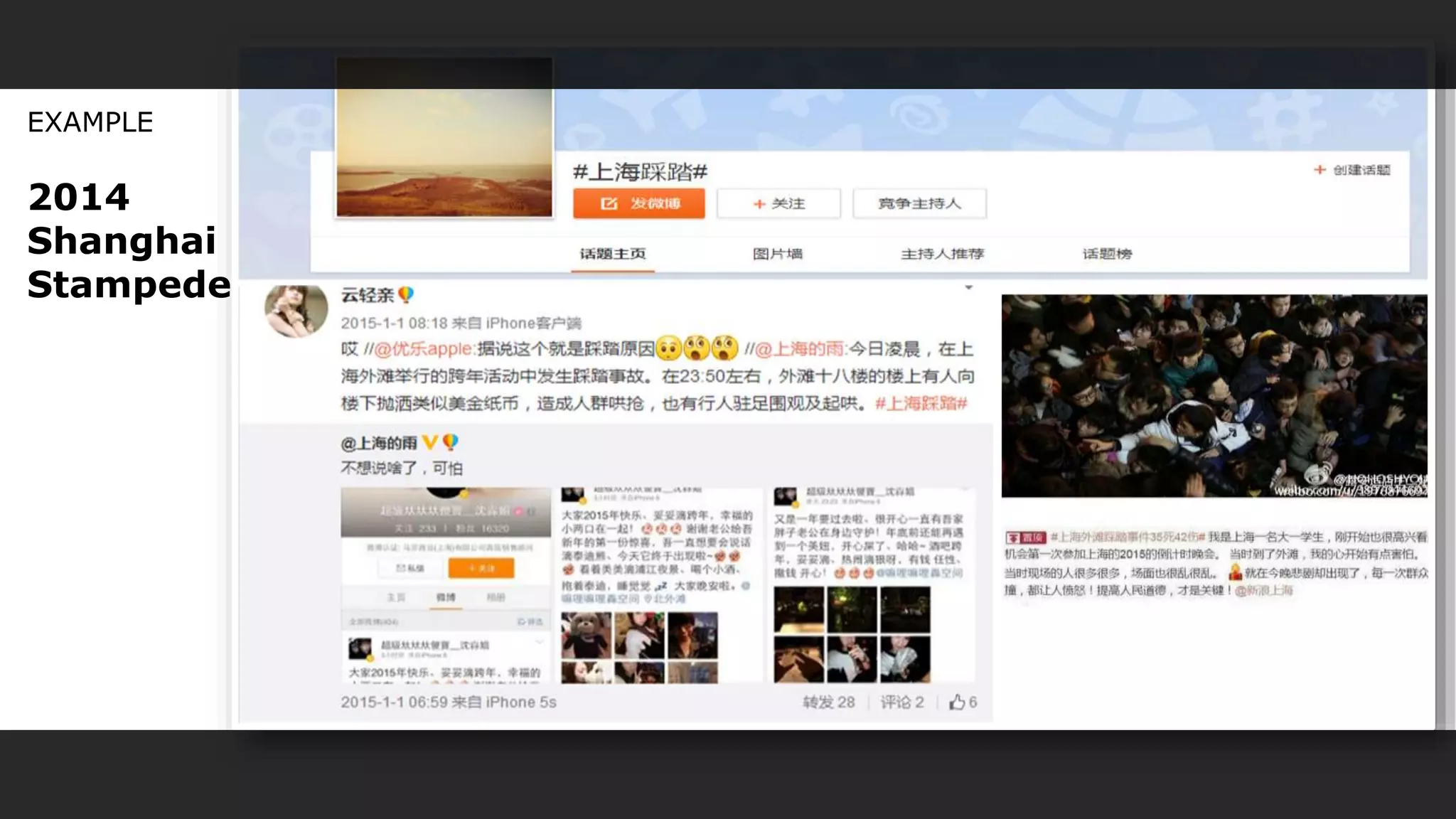
EXAMPLE
2014
Shanghai
Stampede
Hyperlink and information about the writer
enhance perceived story credibility of citizen
journalism.
---
Kirsten A. Johnson and Susan Wiedenbeck:
Enhance Perceived credibility of citizen journalism web sites
“
The Impact of
Citizen Journalism?
1 How does Citizen Journalism
Influences Mainstream Journalism
2 Social impact of Citizen Journalism,
especially in Chinese context
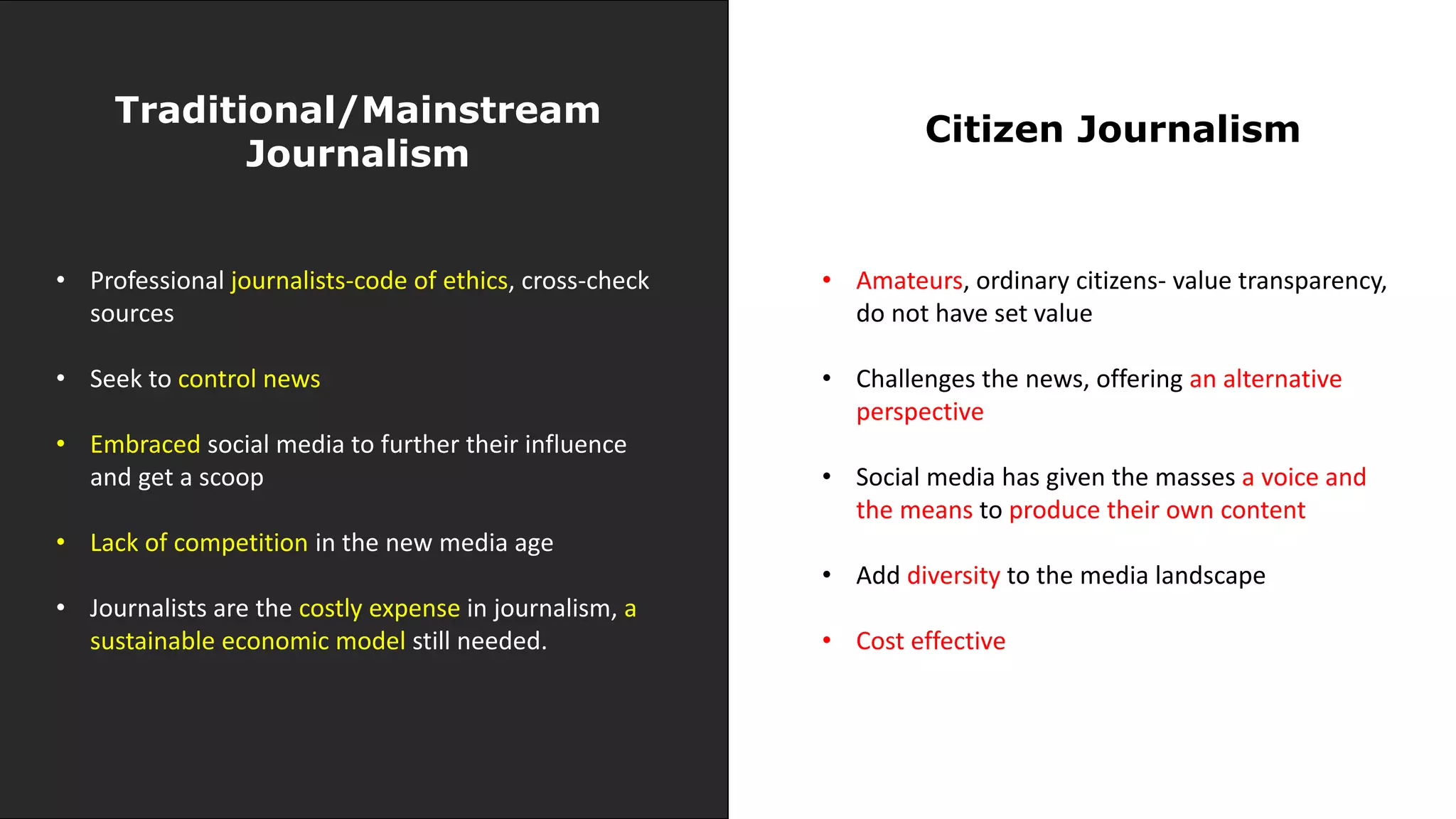
Traditional/Mainstream
Journalism
Citizen Journalism
• Professional journalists-code of ethics, cross-check
sources
• Seek to control news
• Embraced social media to further their influence
and get a scoop
• Lack of competition in the new media age
• Journalists are the costly expense in journalism, a
sustainable economic model still needed.
• Amateurs, ordinary citizens- value transparency,
do not have set value
• Challenges the news, offering an alternative
perspective
• Social media has given the masses a voice and
the means to produce their own content
• Add diversity to the media landscape
• Cost effective
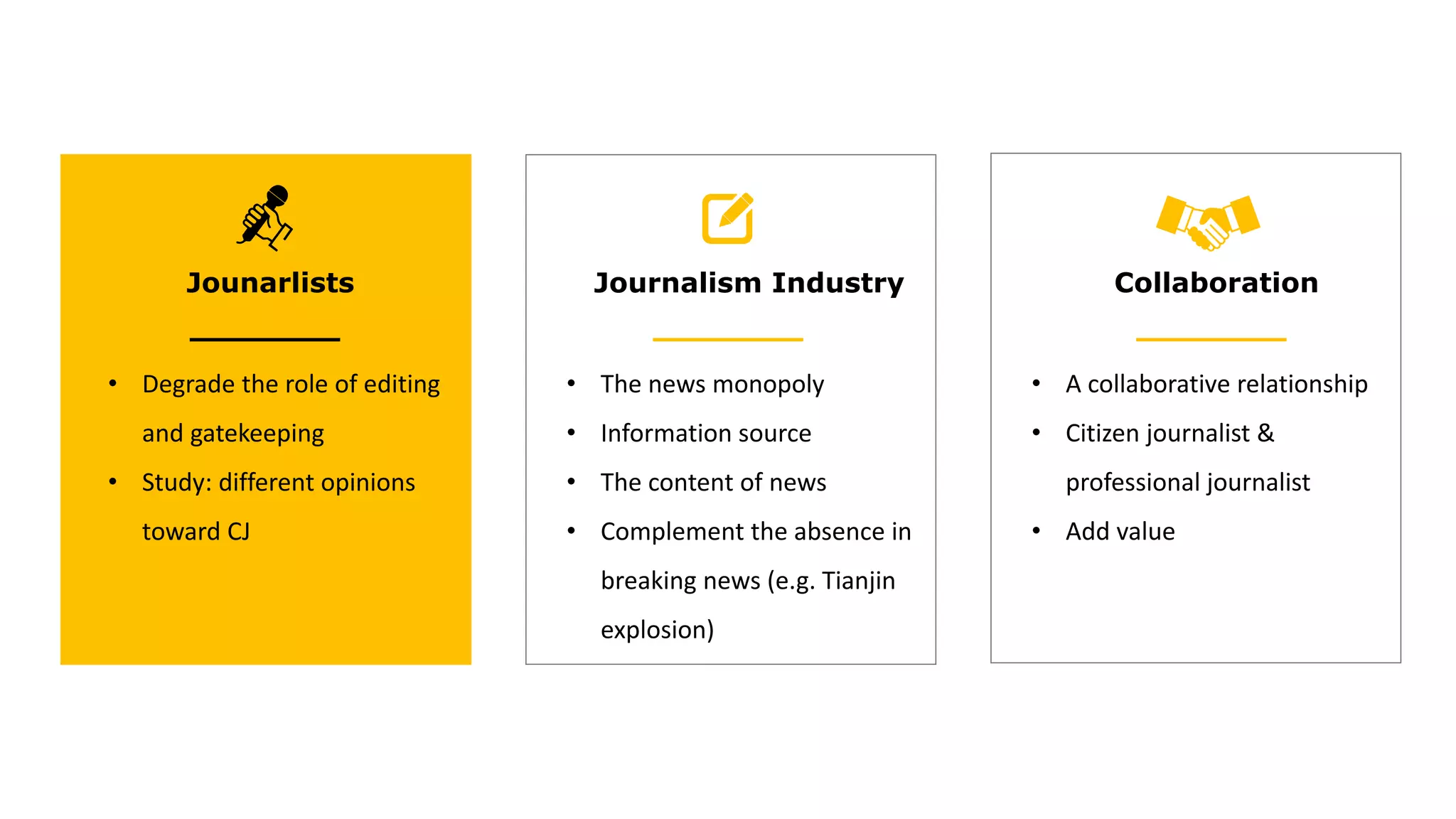
Jounarlists
• Degrade the role of editing
and gatekeeping
• Study: different opinions
toward CJ
Journalism Industry
• The news monopoly
• Information source
• The content of news
• Complement the absence in
breaking news (e.g. Tianjin
explosion)
Collaboration
• A collaborative relationship
• Citizen journalist &
professional journalist
• Add value
Journalists
• In traditional reporting system, journalists are definitely the
gatekeeper who play a vital role in selecting, writing, editing,
positioning, scheduling and massaging information to become news.
• Citizen journalism degrades the editing and gatekeeping role of
professional journalists.
Journalists
• What professional journalists think of citizen journalism?
• How they might incorporate it into their organizations’s news work?
• How they negotiate its challenge to their gatekeeping authority?
Journalists
There is a study on exploring the professional journalists’
attitudes toward citizen journalism.
THINKING ABOUT CITIZEN JOURNALISM
The philosophical and practical challenges of user-generated
content for community newspapers
Journalists
Problem Statement:
• RQ1: In general, what do community newspaper
editors think of citizen journalism, and how likely
are they to incorporate some variation of it in their
news operation?
• RQ2: How do community newspapers negotiate
citizen journalism, as a philosophical concept and a
practical concern, in their role as community
gatekeeper?
Method:Interviews with Journalists
This study relies on interviews with top editors at 29
community around the state of Texas. Using systematic
sampling methods.
Results:
Some editors were more neutral in their positions than
others. Some editors explicitly expressed conflicted positions,
and indicated that they were struggling with the place of
citizen journalism at their newspaper.
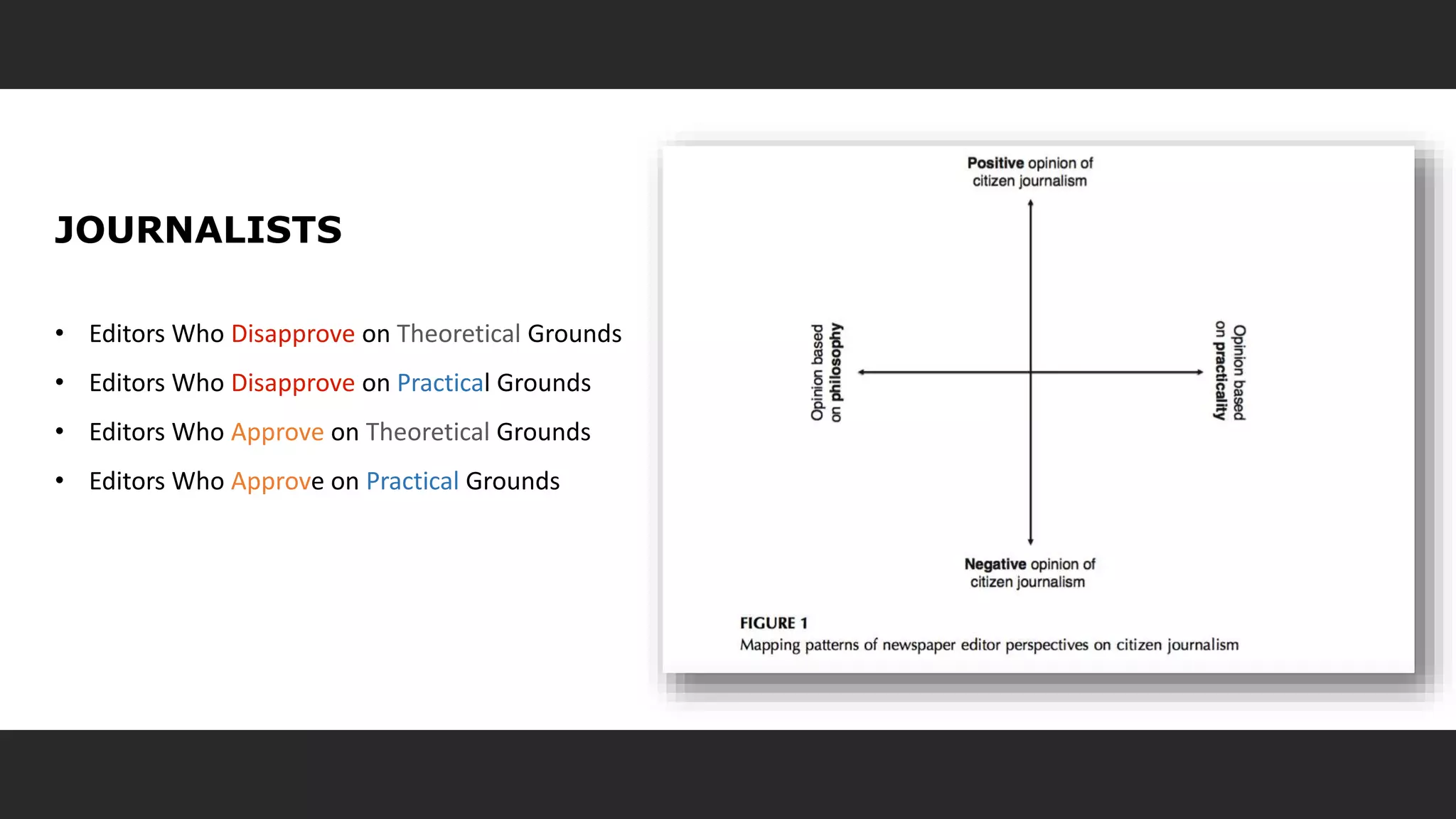
JOURNALISTS
• Editors Who Disapprove on Theoretical Grounds
• Editors Who Disapprove on Practical Grounds
• Editors Who Approve on Theoretical Grounds
• Editors Who Approve on Practical Grounds
Journalists
• Editors Who Disapprove on Theoretical Grounds
Davis McAuley, editor of the Bastrop Advertiser, said of citizen journalism, ‘‘It does not make
any sense. News is meant to be reported professionally, not through some random citizen . . .
Journalism is a profession and it cannot be done by anyone.’’
• Make a clear distinction between professionally trained journalists and everyone else.
• See journalism as the business of professionals only.
Journalists
• Editors Who Disapprove on Practical Grounds
The newspaper stopped using it because of problems of slander. ‘‘My principal concern is that
I see a lot of the citizen but not a lot of journalism. There’s a lot of slander and personal anger
or bitterness, but not news,’’ he said. Floyde concluded, ‘‘I think it’s irresponsible, and I’m not
going to experiment with it again.’’
• unworkable
Journalists
• Editors Who Approve on Theoretical Grounds
Shelly Gormey, editor of the Bay City Tribune, said she thinks citizen journalism represents an
important aspect of the future of journalism. ‘‘I think journalism will not be replaced by it,’’
she said, ‘‘but it will be supplemented by it.’’ She said that ‘‘with tools like citizen journalism,
actual journalism will be well-assisted.’’ She said her newspaper employs citizen journalism
‘‘every chance it is possible. We have people getting involved and contributing.’’
• A distinct advancement
• A natural extension of traditional
Journalists
• Editors Who Approve on Practical Grounds
That’s the only way we engage the community.’’ However, Saught said she thinks citizen
journalism is the future of journalism: ‘‘Yes, it has to be. There is so much more to cover and
[only] so many people who are in a position to cover it. So, I believe it is.’’
• a useful way
• A workable solution
JOURNALISTS “
Regardless of their position, though, one thing is clear:
editors of community newspapers are thinking about
citizen journalism.
Journalism Industry
Break the news monopoly of traditional media
Numerous ordinary citizens are given an opportunity to
express their voice, to produce their content and to set their
own agenda, not just led by the media itself
Journalism Industry
Broaden the information source
With the help of citizen journalism, traditional journalism
can get closer to the readers and audiences;
tailor their content in a more efficient way
Journalism Industry
Enrich the forms and content of news
( 10 Ways Citizen Video Journalism is Impacting Media)
Images, videos, broadcasting , etc…
Journalism Industry
Complement the absence of traditional media in breaking news
• (e.g. 8/12 Tianjin explosion https://www.youtube.com/watch?v=5RNDlL-L4cI)
It is hard for professional journalists to attend every important issues on
time especially the site of breaking news.
However, citizen journalists are everywhere.
They can not only be a witness, but also a reporter.
What they record can be a vital evidence for traditional journalists to do
further report.
““Traditional journalism is the outside looking in. Citizen
journalism is the inside looking out. In order to get the
complete story, it helps to have both points of view. “
---Peter Dooley (2008)
Collaboration
• Sustain a collaborative relationship that can be qualified as vertical
• A citizen journalist could help a professional journalist in terms of getting
information, being an additional set of eyes and ears.
• Traditional journalism can add value to CJ (standing alone it is not credible )
SOCIAL
IMPACT
It’s a media system that is swinging between
the party, the market, and the audiences.
---
Xilong Wang:
Through the eyes of citizen journalists
“
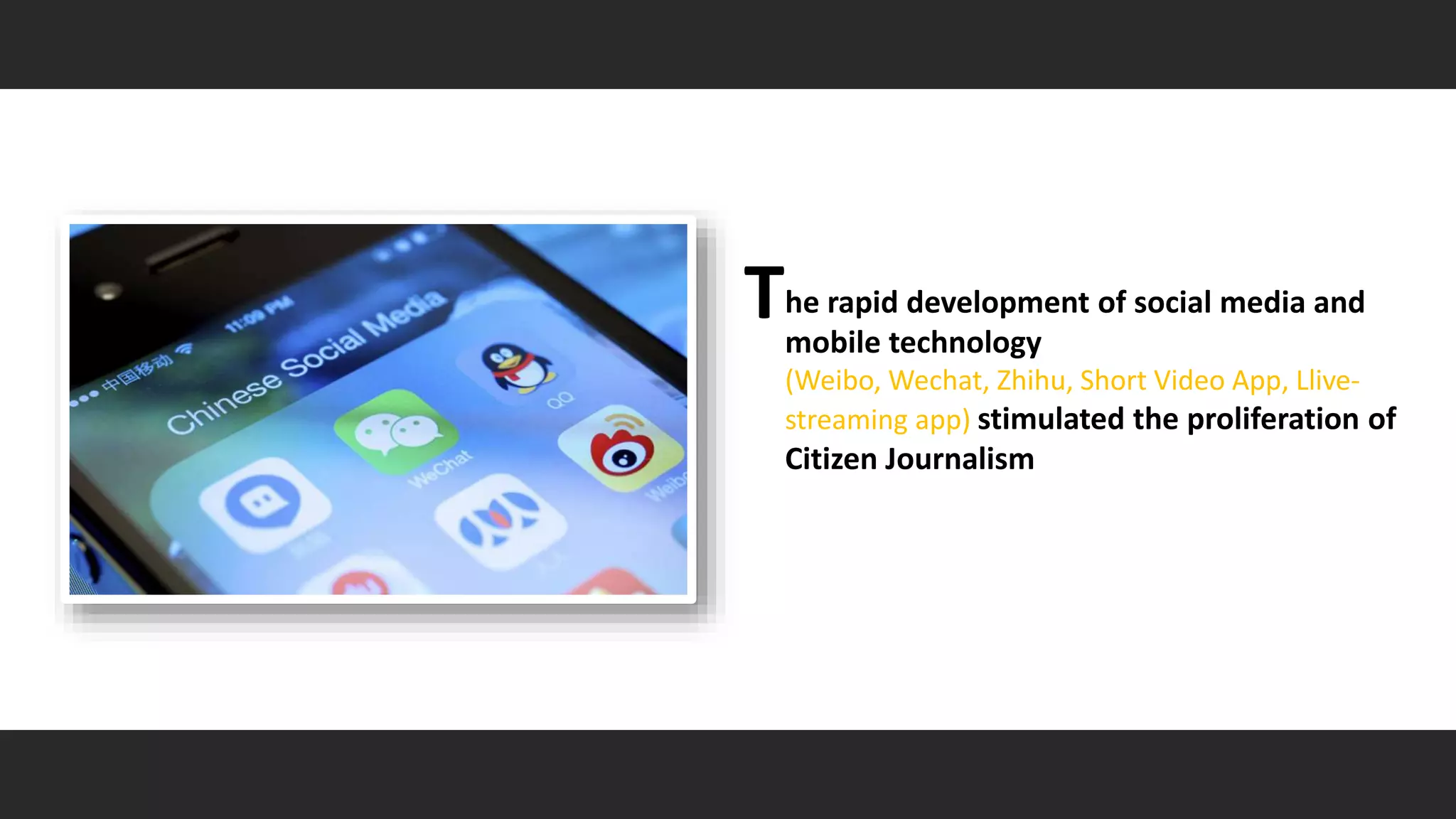
he rapid development of social media and
mobile technology
(Weibo, Wechat, Zhihu, Short Video App, Llive-
streaming app) stimulated the proliferation of
Citizen Journalism
T
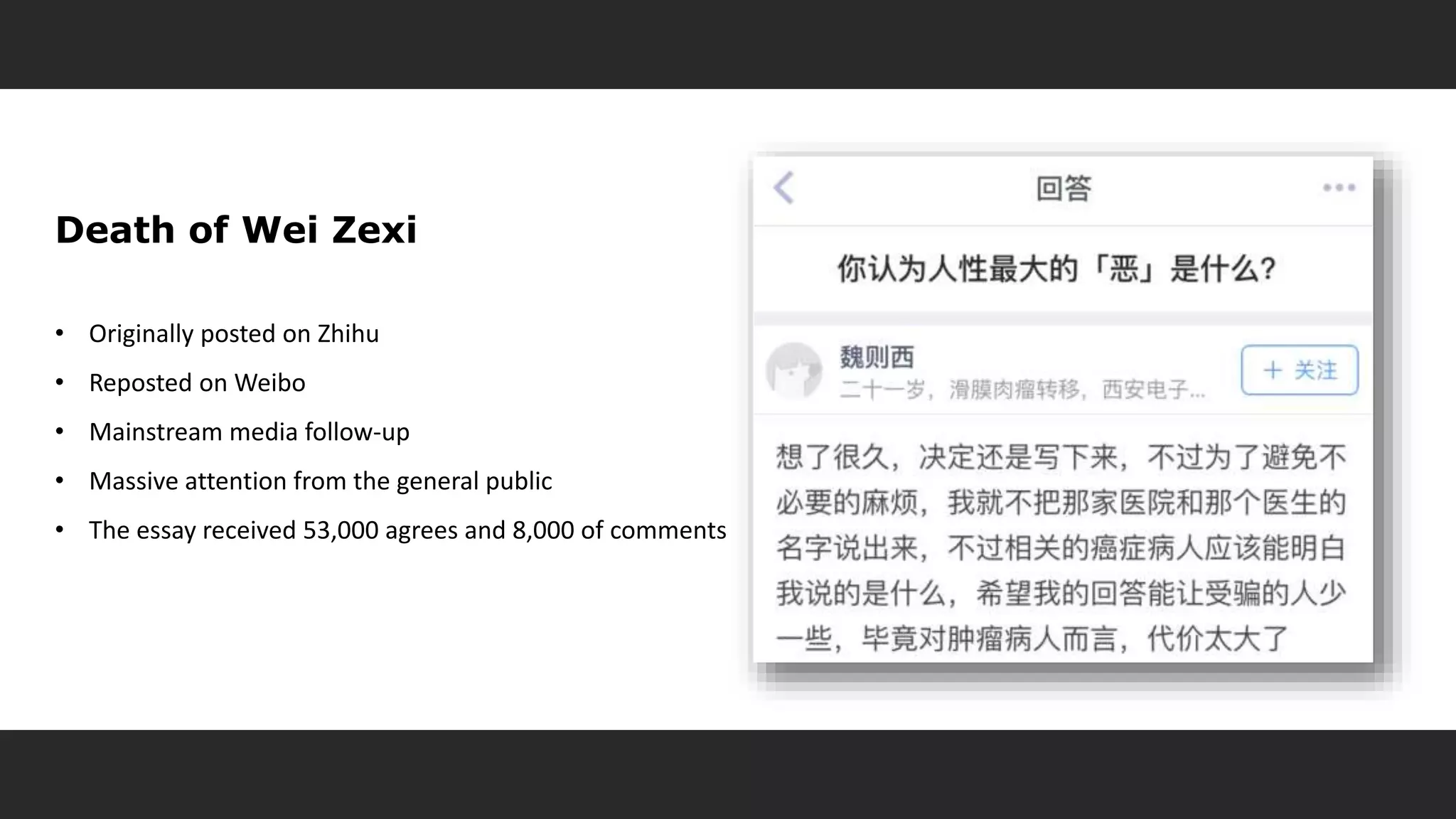
Death of Wei Zexi
• Originally posted on Zhihu
• Reposted on Weibo
• Mainstream media follow-up
• Massive attention from the general public
• The essay received 53,000 agrees and 8,000 of comments
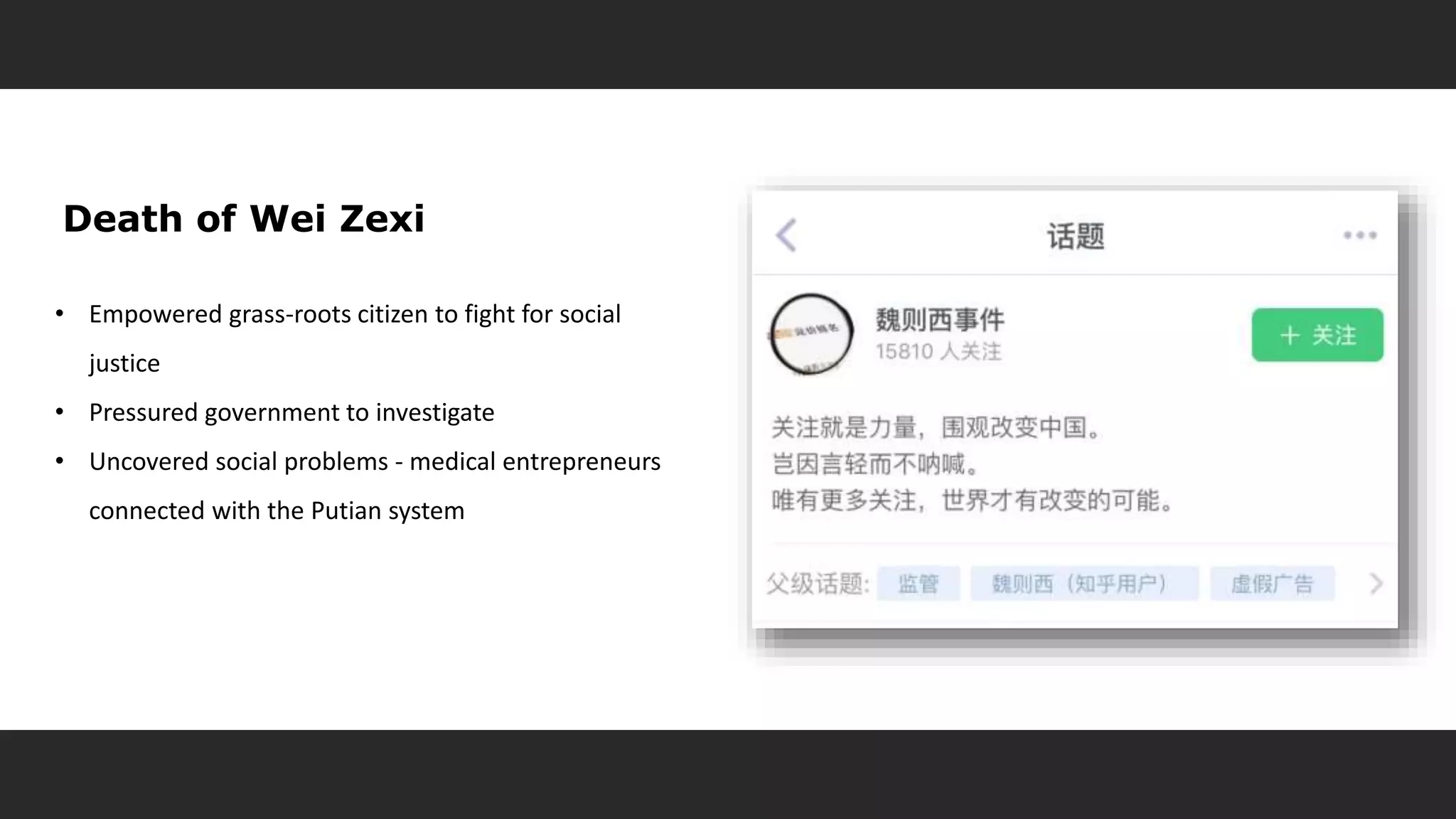
Death of Wei Zexi
• Empowered grass-roots citizen to fight for social
justice
• Pressured government to investigate
• Uncovered social problems - medical entrepreneurs
connected with the Putian system
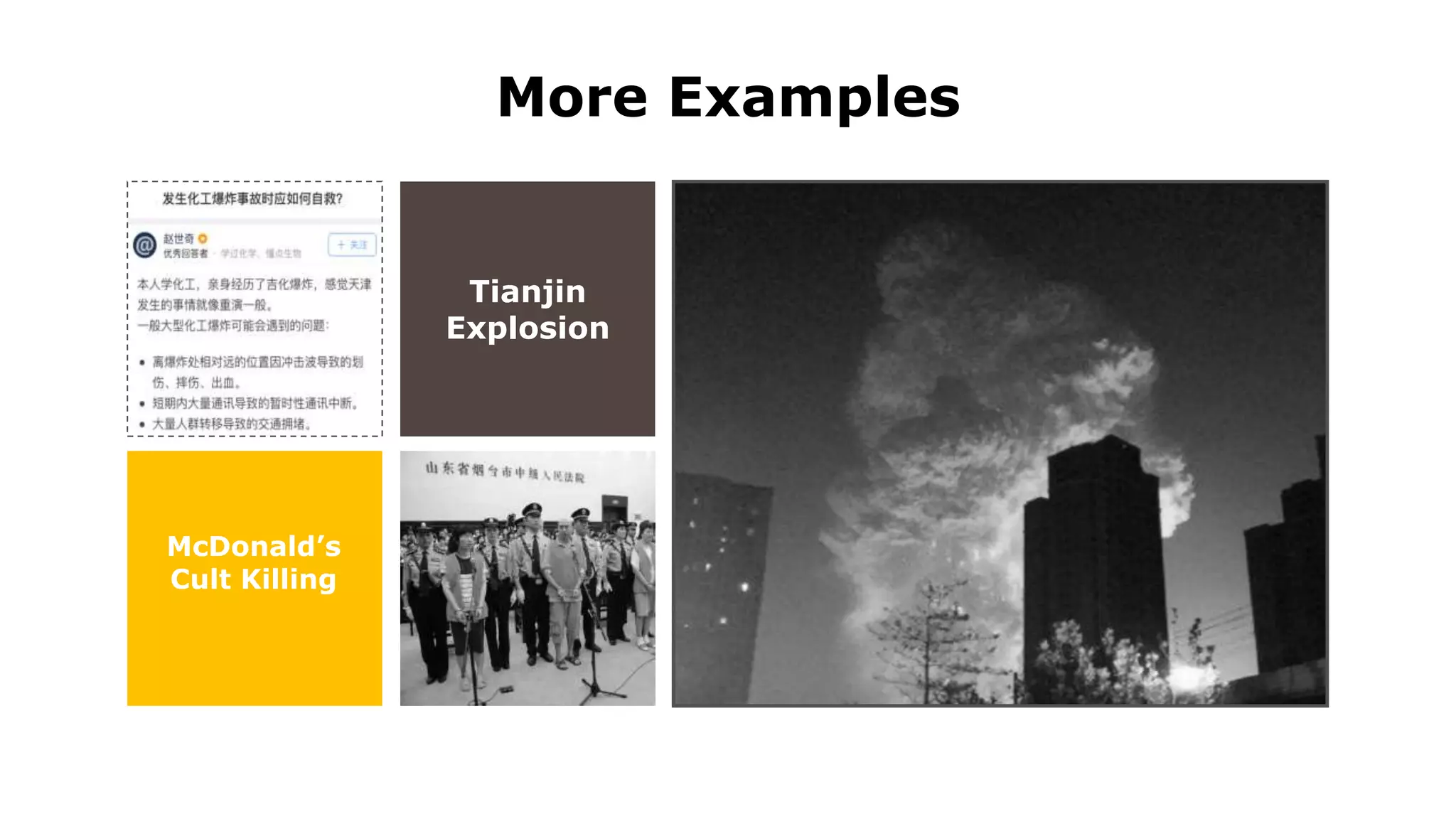
Tianjin
Explosion
McDonald’s
Cult Killing
More Examples
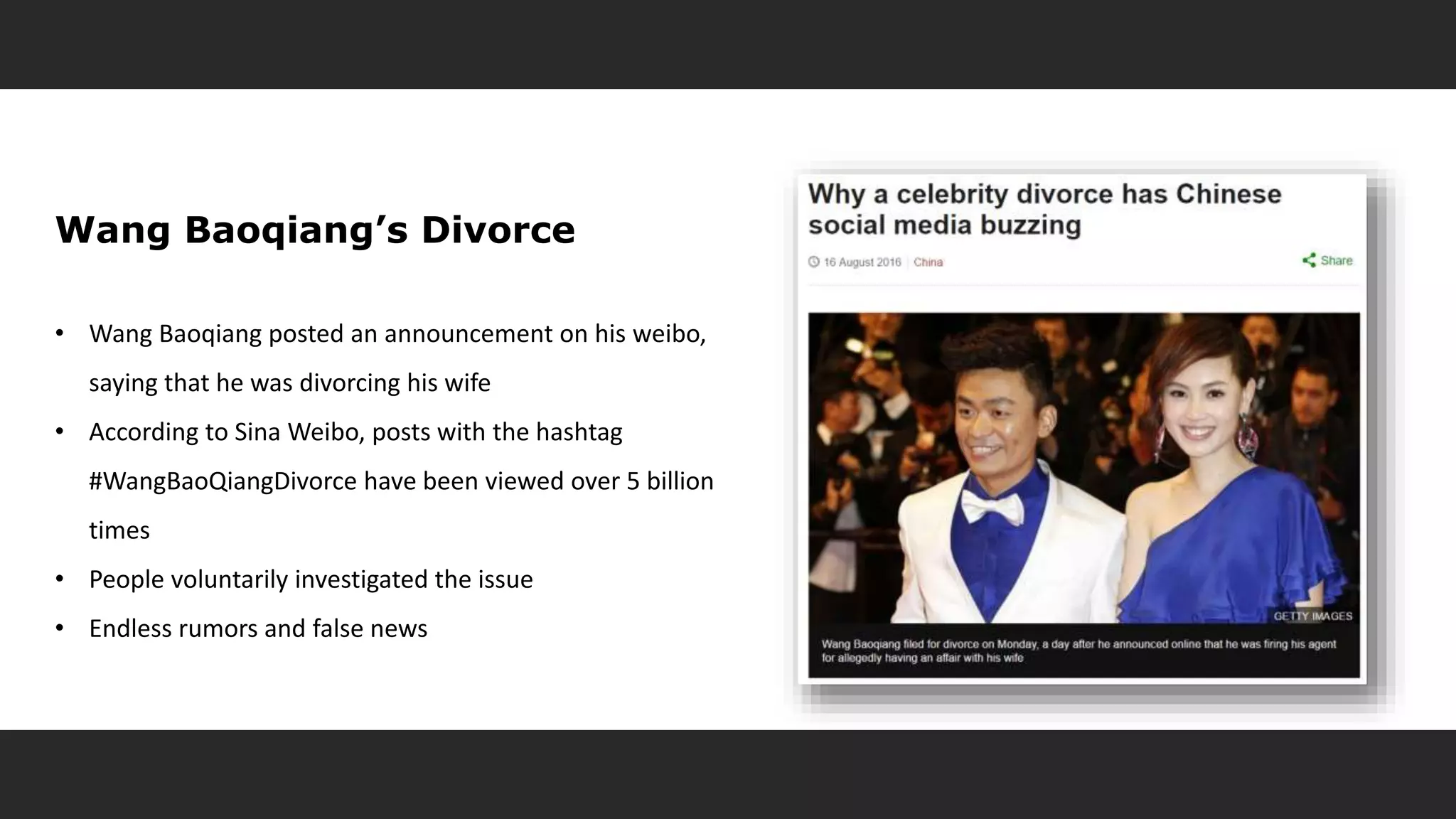
Wang Baoqiang’s Divorce
• Wang Baoqiang posted an announcement on his weibo,
saying that he was divorcing his wife
• According to Sina Weibo, posts with the hashtag
#WangBaoQiangDivorce have been viewed over 5 billion
times
• People voluntarily investigated the issue
• Endless rumors and false news
• Is the Citizen Journalism in China focusing
more on the entertainment topics rather than
other social issues?
• What are the deeply-rooted reasons behind
this phenomenon?
CONCLUSION
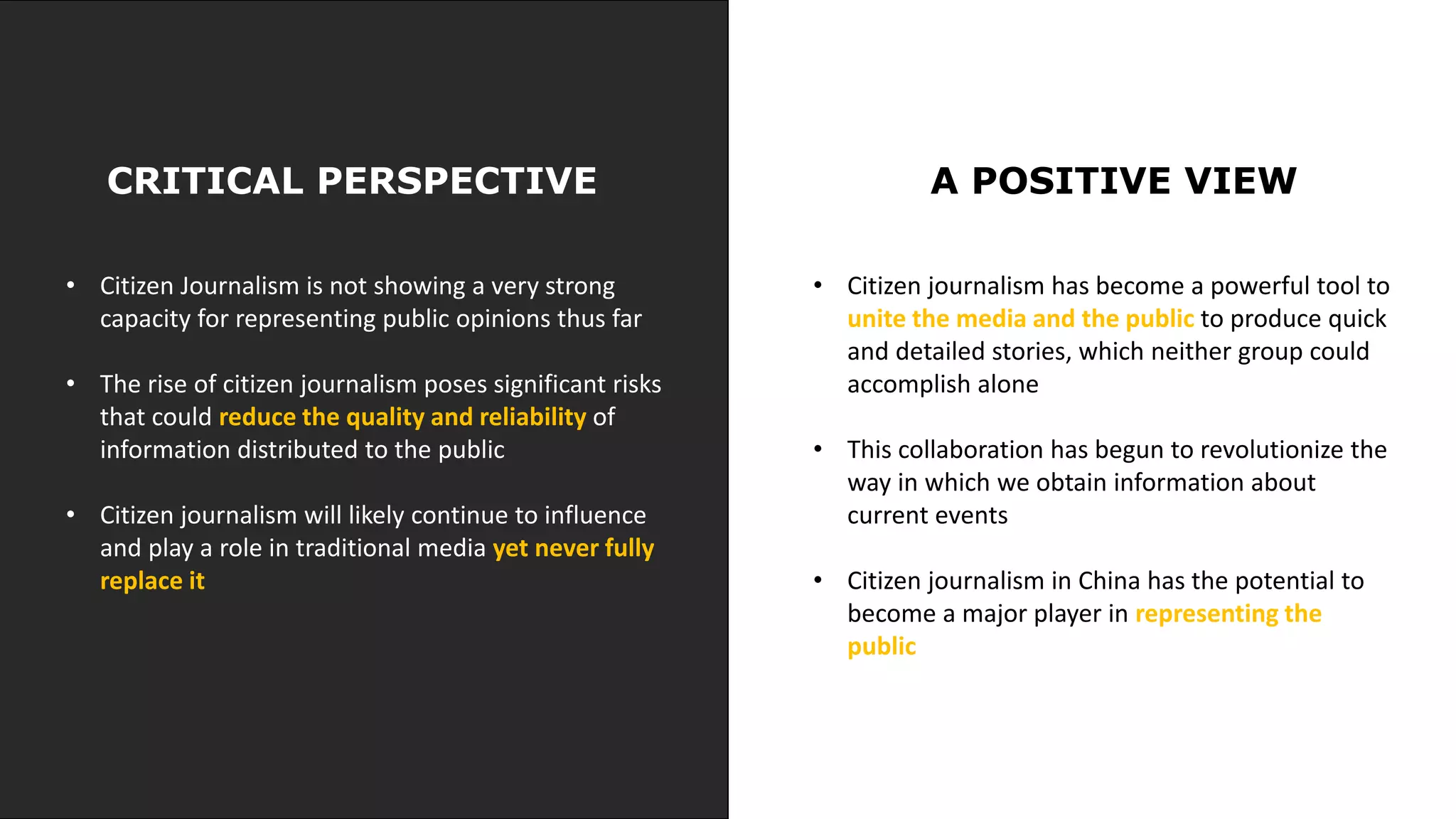
CRITICAL PERSPECTIVE A POSITIVE VIEW
• Citizen Journalism is not showing a very strong
capacity for representing public opinions thus far
• The rise of citizen journalism poses significant risks
that could reduce the quality and reliability of
information distributed to the public
• Citizen journalism will likely continue to influence
and play a role in traditional media yet never fully
replace it
• Citizen journalism has become a powerful tool to
unite the media and the public to produce quick
and detailed stories, which neither group could
accomplish alone
• This collaboration has begun to revolutionize the
way in which we obtain information about
current events
• Citizen journalism in China has the potential to
become a major player in representing the
public

Group 2 Discussion Leading

  • 1.
    Social/Mobile Media and Citizen Journalism BYGroup 2 ● Wang Xin ● Jiang Chunyu ● Jiang Shiran
  • 2.
    AGENDA Introduction01 Definition | History| Channels | Characteristics 02 Impact Impact on professional journalism | Social impact in Chinese context 03 Conclusion Looking towards the future
  • 3.
  • 4.
    What is Citizen Journalism? CitizenJournalism, also referred to as “grass-roots journalism” and “participatory journalism”, is “the act of a citizen, or group of citizens, playing an active role in the process of collecting, reporting, analyzing and disseminating news and information. --- Bowman and Willis, “We Media: How Audiences Are Shaping the Future of News and Information”
  • 5.
    EXAMPLE: Citizen Journalismin the Arab Spring A youth uses a cameraphone to capture the aftermath of a teargas volley fired by police on protesters near Tahrir Square in Cairo, Egypt. Photograph: Peter Macdiarmid/Getty Images. --- The Guardian “Arab spring leads surge in events captured on cameraphones”
  • 6.
    A screenshot ofthe RNN Facebook wall during the 2011 Cairo uprising RNN: Cairo’s Rassd News Network, one of the biggest citizen journalism projects of today.
  • 7.
  • 8.
    The Assassination ofJ.F.K, 1963 The U.S. Presidential Election, 1988
  • 9.
    Citizen Journalism: More noticeablewith the rise of social media and the online world, and more prevalent with the rise of Web 2.0.
  • 10.
    Channels and Platforms Throughwhich channels do citizen journalists report?
  • 11.
    Channels and Platforms •Citizen journalism websites, list of citizen journalism websites • Social Media: Blogs, YouTube, Facebook, Reddit, Twitter, Weibo… • Special sections for citizen journalism on mainstream media, e.g. CNNiReport
  • 12.
    Characteristics What advantages anddisadvantages does citizen journalism have?
  • 13.
    ADVANTAGES • Faster thanprofessional journalists • Reports things that may not be covered by mainstream media • Enjoys greater editorial independence, allows uncensored contents • Supervises the government and promotes social equality and justice • Opportunity for ordinary citizens to express Advantages
  • 14.
    DISADVANTAGES• Less influentialthan mainstream media • Lack of professional training • Biased, even false news rather than objective reports • Dubious perceived credibility Disadvantages
  • 15.
  • 16.
    Hyperlink and informationabout the writer enhance perceived story credibility of citizen journalism. --- Kirsten A. Johnson and Susan Wiedenbeck: Enhance Perceived credibility of citizen journalism web sites “
  • 17.
    The Impact of CitizenJournalism? 1 How does Citizen Journalism Influences Mainstream Journalism 2 Social impact of Citizen Journalism, especially in Chinese context
  • 18.
    Traditional/Mainstream Journalism Citizen Journalism • Professionaljournalists-code of ethics, cross-check sources • Seek to control news • Embraced social media to further their influence and get a scoop • Lack of competition in the new media age • Journalists are the costly expense in journalism, a sustainable economic model still needed. • Amateurs, ordinary citizens- value transparency, do not have set value • Challenges the news, offering an alternative perspective • Social media has given the masses a voice and the means to produce their own content • Add diversity to the media landscape • Cost effective
  • 19.
    Jounarlists • Degrade therole of editing and gatekeeping • Study: different opinions toward CJ Journalism Industry • The news monopoly • Information source • The content of news • Complement the absence in breaking news (e.g. Tianjin explosion) Collaboration • A collaborative relationship • Citizen journalist & professional journalist • Add value
  • 20.
    Journalists • In traditionalreporting system, journalists are definitely the gatekeeper who play a vital role in selecting, writing, editing, positioning, scheduling and massaging information to become news. • Citizen journalism degrades the editing and gatekeeping role of professional journalists.
  • 21.
    Journalists • What professionaljournalists think of citizen journalism? • How they might incorporate it into their organizations’s news work? • How they negotiate its challenge to their gatekeeping authority?
  • 22.
    Journalists There is astudy on exploring the professional journalists’ attitudes toward citizen journalism. THINKING ABOUT CITIZEN JOURNALISM The philosophical and practical challenges of user-generated content for community newspapers
  • 23.
    Journalists Problem Statement: • RQ1:In general, what do community newspaper editors think of citizen journalism, and how likely are they to incorporate some variation of it in their news operation? • RQ2: How do community newspapers negotiate citizen journalism, as a philosophical concept and a practical concern, in their role as community gatekeeper? Method:Interviews with Journalists This study relies on interviews with top editors at 29 community around the state of Texas. Using systematic sampling methods. Results: Some editors were more neutral in their positions than others. Some editors explicitly expressed conflicted positions, and indicated that they were struggling with the place of citizen journalism at their newspaper.
  • 24.
    JOURNALISTS • Editors WhoDisapprove on Theoretical Grounds • Editors Who Disapprove on Practical Grounds • Editors Who Approve on Theoretical Grounds • Editors Who Approve on Practical Grounds
  • 25.
    Journalists • Editors WhoDisapprove on Theoretical Grounds Davis McAuley, editor of the Bastrop Advertiser, said of citizen journalism, ‘‘It does not make any sense. News is meant to be reported professionally, not through some random citizen . . . Journalism is a profession and it cannot be done by anyone.’’ • Make a clear distinction between professionally trained journalists and everyone else. • See journalism as the business of professionals only.
  • 26.
    Journalists • Editors WhoDisapprove on Practical Grounds The newspaper stopped using it because of problems of slander. ‘‘My principal concern is that I see a lot of the citizen but not a lot of journalism. There’s a lot of slander and personal anger or bitterness, but not news,’’ he said. Floyde concluded, ‘‘I think it’s irresponsible, and I’m not going to experiment with it again.’’ • unworkable
  • 27.
    Journalists • Editors WhoApprove on Theoretical Grounds Shelly Gormey, editor of the Bay City Tribune, said she thinks citizen journalism represents an important aspect of the future of journalism. ‘‘I think journalism will not be replaced by it,’’ she said, ‘‘but it will be supplemented by it.’’ She said that ‘‘with tools like citizen journalism, actual journalism will be well-assisted.’’ She said her newspaper employs citizen journalism ‘‘every chance it is possible. We have people getting involved and contributing.’’ • A distinct advancement • A natural extension of traditional
  • 28.
    Journalists • Editors WhoApprove on Practical Grounds That’s the only way we engage the community.’’ However, Saught said she thinks citizen journalism is the future of journalism: ‘‘Yes, it has to be. There is so much more to cover and [only] so many people who are in a position to cover it. So, I believe it is.’’ • a useful way • A workable solution
  • 29.
    JOURNALISTS “ Regardless oftheir position, though, one thing is clear: editors of community newspapers are thinking about citizen journalism.
  • 30.
    Journalism Industry Break thenews monopoly of traditional media Numerous ordinary citizens are given an opportunity to express their voice, to produce their content and to set their own agenda, not just led by the media itself
  • 31.
    Journalism Industry Broaden theinformation source With the help of citizen journalism, traditional journalism can get closer to the readers and audiences; tailor their content in a more efficient way
  • 32.
    Journalism Industry Enrich theforms and content of news ( 10 Ways Citizen Video Journalism is Impacting Media) Images, videos, broadcasting , etc…
  • 33.
    Journalism Industry Complement theabsence of traditional media in breaking news • (e.g. 8/12 Tianjin explosion https://www.youtube.com/watch?v=5RNDlL-L4cI) It is hard for professional journalists to attend every important issues on time especially the site of breaking news. However, citizen journalists are everywhere. They can not only be a witness, but also a reporter. What they record can be a vital evidence for traditional journalists to do further report.
  • 34.
    ““Traditional journalism isthe outside looking in. Citizen journalism is the inside looking out. In order to get the complete story, it helps to have both points of view. “ ---Peter Dooley (2008)
  • 35.
    Collaboration • Sustain acollaborative relationship that can be qualified as vertical • A citizen journalist could help a professional journalist in terms of getting information, being an additional set of eyes and ears. • Traditional journalism can add value to CJ (standing alone it is not credible )
  • 36.
  • 37.
    It’s a mediasystem that is swinging between the party, the market, and the audiences. --- Xilong Wang: Through the eyes of citizen journalists “
  • 38.
    he rapid developmentof social media and mobile technology (Weibo, Wechat, Zhihu, Short Video App, Llive- streaming app) stimulated the proliferation of Citizen Journalism T
  • 39.
    Death of WeiZexi • Originally posted on Zhihu • Reposted on Weibo • Mainstream media follow-up • Massive attention from the general public • The essay received 53,000 agrees and 8,000 of comments
  • 40.
    Death of WeiZexi • Empowered grass-roots citizen to fight for social justice • Pressured government to investigate • Uncovered social problems - medical entrepreneurs connected with the Putian system
  • 41.
  • 42.
    Wang Baoqiang’s Divorce •Wang Baoqiang posted an announcement on his weibo, saying that he was divorcing his wife • According to Sina Weibo, posts with the hashtag #WangBaoQiangDivorce have been viewed over 5 billion times • People voluntarily investigated the issue • Endless rumors and false news
  • 43.
    • Is theCitizen Journalism in China focusing more on the entertainment topics rather than other social issues? • What are the deeply-rooted reasons behind this phenomenon?
  • 44.
  • 45.
    CRITICAL PERSPECTIVE APOSITIVE VIEW • Citizen Journalism is not showing a very strong capacity for representing public opinions thus far • The rise of citizen journalism poses significant risks that could reduce the quality and reliability of information distributed to the public • Citizen journalism will likely continue to influence and play a role in traditional media yet never fully replace it • Citizen journalism has become a powerful tool to unite the media and the public to produce quick and detailed stories, which neither group could accomplish alone • This collaboration has begun to revolutionize the way in which we obtain information about current events • Citizen journalism in China has the potential to become a major player in representing the public