City Resilience Index
December 2015
City Resilience Index
Urban populations are facing increasing
challenges from numerous natural and man-
made pressures such as rapid urbanisation,
climate change, terrorism and increased
risks from natural hazards. Cities must
learn to adapt and thrive in the face of
these diverse challenges - they must learn
how to build resilience in an uncertain
world. Armed with this knowledge and
understanding, governments, donors,
investors, policy makers, and the private
sector will be able to develop effective
strategies to foster more resilient cities.
Supported by the Rockefeller Foundation,
the City Resilience Index (CRI) is being
developed by Arup. It builds on extensive
research undertaken by Arup to establish
an accessible, evidence-based definition
of urban resilience, which culminated
in the publication of the City Resilience
Framework (CRF) in April 2014
(www.arup.com/cri). This provides a
holistic articulation of city resilience,
structured around four dimensions and 12
goals that are critical for the resilience of
our cities. This structure also forms the
foundations of the CRI.
© Arup
Who is the CRI for?
The CRI will measure relative performance
over time rather than comparison between
cities. It will not deliver an overall single
score for comparing performance between
cities, neither will it provide a world ranking
of the most resilient cities. However, it will
provide a common basis of measurement
and assessment to better facilitate dialogue
and knowledge-sharing between cities.
It is envisaged that the CRI will primarily
be used by city governments who are in
the best position to gather administrative
data, but it can also be used by other
interested organisations and individuals (for
example, universities, non-governmental
organisations, community groups). It is
intended that the CRI process will also
provide the means for cities to capture the
views of the poor and vulnerable groups
as they normally suffer more severely the
impacts of disruptions and failures.
1City Resilience Index - The Rockefeller Foundation | Arup
Structure of the CRI
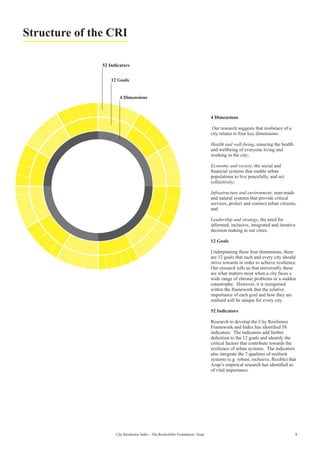
4 Dimensions
Our research suggests that resilience of a
city relates to four key dimensions:
Health and well-being, ensuring the health
and wellbeing of everyone living and
working in the city;
Economy and society, the social and
financial systems that enable urban
populations to live peacefully, and act
collectively;
Infrastructure and environment, man-made
and natural systems that provide critical
services, protect and connect urban citizens;
and
Leadership and strategy, the need for
informed, inclusive, integrated and iterative
decision making in our cities.
12 Goals
Underpinning these four dimensions, there
are 12 goals that each and every city should
strive towards in order to achieve resilience.
Our research tells us that universally these
are what matters most when a city faces a
wide range of chronic problems or a sudden
catastrophe. However, it is recognised
within the framework that the relative
importance of each goal and how they are
realised will be unique for every city.
52 Indicators
Research to develop the City Resilience
Framework and Index has identified 58
indicators. The indicators add further
definition to the 12 goals and identify the
critical factors that contribute towards the
resilience of urban systems. The indicators
also integrate the 7 qualities of resilient
systems (e.g. robust, inclusive, flexible) that
Arup’s empirical research has identified as
of vital importance.
4 Dimensions
12 Goals
52 Indicators
ty
&
rule
oflaw
support
Effectivesafeguardsto
Diverse
li
velihoods
Minimal humananning
Com
pre
hensive
Collectiveidentity&
humanhealth&life
&
em
pl
oym
ent
vulnerability
Health
&
wellbeing
Econom
y
&
society
Safeandaffordablehousing
Adequateaffordableenergysupply
Inclusiveaccesstosafedrinkingwater
Effectivesanitation
Sufficientaffordablefoodsupply
Inclusivelabourpolicies
Relevantskills
and
training
Localbusiness
developm
entand
innovation
Supportive
financing
m
echanism
s
Diverse protection of livelihoods following a shock
Robust public health systems
Adequate access to quality healthcare
Emergency medical care
Effective emergency response services
Local community support
Cohesive communities
Strong city-wide identity and cultureActively engaged citizensEffective systems to det
Proacti
Robustplanningapprovalprocess
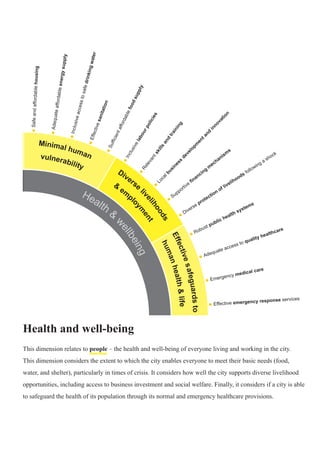
This dimension relates to people – the health and well-being of everyone living and working in the city.
This dimension considers the extent to which the city enables everyone to meet their basic needs (food,
water, and shelter), particularly in times of crisis. It considers how well the city supports diverse livelihood
opportunities, including access to business investment and social welfare. Finally, it considers if a city is able
to safeguard the health of its population through its normal and emergency healthcare provisions.
Health and well-being
2
3City Resilience Index - The Rockefeller Foundation | Arup
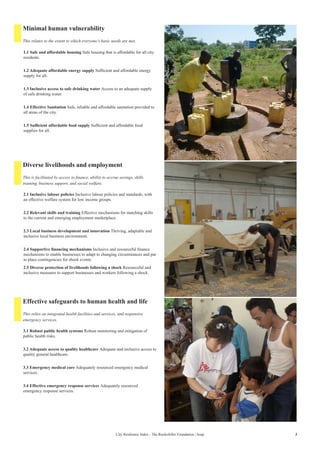
Minimal human vulnerability
Diverse livelihoods and employment
Effective safeguards to human health and life
1.1 Safe and affordable housing Safe housing that is affordable for all city
residents.
1.2 Adequate affordable energy supply Sufficient and affordable energy
supply for all.
1.3 Inclusive access to safe drinking water Access to an adequate supply
of safe drinking water.
1.4 Effective Sanitation Safe, reliable and affordable sanitation provided to
all areas of the city.
1.5 Sufficient affordable food supply Sufficient and affordable food
supplies for all.
2.1 Inclusive labour policies Inclusive labour policies and standards, with
an effective welfare system for low income groups.
2.2 Relevant skills and training Effective mechanisms for matching skills
to the current and emerging employment marketplace.
2.3 Local business development and innovation Thriving, adaptable and
inclusive local business environment.
2.4 Supportive financing mechanisms Inclusive and resourceful finance
mechanisms to enable businesses to adapt to changing circumstances and put
in place contingencies for shock events.
2.5 Diverse protection of livelihoods following a shock Resourceful and
inclusive measures to support businesses and workers following a shock.
3.1 Robust public health systems Robust monitoring and mitigation of
public health risks.
3.2 Adequate access to quality healthcare Adequate and inclusive access to
quality general healthcare.
3.3 Emergency medical care Adequately resourced emergency medical
services.
3.4 Effective emergency response services Adequately resourced
emergency response services.
This relates to the extent to which everyone’s basic needs are met.
This is facilitated by access to finance, ability to accrue savings, skills
training, business support, and social welfare.
This relies on integrated health facilities and services, and responsive
emergency services.
economy
security
&
rule
oflaw
support
ardsto
Sustainable
Com
pre
hensive
Collectiveidentity&
&life
sure
Econom
y&
society
Effective emergency response services
Local community support
Cohesive communities
Strong city-wide identity and cultureActively engaged citizensEffective systems to deter crime
Proactive
corruption
prevention
Com
petentpolicing
Accessiblecriminalandciviljustice
Well-managedpublicfinances
Comprehensivebusinesscontinuityplanning
Diverseeconomicbase
Attractivebusinessenvironment
Strongintegrationwithregionaland
globaleconomies
Comprehensivehazardandexposure
mapping
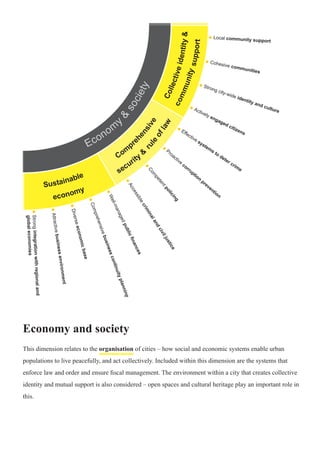
This dimension relates to the organisation of cities – how social and economic systems enable urban
populations to live peacefully, and act collectively. Included within this dimension are the systems that
enforce law and order and ensure fiscal management. The environment within a city that creates collective
identity and mutual support is also considered – open spaces and cultural heritage play an important role in
this.
4
Economy and society
5City Resilience Index - The Rockefeller Foundation | Arup
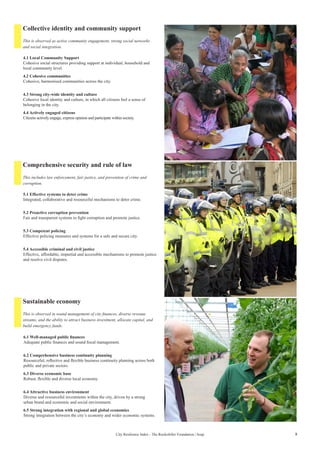
Collective identity and community support
Comprehensive security and rule of law
Sustainable economy
4.1 Local Community Support
Cohesive social structures providing support at individual, household and
local community level.
4.2 Cohesive communities
Cohesive, harmonised communities across the city.
4.3 Strong city-wide identity and culture
Cohesive local identity and culture, in which all citizens feel a sense of
belonging in the city.
4.4 Actively engaged citizens
Citizens actively engage, express opinion and participate within society.
5.1 Effective systems to deter crime
Integrated, collaborative and resourceful mechanisms to deter crime.
5.2 Proactive corruption prevention
Fair and transparent systems to fight corruption and promote justice.
5.3 Competent policing
Effective policing measures and systems for a safe and secure city.
5.4 Accessible criminal and civil justice
Effective, affordable, impartial and accessible mechanisms to promote justice
and resolve civil disputes.
6.1 Well-managed public finances
Adequate public finances and sound fiscal management.
6.2 Comprehensive business continuity planning
Resourceful, reflective and flexible business continuity planning across both
public and private sectors.
6.3 Diverse economic base
Robust, flexible and diverse local economy.
6.4 Attractive business environment
Diverse and resourceful investments within the city, driven by a strong
urban brand and economic and social environment.
6.5 Strong integration with regional and global economies
Strong integration between the city’s economy and wider economic systems.
This is observed as active community engagement, strong social networks
and social integration.
This includes law enforcement, fair justice, and prevention of crime and
corruption.
This is observed in sound management of city finances, diverse revenue
streams, and the ability to attract business investment, allocate capital, and
build emergency funds.
Effe
&communications
ofcritica
l services
& fragility
S
&
Reliablemobility
Effective
provision
Reduced exposure
Infrastructure
&
environment
Strongintegrationwithregionaland
globaleconomies
Comprehensivehazardandexposure
mapping
Appropriatecodes,standardsandenforcement
Effectivelymanagedprotectiveecosystems
Robustprotectiveinfrastructure
Effectivestewardshipofecosystems
Flexible
infrastructure
services
R
etained
spare
capacity
Diligent m
aintenance
Adequate continuity for critical assets
and services
Diverse and affordable transport networks
Effective transport operation
& maintenance
Reliable communications technology
Secure technology networks
Appropriate government decision-making
t bodies
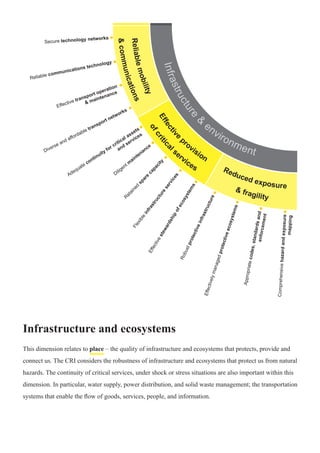
This dimension relates to place – the quality of infrastructure and ecosystems that protects, provide and
connect us. The CRI considers the robustness of infrastructure and ecosystems that protect us from natural
hazards. The continuity of critical services, under shock or stress situations are also important within this
dimension. In particular, water supply, power distribution, and solid waste management; the transportation
systems that enable the flow of goods, services, people, and information.
6
Infrastructure and ecosystems
7City Resilience Index - The Rockefeller Foundation | Arup
Reduced exposure & fragility
Effective provision of critical services
Reliable mobility and communications
7.1 Comprehensive hazard and exposure mapping
Robust systems in place to map the city’s exposure and vulnerability to
hazards based on current data.
7.2 Appropriate codes, standards and enforcement
Building and infrastructure codes and standards are forward looking, appro-
priate to local context and risk profiles, and enforced.
7.3 Effectively managed protective ecosystems
Well-developed understanding and acknowledgement of the role of ecosys-
tems in providing physical protection to the city.
7.4 Robust protective infrastructure
Integrated, forward-looking and robust network of protective infrastructure that
reduces vulnerability and exposure of citizens and critical assets.
8.1 Effective stewardship of ecosystems
Robust mechanisms are in place to maintain and enhance the ecosystem
services that benefit city residents
8.2 Flexible infrastructure
Critical services within the city are supported by diverse and robust infrastruc-
ture, which has been appropriately planned and delivered
8.3. Retained spare capacity
Demand on critical infrastructure is minimised through the resourceful and
flexible use of key resources.
8.4 Diligent maintenance and continuity
Robust monitoring, maintenance and renewal of essential utility infrastruc-
ture, with effective contingency planning.
8.5 Adequate continuity for critical assets and services
Resourceful, reflective and flexible continuity plans to maintain utility ser-
vices to critical assets during emergency situations.
9.1 Diverse and affordable transport networks
Diverse and integrated transport networks, providing flexible and affordable
travel around the city for all.
9.2 Effective transport operation & maintenance
Effective management of the city’s transport network to provide quality, safe
transport.
9.3 Reliable communications technology
Effective and reliable communication systems that are accessible by all.
9.4 Secure technology networks
Robust, effective mechanisms in place to protect the information and operational
technology systems on which the city is dependent.
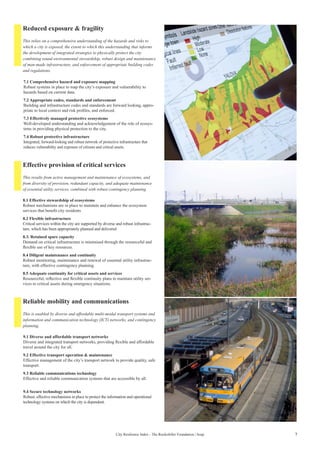
This relies on a comprehensive understanding of the hazards and risks to
which a city is exposed, the extent to which this understanding that informs
the development of integrated strategies to physically protect the city
combining sound environmental stewardship, robust design and maintenance
of man-made infrastructure, and enforcement of appropriate building codes
and regulations.
This results from active management and maintenance of ecosystems, and
from diversity of provision, redundant capacity, and adequate maintenance
of essential utility services, combined with robust contingency planning.
This is enabled by diverse and affordable multi-modal transport systems and
information and communication technology (ICT) networks, and contingency
planning.
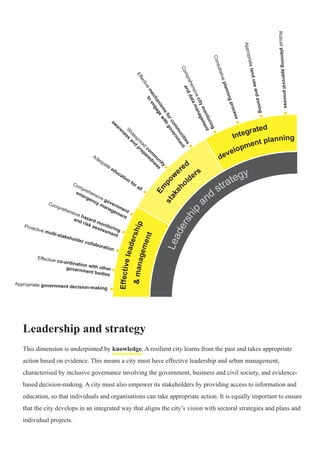
This dimension is underpinned by knowledge. A resilient city learns from the past and takes appropriate
action based on evidence. This means a city must have effective leadership and urban management,
characterised by inclusive governance involving the government, business and civil society, and evidence-
based decision-making. A city must also empower its stakeholders by providing access to information and
education, so that individuals and organisations can take appropriate action. It is equally important to ensure
that the city develops in an integrated way that aligns the city’s vision with sectoral strategies and plans and
individual projects.
Integrated
Em
po
w
ered
Effectiveleadership
&communications
ofcritica
l services
Mi
development planning
stakeh
olders
&management
Reliablemobility
Effective
provision
Reduc
vu
Leadership
and
strategy
Infrastructure
&
environment
Safeandaffordablehousing
es
re
capacity
Diligent m
aintenance
Adequate continuity for critical assets
and services
Diverse and affordable transport networks
Effective transport operation
& maintenance
Reliable communications technology
Secure technology networks
Appropriate government decision-making
Effective co-ordination with othergovernment bodies
Proactive multi-stakeholder collaboration
Comprehensive hazard monitoring
and risk assessment
Comprehensive government
emergency management
Adequate education
for all
W
idespread
com
m
unity
aw
areness
and
preparedness
Effectivem
echanism
sforcom
m
unities
to
engagewith
governm
entComprehensivecitymonitoring
anddatamanagement
Consultativeplanningprocess
Appropriatelanduseandzoning
Robustplanningapprovalprocess
8
Leadership and strategy
9City Resilience Index - The Rockefeller Foundation | Arup
Effective leadership and management
Empowered stakeholders
Integrated development planning
10.1 Appropriate government decision-making
Transparent, inclusive and integrated government decision-making and
leadership.
10.2 Effective co-ordination with other government bodies
Integrated and flexible communication and collaboration between city, state
and national government.
10.3 Proactive multi-stakeholder collaboration
Inclusive and constructive collaboration between all actors involved in city
decision-making.
10.4 Comprehensive hazard monitoring and risk assessment
Effective systems to monitor potential hazards and assess risk.
10.5 Comprehensive government emergency management
City leadership that has sufficient capacity and flexibility to effectively
manage emergencies.
11.1 Adequate education for all
Affordable, quality education for all.
11.2 Widespread community awareness and preparedness
Inclusive efforts to build public awareness of risks.
11.3 Effective mechanisms for communities to engage with government
Inclusive, integrated and transparent mechanisms for communication and
coordination between the city government and citizens.
12.1 Comprehensive city monitoring and data management
Regular monitoring and analysis of relevant data undertaken to inform city
planning and strategies.
12.2 Consultative planning process
Transparent and inclusive process to develop planning policies and
strategies.
12.3 Appropriate land use and zoning
Integrated and flexible land use and zoning plans that ensure appropriate
development of the city.
12.4 Robust planning approval process
Transparent, robust planning approval mechanisms, consistent with planning
policy and strategy.
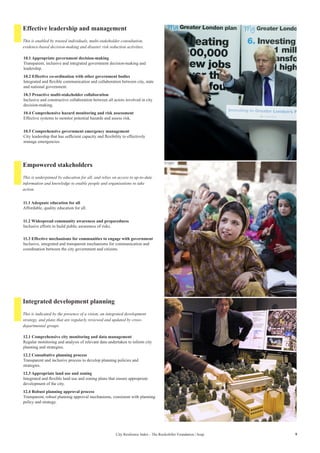
This is enabled by trusted individuals, multi-stakeholder consultation,
evidence-based decision-making and disaster risk reduction activities.
This is underpinned by education for all, and relies on access to up-to-date
information and knowledge to enable people and organisations to take
action.
This is indicated by the presence of a vision, an integrated development
strategy, and plans that are regularly reviewed and updated by cross-
departmental groups.
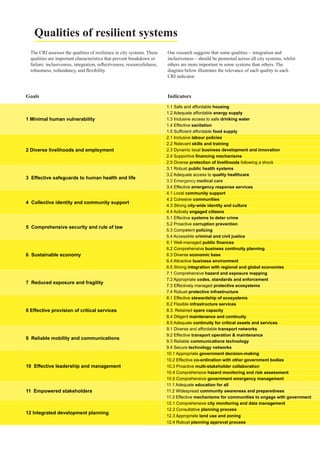
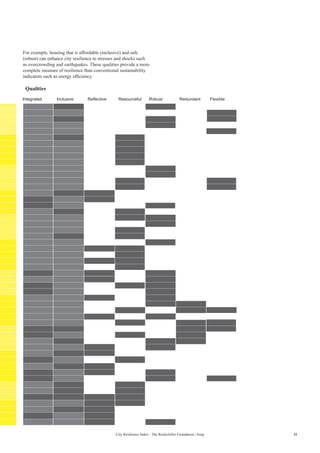
Qualities of resilient systems
The CRI assesses the qualities of resilience in city systems. These
qualities are important characteristics that prevent breakdown or
failure: inclusiveness, integration, reflectiveness, resourcefulness,
robustness, redundancy, and flexibility.
Our research suggests that some qualities – integration and
inclusiveness – should be promoted across all city systems, whilst
others are more important in some systems than others. The
diagram below illustrates the relevance of each quality to each
CRI indicator.
1 Minimal human vulnerability
1.1 Safe and affordable housing
1.2 Adequate affordable energy supply
1.3 Inclusive access to safe drinking water
1.4 Effective sanitation
1.5 Sufficient affordable food supply
2 Diverse livelihoods and employment
2.1 Inclusive labour policies
2.2 Relevant skills and training
2.3 Dynamic local business development and innovation
2.4 Supportive financing mechanisms
2.5 Diverse protection of livelihoods following a shock
3 Effective safeguards to human health and life
3.1 Robust public health systems
3.2 Adequate access to quality healthcare
3.3 Emergency medical care
3.4 Effective emergency response services
4 Collective identity and community support
4.1 Local community support
4.2 Cohesive communities
4.3 Strong city-wide identity and culture
4.4 Actively engaged citizens
5 Comprehensive security and rule of law
5.1 Effective systems to deter crime
5.2 Proactive corruption prevention
5.3 Competent policing
5.4 Accessible criminal and civil justice
6 Sustainable economy
6.1 Well-managed public finances
6.2 Comprehensive business continuity planning
6.3 Diverse economic base
6.4 Attractive business environment
6.5 Strong integration with regional and global economies
7 Reduced exposure and fragility
7.1 Comprehensive hazard and exposure mapping
7.2 Appropriate codes, standards and enforcement
7.3 Effectively managed protective ecosystems
7.4 Robust protective infrastructure
8 Effective provision of critical services
8.1 Effective stewardship of ecosystems
8.2 Flexible infrastructure services
8.3. Retained spare capacity
8.4 Diligent maintenance and continuity
8.5 Adequate continuity for critical assets and services
9 Reliable mobility and communications
9.1 Diverse and affordable transport networks
9.2 Effective transport operation & maintenance
9.3 Reliable communications technology
9.4 Secure technology networks
10 Effective leadership and management
10.1 Appropriate government decision-making
10.2 Effective co-ordination with other government bodies
10.3 Proactive multi-stakeholder collaboration
10.4 Comprehensive hazard monitoring and risk assessment
10.5 Comprehensive government emergency management
11 Empowered stakeholders
11.1 Adequate education for all
11.2 Widespread community awareness and preparedness
11.3 Effective mechanisms for communities to engage with government
12 Integrated development planning
12.1 Comprehensive city monitoring and data management
12.2 Consultative planning process
12.3 Appropriate land use and zoning
12.4 Robust planning approval process
IndicatorsGoals
11City Resilience Index - The Rockefeller Foundation | Arup
For example, housing that is affordable (inclusive) and safe
(robust) can enhance city resilience to stresses and shocks such
as overcrowding and earthquakes. These qualities provide a more
complete measure of resilience than conventional sustainability
indicators such as energy efficiency.
Integrated Inclusive Reflective Resourceful Robust Redundant Flexible


Qualities
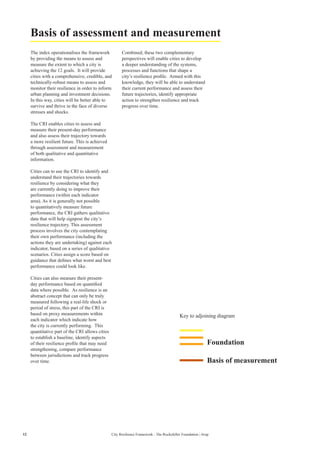
Foundation
Key to adjoining diagram
Basis of measurement
The index operationalises the framework
by providing the means to assess and
measure the extent to which a city is
achieving the 12 goals. It will provide
cities with a comprehensive, credible, and
technically-robust means to assess and
monitor their resilience in order to inform
urban planning and investment decisions.
In this way, cities will be better able to
survive and thrive in the face of diverse
stresses and shocks.
The CRI enables cities to assess and
measure their present-day performance
and also assess their trajectory towards
a more resilient future. This is achieved
through assessment and measurement
of both qualitative and quantitative
information.
Cities can to use the CRI to identify and
understand their trajectories towards
resilience by considering what they
are currently doing to improve their
performance (within each indicator
area). As it is generally not possible
to quantitatively measure future
performance, the CRI gathers qualitative
data that will help signpost the city’s
resilience trajectory. This assessment
process involves the city contemplating
their own performance (including the
actions they are undertaking) against each
indicator, based on a series of qualitative
scenarios. Cities assign a score based on
guidance that defines what worst and best
performance could look like.
Cities can also measure their present-
day performance based on quantified
data where possible. As resilience is an
abstract concept that can only be truly
measured following a real-life shock or
period of stress, this part of the CRI is
based on proxy measurements within
each indicator which indicate how
the city is currently performing. This
quantitative part of the CRI allows cities
to establish a baseline, identify aspects
of their resilience profile that may need
strengthening, compare performance
between jurisdictions and track progress
over time.
Combined, these two complementary
perspectives will enable cities to develop
a deeper understanding of the systems,
processes and functions that shape a
city’s resilience profile. Armed with this
knowledge, they will be able to understand
their current performance and assess their
future trajectories, identify appropriate
action to strengthen resilience and track
progress over time.
Basis of assessment and measurement
12 City Resilience Framework - The Rockefeller Foundation | Arup
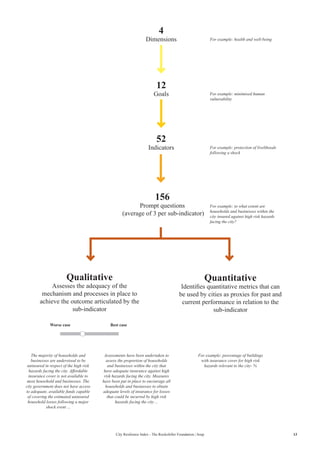
Qualitative
Assesses the adequacy of the
mechanism and processes in place to
achieve the outcome articulated by the
sub-indicator
Quantitative
Identifies quantitative metrics that can
be used by cities as proxies for past and
current performance in relation to the
sub-indicator
4
Dimensions For example: health and well-being
For example: minimised human
vulnerability
For example: protection of livelihoods
following a shock
For example: to what extent are
households and businesses within the
city insured against high risk hazards
facing the city?
For example: percentage of buildings
with insurance cover for high risk
hazards relevant to the city- %
The majority of households and
businesses are understood to be
uninsured in respect of the high risk
hazards facing the city. Affordable
insurance cover is not available to
most household and businesses. The
city government does not have access
to adequate, available funds capable
of covering the estimated uninsured
household losses following a major
shock event ...
Assessments have been undertaken to
assess the proportion of households
and businesses within the city that
have adequate insurance against high
risk hazards facing the city. Measures
have been put in place to encourage all
households and businesses to obtain
adequate levels of insurance for losses
that could be incurred by high risk
hazards facing the city ...
12
Goals
52
Indicators
156
Prompt questions
(average of 3 per sub-indicator)
Worse case Best case
13City Resilience Index - The Rockefeller Foundation | Arup
For more information
Arup
13 Fitzroy Street
London W1T 4BQ
United Kingdom
Jo da Silva
E-mail: Jo.da-Silva@arup.com
Tel: +44 20 7755 3037
Braulio Eduardo Morera
E-mail: Braulio.Morera@arup.com
Tel: +44 20 7755 4820

City Resilience Index

  • 1.
  • 2.
    City Resilience Index Urbanpopulations are facing increasing challenges from numerous natural and man- made pressures such as rapid urbanisation, climate change, terrorism and increased risks from natural hazards. Cities must learn to adapt and thrive in the face of these diverse challenges - they must learn how to build resilience in an uncertain world. Armed with this knowledge and understanding, governments, donors, investors, policy makers, and the private sector will be able to develop effective strategies to foster more resilient cities. Supported by the Rockefeller Foundation, the City Resilience Index (CRI) is being developed by Arup. It builds on extensive research undertaken by Arup to establish an accessible, evidence-based definition of urban resilience, which culminated in the publication of the City Resilience Framework (CRF) in April 2014 (www.arup.com/cri). This provides a holistic articulation of city resilience, structured around four dimensions and 12 goals that are critical for the resilience of our cities. This structure also forms the foundations of the CRI. © Arup Who is the CRI for? The CRI will measure relative performance over time rather than comparison between cities. It will not deliver an overall single score for comparing performance between cities, neither will it provide a world ranking of the most resilient cities. However, it will provide a common basis of measurement and assessment to better facilitate dialogue and knowledge-sharing between cities. It is envisaged that the CRI will primarily be used by city governments who are in the best position to gather administrative data, but it can also be used by other interested organisations and individuals (for example, universities, non-governmental organisations, community groups). It is intended that the CRI process will also provide the means for cities to capture the views of the poor and vulnerable groups as they normally suffer more severely the impacts of disruptions and failures.
  • 3.
    1City Resilience Index- The Rockefeller Foundation | Arup Structure of the CRI 4 Dimensions Our research suggests that resilience of a city relates to four key dimensions: Health and well-being, ensuring the health and wellbeing of everyone living and working in the city; Economy and society, the social and financial systems that enable urban populations to live peacefully, and act collectively; Infrastructure and environment, man-made and natural systems that provide critical services, protect and connect urban citizens; and Leadership and strategy, the need for informed, inclusive, integrated and iterative decision making in our cities. 12 Goals Underpinning these four dimensions, there are 12 goals that each and every city should strive towards in order to achieve resilience. Our research tells us that universally these are what matters most when a city faces a wide range of chronic problems or a sudden catastrophe. However, it is recognised within the framework that the relative importance of each goal and how they are realised will be unique for every city. 52 Indicators Research to develop the City Resilience Framework and Index has identified 58 indicators. The indicators add further definition to the 12 goals and identify the critical factors that contribute towards the resilience of urban systems. The indicators also integrate the 7 qualities of resilient systems (e.g. robust, inclusive, flexible) that Arup’s empirical research has identified as of vital importance. 4 Dimensions 12 Goals 52 Indicators
  • 4.
    ty & rule oflaw support Effectivesafeguardsto Diverse li velihoods Minimal humananning Com pre hensive Collectiveidentity& humanhealth&life & em pl oym ent vulnerability Health & wellbeing Econom y & society Safeandaffordablehousing Adequateaffordableenergysupply Inclusiveaccesstosafedrinkingwater Effectivesanitation Sufficientaffordablefoodsupply Inclusivelabourpolicies Relevantskills and training Localbusiness developm entand innovation Supportive financing m echanism s Diverse protectionof livelihoods following a shock Robust public health systems Adequate access to quality healthcare Emergency medical care Effective emergency response services Local community support Cohesive communities Strong city-wide identity and cultureActively engaged citizensEffective systems to det Proacti Robustplanningapprovalprocess This dimension relates to people – the health and well-being of everyone living and working in the city. This dimension considers the extent to which the city enables everyone to meet their basic needs (food, water, and shelter), particularly in times of crisis. It considers how well the city supports diverse livelihood opportunities, including access to business investment and social welfare. Finally, it considers if a city is able to safeguard the health of its population through its normal and emergency healthcare provisions. Health and well-being 2
  • 5.
    3City Resilience Index- The Rockefeller Foundation | Arup Minimal human vulnerability Diverse livelihoods and employment Effective safeguards to human health and life 1.1 Safe and affordable housing Safe housing that is affordable for all city residents. 1.2 Adequate affordable energy supply Sufficient and affordable energy supply for all. 1.3 Inclusive access to safe drinking water Access to an adequate supply of safe drinking water. 1.4 Effective Sanitation Safe, reliable and affordable sanitation provided to all areas of the city. 1.5 Sufficient affordable food supply Sufficient and affordable food supplies for all. 2.1 Inclusive labour policies Inclusive labour policies and standards, with an effective welfare system for low income groups. 2.2 Relevant skills and training Effective mechanisms for matching skills to the current and emerging employment marketplace. 2.3 Local business development and innovation Thriving, adaptable and inclusive local business environment. 2.4 Supportive financing mechanisms Inclusive and resourceful finance mechanisms to enable businesses to adapt to changing circumstances and put in place contingencies for shock events. 2.5 Diverse protection of livelihoods following a shock Resourceful and inclusive measures to support businesses and workers following a shock. 3.1 Robust public health systems Robust monitoring and mitigation of public health risks. 3.2 Adequate access to quality healthcare Adequate and inclusive access to quality general healthcare. 3.3 Emergency medical care Adequately resourced emergency medical services. 3.4 Effective emergency response services Adequately resourced emergency response services. This relates to the extent to which everyone’s basic needs are met. This is facilitated by access to finance, ability to accrue savings, skills training, business support, and social welfare. This relies on integrated health facilities and services, and responsive emergency services.
  • 6.
    economy security & rule oflaw support ardsto Sustainable Com pre hensive Collectiveidentity& &life sure Econom y& society Effective emergency responseservices Local community support Cohesive communities Strong city-wide identity and cultureActively engaged citizensEffective systems to deter crime Proactive corruption prevention Com petentpolicing Accessiblecriminalandciviljustice Well-managedpublicfinances Comprehensivebusinesscontinuityplanning Diverseeconomicbase Attractivebusinessenvironment Strongintegrationwithregionaland globaleconomies Comprehensivehazardandexposure mapping This dimension relates to the organisation of cities – how social and economic systems enable urban populations to live peacefully, and act collectively. Included within this dimension are the systems that enforce law and order and ensure fiscal management. The environment within a city that creates collective identity and mutual support is also considered – open spaces and cultural heritage play an important role in this. 4 Economy and society
  • 7.
    5City Resilience Index- The Rockefeller Foundation | Arup Collective identity and community support Comprehensive security and rule of law Sustainable economy 4.1 Local Community Support Cohesive social structures providing support at individual, household and local community level. 4.2 Cohesive communities Cohesive, harmonised communities across the city. 4.3 Strong city-wide identity and culture Cohesive local identity and culture, in which all citizens feel a sense of belonging in the city. 4.4 Actively engaged citizens Citizens actively engage, express opinion and participate within society. 5.1 Effective systems to deter crime Integrated, collaborative and resourceful mechanisms to deter crime. 5.2 Proactive corruption prevention Fair and transparent systems to fight corruption and promote justice. 5.3 Competent policing Effective policing measures and systems for a safe and secure city. 5.4 Accessible criminal and civil justice Effective, affordable, impartial and accessible mechanisms to promote justice and resolve civil disputes. 6.1 Well-managed public finances Adequate public finances and sound fiscal management. 6.2 Comprehensive business continuity planning Resourceful, reflective and flexible business continuity planning across both public and private sectors. 6.3 Diverse economic base Robust, flexible and diverse local economy. 6.4 Attractive business environment Diverse and resourceful investments within the city, driven by a strong urban brand and economic and social environment. 6.5 Strong integration with regional and global economies Strong integration between the city’s economy and wider economic systems. This is observed as active community engagement, strong social networks and social integration. This includes law enforcement, fair justice, and prevention of crime and corruption. This is observed in sound management of city finances, diverse revenue streams, and the ability to attract business investment, allocate capital, and build emergency funds.
  • 8.
    Effe &communications ofcritica l services & fragility S & Reliablemobility Effective provision Reducedexposure Infrastructure & environment Strongintegrationwithregionaland globaleconomies Comprehensivehazardandexposure mapping Appropriatecodes,standardsandenforcement Effectivelymanagedprotectiveecosystems Robustprotectiveinfrastructure Effectivestewardshipofecosystems Flexible infrastructure services R etained spare capacity Diligent m aintenance Adequate continuity for critical assets and services Diverse and affordable transport networks Effective transport operation & maintenance Reliable communications technology Secure technology networks Appropriate government decision-making t bodies This dimension relates to place – the quality of infrastructure and ecosystems that protects, provide and connect us. The CRI considers the robustness of infrastructure and ecosystems that protect us from natural hazards. The continuity of critical services, under shock or stress situations are also important within this dimension. In particular, water supply, power distribution, and solid waste management; the transportation systems that enable the flow of goods, services, people, and information. 6 Infrastructure and ecosystems
  • 9.
    7City Resilience Index- The Rockefeller Foundation | Arup Reduced exposure & fragility Effective provision of critical services Reliable mobility and communications 7.1 Comprehensive hazard and exposure mapping Robust systems in place to map the city’s exposure and vulnerability to hazards based on current data. 7.2 Appropriate codes, standards and enforcement Building and infrastructure codes and standards are forward looking, appro- priate to local context and risk profiles, and enforced. 7.3 Effectively managed protective ecosystems Well-developed understanding and acknowledgement of the role of ecosys- tems in providing physical protection to the city. 7.4 Robust protective infrastructure Integrated, forward-looking and robust network of protective infrastructure that reduces vulnerability and exposure of citizens and critical assets. 8.1 Effective stewardship of ecosystems Robust mechanisms are in place to maintain and enhance the ecosystem services that benefit city residents 8.2 Flexible infrastructure Critical services within the city are supported by diverse and robust infrastruc- ture, which has been appropriately planned and delivered 8.3. Retained spare capacity Demand on critical infrastructure is minimised through the resourceful and flexible use of key resources. 8.4 Diligent maintenance and continuity Robust monitoring, maintenance and renewal of essential utility infrastruc- ture, with effective contingency planning. 8.5 Adequate continuity for critical assets and services Resourceful, reflective and flexible continuity plans to maintain utility ser- vices to critical assets during emergency situations. 9.1 Diverse and affordable transport networks Diverse and integrated transport networks, providing flexible and affordable travel around the city for all. 9.2 Effective transport operation & maintenance Effective management of the city’s transport network to provide quality, safe transport. 9.3 Reliable communications technology Effective and reliable communication systems that are accessible by all. 9.4 Secure technology networks Robust, effective mechanisms in place to protect the information and operational technology systems on which the city is dependent. This relies on a comprehensive understanding of the hazards and risks to which a city is exposed, the extent to which this understanding that informs the development of integrated strategies to physically protect the city combining sound environmental stewardship, robust design and maintenance of man-made infrastructure, and enforcement of appropriate building codes and regulations. This results from active management and maintenance of ecosystems, and from diversity of provision, redundant capacity, and adequate maintenance of essential utility services, combined with robust contingency planning. This is enabled by diverse and affordable multi-modal transport systems and information and communication technology (ICT) networks, and contingency planning.
  • 10.
    This dimension isunderpinned by knowledge. A resilient city learns from the past and takes appropriate action based on evidence. This means a city must have effective leadership and urban management, characterised by inclusive governance involving the government, business and civil society, and evidence- based decision-making. A city must also empower its stakeholders by providing access to information and education, so that individuals and organisations can take appropriate action. It is equally important to ensure that the city develops in an integrated way that aligns the city’s vision with sectoral strategies and plans and individual projects. Integrated Em po w ered Effectiveleadership &communications ofcritica l services Mi development planning stakeh olders &management Reliablemobility Effective provision Reduc vu Leadership and strategy Infrastructure & environment Safeandaffordablehousing es re capacity Diligent m aintenance Adequate continuity for critical assets and services Diverse and affordable transport networks Effective transport operation & maintenance Reliable communications technology Secure technology networks Appropriate government decision-making Effective co-ordination with othergovernment bodies Proactive multi-stakeholder collaboration Comprehensive hazard monitoring and risk assessment Comprehensive government emergency management Adequate education for all W idespread com m unity aw areness and preparedness Effectivem echanism sforcom m unities to engagewith governm entComprehensivecitymonitoring anddatamanagement Consultativeplanningprocess Appropriatelanduseandzoning Robustplanningapprovalprocess 8 Leadership and strategy
  • 11.
    9City Resilience Index- The Rockefeller Foundation | Arup Effective leadership and management Empowered stakeholders Integrated development planning 10.1 Appropriate government decision-making Transparent, inclusive and integrated government decision-making and leadership. 10.2 Effective co-ordination with other government bodies Integrated and flexible communication and collaboration between city, state and national government. 10.3 Proactive multi-stakeholder collaboration Inclusive and constructive collaboration between all actors involved in city decision-making. 10.4 Comprehensive hazard monitoring and risk assessment Effective systems to monitor potential hazards and assess risk. 10.5 Comprehensive government emergency management City leadership that has sufficient capacity and flexibility to effectively manage emergencies. 11.1 Adequate education for all Affordable, quality education for all. 11.2 Widespread community awareness and preparedness Inclusive efforts to build public awareness of risks. 11.3 Effective mechanisms for communities to engage with government Inclusive, integrated and transparent mechanisms for communication and coordination between the city government and citizens. 12.1 Comprehensive city monitoring and data management Regular monitoring and analysis of relevant data undertaken to inform city planning and strategies. 12.2 Consultative planning process Transparent and inclusive process to develop planning policies and strategies. 12.3 Appropriate land use and zoning Integrated and flexible land use and zoning plans that ensure appropriate development of the city. 12.4 Robust planning approval process Transparent, robust planning approval mechanisms, consistent with planning policy and strategy. This is enabled by trusted individuals, multi-stakeholder consultation, evidence-based decision-making and disaster risk reduction activities. This is underpinned by education for all, and relies on access to up-to-date information and knowledge to enable people and organisations to take action. This is indicated by the presence of a vision, an integrated development strategy, and plans that are regularly reviewed and updated by cross- departmental groups.
  • 12.
    Qualities of resilientsystems The CRI assesses the qualities of resilience in city systems. These qualities are important characteristics that prevent breakdown or failure: inclusiveness, integration, reflectiveness, resourcefulness, robustness, redundancy, and flexibility. Our research suggests that some qualities – integration and inclusiveness – should be promoted across all city systems, whilst others are more important in some systems than others. The diagram below illustrates the relevance of each quality to each CRI indicator. 1 Minimal human vulnerability 1.1 Safe and affordable housing 1.2 Adequate affordable energy supply 1.3 Inclusive access to safe drinking water 1.4 Effective sanitation 1.5 Sufficient affordable food supply 2 Diverse livelihoods and employment 2.1 Inclusive labour policies 2.2 Relevant skills and training 2.3 Dynamic local business development and innovation 2.4 Supportive financing mechanisms 2.5 Diverse protection of livelihoods following a shock 3 Effective safeguards to human health and life 3.1 Robust public health systems 3.2 Adequate access to quality healthcare 3.3 Emergency medical care 3.4 Effective emergency response services 4 Collective identity and community support 4.1 Local community support 4.2 Cohesive communities 4.3 Strong city-wide identity and culture 4.4 Actively engaged citizens 5 Comprehensive security and rule of law 5.1 Effective systems to deter crime 5.2 Proactive corruption prevention 5.3 Competent policing 5.4 Accessible criminal and civil justice 6 Sustainable economy 6.1 Well-managed public finances 6.2 Comprehensive business continuity planning 6.3 Diverse economic base 6.4 Attractive business environment 6.5 Strong integration with regional and global economies 7 Reduced exposure and fragility 7.1 Comprehensive hazard and exposure mapping 7.2 Appropriate codes, standards and enforcement 7.3 Effectively managed protective ecosystems 7.4 Robust protective infrastructure 8 Effective provision of critical services 8.1 Effective stewardship of ecosystems 8.2 Flexible infrastructure services 8.3. Retained spare capacity 8.4 Diligent maintenance and continuity 8.5 Adequate continuity for critical assets and services 9 Reliable mobility and communications 9.1 Diverse and affordable transport networks 9.2 Effective transport operation & maintenance 9.3 Reliable communications technology 9.4 Secure technology networks 10 Effective leadership and management 10.1 Appropriate government decision-making 10.2 Effective co-ordination with other government bodies 10.3 Proactive multi-stakeholder collaboration 10.4 Comprehensive hazard monitoring and risk assessment 10.5 Comprehensive government emergency management 11 Empowered stakeholders 11.1 Adequate education for all 11.2 Widespread community awareness and preparedness 11.3 Effective mechanisms for communities to engage with government 12 Integrated development planning 12.1 Comprehensive city monitoring and data management 12.2 Consultative planning process 12.3 Appropriate land use and zoning 12.4 Robust planning approval process IndicatorsGoals
  • 13.
    11City Resilience Index- The Rockefeller Foundation | Arup For example, housing that is affordable (inclusive) and safe (robust) can enhance city resilience to stresses and shocks such as overcrowding and earthquakes. These qualities provide a more complete measure of resilience than conventional sustainability indicators such as energy efficiency. Integrated Inclusive Reflective Resourceful Robust Redundant Flexible                                                                                                                                                                                                                                                                                                                                                                                                                                                                                                                                                                                                                                                                                                                                                     Qualities
  • 14.
    Foundation Key to adjoiningdiagram Basis of measurement The index operationalises the framework by providing the means to assess and measure the extent to which a city is achieving the 12 goals. It will provide cities with a comprehensive, credible, and technically-robust means to assess and monitor their resilience in order to inform urban planning and investment decisions. In this way, cities will be better able to survive and thrive in the face of diverse stresses and shocks. The CRI enables cities to assess and measure their present-day performance and also assess their trajectory towards a more resilient future. This is achieved through assessment and measurement of both qualitative and quantitative information. Cities can to use the CRI to identify and understand their trajectories towards resilience by considering what they are currently doing to improve their performance (within each indicator area). As it is generally not possible to quantitatively measure future performance, the CRI gathers qualitative data that will help signpost the city’s resilience trajectory. This assessment process involves the city contemplating their own performance (including the actions they are undertaking) against each indicator, based on a series of qualitative scenarios. Cities assign a score based on guidance that defines what worst and best performance could look like. Cities can also measure their present- day performance based on quantified data where possible. As resilience is an abstract concept that can only be truly measured following a real-life shock or period of stress, this part of the CRI is based on proxy measurements within each indicator which indicate how the city is currently performing. This quantitative part of the CRI allows cities to establish a baseline, identify aspects of their resilience profile that may need strengthening, compare performance between jurisdictions and track progress over time. Combined, these two complementary perspectives will enable cities to develop a deeper understanding of the systems, processes and functions that shape a city’s resilience profile. Armed with this knowledge, they will be able to understand their current performance and assess their future trajectories, identify appropriate action to strengthen resilience and track progress over time. Basis of assessment and measurement 12 City Resilience Framework - The Rockefeller Foundation | Arup
  • 15.
    Qualitative Assesses the adequacyof the mechanism and processes in place to achieve the outcome articulated by the sub-indicator Quantitative Identifies quantitative metrics that can be used by cities as proxies for past and current performance in relation to the sub-indicator 4 Dimensions For example: health and well-being For example: minimised human vulnerability For example: protection of livelihoods following a shock For example: to what extent are households and businesses within the city insured against high risk hazards facing the city? For example: percentage of buildings with insurance cover for high risk hazards relevant to the city- % The majority of households and businesses are understood to be uninsured in respect of the high risk hazards facing the city. Affordable insurance cover is not available to most household and businesses. The city government does not have access to adequate, available funds capable of covering the estimated uninsured household losses following a major shock event ... Assessments have been undertaken to assess the proportion of households and businesses within the city that have adequate insurance against high risk hazards facing the city. Measures have been put in place to encourage all households and businesses to obtain adequate levels of insurance for losses that could be incurred by high risk hazards facing the city ... 12 Goals 52 Indicators 156 Prompt questions (average of 3 per sub-indicator) Worse case Best case 13City Resilience Index - The Rockefeller Foundation | Arup
  • 16.
    For more information Arup 13Fitzroy Street London W1T 4BQ United Kingdom Jo da Silva E-mail: Jo.da-Silva@arup.com Tel: +44 20 7755 3037 Braulio Eduardo Morera E-mail: Braulio.Morera@arup.com Tel: +44 20 7755 4820