A
Corporation
for
Public
Software
Todd Davies
John Gastil
October 27, 2020
Slides are
available at
web.stanford.edu
/~davies
From the description for this
series:
Imagine living in a society in which most of the land and buildings
available for meeting and working were owned by a few for-profit
corporations. Churches, governments, groups of friends, schools,
nonprofits, and grassroots social movements would each have to reserve
space on — or have a key to — a privately-owned facility, often on a large
corporate campus, in order to meet and work together. It would be a
society with no domed capitol buildings, city halls, temples, open
campuses, public parks [or libraries], community centers, or nonprofit
spaces.
From the description for this
series:
Imagine living in a society in which most of the land and buildings
available for meeting and working were owned by a few for-profit
corporations. Churches, governments, groups of friends, schools,
nonprofits, and grassroots social movements would each have to reserve
space on — or have a key to — a privately-owned facility, often on a large
corporate campus, in order to meet and work together. It would be a
society with no domed capitol buildings, city halls, temples, open
campuses, public parks [or libraries], community centers, or nonprofit
spaces.
Fortunately, this is not the society we live in, but it does describe the
online spaces where our digital information is stored and where much of
contemporary life – including civil society action – now takes place. This
scenario is inherently threatening to democracies, in which free
expression and public participation presuppose people have both the
ability and space to assemble outside of corporate or government
monitoring.
Where we are coming from...
Our focus is on our society - the U.S., its States, and
localities.
However,
• we are very open to partnerships across the globe
• we are interested in learning whether our model,
or a different one, would be appropriate outside of
the U.S.
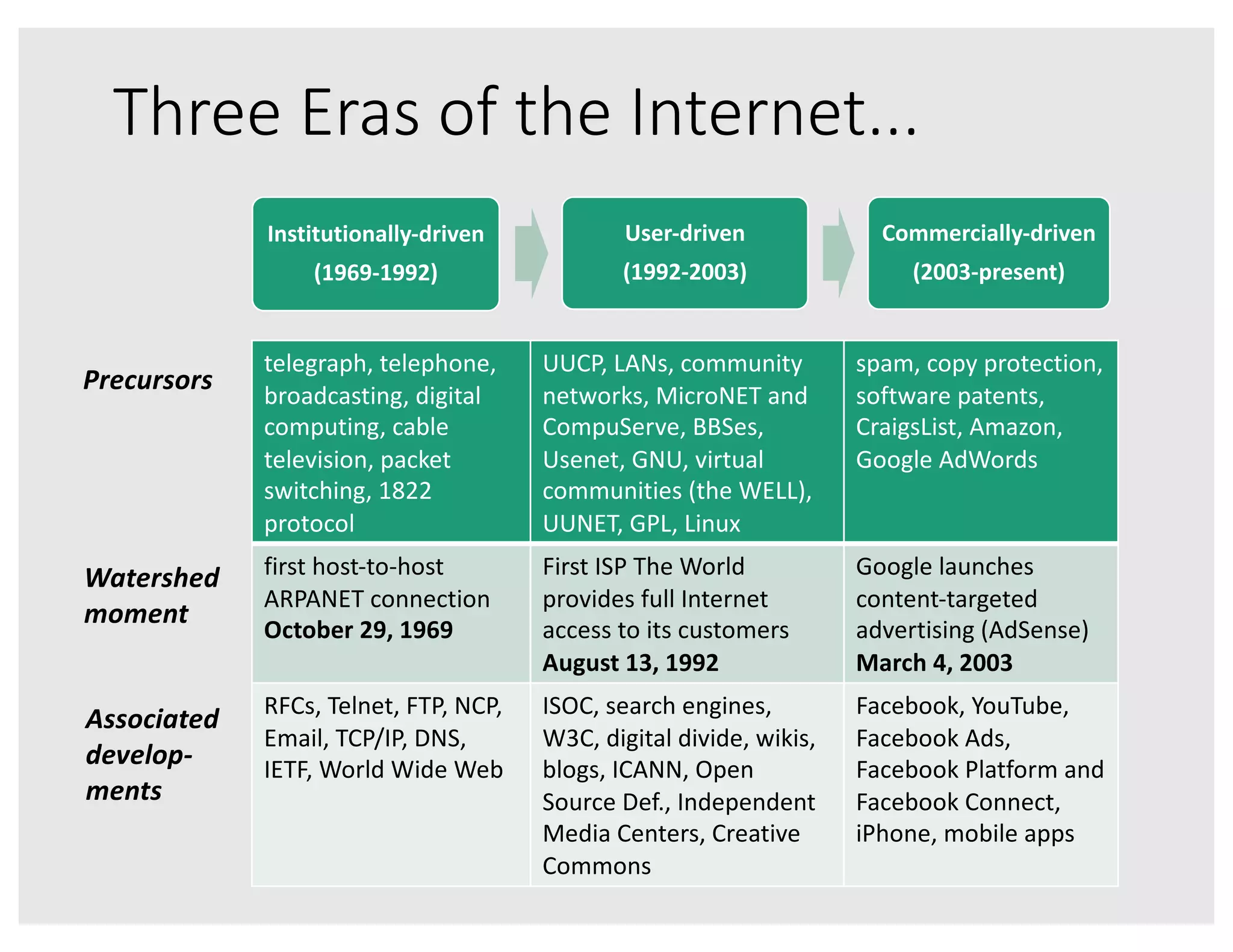
Institutionally-driven
(1969-1992)
User-driven
(1992-2003)
Commercially-driven
(2003-present)
telegraph, telephone,
broadcasting, digital
computing, cable
television, packet
switching, 1822
protocol
UUCP, LANs, community
networks, MicroNET and
CompuServe, BBSes,
Usenet, GNU, virtual
communities (the WELL),
UUNET, GPL, Linux
spam, copy protection,
software patents,
CraigsList, Amazon,
Google AdWords
first host-to-host
ARPANET connection
October 29, 1969
First ISP The World
provides full Internet
access to its customers
August 13, 1992
Google launches
content-targeted
advertising (AdSense)
March 4, 2003
RFCs, Telnet, FTP, NCP,
Email, TCP/IP, DNS,
IETF, World Wide Web
ISOC, search engines,
W3C, digital divide, wikis,
blogs, ICANN, Open
Source Def., Independent
Media Centers, Creative
Commons
Facebook, YouTube,
Facebook Ads,
Facebook Platform and
Facebook Connect,
iPhone, mobile apps
Three Eras of the Internet...
Precursors
Watershed
moment
Associated
develop-
ments
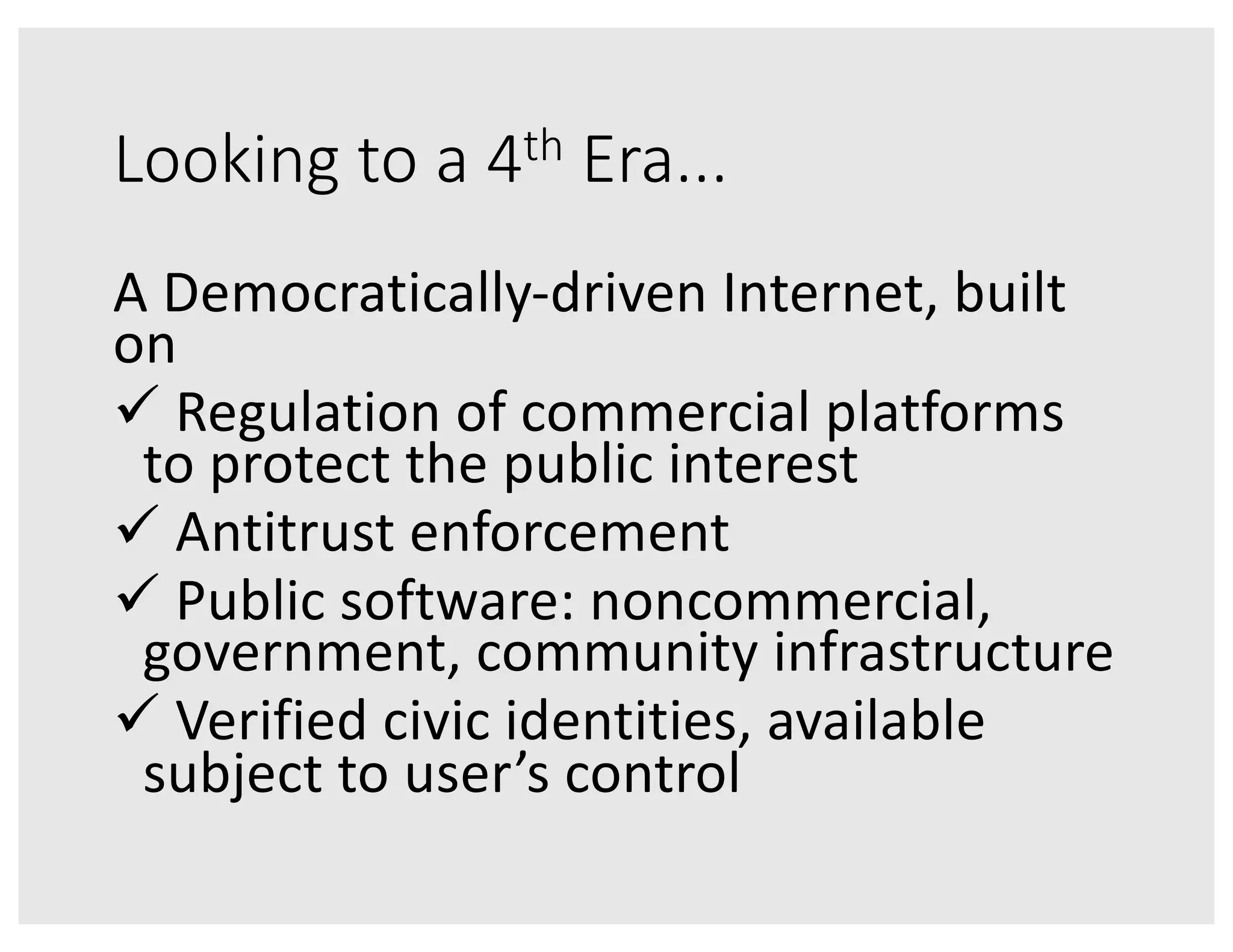
Looking to a 4th Era...
A Democratically-driven Internet, built
on
ü Regulation of commercial platforms
to protect the public interest
ü Antitrust enforcement
ü Public software: noncommercial,
government, community infrastructure
ü Verified civic identities, available
subject to user’s control
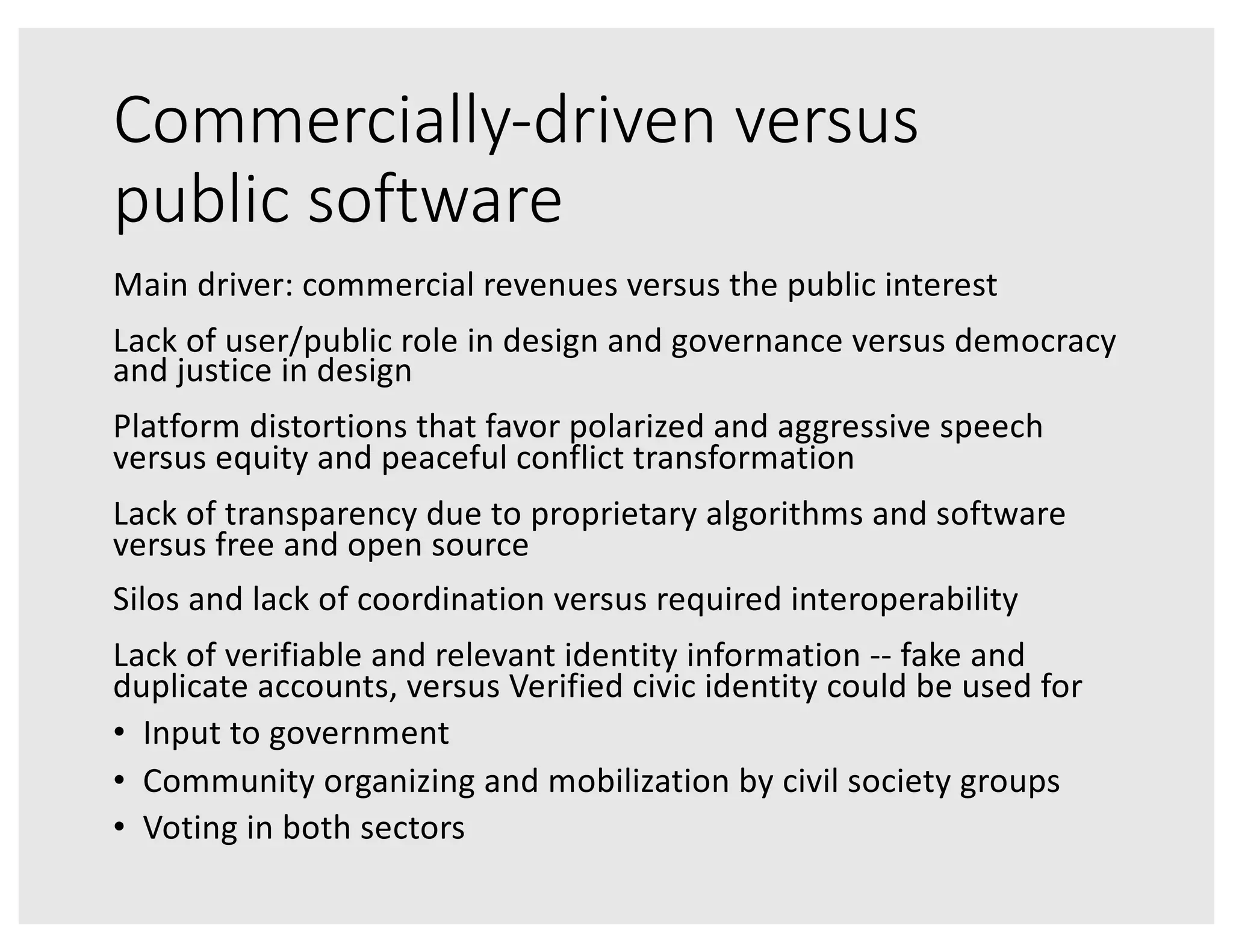
Commercially-driven versus
public software
Main driver: commercial revenues versus the public interest
Lack of user/public role in design and governance versus democracy
and justice in design
Platform distortions that favor polarized and aggressive speech
versus equity and peaceful conflict transformation
Lack of transparency due to proprietary algorithms and software
versus free and open source
Silos and lack of coordination versus required interoperability
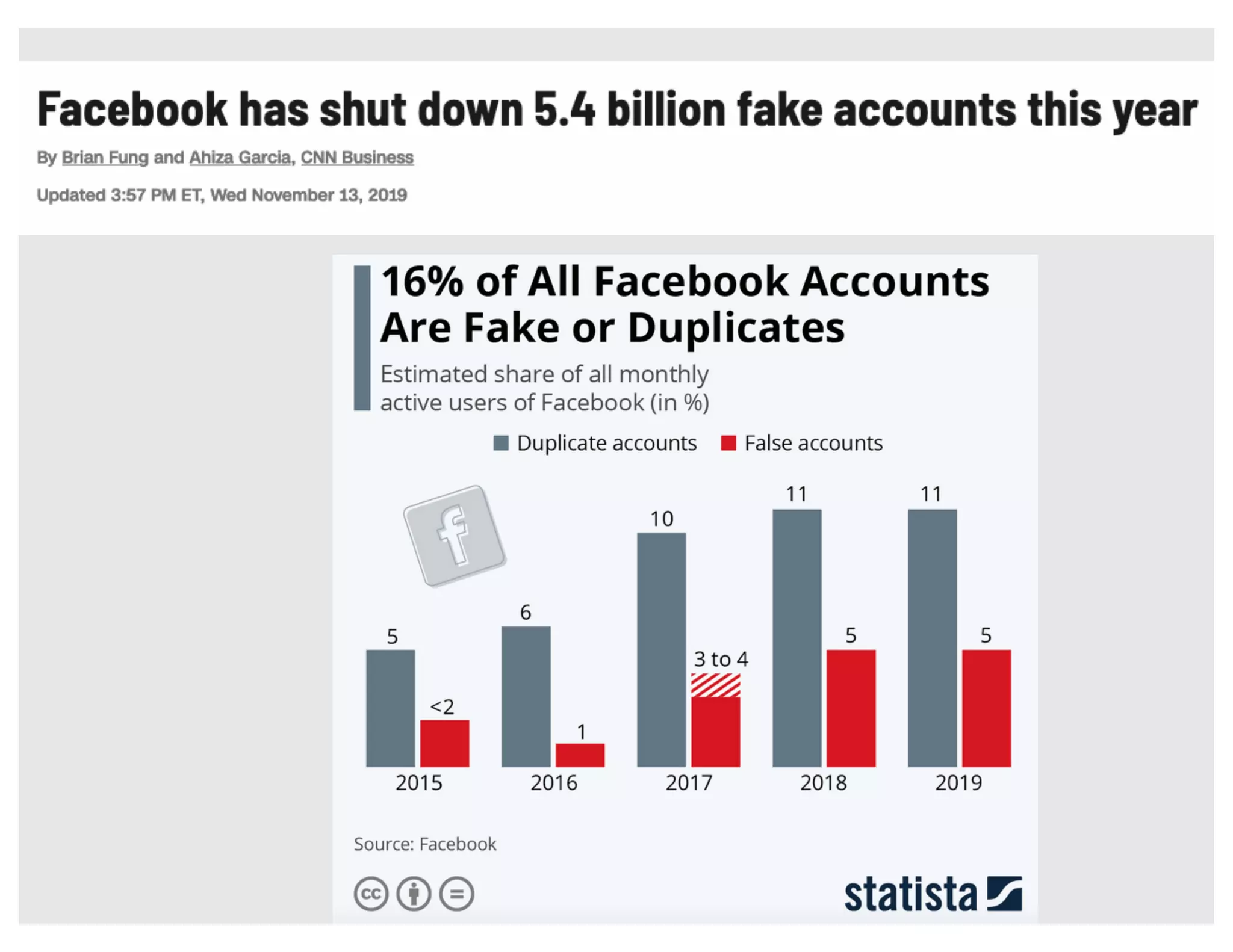
Lack of verifiable and relevant identity information -- fake and
duplicate accounts, versus Verified civic identity could be used for
• Input to government
• Community organizing and mobilization by civil society groups
• Voting in both sectors
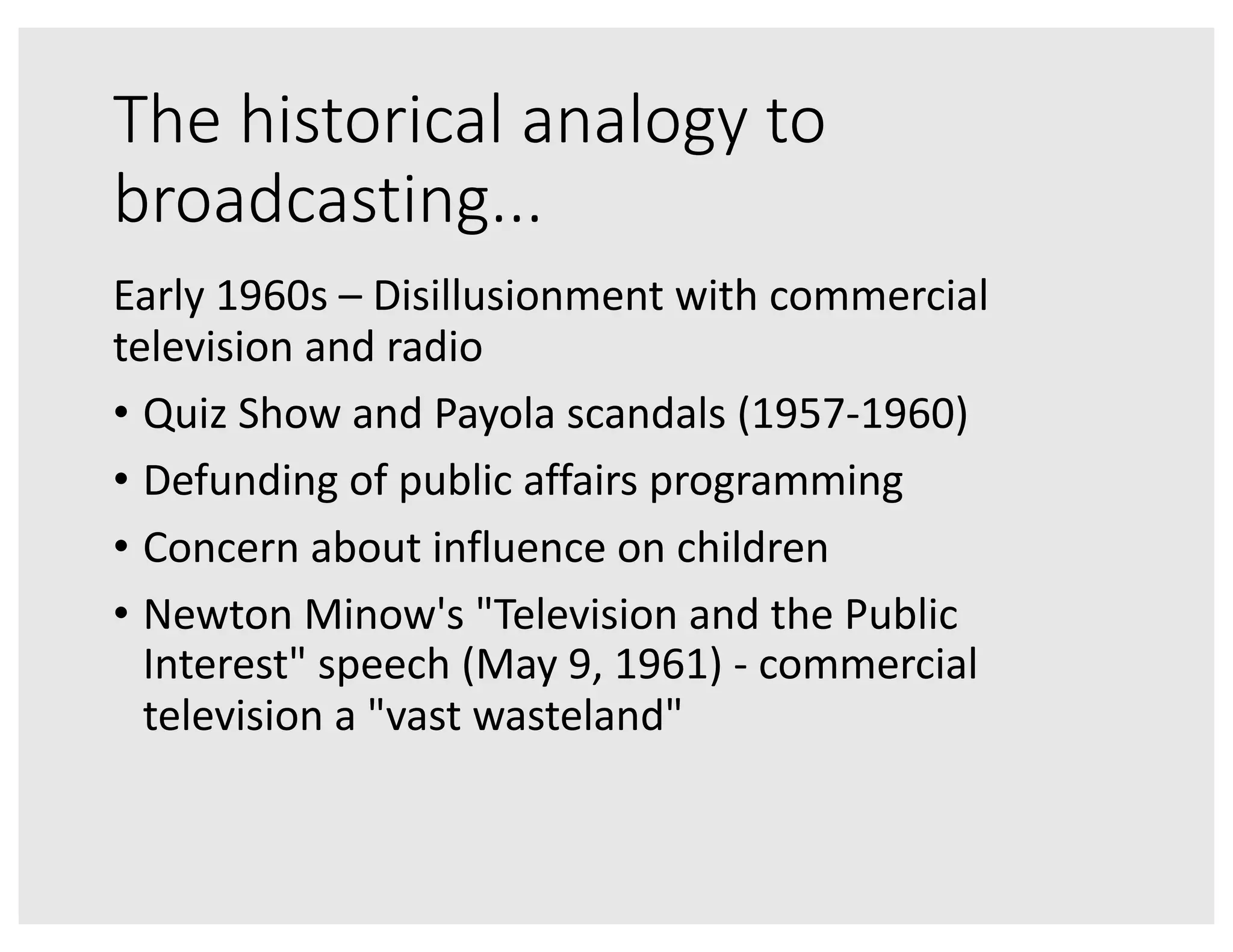
The historical analogy to
broadcasting...
Early 1960s – Disillusionment with commercial
television and radio
• Quiz Show and Payola scandals (1957-1960)
• Defunding of public affairs programming
• Concern about influence on children
• Newton Minow's "Television and the Public
Interest" speech (May 9, 1961) - commercial
television a "vast wasteland"
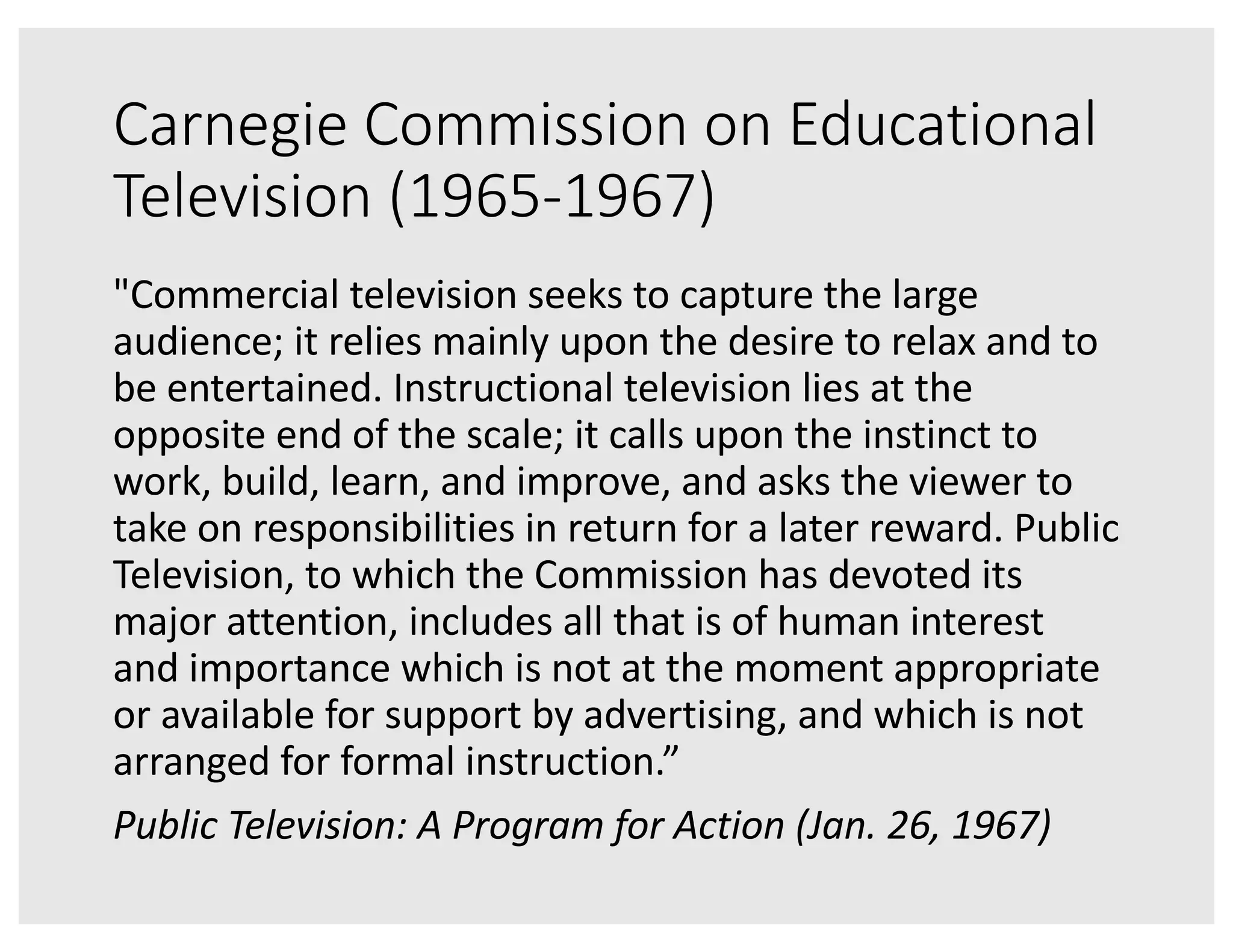
Carnegie Commission on Educational
Television (1965-1967)
"Commercial television seeks to capture the large
audience; it relies mainly upon the desire to relax and to
be entertained. Instructional television lies at the
opposite end of the scale; it calls upon the instinct to
work, build, learn, and improve, and asks the viewer to
take on responsibilities in return for a later reward. Public
Television, to which the Commission has devoted its
major attention, includes all that is of human interest
and importance which is not at the moment appropriate
or available for support by advertising, and which is not
arranged for formal instruction.”
Public Television: A Program for Action (Jan. 26, 1967)
Carnegie Commission on Educational
Television (1965-1967)
"The Carnegie Commission on Educational Television
has reached the conclusion that a well-financed and
well- directed educational television system,
substantially larger and far more pervasive and
effective than that which now exists in the United
States, must be brought into being if the full needs of
the American public are to be served."
Public Television: A Program for Action (Jan. 26,
1967)
Carnegie Commission on Educational
Television (1965-1967)
"We recommend that Congress act promptly to authorize
and to establish a federally chartered, nonprofit,
nongovernmental corporation, to be known as the
‘Corporation for Public Television.’ The Corporation
should be empowered to receive and disburse
governmental and private funds in order to extend and
improve Public Television programming. The Commission
considers the creation of the Corporation fundamental to
its proposal and would be most reluctant to recommend
the other parts of its plan unless the corporate entity is
brought into being."
Public Television: A Program for Action (Jan. 26, 1967)
Key Lessons
Vision First
• Keynes: "Anything we can actually do, we can
afford” (1942 BBC speech)
Draw on the unique capacities of government for
funding, authorization, and coordination
Cultivate partnerships in production
Leverage other sources of support
What problem are we solving?
•Lack of enduring noncommercial
platforms
•Unstable and insufficient funding is
the underlying problem
How to address the problem
•Corporation for Public Software
funded by the federal government
•Operates independently to fulfill a
nonprofit mission
•Could forge international
partnerships, as PBS does with BBC
A broad vision for the CPS,
word by word
CORPORATION
•Federal funding at its core
•Mission: Noncommercial platforms
and software in the public interest
with the ease-of-use and functionality
that users expect from the most
successful commercial products
A broad vision for the CPS,
word by word
PUBLIC
•Internal governance options
•Role for the public at large inspired
by participatory/deliberative
democracy
•Transparent decision making
A broad vision for the CPS,
word by word
SOFTWARE
•Civic engagement/networking
platforms
•Civic education platforms from K-12
to higher ed. to adult
•Non-commercial tools for
connecting the public with each
level of government
A broad vision for the CPS,
word by word
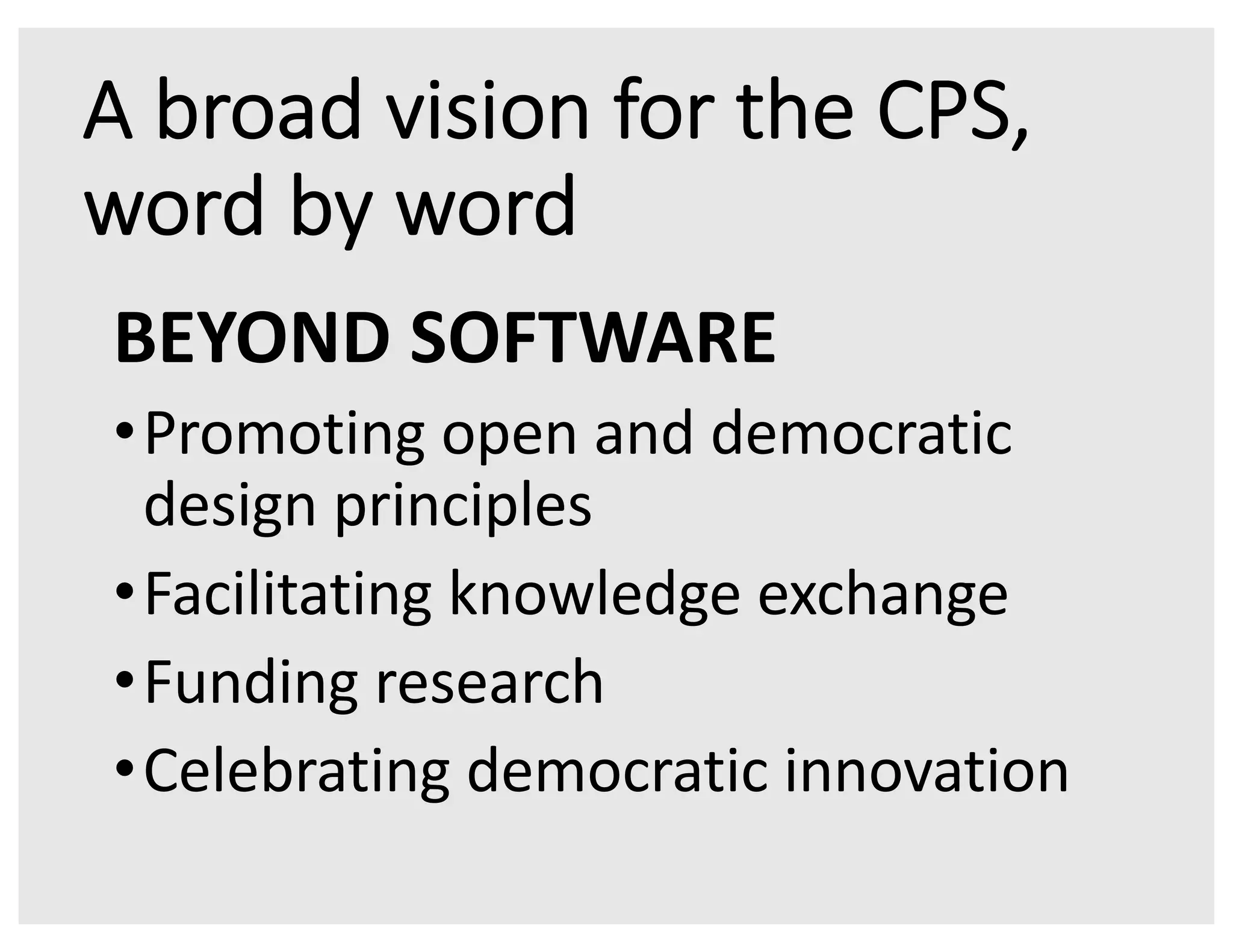
BEYOND SOFTWARE
•Promoting open and democratic
design principles
•Facilitating knowledge exchange
•Funding research
•Celebrating democratic innovation

Digital Public Infrastructure: A Corporation for Public Software

  • 1.
    A Corporation for Public Software Todd Davies John Gastil October27, 2020 Slides are available at web.stanford.edu /~davies
  • 2.
    From the descriptionfor this series: Imagine living in a society in which most of the land and buildings available for meeting and working were owned by a few for-profit corporations. Churches, governments, groups of friends, schools, nonprofits, and grassroots social movements would each have to reserve space on — or have a key to — a privately-owned facility, often on a large corporate campus, in order to meet and work together. It would be a society with no domed capitol buildings, city halls, temples, open campuses, public parks [or libraries], community centers, or nonprofit spaces.
  • 3.
    From the descriptionfor this series: Imagine living in a society in which most of the land and buildings available for meeting and working were owned by a few for-profit corporations. Churches, governments, groups of friends, schools, nonprofits, and grassroots social movements would each have to reserve space on — or have a key to — a privately-owned facility, often on a large corporate campus, in order to meet and work together. It would be a society with no domed capitol buildings, city halls, temples, open campuses, public parks [or libraries], community centers, or nonprofit spaces. Fortunately, this is not the society we live in, but it does describe the online spaces where our digital information is stored and where much of contemporary life – including civil society action – now takes place. This scenario is inherently threatening to democracies, in which free expression and public participation presuppose people have both the ability and space to assemble outside of corporate or government monitoring.
  • 4.
    Where we arecoming from... Our focus is on our society - the U.S., its States, and localities. However, • we are very open to partnerships across the globe • we are interested in learning whether our model, or a different one, would be appropriate outside of the U.S.
  • 5.
    Institutionally-driven (1969-1992) User-driven (1992-2003) Commercially-driven (2003-present) telegraph, telephone, broadcasting, digital computing,cable television, packet switching, 1822 protocol UUCP, LANs, community networks, MicroNET and CompuServe, BBSes, Usenet, GNU, virtual communities (the WELL), UUNET, GPL, Linux spam, copy protection, software patents, CraigsList, Amazon, Google AdWords first host-to-host ARPANET connection October 29, 1969 First ISP The World provides full Internet access to its customers August 13, 1992 Google launches content-targeted advertising (AdSense) March 4, 2003 RFCs, Telnet, FTP, NCP, Email, TCP/IP, DNS, IETF, World Wide Web ISOC, search engines, W3C, digital divide, wikis, blogs, ICANN, Open Source Def., Independent Media Centers, Creative Commons Facebook, YouTube, Facebook Ads, Facebook Platform and Facebook Connect, iPhone, mobile apps Three Eras of the Internet... Precursors Watershed moment Associated develop- ments
  • 6.
    Looking to a4th Era... A Democratically-driven Internet, built on ü Regulation of commercial platforms to protect the public interest ü Antitrust enforcement ü Public software: noncommercial, government, community infrastructure ü Verified civic identities, available subject to user’s control
  • 8.
    Commercially-driven versus public software Maindriver: commercial revenues versus the public interest Lack of user/public role in design and governance versus democracy and justice in design Platform distortions that favor polarized and aggressive speech versus equity and peaceful conflict transformation Lack of transparency due to proprietary algorithms and software versus free and open source Silos and lack of coordination versus required interoperability Lack of verifiable and relevant identity information -- fake and duplicate accounts, versus Verified civic identity could be used for • Input to government • Community organizing and mobilization by civil society groups • Voting in both sectors
  • 9.
    The historical analogyto broadcasting... Early 1960s – Disillusionment with commercial television and radio • Quiz Show and Payola scandals (1957-1960) • Defunding of public affairs programming • Concern about influence on children • Newton Minow's "Television and the Public Interest" speech (May 9, 1961) - commercial television a "vast wasteland"
  • 10.
    Carnegie Commission onEducational Television (1965-1967) "Commercial television seeks to capture the large audience; it relies mainly upon the desire to relax and to be entertained. Instructional television lies at the opposite end of the scale; it calls upon the instinct to work, build, learn, and improve, and asks the viewer to take on responsibilities in return for a later reward. Public Television, to which the Commission has devoted its major attention, includes all that is of human interest and importance which is not at the moment appropriate or available for support by advertising, and which is not arranged for formal instruction.” Public Television: A Program for Action (Jan. 26, 1967)
  • 11.
    Carnegie Commission onEducational Television (1965-1967) "The Carnegie Commission on Educational Television has reached the conclusion that a well-financed and well- directed educational television system, substantially larger and far more pervasive and effective than that which now exists in the United States, must be brought into being if the full needs of the American public are to be served." Public Television: A Program for Action (Jan. 26, 1967)
  • 12.
    Carnegie Commission onEducational Television (1965-1967) "We recommend that Congress act promptly to authorize and to establish a federally chartered, nonprofit, nongovernmental corporation, to be known as the ‘Corporation for Public Television.’ The Corporation should be empowered to receive and disburse governmental and private funds in order to extend and improve Public Television programming. The Commission considers the creation of the Corporation fundamental to its proposal and would be most reluctant to recommend the other parts of its plan unless the corporate entity is brought into being." Public Television: A Program for Action (Jan. 26, 1967)
  • 13.
    Key Lessons Vision First •Keynes: "Anything we can actually do, we can afford” (1942 BBC speech) Draw on the unique capacities of government for funding, authorization, and coordination Cultivate partnerships in production Leverage other sources of support
  • 14.
    What problem arewe solving? •Lack of enduring noncommercial platforms •Unstable and insufficient funding is the underlying problem
  • 15.
    How to addressthe problem •Corporation for Public Software funded by the federal government •Operates independently to fulfill a nonprofit mission •Could forge international partnerships, as PBS does with BBC
  • 16.
    A broad visionfor the CPS, word by word CORPORATION •Federal funding at its core •Mission: Noncommercial platforms and software in the public interest with the ease-of-use and functionality that users expect from the most successful commercial products
  • 17.
    A broad visionfor the CPS, word by word PUBLIC •Internal governance options •Role for the public at large inspired by participatory/deliberative democracy •Transparent decision making
  • 18.
    A broad visionfor the CPS, word by word SOFTWARE •Civic engagement/networking platforms •Civic education platforms from K-12 to higher ed. to adult •Non-commercial tools for connecting the public with each level of government
  • 19.
    A broad visionfor the CPS, word by word BEYOND SOFTWARE •Promoting open and democratic design principles •Facilitating knowledge exchange •Funding research •Celebrating democratic innovation