MSME and National Innovation
Council
Launch

The India Inclusive Innovation Fund
27th January 2014
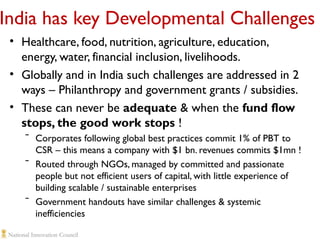
India has key Developmental Challenges
• Healthcare, food, nutrition, agriculture, education,
energy, water, financial inclusion, livelihoods.
• Globally and in India such challenges are addressed in 2
ways – Philanthropy and government grants / subsidies.
• These can never be adequate & when the fund flow
stops, the good work stops !
ˉ Corporates following global best practices commit 1% of PBT to
CSR – this means a company with $1 bn. revenues commits $1mn !
ˉ Routed through NGOs, managed by committed and passionate
people but not efficient users of capital, with little experience of
building scalable / sustainable enterprises
ˉ Government handouts have similar challenges & systemic
inefficiencies
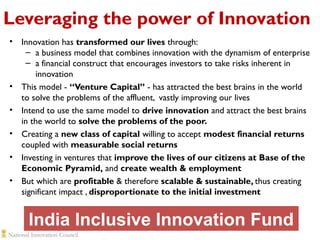
Leveraging the power of Innovation
•

•
•
•
•
•

Innovation has transformed our lives through:
– a business model that combines innovation with the dynamism of enterprise
– a financial construct that encourages investors to take risks inherent in
innovation
This model - “Venture Capital” - has attracted the best brains in the world
to solve the problems of the affluent, vastly improving our lives
Intend to use the same model to drive innovation and attract the best brains
in the world to solve the problems of the poor.
Creating a new class of capital willing to accept modest financial returns
coupled with measurable social returns
Investing in ventures that improve the lives of our citizens at Base of the
Economic Pyramid, and create wealth & employment
But which are profitable & therefore scalable & sustainable, thus creating
significant impact , disproportionate to the initial investment

India Inclusive Innovation Fund
Inclusive Innovation: Does It
Work?

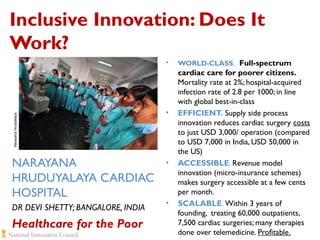
Narayana Hrudyalaya

•

NARAYANA
HRUDUYALAYA CARDIAC
HOSPITAL
DR DEVI SHETTY; BANGALORE, INDIA

Healthcare for the Poor

•

•

•

WORLD-CLASS. Full-spectrum

cardiac care for poorer citizens.
Mortality rate at 2%; hospital-acquired
infection rate of 2.8 per 1000; in line
with global best-in-class
EFFICIENT. Supply side process
innovation reduces cardiac surgery costs
to just USD 3,000/ operation (compared
to USD 7,000 in India, USD 50,000 in
the US)
ACCESSIBLE. Revenue model
innovation (micro-insurance schemes)
makes surgery accessible at a few cents
per month.
SCALABLE. Within 3 years of
founding, treating 60,000 outpatients,
7,500 cardiac surgeries; many therapies
done over telemedicine. Profitable.
Inclusive Innovation: Does It
Work?
•

Narayana Hrudyalaya

•

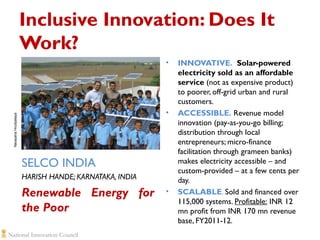
SELCO INDIA
HARISH HANDE; KARNATAKA, INDIA

Renewable Energy for
the Poor

•

INNOVATIVE. Solar-powered
electricity sold as an affordable
service (not as expensive product)
to poorer, off-grid urban and rural
customers.
ACCESSIBLE. Revenue model
innovation (pay-as-you-go billing;
distribution through local
entrepreneurs; micro-finance
facilitation through grameen banks)
makes electricity accessible – and
custom-provided – at a few cents per
day.
SCALABLE. Sold and financed over
115,000 systems. Profitable: INR 12
mn profit from INR 170 mn revenue
base, FY2011-12.
Inclusive Innovation: Does It Work?

The HIndu

•

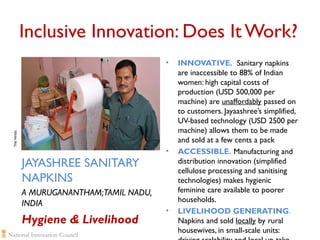
JAYASHREE SANITARY
NAPKINS
A MURUGANANTHAM;TAMIL NADU,
INDIA

Hygiene & Livelihood

•

•

INNOVATIVE. Sanitary napkins
are inaccessible to 88% of Indian
women: high capital costs of
production (USD 500,000 per
machine) are unaffordably passed on
to customers. Jayaashree’s simplified,
UV-based technology (USD 2500 per
machine) allows them to be made
and sold at a few cents a pack
ACCESSIBLE. Manufacturing and
distribution innovation (simplified
cellulose processing and sanitising
technologies) makes hygienic
feminine care available to poorer
households.
LIVELIHOOD GENERATING.
Napkins and sold locally by rural
housewives, in small-scale units:
Inclusive Innovation: Does It Work?
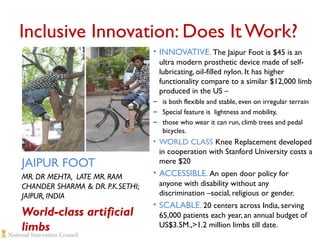
• INNOVATIVE. The Jaipur Foot is $45 is an
ultra modern prosthetic device made of selflubricating, oil-filled nylon. It has higher
functionality compare to a similar $12,000 limb
produced in the US –
– is both flexible and stable, even on irregular terrain
– Special feature is lightness and mobility,
– those who wear it can run, climb trees and pedal
bicycles.

JAIPUR FOOT
MR. DR MEHTA, LATE MR. RAM
CHANDER SHARMA & DR. P.K.SETHI;
JAIPUR, INDIA

World-class artificial
limbs

• WORLD CLASS Knee Replacement developed
in cooperation with Stanford University costs a
mere $20

• ACCESSIBLE. An open door policy for
anyone with disability without any
discrimination –social, religious or gender.

• SCALABLE. 20 centers across India, serving
65,000 patients each year, an annual budget of
US$3.5M.,>1.2 million limbs till date.
IIIF Objectives
•

•

•

•

•

•

•

Drive inclusive growth by igniting innovative entrepreneurship that
addresses Bottom of the Pyramid needs
Mobilise capacity to identify and scale innovative solutions that will
address problems of the disadvantaged
Create an ecosystem of innovative solutions, business models and
approaches that reach beyond IPs/Patents
Balance social and financial returns, simultaneously achieving
social good and economic sustainability
Employment / livelihoods creation at the bottom of the
pyramid will be a key bias for the fund’s investments
Mentor, develop skills, build capacity : create dedicated support
networks and education programmes for socially focused
entrepreneurs
Pool innovators and entrepreneurs focused on the bottom of
the pyramid: partner with incubators, entrepreneurship cells, angel
networks, VC Funds, etc.
Fund Characteristics
• Structured as an autonomous, Rs. 5,000 fund, first close Rs. 500
crores
– Indian Government contributing 20% ( Rs. 100 crores ) to first close
through Ministry of MSME

• Balance contribution from public sector banks, financial institutions,
insurance companies, multilateral / bilateral development agencies,
Indian & global corporates,
• Fund Life: 9 years, extendable by up to 2 years (subject to approval of
contributors)
• IRR: Fund will target Internal Rate of Return of 12% per annum
• Hurdle Rate: 8% per annum
• Management Fee: 2.5% declining to 1.5% based on the size of corpus
• Focus Sectors: Include (i) healthcare; (ii) food and nutrition; (iii)
agriculture; (iv) education; (v) energy; (vi) financial inclusion; (vii)
environment; (viii) technology as an enabler, etc.
Fund Characteristics (cont’d)
• Will Invest directly in BOP enterprises, across the
venture development cycle: majority in seed/early tage
• Will also invest indirectly through other BOP-focused funds
• Professionally managed by world class professionals
• Will operate as a for profit entity, providing investors
modest financial returns, coupled with measurable social
returns
• Will Source pipeline via a multitude of on line and off line
channels
• Will Partner with all stakeholders locally and globally, learn
and share experiences

Create a Model for the World to Emulate
Fund Management
• Governing Council
– Comprises eminent people from industry & govt. to oversee
the thesis of the Fund

• Investment Committee
– Mix of successful business people - entrepreneurs,
management / domain / industry experts, and
representatives of investors & management team

• Management Team
– Comprises successful serial entrepreneurs and experienced
fund managers
– Will get a salary and “carry” – incentivized equally on social
and financial returns
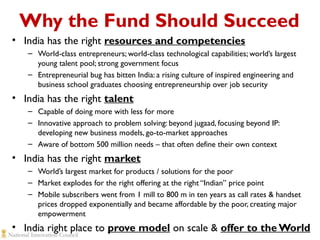
Why the Fund Should Succeed
• India has the right resources and competencies
– World-class entrepreneurs; world-class technological capabilities; world’s largest
young talent pool; strong government focus
– Entrepreneurial bug has bitten India: a rising culture of inspired engineering and
business school graduates choosing entrepreneurship over job security

• India has the right talent
– Capable of doing more with less for more
– Innovative approach to problem solving: beyond jugaad, focusing beyond IP:
developing new business models, go-to-market approaches
– Aware of bottom 500 million needs – that often define their own context

• India has the right market
– World’s largest market for products / solutions for the poor
– Market explodes for the right offering at the right “Indian” price point
– Mobile subscribers went from 1 mill to 800 m in ten years as call rates & handset
prices dropped exponentially and became affordable by the poor, creating major
empowerment

• India right place to prove model on scale & offer to the World
Thank You
For more information on India Inclusive Innovation Fund visit

www.innovationcouncil.gov.in

India Inclusive Innovation Fund - Launches on 27th January 2014

  • 1.
    MSME and NationalInnovation Council Launch The India Inclusive Innovation Fund 27th January 2014
  • 2.
    India has keyDevelopmental Challenges • Healthcare, food, nutrition, agriculture, education, energy, water, financial inclusion, livelihoods. • Globally and in India such challenges are addressed in 2 ways – Philanthropy and government grants / subsidies. • These can never be adequate & when the fund flow stops, the good work stops ! ˉ Corporates following global best practices commit 1% of PBT to CSR – this means a company with $1 bn. revenues commits $1mn ! ˉ Routed through NGOs, managed by committed and passionate people but not efficient users of capital, with little experience of building scalable / sustainable enterprises ˉ Government handouts have similar challenges & systemic inefficiencies
  • 3.
    Leveraging the powerof Innovation • • • • • • Innovation has transformed our lives through: – a business model that combines innovation with the dynamism of enterprise – a financial construct that encourages investors to take risks inherent in innovation This model - “Venture Capital” - has attracted the best brains in the world to solve the problems of the affluent, vastly improving our lives Intend to use the same model to drive innovation and attract the best brains in the world to solve the problems of the poor. Creating a new class of capital willing to accept modest financial returns coupled with measurable social returns Investing in ventures that improve the lives of our citizens at Base of the Economic Pyramid, and create wealth & employment But which are profitable & therefore scalable & sustainable, thus creating significant impact , disproportionate to the initial investment India Inclusive Innovation Fund
  • 4.
    Inclusive Innovation: DoesIt Work? Narayana Hrudyalaya • NARAYANA HRUDUYALAYA CARDIAC HOSPITAL DR DEVI SHETTY; BANGALORE, INDIA Healthcare for the Poor • • • WORLD-CLASS. Full-spectrum cardiac care for poorer citizens. Mortality rate at 2%; hospital-acquired infection rate of 2.8 per 1000; in line with global best-in-class EFFICIENT. Supply side process innovation reduces cardiac surgery costs to just USD 3,000/ operation (compared to USD 7,000 in India, USD 50,000 in the US) ACCESSIBLE. Revenue model innovation (micro-insurance schemes) makes surgery accessible at a few cents per month. SCALABLE. Within 3 years of founding, treating 60,000 outpatients, 7,500 cardiac surgeries; many therapies done over telemedicine. Profitable.
  • 5.
    Inclusive Innovation: DoesIt Work? • Narayana Hrudyalaya • SELCO INDIA HARISH HANDE; KARNATAKA, INDIA Renewable Energy for the Poor • INNOVATIVE. Solar-powered electricity sold as an affordable service (not as expensive product) to poorer, off-grid urban and rural customers. ACCESSIBLE. Revenue model innovation (pay-as-you-go billing; distribution through local entrepreneurs; micro-finance facilitation through grameen banks) makes electricity accessible – and custom-provided – at a few cents per day. SCALABLE. Sold and financed over 115,000 systems. Profitable: INR 12 mn profit from INR 170 mn revenue base, FY2011-12.
  • 6.
    Inclusive Innovation: DoesIt Work? The HIndu • JAYASHREE SANITARY NAPKINS A MURUGANANTHAM;TAMIL NADU, INDIA Hygiene & Livelihood • • INNOVATIVE. Sanitary napkins are inaccessible to 88% of Indian women: high capital costs of production (USD 500,000 per machine) are unaffordably passed on to customers. Jayaashree’s simplified, UV-based technology (USD 2500 per machine) allows them to be made and sold at a few cents a pack ACCESSIBLE. Manufacturing and distribution innovation (simplified cellulose processing and sanitising technologies) makes hygienic feminine care available to poorer households. LIVELIHOOD GENERATING. Napkins and sold locally by rural housewives, in small-scale units:
  • 7.
    Inclusive Innovation: DoesIt Work? • INNOVATIVE. The Jaipur Foot is $45 is an ultra modern prosthetic device made of selflubricating, oil-filled nylon. It has higher functionality compare to a similar $12,000 limb produced in the US – – is both flexible and stable, even on irregular terrain – Special feature is lightness and mobility, – those who wear it can run, climb trees and pedal bicycles. JAIPUR FOOT MR. DR MEHTA, LATE MR. RAM CHANDER SHARMA & DR. P.K.SETHI; JAIPUR, INDIA World-class artificial limbs • WORLD CLASS Knee Replacement developed in cooperation with Stanford University costs a mere $20 • ACCESSIBLE. An open door policy for anyone with disability without any discrimination –social, religious or gender. • SCALABLE. 20 centers across India, serving 65,000 patients each year, an annual budget of US$3.5M.,>1.2 million limbs till date.
  • 8.
    IIIF Objectives • • • • • • • Drive inclusivegrowth by igniting innovative entrepreneurship that addresses Bottom of the Pyramid needs Mobilise capacity to identify and scale innovative solutions that will address problems of the disadvantaged Create an ecosystem of innovative solutions, business models and approaches that reach beyond IPs/Patents Balance social and financial returns, simultaneously achieving social good and economic sustainability Employment / livelihoods creation at the bottom of the pyramid will be a key bias for the fund’s investments Mentor, develop skills, build capacity : create dedicated support networks and education programmes for socially focused entrepreneurs Pool innovators and entrepreneurs focused on the bottom of the pyramid: partner with incubators, entrepreneurship cells, angel networks, VC Funds, etc.
  • 9.
    Fund Characteristics • Structuredas an autonomous, Rs. 5,000 fund, first close Rs. 500 crores – Indian Government contributing 20% ( Rs. 100 crores ) to first close through Ministry of MSME • Balance contribution from public sector banks, financial institutions, insurance companies, multilateral / bilateral development agencies, Indian & global corporates, • Fund Life: 9 years, extendable by up to 2 years (subject to approval of contributors) • IRR: Fund will target Internal Rate of Return of 12% per annum • Hurdle Rate: 8% per annum • Management Fee: 2.5% declining to 1.5% based on the size of corpus • Focus Sectors: Include (i) healthcare; (ii) food and nutrition; (iii) agriculture; (iv) education; (v) energy; (vi) financial inclusion; (vii) environment; (viii) technology as an enabler, etc.
  • 10.
    Fund Characteristics (cont’d) •Will Invest directly in BOP enterprises, across the venture development cycle: majority in seed/early tage • Will also invest indirectly through other BOP-focused funds • Professionally managed by world class professionals • Will operate as a for profit entity, providing investors modest financial returns, coupled with measurable social returns • Will Source pipeline via a multitude of on line and off line channels • Will Partner with all stakeholders locally and globally, learn and share experiences Create a Model for the World to Emulate
  • 11.
    Fund Management • GoverningCouncil – Comprises eminent people from industry & govt. to oversee the thesis of the Fund • Investment Committee – Mix of successful business people - entrepreneurs, management / domain / industry experts, and representatives of investors & management team • Management Team – Comprises successful serial entrepreneurs and experienced fund managers – Will get a salary and “carry” – incentivized equally on social and financial returns
  • 12.
    Why the FundShould Succeed • India has the right resources and competencies – World-class entrepreneurs; world-class technological capabilities; world’s largest young talent pool; strong government focus – Entrepreneurial bug has bitten India: a rising culture of inspired engineering and business school graduates choosing entrepreneurship over job security • India has the right talent – Capable of doing more with less for more – Innovative approach to problem solving: beyond jugaad, focusing beyond IP: developing new business models, go-to-market approaches – Aware of bottom 500 million needs – that often define their own context • India has the right market – World’s largest market for products / solutions for the poor – Market explodes for the right offering at the right “Indian” price point – Mobile subscribers went from 1 mill to 800 m in ten years as call rates & handset prices dropped exponentially and became affordable by the poor, creating major empowerment • India right place to prove model on scale & offer to the World
  • 13.
    Thank You For moreinformation on India Inclusive Innovation Fund visit www.innovationcouncil.gov.in

Editor's Notes

  • #5 Founded by Dr Devi Shetty, 2001 Provides heart care to poor rural citizens, at a fraction of Western costs Within 3 years of founding, scaled: treating 60,000 outpatients, 7,500 cardiac surgeries; many therapies done over telemedicine Profitable (2004 gross margins: 19.0%) Innovation: process + business model Supply side innovation: specialises in heart care, 24/7/365 Highest cost factors: doctors’ time; expensive medical equipment Doctor’s time: breaks down total process into components; outsources non-essential (non-surgery) components (e.g. reading ECG) to less-skilled, less-paid workers; more of doctors’ (expensive) time focused on surgery => higher throughput. Also: economies of learning: doctors specialise in particular procedures; do more in less time =>higher productivity Equipment: In most multispecialty hospitals, heart-equipment used only part of the time -> high latency -> low utilisation ->lower amortisation. In NH hospital: used 24/7/365; better value for money Demand side: insurance scheme Spread over very large number of patients Brings cost/patient down at point of use; only a few 10s of rupees a month as premium, per individual – but massively scaled Commercial returns: profitable, reaching untapped markets, with cost-optimised model Social returns: tens of thousands of poor citizens getting world-class healthcare
  • #6 Founded by Harish Hande Solar-based electricity for off-grid rural and urban areas (Karnataka + Gujarat) Electricity sold as a service – rather than solar cells sold as products FY ending March 30, 2012: revenue of Rs. 17 crore, profit of Rs. 1.2 crore Complete package of product, service and consumer financing Financing through grameen banks, cooperative societies, commercial banks and micro-finance institutions. Pay as you go Uses an innovative ‘entrepreneur-model’ Systematically identify local customer needs Assists local entrepreneurs to serve these needs Help these entrepreneurs micro-financing from micro-finance agencies Entrepreneur provides customised service to end-users – including doorstep financing. Example: to address street-vendor customers, who wanted lighting SELCO created entrepreneurs who maintain centralised solar charging stations Deliver solar charged batteries directly to street hawkers Negotiated price, collected on a daily basis from street hawkers Strong after-sales and maintenance support Employs about 170 employees, across 25 energy service centres. Since 1995, have sold, serviced and financed over 115,000 solar systems. Commercial returns: untapped markets, thanks to affordability = customised financing + franchisee model + customised service. Leverages government subsidy schemes, to bring down cap-ex. Social returns: electricity for the poor
  • #7 Developed by Arunachalam Muruganatham 88% of Indian women use dirty rags, newspapers, dried leaves, and ashes during their period – because they find sanitary napkins unaffordable Murugunatham realised that the machinery used to convert pine wood into cellulose (used as the absorbent in napkins) cost more than USD 500,000 Equipment capex pushed up napkin prices, beyond affordability of poorer Indians Create a simpler version of the machine: powered by electricity and foot pedals. Machine de-fibers the cellulose, compresses it into napkin form, seals it with non-woven fabrics, uses UV light to sterilise it. Costs only USD 2500. Murgunatham can now make 1,000 napkins a day, which retail for about $.25 for a package of eight. Machines are being sold to housewives, to run small businesses making (and selling) sanitary napkins.