+
    Mobilizing multi-Stakeholder
     Support through Strategic
          Communication

           A Case Scenario


                CabyVerzosa

            Communication Advisor

             World Bank Institute
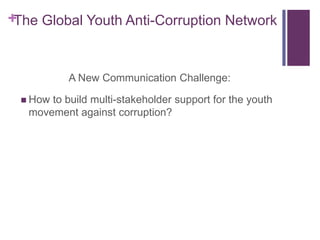
+The Global Youth Anti-Corruption Network


           A New Communication Challenge:

  How to build multi-stakeholder support for the youth
   movement against corruption?
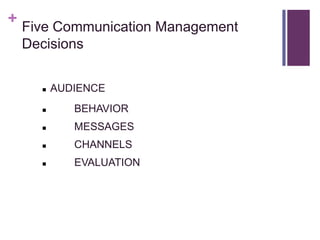
+ Five Communication Management
 Decisions


       AUDIENCE
          BEHAVIOR
          MESSAGES
          CHANNELS
          EVALUATION
+
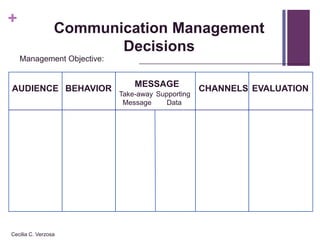
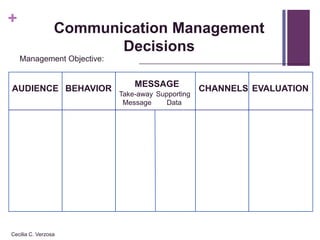
                 Communication Management
                        Decisions
    Management Objective:


                                MESSAGE
AUDIENCE BEHAVIOR                                  CHANNELS EVALUATION
                            Take-away Supporting
                             Message     Data


Cecilia C. Verzosa
+
    AUDIENCE
        Whose support is critical to the success of
          the project/ program/policy reform?
+
    BEHAVIOR

      What behaviors, if adopted, will help
        achieve the defined objectives?
+
    MESSAGES


      What messages will influence people to
    support the project/ program/policy reform?
+
    CHANNELS

     What channels of communication will reach
    these people and would be credible to them?
+
    EVALUATION


      How will communication activities be
          monitored and evaluated ?
+
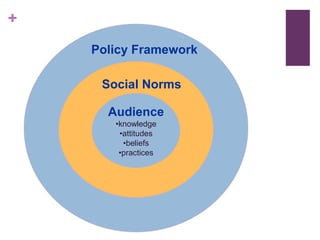
    Policy Framework

     Social Norms

      Audience
       •knowledge
        •attitudes
         •beliefs
        •practices
+
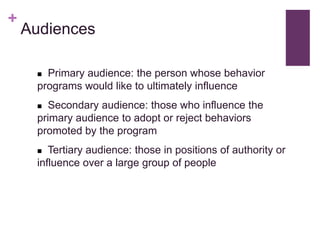
    Audiences

      Primary audience: the person whose behavior
     programs would like to ultimately influence
      Secondary audience: those who influence the
     primary audience to adopt or reject behaviors
     promoted by the program
       Tertiary audience: those in positions of authority or
     influence over a large group of people
+
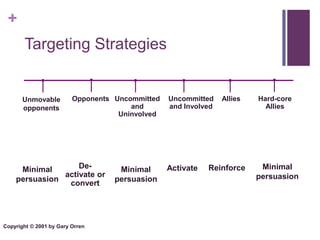
       Targeting Strategies


       Unmovable         Opponents Uncommitted   Uncommitted    Allies   Hard-core
       opponents                       and       and Involved              Allies
                                    Uninvolved


     Minimal       De-              Minimal      Activate   Reinforce     Minimal
               activate or                                               persuasion
    persuasion                     persuasion
                convert


Copyright © 2001 by Gary Orren
+
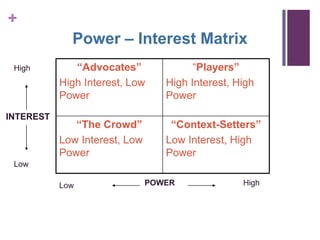
             Power – Interest Matrix
 High         “Advocates”               “Players”
           High Interest, Low     High Interest, High
           Power                  Power
INTEREST
              “The Crowd”          “Context-Setters”
           Low Interest, Low      Low Interest, High
           Power                  Power
 Low

           Low                 POWER              High
+
 Behavior


  Action one would like the target audience to
  take to help the program achieve its goal.
+

    Technical Message

           vs.

    Take-Away Message
+
    Message

      Refers to the take-away message for a
      particular audience. A take-away
      message consists of the target
      audience’s response to the message
      received NOT the information given by
      the communicator.
+
    The Take-Away Message. . .

    Good Take-Away Messages:
       Focus on Stakeholders’ Needs
       Target Stakeholder Beliefs or Opinions
       Are Culturally Sensitive
    Answer the Stakeholder’s question: What does this have to do
    with me?
       Are memorable: simple, focused and concise
+
    Supporting Data


    Refers to information the communicator
    uses to persuade audiences that adoption of
    the behavior benefits them.
+
    Channels of Communication


    Various means of relaying messages - via
      face-to-face meetings, radio, TV, group
      sessions, individual counseling
      sessions.
+
    Evaluation


      Indicators of success of communication
        activities in achieving changes in
        knowledge, attitudes, beliefs, and
        practices.
+
                 Communication Management
                        Decisions
    Management Objective:


                                MESSAGE
AUDIENCE BEHAVIOR                                  CHANNELS EVALUATION
                            Take-away Supporting
                             Message     Data


Cecilia C. Verzosa
+
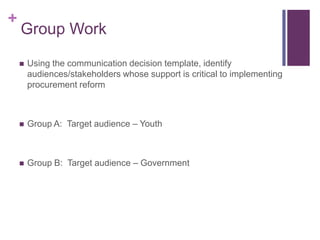
    Group Work

       Using the communication decision template, identify
        audiences/stakeholders whose support is critical to implementing
        procurement reform


       Group A: Target audience – Youth


       Group B: Target audience – Government
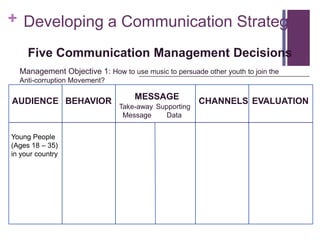
+ Developing a Communication Strategy

     Five Communication Management Decisions
  Management Objective 1: How to use music to persuade other youth to join the
  Anti-corruption Movement?

                                   MESSAGE
AUDIENCE BEHAVIOR                                     CHANNELS EVALUATION
                               Take-away Supporting
                                Message     Data


Young People
(Ages 18 – 35)
in your country
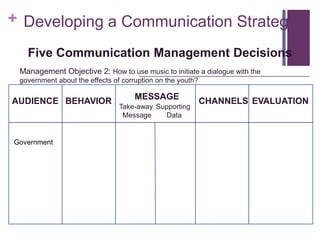
+ Developing a Communication Strategy

   Five Communication Management Decisions
 Management Objective 2: How to use music to initiate a dialogue with the
 government about the effects of corruption on the youth?

                                     MESSAGE
AUDIENCE BEHAVIOR                                           CHANNELS EVALUATION
                                Take-away Supporting
                                 Message     Data


Government
+
    Reporting
+
    Lessons Learned
+
    Lessons Learned

Mobilizing multi-Stakeholder Support through Strategic Communication - A Case Scenario

  • 1.
    + Mobilizing multi-Stakeholder Support through Strategic Communication A Case Scenario CabyVerzosa Communication Advisor World Bank Institute
  • 2.
    +The Global YouthAnti-Corruption Network A New Communication Challenge:  How to build multi-stakeholder support for the youth movement against corruption?
  • 3.
    + Five CommunicationManagement Decisions  AUDIENCE  BEHAVIOR  MESSAGES  CHANNELS  EVALUATION
  • 4.
    + Communication Management Decisions Management Objective: MESSAGE AUDIENCE BEHAVIOR CHANNELS EVALUATION Take-away Supporting Message Data Cecilia C. Verzosa
  • 5.
    + AUDIENCE Whose support is critical to the success of the project/ program/policy reform?
  • 6.
    + BEHAVIOR What behaviors, if adopted, will help achieve the defined objectives?
  • 7.
    + MESSAGES What messages will influence people to support the project/ program/policy reform?
  • 8.
    + CHANNELS What channels of communication will reach these people and would be credible to them?
  • 9.
    + EVALUATION How will communication activities be monitored and evaluated ?
  • 10.
    + Policy Framework Social Norms Audience •knowledge •attitudes •beliefs •practices
  • 11.
    + Audiences  Primary audience: the person whose behavior programs would like to ultimately influence  Secondary audience: those who influence the primary audience to adopt or reject behaviors promoted by the program  Tertiary audience: those in positions of authority or influence over a large group of people
  • 12.
    + Targeting Strategies Unmovable Opponents Uncommitted Uncommitted Allies Hard-core opponents and and Involved Allies Uninvolved Minimal De- Minimal Activate Reinforce Minimal activate or persuasion persuasion persuasion convert Copyright © 2001 by Gary Orren
  • 13.
    + Power – Interest Matrix High “Advocates” “Players” High Interest, Low High Interest, High Power Power INTEREST “The Crowd” “Context-Setters” Low Interest, Low Low Interest, High Power Power Low Low POWER High
  • 14.
    + Behavior Action one would like the target audience to take to help the program achieve its goal.
  • 15.
    + Technical Message vs. Take-Away Message
  • 16.
    + Message Refers to the take-away message for a particular audience. A take-away message consists of the target audience’s response to the message received NOT the information given by the communicator.
  • 17.
    + The Take-Away Message. . . Good Take-Away Messages:  Focus on Stakeholders’ Needs  Target Stakeholder Beliefs or Opinions  Are Culturally Sensitive Answer the Stakeholder’s question: What does this have to do with me?  Are memorable: simple, focused and concise
  • 18.
    + Supporting Data Refers to information the communicator uses to persuade audiences that adoption of the behavior benefits them.
  • 19.
    + Channels of Communication Various means of relaying messages - via face-to-face meetings, radio, TV, group sessions, individual counseling sessions.
  • 20.
    + Evaluation Indicators of success of communication activities in achieving changes in knowledge, attitudes, beliefs, and practices.
  • 21.
    + Communication Management Decisions Management Objective: MESSAGE AUDIENCE BEHAVIOR CHANNELS EVALUATION Take-away Supporting Message Data Cecilia C. Verzosa
  • 22.
    + Group Work  Using the communication decision template, identify audiences/stakeholders whose support is critical to implementing procurement reform  Group A: Target audience – Youth  Group B: Target audience – Government
  • 23.
    + Developing aCommunication Strategy Five Communication Management Decisions Management Objective 1: How to use music to persuade other youth to join the Anti-corruption Movement? MESSAGE AUDIENCE BEHAVIOR CHANNELS EVALUATION Take-away Supporting Message Data Young People (Ages 18 – 35) in your country
  • 24.
    + Developing aCommunication Strategy Five Communication Management Decisions Management Objective 2: How to use music to initiate a dialogue with the government about the effects of corruption on the youth? MESSAGE AUDIENCE BEHAVIOR CHANNELS EVALUATION Take-away Supporting Message Data Government
  • 25.
    + Reporting
  • 26.
    + Lessons Learned
  • 27.
    + Lessons Learned