• Define public debt
• Describe salient characteristics of the size, composition,
and nature of public debt in South Africa
• Explain and compare different theories of public debt and
evaluate them critically
• Argue the relative merits of debt and tax financing of
government expenditure
• Define public debt management
• Identify and describe the different types of public debt
cost
• Identify the goals of public debt management and discuss
their pursuance, with special reference to South Africa.
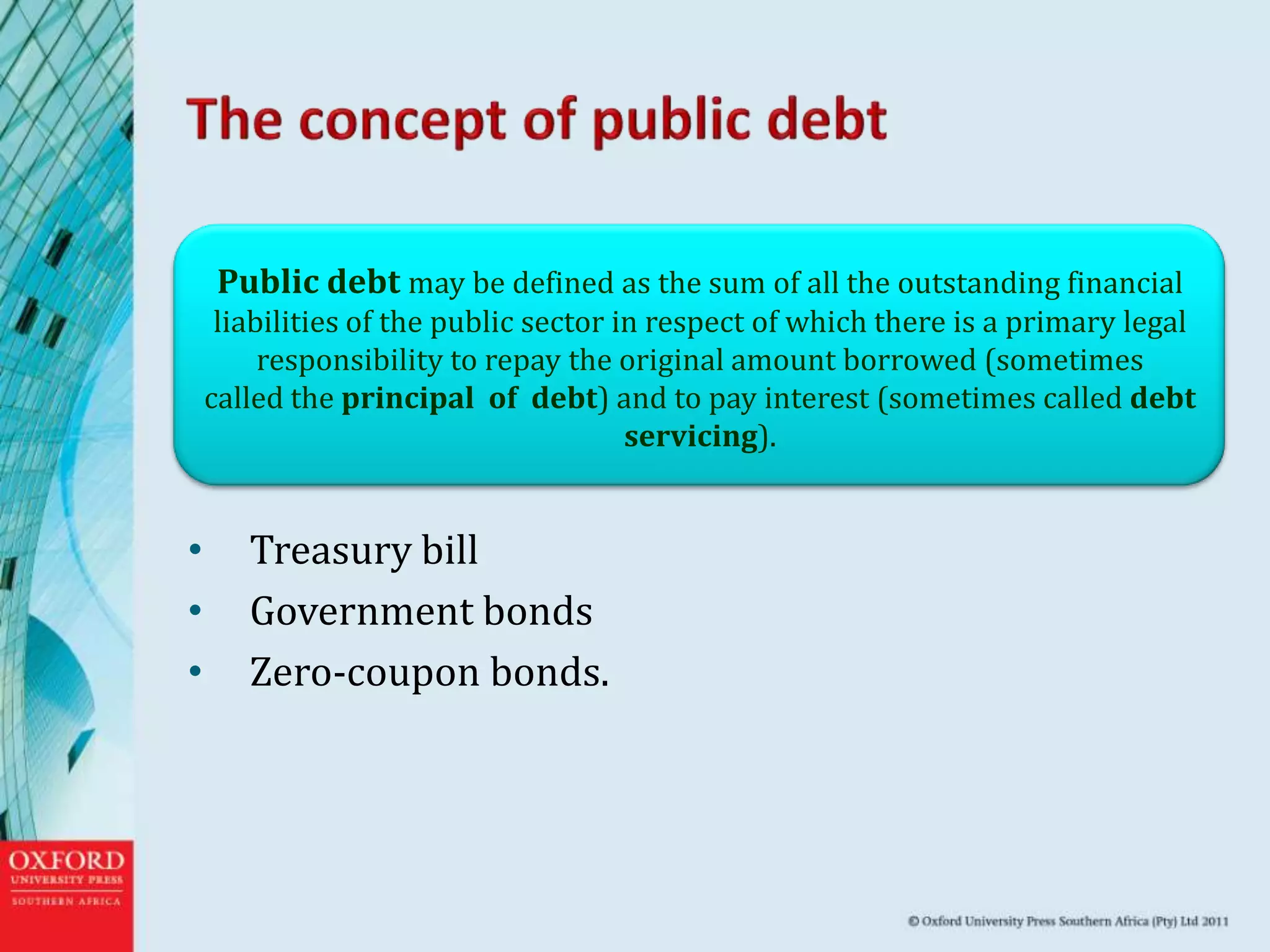
• Treasury bill
• Government bonds
• Zero-coupon bonds.
Public debt may be defined as the sum of all the outstanding financial
liabilities of the public sector in respect of which there is a primary legal
responsibility to repay the original amount borrowed (sometimes
called the principal of debt) and to pay interest (sometimes called debt
servicing).
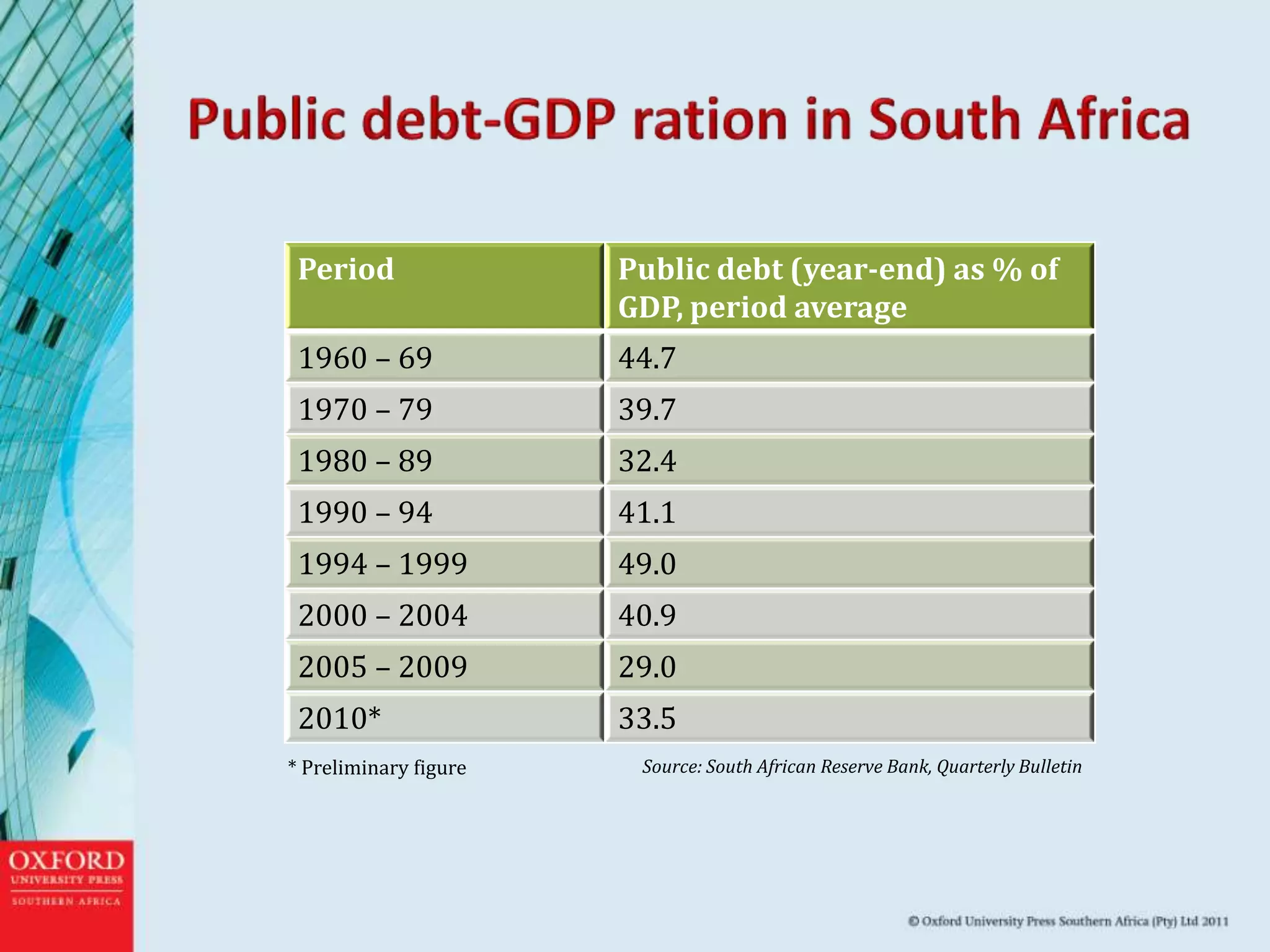
Period Public debt (year-end) as % of
GDP, period average
1960 – 69 44.7
1970 – 79 39.7
1980 – 89 32.4
1990 – 94 41.1
1994 – 1999 49.0
2000 – 2004 40.9
2005 – 2009 29.0
2010* 33.5
* Preliminary figure Source: South African Reserve Bank, Quarterly Bulletin
• Debt trap
• Ownership distribution
• Current expenditure
• Capital expenditure
• Net worth
• Net indebtedness
• Consul.
• Inter-temporal burden
• Domestic or internal debt
• Foreign or external debt
• Internal vs external debt and the burden on future
generations
• Inter-temporal burden
• Fiscal neutrality and Ricardian equivalence
• Fiscal activism and Keynsian demand management
• The crowding-out phenomenon
• The public choice view.
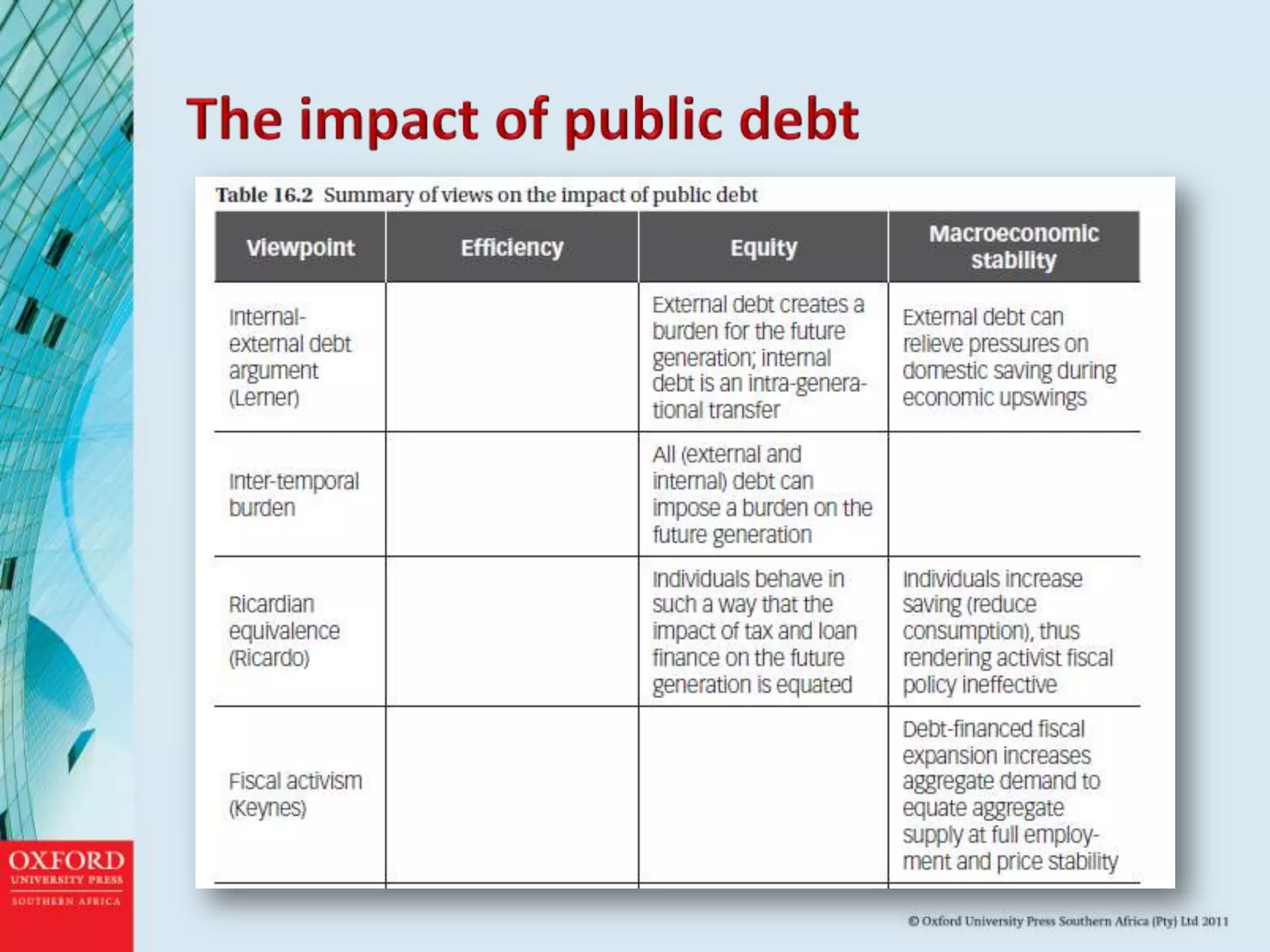
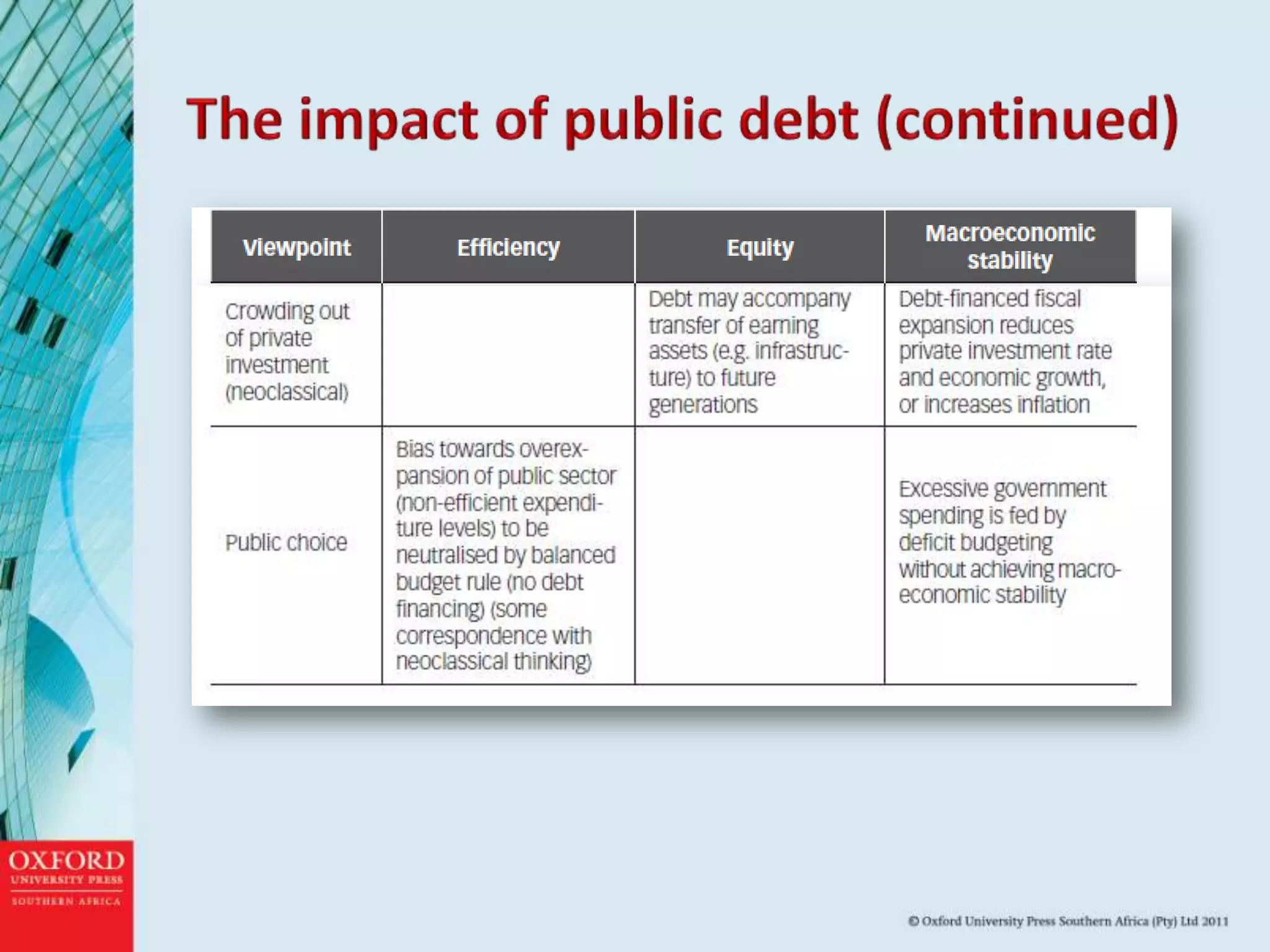
• Allocation efficiency
• Distribution (equity)
• Macroeconomic stability.
Objectives
• Minimisation of state debt cost
• Macroeconomic stability
• Development of domestic financial markets
• Financial credibility.
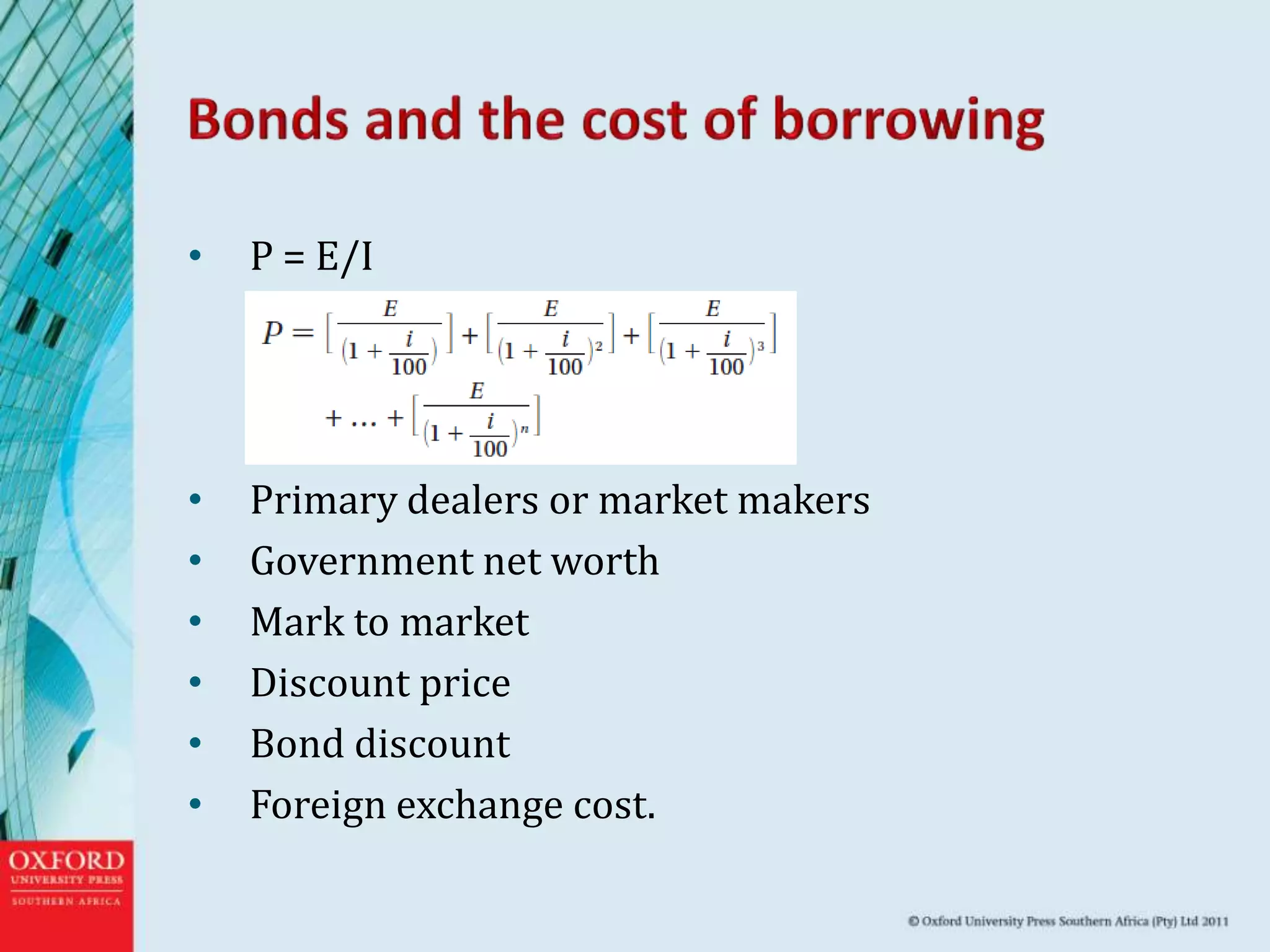
• P = E/I
• Primary dealers or market makers
• Government net worth
• Mark to market
• Discount price
• Bond discount
• Foreign exchange cost.
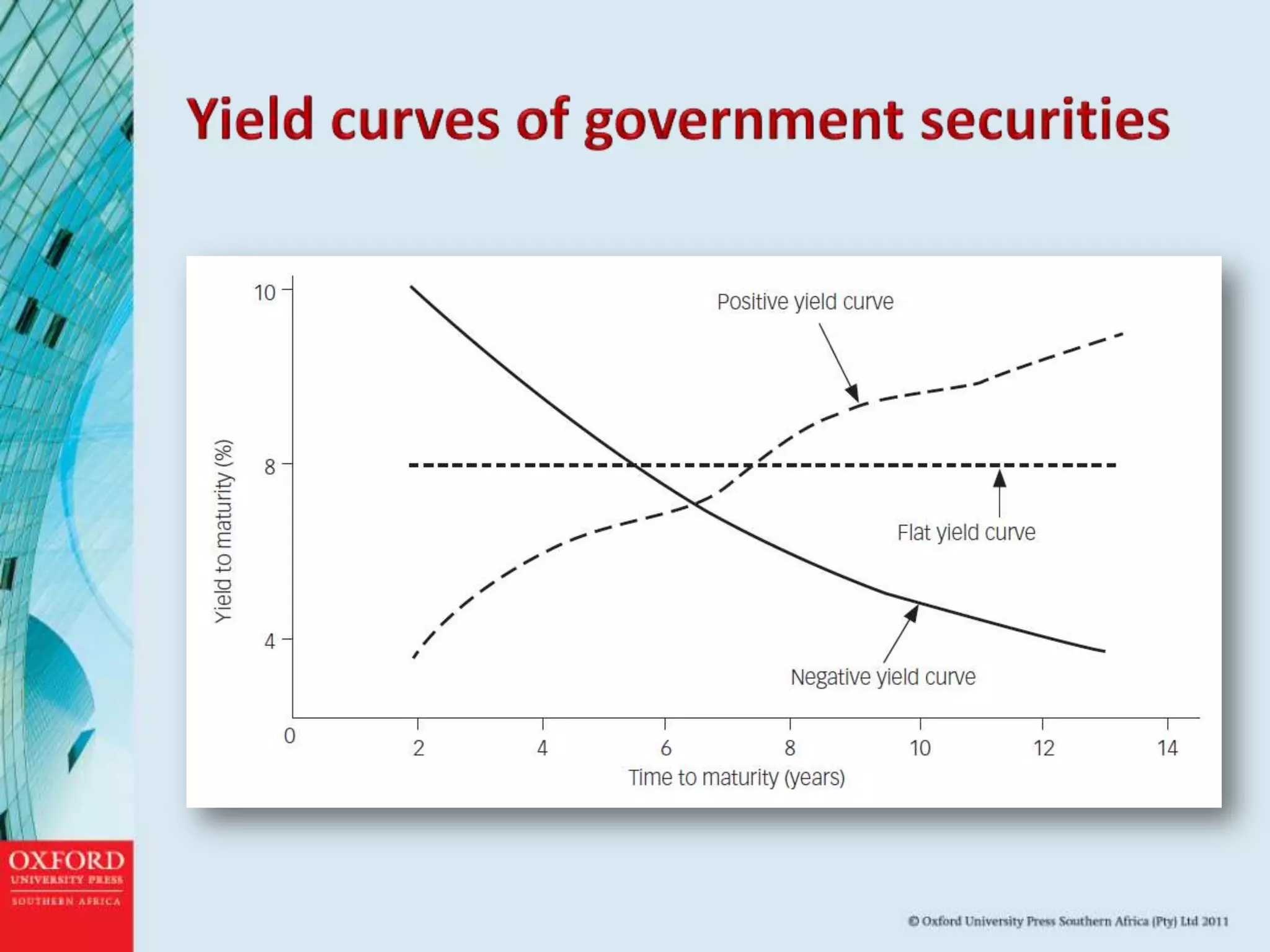
• Horizontal or flat
• Negatively sloped or inverse
• Upward sloped or positive.
Two questions
• Can the country service its debt?
• Will the country service its debt?
• Explicit
– Government guarantees on foreign exchange borrowings
• Implicit
– No contractual obligation to provide assistance but does so.
Pe5e chapter 16 v1.0

Pe5e chapter 16 v1.0

  • 2.
    • Define publicdebt • Describe salient characteristics of the size, composition, and nature of public debt in South Africa • Explain and compare different theories of public debt and evaluate them critically • Argue the relative merits of debt and tax financing of government expenditure • Define public debt management • Identify and describe the different types of public debt cost • Identify the goals of public debt management and discuss their pursuance, with special reference to South Africa.
  • 3.
    • Treasury bill •Government bonds • Zero-coupon bonds. Public debt may be defined as the sum of all the outstanding financial liabilities of the public sector in respect of which there is a primary legal responsibility to repay the original amount borrowed (sometimes called the principal of debt) and to pay interest (sometimes called debt servicing).
  • 4.
    Period Public debt(year-end) as % of GDP, period average 1960 – 69 44.7 1970 – 79 39.7 1980 – 89 32.4 1990 – 94 41.1 1994 – 1999 49.0 2000 – 2004 40.9 2005 – 2009 29.0 2010* 33.5 * Preliminary figure Source: South African Reserve Bank, Quarterly Bulletin
  • 5.
    • Debt trap •Ownership distribution • Current expenditure • Capital expenditure • Net worth • Net indebtedness • Consul.
  • 6.
    • Inter-temporal burden •Domestic or internal debt • Foreign or external debt • Internal vs external debt and the burden on future generations • Inter-temporal burden • Fiscal neutrality and Ricardian equivalence • Fiscal activism and Keynsian demand management • The crowding-out phenomenon • The public choice view.
  • 9.
    • Allocation efficiency •Distribution (equity) • Macroeconomic stability.
  • 10.
    Objectives • Minimisation ofstate debt cost • Macroeconomic stability • Development of domestic financial markets • Financial credibility.
  • 11.
    • P =E/I • Primary dealers or market makers • Government net worth • Mark to market • Discount price • Bond discount • Foreign exchange cost.
  • 13.
    • Horizontal orflat • Negatively sloped or inverse • Upward sloped or positive.
  • 14.
    Two questions • Canthe country service its debt? • Will the country service its debt?
  • 15.
    • Explicit – Governmentguarantees on foreign exchange borrowings • Implicit – No contractual obligation to provide assistance but does so.