Unit 1
Studying
History
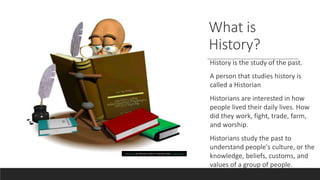
What is
History?
History is the study of the past.
A person that studies history is
called a Historian
Historians are interested in how
people lived their daily lives. How
did they work, fight, trade, farm,
and worship.
Historians study the past to
understand people's culture, or the
knowledge, beliefs, customs, and
values of a group of people.
This Photo by Unknown author is licensed under CC BY-NC-ND.
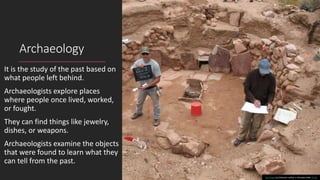
Archaeology
It is the study of the past based on
what people left behind.
Archaeologists explore places
where people once lived, worked,
or fought.
They can find things like jewelry,
dishes, or weapons.
Archaeologists examine the objects
that were found to learn what they
can tell from the past.
This Photo by Unknown author is licensed under CC BY.
Understanding
History
The main reason people want to understand the past is
because it helps us to understand the world today.
It can help us to understand other people—their
beliefs, values, and ways of life
We rely on a variety of sources to learn about history
A fossil is a part of imprint of something that was once alive
◦ Bones and footprints preserved in rock are examples of fossils
Artifacts are objects created by and used by humans
-can include coins, arrowheads, tools, toys, and pottery
People kept written records of history through stone pillars, stamped
into clay tablets, scribbled on turtle shells, typed with typewriters.
Primary v Secondary Sources
Primary
◦ Its an account of an event created by someone who took part in or witnessed
the event
◦ Examples: treaties, letters, diaries, laws, court documents
Secondary
◦ Information gathered by someone who did not witness or take part in the
event
◦ It is second-hand information
◦ Examples: textbooks, journal articles, and encyclopedias
Geography
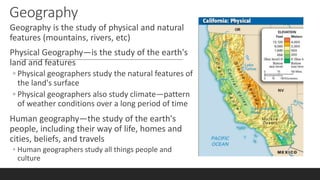
Geography is the study of physical and natural
features (mountains, rivers, etc)
Physical Geography—is the study of the earth's
land and features
◦ Physical geographers study the natural features of
the land's surface
◦ Physical geographers also study climate—pattern
of weather conditions over a long period of time
Human geography—the study of the earth's
people, including their way of life, homes and
cities, beliefs, and travels
◦ Human geographers study all things people and
culture
Geography
Location is the exact description of a place. No two places on the earth are exactly alike.
Location allows geographers to study locations to determine the effects that it has on different
populations
◦ Exact
◦ Relative
A region is an area with one or more features that make it different from surrounding areas
(forests, grasslands, different climates, mountains)

Unit_1_PPT.pptx is for studying histories

  • 1.
  • 2.
    What is History? History isthe study of the past. A person that studies history is called a Historian Historians are interested in how people lived their daily lives. How did they work, fight, trade, farm, and worship. Historians study the past to understand people's culture, or the knowledge, beliefs, customs, and values of a group of people. This Photo by Unknown author is licensed under CC BY-NC-ND.
  • 3.
    Archaeology It is thestudy of the past based on what people left behind. Archaeologists explore places where people once lived, worked, or fought. They can find things like jewelry, dishes, or weapons. Archaeologists examine the objects that were found to learn what they can tell from the past. This Photo by Unknown author is licensed under CC BY.
  • 4.
    Understanding History The main reasonpeople want to understand the past is because it helps us to understand the world today. It can help us to understand other people—their beliefs, values, and ways of life We rely on a variety of sources to learn about history A fossil is a part of imprint of something that was once alive ◦ Bones and footprints preserved in rock are examples of fossils Artifacts are objects created by and used by humans -can include coins, arrowheads, tools, toys, and pottery People kept written records of history through stone pillars, stamped into clay tablets, scribbled on turtle shells, typed with typewriters.
  • 5.
    Primary v SecondarySources Primary ◦ Its an account of an event created by someone who took part in or witnessed the event ◦ Examples: treaties, letters, diaries, laws, court documents Secondary ◦ Information gathered by someone who did not witness or take part in the event ◦ It is second-hand information ◦ Examples: textbooks, journal articles, and encyclopedias
  • 6.
    Geography Geography is thestudy of physical and natural features (mountains, rivers, etc) Physical Geography—is the study of the earth's land and features ◦ Physical geographers study the natural features of the land's surface ◦ Physical geographers also study climate—pattern of weather conditions over a long period of time Human geography—the study of the earth's people, including their way of life, homes and cities, beliefs, and travels ◦ Human geographers study all things people and culture
  • 7.
    Geography Location is theexact description of a place. No two places on the earth are exactly alike. Location allows geographers to study locations to determine the effects that it has on different populations ◦ Exact ◦ Relative A region is an area with one or more features that make it different from surrounding areas (forests, grasslands, different climates, mountains)