Primary and Secondary Sources
What are they?
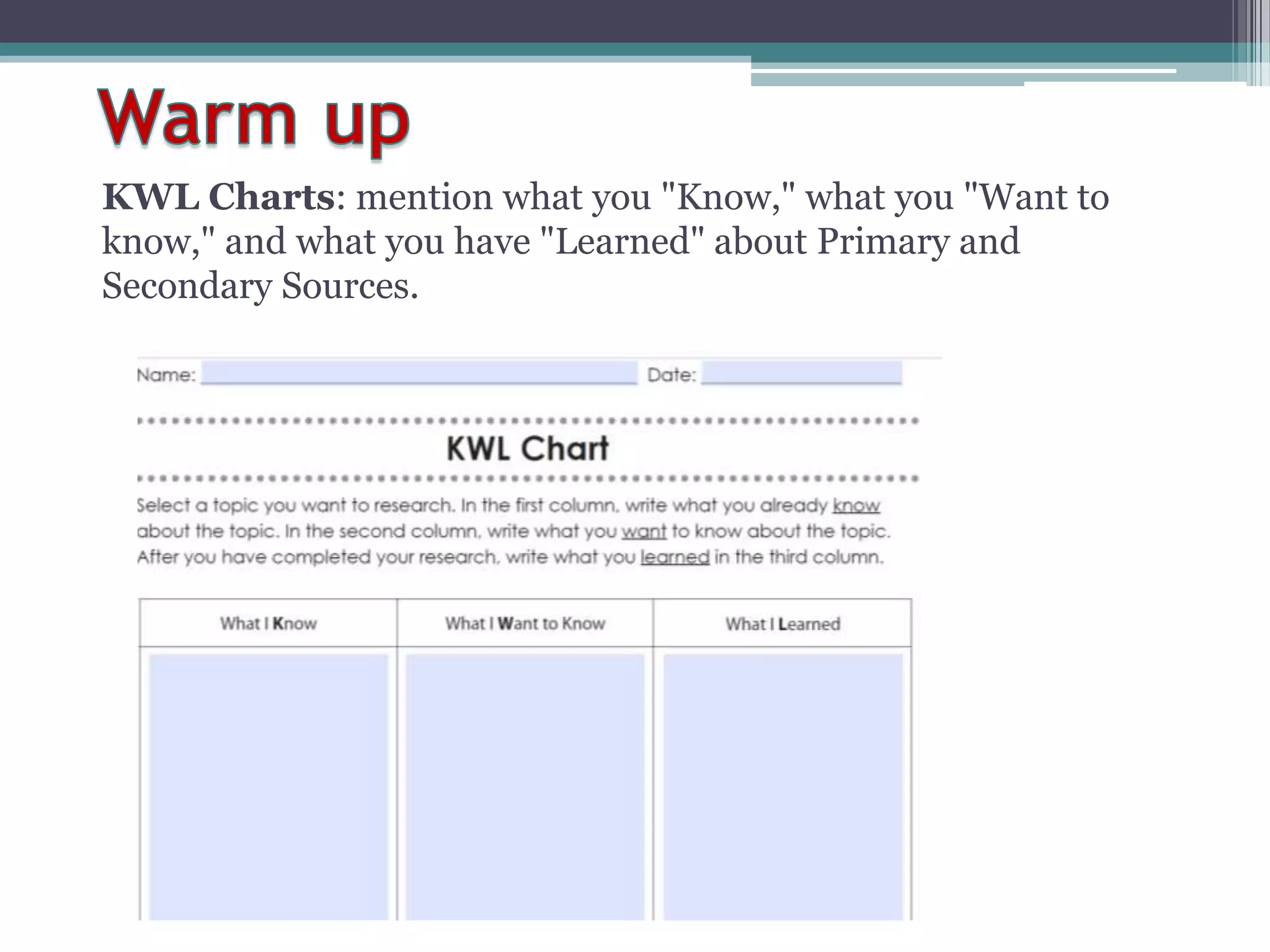
KWL Charts: mention what you "Know," what you "Want to
know," and what you have "Learned" about Primary and
Secondary Sources.
As a class, discuss the following
questions and Write the answers in
your notebooks.
• a) Are primary sources always unbiased and
accurate?
• b) Are secondary sources always unbiased and
accurate?
• c) If someone in the future wanted to study who
YOU were and what YOUR life was like, what
primary and/or secondary sources might they
turn to?
Primary sources
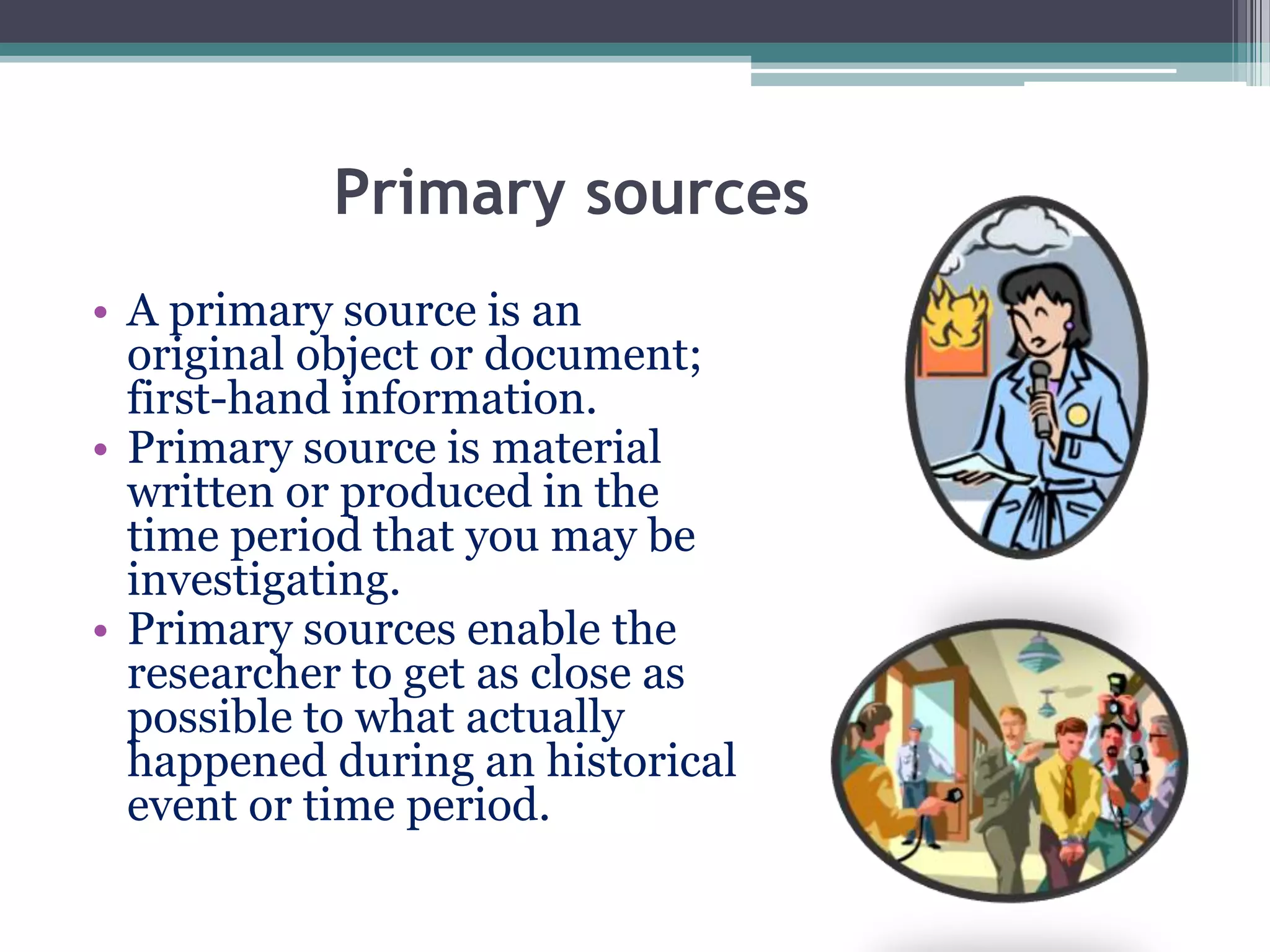
• A primary source is an
original object or document;
first-hand information.
• Primary source is material
written or produced in the
time period that you may be
investigating.
• Primary sources enable the
researcher to get as close as
possible to what actually
happened during an historical
event or time period.
Primary Source
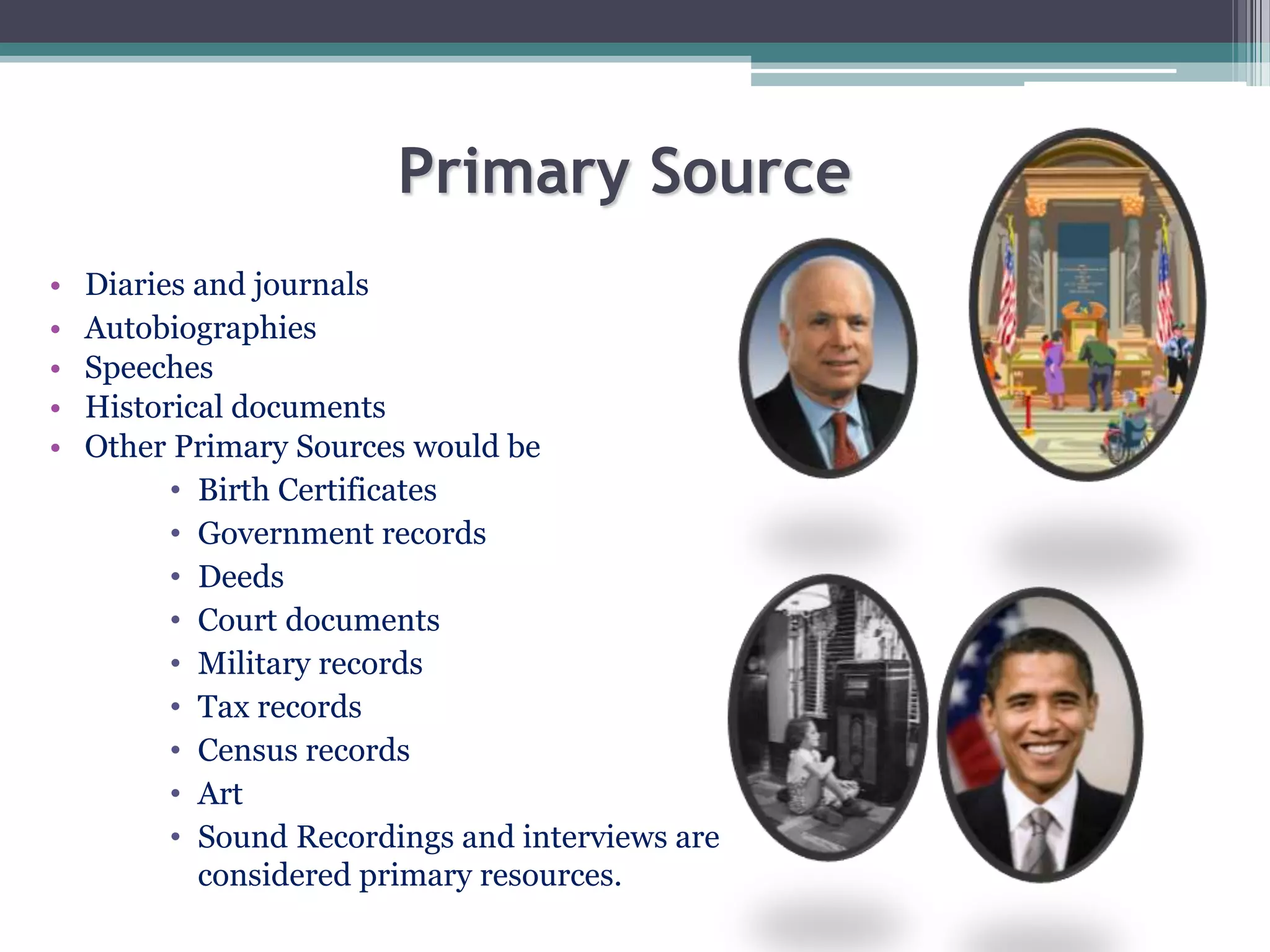
• Diaries and journals
• Autobiographies
• Speeches
• Historical documents
• Other Primary Sources would be
• Birth Certificates
• Government records
• Deeds
• Court documents
• Military records
• Tax records
• Census records
• Art
• Sound Recordings and interviews are
considered primary resources.
What is a Secondary Source?
• A secondary source is
something written about a
primary source.
• Secondary sources are written
"after the fact" - that is, at a later
date.
• Usually the author of a secondary
source will have studied the
primary sources of an historical
period or event and will then
interpret the "evidence" found in
these sources.
• You can think of secondary sources
as second-hand information.
Secondary Source
• Think about it like this….
• If I tell you something, I am
the primary source. If you
tell someone else what I
told you, you are the
secondary source.
• Secondary source materials
can be articles in
newspapers, magazines,
books or articles found that
evaluate or criticize
someone else's original
research
Secondary Source
• Almanacs, encyclopedias, history books
(textbooks), Biography etc. are all
secondary sources because they were
written “after” the these events occurred.
Primary or Secondary Sources?
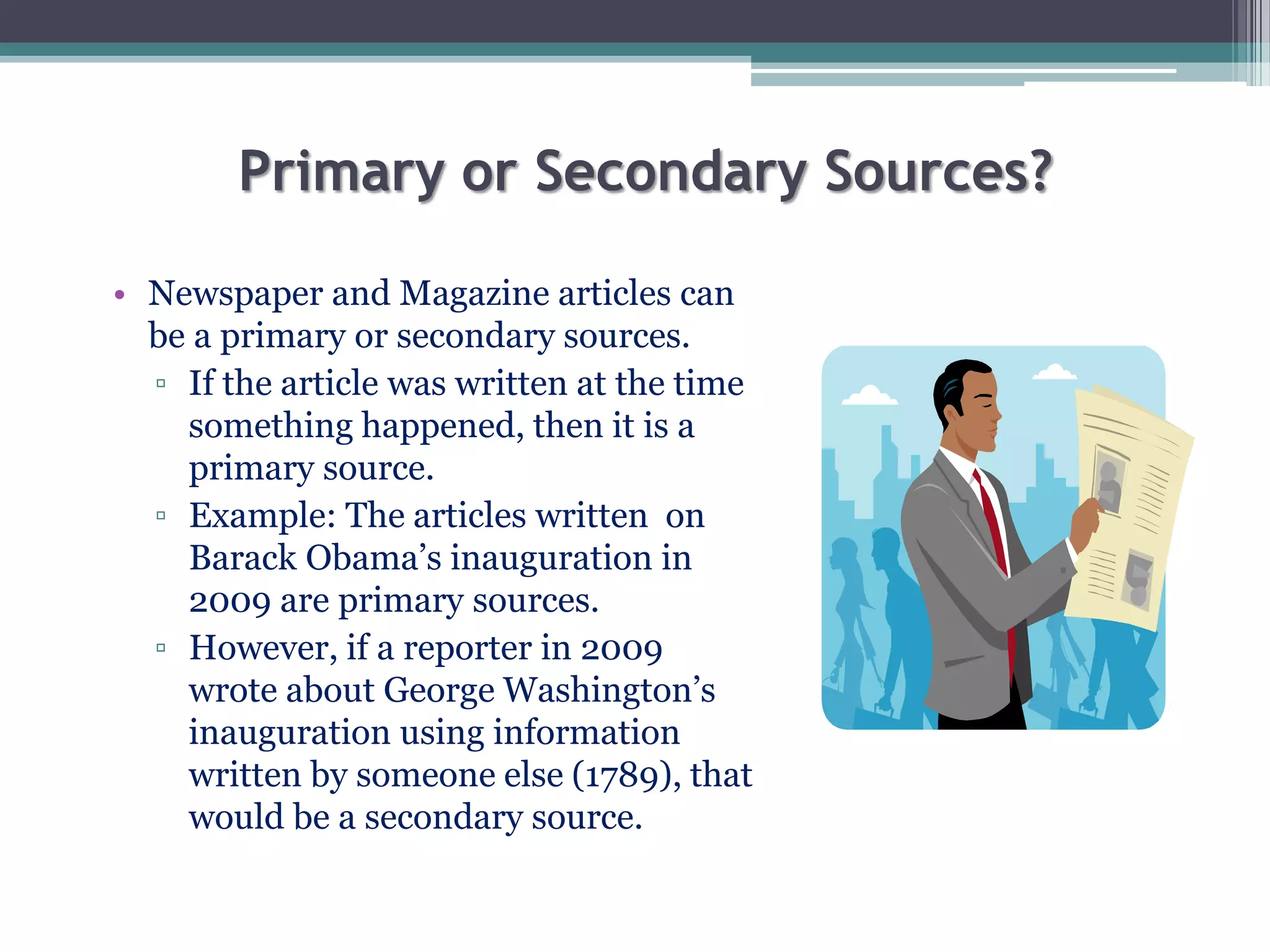
• Newspaper and Magazine articles can
be a primary or secondary sources.
▫ If the article was written at the time
something happened, then it is a
primary source.
▫ Example: The articles written on
Barack Obama’s inauguration in
2009 are primary sources.
▫ However, if a reporter in 2009
wrote about George Washington’s
inauguration using information
written by someone else (1789), that
would be a secondary source.
Differentiated Tasks
• You have 20 min to work on your Tasks
Why Use Primary Sources?
Advantages
• Primary sources provide a window into the
past—unfiltered access to the record of artistic,
social, scientific and political thought and
achievement during the specific period under
study, produced by people who lived during that
period
• these unique, often profoundly personal,
documents and objects can give a very real sense
of what it was like to be alive during a long-past
era.
Primary Source Disadvantages
• Questions of creator bias, purpose, and point of
view may challenge students’ assumptions.
• Primary sources are often incomplete and have
little context. Students must use prior
knowledge and work with multiple primary
sources to find patterns
• In analyzing primary sources, students move
from concrete observations and facts to
questioning and making inferences about the
materials.
Why Use Secondary Sources?
Advantages
• Secondary sources can provide analysis, synthesis,
interpretation, or evaluation of the original
information.
• Secondary sources are best for uncovering
background or historical information about a topic
and broadening your understanding of a topic by
exposing you to others’ perspectives,
interpretations, and conclusions
• Allows the reader to get expert views of events and
often bring together multiple primary sources
relevant to the subject matter
Secondary Source Disadvantages
• Their reliability and validity are open to
question, and often they do not provide exact
information
• They do not represent first hand knowledge of a
subject or event
• There are countless books, journals, magazine
articles and web pages that attempt to interpret
the past and finding good secondary sources can
be an issue

PrimaryandSecondarySources.ppt

  • 1.
    Primary and SecondarySources What are they?
  • 2.
    KWL Charts: mentionwhat you "Know," what you "Want to know," and what you have "Learned" about Primary and Secondary Sources.
  • 3.
    As a class,discuss the following questions and Write the answers in your notebooks. • a) Are primary sources always unbiased and accurate? • b) Are secondary sources always unbiased and accurate? • c) If someone in the future wanted to study who YOU were and what YOUR life was like, what primary and/or secondary sources might they turn to?
  • 4.
    Primary sources • Aprimary source is an original object or document; first-hand information. • Primary source is material written or produced in the time period that you may be investigating. • Primary sources enable the researcher to get as close as possible to what actually happened during an historical event or time period.
  • 5.
    Primary Source • Diariesand journals • Autobiographies • Speeches • Historical documents • Other Primary Sources would be • Birth Certificates • Government records • Deeds • Court documents • Military records • Tax records • Census records • Art • Sound Recordings and interviews are considered primary resources.
  • 6.
    What is aSecondary Source? • A secondary source is something written about a primary source. • Secondary sources are written "after the fact" - that is, at a later date. • Usually the author of a secondary source will have studied the primary sources of an historical period or event and will then interpret the "evidence" found in these sources. • You can think of secondary sources as second-hand information.
  • 7.
    Secondary Source • Thinkabout it like this…. • If I tell you something, I am the primary source. If you tell someone else what I told you, you are the secondary source. • Secondary source materials can be articles in newspapers, magazines, books or articles found that evaluate or criticize someone else's original research
  • 8.
    Secondary Source • Almanacs,encyclopedias, history books (textbooks), Biography etc. are all secondary sources because they were written “after” the these events occurred.
  • 9.
    Primary or SecondarySources? • Newspaper and Magazine articles can be a primary or secondary sources. ▫ If the article was written at the time something happened, then it is a primary source. ▫ Example: The articles written on Barack Obama’s inauguration in 2009 are primary sources. ▫ However, if a reporter in 2009 wrote about George Washington’s inauguration using information written by someone else (1789), that would be a secondary source.
  • 10.
    Differentiated Tasks • Youhave 20 min to work on your Tasks
  • 11.
    Why Use PrimarySources? Advantages • Primary sources provide a window into the past—unfiltered access to the record of artistic, social, scientific and political thought and achievement during the specific period under study, produced by people who lived during that period • these unique, often profoundly personal, documents and objects can give a very real sense of what it was like to be alive during a long-past era.
  • 12.
    Primary Source Disadvantages •Questions of creator bias, purpose, and point of view may challenge students’ assumptions. • Primary sources are often incomplete and have little context. Students must use prior knowledge and work with multiple primary sources to find patterns • In analyzing primary sources, students move from concrete observations and facts to questioning and making inferences about the materials.
  • 13.
    Why Use SecondarySources? Advantages • Secondary sources can provide analysis, synthesis, interpretation, or evaluation of the original information. • Secondary sources are best for uncovering background or historical information about a topic and broadening your understanding of a topic by exposing you to others’ perspectives, interpretations, and conclusions • Allows the reader to get expert views of events and often bring together multiple primary sources relevant to the subject matter
  • 14.
    Secondary Source Disadvantages •Their reliability and validity are open to question, and often they do not provide exact information • They do not represent first hand knowledge of a subject or event • There are countless books, journals, magazine articles and web pages that attempt to interpret the past and finding good secondary sources can be an issue