THE PSYCHROMETRIC CHART:
Theory and Application
Perry PeraltaPerry Peralta
NC State UniversityNC State University
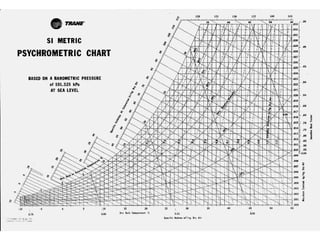
PSYCHROMETRIC CHART
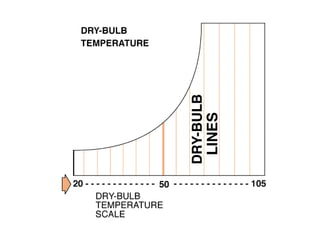
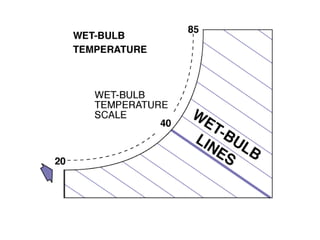
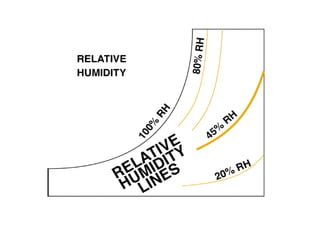
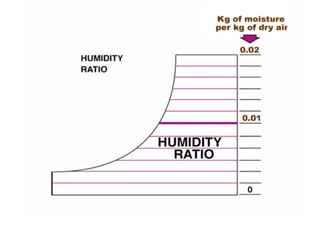
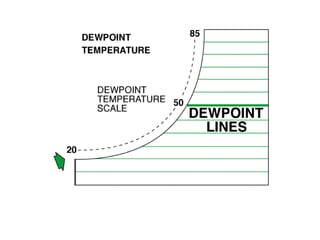
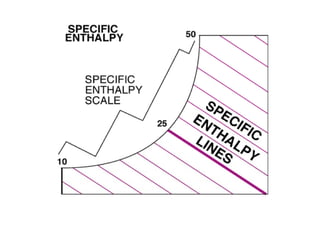
Identify parts of the chartIdentify parts of the chart
Determine moist air propertiesDetermine moist air properties
Use chart to analyze processesUse chart to analyze processes
involving moist airinvolving moist air
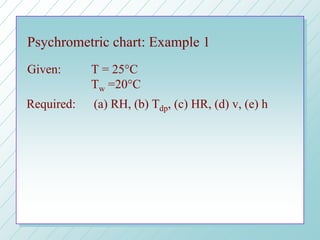
Psychrometric chart: Example 1
Given: T = 25°C
Tw =20°C
Required: (a) RH, (b) Tdp, (c) HR, (d) v, (e) h
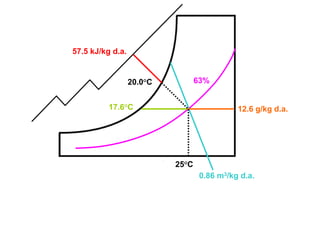
25°C
20.0°C
57.5 kJ/kg d.a.
63%
0.86 m3/kg d.a.
17.6°C 12.6 g/kg d.a.
PSYCHROMETRIC PROCESSES
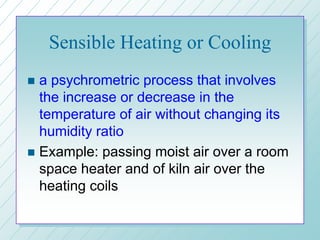
Sensible Heating or Cooling
a psychrometric process that involves
the increase or decrease in the
temperature of air without changing its
humidity ratio
Example: passing moist air over a room
space heater and of kiln air over the
heating coils
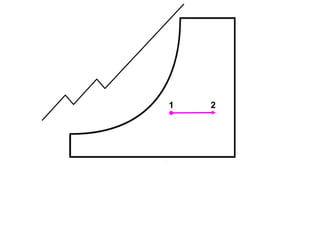
1 2
Sensible heating: Example 5
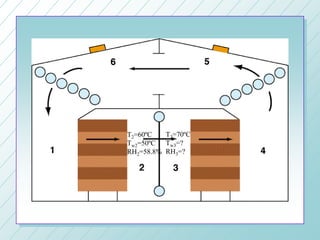
T2=60ºC
Tw2=50ºC
RH2=58.8%
T3=70ºC
Tw3=?
RH3=?
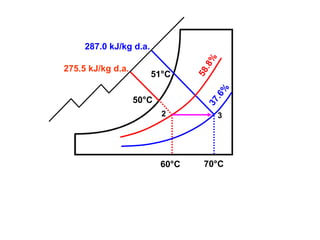
60°C 70°C
50°C
58.8%37.6%
2 3
275.5 kJ/kg d.a.
287.0 kJ/kg d.a.
51°C
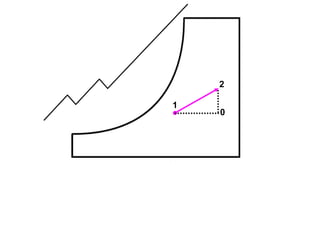
Heating and Humidifying
a psychrometric process that involves
the simultaneous increase in both the
dry bulb temperature and humidity ratio
of the air
1
2
0
Heating and humidifying: Example 7
Two and a half cubic meters of lumber is being dried
at 60°C dry bulb temperature and 52°C wet bulb
temperature. The drying rate of the lumber is 12.5
kg of water per hour. If outside air is at 27°C
dry bulb temperature and 80% relative humidity,
how much outside air is needed per minute to carry
away the evaporated moisture?
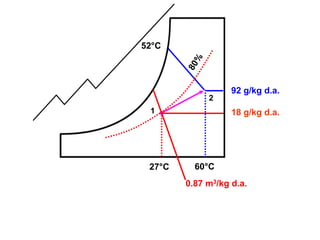
27°C 60°C
80%
1
2
92 g/kg d.a.
18 g/kg d.a.
0.87 m3/kg d.a.
52°C
Heating and humidifying: Example 7
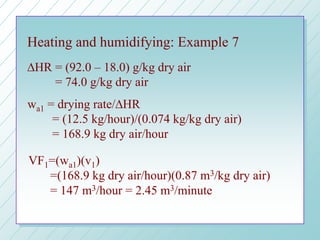
∆HR = (92.0 – 18.0) g/kg dry air
= 74.0 g/kg dry air
wa1 = drying rate/∆HR
= (12.5 kg/hour)/(0.074 kg/kg dry air)
= 168.9 kg dry air/hour
VF1=(wa1)(v1)
=(168.9 kg dry air/hour)(0.87 m3/kg dry air)
= 147 m3/hour = 2.45 m3/minute
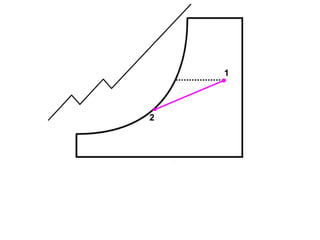
Cooling and Dehumidifying
a psychrometric process that involves
the removal of water from the air as the
air temperature falls below the dew-
point temperature
1
2
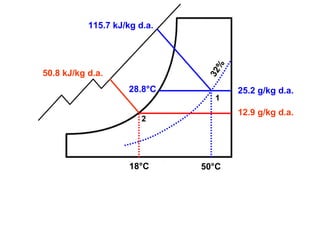
Cooling and dehumidifying: Example 9
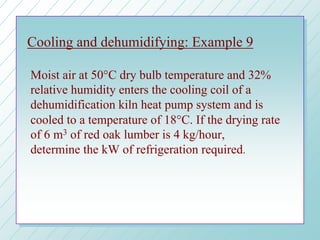
Moist air at 50°C dry bulb temperature and 32%
relative humidity enters the cooling coil of a
dehumidification kiln heat pump system and is
cooled to a temperature of 18°C. If the drying rate
of 6 m3 of red oak lumber is 4 kg/hour,
determine the kW of refrigeration required.
18°C 50°C
32%
2
1
25.2 g/kg d.a.
12.9 g/kg d.a.
28.8°C
115.7 kJ/kg d.a.
50.8 kJ/kg d.a.
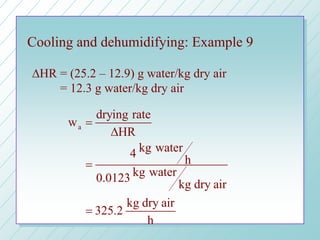
Cooling and dehumidifying: Example 9
a
drying rate
w
HR
kg water4
h
kg water0.0123
kg dry air
kg dry air
325.2
h
=
∆
=
=
∆HR = (25.2 – 12.9) g water/kg dry air
= 12.3 g water/kg dry air
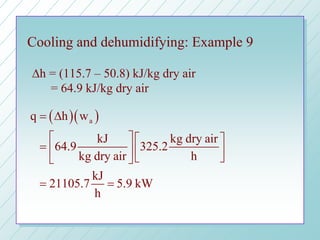
Cooling and dehumidifying: Example 9
( )( )aq h w
kJ kg dry air
64.9 325.2
kg dry air h
kJ
21105.7 5.9 kW
h
= ∆
   
=      
= =
∆h = (115.7 – 50.8) kJ/kg dry air
= 64.9 kJ/kg dry air
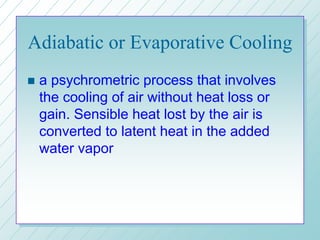
Adiabatic or Evaporative Cooling
a psychrometric process that involves
the cooling of air without heat loss or
gain. Sensible heat lost by the air is
converted to latent heat in the added
water vapor
1
2
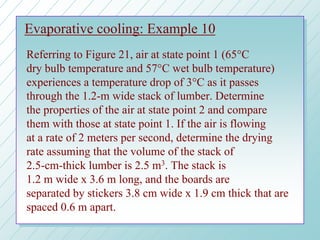
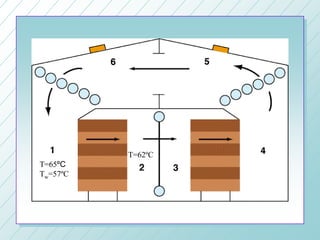
Evaporative cooling: Example 10
Referring to Figure 21, air at state point 1 (65°C
dry bulb temperature and 57°C wet bulb temperature)
experiences a temperature drop of 3°C as it passes
through the 1.2-m wide stack of lumber. Determine
the properties of the air at state point 2 and compare
them with those at state point 1. If the air is flowing
at a rate of 2 meters per second, determine the drying
rate assuming that the volume of the stack of
2.5-cm-thick lumber is 2.5 m3. The stack is
1.2 m wide x 3.6 m long, and the boards are
separated by stickers 3.8 cm wide x 1.9 cm thick that are
spaced 0.6 m apart.
T=65ºC
Tw=57ºC
T=62ºC
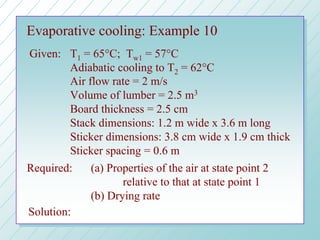
Evaporative cooling: Example 10
Given: T1 = 65°C; Tw1 = 57°C
Adiabatic cooling to T2 = 62°C
Air flow rate = 2 m/s
Volume of lumber = 2.5 m3
Board thickness = 2.5 cm
Stack dimensions: 1.2 m wide x 3.6 m long
Sticker dimensions: 3.8 cm wide x 1.9 cm thick
Sticker spacing = 0.6 m
Required: (a) Properties of the air at state point 2
relative to that at state point 1
(b) Drying rate
Solution:
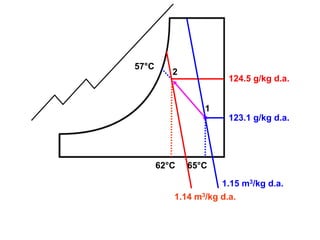
1
2
65°C62°C
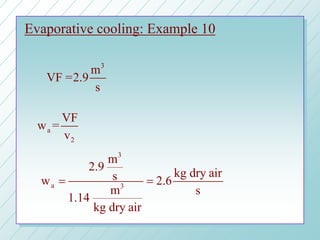
1.14 m3/kg d.a.
1.15 m3/kg d.a.
123.1 g/kg d.a.
124.5 g/kg d.a.
57°C
Evaporative cooling: Example 10
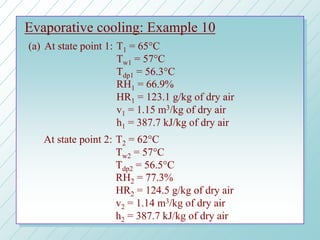
(a) At state point 1: T1 = 65°C
Tw1 = 57°C
Tdp1 = 56.3°C
RH1 = 66.9%
HR1 = 123.1 g/kg of dry air
v1 = 1.15 m3/kg of dry air
h1 = 387.7 kJ/kg of dry air
At state point 2: T2 = 62°C
Tw2 = 57°C
Tdp2 = 56.5°C
RH2 = 77.3%
HR2 = 124.5 g/kg of dry air
v2 = 1.14 m3/kg of dry air
h2 = 387.7 kJ/kg of dry air
Evaporative cooling: Example 10
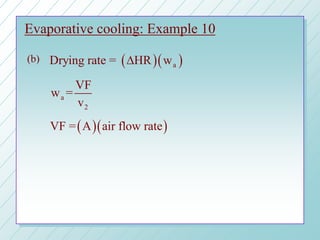
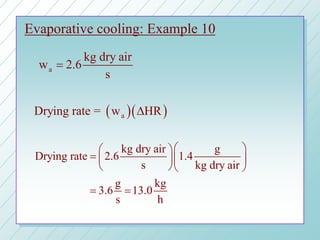
(b) ( )( )aDrying rate = HR w∆
a
2
VF
w =
v
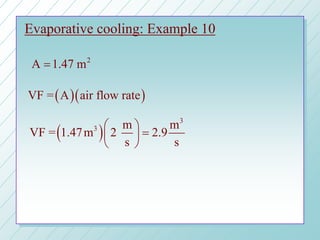
( )( )VF = A air flow rate
Evaporative cooling: Example 10
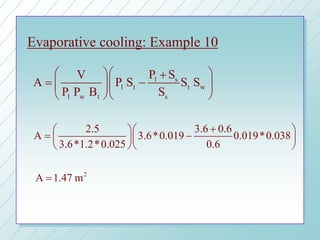
l s
l t t w
l w t s
V P S
A P S S S
P P B S
  +
= −  
  
2.5 3.6 0.6
A 3.6*0.019 0.019*0.038
3.6*1.2*0.025 0.6
+  
= −  
  
2
A 1.47 m=
Evaporative cooling: Example 10
2
A 1.47 m=
( )
3
3 m m
VF = 1.47m 2 2.9
s s
 
= 
 
( )( )VF = A air flow rate
Evaporative cooling: Example 10
3
m
VF =2.9
s
3
a 3
m
2.9
kg dry airsw 2.6
m s
1.14
kg dry air
= =
a
2
VF
w =
v
Evaporative cooling: Example 10
kg dry air g
Drying rate 2.6 1.4
s kg dry air
g kg
3.6 13.0
s h
  
=   
  
= =
a
kg dry air
w 2.6
s
=
( )( )aDrying rate = w HR∆
Adiabatic Mixing of Moist Air
Stream
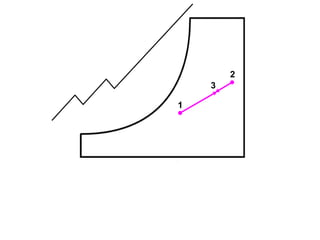
A psychrometric process that involves
no net heat loss or gain during the
mixing of two air streams
1
3
2
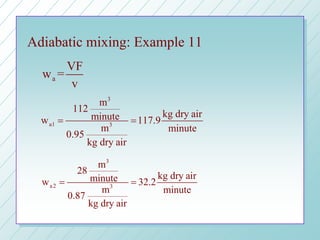
Adiabatic mixing: Example 11
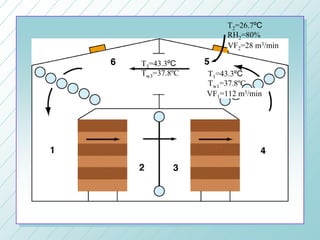
T1=43.3ºC
Tw1=37.8ºC
T2=26.7ºC
RH2=80%
VF1=112 m3/min
VF2=28 m3/min
T3=43.3ºC
Tw3=37.8ºC
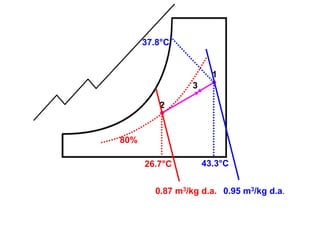
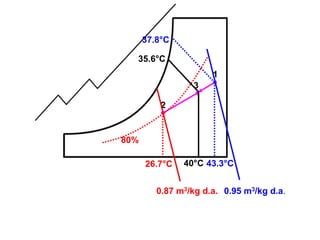
2
3
1
0.95 m3/kg d.a.0.87 m3/kg d.a.
43.3°C
37.8°C
26.7°C
80%
Adiabatic mixing: Example 11
a
VF
w =
v
3
a1 3
m
112
kg dry airminutew 117.9
m minute
0.95
kg dry air
= =
3
a2 3
m
28
kg dry airminutew 32.2
m minute
0.87
kg dry air
= =
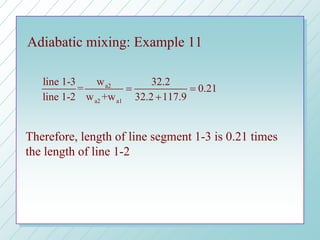
Adiabatic mixing: Example 11
a2
a2 a1
line 1-3 w 32.2
= 0.21
line 1-2 w +w 32.2 117.9
= =
+
Therefore, length of line segment 1-3 is 0.21 times
the length of line 1-2
2
3
1
0.95 m3/kg d.a.0.87 m3/kg d.a.
43.3°C
37.8°C
26.7°C
80%
40°C
35.6°C
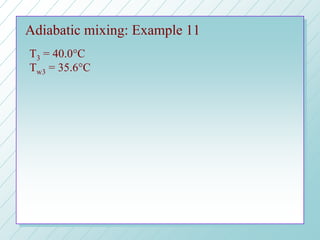
Adiabatic mixing: Example 11
T3 = 40.0°C
Tw3 = 35.6°C

Psychrometry

  • 1.
    THE PSYCHROMETRIC CHART: Theoryand Application Perry PeraltaPerry Peralta NC State UniversityNC State University
  • 2.
    PSYCHROMETRIC CHART Identify partsof the chartIdentify parts of the chart Determine moist air propertiesDetermine moist air properties Use chart to analyze processesUse chart to analyze processes involving moist airinvolving moist air
  • 11.
    Psychrometric chart: Example1 Given: T = 25°C Tw =20°C Required: (a) RH, (b) Tdp, (c) HR, (d) v, (e) h
  • 12.
    25°C 20.0°C 57.5 kJ/kg d.a. 63% 0.86m3/kg d.a. 17.6°C 12.6 g/kg d.a.
  • 13.
  • 14.
    Sensible Heating orCooling a psychrometric process that involves the increase or decrease in the temperature of air without changing its humidity ratio Example: passing moist air over a room space heater and of kiln air over the heating coils
  • 15.
  • 16.
  • 17.
  • 18.
    60°C 70°C 50°C 58.8%37.6% 2 3 275.5kJ/kg d.a. 287.0 kJ/kg d.a. 51°C
  • 19.
    Heating and Humidifying apsychrometric process that involves the simultaneous increase in both the dry bulb temperature and humidity ratio of the air
  • 20.
  • 21.
    Heating and humidifying:Example 7 Two and a half cubic meters of lumber is being dried at 60°C dry bulb temperature and 52°C wet bulb temperature. The drying rate of the lumber is 12.5 kg of water per hour. If outside air is at 27°C dry bulb temperature and 80% relative humidity, how much outside air is needed per minute to carry away the evaporated moisture?
  • 22.
    27°C 60°C 80% 1 2 92 g/kgd.a. 18 g/kg d.a. 0.87 m3/kg d.a. 52°C
  • 23.
    Heating and humidifying:Example 7 ∆HR = (92.0 – 18.0) g/kg dry air = 74.0 g/kg dry air wa1 = drying rate/∆HR = (12.5 kg/hour)/(0.074 kg/kg dry air) = 168.9 kg dry air/hour VF1=(wa1)(v1) =(168.9 kg dry air/hour)(0.87 m3/kg dry air) = 147 m3/hour = 2.45 m3/minute
  • 24.
    Cooling and Dehumidifying apsychrometric process that involves the removal of water from the air as the air temperature falls below the dew- point temperature
  • 25.
  • 26.
    Cooling and dehumidifying:Example 9 Moist air at 50°C dry bulb temperature and 32% relative humidity enters the cooling coil of a dehumidification kiln heat pump system and is cooled to a temperature of 18°C. If the drying rate of 6 m3 of red oak lumber is 4 kg/hour, determine the kW of refrigeration required.
  • 27.
    18°C 50°C 32% 2 1 25.2 g/kgd.a. 12.9 g/kg d.a. 28.8°C 115.7 kJ/kg d.a. 50.8 kJ/kg d.a.
  • 28.
    Cooling and dehumidifying:Example 9 a drying rate w HR kg water4 h kg water0.0123 kg dry air kg dry air 325.2 h = ∆ = = ∆HR = (25.2 – 12.9) g water/kg dry air = 12.3 g water/kg dry air
  • 29.
    Cooling and dehumidifying:Example 9 ( )( )aq h w kJ kg dry air 64.9 325.2 kg dry air h kJ 21105.7 5.9 kW h = ∆     =       = = ∆h = (115.7 – 50.8) kJ/kg dry air = 64.9 kJ/kg dry air
  • 30.
    Adiabatic or EvaporativeCooling a psychrometric process that involves the cooling of air without heat loss or gain. Sensible heat lost by the air is converted to latent heat in the added water vapor
  • 31.
  • 32.
    Evaporative cooling: Example10 Referring to Figure 21, air at state point 1 (65°C dry bulb temperature and 57°C wet bulb temperature) experiences a temperature drop of 3°C as it passes through the 1.2-m wide stack of lumber. Determine the properties of the air at state point 2 and compare them with those at state point 1. If the air is flowing at a rate of 2 meters per second, determine the drying rate assuming that the volume of the stack of 2.5-cm-thick lumber is 2.5 m3. The stack is 1.2 m wide x 3.6 m long, and the boards are separated by stickers 3.8 cm wide x 1.9 cm thick that are spaced 0.6 m apart.
  • 33.
  • 34.
    Evaporative cooling: Example10 Given: T1 = 65°C; Tw1 = 57°C Adiabatic cooling to T2 = 62°C Air flow rate = 2 m/s Volume of lumber = 2.5 m3 Board thickness = 2.5 cm Stack dimensions: 1.2 m wide x 3.6 m long Sticker dimensions: 3.8 cm wide x 1.9 cm thick Sticker spacing = 0.6 m Required: (a) Properties of the air at state point 2 relative to that at state point 1 (b) Drying rate Solution:
  • 35.
    1 2 65°C62°C 1.14 m3/kg d.a. 1.15m3/kg d.a. 123.1 g/kg d.a. 124.5 g/kg d.a. 57°C
  • 36.
    Evaporative cooling: Example10 (a) At state point 1: T1 = 65°C Tw1 = 57°C Tdp1 = 56.3°C RH1 = 66.9% HR1 = 123.1 g/kg of dry air v1 = 1.15 m3/kg of dry air h1 = 387.7 kJ/kg of dry air At state point 2: T2 = 62°C Tw2 = 57°C Tdp2 = 56.5°C RH2 = 77.3% HR2 = 124.5 g/kg of dry air v2 = 1.14 m3/kg of dry air h2 = 387.7 kJ/kg of dry air
  • 37.
    Evaporative cooling: Example10 (b) ( )( )aDrying rate = HR w∆ a 2 VF w = v ( )( )VF = A air flow rate
  • 38.
    Evaporative cooling: Example10 l s l t t w l w t s V P S A P S S S P P B S   + = −      2.5 3.6 0.6 A 3.6*0.019 0.019*0.038 3.6*1.2*0.025 0.6 +   = −      2 A 1.47 m=
  • 39.
    Evaporative cooling: Example10 2 A 1.47 m= ( ) 3 3 m m VF = 1.47m 2 2.9 s s   =    ( )( )VF = A air flow rate
  • 40.
    Evaporative cooling: Example10 3 m VF =2.9 s 3 a 3 m 2.9 kg dry airsw 2.6 m s 1.14 kg dry air = = a 2 VF w = v
  • 41.
    Evaporative cooling: Example10 kg dry air g Drying rate 2.6 1.4 s kg dry air g kg 3.6 13.0 s h    =       = = a kg dry air w 2.6 s = ( )( )aDrying rate = w HR∆
  • 42.
    Adiabatic Mixing ofMoist Air Stream A psychrometric process that involves no net heat loss or gain during the mixing of two air streams
  • 43.
  • 44.
  • 45.
  • 46.
    2 3 1 0.95 m3/kg d.a.0.87m3/kg d.a. 43.3°C 37.8°C 26.7°C 80%
  • 47.
    Adiabatic mixing: Example11 a VF w = v 3 a1 3 m 112 kg dry airminutew 117.9 m minute 0.95 kg dry air = = 3 a2 3 m 28 kg dry airminutew 32.2 m minute 0.87 kg dry air = =
  • 48.
    Adiabatic mixing: Example11 a2 a2 a1 line 1-3 w 32.2 = 0.21 line 1-2 w +w 32.2 117.9 = = + Therefore, length of line segment 1-3 is 0.21 times the length of line 1-2
  • 49.
    2 3 1 0.95 m3/kg d.a.0.87m3/kg d.a. 43.3°C 37.8°C 26.7°C 80% 40°C 35.6°C
  • 50.
    Adiabatic mixing: Example11 T3 = 40.0°C Tw3 = 35.6°C