UNIT –III PSYCHROMETRIC PROCESSES
 Psychrometry is the study of the properties of mixtures of air and water vapour.
 The moist air can be thought of as a mixture of dry air and moisture. For all practical
purposes, the composition of dry air can be considered as constant.
 The molecular weight of dry air is found to be 28.966 and the gas constant R is 287.035
J/kg.K.
 Air to be processed in air conditioning systems is a mixture of dry air and water vapour.
While the composition of dry air is constant.
 The amount of water vapour present in the air may vary from zero to a maximum
depending upon the temperature and pressure of the mixture (dry air + water vapour)
 saturated air-At a given temperature and pressure the dry air can only hold a certain
maximum amount of moisture. The state air is saturated.
 Basic gas laws for moist air:
 Gibbs-Dalton law - The total pressure exerted by the mixture is equal to the sum of partial
pressures of the constituent gases.
 Total pressure = Pa + Pv
 Pa – Partial pressure of dry air. Pv – partial pressure of water vapour.
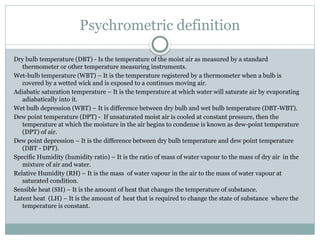
Psychrometric definition
Dry bulb temperature (DBT) - Is the temperature of the moist air as measured by a standard
thermometer or other temperature measuring instruments.
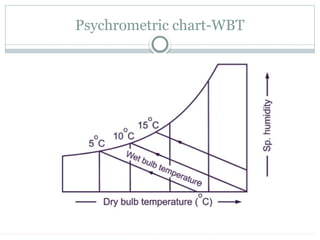
Wet-bulb temperature (WBT) – It is the temperature registered by a thermometer when a bulb is
covered by a wetted wick and is exposed to a continues moving air.
Adiabatic saturation temperature – It is the temperature at which water will saturate air by evaporating
adiabatically into it.
Wet bulb depression (WBT) – It is difference between dry bulb and wet bulb temperature (DBT-WBT).
Dew point temperature (DPT) - If unsaturated moist air is cooled at constant pressure, then the
temperature at which the moisture in the air begins to condense is known as dew-point temperature
(DPT) of air.
Dew point depression – It is the difference between dry bulb temperature and dew point temperature
(DBT - DPT).
Specific Humidity (humidity ratio) – It is the ratio of mass of water vapour to the mass of dry air in the
mixture of air and water.
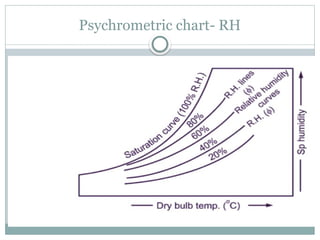
Relative Humidity (RH) – It is the mass of water vapour in the air to the mass of water vapour at
saturated condition.
Sensible heat (SH) – It is the amount of heat that changes the temperature of substance.
Latent heat (LH) – It is the amount of heat that is required to change the state of substance where the
temperature is constant.
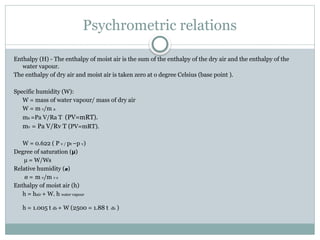
Psychrometric relations
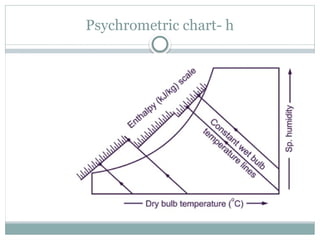
Enthalpy (H) - The enthalpy of moist air is the sum of the enthalpy of the dry air and the enthalpy of the
water vapour.
The enthalpy of dry air and moist air is taken zero at o degree Celsius (base point ).
Specific humidity (W):
W = mass of water vapour/ mass of dry air
W = m v/m a
ma =Pa V/Ra T (PV=mRT).
mv = Pa V/Rv T (PV=mRT).
W = 0.622 ( P v / pt –p v)
Degree of saturation (µ)
µ = W/Ws
Relative humidity (ø)
ø = m v/m v s
Enthalpy of moist air (h)
h = hair + W. h water vapour
h = 1.005 t db + W (2500 = 1.88 t db )
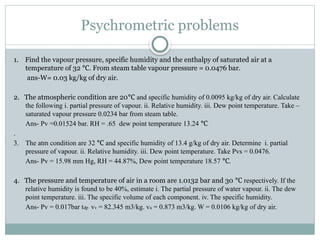
Psychrometric problems
1. Find the vapour pressure, specific humidity and the enthalpy of saturated air at a
temperature of 32 ℃. From steam table vapour pressure = 0.0476 bar.
ans-W= 0.03 kg/kg of dry air.
2. The atmospheric condition are 20 and specific humidity of 0.0095 kg/kg of dry air. Calculate
℃
the following i. partial pressure of vapour. ii. Relative humidity. iii. Dew point temperature. Take –
saturated vapour pressure 0.0234 bar from steam table.
Ans- Pv =0.01524 bar. RH = .65 dew point temperature 13.24 ℃
.
3. The atm condition are 32 and specific humidity of 13.4 g/kg of dry air. Determine i. partial
℃
pressure of vapour. ii. Relative humidity. iii. Dew point temperature. Take Pvs = 0.0476.
Ans- Pv = 15.98 mm Hg, RH = 44.87%, Dew point temperature 18.57 .
℃
4. The pressure and temperature of air in a room are 1.0132 bar and 30 respectively. If the
℃
relative humidity is found to be 40%, estimate i. The partial pressure of water vapour. ii. The dew
point temperature. iii. The specific volume of each component. iv. The specific humidity.
Ans- Pv = 0.017bar tdp vv = 82.345 m3/kg. va = 0.873 m3/kg. W = 0.0106 kg/kg of dry air.
Psychrometric problems
5. In a laboratory test, a psychrometer recorded dry bulb temperature as 35 and wet bulb
℃
temperature 28 . calculate i. vapour pressure. ii. Relative humidity. iii. Specific humidity. iv.
℃
Degree of saturation. v. Dew point temperature. vi. Enthalpy of mixture. Take barometric pressure
is 1.0132 bar. Vapour pressure is 0.0378 bar.
Ans- Vapour pressure- 0.0332 bar. Relative humidity-58.97%. Specific humidity- 0.021kg/kg of
dry air. Degree of saturation - .576, Dew point temperature - 26 , Enthalpy of mixture – 89.06
℃
kj/kg of dry air.
PSYCHROMETERS
Psychrometer is a device which is used for measuring dry bulb temperature and wet bulb temperatures
simultaneously.
1. Laboratory psychrometer.
2. Sling psychrometer.
3. Aspirating psychrometer.
4. Continuous recording psychrometer.
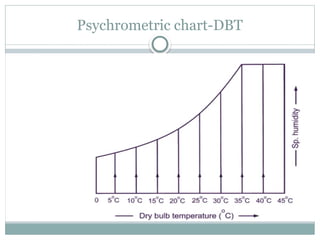
Psychrometric chart-DBT
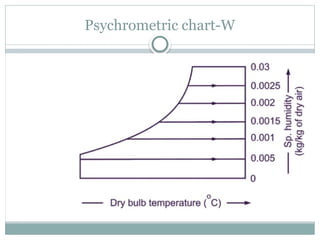
Psychrometric chart-W
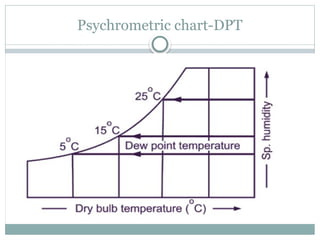
Psychrometric chart-DPT
Psychrometric chart-WBT
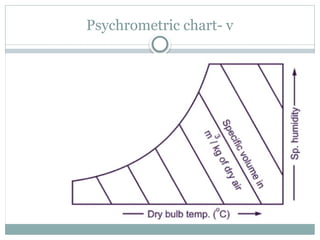
Psychrometric chart- v
Psychrometric chart- h
Psychrometric chart- RH
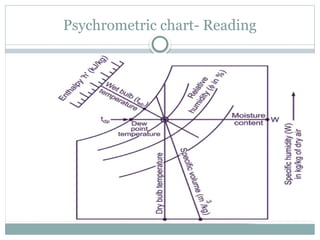
Psychrometric chart- Reading
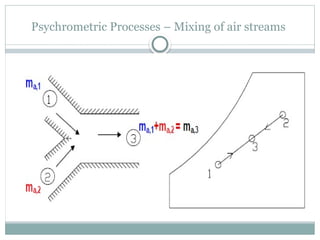
Psychrometric Processes – Mixing of air streams
The processes affecting the psychrometric properties of air called as psychrometric processes.
Mixing of several air streams is the process which is very frequently used in air conditioning.
Assume adiabatically and constant total moisture content.
m1+m2 = m3
m1.W1 + m2.W2 = m3W3
m1.h1 + m2h2 = m3h3
m = mass of dry air.
W = Specific humidity.
h = enthalpy.
If the air quantities are mentioned in volumes – cubic meter per minute.
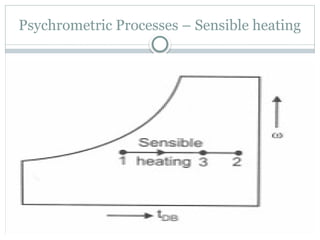
Psychrometric Processes – Sensible heating
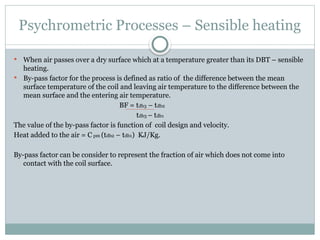
 When air passes over a dry surface which at a temperature greater than its DBT – sensible
heating.
 By-pass factor for the process is defined as ratio of the difference between the mean
surface temperature of the coil and leaving air temperature to the difference between the
mean surface and the entering air temperature.
BF = tdb3 – tdb2
tdb3 – tdb1
The value of the by-pass factor is function of coil design and velocity.
Heat added to the air = C pm (tdb2 – tdb1) KJ/Kg.
By-pass factor can be consider to represent the fraction of air which does not come into
contact with the coil surface.
Psychrometric Processes – Sensible cooling
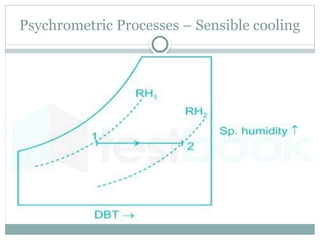
 When ever air passes over a surface the temperature of the surface is maintained less than
dry bulb temperature and more than dew point temperature it is called as sensible
cooling.
 Heat removed from air can be obtained from Q = Cp (dT)
Psychrometric Processes – Cooling and Humidification
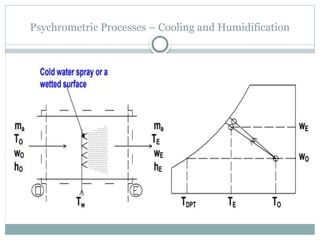
 If unsaturated air is passed through a spray of continuously recirculated water, the
specific humidity will increase and dry bulb temperature decreases.
 To describe the performance of a humidifying apparatus – saturation or humidifying
efficiency.
 It the ratio of dry bulb temperature decrease to the entering wet bulb depression.
 1- BF
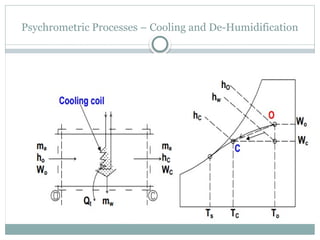
Psychrometric Processes – Cooling and De-Humidification
 the air is passed over a surface or through a spray of water that is a temperature less than
the dew point temperature of air, condensation of some of the water vapour in the air will
occur simultaneously with the sensible cooling process.
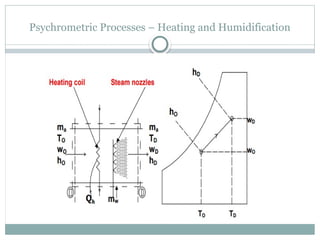
Psychrometric Processes – Heating and Humidification
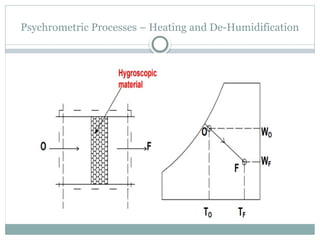
Psychrometric Processes – Heating and De-Humidification
Refrigeration and Air-conditioning Unit-3.pptx

Refrigeration and Air-conditioning Unit-3.pptx

  • 1.
    UNIT –III PSYCHROMETRICPROCESSES  Psychrometry is the study of the properties of mixtures of air and water vapour.  The moist air can be thought of as a mixture of dry air and moisture. For all practical purposes, the composition of dry air can be considered as constant.  The molecular weight of dry air is found to be 28.966 and the gas constant R is 287.035 J/kg.K.  Air to be processed in air conditioning systems is a mixture of dry air and water vapour. While the composition of dry air is constant.  The amount of water vapour present in the air may vary from zero to a maximum depending upon the temperature and pressure of the mixture (dry air + water vapour)  saturated air-At a given temperature and pressure the dry air can only hold a certain maximum amount of moisture. The state air is saturated.  Basic gas laws for moist air:  Gibbs-Dalton law - The total pressure exerted by the mixture is equal to the sum of partial pressures of the constituent gases.  Total pressure = Pa + Pv  Pa – Partial pressure of dry air. Pv – partial pressure of water vapour.
  • 2.
    Psychrometric definition Dry bulbtemperature (DBT) - Is the temperature of the moist air as measured by a standard thermometer or other temperature measuring instruments. Wet-bulb temperature (WBT) – It is the temperature registered by a thermometer when a bulb is covered by a wetted wick and is exposed to a continues moving air. Adiabatic saturation temperature – It is the temperature at which water will saturate air by evaporating adiabatically into it. Wet bulb depression (WBT) – It is difference between dry bulb and wet bulb temperature (DBT-WBT). Dew point temperature (DPT) - If unsaturated moist air is cooled at constant pressure, then the temperature at which the moisture in the air begins to condense is known as dew-point temperature (DPT) of air. Dew point depression – It is the difference between dry bulb temperature and dew point temperature (DBT - DPT). Specific Humidity (humidity ratio) – It is the ratio of mass of water vapour to the mass of dry air in the mixture of air and water. Relative Humidity (RH) – It is the mass of water vapour in the air to the mass of water vapour at saturated condition. Sensible heat (SH) – It is the amount of heat that changes the temperature of substance. Latent heat (LH) – It is the amount of heat that is required to change the state of substance where the temperature is constant.
  • 3.
    Psychrometric relations Enthalpy (H)- The enthalpy of moist air is the sum of the enthalpy of the dry air and the enthalpy of the water vapour. The enthalpy of dry air and moist air is taken zero at o degree Celsius (base point ). Specific humidity (W): W = mass of water vapour/ mass of dry air W = m v/m a ma =Pa V/Ra T (PV=mRT). mv = Pa V/Rv T (PV=mRT). W = 0.622 ( P v / pt –p v) Degree of saturation (µ) µ = W/Ws Relative humidity (ø) ø = m v/m v s Enthalpy of moist air (h) h = hair + W. h water vapour h = 1.005 t db + W (2500 = 1.88 t db )
  • 4.
    Psychrometric problems 1. Findthe vapour pressure, specific humidity and the enthalpy of saturated air at a temperature of 32 ℃. From steam table vapour pressure = 0.0476 bar. ans-W= 0.03 kg/kg of dry air. 2. The atmospheric condition are 20 and specific humidity of 0.0095 kg/kg of dry air. Calculate ℃ the following i. partial pressure of vapour. ii. Relative humidity. iii. Dew point temperature. Take – saturated vapour pressure 0.0234 bar from steam table. Ans- Pv =0.01524 bar. RH = .65 dew point temperature 13.24 ℃ . 3. The atm condition are 32 and specific humidity of 13.4 g/kg of dry air. Determine i. partial ℃ pressure of vapour. ii. Relative humidity. iii. Dew point temperature. Take Pvs = 0.0476. Ans- Pv = 15.98 mm Hg, RH = 44.87%, Dew point temperature 18.57 . ℃ 4. The pressure and temperature of air in a room are 1.0132 bar and 30 respectively. If the ℃ relative humidity is found to be 40%, estimate i. The partial pressure of water vapour. ii. The dew point temperature. iii. The specific volume of each component. iv. The specific humidity. Ans- Pv = 0.017bar tdp vv = 82.345 m3/kg. va = 0.873 m3/kg. W = 0.0106 kg/kg of dry air.
  • 5.
    Psychrometric problems 5. Ina laboratory test, a psychrometer recorded dry bulb temperature as 35 and wet bulb ℃ temperature 28 . calculate i. vapour pressure. ii. Relative humidity. iii. Specific humidity. iv. ℃ Degree of saturation. v. Dew point temperature. vi. Enthalpy of mixture. Take barometric pressure is 1.0132 bar. Vapour pressure is 0.0378 bar. Ans- Vapour pressure- 0.0332 bar. Relative humidity-58.97%. Specific humidity- 0.021kg/kg of dry air. Degree of saturation - .576, Dew point temperature - 26 , Enthalpy of mixture – 89.06 ℃ kj/kg of dry air. PSYCHROMETERS Psychrometer is a device which is used for measuring dry bulb temperature and wet bulb temperatures simultaneously. 1. Laboratory psychrometer. 2. Sling psychrometer. 3. Aspirating psychrometer. 4. Continuous recording psychrometer.
  • 6.
  • 7.
  • 8.
  • 9.
  • 10.
  • 11.
  • 12.
  • 13.
  • 14.
    Psychrometric Processes –Mixing of air streams
  • 15.
    Psychrometric Processes –Mixing of air streams The processes affecting the psychrometric properties of air called as psychrometric processes. Mixing of several air streams is the process which is very frequently used in air conditioning. Assume adiabatically and constant total moisture content. m1+m2 = m3 m1.W1 + m2.W2 = m3W3 m1.h1 + m2h2 = m3h3 m = mass of dry air. W = Specific humidity. h = enthalpy. If the air quantities are mentioned in volumes – cubic meter per minute.
  • 16.
  • 17.
    Psychrometric Processes –Sensible heating  When air passes over a dry surface which at a temperature greater than its DBT – sensible heating.  By-pass factor for the process is defined as ratio of the difference between the mean surface temperature of the coil and leaving air temperature to the difference between the mean surface and the entering air temperature. BF = tdb3 – tdb2 tdb3 – tdb1 The value of the by-pass factor is function of coil design and velocity. Heat added to the air = C pm (tdb2 – tdb1) KJ/Kg. By-pass factor can be consider to represent the fraction of air which does not come into contact with the coil surface.
  • 18.
  • 19.
    Psychrometric Processes –Sensible cooling  When ever air passes over a surface the temperature of the surface is maintained less than dry bulb temperature and more than dew point temperature it is called as sensible cooling.  Heat removed from air can be obtained from Q = Cp (dT)
  • 20.
    Psychrometric Processes –Cooling and Humidification
  • 21.
    Psychrometric Processes –Cooling and Humidification  If unsaturated air is passed through a spray of continuously recirculated water, the specific humidity will increase and dry bulb temperature decreases.  To describe the performance of a humidifying apparatus – saturation or humidifying efficiency.  It the ratio of dry bulb temperature decrease to the entering wet bulb depression.  1- BF
  • 22.
    Psychrometric Processes –Cooling and De-Humidification
  • 23.
    Psychrometric Processes –Cooling and De-Humidification  the air is passed over a surface or through a spray of water that is a temperature less than the dew point temperature of air, condensation of some of the water vapour in the air will occur simultaneously with the sensible cooling process.
  • 24.
    Psychrometric Processes –Heating and Humidification
  • 25.
    Psychrometric Processes –Heating and De-Humidification