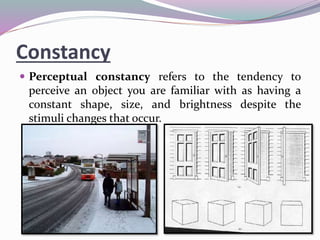
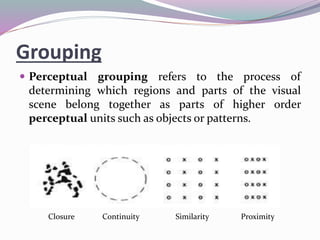
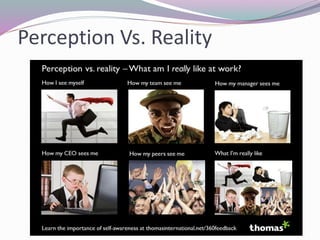
The document discusses perception and the perceptual process. It defines perception as the organization, identification, and interpretation of sensory information to represent and understand the environment. The perceptual process involves two stages - processing sensory input into higher-level information, and processing based on a person's knowledge and expectations. Features like constancy, grouping, contrast effects, experience, and motivation and expectations can influence perception. How people perceive situations affects their behavior, as perception impacts whether one sees situations positively or negatively. The conclusion emphasizes that perception is important for human behavior and how people deal with problems.