Getting started
Dissertation preparation
Today....
     Thinking about topics

     Narrowing your topic

     What to do with Literature at this stage? Finding
      tests, extra databases you may not have used etc ...

     INFERRING – from one context to your context

     Alerts in your interest area(s)

     Where to find referencing information
2
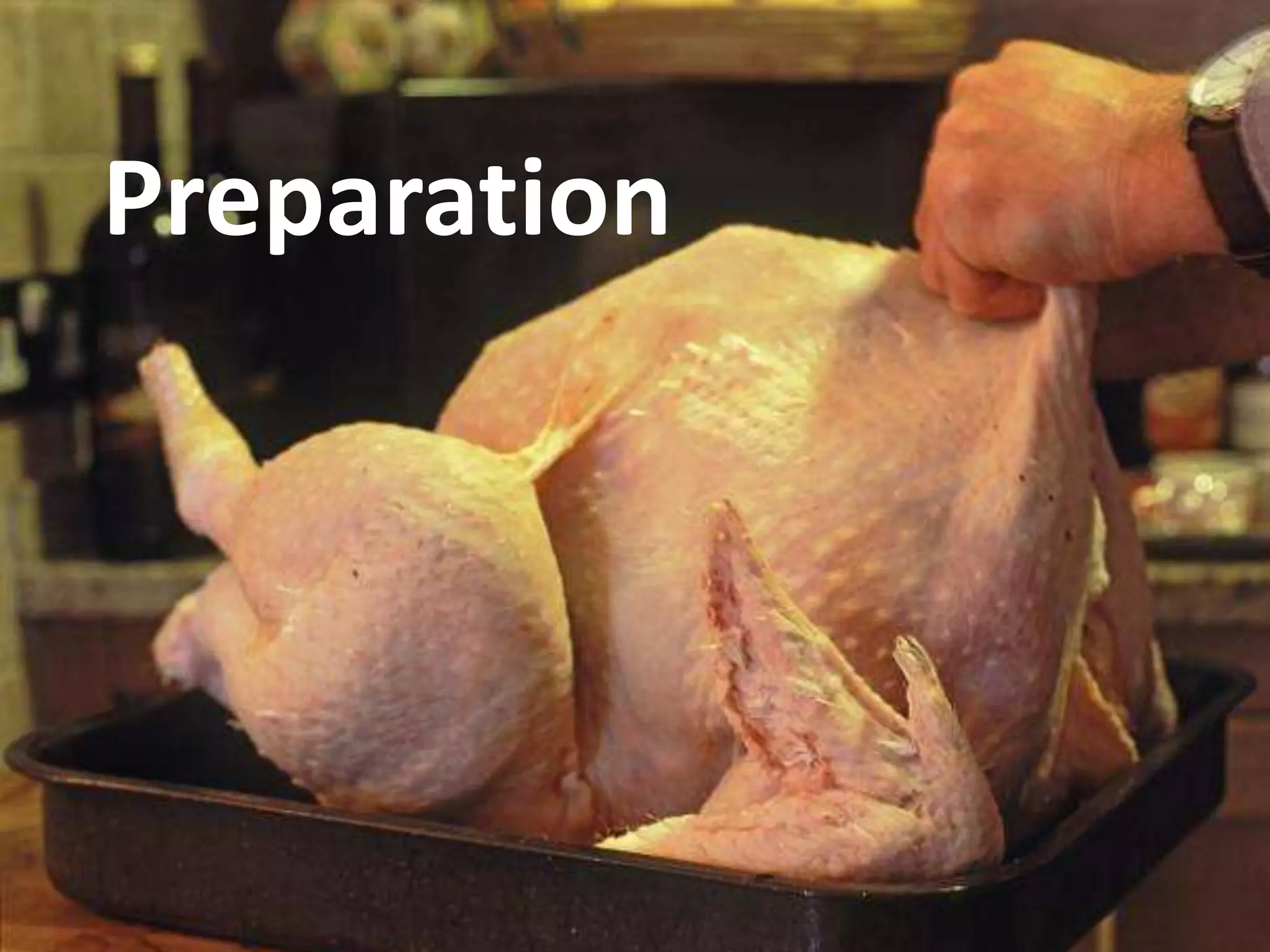
Preparation


3
Picking your topic
     What are you interested in?

     Did any essays/lectures/articles particularly spark
     your interest?
        Were there ideas or aspects of the topic you’d like to explore in
         more detail?
        Are there particular groups of people you would like to look at in
         relation to this topic?


     Look for gaps in research (NOT voids!)

4
Picking your topic 2
     Not interested?!
          What did you get the best grades in?
          Which subjects came easier?
          Remember this is just the planning stage – thinking like this will help
           you narrow to look at topics within one area

     Still lost?
          Placements – those doing placements think about people you will work
           with, any studies they may be already doing from which you could re-
           use data or data you may be able to collect through organisation


         TOP TIP: Keep a notebook/word file where you can
         add anything which takes your interest and any ideas
         which could be candidates for diss topics
5
Be practical
     Most common mistake is that people’s ideas are too big!

     Remember this is real – not fantasy!
     The study you propose you have to carry out =
      No studies interviewing battered wives or sex offenders
      please!

     Remember the participant groups you will have ready
      access to = students and staff at MDX, people you
      encounter on your placement etc

     You can also re-use data from other studies (do a
      secondary analysis) - this can come from another study
      which you want to follow up on or from data your
      placement organisation
6
Be Practical 2 – find a balance
     You will need to do some literature searching for journal
      articles in your area – this will help you figure out how
      feasible your study is
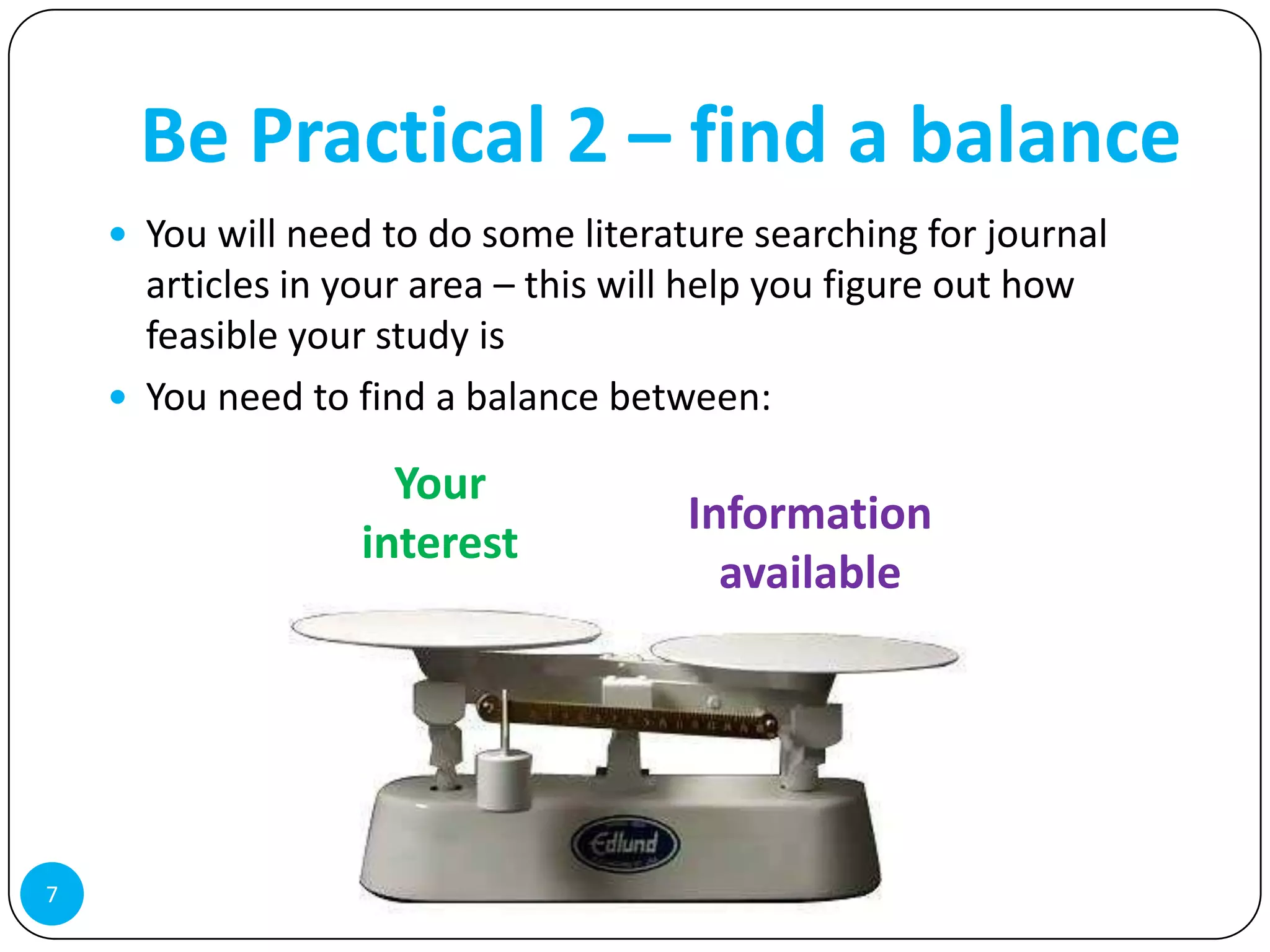
     You need to find a balance between:

                     Your
                                       Information
                   interest
                                         available


7
Just the right amount of literature
     Think how studies work and what
      options are open to you and
      importantly - NOT OPEN TO YOU!

     You want a GAP in literature NOT A
      VOID

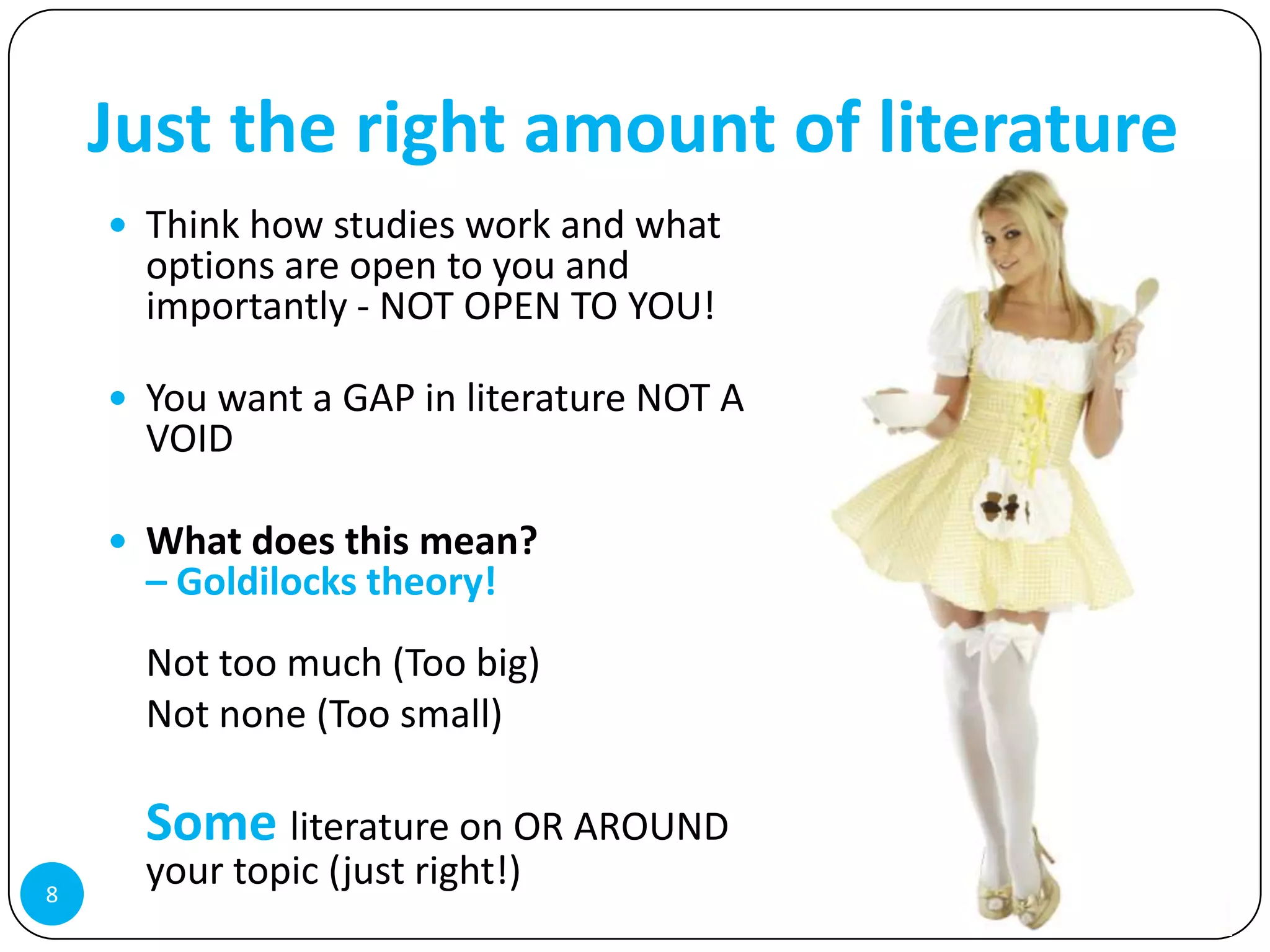
     What does this mean?
      – Goldilocks theory!
      Not too much (Too big)
      Not none (Too small)

      Some literature on OR AROUND
8
      your topic (just right!)
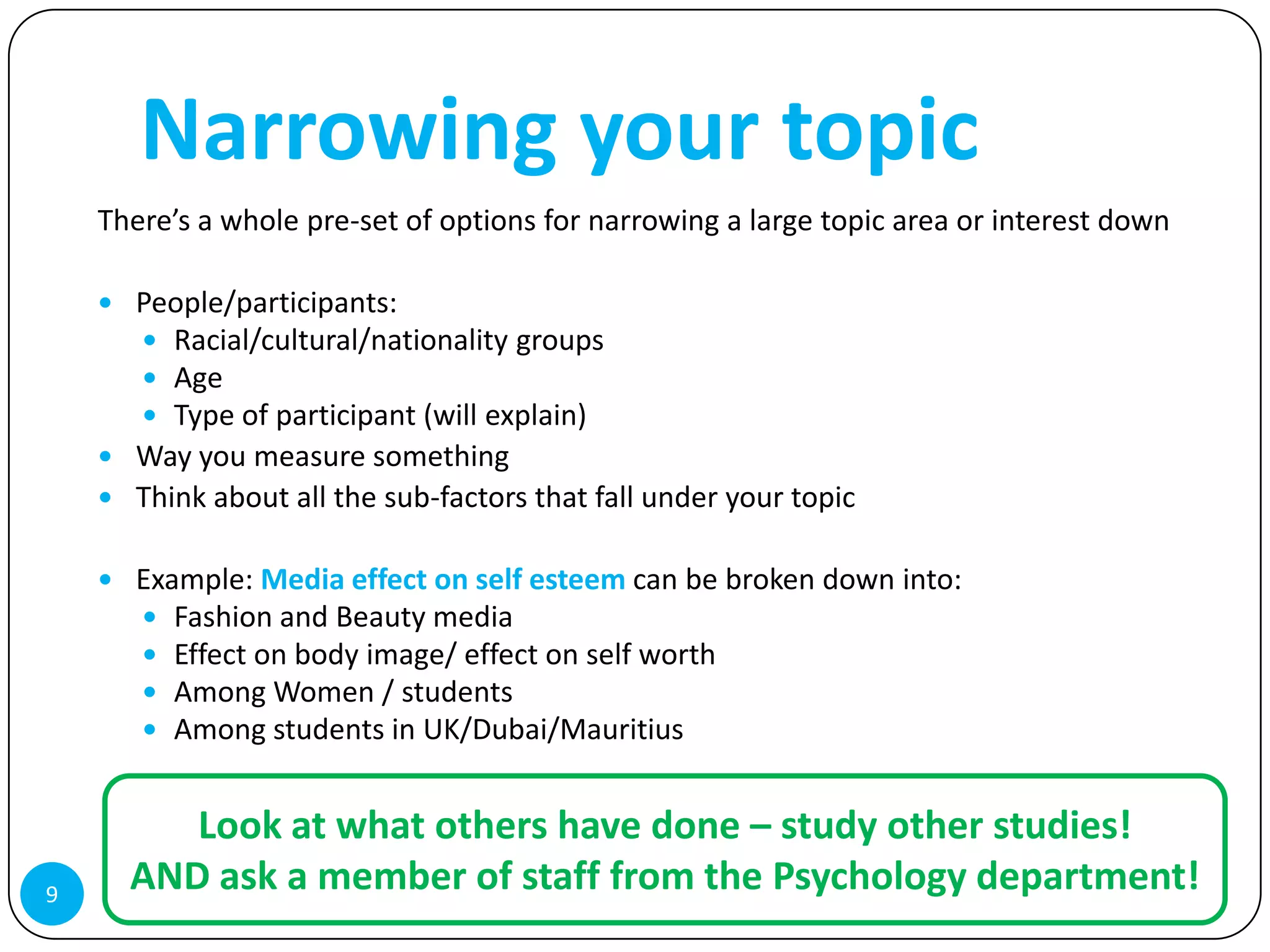
Narrowing your topic
    There’s a whole pre-set of options for narrowing a large topic area or interest down

     People/participants:
       Racial/cultural/nationality groups
       Age
       Type of participant (will explain)
     Way you measure something
     Think about all the sub-factors that fall under your topic


     Example: Media effect on self esteem can be broken down into:
       Fashion and Beauty media
       Effect on body image/ effect on self worth
       Among Women / students
       Among students in UK/Dubai/Mauritius


         Look at what others have done – study other studies!
9
      AND ask a member of staff from the Psychology department!
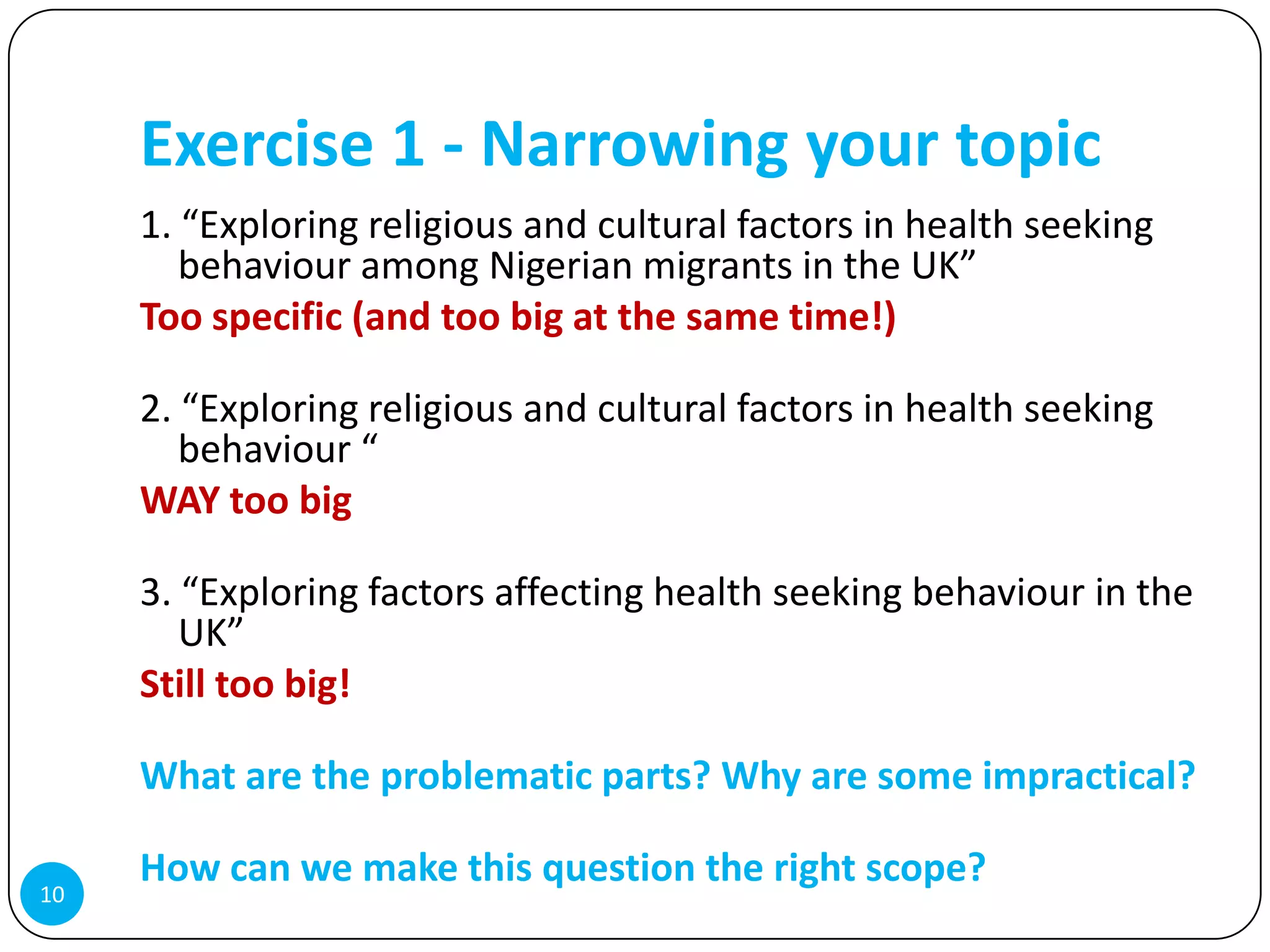
Exercise 1 - Narrowing your topic
     1. “Exploring religious and cultural factors in health seeking
        behaviour among Nigerian migrants in the UK”
     Too specific (and too big at the same time!)

     2. “Exploring religious and cultural factors in health seeking
        behaviour “
     WAY too big

     3. “Exploring factors affecting health seeking behaviour in the
        UK”
     Still too big!

     What are the problematic parts? Why are some impractical?

     How can we make this question the right scope?
10
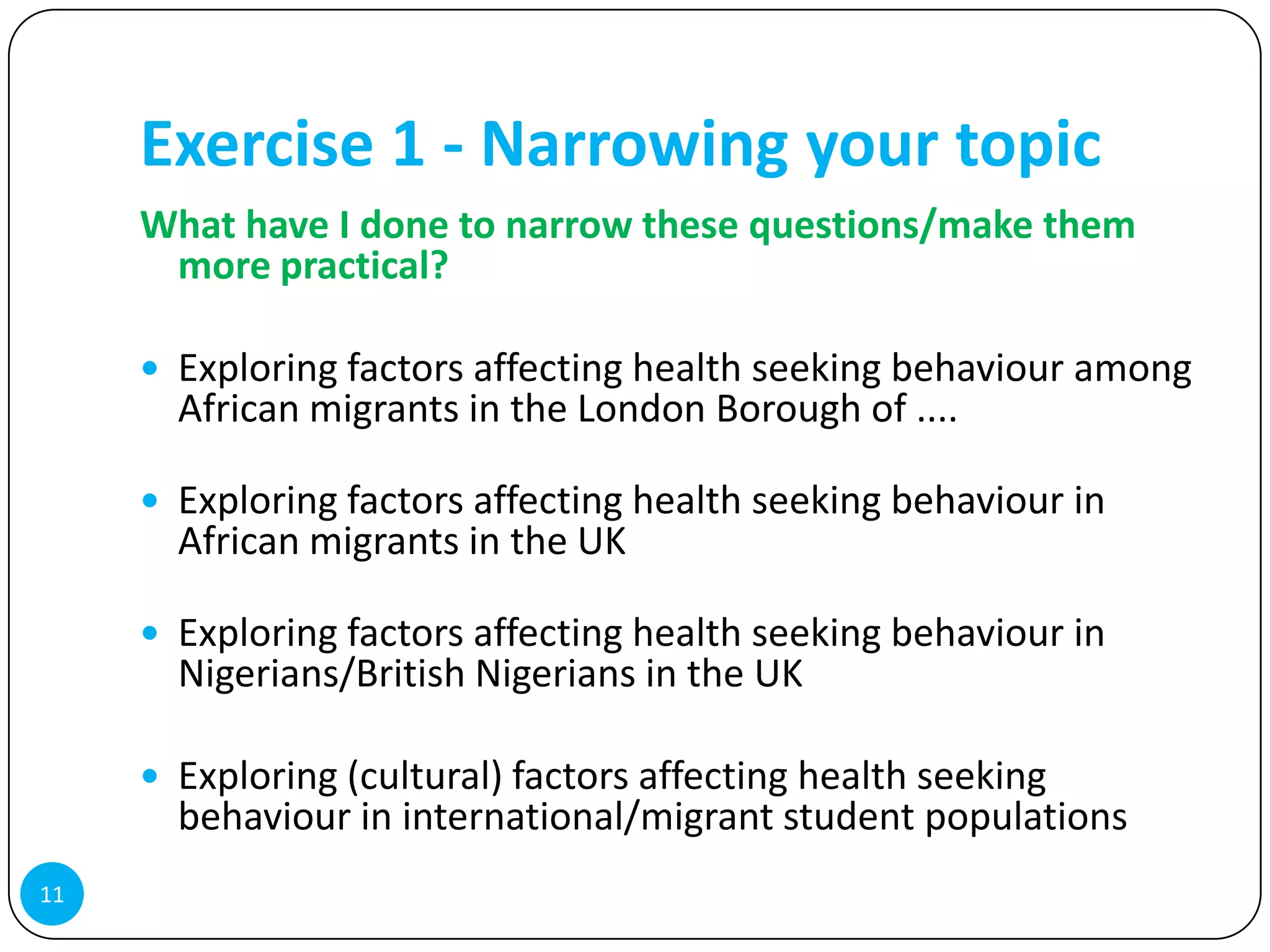
Exercise 1 - Narrowing your topic
     What have I done to narrow these questions/make them
      more practical?

      Exploring factors affecting health seeking behaviour among
       African migrants in the London Borough of ....

      Exploring factors affecting health seeking behaviour in
       African migrants in the UK

      Exploring factors affecting health seeking behaviour in
       Nigerians/British Nigerians in the UK

      Exploring (cultural) factors affecting health seeking
       behaviour in international/migrant student populations
11
Literature Searching
12
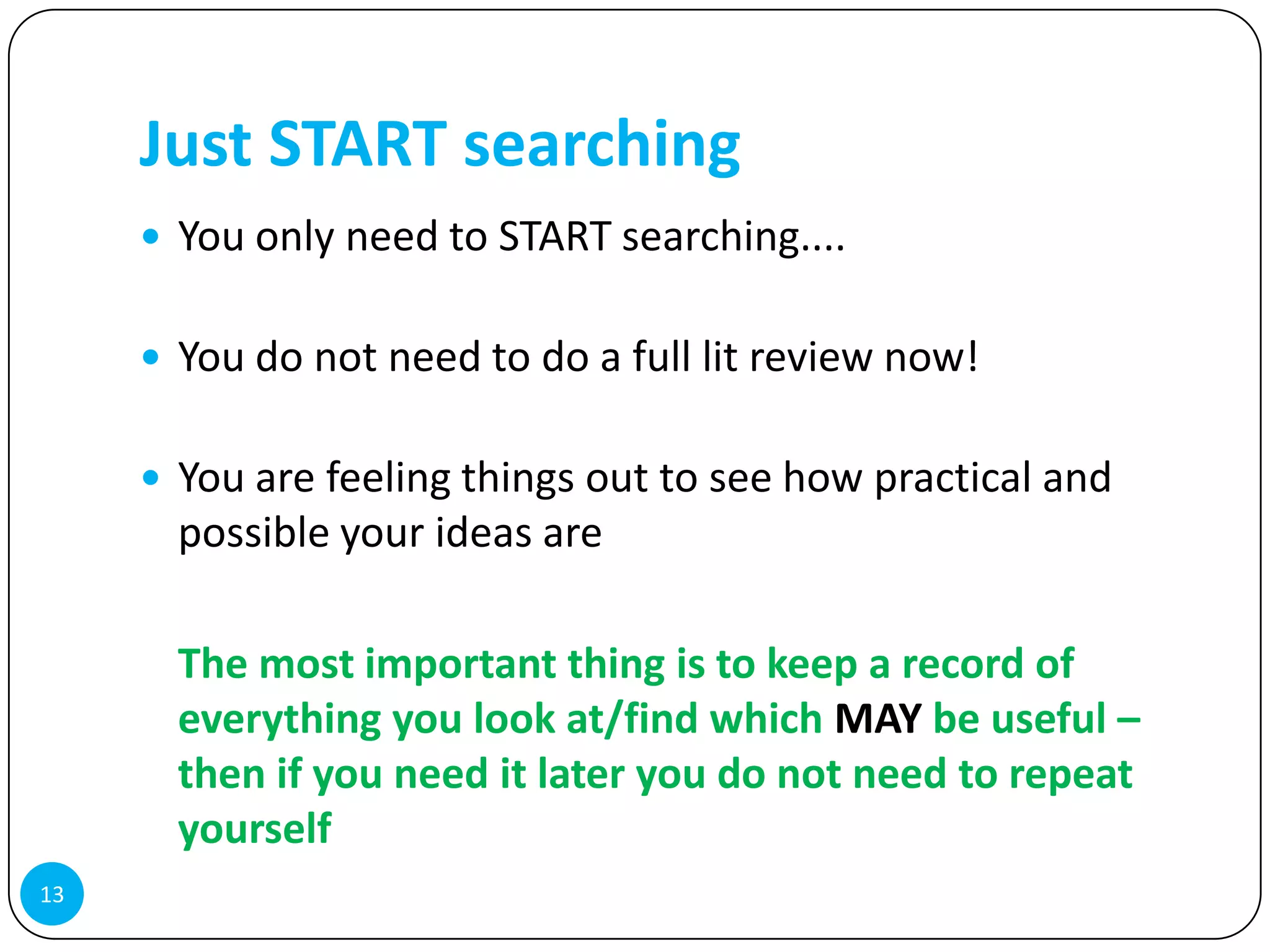
Just START searching
      You only need to START searching....


      You do not need to do a full lit review now!


      You are feeling things out to see how practical and
       possible your ideas are

       The most important thing is to keep a record of
       everything you look at/find which MAY be useful –
       then if you need it later you do not need to repeat
       yourself
13
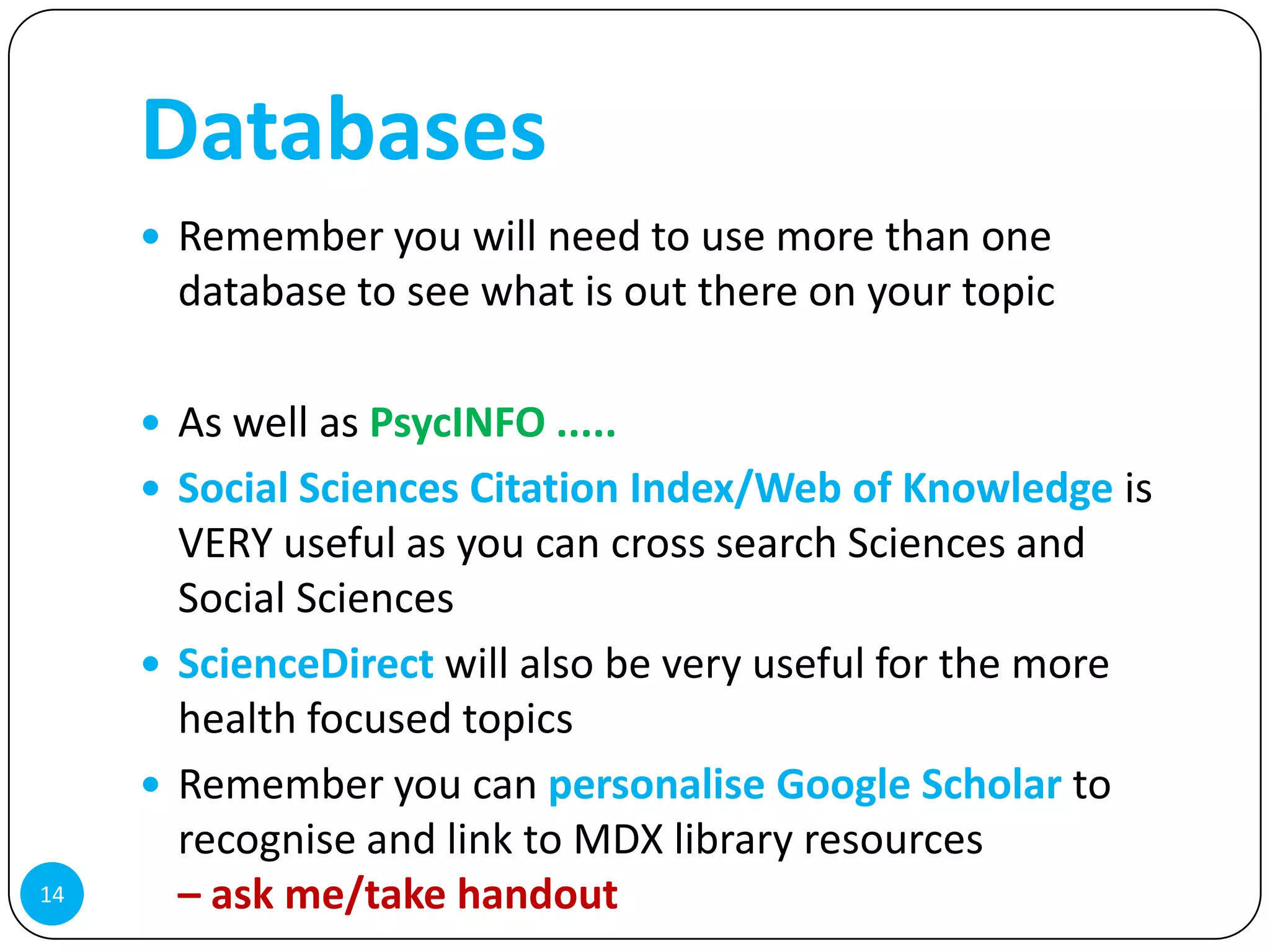
Databases
      Remember you will need to use more than one
       database to see what is out there on your topic

      As well as PsycINFO .....
      Social Sciences Citation Index/Web of Knowledge is
       VERY useful as you can cross search Sciences and
       Social Sciences
      ScienceDirect will also be very useful for the more
       health focused topics
      Remember you can personalise Google Scholar to
       recognise and link to MDX library resources
14     – ask me/take handout
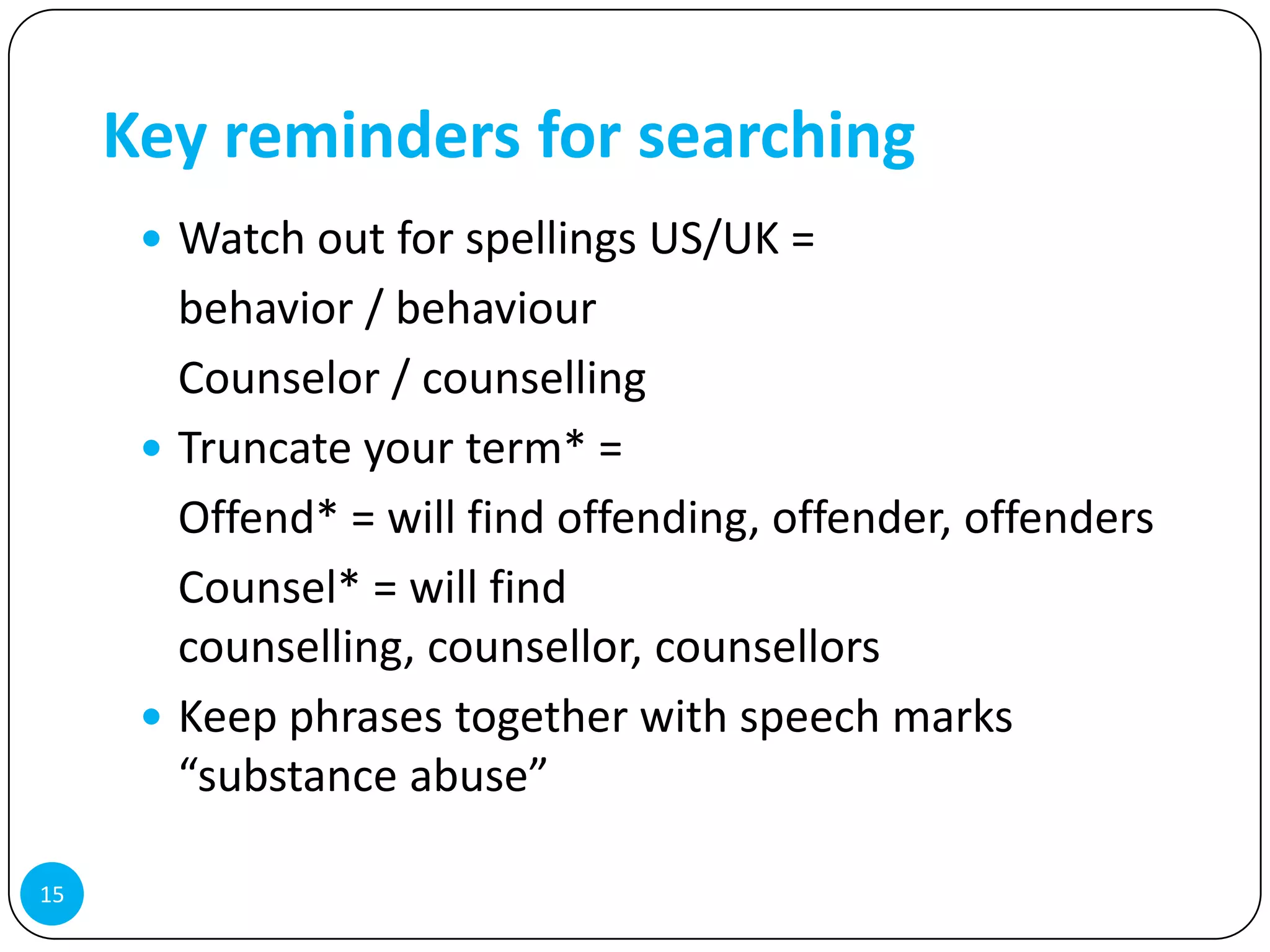
Key reminders for searching
       Watch out for spellings US/UK =
        behavior / behaviour
        Counselor / counselling
       Truncate your term* =
        Offend* = will find offending, offender, offenders
        Counsel* = will find
        counselling, counsellor, counsellors
       Keep phrases together with speech marks
        “substance abuse”

15
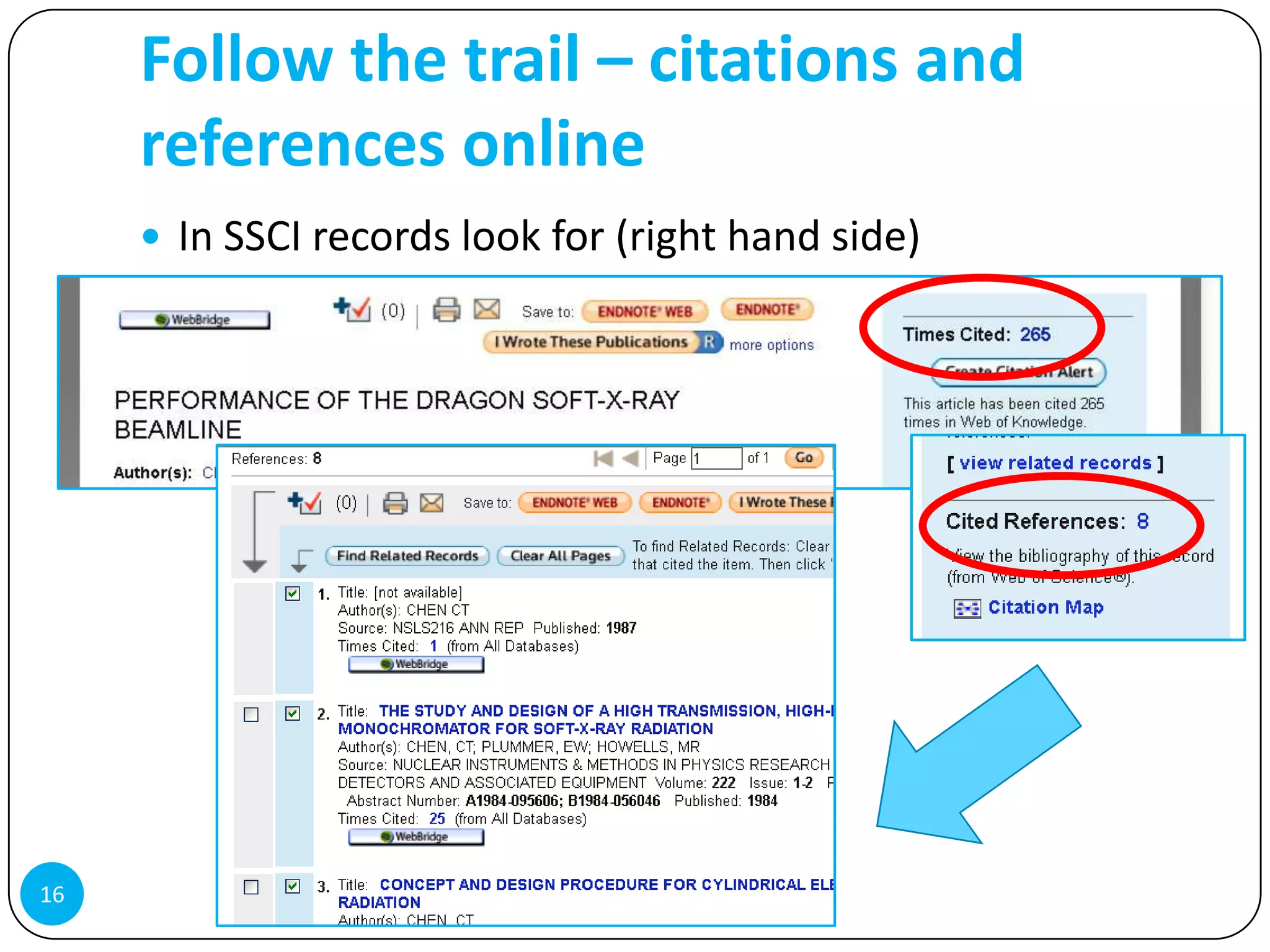
Follow the trail – citations and
     references online
      In SSCI records look for (right hand side)


16
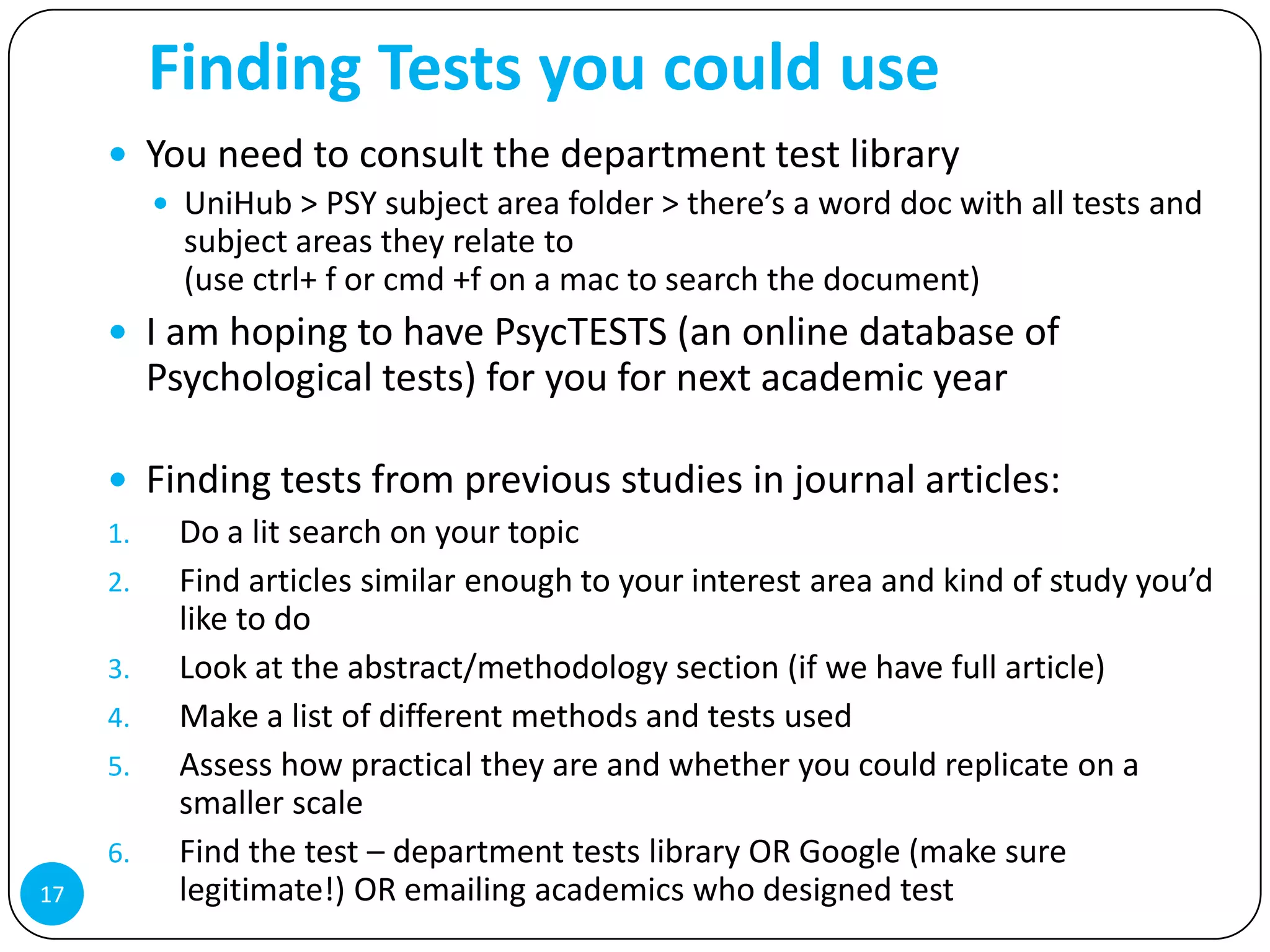
Finding Tests you could use
      You need to consult the department test library
        UniHub > PSY subject area folder > there’s a word doc with all tests and
         subject areas they relate to
         (use ctrl+ f or cmd +f on a mac to search the document)
      I am hoping to have PsycTESTS (an online database of
       Psychological tests) for you for next academic year

      Finding tests from previous studies in journal articles:
     1.  Do a lit search on your topic
     2.  Find articles similar enough to your interest area and kind of study you’d
         like to do
     3.  Look at the abstract/methodology section (if we have full article)
     4.  Make a list of different methods and tests used
     5.  Assess how practical they are and whether you could replicate on a
         smaller scale
     6.  Find the test – department tests library OR Google (make sure
17       legitimate!) OR emailing academics who designed test
INFERRING! Or how to infer ....
      There may be no research on your very specific diss
       topic

      DON’T PANIC – keep calm and ask the librarian!


      But there may be studies which are similar but with a
       different participant group or

      And there may be studies which address each element
       of your topic separately

18
Example: The effectiveness of mentoring on young
     homeless people
  There were a NO articles for this so the student had to infer from
     the contexts below:

      Mentoring and young people

      Mentors and homeless people

      Studies of homeless people /support for homeless people getting out
       of homelessness

     SO – don’t panic if there’s nothing matching your question exactly
     – you just need enough around the elements of your topic to
     construct a lit review and discussion of your results
     TOP MARKS! This also gives you room to say something original!
     Joining the dots between different research or pointing out areas
19   for further exploration in the field.
Example: Peer, media and family influences among African
       and Afro-Caribbean women and the effects on self esteem
       and body image

      There were a few articles for this but mostly this student had to infer
       from the contexts below:

        Media influences on women and their self image
        Peer/family/cultural influences on women and their self image

        Media influences on Black/Afro Caribbean populations and their
         confidence/self image
        Peer/family/cultural on Black/Afro Caribbean populations and their
         confidence/self image

        Media influences on people’s self worth and body image


       So you widen your searches and take a little bit of information from
20
       each context to construct a research-jigsaw-puzzle
Cutting Edge?
21
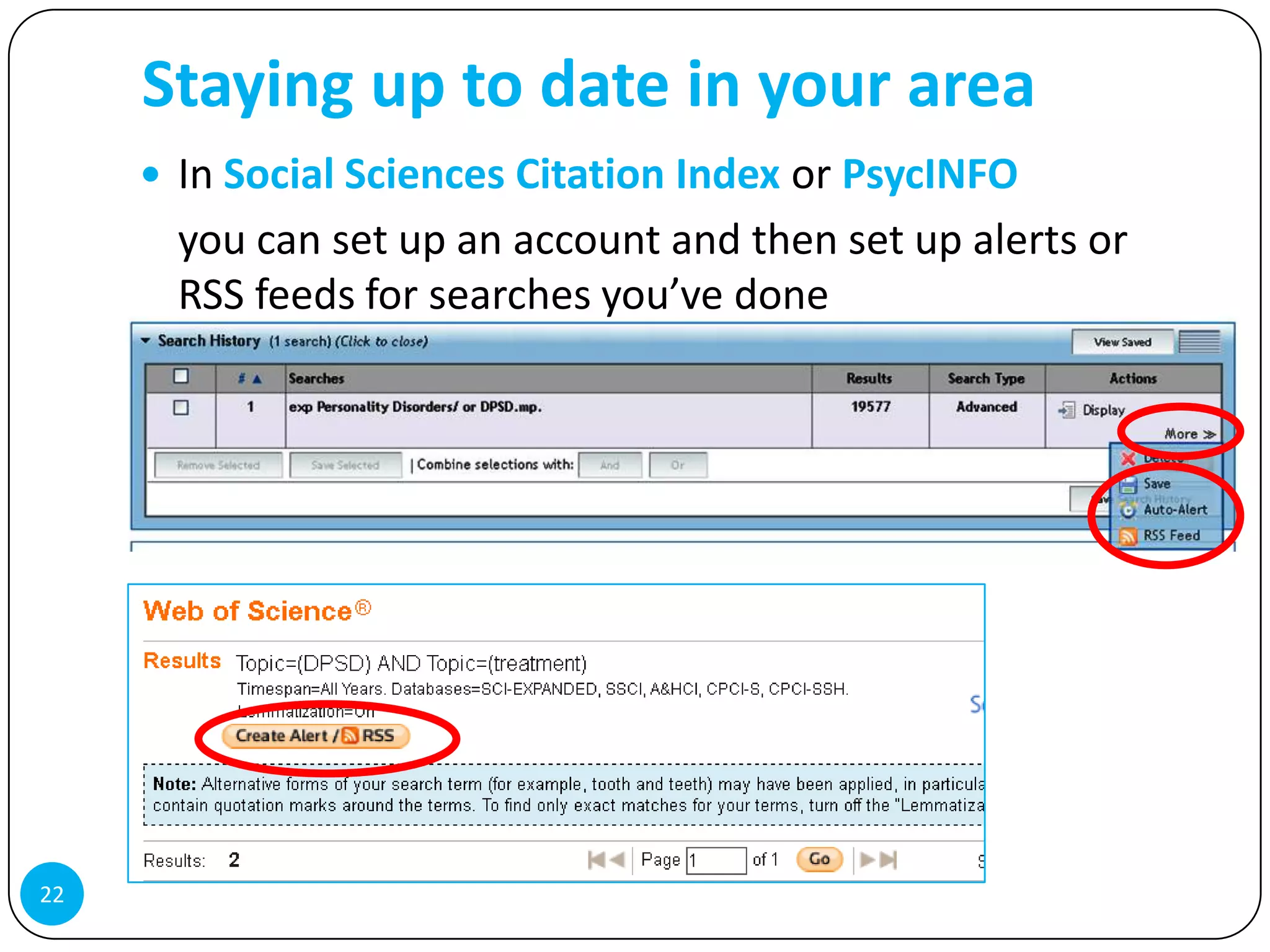
Staying up to date in your area
      In Social Sciences Citation Index or PsycINFO
       you can set up an account and then set up alerts or
       RSS feeds for searches you’ve done


22
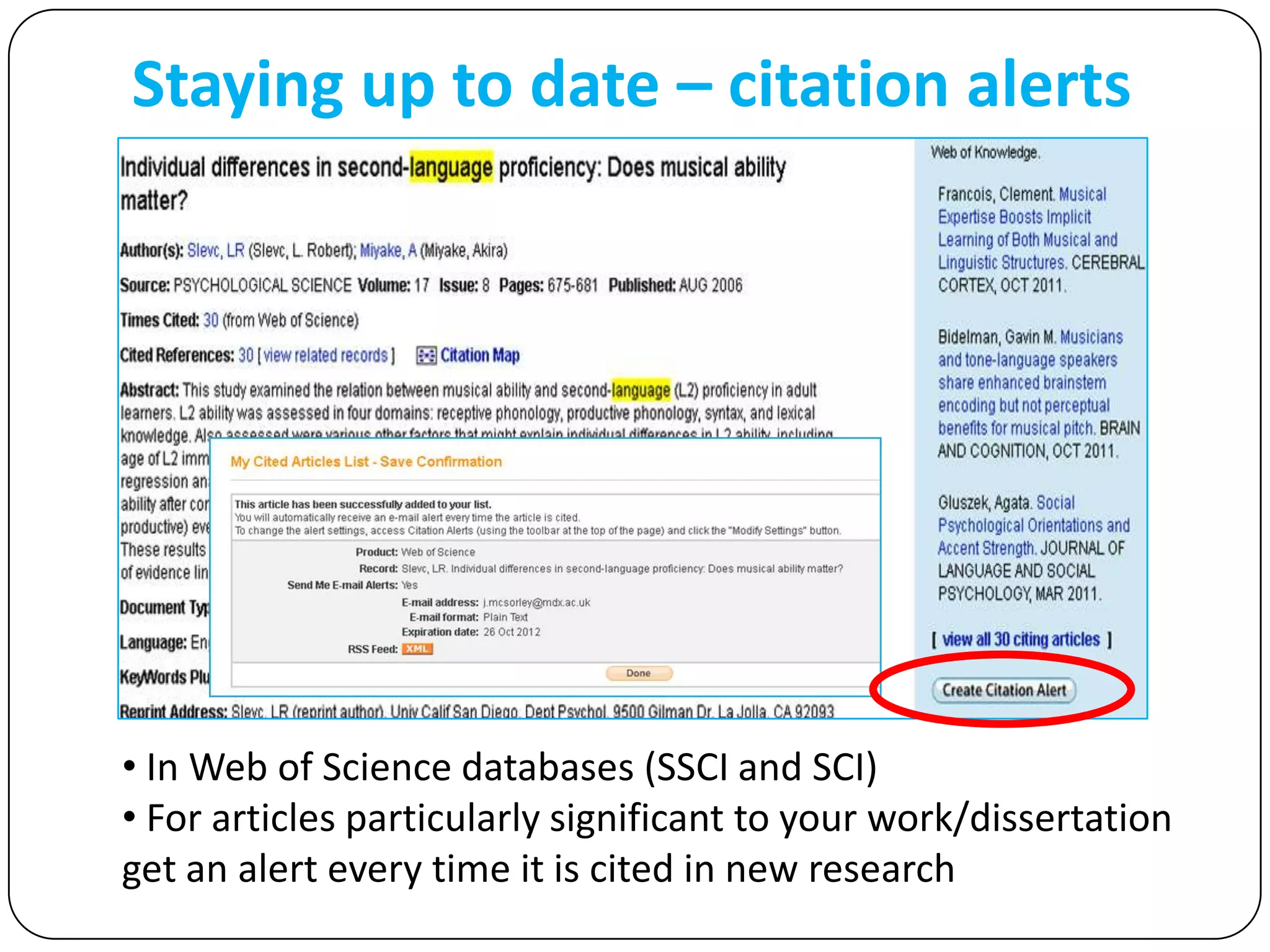
Staying up to date – citation alerts


• In Web of Science databases (SSCI and SCI)
• For articles particularly significant to your work/dissertation
get an alert every time it is cited in new research
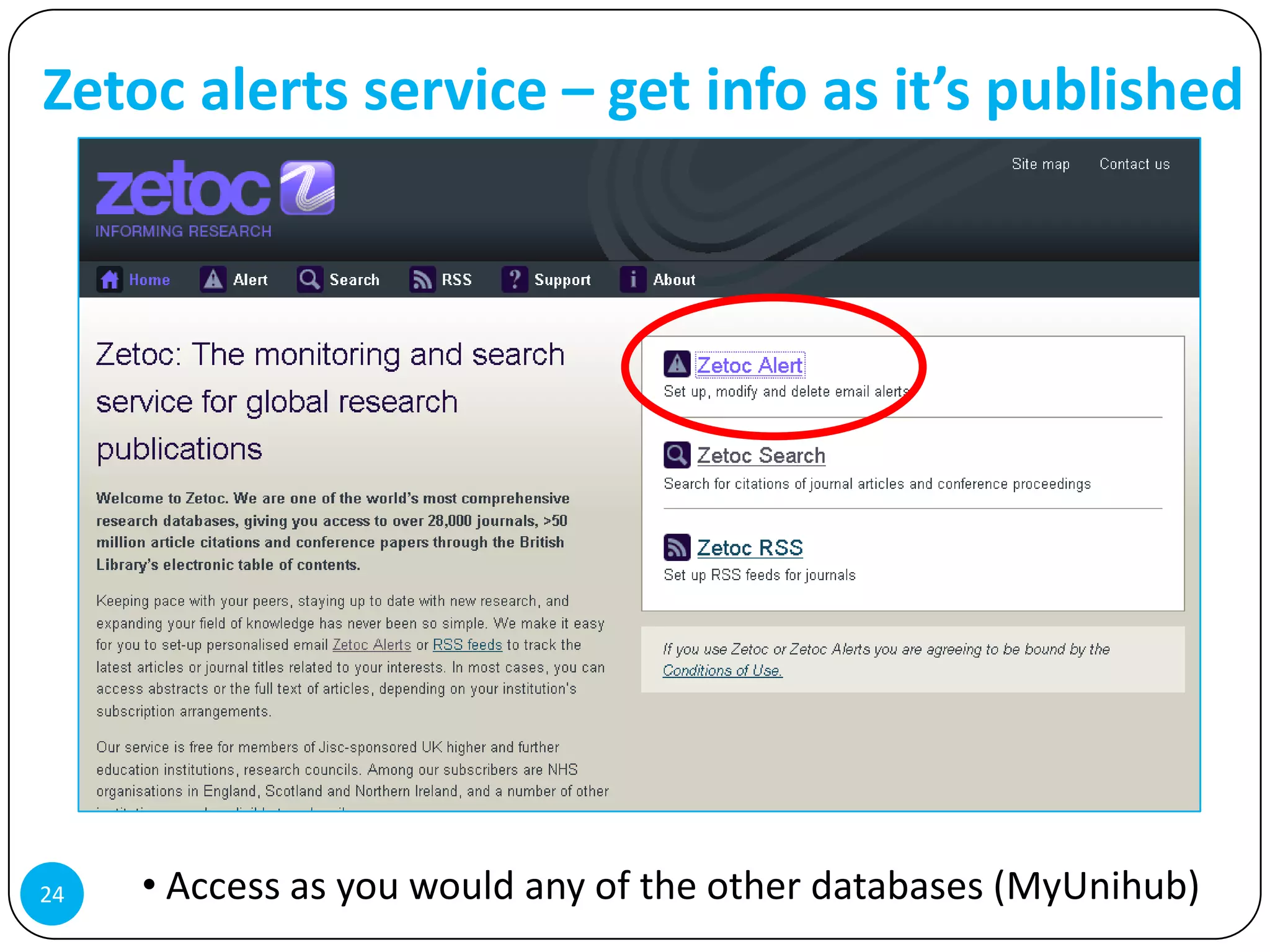
Zetoc alerts service – get info as it’s published


24   • Access as you would any of the other databases (MyUnihub)
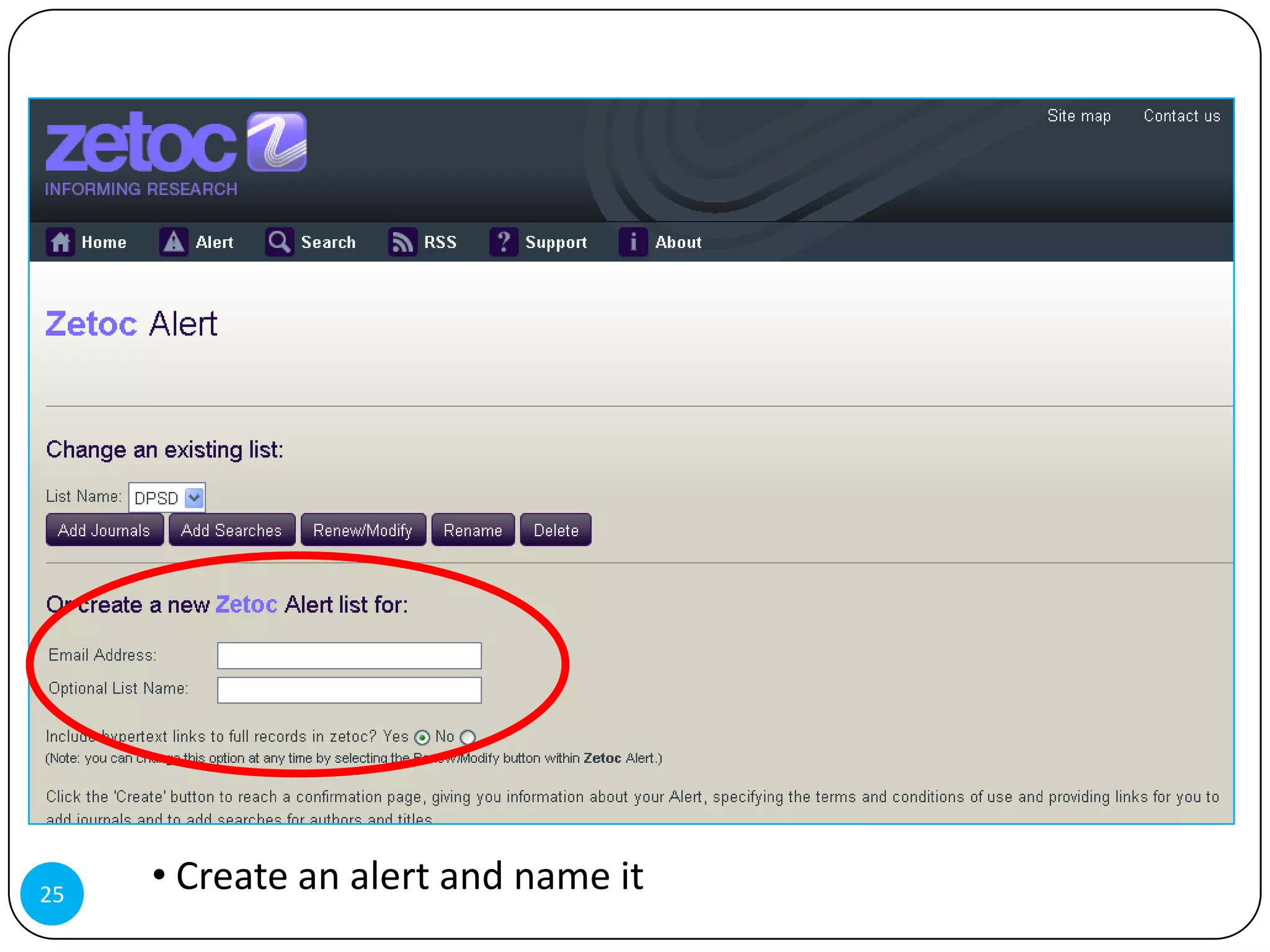
25
     • Create an alert and name it
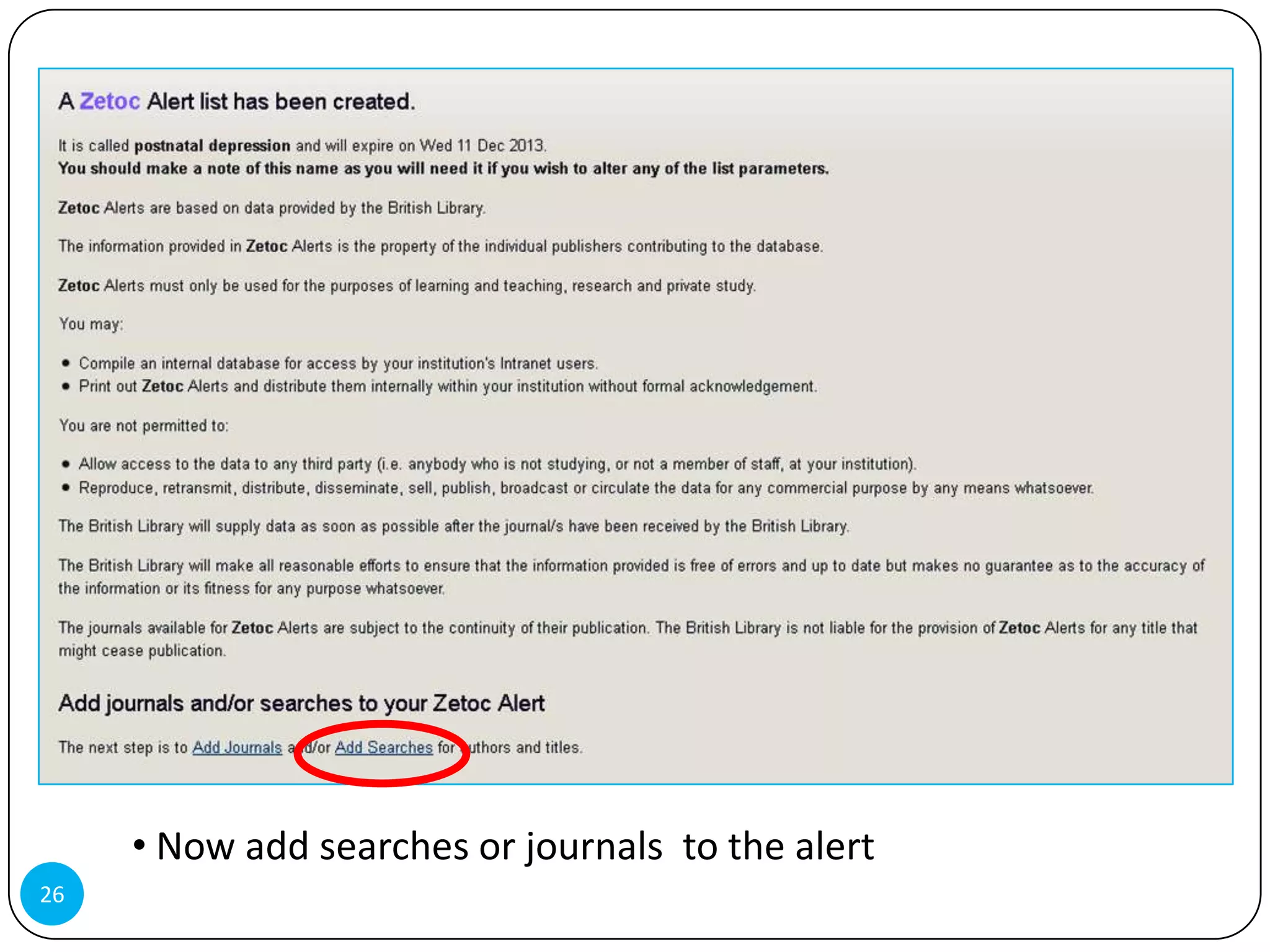
• Now add searches or journals to the alert
26
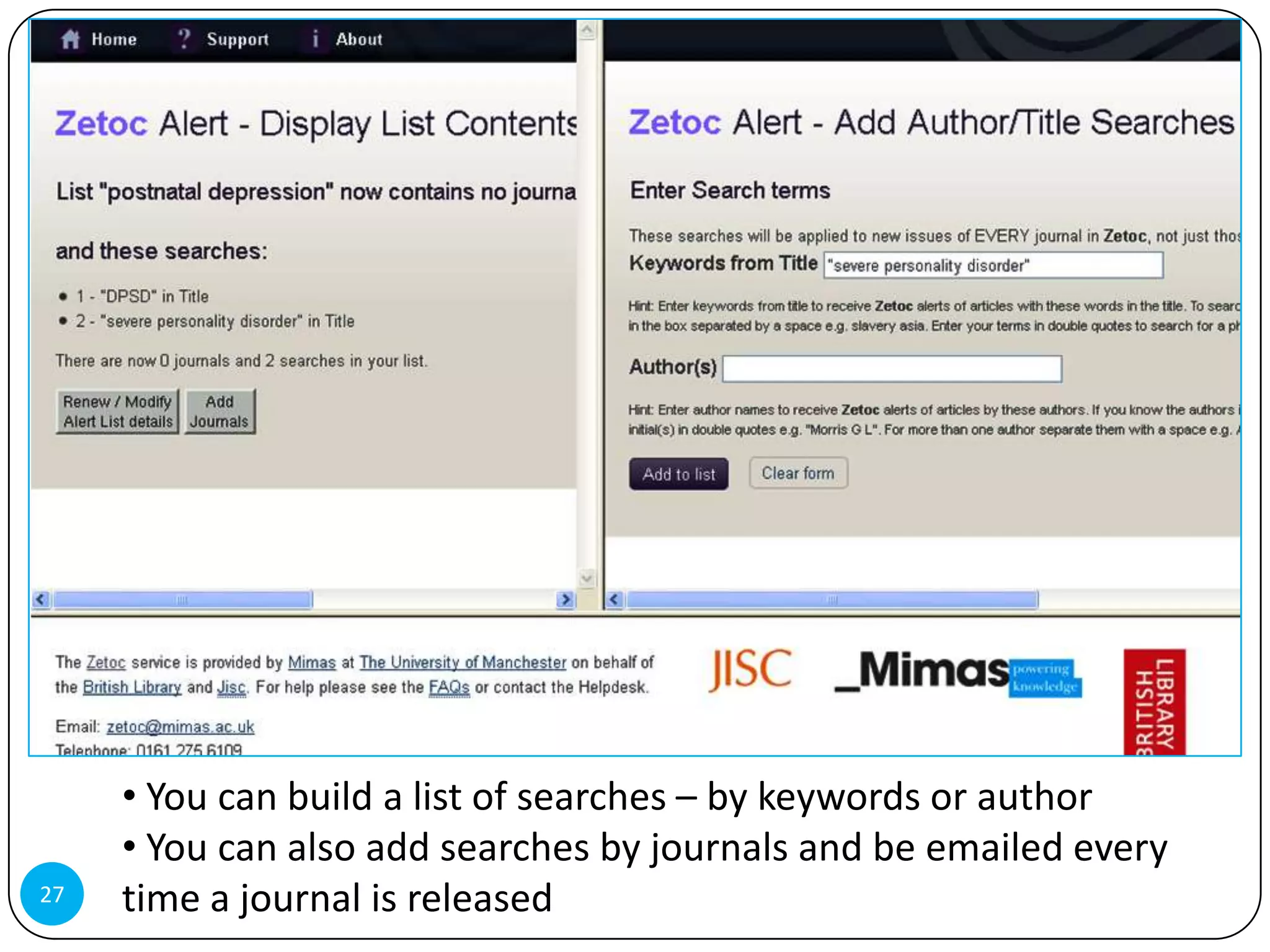
• You can build a list of searches – by keywords or author
     • You can also add searches by journals and be emailed every
27   time a journal is released
Excercise 2 - Zetoc
      Set up some alerts and add searches relevant to your
       log books for this module

      Remember you can add multiple searches for each of
       the synonyms for your search term to your alert

      Grab me if you need a hand or help picking search
       terms.


28
Attribution


29
Referencing
 Is very important
 Acknowledges other people’s work (avoids plagiarism)
 Shows you’ve read around the subject
 Supports your discussion and arguments
 Gets you better marks!
 Enables others to find your references


 As dissertation students it would be useful to use a
  referencing software like RefWorks or Mendeley as
  you go along
Referencing tools
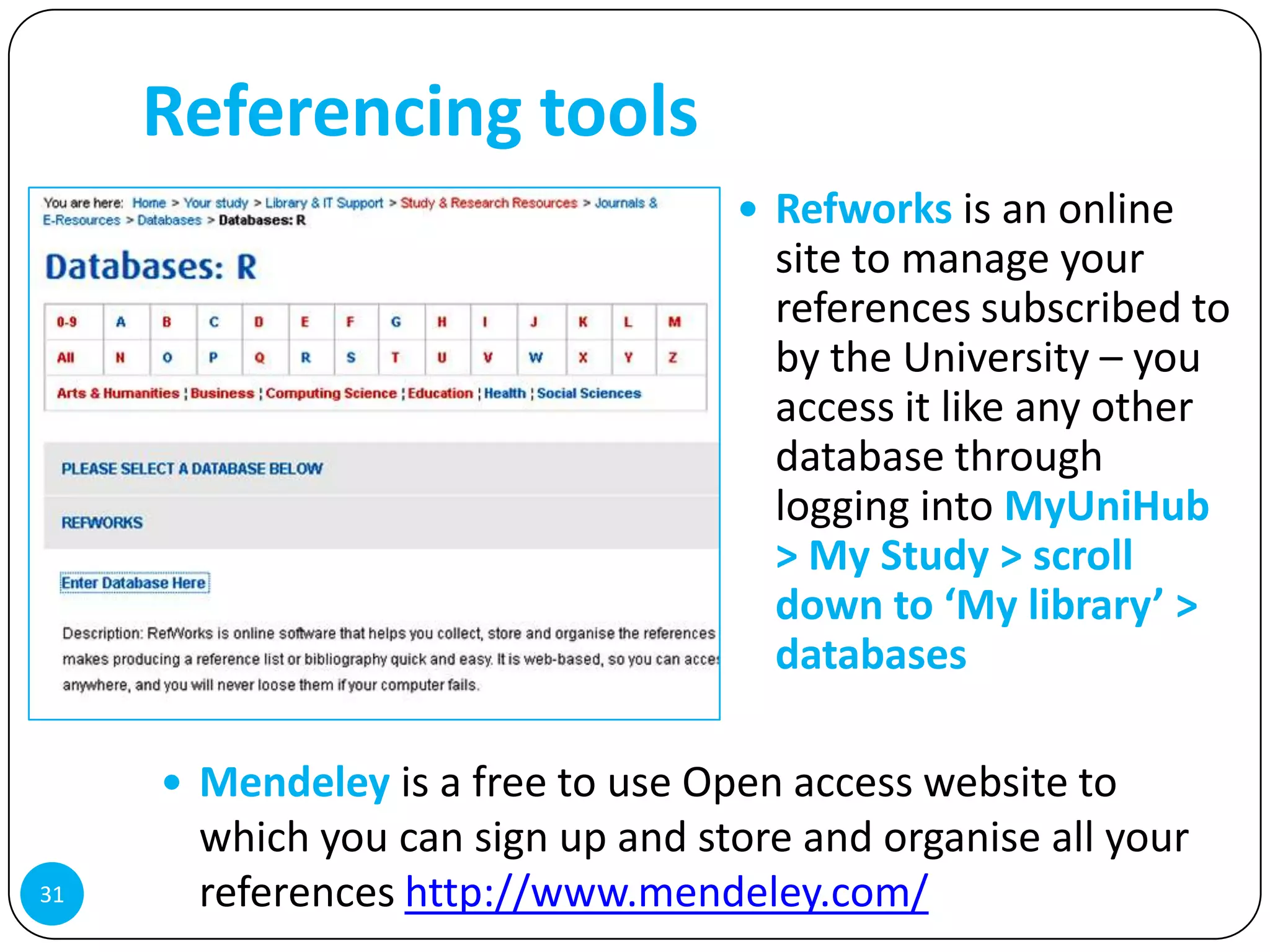
                                    Refworks is an online
                                     site to manage your
                                     references subscribed to
                                     by the University – you
                                     access it like any other
                                     database through
                                     logging into MyUniHub
                                     > My Study > scroll
                                     down to ‘My library’ >
                                     databases

      Mendeley is a free to use Open access website to
      which you can sign up and store and organise all your
31    references http://www.mendeley.com/
Referencing guide
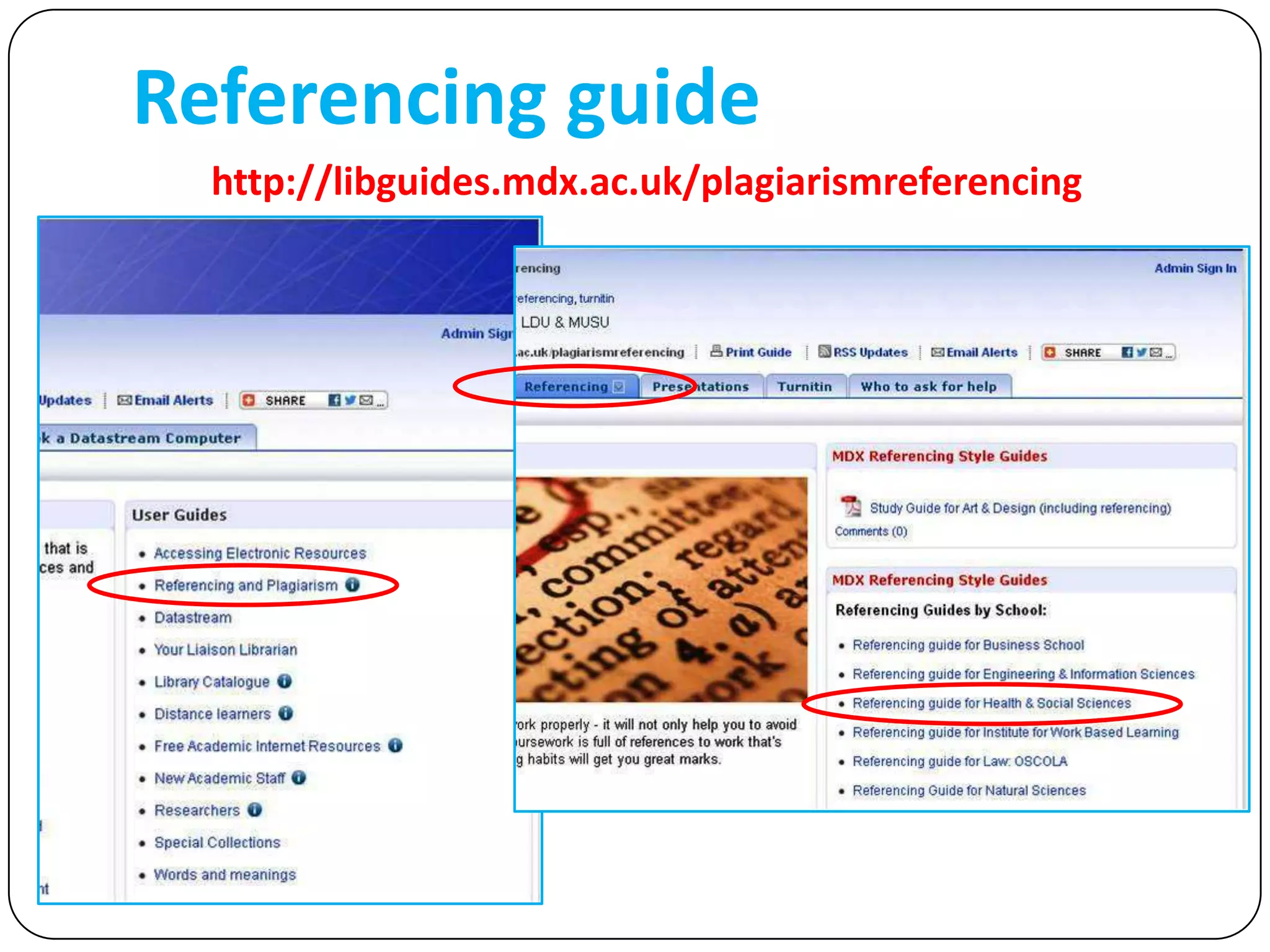
  http://libguides.mdx.ac.uk/plagiarismreferencing
Psychology Library subject guide
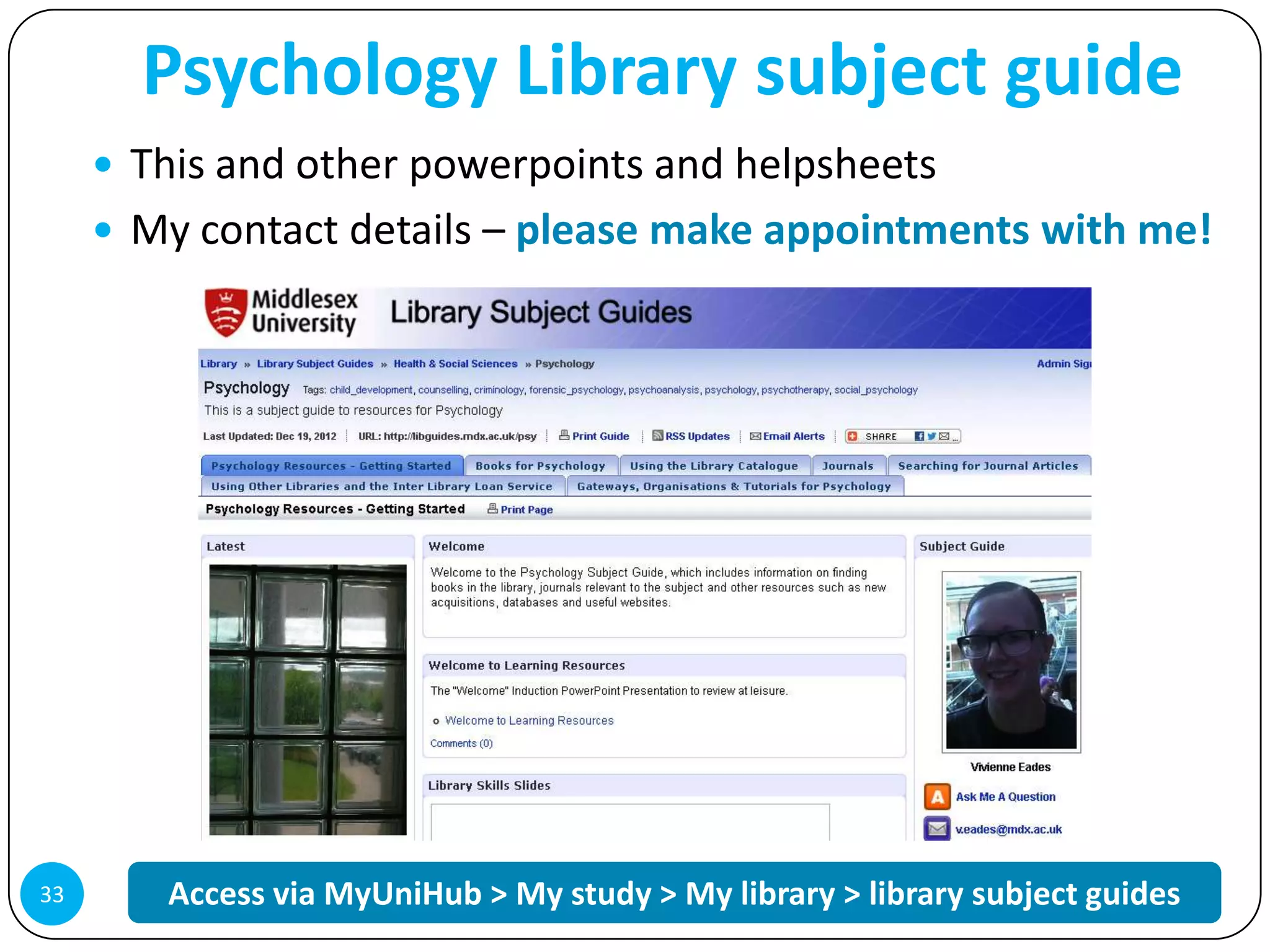
      This and other powerpoints and helpsheets
      My contact details – please make appointments with me!


33      Access via MyUniHub > My study > My library > library subject guides

Dissertation planning session

  • 1.
  • 2.
    Today....  Thinking about topics  Narrowing your topic  What to do with Literature at this stage? Finding tests, extra databases you may not have used etc ...  INFERRING – from one context to your context  Alerts in your interest area(s)  Where to find referencing information 2
  • 3.
  • 4.
    Picking your topic  What are you interested in?  Did any essays/lectures/articles particularly spark your interest?  Were there ideas or aspects of the topic you’d like to explore in more detail?  Are there particular groups of people you would like to look at in relation to this topic?  Look for gaps in research (NOT voids!) 4
  • 5.
    Picking your topic2  Not interested?!  What did you get the best grades in?  Which subjects came easier?  Remember this is just the planning stage – thinking like this will help you narrow to look at topics within one area  Still lost?  Placements – those doing placements think about people you will work with, any studies they may be already doing from which you could re- use data or data you may be able to collect through organisation TOP TIP: Keep a notebook/word file where you can add anything which takes your interest and any ideas which could be candidates for diss topics 5
  • 6.
    Be practical  Most common mistake is that people’s ideas are too big!  Remember this is real – not fantasy!  The study you propose you have to carry out = No studies interviewing battered wives or sex offenders please!  Remember the participant groups you will have ready access to = students and staff at MDX, people you encounter on your placement etc  You can also re-use data from other studies (do a secondary analysis) - this can come from another study which you want to follow up on or from data your placement organisation 6
  • 7.
    Be Practical 2– find a balance  You will need to do some literature searching for journal articles in your area – this will help you figure out how feasible your study is  You need to find a balance between: Your Information interest available 7
  • 8.
    Just the rightamount of literature  Think how studies work and what options are open to you and importantly - NOT OPEN TO YOU!  You want a GAP in literature NOT A VOID  What does this mean? – Goldilocks theory! Not too much (Too big) Not none (Too small) Some literature on OR AROUND 8 your topic (just right!)
  • 9.
    Narrowing your topic There’s a whole pre-set of options for narrowing a large topic area or interest down  People/participants:  Racial/cultural/nationality groups  Age  Type of participant (will explain)  Way you measure something  Think about all the sub-factors that fall under your topic  Example: Media effect on self esteem can be broken down into:  Fashion and Beauty media  Effect on body image/ effect on self worth  Among Women / students  Among students in UK/Dubai/Mauritius Look at what others have done – study other studies! 9 AND ask a member of staff from the Psychology department!
  • 10.
    Exercise 1 -Narrowing your topic 1. “Exploring religious and cultural factors in health seeking behaviour among Nigerian migrants in the UK” Too specific (and too big at the same time!) 2. “Exploring religious and cultural factors in health seeking behaviour “ WAY too big 3. “Exploring factors affecting health seeking behaviour in the UK” Still too big! What are the problematic parts? Why are some impractical? How can we make this question the right scope? 10
  • 11.
    Exercise 1 -Narrowing your topic What have I done to narrow these questions/make them more practical?  Exploring factors affecting health seeking behaviour among African migrants in the London Borough of ....  Exploring factors affecting health seeking behaviour in African migrants in the UK  Exploring factors affecting health seeking behaviour in Nigerians/British Nigerians in the UK  Exploring (cultural) factors affecting health seeking behaviour in international/migrant student populations 11
  • 12.
  • 13.
    Just START searching  You only need to START searching....  You do not need to do a full lit review now!  You are feeling things out to see how practical and possible your ideas are The most important thing is to keep a record of everything you look at/find which MAY be useful – then if you need it later you do not need to repeat yourself 13
  • 14.
    Databases  Remember you will need to use more than one database to see what is out there on your topic  As well as PsycINFO .....  Social Sciences Citation Index/Web of Knowledge is VERY useful as you can cross search Sciences and Social Sciences  ScienceDirect will also be very useful for the more health focused topics  Remember you can personalise Google Scholar to recognise and link to MDX library resources 14 – ask me/take handout
  • 15.
    Key reminders forsearching  Watch out for spellings US/UK = behavior / behaviour Counselor / counselling  Truncate your term* = Offend* = will find offending, offender, offenders Counsel* = will find counselling, counsellor, counsellors  Keep phrases together with speech marks “substance abuse” 15
  • 16.
    Follow the trail– citations and references online  In SSCI records look for (right hand side) 16
  • 17.
    Finding Tests youcould use  You need to consult the department test library  UniHub > PSY subject area folder > there’s a word doc with all tests and subject areas they relate to (use ctrl+ f or cmd +f on a mac to search the document)  I am hoping to have PsycTESTS (an online database of Psychological tests) for you for next academic year  Finding tests from previous studies in journal articles: 1. Do a lit search on your topic 2. Find articles similar enough to your interest area and kind of study you’d like to do 3. Look at the abstract/methodology section (if we have full article) 4. Make a list of different methods and tests used 5. Assess how practical they are and whether you could replicate on a smaller scale 6. Find the test – department tests library OR Google (make sure 17 legitimate!) OR emailing academics who designed test
  • 18.
    INFERRING! Or howto infer ....  There may be no research on your very specific diss topic  DON’T PANIC – keep calm and ask the librarian!  But there may be studies which are similar but with a different participant group or  And there may be studies which address each element of your topic separately 18
  • 19.
    Example: The effectivenessof mentoring on young homeless people  There were a NO articles for this so the student had to infer from the contexts below:  Mentoring and young people  Mentors and homeless people  Studies of homeless people /support for homeless people getting out of homelessness SO – don’t panic if there’s nothing matching your question exactly – you just need enough around the elements of your topic to construct a lit review and discussion of your results TOP MARKS! This also gives you room to say something original! Joining the dots between different research or pointing out areas 19 for further exploration in the field.
  • 20.
    Example: Peer, mediaand family influences among African and Afro-Caribbean women and the effects on self esteem and body image  There were a few articles for this but mostly this student had to infer from the contexts below:  Media influences on women and their self image  Peer/family/cultural influences on women and their self image  Media influences on Black/Afro Caribbean populations and their confidence/self image  Peer/family/cultural on Black/Afro Caribbean populations and their confidence/self image  Media influences on people’s self worth and body image So you widen your searches and take a little bit of information from 20 each context to construct a research-jigsaw-puzzle
  • 21.
  • 22.
    Staying up todate in your area  In Social Sciences Citation Index or PsycINFO you can set up an account and then set up alerts or RSS feeds for searches you’ve done 22
  • 23.
    Staying up todate – citation alerts • In Web of Science databases (SSCI and SCI) • For articles particularly significant to your work/dissertation get an alert every time it is cited in new research
  • 24.
    Zetoc alerts service– get info as it’s published 24 • Access as you would any of the other databases (MyUnihub)
  • 25.
    25 • Create an alert and name it
  • 26.
    • Now addsearches or journals to the alert 26
  • 27.
    • You canbuild a list of searches – by keywords or author • You can also add searches by journals and be emailed every 27 time a journal is released
  • 28.
    Excercise 2 -Zetoc  Set up some alerts and add searches relevant to your log books for this module  Remember you can add multiple searches for each of the synonyms for your search term to your alert  Grab me if you need a hand or help picking search terms. 28
  • 29.
  • 30.
    Referencing  Is veryimportant  Acknowledges other people’s work (avoids plagiarism)  Shows you’ve read around the subject  Supports your discussion and arguments  Gets you better marks!  Enables others to find your references  As dissertation students it would be useful to use a referencing software like RefWorks or Mendeley as you go along
  • 31.
    Referencing tools  Refworks is an online site to manage your references subscribed to by the University – you access it like any other database through logging into MyUniHub > My Study > scroll down to ‘My library’ > databases  Mendeley is a free to use Open access website to which you can sign up and store and organise all your 31 references http://www.mendeley.com/
  • 32.
    Referencing guide http://libguides.mdx.ac.uk/plagiarismreferencing
  • 33.
    Psychology Library subjectguide  This and other powerpoints and helpsheets  My contact details – please make appointments with me! 33 Access via MyUniHub > My study > My library > library subject guides

Editor's Notes

  • #3 This session is kind of a what you need to think about / starting off activities – you can contact me for more database support and there will be more on database searching in your 3rd year
  • #4 Photo credit http://christmasstockimages.com/free/food-dining/slides/turkey_preparation.htm
  • #5 Try and get some examples out of them and discuss how we could narrow. Gaps – will come back to this when we look at lit searching for your diss
  • #6 Any ideas – basic notes ‘autism’ ‘CBT’ ‘creativity’ ‘bilingualism’
  • #7 Will talk about what’s too small or too big in a secondYou have to get ethical approval!
  • #8 Image courtesy Zesco.com of: http://www.zesco.com/Edlund-BDS-16-Baker-s-Scale-16-lb.-Capacity-pz214D055.htmYou could be really interested but if there’s NO literature on the topic this is not an area for UG study!
  • #9 Image courtesy of www.mcpeakesbelfast.co.uk : http://www.mcpeakesbelfast.co.uk/funshack/ladies/2101-Goldilocks%20%28B%29.jpgPicking something with lots of lit makes it harder to get good marks - there’s less for you to say if it’s a heavily covered subject – unless you find a niche in that subject which hasn’t been addressed. Doing something which there’s mountains of information on doesn’t leave you much room to be original in what you say unless you can see a flaw or gap in the research that’s been done.None – doesn’t mean none on your very specific diss topic/study – but your area of interest – will explain further
  • #10 Examples:Gym goers/non gym goersStudentsAcademic staff/support staff
  • #11 Is a PhD topic!Think about the topic you are addressing – you will have to discuss all the elements with supported literatureAnd also think the about the study you will do to support your topic – and how possible/practical that idea is .Your topic could very well be
  • #12 Could explore factors in general – gives you scope for discussion or cultural factors and then discuss religion if it comes up
  • #13 Photo credit: http://www.missyblurkit.com/2012/11/movie-review-finding-nemo-3d.html
  • #16 These either stop you from missing things out (diff spellings & truncation) or make your results more specific and relevant (speech marks)
  • #17 Only on WOS
  • #18 NOT ALL TESTS ARE FREELY AVAILABLE
  • #19 Stupid word – good skill – one which will be useful to you in any area of Psych work and definitely if you are goign to continue to PG study Examples next page ....
  • #20 So you widen your searches and take a little bit of information from each context to construct a research-jigsaw-puzzle
  • #21 This also gives you room to say something original! Joining the dots between different research or pointing out areas for further exploration in the field.
  • #22 Photo credit: www.pickywallpapers.com
  • #25 Regularly updated – most up to date alerts – journals are indexed here by BL quicker than other databases.
  • #30 Photo credit: http://globalfootballtoday.com/wp-content/uploads/2011/04/pierluigi-collina.jpeg
  • #31 Quick run through on where to find referencing info