PSY0010:Research and the
Library
Today we will cover… Finding information for your
assignments
• Types of information
• Library Search
• Google Scholar
• Evaluating information
Presentation Topics
• Cognitive Psychology
• ‘Memory & Music’ OR ‘Attention’
• Learning
• ‘Media & Violence’ OR ‘Observational Learning’
• Developmental Psychology
• ‘Attachment’ OR ‘Theory of Mind’
You need information! Who ya
gonna call?
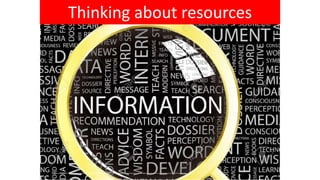
http://previews.123rf.com/images/studiom1/studiom11102/studiom1110200090/9128382-information-magnifying-glass-over-background-with-different-association-terms-vector-illustration.jpg
Thinking about resources
Library Resources
• The Library provides a range resources to support your research and
study including:
• Books
• Journals
• Trade Journals or Magazines
• Newspapers
• Websites
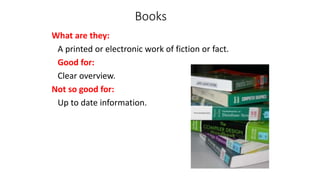
Books
What are they:
A printed or electronic work of fiction or fact.
Good for:
Clear overview.
Not so good for:
Up to date information.
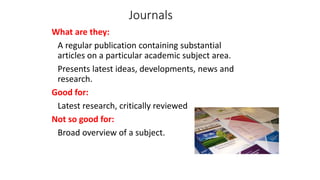
Journals
What are they:
A regular publication containing substantial
articles on a particular academic subject area.
Presents latest ideas, developments, news and
research.
Good for:
Latest research, critically reviewed by experts.
Not so good for:
Broad overview of a subject.
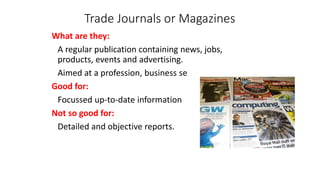
Trade Journals or Magazines
What are they:
A regular publication containing news, jobs,
products, events and advertising.
Aimed at a profession, business sector or hobby.
Good for:
Focussed up-to-date information.
Not so good for:
Detailed and objective reports.
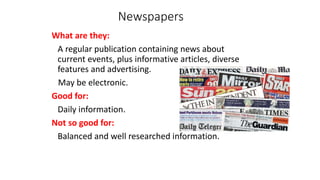
Newspapers
What are they:
A regular publication containing news about
current events, plus informative articles, diverse
features and advertising.
May be electronic.
Good for:
Daily information.
Not so good for:
Balanced and well researched information.
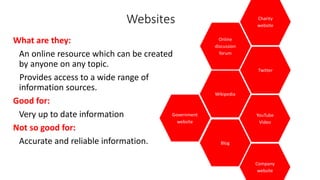
Websites
What are they:
An online resource which can be created
by anyone on any topic.
Provides access to a wide range of
information sources.
Good for:
Very up to date information.
Not so good for:
Accurate and reliable information.
Company
website
YouTube
Video
Twitter
Blog
Wikipedia
Government
website
Charity
website
Online
discussion
forum
Keywords – what are they?
Keywords are words or phrases that describe
content you are searching for
Keywords – Game
• How can you ensure you are finding what you need? Make sure you
search with the right keywords…
• Keywords Game…….
http://www.flickr.com/photos/rossjamesparker/89414788/
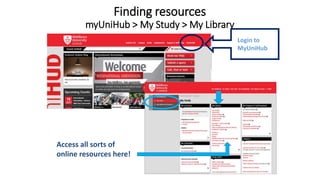
Finding resources
myUniHub > My Study > My Library
Access all sorts of
online resources here!
Login to
MyUniHub
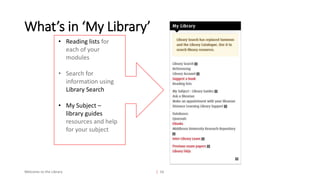
What’s in ‘My Library’
Welcome to the Library | 16
• Reading lists for
each of your
modules
• Search for
information using
Library Search
• My Subject –
library guides
resources and help
for your subject
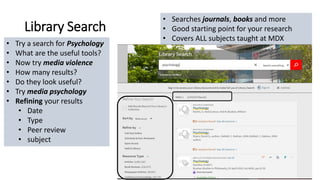
Library Search
• Searches journals, books and more
• Good starting point for your research
• Covers ALL subjects taught at MDX
• Try a search for Psychology
• What are the useful tools?
• Now try media violence
• How many results?
• Do they look useful?
• Try media psychology
• Refining your results
• Date
• Type
• Peer review
• subject
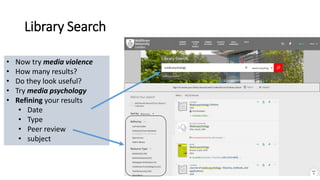
Library Search
• Now try media violence
• How many results?
• Do they look useful?
• Try media psychology
• Refining your results
• Date
• Type
• Peer review
• subject
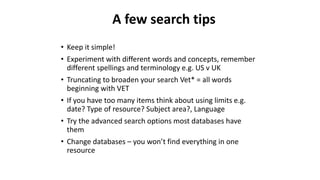
• Keep it simple!
• Experiment with different words and concepts, remember
different spellings and terminology e.g. US v UK
• Truncating to broaden your search Vet* = all words
beginning with VET
• If you have too many items think about using limits e.g.
date? Type of resource? Subject area?, Language
• Try the advanced search options most databases have
them
• Change databases – you won’t find everything in one
resource
A few search tips
When you are looking for
information about anything where
do you go first?
Presentation title
Google…grumpy cat says no…..
Presentation title
Good Google….
Presentation title
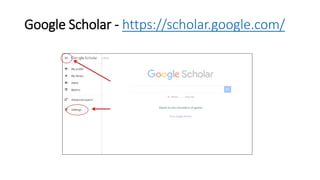
Google Scholar provides a simple way to broadly search
for scholarly literature. From one place, you can search
across many disciplines and sources: articles, theses,
books, abstracts and court opinions, from academic
publishers, professional societies, online repositories,
universities and other web sites
Google Scholar - https://scholar.google.com/
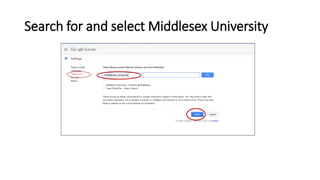
Search for and select Middlesex University
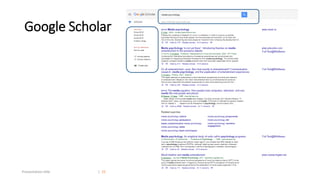
Google Scholar
Presentation title | 25
Evaluate Your Sources
C
A
R
P
• Currency
• Authority
• Relevancy
• Purpose/Point
of View
Currency
• When was the information published or posted?
• Has the information been revised or updated?
• Does your topic require current information, or will older sources
work as well?
Accuracy/Authority
• Is the information supported by evidence (e.g. references, research data)?
• Has the information been reviewed or refereed?
• Can you verify any of the information in another source or from personal
knowledge?
• Are there spelling, grammar or typographical errors?
• Who is the author/publisher/source/sponsor?
• What are the author's credentials or organisational affiliations?
• Is the author qualified to write on the topic?
• Is there contact information, such as a publisher or email address?
• Does the URL reveal anything about the author or source? examples: .com
.edu .gov .org .net
Relevancy
• Does the information relate to your topic or answer your question?
• Who is the intended audience?
• Is the information at an appropriate academic level?
• Have you looked at a variety of sources before determining this is one
you will use?
• Would you be comfortable citing this source in your research paper?
Purpose
• What is the purpose of the information? Is it to inform, teach, sell,
entertain or persuade?
• Do the authors/sponsors make their intentions or purpose clear?
• Is the information fact, opinion or propaganda?
• Does the point of view appear objective and impartial?
• Are there political, ideological, cultural, religious, institutional or
personal biases?
Evaluation game
• Look at these 4 pieces of information on self esteem
• In groups decide
• Which are relevant
• Which are no use
• Which has most academic authority
• Which items might be biased
• Which item is most current
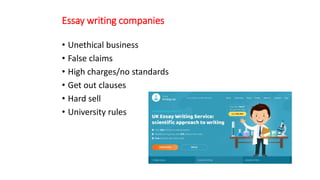
Essay writing companies
• Unethical business
• False claims
• High charges/no standards
• Get out clauses
• Hard sell
• University rules
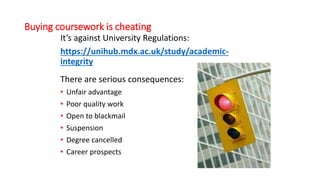
Buying coursework is cheating
It’s against University Regulations:
https://unihub.mdx.ac.uk/study/academic-
integrity
There are serious consequences:
• Unfair advantage
• Poor quality work
• Open to blackmail
• Suspension
• Degree cancelled
• Career prospects
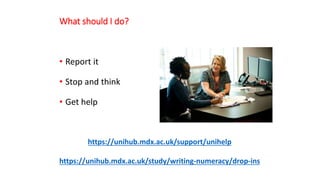
What should I do?
• Report it
• Stop and think
• Get help
https://unihub.mdx.ac.uk/support/unihelp
https://unihub.mdx.ac.uk/study/writing-numeracy/drop-ins
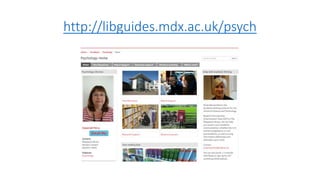
http://libguides.mdx.ac.uk/psych
Any questions?
Need help?
• Librarians in the Study Hub (1st floor) Monday – Friday, 9-5
• Ask a Librarian https://unihelp.mdx.ac.uk/askalibrarian
• Library guide for Psychology http://libguides.mdx.ac.uk/psych
• Psychology librarian: Susannah Parry s.parry@mdx.sc.uk

PSY0010 Foundation Level

  • 1.
  • 2.
    Today we willcover… Finding information for your assignments • Types of information • Library Search • Google Scholar • Evaluating information
  • 3.
    Presentation Topics • CognitivePsychology • ‘Memory & Music’ OR ‘Attention’ • Learning • ‘Media & Violence’ OR ‘Observational Learning’ • Developmental Psychology • ‘Attachment’ OR ‘Theory of Mind’
  • 4.
    You need information!Who ya gonna call?
  • 5.
  • 6.
    Library Resources • TheLibrary provides a range resources to support your research and study including: • Books • Journals • Trade Journals or Magazines • Newspapers • Websites
  • 7.
    Books What are they: Aprinted or electronic work of fiction or fact. Good for: Clear overview. Not so good for: Up to date information.
  • 8.
    Journals What are they: Aregular publication containing substantial articles on a particular academic subject area. Presents latest ideas, developments, news and research. Good for: Latest research, critically reviewed by experts. Not so good for: Broad overview of a subject.
  • 9.
    Trade Journals orMagazines What are they: A regular publication containing news, jobs, products, events and advertising. Aimed at a profession, business sector or hobby. Good for: Focussed up-to-date information. Not so good for: Detailed and objective reports.
  • 10.
    Newspapers What are they: Aregular publication containing news about current events, plus informative articles, diverse features and advertising. May be electronic. Good for: Daily information. Not so good for: Balanced and well researched information.
  • 11.
    Websites What are they: Anonline resource which can be created by anyone on any topic. Provides access to a wide range of information sources. Good for: Very up to date information. Not so good for: Accurate and reliable information. Company website YouTube Video Twitter Blog Wikipedia Government website Charity website Online discussion forum
  • 12.
    Keywords – whatare they? Keywords are words or phrases that describe content you are searching for
  • 13.
    Keywords – Game •How can you ensure you are finding what you need? Make sure you search with the right keywords… • Keywords Game…….
  • 14.
  • 15.
    Finding resources myUniHub >My Study > My Library Access all sorts of online resources here! Login to MyUniHub
  • 16.
    What’s in ‘MyLibrary’ Welcome to the Library | 16 • Reading lists for each of your modules • Search for information using Library Search • My Subject – library guides resources and help for your subject
  • 17.
    Library Search • Searchesjournals, books and more • Good starting point for your research • Covers ALL subjects taught at MDX • Try a search for Psychology • What are the useful tools? • Now try media violence • How many results? • Do they look useful? • Try media psychology • Refining your results • Date • Type • Peer review • subject
  • 18.
    Library Search • Nowtry media violence • How many results? • Do they look useful? • Try media psychology • Refining your results • Date • Type • Peer review • subject
  • 19.
    • Keep itsimple! • Experiment with different words and concepts, remember different spellings and terminology e.g. US v UK • Truncating to broaden your search Vet* = all words beginning with VET • If you have too many items think about using limits e.g. date? Type of resource? Subject area?, Language • Try the advanced search options most databases have them • Change databases – you won’t find everything in one resource A few search tips
  • 20.
    When you arelooking for information about anything where do you go first? Presentation title
  • 21.
    Google…grumpy cat saysno….. Presentation title
  • 22.
    Good Google…. Presentation title GoogleScholar provides a simple way to broadly search for scholarly literature. From one place, you can search across many disciplines and sources: articles, theses, books, abstracts and court opinions, from academic publishers, professional societies, online repositories, universities and other web sites
  • 23.
    Google Scholar -https://scholar.google.com/
  • 24.
    Search for andselect Middlesex University
  • 25.
  • 26.
    Evaluate Your Sources C A R P •Currency • Authority • Relevancy • Purpose/Point of View
  • 27.
    Currency • When wasthe information published or posted? • Has the information been revised or updated? • Does your topic require current information, or will older sources work as well?
  • 28.
    Accuracy/Authority • Is theinformation supported by evidence (e.g. references, research data)? • Has the information been reviewed or refereed? • Can you verify any of the information in another source or from personal knowledge? • Are there spelling, grammar or typographical errors? • Who is the author/publisher/source/sponsor? • What are the author's credentials or organisational affiliations? • Is the author qualified to write on the topic? • Is there contact information, such as a publisher or email address? • Does the URL reveal anything about the author or source? examples: .com .edu .gov .org .net
  • 29.
    Relevancy • Does theinformation relate to your topic or answer your question? • Who is the intended audience? • Is the information at an appropriate academic level? • Have you looked at a variety of sources before determining this is one you will use? • Would you be comfortable citing this source in your research paper?
  • 30.
    Purpose • What isthe purpose of the information? Is it to inform, teach, sell, entertain or persuade? • Do the authors/sponsors make their intentions or purpose clear? • Is the information fact, opinion or propaganda? • Does the point of view appear objective and impartial? • Are there political, ideological, cultural, religious, institutional or personal biases?
  • 31.
    Evaluation game • Lookat these 4 pieces of information on self esteem • In groups decide • Which are relevant • Which are no use • Which has most academic authority • Which items might be biased • Which item is most current
  • 32.
    Essay writing companies •Unethical business • False claims • High charges/no standards • Get out clauses • Hard sell • University rules
  • 33.
    Buying coursework ischeating It’s against University Regulations: https://unihub.mdx.ac.uk/study/academic- integrity There are serious consequences: • Unfair advantage • Poor quality work • Open to blackmail • Suspension • Degree cancelled • Career prospects
  • 34.
    What should Ido? • Report it • Stop and think • Get help https://unihub.mdx.ac.uk/support/unihelp https://unihub.mdx.ac.uk/study/writing-numeracy/drop-ins
  • 35.
  • 36.
  • 37.
    Need help? • Librariansin the Study Hub (1st floor) Monday – Friday, 9-5 • Ask a Librarian https://unihelp.mdx.ac.uk/askalibrarian • Library guide for Psychology http://libguides.mdx.ac.uk/psych • Psychology librarian: Susannah Parry s.parry@mdx.sc.uk

Editor's Notes

  • #3 We will look at different information types Have a look at library search and google scholar and think about how you decide what is a good source of information
  • #4 I understand that you will be presenting on one of these topics?
  • #5 Where do you go to find out about these topics? I imagine most student too young to recognise original Ghostbusters film cast…. Ask does anyone remember this film… came out on 1984
  • #6 Card Game We’re going to start off by: Exploring the range of resources available. Consider the value of different information sources. Think about which sources are going to help you find the information that you need. Its important to use a wide range of relevant resources in your work. This gives a balance and diversity to your work. Hand out exercise Thinking about resources. Card game Groups 10-15 mins Feedback (see next slides) 5 Yellow cards = different resources 5 Green cards = What are they match the definition to the resource 5 Pink cards = Not so good for…. 5 Purple cards = Good for…
  • #7 Before you start the slides ask one group to read out their cards and then show the slide see if it matches
  • #8 Good for: broad/general overview of a subject and background information Edited for quality and accuracy Not so good for: May not be specific enough Can be out of date, check the edition and publication date
  • #9 Good for: Up-to-date Specialist/focussed Present latest research Edited for accuracy/quality (peer reviewed) Lots of references Not so good for: Can be hard to locate/access Expensive May be too specific May be at wrong level
  • #10 Good for: Latest information Current events Concise info Product news Often available online with RSS/Twitter etc Not so good for: Detail Objective information ie. can be bias, adverts, preferential products etc Often hard to find old issues Back issues/archive
  • #11 Good for: Up-to-date Edited Readily available (latest copies especially) Not so good for: Can be bias Can be unbalanced Can be sensationalist Hard to get hold of/access (back issues) Broadsheet v tabloid – have they heard these terms
  • #12 There are loads of different types of information available on the internet, anything from social media and crowd sourced resources such as Wikipedia to organisational or academic sources. You need to be really critical of information that you find on the Internet and consider the provenance of the information i.e. who created it, when and why? Good for: Easy to use/search All subjects covered Can be very up-to-date Mobile Not so good for: No editorial control Unreliable sources Can be created by anyone Material can lack provenance Can be out-of-date Not everyone has access
  • #13 Keywords are words or phrases that describe content you are searching for
  • #14  Do the Cup of Tea Game : 10-15 mins? Split into groups or pairs and hand each pair a sheet with an image which they need to describe without using the words on the paper. Write keywords on flipchart sheet each and then present back to the other groups to see if the other groups can guess what the image is If they can = good choice of keywords If they can’t = a bit more thought required… or The Fruit Stall Game If there is time and they have understood the Cup of Tea or Fruit game try a Real thing version. Think about keywords for their presentation topic Put them into presentation topic groups so they can work together
  • #15 What can you see in the picture…fruit If type ‘fruit’ into database will get millions of hits, how can you break it down ie. search for something more specific to get more manageable results Can you be more specific ie. Type of fruit: apples, oranges, bananas etc Location: Stall, market, outdoor market, fruit market, Britain Detail: boxes, signs, astroturf, prices, colour of fruit, lights, pound £ signs, special offer etc People in background: old, young, male, female > stall holder, customers, browsers etc Think of related subjects eg. retail, commercial, financial, point-of-sale Shopping, shops, fish/meat/clothes market, shopping centres, high street Town, city, centre, British town Nutrition: vits and mins Also: Words with more than one meaning Orange or Blackberry: fruit NOT telephone Apple: fruit NOT computer Thinking beyond the obvious, looking for the detail that might make a difference.
  • #16  Get students to log into MyUniHub if not done so already
  • #17 Run through the list of options Lib Search Lib account Reading lists
  • #18 Remind to sign in
  • #19 Get the students to do searches for their presentations on library search Save searches
  • #20 Combine search terms Use AND to Narrow them Use OR to broaden them Use Not to exclude them VET* = words beginning with VET NURS* = nurse, nurses, nursing
  • #21 Google
  • #23 What is Google Scholar? Google Scholar is an online, freely accessible search engine that lets users look for both physical and digital copies of articles.   Find journal articles, dissertations, books, and more, from academic publishers, professional societies, universities and other web sites. Search across many subject areas Features of Google Scholar Search all scholarly literature from one convenient place Explore related works, citations, authors, and publications Locate the complete document through your library or on the web Keep up with recent developments in any area of research Check who's citing your publications, create a public author profile
  • #26 Get students to search with their topics
  • #27 Great you’ve found loads of stuff but is it any good…..
  • #32 Handout the self esteem items should be 5 of each of the 4 items and an evaluation sheet – put them in small groups or pairs
  • #33 Essay mills, essay writing services aka contract cheating are unethical business Not illegal under UK law but against university regulations (see later) Normally they claim only to be providing examples and in small print say must not be handed in as own work, but offer 1st class work at a higher price and will write entire dissertations, so hardly examples. Often high charges but no way to tell if the work is actually any good unless submitted. Claim it will pass Turnitin as original, but how do you know what you have paid for? (just as if you buy a fake pair of trainers which fall apart in a week) Normally have a small print get out clause saying money back if not satisfied but not applicable if the essay is submitted as course work. Hard sell techniques via internet, social media, flyers handed out in the street or left in rooms (even the library) Causes distress to honest students but also plays on fears of students who may be finding university challenging. Middlesex University has strict rules which ban the use of purchased essays
  • #34 There are risks associated with buying coursework such as essays, dissertations and projects from essay writing services such as the one on the screen. It’s cheating and against University Rules and there are serious consequences: We will stop students using it to get an unfair advantage You may waste your money paying for poor quality work which gets you worse results You may find yourself open to blackmail by the essay writing company: They know you have paid for their services and may then ask for more money or threaten to tall the University what you have done. You could be suspended or lose your place at University because of your academic misconduct. This is very serious and……. ……..could mean your degree is cancelled later in life ……..could have a negative impact on your future career prospects, as your employer might then fire you.
  • #35 Report it: If you are approached by a company or person who wants to sell you coursework or essays; or you find flyers on campus regards these services, then report it to your module leader. Stop and think: If you are tempted to buy coursework or essays, then stop and think carefully about the consequences of doing so. You will be found out and you could damage your future prospects as a result. Get help: If you are tempted to buy coursework because you are struggling with your academic work or there are other problems in your personal life, then get help: Academic Writing drop-in 12:00-15:00 Monday to Friday in StudyHub Ask a Librarian 09:00-17:00 Monday to Friday in StudyHub You can also make a 1-1 appointment with our librarians and academic writing experts. Ask at UniHelp regards help and support available for issues regarding progression, finance, housing etc You can drop-in to see a counsellor at Sunny Hill House/Farmside if you are struggling emotionally. Speak to your personal tutor if you are having problems with your programme.
  • #36 This is the library guide for psychology – look at it!
  • #38 Just mention usual support/contact options Congratulations you have finished the session!