
![Albert Ellis Albert Ellis (September 27, 1913 – July 24, 2007) was an American psychologist who in 1955 developed Rational Emotive Behavior Therapy (REBT). He held M.A. and Ph.D. degrees in clinical psychology from Columbia University and American Board of Professional Psychology (ABPP). He also founded and was the president emeritus of the New York City-based Albert Ellis Institute [1] . He is generally considered to be one of the originators of the cognitive revolutionary paradigm shift in psychotherapy and the founder of cognitive-behavioral therapies .](https://image.slidesharecdn.com/presentasikonseling-111010040038-phpapp02/85/psikologi-konseling-3-320.jpg)
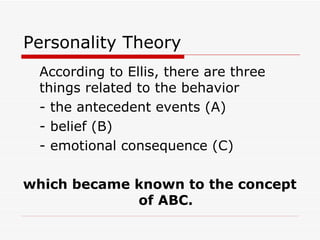


Rational Emotive Behavior Counseling was developed by American psychologist Albert Ellis in 1955. It is based on the theory that dysfunctional emotions stem from irrational and rigid beliefs. The counseling aims to dispute irrational beliefs and help clients achieve a more rational way of thinking. REBT counseling involves understanding how antecedent events, beliefs and emotional consequences are connected, and learning to dispute irrational beliefs through different stages of counseling. Counselors take an unconditionally accepting approach to help clients fully accept themselves. REBT can be applied in individual counseling and group settings for issues like anxiety, neuroses, interpersonal problems and addiction.


