World Journal of Pharmaceutical Sciences
ISSN (Print): 2321-3310; ISSN (Online): 2321-3086
Published by Atom and Cell Publishers © All Rights Reserved
Available online at: http://www.wjpsonline.org/
Short Communication
Comparative study between silicone and fatty surfactant
1
Minakshee Bhagwan Vaidya, 2
Bharti Ganu, 1
Deepak Wasule
1
Department of Cosmetic Technology, L.A.D. College, Seminary Hills, Rashtrasant Tukdoji Maharaj Nagpur
University, Nagpur-440009, Maharashtra , India
2
Masters in (M. Sc) Organic Chemistry; Lecturer at Department of Cosmetic Technology, Nikalas Mahila
Mahavidyalaya,
Received: 03-02-2015 / Revised: 24-02-2015 / Accepted: xx-xx-2015
ABSTRACT
The present study has been undertaken with the aim to formulate and evaluate shampoo with Silicone Surfactant
and to do a comparative study with that of Fatty Surfactant. In general, various Fatty surfactants used in
shampoos, face washes, shaving creams can cause severe skin and eye irritation as well as allergic reaction.
They remove fat from the skin and make skin as well as hair surface dry. Therefore present study introduces the
Silicone Surfactant, a new class of surfactant which are non irritant, non toxic yet eco-friendly as well they
alters surface tension, spreadability, cushion and play time in formulation and give Silicone specific silk like
feel on skin and hair. In present study by incorporating Silicone surfactant (Dimethicone copolyol) and Fatty
surfactant (SLES) into shampoo, different parameters such as Surface tension, Foaming, Wetting, Cleansing and
Conditioning effect were studied to carry out the comparative study between both the surfactants.
Key words: Silicone surfactant, Fatty surfactant, Surface tension, Shampoo, etc
INTRODUCTION
A surfactant is a molecule with two portions that if
they are pure would be insoluble in one another.
These molecules travel to an interface where they
lower surface tension. Lowering of surface tension
is a necessary fact for providing foam, wetting,
emulsification and other surfactant properties. One
way to study the surfactant system is by looking at
their surface tension. Surface tension reduction is
an indicator of surface activity.[1]
Present study
includes Silicone surfactant and Fatty surfactant
which differ fundamentally in their surface tension
properties. Surface tension of Fatty surfactant (ex;
Sodium laureth sulphate) has aqueous surface
tension of around 32dynes/sq cm. While Silicone
surfactant (ex. Dimethicone copolyol) have surface
tension of around 20dynes/sq cm. Silicone
surfactants are able to alter the surface tension,
spreadability, cushion and play time of oil phases.
Even low concentration of a properly selected
Silicone surfactant can reduce surface tensions. [2]
Varying the surface tension of the resulting
solution can adjust the feel, change in bubble size
and texture, and alter other properties of the
product. Thus selecting the proper surfactants will
allow the formulator to achieve different aesthetics
in the formulation. [3]
Therefore present study introduces the Silicone
surfactant, a new class of surfactant which alters
surface tension, spreadability, cushion and play
time in formulation as well as give Silicone
specific silk like feel on skin and hair when applied
to skin and hair care formulation. Thus by
incorporating the proper type and amount of
Silicone surfactant into products, allows to obtain
substantially different aesthetics from formulations
that are already developed, minimizing
development time and maximizing efficiency.
MATERIALS AND METHODS
Surfactant: Surfactants are used in many
cosmetics as foaming agents, cleansers,
emulsifiers, conditioners and solubilizers or
dispersants. The word surfactant comes ‘surface
*Corresponding Author Address: Ms. Minakshee Bhagwan Vaidya, M. Tech. Cosmetic Technology, L.A.D. College, Seminary Hills,
Rashtrasant Tukdoji Maharaj Nagpur University, Nagpur;India
Minakshee et al., World J Pharm Sci 2015; 3(3): xxxx
active agent’. They are ingredients that lower the
surface tension of a liquid or another way to put it
is that they are wetting agents. [19]
A single
surfactant molecule has two ends; one that is
attracted to water (hydrophilic) and one that is
attracted to oil (hydrophobic). This property of
having both water soluble and oil soluble parts is
called amphiphilic. Surfactants are used in both
aqueous and non-aqueous systems. [19]
In cosmetic
products, surfactant performs various functions
such as cleansing, emulsifying agent, foam booster
solubilizing agent, hydro tropes, suspending agent
and many others. [17]
Reduction of Surface Tension by surfactants:
Surfactants reduce the surface tension of water by
adsorbing at the liquid-gas interface. They also
reduce the interfacial tension between oil and water
by adsorbing at the liquid-liquid interface. [14]
Reduction of surface or interfacial tension is one of
the most commonly measured properties of
surfactant solution. The purpose of comparing the
performance of surfactant in reducing the surface
tension, it is necessary to distinguish between the
efficiency of the surfactant (the bulk phase
concentration of surfactant required to reduce the
surface or interfacial tension by some significant
amount) and its effectiveness, the maximum
reduction in tension that can be obtained,
regardless of the bulk phase concentration of
surfactant. [11], [26]
Fig. Reduction of surface tension
Effect of Surface Tension on Surfactant
Efficacy: The performance of a surfactant in
lowering the surface tension of a solution, it is
necessary to consider two aspects of the process
which are, The concentration of surfactant in the
bulk phase required to produce a given surface
tension reduction and the maximum reduction in
surface tension that can be obtained, regardless of
the concentration of surfactant present. [10]
Surfactant efficiency is related to the extent of
adsorption at the interface as a function of bulk
surfactant concentration.[11]
FATTY AND SILICONE SURFACTANT
For comparative study between Fatty surfactant
and Silicone surfactant, Sodium Lauryl Ether
Sulphate (SLES) was selected as a Fatty surfactant
and Dimethicone Copolyol (DMC) as a Silicone
surfactant.
FATTY SURFACTANT
Fatty surfactants are simply compounds with oil
and water soluble groups whereas Silicone
surfactants are compounds with Silicone-soluble
and water-soluble groups.[1]
Fatty surfactants such
as Sodium Lauryl Sulphate (SLS), Sodium Laureth
Sulphate (SLES) will reduce the surface tension of
water from about 72dyne/cm2
to around
32dyne/cm2
. The use of Fatty surfactants is not
effective due to insolubility and/or the fact that the
Fatty surfactant has a higher surface tension than
the solvent. [1], [21]
Sodium Laureth Sulphate or
Sodium Lauryl Ether Sulphate (SLES) is cationic
surfactant. SLES is a sodium salt compound and
this sodium salt is also a surfactant which means,
SLES is a wetting agent that allows the product to
spread more easily, suspends soil, and emulsifies
oils.[13]
SLES can be obtained from ethoxylation of
Sodium Lauryl Sulphate, which is a detergent and
surfactant found in many personal care products.
According to the Environmental Working Group,
this chemical is listed under many other names, is
highly irritant to humans and is a possible
carcinogen (cancer causer). SLES is known to
contribute to skin and hair dryness as well as eye
irritation. Cosmetics and personal care products
containing Sodium laureth sulphate can cause
roughness and flaking of the skin. SLES is a
caustic cleanser that could corrode the hair. [6], [19]
SILICONE SURFACTANT
The introduction of surfactant based upon Silicone
hydrophobes offer another dimension to surface
technology. Silicone surfactants are compound
with Silicone soluble and water soluble group. [1]
In
some instances, Silicone is incorporated into a
surface-active agent, with a polyoxyalkylene
portion of the molecule and or a hydrocarbon
portion of the molecule, this results in several
unique properties of the surfactant.[25]
Historically,
Silicone compounds have been available as water
insoluble oily materials. This has limited the
number of Silicone compounds that the formulator
could use in many applications. Silicone
compounds that not only provide the desired
softening, conditioning and treatment affects but
are self-emulsifying.Surfactants are materials with
an oil soluble group, generally Fatty and a water-
soluble group. If one either includes a Silicone
group as the hydrophobes or includes a Silicone
hydrophobes into the molecule a whole new world
of formulator friendly compounds opens up.[25]
Silicones are highly surface active due to their low
surface tension, caused by large number of Methyl
groups and due to the small intermolecular
2
Minakshee et al., World J Pharm Sci 2015; 3(3): xxxx
attractions between the siloxane. Siloxane
backbone of the molecule is highly flexible which
allows for maximum orientation of the attached
group at interfaces. [7]
The use of Silicone, not
merely as an oil phase requires the
functionalization of the molecule to make it useful
in application areas where a water insoluble
product is not appropriate.[25], [8]
The traditional oil
soluble portion of the molecule is Fatty. The
Silicone surfactants substitute or add Silicone
based hydrophobicity. This results in materials that
have the substantively lower irritation, skin feel
and other attributes of Silicone in addition to the
properties one expects from the Fatty surfactant. If
the molecule has both a Silicone and Fatty
hydrophobes present it will function with attributes
of both of the materials. This allows for the
formulation of a wide variety of products that have
oil, water, Silicone or variable solubility. [1], [8]
Dimethicone Copolyol
Dimethicone copolyols (DMC) (also called
PEG/PPG dimethicones, Silicone glycols and
Silicone surfactants) are one class of amphiphilic
materials having water soluble and a Silicone
soluble portion in one molecule. [1]
CH CH3 CH3 CH3
| | | |
CH3-Si-O- (- Si- O)a- (-Si-O)b -- Si- CH3 Silicone Soluble
| | | |
CH3 CH3 (CH2)3 CH3
|
O- (CH2CH2O)xH Water Soluble
Fig. No. Structure of Dimethicone Copolyol
Dimethicone copolyol is derived from Silicone,
which is from silica unlike most silicon derivatives;
it is soluble in water and combines regularly with
inorganic oils and waxes. The dimethicone
copolyol has been the workhorse of the personal
care industry for many years. Since Silicone fluids
are difficult to formulate into aqueous products,
many formulators have used dimethicone copolyol.
Dimethicone copolyol softens and smoothes skin
and hair. It repels water and ads shine to hair. It
helps certain personal care products spread more
smoothly and evenly and in some cases acts as a
moisturizer. Since the molecule contains water-
soluble groups, the resulting surfactant is easily
added to aqueous products. Dimethicone copolyol
is a low-odor ingredient that replaces other
ingredients that have an unpleasant odor. The main
purpose of this additive is to add shine and make
hair feel fuller. Although it is a Silicone derivative,
dimethicone copolyol has not been shown to clog
pores and this is safe in shampoos, conditioners and
skin care products. [2], [15]
Toxicity: Dimethicone copolyol is non-toxic and is
not listed by any country or organization as being
toxic in any way. However, dimethicone copolyol
is far less irritating than the compounds that it
replaces. It results in products which are,
comparatively, less irritating than ones using older
additives.
Ecotoxicity: Dimethicone copolyol has no known
negative effects on wildlife or natural systems.
Dimethicone Copolyol Chemistry: There are a
number of descriptive names used to denote
dimethicone copolyol. The Cosmetics, Toiletry and
Fragrance Association use the term dimethicone
copolyol to describe this class of
Silicone/polyoxyalkylene derivatives. Dimethicone
copolyol surfactants are a class of compounds that
confirm to the following structure.
CH3 CH3 CH3 CH3
| | | |
CH3-Si--(- O—Si--)a—(O--Si )b—O—Si-CH3
| | | |
CH3 CH3 (CH2)3 CH3
|
O- (CH2CH2O)cH
Fig. Structure of Dimethicone Copolyol
The nomenclature was developed to reflect the fact
that the molecule is
(a) A Silicone polymer (Dimethicone)
(b) A copolymer (Copolyol part) and
3
Minakshee et al., World J Pharm Sci 2015; 3(3): xxxx
(c) Hydroxyl functional (Ol ending). [20],
Dimethicone Copolyol Properties: It has Low
surface tension and Moderate water interfacial
tension it possess no surface viscosity. Spreading
and ‘creep’ behavior also have Variety of
configuration
 Large free volume
 Low glass transition temperature
 Low Flammability and Fire Hazard
 Excellent weather Resistant
 Liquid Nature at High Molecular Weight.[7]
EXPERIMENTATION
Formulation and Development: For carrying out
comparative study between Fatty surfactant and
Silicone surfactant in cosmetic products shampoo
was selected, as shampoo contain about 30-45%
surfactant in their formulation.
Basic Ingredients Used In Shampoo
1. Surfactants
2. Conditioning Agents
3. Foam Booster and Stabilizers
4. Special Additives
5. Preservatives
6. Sequestering Agents
7. Viscosity Modifiers
8. Opacifying or Clarifying Agents
9. Fragrance
10. Color
11. Stabilizers - Suspending agents
12. Antioxidant, UV absorber [23]
Shampoo: Shampoo is a hair care product used for
the removal of oils, dirt, skin particles, dandruff,
environmental pollutants and other contaminant
particles that gradually build up in hair. The goal is
to remove the unwanted build-up without stripping
out so much sebum as to make hair unmanageable.
[20]
Shampoo is a cosmetic product which consists
mainly of different types of surfactants. These
surfactants are added in shampoo as cleansing,
foaming, and solublizing and wetting agents to
perform respective functions. [23], [12]
Functions of Shampoo
 Spread easily
 Lathering Power
 Efficient soil remover
 Luster to hair
 Setting of hair [5], [23]
Formulation & Development
Shampoos were formulated using different ratio of Silicone as well Fatty Surfactant.
Quantity for 100 %
Ingredients F1 F2 F3 F 4 F5 F6
SodiumLaureth
Sulphate(SLES)
40 35 30 20 10 -
Dimethicone Copolyol - 5 10 20 30 40
Cocobetain 5 5 5 5 5 5
Cocodiethanolamine 3 3 3 3 3 3
Water 51 52 52 52 51.5 51.5
Methyl Paraben o.2 o.2 o.2 0.2 0.2 o.2
Sodium Chloride 1 0.2 o.2 0.2 0.7 0.8
Citric Acid o.o2 0.02 0.02 0.02 0.02 0.02
Shampoos with different concentration of Silicone
surfactant were prepared to study the effect of
Silicone surfactant. Formulations F1, F2, F3, F4
and F5 were stable at room temperature but F6 lose
its consistency after 2-3 days of preparation.
Therefore F1, F2, F3, F4, F5 were finalized for
comparative study between Silicone surfactant and
Fatty surfactant.
Abbreviations Used
1. Sodium Laureth sulphate => SLES
2. Dimethicone Copolyol => DMC
3. Shampoo with 40% Fatty surfactant
(SLES) and 0% Silicone surfactant
(DMC) => A
4. Shampoo with 35%Fatty surfactant
(SLES) and 5% Silicone surfactant
(DMC) => B
5. Shampoo with 30% Fatty surfactant
(SLES) and 10% Silicone surfactant
(DMC)=> C
6. Shampoo with 20% Fatty surfactant
(SLES) and 20% Silicone surfactant
(DMC) => D
4
Minakshee et al., World J Pharm Sci 2015; 3(3): xxxx
7. Shampoo with 10% Fatty surfactant
(SLES) and 30% Silicone surfactant
(DMC)=> E
Experimental Analysis of Finished Products:
The performance and quality of shampoo using
Silicone surfactant and Fatty surfactant was
evaluated on the basis of effects like, cleansing
power, foaming power, viscosity, etc.
Physical Analysis
1] Appearance: Result - All the samples of
shampoo prepared for test were freed from
sediment and they were homogenous, when
examined visually.
2] Determination of pH: pH was determined as
per BIS Specification IS 7884.1992 for shampoo.
[12]
From table no.1, pH of all Shampoos was found
to be within a standard range.
Table No. 1 Results for pH
3] Viscosity: Viscosity is an important factor in
shampoo formulations. Viscosity was measured
with the help of Brookfield viscometer (Brookfield
Engineering Lab. U.S. Model LVDVI) using
spindle #6, at a speed of 100rpm at 25ºC. [9]
From graph no.1, it was found that viscosity of
shampoo increased with increase in Silicone
surfactant concentration, but when 30% DMC
added viscosity dropped. Shampoo with SLES
required more amounts of viscosity modifiers i.e.
about 1-2% salt to obtained desired viscosity, while
in shampoo with different concentration of DMC
required less than 1% salt to achieve the same
viscosity.
5
As per
standard
Test Samples
A B C D E
5-9 7.4 7.14 7.26 7.8 7.67
Graph no.1 Viscosity vs. Shampoos containing variation in DMC concentration
Test Samples
Minakshee et al., World J Pharm Sci 2015; 3(3): xxxx
Chemical Analysis
1] Determination of Non-Volatile Alcohol Soluble Matter [12]
Reagents- As per BIS IS 7884.1992 for shampoo
Table No.2 Nonvolatile Alcohol soluble Matter
As per standard Test Samples
Min10% by mass A B C D E
11.6% 10.7% 10.4% 10.23% 10.23%
Result- From above table no.2, % of non-volatile alcohol soluble matter of shampoos was found to be as per
standard.
2] Active Detergent Content
Sample Calculation – As per BIS IS 7884.1992 for shampoo
Following graph was plotted. [12]
6
Minakshee et al., World J Pharm Sci 2015; 3(3): xxxx
0.00%
5.00%
10.00%
15.00%
20.00%
25.00%
A B C D E
ActiveDetergentContent(%)
Active detergent content vs. ShampoocontainingvariationinDMC concentration
Test Samples
Graph No.2 Active detergent Vs shampoos containing variation in DMC concentration
Result - From the above graph no.2, active detergent content was found to be decreased at shampoo B, C, E
as compare to that of shampoo A and shampoo D.
3] Determination of Foam Height: In order to
check the ability of a shampoo to produce lather,
the volume of foam obtained under specific
experimental conditions was determined.
Procedure: In a beaker about 10gm of sample was
weighed. It was mixed with 200ml of water by
stirring slowly, the above prepared solution was
added to a 1000ml measuring cylinder up to the
mark of 200 ml and 12 shakes were given to the
cylinder. One shake was taken when cylinder was
inverted and brought to its original position. The
height of foam was noted after 5 minute of the 12
shakes. The foam height was taken as the
difference between the supernatant liquid layer and
foam layer. After the foam height reading,
immediately the amounts of small, creamy,
bubbles, medium sized bubbles and large bubbles
were recorded –smaller bubbles produced creamy
lather whereas larger bubbles provided good flash
foaming effect. Finally the foam volume was read
7
Minakshee et al., World J Pharm Sci 2015; 3(3): xxxx
again after 5 min to determine the foam’s stability.
The lesser the difference between the immediate
foam height and foam height after 5 min, the more
stable the foam. [25], [16]
Table No. 3 Foam height and bubble no. [17]
Test
Sampl
e
Initial foam
Height ‘mm’
Medium
bubbles
Large
Bubbles
Foam height after
5 min‘mm’
A 235 70 60 235
B 215 50 40 2 10
C 220 60 25 215
D 250 60 30 250
E 200 60 20 200
Graph No. 3 Foam height vs. Shampoos containing variation in DMC Concentration
Result: As shown in above graph, the shampoo
containing 50:50 mixtures of Silicone and Fatty
surfactant respectively i.e. D, produced the higher
quantity of foam. This mixture also had good foam
stability for 5 min. This suggests that a shampoo
containing Silicone surfactant (DMC) along with
Fatty surfactant (SLES) would have efficacious
foaming properties, both quantitatively and
qualitatively
Determination of Cleansing Property: The
measurement of surface (liquid to air) and
interfacial (liquid to liquid) tension are, to an extent
a guide to how effectively surfactant solution can
surround , break-up and solublized soil. It should
be noted that surface tension of pure water is
78dynes/cm2
and that relatively low concentration
normally has low influence in further lowering
surface tension. The surface tension of shampoo
can be determined by using, Dunoüy ring method.
[25]
8
Minakshee et al., World J Pharm Sci 2015; 3(3): xxxx
Graph No.4 Surface Tension vs. Shampoos containing variation in DMC concentration
Result - From the above graph, it was found that
shampoo with SLES as a Primary surfactant i.e. A
showed highest surface tension but, as the Silicone
surfactant added surface tension decreased ,
shampoo with both 20% DMC and 20% SLES i.e.
D had lowest surface tension.
Cleansing: Human hair has similar chemical
composition, physical property and histological
structure those of keratin fiber used in textile
industry, when formulating a hair shampoo, certain
restriction must be kept in mind.
1. Cleansing can be carried out at 40-45ºc
2. Time available for cleansing is very short
3. The detergent used should be tested for efficacy
Evaluation of Cleansing Activity - The standard
laboratory shampooing technique was employed to
study this action. The method was as follows-
• Saloon sweeping were degreased by washing
with diethyl ether.
• The hair was washed by rubbing and mixing
for 10 minutes. Then degreased hairs were
dried at 30-35ºC.
• About 1 of degreased hair was blended with
1% standard soil using diethyl ether. The
blending condition was continued until there
is no smell of ether left.
• The degreased hairs were further dried at 30-
35ºc for 1 hour. The hair was weighed then
the soiled hair was kept in polyethylene bag,
90c.c of water was then added to the hair.
• The water was mixed in the hair.
• The 10c.c shampoo was added and hair
washed for 1min under tap water and
thoroughly dried.
• The weight of the hair was noted.
• The soil removal capacity in 1% was
considered as cleansing power.
The standard soil was prepared using information
of literature survey. The composition of natural soil
was as follows-
• Soil (dust)-60%
• Carbon black-20%
• Liquid paraffin-20%
The cleansing activity of the shampoo was
determined under two conditions.
1. Water at room temperature
2. Water at 50ºC(bathing temp)
These conditions were followed while washing
the soiled hair.
9
Minakshee et al., World J Pharm Sci 2015; 3(3): xxxx
Graph No.5 - %Cleansing Activity vs. Shampoos containing different concentration of DMC
Result: From the above graph, it was found that as
the % of Silicone surfactant (DMC) increased,
cleansing activity also increased. Shampoo
containing 20% DMC i.e. D and Shampoo
containing 30% DMC i.e. E showed best cleansing
activity.
Wetting Ability: The interaction of two different
types of surfactant with each other, either in mixed
monolayer at an interface or in mixed micelles in
aqueous solution, can result in synergistic
enhancement of their interfacial properties which
can result in improved performance properties,
such as wetting. Enhancement of wetting is the
result of synergistic interaction producing a
decrease in dynamic and equilibrium surface
tension values. The present Draves Wetting Test is
aimed to study the performance of the surfactant
(Fatty surfactant as well as Silicone surfactant)
present in shampoo. [4], [27]
Draves Wetting Test: In this test a 0.1% given
solution is used to sink a cotton skein.
Method
1. The weight of each skein corrected to 5.0 g ±
0.05 g before using.
2. Cut one skein apart and used the individual
threads to correct other skeins.
3. A solution of the test product at the test
concentration prepared.
4. The graduated cylinder filled with test
solution sufficient to completely cover the
skein assembly. Pour solution slowly down
the side of the cylinder to minimize amount of
foam created on surface. Air bubbles created
during pouring allowed to settle out.
5. Attached a folded skein to the shook.
6. Holding the skein at the top with the hook
dropped the assembly into the foam solution
in the graduate cylinder.
7. The time for the skein to sink was measured.
8. The time, in seconds for the skein to sink was
recorded.
9. The solution and skein discarded.
10. Repeated steps 2 through 9, three times using
fresh solution and a new skein each time.
11. Average the results of the three trials,
recorded the average. [10], [16], [28]
10
Minakshee et al., World J Pharm Sci 2015; 3(3): xxxx
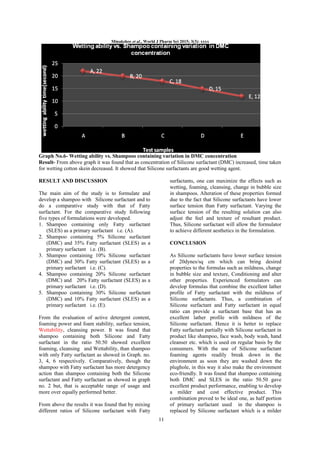
Graph No.6- Wetting ability vs. Shampoos containing variation in DMC concentration
Result- From above graph it was found that as concentration of Silicone surfactant (DMC) increased, time taken
for wetting cotton skein decreased. It showed that Silicone surfactants are good wetting agent.
RESULT AND DISCUSSION
The main aim of the study is to formulate and
develop a shampoo with Silicone surfactant and to
do a comparative study with that of Fatty
surfactant. For the comparative study following
five types of formulations were developed.
1. Shampoo containing only Fatty surfactant
(SLES) as a primary surfactant i.e. (A).
2. Shampoo containing 5% Silicone surfactant
(DMC) and 35% Fatty surfactant (SLES) as a
primary surfactant i.e. (B).
3. Shampoo containing 10% Silicone surfactant
(DMC) and 30% Fatty surfactant (SLES) as a
primary surfactant i.e. (C).
4. Shampoo containing 20% Silicone surfactant
(DMC) and 20% Fatty surfactant (SLES) as a
primary surfactant i.e. (D).
5. Shampoo containing 30% Silicone surfactant
(DMC) and 10% Fatty surfactant (SLES) as a
primary surfactant i.e. (E).
From the evaluation of active detergent content,
foaming power and foam stability, surface tension,
Wettability, cleansing power. It was found that
shampoo containing both Silicone and Fatty
surfactant in the ratio 50.50 showed excellent
foaming, cleansing and Wettability, than shampoo
with only Fatty surfactant as showed in Graph. no.
3, 4, 6 respectively. Comparatively, though the
shampoo with Fatty surfactant has more detergency
action than shampoo containing both the Silicone
surfactant and Fatty surfactant as showed in graph
no. 2 but, that is acceptable range of usage and
more over equally performed better.
From above the results it was found that by mixing
different ratios of Silicone surfactant with Fatty
surfactants, one can maximize the effects such as
wetting, foaming, cleansing, change in bubble size
in shampoos. Alteration of these properties formed
due to the fact that Silicone surfactants have lower
surface tension than Fatty surfactant. Varying the
surface tension of the resulting solution can also
adjust the feel and texture of resultant product.
Thus, Silicone surfactant will allow the formulator
to achieve different aesthetics in the formulation.
CONCLUSION
As Silicone surfactants have lower surface tension
of 20dynes/sq cm which can bring desired
properties to the formulas such as mildness, change
in bubble size and texture, Conditioning and alter
other properties. Experienced formulators can
develop formulas that combine the excellent lather
profile of Fatty surfactant with the mildness of
Silicone surfactants. Thus, a combination of
Silicone surfactant and Fatty surfactant in equal
ratio can provide a surfactant base that has an
excellent lather profile with mildness of the
Silicone surfactant. Hence it is better to replace
Fatty surfactant partially with Silicone surfactant in
product like shampoo, face wash, body wash, hand
cleanser etc. which is used on regular basis by the
consumers. With the use of Silicone surfactant
foaming agents readily break down in the
environment as soon they are washed down the
plughole, in this way it also make the environment
eco-friendly. It was found that shampoo containing
both DMC and SLES in the ratio 50.50 gave
excellent product performance, enabling to develop
a milder and cost effective product. This
combination proved to be ideal one, as half portion
of primary surfactant used in the shampoo is
replaced by Silicone surfactant which is a milder
11
Minakshee et al., World J Pharm Sci 2015; 3(3): xxxx
than Fatty surfactant, having additional benefits such as conditioning effect to hair beside excellent
cleansing, wetting, foaming ability.
RFERENCES
1. Anthony J. O’Lenick Jr., Thomas G. O’Lenick, Laura Anderson. Mixed Fatty/Silicone Surfactant System, Cosmetic and
Toiletries Science Applied. Published by Allured Business Media, August 2007, pg no. 49-54.
2. Anthony J. O’Lenick, Laura Anderson. Selecting Silicone Surfactants for Personal Care Formulations. Cosmetic and Toiletries
Science Applied. Published by Allured Business Media. July2008, pg. no. 27-29.
3. Andrew O’Lenick Jr., Silicone Emulsion and Surfactant - A review. Published by Siliconespectator, March 2009, pg. no. 4-5.
4. Anthony J. O’Lenick, Kevin A. O’ Lenick. Surfactants-Silicone Amphilies. Published by Household and Personal Care Today,
Feb2008, pg. no.1-4.
5. Anthony O. Lenick, Mitchell Schlossman, and P. Somasundaran (Eds.). Surfactants in Personal Care Products and Decorative
Cosmetics. Published by Boca Raton. CRC, 2007, 3 rd edition, volume 135.
6. A. O’Lenick. 3D HLB. Silicone for Personal Care. Allured Publication, 2003, pg.no. 2,123.
7. Anthony J. O’Lenick. Surfactants strategic raw materials, Allured publishing. January 2005. pg.no.112.
8. Adriana Urrutia. Silicone. The Basis of a Perfect Formulation for Hair Care. Published by Dow Corning de Mexico S.A. de C.V.
pg. no. 1-4
9. Amparo Salvador and Alberto Chisvert. Analysis o f Cosmetic Products. ELSEVIER Publication. Pg.no.291-293.
10. American Society for Testing and Materials. Standard Test Method for Evaluation of Wetting Agents by the Skein Test. D2281-
68 (2005).
11. Baquerizo, M.A. Ruiz, J.A. Holgado, M.A. Cabrerizo b, V. Gallardo. Measurement of dynamic surface tension to determine
critical micellar concentration in lipophilic Silicone surfactants. Published by Elesevier publication, July 2008, (www.elsevier.nl)
12. Bureau of Indian Standards. Specification for Shampoo, Synthetic Detergent Based. IS 7884.1992. pg.no.1-6.
13. B.M. Mildwiskey and D.M. Gabriell. Detergent analysis-A Handbook of cost effective quality control. pg.no. 175-180.
14. Drew Mayer. Surfactant Science and Technology. Published by Whinsey publication 1992. 2nd
edition. pg. no. 64
15. E.G.Thomasse. Modern Technology of Cosmetics. Published by NIIR Board. 1st
edition,1983. pg. no. 21-23.
16. G.E New. Standard Laboratory Shampooing International Federation of Society of Cosmetics Chemist. London-1962, pg. no.
257.
17. Jim W. Goodwin. Colloids and Interfaces with Surfactants and Polymers. Interfacial Dynamics Corporation. Published by John
Wiley and Sons, pg. no.20, 22.
18. J. L. Garaud, Silicones in Personal Care Applications. Seneffe (Belgium). Published by Dow Corning Europe SA, pg.no.1-3.
19. Milton. Jacques Rosen. Surfactant and Interfacial Phenomenon. Published by John Wiley and Sons 2004, 3rd
edition, pg. no. 32,
40.
20. Martin M. Reiger and Linda, D. Rhein. Surfactants in Cosmetics. Published by CRC press, 2nd
edition, 1997, Volume 68, pg
no.10.
21. Michael Ash, Irene Ash. Surfactants Encyclopedia. Published by Chemical publication, 1985, pg. no. 56.
22. M. S. Balsam, Edward Sagarin. Cosmetics Science and Technology. Published by Kriegers publishing company. 2nd
edition,
Volume 2, pg.no.343.
23. Richard J. Fern. Chemistry and Technology of Surfactants. Published by Blackwell publishing 2006, 2nd
edition, pg. no.83.
24. R. M. Hill, M. He, H.T. Davis, L.E. Scriven, Langmuir. Silicone Surfactant Interaction (1994). pg. no. 17-24.
25. Shoib Arif. Sulfate Vs. Sulfate-free Journal of Cosmetics and Toiletries. Volume-124. NO.2. February 2009. pg. no.73-75, 78-
79.
26. W.M. Linfield. Anionic Surfactants-Part-I. Published by John Wiley and Sons, 1998. pg. no. 253.
27. Y. K. Kamath, C.J. Dansizer, H.D. Weigmann. Surface Wettability of Human Hair II. Wetting behavior of Human Hair Fibers.
Published by Journal of Applied Polymer Science 1978, 22.2295, pg. no. 4-5
12

PS0607 (1)

  • 1.
    World Journal ofPharmaceutical Sciences ISSN (Print): 2321-3310; ISSN (Online): 2321-3086 Published by Atom and Cell Publishers © All Rights Reserved Available online at: http://www.wjpsonline.org/ Short Communication Comparative study between silicone and fatty surfactant 1 Minakshee Bhagwan Vaidya, 2 Bharti Ganu, 1 Deepak Wasule 1 Department of Cosmetic Technology, L.A.D. College, Seminary Hills, Rashtrasant Tukdoji Maharaj Nagpur University, Nagpur-440009, Maharashtra , India 2 Masters in (M. Sc) Organic Chemistry; Lecturer at Department of Cosmetic Technology, Nikalas Mahila Mahavidyalaya, Received: 03-02-2015 / Revised: 24-02-2015 / Accepted: xx-xx-2015 ABSTRACT The present study has been undertaken with the aim to formulate and evaluate shampoo with Silicone Surfactant and to do a comparative study with that of Fatty Surfactant. In general, various Fatty surfactants used in shampoos, face washes, shaving creams can cause severe skin and eye irritation as well as allergic reaction. They remove fat from the skin and make skin as well as hair surface dry. Therefore present study introduces the Silicone Surfactant, a new class of surfactant which are non irritant, non toxic yet eco-friendly as well they alters surface tension, spreadability, cushion and play time in formulation and give Silicone specific silk like feel on skin and hair. In present study by incorporating Silicone surfactant (Dimethicone copolyol) and Fatty surfactant (SLES) into shampoo, different parameters such as Surface tension, Foaming, Wetting, Cleansing and Conditioning effect were studied to carry out the comparative study between both the surfactants. Key words: Silicone surfactant, Fatty surfactant, Surface tension, Shampoo, etc INTRODUCTION A surfactant is a molecule with two portions that if they are pure would be insoluble in one another. These molecules travel to an interface where they lower surface tension. Lowering of surface tension is a necessary fact for providing foam, wetting, emulsification and other surfactant properties. One way to study the surfactant system is by looking at their surface tension. Surface tension reduction is an indicator of surface activity.[1] Present study includes Silicone surfactant and Fatty surfactant which differ fundamentally in their surface tension properties. Surface tension of Fatty surfactant (ex; Sodium laureth sulphate) has aqueous surface tension of around 32dynes/sq cm. While Silicone surfactant (ex. Dimethicone copolyol) have surface tension of around 20dynes/sq cm. Silicone surfactants are able to alter the surface tension, spreadability, cushion and play time of oil phases. Even low concentration of a properly selected Silicone surfactant can reduce surface tensions. [2] Varying the surface tension of the resulting solution can adjust the feel, change in bubble size and texture, and alter other properties of the product. Thus selecting the proper surfactants will allow the formulator to achieve different aesthetics in the formulation. [3] Therefore present study introduces the Silicone surfactant, a new class of surfactant which alters surface tension, spreadability, cushion and play time in formulation as well as give Silicone specific silk like feel on skin and hair when applied to skin and hair care formulation. Thus by incorporating the proper type and amount of Silicone surfactant into products, allows to obtain substantially different aesthetics from formulations that are already developed, minimizing development time and maximizing efficiency. MATERIALS AND METHODS Surfactant: Surfactants are used in many cosmetics as foaming agents, cleansers, emulsifiers, conditioners and solubilizers or dispersants. The word surfactant comes ‘surface *Corresponding Author Address: Ms. Minakshee Bhagwan Vaidya, M. Tech. Cosmetic Technology, L.A.D. College, Seminary Hills, Rashtrasant Tukdoji Maharaj Nagpur University, Nagpur;India
  • 2.
    Minakshee et al.,World J Pharm Sci 2015; 3(3): xxxx active agent’. They are ingredients that lower the surface tension of a liquid or another way to put it is that they are wetting agents. [19] A single surfactant molecule has two ends; one that is attracted to water (hydrophilic) and one that is attracted to oil (hydrophobic). This property of having both water soluble and oil soluble parts is called amphiphilic. Surfactants are used in both aqueous and non-aqueous systems. [19] In cosmetic products, surfactant performs various functions such as cleansing, emulsifying agent, foam booster solubilizing agent, hydro tropes, suspending agent and many others. [17] Reduction of Surface Tension by surfactants: Surfactants reduce the surface tension of water by adsorbing at the liquid-gas interface. They also reduce the interfacial tension between oil and water by adsorbing at the liquid-liquid interface. [14] Reduction of surface or interfacial tension is one of the most commonly measured properties of surfactant solution. The purpose of comparing the performance of surfactant in reducing the surface tension, it is necessary to distinguish between the efficiency of the surfactant (the bulk phase concentration of surfactant required to reduce the surface or interfacial tension by some significant amount) and its effectiveness, the maximum reduction in tension that can be obtained, regardless of the bulk phase concentration of surfactant. [11], [26] Fig. Reduction of surface tension Effect of Surface Tension on Surfactant Efficacy: The performance of a surfactant in lowering the surface tension of a solution, it is necessary to consider two aspects of the process which are, The concentration of surfactant in the bulk phase required to produce a given surface tension reduction and the maximum reduction in surface tension that can be obtained, regardless of the concentration of surfactant present. [10] Surfactant efficiency is related to the extent of adsorption at the interface as a function of bulk surfactant concentration.[11] FATTY AND SILICONE SURFACTANT For comparative study between Fatty surfactant and Silicone surfactant, Sodium Lauryl Ether Sulphate (SLES) was selected as a Fatty surfactant and Dimethicone Copolyol (DMC) as a Silicone surfactant. FATTY SURFACTANT Fatty surfactants are simply compounds with oil and water soluble groups whereas Silicone surfactants are compounds with Silicone-soluble and water-soluble groups.[1] Fatty surfactants such as Sodium Lauryl Sulphate (SLS), Sodium Laureth Sulphate (SLES) will reduce the surface tension of water from about 72dyne/cm2 to around 32dyne/cm2 . The use of Fatty surfactants is not effective due to insolubility and/or the fact that the Fatty surfactant has a higher surface tension than the solvent. [1], [21] Sodium Laureth Sulphate or Sodium Lauryl Ether Sulphate (SLES) is cationic surfactant. SLES is a sodium salt compound and this sodium salt is also a surfactant which means, SLES is a wetting agent that allows the product to spread more easily, suspends soil, and emulsifies oils.[13] SLES can be obtained from ethoxylation of Sodium Lauryl Sulphate, which is a detergent and surfactant found in many personal care products. According to the Environmental Working Group, this chemical is listed under many other names, is highly irritant to humans and is a possible carcinogen (cancer causer). SLES is known to contribute to skin and hair dryness as well as eye irritation. Cosmetics and personal care products containing Sodium laureth sulphate can cause roughness and flaking of the skin. SLES is a caustic cleanser that could corrode the hair. [6], [19] SILICONE SURFACTANT The introduction of surfactant based upon Silicone hydrophobes offer another dimension to surface technology. Silicone surfactants are compound with Silicone soluble and water soluble group. [1] In some instances, Silicone is incorporated into a surface-active agent, with a polyoxyalkylene portion of the molecule and or a hydrocarbon portion of the molecule, this results in several unique properties of the surfactant.[25] Historically, Silicone compounds have been available as water insoluble oily materials. This has limited the number of Silicone compounds that the formulator could use in many applications. Silicone compounds that not only provide the desired softening, conditioning and treatment affects but are self-emulsifying.Surfactants are materials with an oil soluble group, generally Fatty and a water- soluble group. If one either includes a Silicone group as the hydrophobes or includes a Silicone hydrophobes into the molecule a whole new world of formulator friendly compounds opens up.[25] Silicones are highly surface active due to their low surface tension, caused by large number of Methyl groups and due to the small intermolecular 2
  • 3.
    Minakshee et al.,World J Pharm Sci 2015; 3(3): xxxx attractions between the siloxane. Siloxane backbone of the molecule is highly flexible which allows for maximum orientation of the attached group at interfaces. [7] The use of Silicone, not merely as an oil phase requires the functionalization of the molecule to make it useful in application areas where a water insoluble product is not appropriate.[25], [8] The traditional oil soluble portion of the molecule is Fatty. The Silicone surfactants substitute or add Silicone based hydrophobicity. This results in materials that have the substantively lower irritation, skin feel and other attributes of Silicone in addition to the properties one expects from the Fatty surfactant. If the molecule has both a Silicone and Fatty hydrophobes present it will function with attributes of both of the materials. This allows for the formulation of a wide variety of products that have oil, water, Silicone or variable solubility. [1], [8] Dimethicone Copolyol Dimethicone copolyols (DMC) (also called PEG/PPG dimethicones, Silicone glycols and Silicone surfactants) are one class of amphiphilic materials having water soluble and a Silicone soluble portion in one molecule. [1] CH CH3 CH3 CH3 | | | | CH3-Si-O- (- Si- O)a- (-Si-O)b -- Si- CH3 Silicone Soluble | | | | CH3 CH3 (CH2)3 CH3 | O- (CH2CH2O)xH Water Soluble Fig. No. Structure of Dimethicone Copolyol Dimethicone copolyol is derived from Silicone, which is from silica unlike most silicon derivatives; it is soluble in water and combines regularly with inorganic oils and waxes. The dimethicone copolyol has been the workhorse of the personal care industry for many years. Since Silicone fluids are difficult to formulate into aqueous products, many formulators have used dimethicone copolyol. Dimethicone copolyol softens and smoothes skin and hair. It repels water and ads shine to hair. It helps certain personal care products spread more smoothly and evenly and in some cases acts as a moisturizer. Since the molecule contains water- soluble groups, the resulting surfactant is easily added to aqueous products. Dimethicone copolyol is a low-odor ingredient that replaces other ingredients that have an unpleasant odor. The main purpose of this additive is to add shine and make hair feel fuller. Although it is a Silicone derivative, dimethicone copolyol has not been shown to clog pores and this is safe in shampoos, conditioners and skin care products. [2], [15] Toxicity: Dimethicone copolyol is non-toxic and is not listed by any country or organization as being toxic in any way. However, dimethicone copolyol is far less irritating than the compounds that it replaces. It results in products which are, comparatively, less irritating than ones using older additives. Ecotoxicity: Dimethicone copolyol has no known negative effects on wildlife or natural systems. Dimethicone Copolyol Chemistry: There are a number of descriptive names used to denote dimethicone copolyol. The Cosmetics, Toiletry and Fragrance Association use the term dimethicone copolyol to describe this class of Silicone/polyoxyalkylene derivatives. Dimethicone copolyol surfactants are a class of compounds that confirm to the following structure. CH3 CH3 CH3 CH3 | | | | CH3-Si--(- O—Si--)a—(O--Si )b—O—Si-CH3 | | | | CH3 CH3 (CH2)3 CH3 | O- (CH2CH2O)cH Fig. Structure of Dimethicone Copolyol The nomenclature was developed to reflect the fact that the molecule is (a) A Silicone polymer (Dimethicone) (b) A copolymer (Copolyol part) and 3
  • 4.
    Minakshee et al.,World J Pharm Sci 2015; 3(3): xxxx (c) Hydroxyl functional (Ol ending). [20], Dimethicone Copolyol Properties: It has Low surface tension and Moderate water interfacial tension it possess no surface viscosity. Spreading and ‘creep’ behavior also have Variety of configuration  Large free volume  Low glass transition temperature  Low Flammability and Fire Hazard  Excellent weather Resistant  Liquid Nature at High Molecular Weight.[7] EXPERIMENTATION Formulation and Development: For carrying out comparative study between Fatty surfactant and Silicone surfactant in cosmetic products shampoo was selected, as shampoo contain about 30-45% surfactant in their formulation. Basic Ingredients Used In Shampoo 1. Surfactants 2. Conditioning Agents 3. Foam Booster and Stabilizers 4. Special Additives 5. Preservatives 6. Sequestering Agents 7. Viscosity Modifiers 8. Opacifying or Clarifying Agents 9. Fragrance 10. Color 11. Stabilizers - Suspending agents 12. Antioxidant, UV absorber [23] Shampoo: Shampoo is a hair care product used for the removal of oils, dirt, skin particles, dandruff, environmental pollutants and other contaminant particles that gradually build up in hair. The goal is to remove the unwanted build-up without stripping out so much sebum as to make hair unmanageable. [20] Shampoo is a cosmetic product which consists mainly of different types of surfactants. These surfactants are added in shampoo as cleansing, foaming, and solublizing and wetting agents to perform respective functions. [23], [12] Functions of Shampoo  Spread easily  Lathering Power  Efficient soil remover  Luster to hair  Setting of hair [5], [23] Formulation & Development Shampoos were formulated using different ratio of Silicone as well Fatty Surfactant. Quantity for 100 % Ingredients F1 F2 F3 F 4 F5 F6 SodiumLaureth Sulphate(SLES) 40 35 30 20 10 - Dimethicone Copolyol - 5 10 20 30 40 Cocobetain 5 5 5 5 5 5 Cocodiethanolamine 3 3 3 3 3 3 Water 51 52 52 52 51.5 51.5 Methyl Paraben o.2 o.2 o.2 0.2 0.2 o.2 Sodium Chloride 1 0.2 o.2 0.2 0.7 0.8 Citric Acid o.o2 0.02 0.02 0.02 0.02 0.02 Shampoos with different concentration of Silicone surfactant were prepared to study the effect of Silicone surfactant. Formulations F1, F2, F3, F4 and F5 were stable at room temperature but F6 lose its consistency after 2-3 days of preparation. Therefore F1, F2, F3, F4, F5 were finalized for comparative study between Silicone surfactant and Fatty surfactant. Abbreviations Used 1. Sodium Laureth sulphate => SLES 2. Dimethicone Copolyol => DMC 3. Shampoo with 40% Fatty surfactant (SLES) and 0% Silicone surfactant (DMC) => A 4. Shampoo with 35%Fatty surfactant (SLES) and 5% Silicone surfactant (DMC) => B 5. Shampoo with 30% Fatty surfactant (SLES) and 10% Silicone surfactant (DMC)=> C 6. Shampoo with 20% Fatty surfactant (SLES) and 20% Silicone surfactant (DMC) => D 4
  • 5.
    Minakshee et al.,World J Pharm Sci 2015; 3(3): xxxx 7. Shampoo with 10% Fatty surfactant (SLES) and 30% Silicone surfactant (DMC)=> E Experimental Analysis of Finished Products: The performance and quality of shampoo using Silicone surfactant and Fatty surfactant was evaluated on the basis of effects like, cleansing power, foaming power, viscosity, etc. Physical Analysis 1] Appearance: Result - All the samples of shampoo prepared for test were freed from sediment and they were homogenous, when examined visually. 2] Determination of pH: pH was determined as per BIS Specification IS 7884.1992 for shampoo. [12] From table no.1, pH of all Shampoos was found to be within a standard range. Table No. 1 Results for pH 3] Viscosity: Viscosity is an important factor in shampoo formulations. Viscosity was measured with the help of Brookfield viscometer (Brookfield Engineering Lab. U.S. Model LVDVI) using spindle #6, at a speed of 100rpm at 25ºC. [9] From graph no.1, it was found that viscosity of shampoo increased with increase in Silicone surfactant concentration, but when 30% DMC added viscosity dropped. Shampoo with SLES required more amounts of viscosity modifiers i.e. about 1-2% salt to obtained desired viscosity, while in shampoo with different concentration of DMC required less than 1% salt to achieve the same viscosity. 5 As per standard Test Samples A B C D E 5-9 7.4 7.14 7.26 7.8 7.67 Graph no.1 Viscosity vs. Shampoos containing variation in DMC concentration Test Samples
  • 6.
    Minakshee et al.,World J Pharm Sci 2015; 3(3): xxxx Chemical Analysis 1] Determination of Non-Volatile Alcohol Soluble Matter [12] Reagents- As per BIS IS 7884.1992 for shampoo Table No.2 Nonvolatile Alcohol soluble Matter As per standard Test Samples Min10% by mass A B C D E 11.6% 10.7% 10.4% 10.23% 10.23% Result- From above table no.2, % of non-volatile alcohol soluble matter of shampoos was found to be as per standard. 2] Active Detergent Content Sample Calculation – As per BIS IS 7884.1992 for shampoo Following graph was plotted. [12] 6
  • 7.
    Minakshee et al.,World J Pharm Sci 2015; 3(3): xxxx 0.00% 5.00% 10.00% 15.00% 20.00% 25.00% A B C D E ActiveDetergentContent(%) Active detergent content vs. ShampoocontainingvariationinDMC concentration Test Samples Graph No.2 Active detergent Vs shampoos containing variation in DMC concentration Result - From the above graph no.2, active detergent content was found to be decreased at shampoo B, C, E as compare to that of shampoo A and shampoo D. 3] Determination of Foam Height: In order to check the ability of a shampoo to produce lather, the volume of foam obtained under specific experimental conditions was determined. Procedure: In a beaker about 10gm of sample was weighed. It was mixed with 200ml of water by stirring slowly, the above prepared solution was added to a 1000ml measuring cylinder up to the mark of 200 ml and 12 shakes were given to the cylinder. One shake was taken when cylinder was inverted and brought to its original position. The height of foam was noted after 5 minute of the 12 shakes. The foam height was taken as the difference between the supernatant liquid layer and foam layer. After the foam height reading, immediately the amounts of small, creamy, bubbles, medium sized bubbles and large bubbles were recorded –smaller bubbles produced creamy lather whereas larger bubbles provided good flash foaming effect. Finally the foam volume was read 7
  • 8.
    Minakshee et al.,World J Pharm Sci 2015; 3(3): xxxx again after 5 min to determine the foam’s stability. The lesser the difference between the immediate foam height and foam height after 5 min, the more stable the foam. [25], [16] Table No. 3 Foam height and bubble no. [17] Test Sampl e Initial foam Height ‘mm’ Medium bubbles Large Bubbles Foam height after 5 min‘mm’ A 235 70 60 235 B 215 50 40 2 10 C 220 60 25 215 D 250 60 30 250 E 200 60 20 200 Graph No. 3 Foam height vs. Shampoos containing variation in DMC Concentration Result: As shown in above graph, the shampoo containing 50:50 mixtures of Silicone and Fatty surfactant respectively i.e. D, produced the higher quantity of foam. This mixture also had good foam stability for 5 min. This suggests that a shampoo containing Silicone surfactant (DMC) along with Fatty surfactant (SLES) would have efficacious foaming properties, both quantitatively and qualitatively Determination of Cleansing Property: The measurement of surface (liquid to air) and interfacial (liquid to liquid) tension are, to an extent a guide to how effectively surfactant solution can surround , break-up and solublized soil. It should be noted that surface tension of pure water is 78dynes/cm2 and that relatively low concentration normally has low influence in further lowering surface tension. The surface tension of shampoo can be determined by using, Dunoüy ring method. [25] 8
  • 9.
    Minakshee et al.,World J Pharm Sci 2015; 3(3): xxxx Graph No.4 Surface Tension vs. Shampoos containing variation in DMC concentration Result - From the above graph, it was found that shampoo with SLES as a Primary surfactant i.e. A showed highest surface tension but, as the Silicone surfactant added surface tension decreased , shampoo with both 20% DMC and 20% SLES i.e. D had lowest surface tension. Cleansing: Human hair has similar chemical composition, physical property and histological structure those of keratin fiber used in textile industry, when formulating a hair shampoo, certain restriction must be kept in mind. 1. Cleansing can be carried out at 40-45ºc 2. Time available for cleansing is very short 3. The detergent used should be tested for efficacy Evaluation of Cleansing Activity - The standard laboratory shampooing technique was employed to study this action. The method was as follows- • Saloon sweeping were degreased by washing with diethyl ether. • The hair was washed by rubbing and mixing for 10 minutes. Then degreased hairs were dried at 30-35ºC. • About 1 of degreased hair was blended with 1% standard soil using diethyl ether. The blending condition was continued until there is no smell of ether left. • The degreased hairs were further dried at 30- 35ºc for 1 hour. The hair was weighed then the soiled hair was kept in polyethylene bag, 90c.c of water was then added to the hair. • The water was mixed in the hair. • The 10c.c shampoo was added and hair washed for 1min under tap water and thoroughly dried. • The weight of the hair was noted. • The soil removal capacity in 1% was considered as cleansing power. The standard soil was prepared using information of literature survey. The composition of natural soil was as follows- • Soil (dust)-60% • Carbon black-20% • Liquid paraffin-20% The cleansing activity of the shampoo was determined under two conditions. 1. Water at room temperature 2. Water at 50ºC(bathing temp) These conditions were followed while washing the soiled hair. 9
  • 10.
    Minakshee et al.,World J Pharm Sci 2015; 3(3): xxxx Graph No.5 - %Cleansing Activity vs. Shampoos containing different concentration of DMC Result: From the above graph, it was found that as the % of Silicone surfactant (DMC) increased, cleansing activity also increased. Shampoo containing 20% DMC i.e. D and Shampoo containing 30% DMC i.e. E showed best cleansing activity. Wetting Ability: The interaction of two different types of surfactant with each other, either in mixed monolayer at an interface or in mixed micelles in aqueous solution, can result in synergistic enhancement of their interfacial properties which can result in improved performance properties, such as wetting. Enhancement of wetting is the result of synergistic interaction producing a decrease in dynamic and equilibrium surface tension values. The present Draves Wetting Test is aimed to study the performance of the surfactant (Fatty surfactant as well as Silicone surfactant) present in shampoo. [4], [27] Draves Wetting Test: In this test a 0.1% given solution is used to sink a cotton skein. Method 1. The weight of each skein corrected to 5.0 g ± 0.05 g before using. 2. Cut one skein apart and used the individual threads to correct other skeins. 3. A solution of the test product at the test concentration prepared. 4. The graduated cylinder filled with test solution sufficient to completely cover the skein assembly. Pour solution slowly down the side of the cylinder to minimize amount of foam created on surface. Air bubbles created during pouring allowed to settle out. 5. Attached a folded skein to the shook. 6. Holding the skein at the top with the hook dropped the assembly into the foam solution in the graduate cylinder. 7. The time for the skein to sink was measured. 8. The time, in seconds for the skein to sink was recorded. 9. The solution and skein discarded. 10. Repeated steps 2 through 9, three times using fresh solution and a new skein each time. 11. Average the results of the three trials, recorded the average. [10], [16], [28] 10
  • 11.
    Minakshee et al.,World J Pharm Sci 2015; 3(3): xxxx Graph No.6- Wetting ability vs. Shampoos containing variation in DMC concentration Result- From above graph it was found that as concentration of Silicone surfactant (DMC) increased, time taken for wetting cotton skein decreased. It showed that Silicone surfactants are good wetting agent. RESULT AND DISCUSSION The main aim of the study is to formulate and develop a shampoo with Silicone surfactant and to do a comparative study with that of Fatty surfactant. For the comparative study following five types of formulations were developed. 1. Shampoo containing only Fatty surfactant (SLES) as a primary surfactant i.e. (A). 2. Shampoo containing 5% Silicone surfactant (DMC) and 35% Fatty surfactant (SLES) as a primary surfactant i.e. (B). 3. Shampoo containing 10% Silicone surfactant (DMC) and 30% Fatty surfactant (SLES) as a primary surfactant i.e. (C). 4. Shampoo containing 20% Silicone surfactant (DMC) and 20% Fatty surfactant (SLES) as a primary surfactant i.e. (D). 5. Shampoo containing 30% Silicone surfactant (DMC) and 10% Fatty surfactant (SLES) as a primary surfactant i.e. (E). From the evaluation of active detergent content, foaming power and foam stability, surface tension, Wettability, cleansing power. It was found that shampoo containing both Silicone and Fatty surfactant in the ratio 50.50 showed excellent foaming, cleansing and Wettability, than shampoo with only Fatty surfactant as showed in Graph. no. 3, 4, 6 respectively. Comparatively, though the shampoo with Fatty surfactant has more detergency action than shampoo containing both the Silicone surfactant and Fatty surfactant as showed in graph no. 2 but, that is acceptable range of usage and more over equally performed better. From above the results it was found that by mixing different ratios of Silicone surfactant with Fatty surfactants, one can maximize the effects such as wetting, foaming, cleansing, change in bubble size in shampoos. Alteration of these properties formed due to the fact that Silicone surfactants have lower surface tension than Fatty surfactant. Varying the surface tension of the resulting solution can also adjust the feel and texture of resultant product. Thus, Silicone surfactant will allow the formulator to achieve different aesthetics in the formulation. CONCLUSION As Silicone surfactants have lower surface tension of 20dynes/sq cm which can bring desired properties to the formulas such as mildness, change in bubble size and texture, Conditioning and alter other properties. Experienced formulators can develop formulas that combine the excellent lather profile of Fatty surfactant with the mildness of Silicone surfactants. Thus, a combination of Silicone surfactant and Fatty surfactant in equal ratio can provide a surfactant base that has an excellent lather profile with mildness of the Silicone surfactant. Hence it is better to replace Fatty surfactant partially with Silicone surfactant in product like shampoo, face wash, body wash, hand cleanser etc. which is used on regular basis by the consumers. With the use of Silicone surfactant foaming agents readily break down in the environment as soon they are washed down the plughole, in this way it also make the environment eco-friendly. It was found that shampoo containing both DMC and SLES in the ratio 50.50 gave excellent product performance, enabling to develop a milder and cost effective product. This combination proved to be ideal one, as half portion of primary surfactant used in the shampoo is replaced by Silicone surfactant which is a milder 11
  • 12.
    Minakshee et al.,World J Pharm Sci 2015; 3(3): xxxx than Fatty surfactant, having additional benefits such as conditioning effect to hair beside excellent cleansing, wetting, foaming ability. RFERENCES 1. Anthony J. O’Lenick Jr., Thomas G. O’Lenick, Laura Anderson. Mixed Fatty/Silicone Surfactant System, Cosmetic and Toiletries Science Applied. Published by Allured Business Media, August 2007, pg no. 49-54. 2. Anthony J. O’Lenick, Laura Anderson. Selecting Silicone Surfactants for Personal Care Formulations. Cosmetic and Toiletries Science Applied. Published by Allured Business Media. July2008, pg. no. 27-29. 3. Andrew O’Lenick Jr., Silicone Emulsion and Surfactant - A review. Published by Siliconespectator, March 2009, pg. no. 4-5. 4. Anthony J. O’Lenick, Kevin A. O’ Lenick. Surfactants-Silicone Amphilies. Published by Household and Personal Care Today, Feb2008, pg. no.1-4. 5. Anthony O. Lenick, Mitchell Schlossman, and P. Somasundaran (Eds.). Surfactants in Personal Care Products and Decorative Cosmetics. Published by Boca Raton. CRC, 2007, 3 rd edition, volume 135. 6. A. O’Lenick. 3D HLB. Silicone for Personal Care. Allured Publication, 2003, pg.no. 2,123. 7. Anthony J. O’Lenick. Surfactants strategic raw materials, Allured publishing. January 2005. pg.no.112. 8. Adriana Urrutia. Silicone. The Basis of a Perfect Formulation for Hair Care. Published by Dow Corning de Mexico S.A. de C.V. pg. no. 1-4 9. Amparo Salvador and Alberto Chisvert. Analysis o f Cosmetic Products. ELSEVIER Publication. Pg.no.291-293. 10. American Society for Testing and Materials. Standard Test Method for Evaluation of Wetting Agents by the Skein Test. D2281- 68 (2005). 11. Baquerizo, M.A. Ruiz, J.A. Holgado, M.A. Cabrerizo b, V. Gallardo. Measurement of dynamic surface tension to determine critical micellar concentration in lipophilic Silicone surfactants. Published by Elesevier publication, July 2008, (www.elsevier.nl) 12. Bureau of Indian Standards. Specification for Shampoo, Synthetic Detergent Based. IS 7884.1992. pg.no.1-6. 13. B.M. Mildwiskey and D.M. Gabriell. Detergent analysis-A Handbook of cost effective quality control. pg.no. 175-180. 14. Drew Mayer. Surfactant Science and Technology. Published by Whinsey publication 1992. 2nd edition. pg. no. 64 15. E.G.Thomasse. Modern Technology of Cosmetics. Published by NIIR Board. 1st edition,1983. pg. no. 21-23. 16. G.E New. Standard Laboratory Shampooing International Federation of Society of Cosmetics Chemist. London-1962, pg. no. 257. 17. Jim W. Goodwin. Colloids and Interfaces with Surfactants and Polymers. Interfacial Dynamics Corporation. Published by John Wiley and Sons, pg. no.20, 22. 18. J. L. Garaud, Silicones in Personal Care Applications. Seneffe (Belgium). Published by Dow Corning Europe SA, pg.no.1-3. 19. Milton. Jacques Rosen. Surfactant and Interfacial Phenomenon. Published by John Wiley and Sons 2004, 3rd edition, pg. no. 32, 40. 20. Martin M. Reiger and Linda, D. Rhein. Surfactants in Cosmetics. Published by CRC press, 2nd edition, 1997, Volume 68, pg no.10. 21. Michael Ash, Irene Ash. Surfactants Encyclopedia. Published by Chemical publication, 1985, pg. no. 56. 22. M. S. Balsam, Edward Sagarin. Cosmetics Science and Technology. Published by Kriegers publishing company. 2nd edition, Volume 2, pg.no.343. 23. Richard J. Fern. Chemistry and Technology of Surfactants. Published by Blackwell publishing 2006, 2nd edition, pg. no.83. 24. R. M. Hill, M. He, H.T. Davis, L.E. Scriven, Langmuir. Silicone Surfactant Interaction (1994). pg. no. 17-24. 25. Shoib Arif. Sulfate Vs. Sulfate-free Journal of Cosmetics and Toiletries. Volume-124. NO.2. February 2009. pg. no.73-75, 78- 79. 26. W.M. Linfield. Anionic Surfactants-Part-I. Published by John Wiley and Sons, 1998. pg. no. 253. 27. Y. K. Kamath, C.J. Dansizer, H.D. Weigmann. Surface Wettability of Human Hair II. Wetting behavior of Human Hair Fibers. Published by Journal of Applied Polymer Science 1978, 22.2295, pg. no. 4-5 12