2. ASME B&PV Code
Section I - PRV
Presented by
David Alexandre
Introduction to the
ASME BPVC Section I
ASME B&PV Code Section I - PRV
3
ASME BPVC Section I - PRV
History
▪ The section I has given birth of the ASME B&PV Code.
▪ On the Mississippi river, on the 5th of March 1865, the boiler of a boat burst.
This caused the death of a few engineers. Beside this, over a thousand
passengers died due to the boat seeking: most of the people at that time
did not know how to swim.
▪ The reasons of the bursting was due to improper engineering, mainly
material selection (same reason for the Titanic event a few years
afterwards).
▪ After this accident other similar in buildings or factories, the best US
engineers have created the American Society of Mechanical Engineers.
▪ 1880 : The Boiler and Pressure Vessel Code founded.
▪ 1884 : Boiler testing code
▪ 1905 (March 10) : Grover Shoe Factory Disaster (old boiler explosion) in
Brockton, Massachusetts being at the origin of the first boiler laws written in
1908.
▪ 1915 : ASME B&PV Code officially established, being the turning points on civil
life..
Steamboat Sultana disaster (20/05/1865)
Steam power machine
4
ASME BPVC Section I - PRV
Typical subcritical power boiler
1. Furnace
2. Drum
3. Superheater outlet
4. Turbine
5. Condenser
6. Condensate pump
7. Boiler feed water pump
8. Cold reheat inlet
9. Hot reheat outlet
Typical subcritical boiler
5
ASME BPVC Section I - PRV
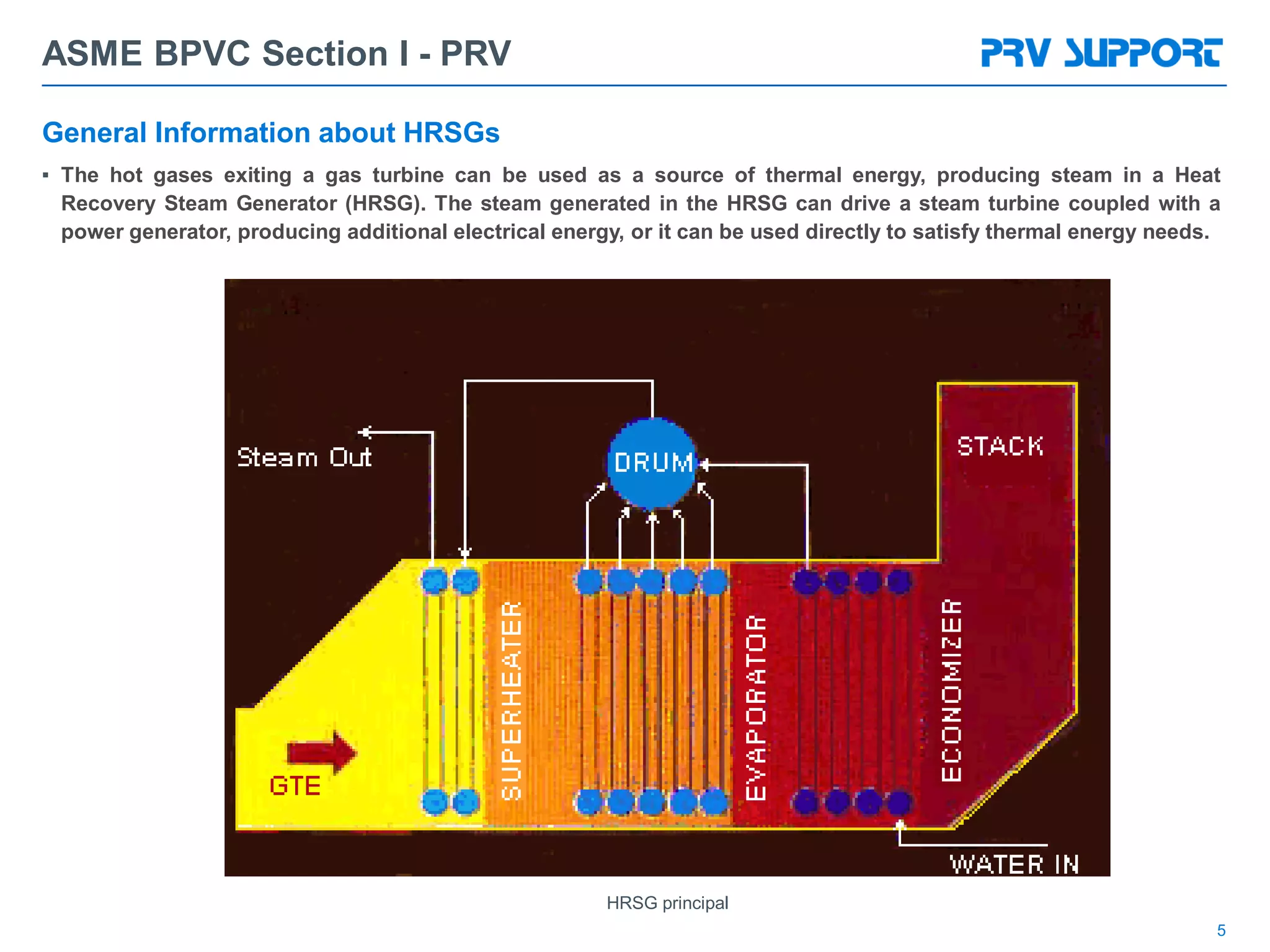
General Information about HRSGs
▪ The hot gases exiting a gas turbine can be used as a source of thermal energy, producing steam in a Heat
Recovery Steam Generator (HRSG). The steam generated in the HRSG can drive a steam turbine coupled with a
power generator, producing additional electrical energy, or it can be used directly to satisfy thermal energy needs.
HRSG principal
6
ASME BPVC Section I - PRV
HRSG: 2 drums & 1 economizer
7
ASME BPVC Section I - PRV
HRSG: 3 drums & 2 economizer
Typical power boiler
▪ Typical range of spring loaded Pressure Relief Valve
* Note: larger valves decrease the class limit values – thus RR or T orifice at 600# inlet are classified HP
ASME BPVC Section I - PRV
SUBCRITICAL SUPERCRITICAL ULTRA SUPERCRITICAL
BOILER MW (up to) 15 100 600 800 > 800
VALVE TYPE LP MP HP
TYPICAL CLASS * 150 – 300 – 600 900 – 1500 2500 – 3000 - 4500
P/T BOILER T (°C) P (bar) T (°C) P (bar) T (°C) P (bar) T (°C) P (bar) T (°C) P (bar)
MIN 100 1 259 45 315 110 374 220 593 220
MAX 538 45 565 110 593 220 593 370 700 370
Requirements
ASME B&PV Code Section I - PRV
10
ASME BPVC Section I - PRV
Requirements: stamp
▪ PRV stamped symbol according the ASME B&PV Code :
▪ Section I : V
▪ Section VIII : UV
▪ V stands for Vessel (UV stands for Unfired Vessel).
▪ The stamp is not always required (especially in EU) but tends to be more
and more. In North America, it is required by law.
▪ The symbols changed in 2012.
▪ Certification to renew every
▪ 6 years for the product
▪ 3 years for the plant
V stamp
Requirements: design
▪ Covers all fired vessels with operating pressure from 15 psig (1.03 barg)
▪ Before 2010: Safety Valves must be spring loaded
▪ Since 2010: Safety Valves can be Pilot operated as well as for steam or water. The terminology change: the code
refers now to Pressure Relief Valves including:
▪ Direct spring-loaded safety valves (steam)
▪ Direct spring-loaded safety relief valves (water)
▪ Pilot-operated pressure relief valves (steam or water)
▪ Requires lifting device to provide a means of verifying whether the PRV is free (no seizing).
ASME BPVC Section I - PRV
Requirements: design
▪ Deadweight or weighted lever safety valves are not allowed.
▪ No intervening isolation valves (excepted for PAPRV).
▪ Valves greater than 80 mm must be flanged or welded.
▪ Over 10 barg, cast iron is forbidden.
▪ Below 10 barg and valves smaller than 80mm, threaded ends are allowed.
▪ The valve must be bonnet or open yoke (vented spring)
▪ Bronze parts allowed if temperature is less than 208°C (406°F), but not for hot water (over 60°C - 140°F).
ASME BPVC Section I - PRV
Requirements: performances
▪ Overpressure: 3% of set pressure or 2 psi (0.137 bar)
Valves to discharge at rate capacity at full lift.
▪ Blowdown:
▪ Minimum: 2 psi (0.14 bar) or 2% of SP whichever is greater
▪ Maximum:
▪ SP < 67 psi (4.62 bar): 4 psi (0.28 bar)
▪ 67 psi ≤ SP ≤ 250 psi (17.24 bar): 6% of SP
▪ 250 psi < SP < 375 psi (25.85 bar): 15 psi (1.03 bar)
▪ SP > 375 psi: 4%
▪ Forced flow steam (supercritical) 10%
ASME BPVC Section I - PRV
Requirements: performances
▪ Flow coefficient
▪ Maximum: Kd 0.975 / K (derated) 0.975 x 0.9 = 0.878
▪ Spring loaded
▪ V series (Starsteam) tested flow coefficient is 0.982, therefore Kd limited to 0.975 (K 0,878).
▪ The main Starsteam competition has 0.975
▪ Pilot operated (economizer)
▪ 76 series (Stareco)
▪ Steam Kd is 0.970 (K 0,873),
▪ Water Kd is 0,944 (K 0,850).
ASME BPVC Section I - PRV
Requirements: performances
▪ Set pressure
ASME BPVC Section I - PRV
Furnace
MAWP
Maximum System Accumulation1.06 X MAWP
Highest Set PRV1.03 X MAWP
Lowest Set Drum Valve
Drum Superheater
Operating Pressure
Pressure
Drop
Lowest Set SHO Valve
PAPRV (PCV)
A
B
Note : A > B
Furnace
MAWP
Maximum System Accumulation1.06 X MAWP
Highest Set PRV1.03 X MAWP
Lowest Set Drum Valve
Drum Superheater
Operating Pressure
Pressure
Drop
Lowest Set SHO Valve
PAPRV (PCV)
ASME SECTION I
ASME BPVC Section I - PRV
Requirements: performances
▪ Lift
Requirements: performances
▪ Blowdown: All drum PRVs must reseat not lower than 96% of the SP of the lowest SP drum PRV.
ASME BPVC Section I - PRV
Furnace
MAWP
Maximum System Accumulation1.06 X MAWP
Highest Set PRV1.03 X MAWP
Lowest Set Drum Valve
Drum Superheater
Operating Pressure
Pressure
Drop
Lowest Set SHO Valve
PAPRV (PCV)
-7%
-4%
-4%
Requirements: configuration of boiler PRVs
▪ Minimum quantities
▪ 2 PRVs on the drum or 1 PRV on the superheater inlet (SHI)
▪ 1 PRV on the superheater outlet (SHO)
▪ 1 PRV on the reheater inlet (RHI) (if any)
▪ 1 PRV on the reheater outlet (RHO) (if any)
▪ 1 PRV on the economizer (if any)
▪ 1 PRV on the sootblower (if any)
ASME BPVC Section I - PRV
Requirements: configuration of boiler PRVs
▪ Power actuated PRV
▪ This protects the PRV against damage from frequent operation.
▪ The valve may discharge to atmosphere or to a container at lower pressure.
▪ It could be requested on the SHO (depends on end-use location).
▪ It can be joined with an isolation valve to install in between the PAPRV and the boiler.
ASME BPVC Section I - PRV
Requirements: configuration of boiler PRVs
▪ Drum (or SHI) and superheater outlet (SHO) valves are sized as one complete boiler set
▪ Reheater valves are sized separately
ASME BPVC Section I - PRV
Requirements: configuration of subcritical boiler PRVs
▪ No. of valves
▪ 2 or more valves on the drum if boiler capacity exceeds 4000 lb/hr (1815 kg/hr)
▪ 1 or more valves on SHO , RHI, RHO, Sootblowers (if any existing)
▪ Relieving Capacity
▪ Drum PRV + SHO PRV = Total boiler relieving capacity > 100% of MCR (Maximum Continuous Rating of Boiler)
▪ Drum PRV capacity > 75% of MCR.
▪ RHI PRV + RHO PRV = 100% Total Reheater Relieving Capacity (> Reheater steam flow).
▪ RHO PRV capacity > 15% R/H
▪ Power actuated PRV not less than 10% of MCR.
▪ Economizer valve
▪ Most RFQ come with water capacity
▪ Most boiler OME expects a steam sizing and selection based on the water capacity
▪ Water capacity of the steam based selection to be highlighted
ASME BPVC Section I - PRV
Requirements: configuration of supercritical boiler PRVs
▪ No. of valves
▪ 2 or more valves on the boiler if its capacity exceeds 4000 lb/hr (1815 kg/hr)
▪ 1 or more valves on SHI, SHO, RHI, RHO, Sootblowers (if any existing)
▪ Relieving Capacity
▪ SHI PRV + SHO PRV + PAPRV = Total boiler relieving capacity > 100% of MCR (Maximum Continuous Rating of Boiler)
▪ 10% MCR < PAPRV capacity < 30% of MCR.
▪ RHI PRV + RHO PRV = 100% Total Reheater Relieving Capacity (> Reheater steam flow).
▪ RHO PRV capacity > 15% R/H
ASME BPVC Section I - PRV
Requirements: configuration of boiler PRVs
▪ Set pressure tolerance:
▪ ± 2 psi (0.13 bar) up to and including 70 psi (4.82 bar)
▪ ± 3% for SP above 70 psi (4.82) up to and including 300 psi (20.68 bar)
▪ ± 10 psi (0.68 bar) for SP above 300 psi (20.68 bar) up to and including 1000 psi (68.9 bar)
▪ ± 1% for SP above 1000 psi (68.9 bar)
▪ Multiple valves
▪ One set at or below MAWP, balance may be stagger set with the highest being no more than 103% of MAWP
▪ Largest valve cap. must not be more that 50% of smallest valve capacity.
▪ Restricted lift
▪ It is allowed to restricted the lift to adjust the maximum PRV capacity.
▪ The minimum lift is 30% of full rated lift or 2mm.
ASME BPVC Section I - PRV
Requirements: Materials Selection
▪ Body, bonnet/yoke must be ASME BPVC Section II material.
▪ Nozzle, disc and parts contained within structure must meet:
▪ ASME BPVC Section II material
▪ or
▪ ASTM International Specification
▪ Cast iron material for trim construction is not allowed
▪ Manufacturers are allowed to use material of better specification as those above
ASME BPVC Section I - PRV
Requirements: Applications
▪ Boilers
▪ Drum (subcritical) or SHI (surpercritical)
▪ SHO
▪ RHI & RHO
▪ Economisers
▪ Soot blowers of forced flow steam generators.
▪ Organic fluid vapor generators
▪ High temperature hot water generators
▪ Electrical boilers
ASME BPVC Section I - PRV
Applications
ASME B&PV Code Section I - PRV
Operating: Overpressure
▪ No chatter.
▪ Full lift shall not exceed 3% of the Set Pressure.
ASME BPVC Section I - PRV
Operating: Blowdown
▪ 0.13 Barg or 2% of the Set Pressure minimum (whichever is smaller)
▪ 0.27 Barg or 4% of the Set Pressure (whichever is greater)
ASME BPVC Section I - PRV
Operating: Accumulation
▪ Maximum 6% of MAWP for multiple PRVs.
ASME BPVC Section I - PRV
Operating: Overpressure
Source: ASME B&PVC Section I
ASME BPVC Section I - PRV
100 MAWP
ALLOWABLE
ACCUMULATION
with multiple PRD
(EQUIPMENT)
106% of MAWP
ALLOWABLE
OVERPRESSURE
(PRD 1)
ACCUMUL.
VALUE
SP
106
ALLOWABLE
OVERPRESSURE
(PRD 2)
103
Allowable overpressure – Multiple PRD
Operating: Overpressure
Source: ASME B&PVC Section I
ASME BPVC Section I - PRV
100 MAWP
ALLOWABLE
ACCUMULATION
with multiple PRD
(EQUIPMENT)
106% of MAWP
PRD 1 : Maximum allowable
overpressure = (106-99)/99 = 7 %
PRD 2 (max 103% MAWP) : Allowable
Overpressure = 3%
ALLOWABLE
OVERPRESSURE
(PRD 1)
ACCUMUL.
VALUE
SP
106
ALLOWABLE
OVERPRESSURE
(PRD 2)
103
99
Allowable overpressure – Multiple PRD
Operating: Installation
▪ Spring loaded PRV must be mounted with vertical spindle.
▪ Spring loaded PRV must use a spring cover or weatherhood for environmental protection only.
▪ Reminder: No intervening stop valve upstream the PRV.
ASME BPVC Section I - PRV
Operating: Field recalibration
▪ Resetting of spring in field is limited to +/- 5% (unless permitted by the PRV manufacturer).
ASME BPVC Section I - PRV
Operating: Test criteria
▪ All valves to be tested on steam to demonstrate the popping point and pressure containing integrity.
▪ If the valve is beyond capacity of the boiler test bench, it can be set with alternative test methods:
▪ Higher capacity: restricted lift to demonstrate set pressure.
▪ Higher set pressure: pneumatic (or hydraulic) assist device.
ASME BPVC Section I - PRV
Operating: Test criteria
▪ Leak test:
▪ A seat tightness test shall be conducted at the maximum expected operating pressure but at a pressure not exceeding the
reseating pressure of the valve.
▪ Closed bonnet PRV designed for discharge to a closed system shall be tested with a minimum of 30 psig (200 kPa) of air
or other gas in the secondary pressure zone.
▪ Seat tightness: no sign of leakage shall be considered adequately tight.
ASME BPVC Section I - PRV
Downward
Spring Force
System
Pressure
PRV Support SAS
13 rue de l’érable
95540 Méry sur Oise
France
T +33 (0)6 95 21 31 99
www.prv-support.com
contact@prv-support.com
Follow us on LinkedIn

Prvs 2. asme section i fired vessel rev4

  • 1.
    2. ASME B&PVCode Section I - PRV Presented by David Alexandre
  • 2.
    Introduction to the ASMEBPVC Section I ASME B&PV Code Section I - PRV
  • 3.
    3 ASME BPVC SectionI - PRV History ▪ The section I has given birth of the ASME B&PV Code. ▪ On the Mississippi river, on the 5th of March 1865, the boiler of a boat burst. This caused the death of a few engineers. Beside this, over a thousand passengers died due to the boat seeking: most of the people at that time did not know how to swim. ▪ The reasons of the bursting was due to improper engineering, mainly material selection (same reason for the Titanic event a few years afterwards). ▪ After this accident other similar in buildings or factories, the best US engineers have created the American Society of Mechanical Engineers. ▪ 1880 : The Boiler and Pressure Vessel Code founded. ▪ 1884 : Boiler testing code ▪ 1905 (March 10) : Grover Shoe Factory Disaster (old boiler explosion) in Brockton, Massachusetts being at the origin of the first boiler laws written in 1908. ▪ 1915 : ASME B&PV Code officially established, being the turning points on civil life.. Steamboat Sultana disaster (20/05/1865) Steam power machine
  • 4.
    4 ASME BPVC SectionI - PRV Typical subcritical power boiler 1. Furnace 2. Drum 3. Superheater outlet 4. Turbine 5. Condenser 6. Condensate pump 7. Boiler feed water pump 8. Cold reheat inlet 9. Hot reheat outlet Typical subcritical boiler
  • 5.
    5 ASME BPVC SectionI - PRV General Information about HRSGs ▪ The hot gases exiting a gas turbine can be used as a source of thermal energy, producing steam in a Heat Recovery Steam Generator (HRSG). The steam generated in the HRSG can drive a steam turbine coupled with a power generator, producing additional electrical energy, or it can be used directly to satisfy thermal energy needs. HRSG principal
  • 6.
    6 ASME BPVC SectionI - PRV HRSG: 2 drums & 1 economizer
  • 7.
    7 ASME BPVC SectionI - PRV HRSG: 3 drums & 2 economizer
  • 8.
    Typical power boiler ▪Typical range of spring loaded Pressure Relief Valve * Note: larger valves decrease the class limit values – thus RR or T orifice at 600# inlet are classified HP ASME BPVC Section I - PRV SUBCRITICAL SUPERCRITICAL ULTRA SUPERCRITICAL BOILER MW (up to) 15 100 600 800 > 800 VALVE TYPE LP MP HP TYPICAL CLASS * 150 – 300 – 600 900 – 1500 2500 – 3000 - 4500 P/T BOILER T (°C) P (bar) T (°C) P (bar) T (°C) P (bar) T (°C) P (bar) T (°C) P (bar) MIN 100 1 259 45 315 110 374 220 593 220 MAX 538 45 565 110 593 220 593 370 700 370
  • 9.
  • 10.
    10 ASME BPVC SectionI - PRV Requirements: stamp ▪ PRV stamped symbol according the ASME B&PV Code : ▪ Section I : V ▪ Section VIII : UV ▪ V stands for Vessel (UV stands for Unfired Vessel). ▪ The stamp is not always required (especially in EU) but tends to be more and more. In North America, it is required by law. ▪ The symbols changed in 2012. ▪ Certification to renew every ▪ 6 years for the product ▪ 3 years for the plant V stamp
  • 11.
    Requirements: design ▪ Coversall fired vessels with operating pressure from 15 psig (1.03 barg) ▪ Before 2010: Safety Valves must be spring loaded ▪ Since 2010: Safety Valves can be Pilot operated as well as for steam or water. The terminology change: the code refers now to Pressure Relief Valves including: ▪ Direct spring-loaded safety valves (steam) ▪ Direct spring-loaded safety relief valves (water) ▪ Pilot-operated pressure relief valves (steam or water) ▪ Requires lifting device to provide a means of verifying whether the PRV is free (no seizing). ASME BPVC Section I - PRV
  • 12.
    Requirements: design ▪ Deadweightor weighted lever safety valves are not allowed. ▪ No intervening isolation valves (excepted for PAPRV). ▪ Valves greater than 80 mm must be flanged or welded. ▪ Over 10 barg, cast iron is forbidden. ▪ Below 10 barg and valves smaller than 80mm, threaded ends are allowed. ▪ The valve must be bonnet or open yoke (vented spring) ▪ Bronze parts allowed if temperature is less than 208°C (406°F), but not for hot water (over 60°C - 140°F). ASME BPVC Section I - PRV
  • 13.
    Requirements: performances ▪ Overpressure:3% of set pressure or 2 psi (0.137 bar) Valves to discharge at rate capacity at full lift. ▪ Blowdown: ▪ Minimum: 2 psi (0.14 bar) or 2% of SP whichever is greater ▪ Maximum: ▪ SP < 67 psi (4.62 bar): 4 psi (0.28 bar) ▪ 67 psi ≤ SP ≤ 250 psi (17.24 bar): 6% of SP ▪ 250 psi < SP < 375 psi (25.85 bar): 15 psi (1.03 bar) ▪ SP > 375 psi: 4% ▪ Forced flow steam (supercritical) 10% ASME BPVC Section I - PRV
  • 14.
    Requirements: performances ▪ Flowcoefficient ▪ Maximum: Kd 0.975 / K (derated) 0.975 x 0.9 = 0.878 ▪ Spring loaded ▪ V series (Starsteam) tested flow coefficient is 0.982, therefore Kd limited to 0.975 (K 0,878). ▪ The main Starsteam competition has 0.975 ▪ Pilot operated (economizer) ▪ 76 series (Stareco) ▪ Steam Kd is 0.970 (K 0,873), ▪ Water Kd is 0,944 (K 0,850). ASME BPVC Section I - PRV
  • 15.
    Requirements: performances ▪ Setpressure ASME BPVC Section I - PRV Furnace MAWP Maximum System Accumulation1.06 X MAWP Highest Set PRV1.03 X MAWP Lowest Set Drum Valve Drum Superheater Operating Pressure Pressure Drop Lowest Set SHO Valve PAPRV (PCV) A B Note : A > B
  • 16.
    Furnace MAWP Maximum System Accumulation1.06X MAWP Highest Set PRV1.03 X MAWP Lowest Set Drum Valve Drum Superheater Operating Pressure Pressure Drop Lowest Set SHO Valve PAPRV (PCV) ASME SECTION I ASME BPVC Section I - PRV Requirements: performances ▪ Lift
  • 17.
    Requirements: performances ▪ Blowdown:All drum PRVs must reseat not lower than 96% of the SP of the lowest SP drum PRV. ASME BPVC Section I - PRV Furnace MAWP Maximum System Accumulation1.06 X MAWP Highest Set PRV1.03 X MAWP Lowest Set Drum Valve Drum Superheater Operating Pressure Pressure Drop Lowest Set SHO Valve PAPRV (PCV) -7% -4% -4%
  • 18.
    Requirements: configuration ofboiler PRVs ▪ Minimum quantities ▪ 2 PRVs on the drum or 1 PRV on the superheater inlet (SHI) ▪ 1 PRV on the superheater outlet (SHO) ▪ 1 PRV on the reheater inlet (RHI) (if any) ▪ 1 PRV on the reheater outlet (RHO) (if any) ▪ 1 PRV on the economizer (if any) ▪ 1 PRV on the sootblower (if any) ASME BPVC Section I - PRV
  • 19.
    Requirements: configuration ofboiler PRVs ▪ Power actuated PRV ▪ This protects the PRV against damage from frequent operation. ▪ The valve may discharge to atmosphere or to a container at lower pressure. ▪ It could be requested on the SHO (depends on end-use location). ▪ It can be joined with an isolation valve to install in between the PAPRV and the boiler. ASME BPVC Section I - PRV
  • 20.
    Requirements: configuration ofboiler PRVs ▪ Drum (or SHI) and superheater outlet (SHO) valves are sized as one complete boiler set ▪ Reheater valves are sized separately ASME BPVC Section I - PRV
  • 21.
    Requirements: configuration ofsubcritical boiler PRVs ▪ No. of valves ▪ 2 or more valves on the drum if boiler capacity exceeds 4000 lb/hr (1815 kg/hr) ▪ 1 or more valves on SHO , RHI, RHO, Sootblowers (if any existing) ▪ Relieving Capacity ▪ Drum PRV + SHO PRV = Total boiler relieving capacity > 100% of MCR (Maximum Continuous Rating of Boiler) ▪ Drum PRV capacity > 75% of MCR. ▪ RHI PRV + RHO PRV = 100% Total Reheater Relieving Capacity (> Reheater steam flow). ▪ RHO PRV capacity > 15% R/H ▪ Power actuated PRV not less than 10% of MCR. ▪ Economizer valve ▪ Most RFQ come with water capacity ▪ Most boiler OME expects a steam sizing and selection based on the water capacity ▪ Water capacity of the steam based selection to be highlighted ASME BPVC Section I - PRV
  • 22.
    Requirements: configuration ofsupercritical boiler PRVs ▪ No. of valves ▪ 2 or more valves on the boiler if its capacity exceeds 4000 lb/hr (1815 kg/hr) ▪ 1 or more valves on SHI, SHO, RHI, RHO, Sootblowers (if any existing) ▪ Relieving Capacity ▪ SHI PRV + SHO PRV + PAPRV = Total boiler relieving capacity > 100% of MCR (Maximum Continuous Rating of Boiler) ▪ 10% MCR < PAPRV capacity < 30% of MCR. ▪ RHI PRV + RHO PRV = 100% Total Reheater Relieving Capacity (> Reheater steam flow). ▪ RHO PRV capacity > 15% R/H ASME BPVC Section I - PRV
  • 23.
    Requirements: configuration ofboiler PRVs ▪ Set pressure tolerance: ▪ ± 2 psi (0.13 bar) up to and including 70 psi (4.82 bar) ▪ ± 3% for SP above 70 psi (4.82) up to and including 300 psi (20.68 bar) ▪ ± 10 psi (0.68 bar) for SP above 300 psi (20.68 bar) up to and including 1000 psi (68.9 bar) ▪ ± 1% for SP above 1000 psi (68.9 bar) ▪ Multiple valves ▪ One set at or below MAWP, balance may be stagger set with the highest being no more than 103% of MAWP ▪ Largest valve cap. must not be more that 50% of smallest valve capacity. ▪ Restricted lift ▪ It is allowed to restricted the lift to adjust the maximum PRV capacity. ▪ The minimum lift is 30% of full rated lift or 2mm. ASME BPVC Section I - PRV
  • 24.
    Requirements: Materials Selection ▪Body, bonnet/yoke must be ASME BPVC Section II material. ▪ Nozzle, disc and parts contained within structure must meet: ▪ ASME BPVC Section II material ▪ or ▪ ASTM International Specification ▪ Cast iron material for trim construction is not allowed ▪ Manufacturers are allowed to use material of better specification as those above ASME BPVC Section I - PRV
  • 25.
    Requirements: Applications ▪ Boilers ▪Drum (subcritical) or SHI (surpercritical) ▪ SHO ▪ RHI & RHO ▪ Economisers ▪ Soot blowers of forced flow steam generators. ▪ Organic fluid vapor generators ▪ High temperature hot water generators ▪ Electrical boilers ASME BPVC Section I - PRV
  • 26.
  • 27.
    Operating: Overpressure ▪ Nochatter. ▪ Full lift shall not exceed 3% of the Set Pressure. ASME BPVC Section I - PRV
  • 28.
    Operating: Blowdown ▪ 0.13Barg or 2% of the Set Pressure minimum (whichever is smaller) ▪ 0.27 Barg or 4% of the Set Pressure (whichever is greater) ASME BPVC Section I - PRV
  • 29.
    Operating: Accumulation ▪ Maximum6% of MAWP for multiple PRVs. ASME BPVC Section I - PRV
  • 30.
    Operating: Overpressure Source: ASMEB&PVC Section I ASME BPVC Section I - PRV 100 MAWP ALLOWABLE ACCUMULATION with multiple PRD (EQUIPMENT) 106% of MAWP ALLOWABLE OVERPRESSURE (PRD 1) ACCUMUL. VALUE SP 106 ALLOWABLE OVERPRESSURE (PRD 2) 103 Allowable overpressure – Multiple PRD
  • 31.
    Operating: Overpressure Source: ASMEB&PVC Section I ASME BPVC Section I - PRV 100 MAWP ALLOWABLE ACCUMULATION with multiple PRD (EQUIPMENT) 106% of MAWP PRD 1 : Maximum allowable overpressure = (106-99)/99 = 7 % PRD 2 (max 103% MAWP) : Allowable Overpressure = 3% ALLOWABLE OVERPRESSURE (PRD 1) ACCUMUL. VALUE SP 106 ALLOWABLE OVERPRESSURE (PRD 2) 103 99 Allowable overpressure – Multiple PRD
  • 32.
    Operating: Installation ▪ Springloaded PRV must be mounted with vertical spindle. ▪ Spring loaded PRV must use a spring cover or weatherhood for environmental protection only. ▪ Reminder: No intervening stop valve upstream the PRV. ASME BPVC Section I - PRV
  • 33.
    Operating: Field recalibration ▪Resetting of spring in field is limited to +/- 5% (unless permitted by the PRV manufacturer). ASME BPVC Section I - PRV
  • 34.
    Operating: Test criteria ▪All valves to be tested on steam to demonstrate the popping point and pressure containing integrity. ▪ If the valve is beyond capacity of the boiler test bench, it can be set with alternative test methods: ▪ Higher capacity: restricted lift to demonstrate set pressure. ▪ Higher set pressure: pneumatic (or hydraulic) assist device. ASME BPVC Section I - PRV
  • 35.
    Operating: Test criteria ▪Leak test: ▪ A seat tightness test shall be conducted at the maximum expected operating pressure but at a pressure not exceeding the reseating pressure of the valve. ▪ Closed bonnet PRV designed for discharge to a closed system shall be tested with a minimum of 30 psig (200 kPa) of air or other gas in the secondary pressure zone. ▪ Seat tightness: no sign of leakage shall be considered adequately tight. ASME BPVC Section I - PRV Downward Spring Force System Pressure
  • 36.
    PRV Support SAS 13rue de l’érable 95540 Méry sur Oise France T +33 (0)6 95 21 31 99 www.prv-support.com contact@prv-support.com Follow us on LinkedIn