ASME VIII Div.1
Ing. José Juan Jiménez Alejandro: jjjimeneza@gmail.com
Lethal Service - Quick GuideServicios de
Soldadura
Industrial
Introductions
Requirements for lethal service are scattered through
VIII-1, the code cases and the interpretations. ASME VIII-
1 section UW-2 has most of the requirements for lethal
service. Two definitions of lethal service are provided in
UW-2. The second definition is also duplicated in the end
notes:
[A] vessel is to contain fluids of such a nature that a very
small amount mixed or unmixed with air is dangerous to
life when inhaled[.]
Introductions
By "lethal substances" are meant poisonous gases or liquids
of such a nature that a very small amount of the gas or of
the vapour of the liquid mixed or unmixed with air is
dangerous to-life when inhaled. For purposes of this
Division, this class includes substances of this nature which
are stored under pressure or may generate a pressure if
stored in a closed vessel.
It is up to the user to determine if a service is lethal. We at
Pressure Vessel Engineering do not determine if the
vessel service is lethal (but we might have opinions
based on previous jobs).
ASME VIII-1 Lethal Service Code References
UW-2 Service Restrictions is a very important section for
lethal service vessels and must be read in its entirety. A few
brief points from UW-2:
UW-2(a) and UW-11(a)(1) - All butt welds shall be
100% radiographed
UW-2(a) - ERW pipe (like some grades of SA-53) is not
permitted but interpretation VIII-1-01-118 says it is
acceptable if the long seam is fully radiographed
UW-2(a) - Post weld heat treatment is required for CS
and Low Alloy
UW-2(a)(1)(a) - Category A welds shall be type 1 only
(butt welded with no permanent backing strip)
ASME VIII-1 Lethal Service Code References
UW-2(a)(1)(b&c) &Interpretation VIII-1 92-211 -
Category B & C welds shall be type 1 or 2 only (butt
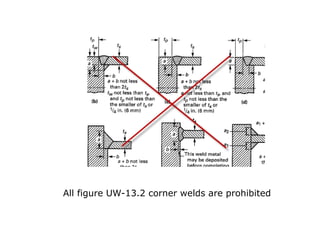
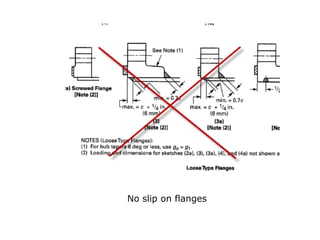
welded). No slip on flanges! No Figure UW-13.2 Flange or
Head to Shell attachments
Interpretation VIII-I-98-23 - Category D welds
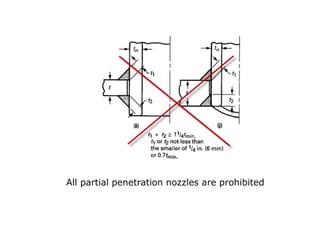
(typically nozzles) shall be full penetration.
UW-2(a)(1)(c) - Category C joints for stub ends have a
long list of requirements
UW-2(a)(2 and 3) - Heat exchangers have a long list of
requirements
Read all of UW-2 for more restrictions...
ASME VIII-1 Lethal Service Code References
When it has been determined that a vessel is in Lethal
Service, some of the following code sections will apply. Other
code sections might also be required. (List last updated June
16 2015 based on the ASME 2013 VIII-1 code edition.)
U-2(a)(2) - The user determines if the service is lethal.
UG-16(5)(a) - Air cooled and cooling tower heat
exchanger tube walls to be 1/16" min.
UG-24(6) - Casting RT requirements.
UG-25(e) - No telltale holes.
UG-99(g),(k) - Hydro test visual leak inspection cannot be
waived. Do not paint prior to the hydro test.
ASME VIII-1 Lethal Service Code References
UG-100(d)(4) - Pneumatic tests cannot be used for
lethal service vessels, but also see code cases 2046-2,
2055-2, 2407 regarding pneumatic instead of hydrostatic
testing
UG-116(c) - "L" stamping must be added to the
nameplate.
UG-120(d)(1) - "lethal service" is added to the data
report
UW-2 - Service Restrictions - main source of info on
Lethal Service (see lots more from UW-2 below)
UW-11(a)(1) - All shell and head butt welds to be
100% RT
ASME VIII-1 Lethal Service Code References
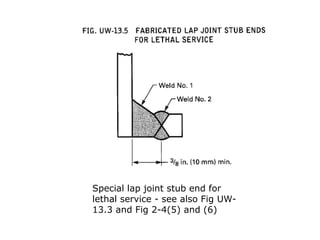
Fig UW-13.5 - One possible lap joint stub end
configuration - see also interpretation BC-79-680 / VIII-
80-111
UB-3 - Brazed vessels shall not be used
UCS-6 - Do not use SA-36, 38W or SA-283
UCS-79 - PWHT and extreme fiber elongation - read for
rules when heat treatment is required
UCI-2, UCD-2 Cast iron and ductile cast iron vessels are
not allowed.
ASME VIII-1 Lethal Service Code References
UIG-2(c) - Metal parts for graphite vessels are to be
designed to UIG requirements
UIG-23(b) - Factor of safety for lethal service
UIG-60 - Lethal service
UIG-99 - Lethal service pressure tests
ULW-1 & ULW-26(b)(4) - Layered vessels lethal
restrictions apply to the inner shell and heads only
ASME VIII-1 Lethal Service Code References
UHX-19.1(b) - Heat exchanger markings
Appendix 2-5(d) & 2-6 - Maximum Flange Bolt Spacing
Appendix 2-14(a) - Mandatory flange flexibility
Appendix 7-1, 7-5 - Steel casting examination for 100%
quality factor
Appendix 9-8 - if the jacket does not carry lethal
substances, lethal service restrictions do not apply to it
ASME VIII-1 Lethal Service Code References
Appendix 17-2(a) - Dimple jackets will not contain lethal
substances
Appendix 35-3(c) & 35-7(d) - Mass production rules
Appendix W Table W-3 - Filing out the U forms
Appendix KK (note 12) - Filling out User Design
Requirements forms
Appendix NN Table NN-6-5 - User or designated again
determines if the contents are lethal
End notes 65 - Definition of lethal service
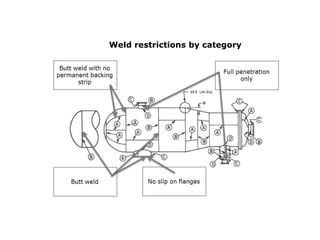
Weld restrictions by category
Special lap joint stub end for
lethal service - see also Fig UW-
13.3 and Fig 2-4(5) and (6)
All partial penetration nozzles are prohibited
All figure UW-13.2 corner welds are prohibited
No slip on flanges
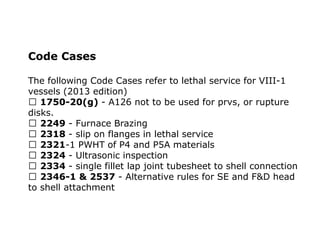
Code Cases
The following Code Cases refer to lethal service for VIII-1
vessels (2013 edition)
1750-20(g) - A126 not to be used for prvs, or rupture
disks.
2249 - Furnace Brazing
2318 - slip on flanges in lethal service
2321-1 PWHT of P4 and P5A materials
2324 - Ultrasonic inspection
2334 - single fillet lap joint tubesheet to shell connection
2346-1 & 2537 - Alternative rules for SE and F&D head
to shell attachment
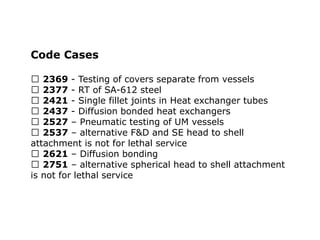
Code Cases
2369 - Testing of covers separate from vessels
2377 - RT of SA-612 steel
2421 - Single fillet joints in Heat exchanger tubes
2437 - Diffusion bonded heat exchangers
2527 – Pneumatic testing of UM vessels
2537 – alternative F&D and SE head to shell
attachment is not for lethal service
2621 – Diffusion bonding
2751 – alternative spherical head to shell attachment
is not for lethal service
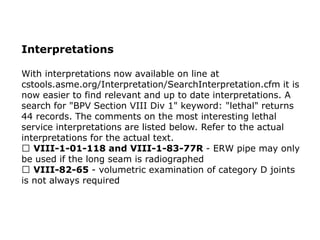
Interpretations
With interpretations now available on line at
cstools.asme.org/Interpretation/SearchInterpretation.cfm it is
now easier to find relevant and up to date interpretations. A
search for "BPV Section VIII Div 1" keyword: "lethal" returns
44 records. The comments on the most interesting lethal
service interpretations are listed below. Refer to the actual
interpretations for the actual text.
VIII-1-01-118 and VIII-1-83-77R - ERW pipe may only
be used if the long seam is radiographed
VIII-82-65 - volumetric examination of category D joints
is not always required
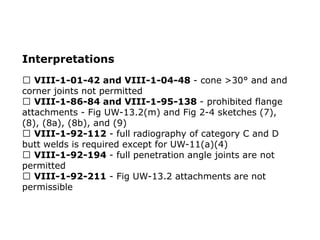
Interpretations
VIII-1-01-42 and VIII-1-04-48 - cone >30° and and
corner joints not permitted
VIII-1-86-84 and VIII-1-95-138 - prohibited flange
attachments - Fig UW-13.2(m) and Fig 2-4 sketches (7),
(8), (8a), (8b), and (9)
VIII-1-92-112 - full radiography of category C and D
butt welds is required except for UW-11(a)(4)
VIII-1-92-194 - full penetration angle joints are not
permitted
VIII-1-92-211 - Fig UW-13.2 attachments are not
permissible
Interpretations
 VIII-1-98-113 - permissible repad and flange pad
arrangements
VIII-1-98-23 - Fig UW-16.1 (a) and (c) are permissible
nozzle attachments, others are not discussed
VIII-77-62 - "It is the intent of Section VIII, Division 1
that Category B and C butt welds in nozzles and
communicating chambers that neither exceed 10 in.
nominal pipe size or 1-1/8 wall thickness are excluded from
the provisions of radiography, even though the vessel is in
lethal service. This overrides the provisions of UW-2(a)."
Interpretations
VIII-80-02 - do not use corner joints from Fig UW-
13.2 - redesign to create butt joints that can be
radiographed
VIII-80-111 - acceptable lap joint flanges include
Fig. 2-4(1) and Fig. UW-13.3 and Fig. 2-4(5) and (6)
Disclaimer: This material is provided for educational uses
only. Only ASME can make code interpretations.
http://www.pveng.com/ASME/ASMEComment/LethalService/LethalService.php

Lethal service quick guide

  • 1.
    ASME VIII Div.1 Ing.José Juan Jiménez Alejandro: jjjimeneza@gmail.com Lethal Service - Quick GuideServicios de Soldadura Industrial
  • 2.
    Introductions Requirements for lethalservice are scattered through VIII-1, the code cases and the interpretations. ASME VIII- 1 section UW-2 has most of the requirements for lethal service. Two definitions of lethal service are provided in UW-2. The second definition is also duplicated in the end notes: [A] vessel is to contain fluids of such a nature that a very small amount mixed or unmixed with air is dangerous to life when inhaled[.]
  • 3.
    Introductions By "lethal substances"are meant poisonous gases or liquids of such a nature that a very small amount of the gas or of the vapour of the liquid mixed or unmixed with air is dangerous to-life when inhaled. For purposes of this Division, this class includes substances of this nature which are stored under pressure or may generate a pressure if stored in a closed vessel. It is up to the user to determine if a service is lethal. We at Pressure Vessel Engineering do not determine if the vessel service is lethal (but we might have opinions based on previous jobs).
  • 4.
    ASME VIII-1 LethalService Code References UW-2 Service Restrictions is a very important section for lethal service vessels and must be read in its entirety. A few brief points from UW-2: UW-2(a) and UW-11(a)(1) - All butt welds shall be 100% radiographed UW-2(a) - ERW pipe (like some grades of SA-53) is not permitted but interpretation VIII-1-01-118 says it is acceptable if the long seam is fully radiographed UW-2(a) - Post weld heat treatment is required for CS and Low Alloy UW-2(a)(1)(a) - Category A welds shall be type 1 only (butt welded with no permanent backing strip)
  • 5.
    ASME VIII-1 LethalService Code References UW-2(a)(1)(b&c) &Interpretation VIII-1 92-211 - Category B & C welds shall be type 1 or 2 only (butt welded). No slip on flanges! No Figure UW-13.2 Flange or Head to Shell attachments Interpretation VIII-I-98-23 - Category D welds (typically nozzles) shall be full penetration. UW-2(a)(1)(c) - Category C joints for stub ends have a long list of requirements UW-2(a)(2 and 3) - Heat exchangers have a long list of requirements Read all of UW-2 for more restrictions...
  • 6.
    ASME VIII-1 LethalService Code References When it has been determined that a vessel is in Lethal Service, some of the following code sections will apply. Other code sections might also be required. (List last updated June 16 2015 based on the ASME 2013 VIII-1 code edition.) U-2(a)(2) - The user determines if the service is lethal. UG-16(5)(a) - Air cooled and cooling tower heat exchanger tube walls to be 1/16" min. UG-24(6) - Casting RT requirements. UG-25(e) - No telltale holes. UG-99(g),(k) - Hydro test visual leak inspection cannot be waived. Do not paint prior to the hydro test.
  • 7.
    ASME VIII-1 LethalService Code References UG-100(d)(4) - Pneumatic tests cannot be used for lethal service vessels, but also see code cases 2046-2, 2055-2, 2407 regarding pneumatic instead of hydrostatic testing UG-116(c) - "L" stamping must be added to the nameplate. UG-120(d)(1) - "lethal service" is added to the data report UW-2 - Service Restrictions - main source of info on Lethal Service (see lots more from UW-2 below) UW-11(a)(1) - All shell and head butt welds to be 100% RT
  • 8.
    ASME VIII-1 LethalService Code References Fig UW-13.5 - One possible lap joint stub end configuration - see also interpretation BC-79-680 / VIII- 80-111 UB-3 - Brazed vessels shall not be used UCS-6 - Do not use SA-36, 38W or SA-283 UCS-79 - PWHT and extreme fiber elongation - read for rules when heat treatment is required UCI-2, UCD-2 Cast iron and ductile cast iron vessels are not allowed.
  • 9.
    ASME VIII-1 LethalService Code References UIG-2(c) - Metal parts for graphite vessels are to be designed to UIG requirements UIG-23(b) - Factor of safety for lethal service UIG-60 - Lethal service UIG-99 - Lethal service pressure tests ULW-1 & ULW-26(b)(4) - Layered vessels lethal restrictions apply to the inner shell and heads only
  • 10.
    ASME VIII-1 LethalService Code References UHX-19.1(b) - Heat exchanger markings Appendix 2-5(d) & 2-6 - Maximum Flange Bolt Spacing Appendix 2-14(a) - Mandatory flange flexibility Appendix 7-1, 7-5 - Steel casting examination for 100% quality factor Appendix 9-8 - if the jacket does not carry lethal substances, lethal service restrictions do not apply to it
  • 11.
    ASME VIII-1 LethalService Code References Appendix 17-2(a) - Dimple jackets will not contain lethal substances Appendix 35-3(c) & 35-7(d) - Mass production rules Appendix W Table W-3 - Filing out the U forms Appendix KK (note 12) - Filling out User Design Requirements forms Appendix NN Table NN-6-5 - User or designated again determines if the contents are lethal End notes 65 - Definition of lethal service
  • 12.
  • 13.
    Special lap jointstub end for lethal service - see also Fig UW- 13.3 and Fig 2-4(5) and (6)
  • 14.
    All partial penetrationnozzles are prohibited
  • 15.
    All figure UW-13.2corner welds are prohibited
  • 16.
    No slip onflanges
  • 17.
    Code Cases The followingCode Cases refer to lethal service for VIII-1 vessels (2013 edition) 1750-20(g) - A126 not to be used for prvs, or rupture disks. 2249 - Furnace Brazing 2318 - slip on flanges in lethal service 2321-1 PWHT of P4 and P5A materials 2324 - Ultrasonic inspection 2334 - single fillet lap joint tubesheet to shell connection 2346-1 & 2537 - Alternative rules for SE and F&D head to shell attachment
  • 18.
    Code Cases 2369 -Testing of covers separate from vessels 2377 - RT of SA-612 steel 2421 - Single fillet joints in Heat exchanger tubes 2437 - Diffusion bonded heat exchangers 2527 – Pneumatic testing of UM vessels 2537 – alternative F&D and SE head to shell attachment is not for lethal service 2621 – Diffusion bonding 2751 – alternative spherical head to shell attachment is not for lethal service
  • 19.
    Interpretations With interpretations nowavailable on line at cstools.asme.org/Interpretation/SearchInterpretation.cfm it is now easier to find relevant and up to date interpretations. A search for "BPV Section VIII Div 1" keyword: "lethal" returns 44 records. The comments on the most interesting lethal service interpretations are listed below. Refer to the actual interpretations for the actual text. VIII-1-01-118 and VIII-1-83-77R - ERW pipe may only be used if the long seam is radiographed VIII-82-65 - volumetric examination of category D joints is not always required
  • 20.
    Interpretations VIII-1-01-42 and VIII-1-04-48- cone >30° and and corner joints not permitted VIII-1-86-84 and VIII-1-95-138 - prohibited flange attachments - Fig UW-13.2(m) and Fig 2-4 sketches (7), (8), (8a), (8b), and (9) VIII-1-92-112 - full radiography of category C and D butt welds is required except for UW-11(a)(4) VIII-1-92-194 - full penetration angle joints are not permitted VIII-1-92-211 - Fig UW-13.2 attachments are not permissible
  • 21.
    Interpretations  VIII-1-98-113 -permissible repad and flange pad arrangements VIII-1-98-23 - Fig UW-16.1 (a) and (c) are permissible nozzle attachments, others are not discussed VIII-77-62 - "It is the intent of Section VIII, Division 1 that Category B and C butt welds in nozzles and communicating chambers that neither exceed 10 in. nominal pipe size or 1-1/8 wall thickness are excluded from the provisions of radiography, even though the vessel is in lethal service. This overrides the provisions of UW-2(a)."
  • 22.
    Interpretations VIII-80-02 - donot use corner joints from Fig UW- 13.2 - redesign to create butt joints that can be radiographed VIII-80-111 - acceptable lap joint flanges include Fig. 2-4(1) and Fig. UW-13.3 and Fig. 2-4(5) and (6) Disclaimer: This material is provided for educational uses only. Only ASME can make code interpretations. http://www.pveng.com/ASME/ASMEComment/LethalService/LethalService.php