2021
ASME BOILER &
PRESSURE VESSEL CODE
Today’s Speaker and Moderator
Chris Mahler
ASME
Director, Derivative Programs
Conformity Assessment
mahlerc@asme.org
1
2
ASME
ASME’s codes and standards are used and developed
throughout the world by enterprises of all sizes,
ranging from small- and medium-size businesses, in
developed and developing nations, to large, multi-
national corporations.
• Manufacturers
• Facility owners
• Plant operators
• Designers
• Constructors
• Inspection bodies
• Insurers
• Research institutes
• Local and national government
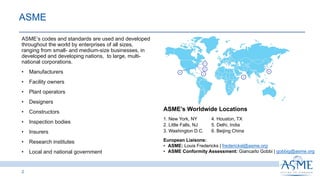
ASME’s Worldwide Locations
1. New York, NY 4. Houston, TX
2. Little Falls, NJ 5. Delhi, India
3. Washington D.C. 6. Beijing China
European Liaisons:
• ASME: Louis Fredericks | fredericksl@asme.org
• ASME Conformity Assessment: Giancarlo Gobbi | gobbig@asme.org
1
2
3
4
5
6
3
ASME Codes & Standards
Nuclear
• Nuclear Codes and Standards,
Sections III & XI
• Standards Committee on Cranes for
Nuclear Facilities
Pressure Technology
• BPVC Sections I, II, IV, V, VIII, IX, X, XII
• B31 Code
• Bioprocessing Equipment (BPE)
Safety
• A17 Elevators and Escalators
• B20 Safety Standards for Conveyors
and Related Equipment
• Rail Transit Vehicle Standard Committee
Standardization & Testing
• Y14 Engineering Drawings and
Related Documents
• EA Industrial Energy Assessment
Standards Committee
• Performance Test Codes
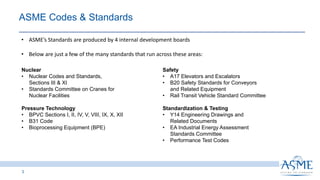
• ASME’s Standards are produced by 4 internal development boards
• Below are just a few of the many standards that run across these areas:
4
2021 ASME Boiler & Pressure Vessel Code
• Anticipated release, July 2021
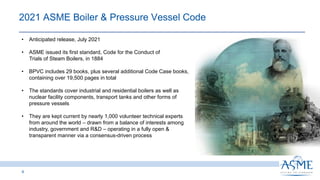
• ASME issued its first standard, Code for the Conduct of
Trials of Steam Boilers, in 1884
• BPVC includes 29 books, plus several additional Code Case books,
containing over 19,500 pages in total
• The standards cover industrial and residential boilers as well as
nuclear facility components, transport tanks and other forms of
pressure vessels
• They are kept current by nearly 1,000 volunteer technical experts
from around the world – drawn from a balance of interests among
industry, government and R&D – operating in a fully open &
transparent manner via a consensus-driven process
5
2021 ASME Boiler & Pressure Vessel Code​
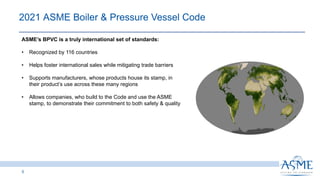
ASME’s BPVC is a truly international set of standards:
• Recognized by 116 countries
• Helps foster international sales while mitigating trade barriers
• Supports manufacturers, whose products house its stamp, in
their product’s use across these many regions
• Allows companies, who build to the Code and use the ASME
stamp, to demonstrate their commitment to both safety & quality
6
2021 ASME Boiler and Pressure Vessel Code​
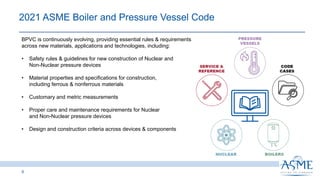
BPVC is continuously evolving, providing essential rules & requirements
across new materials, applications and technologies, including:
• Safety rules & guidelines for new construction of Nuclear and
Non-Nuclear pressure devices
• Material properties and specifications for construction,
including ferrous & nonferrous materials
• Customary and metric measurements
• Proper care and maintenance requirements for Nuclear
and Non-Nuclear pressure devices
• Design and construction criteria across devices & components
7
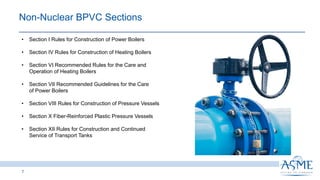
Non-Nuclear BPVC Sections​
• Section I Rules for Construction of Power Boilers ​
• Section IV Rules for Construction of Heating Boilers ​
• Section VI Recommended Rules for the Care and
Operation of Heating Boilers​
• Section VII Recommended Guidelines for the Care
of Power Boilers​
• Section VIII Rules for Construction of Pressure Vessels ​
• Section X Fiber-Reinforced Plastic Pressure Vessels ​
• Section XII Rules for Construction and Continued
Service of Transport Tanks​
8
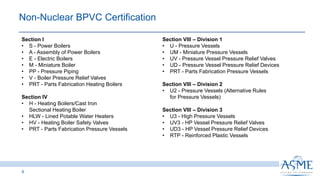
Non-Nuclear BPVC Certification​
Section I
• S - Power Boilers
• A - Assembly of Power Boilers
• E - Electric Boilers
• M - Miniature Boiler
• PP - Pressure Piping
• V - Boiler Pressure Relief Valves
• PRT - Parts Fabrication Heating Boilers
Section IV
• H - Heating Boilers/Cast Iron
Sectional Heating Boiler
• HLW - Lined Potable Water Heaters
• HV - Heating Boiler Safety Valves
• PRT - Parts Fabrication Pressure Vessels
Section VIII ‒ Division 1
• U - Pressure Vessels
• UM - Miniature Pressure Vessels
• UV - Pressure Vessel Pressure Relief Valves
• UD - Pressure Vessel Pressure Relief Devices
• PRT - Parts Fabrication Pressure Vessels
Section VIII ‒ Division 2
• U2 - Pressure Vessels (Alternative Rules
for Pressure Vessels)
Section VIII ‒ Division 3
• U3 - High Pressure Vessels
• UV3 - HP Vessel Pressure Relief Valves
• UD3 - HP Vessel Pressure Relief Devices
• RTP - Reinforced Plastic Vessels
9
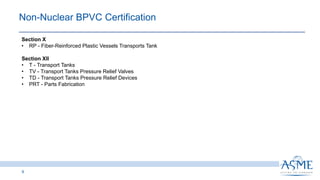
Section X
• RP - Fiber-Reinforced Plastic Vessels Transports Tank
Section XII
• T - Transport Tanks
• TV - Transport Tanks Pressure Relief Valves
• TD - Transport Tanks Pressure Relief Devices
• PRT - Parts Fabrication
Non-Nuclear BPVC Certification​
10
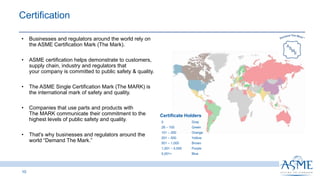
Certification ​
• Businesses and regulators around the world rely on
the ASME Certification Mark (The Mark).
• ASME certification helps demonstrate to customers,
supply chain, industry and regulators that
your company is committed to public safety & quality.
• The ASME Single Certification Mark (The MARK) is
the international mark of safety and quality.
• Companies that use parts and products with
The MARK communicate their commitment to the
highest levels of public safety and quality.
• That's why businesses and regulators around the
world “Demand The Mark.”
0​ Gray​
26 – 100​ Green​
101 – 200​ Orange​
201 – 500​ Yellow​
501 – 1,000​ Brown​
1,001 – 5,000​ Purple​
5,001+​ Blue​
Certificate Holders
11
Certification
To be in compliance with Certification, the applicant must be on
the latest release of the standard 6 months after its release.
All Code book purchases will be verified.
ASME Information Certification BPV-GUI-03 Issue 1, Rev. 1 12-
05-2018…………Subscription to the indicated sections of the
ASME Boiler and Pressure Vessel Code is required for
certification to assure that Code users have the latest applicable
Code rules.
ASME CA-1, 2020 Chapter 2…..2.1.3 The organization shall
obtain and retain a copy of the governing standard(s) from an
authorized seller of ASME codes and standards. Reproductions
and translations from other sources are not acceptable for ASME
accreditation and certification.
Certification ​
12
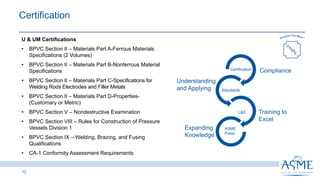
U & UM Certifications
• BPVC Section II ‒ Materials Part A-Ferrous Materials
Specifications (2 Volumes)
• BPVC Section II ‒ Materials Part B-Nonferrous Material
Specifications
• BPVC Section II ‒ Materials Part C-Specifications for
Welding Rods Electrodes and Filler Metals
• BPVC Section II ‒ Materials Part D-Properties-
(Customary or Metric)
• BPVC Section V ‒ Nondestructive Examination
• BPVC Section VIII ‒ Rules for Construction of Pressure
Vessels Division 1
• BPVC Section IX ‒ Welding, Brazing, and Fusing
Qualifications
• CA-1 Conformity Assessment Requirements
Certification
Standards
L&D
ASME
Press
Compliance
Training to
Excel
Expanding
Knowledge
Understanding
and Applying
Boiler Sections ​
13
• Section I ‒ Rules for Construction of Power Boilers ​
• Section IV ‒ Rules for Construction of Heating Boilers ​
• Section VI ‒ Recommended Rules for the Care and
Operation of Heating Boilers​
• Section VII ‒ Recommended Guidelines for the Care
of Power Boilers​
Section I ‒ Rules for Construction of Power Boilers ​
14
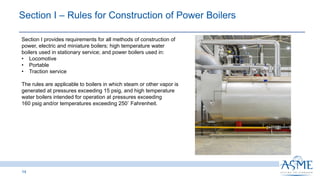
Section I provides requirements for all methods of construction of
power, electric and miniature boilers; high temperature water
boilers used in stationary service; and power boilers used in:
• Locomotive
• Portable
• Traction service
The rules are applicable to boilers in which steam or other vapor is
generated at pressures exceeding 15 psig, and high temperature
water boilers intended for operation at pressures exceeding
160 psig and/or temperatures exceeding 250◦ Fahrenheit.
Section IV ‒ Rules for Construction of Heating Boilers ​​
15
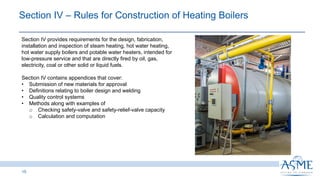
Section IV provides requirements for the design, fabrication,
installation and inspection of steam heating, hot water heating,
hot water supply boilers and potable water heaters, intended for
low-pressure service and that are directly fired by oil, gas,
electricity, coal or other solid or liquid fuels.
Section IV contains appendices that cover:
• Submission of new materials for approval
• Definitions relating to boiler design and welding
• Quality control systems
• Methods along with examples of
o Checking safety-valve and safety-relief-valve capacity
o Calculation and computation
Section VI ‒ Recommended Rules for the Care and Operation of
Heating Boilers
16
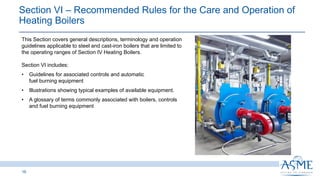
This Section covers general descriptions, terminology and operation
guidelines applicable to steel and cast-iron boilers that are limited to
the operating ranges of Section IV Heating Boilers.
Section VI includes:
• Guidelines for associated controls and automatic
fuel burning equipment
• Illustrations showing typical examples of available equipment.
• A glossary of terms commonly associated with boilers, controls
and fuel burning equipment
Section VII ‒ Recommended Guidelines for the Care of
Power Boilers​
17
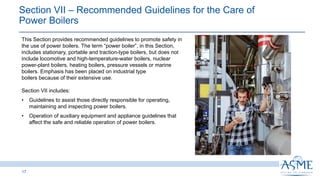
This Section provides recommended guidelines to promote safety in
the use of power boilers. The term “power boiler”, in this Section,
includes stationary, portable and traction-type boilers, but does not
include locomotive and high-temperature-water boilers, nuclear
power-plant boilers, heating boilers, pressure vessels or marine
boilers. Emphasis has been placed on industrial type
boilers because of their extensive use.
Section VII includes:
• Guidelines to assist those directly responsible for operating,
maintaining and inspecting power boilers.
• Operation of auxiliary equipment and appliance guidelines that
affect the safe and reliable operation of power boilers.
Pressure Vessel Sections ​
18
• Section VIII ‒ Rules for Construction of Pressure Vessels
• Section X ‒ Fiber-Reinforced Plastic Pressure Vessels ​
• Section XII ‒ Rules for Construction and Continued
Service of Transport Tanks
19
Division 1 is very important from a design perspective because of
the compulsory requirements, specific prohibitions, and impulsive,
guidelines for materials, design, fabrication, inspection, and testing,
markings and reports, overpressure protection, and certification of
pressure vessels having an indoor or external pressure more than
15 psi (100 kPa)
The Division isn’t numbered within the traditional method (Part 1,
Part 2, etc.) but is structured with Subsections and Parts, which
contains letters followed by variety.
“Design-by-Rule” philosophy
Section VIII ‒ Rules for Construction of Pressure Vessels,
Division 1​
Section VIII ‒ Rules for Construction of Pressure Vessels,
Division 2, Alternative Rules ​
20
• Division 2 provides requirements applicable to the design,
fabrication, inspection, testing, and certification of pressure
vessels operating at either internal or external pressures
exceeding 15 psig.
• This pressure may be obtained from an external source or by the
application of heat from a direct or indirect source, or any
combination thereof.
• These rules provide an alternative to the minimum requirements
for pressure vessels under Division 1 rules. These rules may also
apply to human occupancy pressure vessels typically in the
diving industry.
• Both “Design-by-Rule” and “Design-by-Analysis” (a methodical
approach for demonstrating the adequacy of a pressure vessel
component design. It provides detailed rules for performing
analyses.) philosophy
21
ASME Section VIII, Division 2 is intended for purpose-specific
vessels with a defined fixed location. Another major difference
between the Division 1 and Division 2 lies in failure theory.
While Division 1 is based on normal stress theory, Division 2 is
based on maximum distortion energy.
von Mises Distortion Energy Theory (1913). In this theory failure by
yielding occurs when at any point in the body ,the distortion energy
per unit volume in a state of combined stress becomes equal to that
associated with yielding in a simple tension test.
Section VIII ‒ Rules for Construction of Pressure Vessels,
Differences Between Divisions 1 & 2 ​
22
• Provides requirements applicable to the design, fabrication,
inspection, testing, and certification of pressure vessels
operating at either internal or external pressures generally
above 10,000 psi.
• Division 3 rules cover vessels intended for a specific service and
installed in a fixed location or relocated from work site to work
site between pressurizations.
• Division 3 does not establish maximum pressure limits for either
Section VIII, Divisions 1 or 2.
Section VIII ‒ Rules for Construction of Pressure Vessels,
Division 3, Alternative Rules for Construction of High Pressure Vessels
23
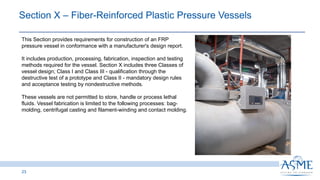
This Section provides requirements for construction of an FRP
pressure vessel in conformance with a manufacturer's design report.
It includes production, processing, fabrication, inspection and testing
methods required for the vessel. Section X includes three Classes of
vessel design; Class I and Class III - qualification through the
destructive test of a prototype and Class II - mandatory design rules
and acceptance testing by nondestructive methods.
These vessels are not permitted to store, handle or process lethal
fluids. Vessel fabrication is limited to the following processes: bag-
molding, centrifugal casting and filament-winding and contact molding.
Section X ‒ Fiber-Reinforced Plastic Pressure Vessels ​
24
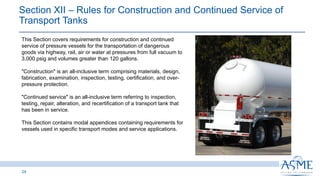
This Section covers requirements for construction and continued
service of pressure vessels for the transportation of dangerous
goods via highway, rail, air or water at pressures from full vacuum to
3,000 psig and volumes greater than 120 gallons.
"Construction" is an all-inclusive term comprising materials, design,
fabrication, examination, inspection, testing, certification, and over-
pressure protection.
"Continued service" is an all-inclusive term referring to inspection,
testing, repair, alteration, and recertification of a transport tank that
has been in service.
This Section contains modal appendices containing requirements for
vessels used in specific transport modes and service applications.
Section XII ‒ Rules for Construction and Continued Service of
Transport Tanks ​
Nuclear Sections ​
25
• Section III ‒ Rules for Construction of Nuclear
Facility Components
• Section XI ‒ Rules for In-Service Inspection of Nuclear Power
Plant Components
26
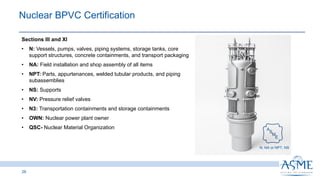
Sections III and XI
• N: Vessels, pumps, valves, piping systems, storage tanks, core
support structures, concrete containments, and transport packaging
• NA: Field installation and shop assembly of all items
• NPT: Parts, appurtenances, welded tubular products, and piping
subassemblies
• NS: Supports
• NV: Pressure relief valves
• N3: Transportation containments and storage containments
• OWN: Nuclear power plant owner
• QSC- Nuclear Material Organization
Nuclear BPVC Certification
N, NA or NPT, NS
27
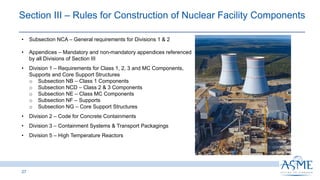
• Subsection NCA ‒ General requirements for Divisions 1 & 2
• Appendices ‒ Mandatory and non-mandatory appendices referenced
by all Divisions of Section III
• Division 1 ‒ Requirements for Class 1, 2, 3 and MC Components,
Supports and Core Support Structures
o Subsection NB ‒ Class 1 Components
o Subsection NCD ‒ Class 2 & 3 Components
o Subsection NE ‒ Class MC Components
o Subsection NF ‒ Supports
o Subsection NG ‒ Core Support Structures
• Division 2 ‒ Code for Concrete Containments
• Division 3 ‒ Containment Systems & Transport Packagings
• Division 5 ‒ High Temperature Reactors
Section III ‒ Rules for Construction of Nuclear Facility Components
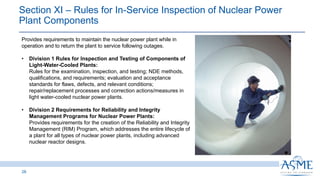
Section XI ‒ Rules for In-Service Inspection of Nuclear Power
Plant Components
28
Provides requirements to maintain the nuclear power plant while in
operation and to return the plant to service following outages.
• Division 1 Rules for Inspection and Testing of Components of
Light-Water-Cooled Plants:
Rules for the examination, inspection, and testing; NDE methods,
qualifications, and requirements; evaluation and acceptance
standards for flaws, defects, and relevant conditions;
repair/replacement processes and correction actions/measures in
light water-cooled nuclear power plants.
• Division 2 Requirements for Reliability and Integrity
Management Programs for Nuclear Power Plants:
Provides requirements for the creation of the Reliability and Integrity
Management (RIM) Program, which addresses the entire lifecycle of
a plant for all types of nuclear power plants, including advanced
nuclear reactor designs.
Service & Reference Sections
29
• Section II ‒ Materials
• Section V ‒ Nondestructive Examination
• Section IX ‒ Welding, Brazing and Fusing Qualifications
• Section XIII ‒ Rules for Overpressure Protection
NEW!!
30
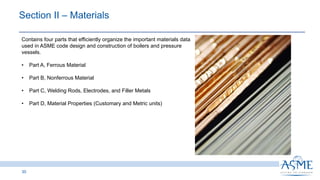
Contains four parts that efficiently organize the important materials data
used in ASME code design and construction of boilers and pressure
vessels.
• Part A, Ferrous Material
• Part B, Nonferrous Material
• Part C, Welding Rods, Electrodes, and Filler Metals
• Part D, Material Properties (Customary and Metric units)
Section II ‒ Materials
31
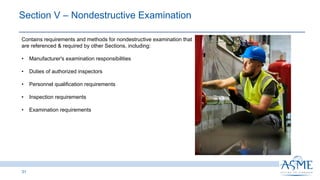
Section V ‒ Nondestructive Examination
Contains requirements and methods for nondestructive examination that
are referenced & required by other Sections, including:
• Manufacturer's examination responsibilities
• Duties of authorized inspectors
• Personnel qualification requirements
• Inspection requirements
• Examination requirements
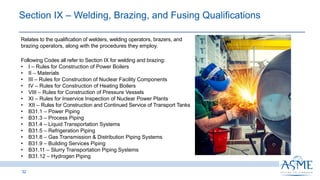
Section IX ‒ Welding, Brazing, and Fusing Qualifications
32
Relates to the qualification of welders, welding operators, brazers, and
brazing operators, along with the procedures they employ.
Following Codes all refer to Section IX for welding and brazing​:
• I ‒ Rules for Construction of Power Boilers
• II ‒ Materials
• III ‒ Rules for Construction of Nuclear Facility Components
• IV ‒ Rules for Construction of Heating Boilers
• VIII ‒ Rules for Construction of Pressure Vessels
• XI ‒ Rules for Inservice Inspection of Nuclear Power Plants
• XII ‒ Rules for Construction and Continued Service of Transport Tanks
• B31.1 ‒ Power Piping
• B31.3 ‒ Process Piping
• B31.4 ‒ Liquid Transportation Systems
• B31.5 ‒ Refrigeration Piping
• B31.8 ‒ Gas Transmission & Distribution Piping Systems
• B31.9 ‒ Building Services Piping
• B31.11 ‒ Slurry Transportation Piping Systems
• B31.12 ‒ Hydrogen Piping
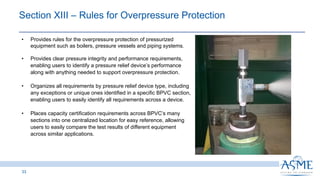
Section XIII ‒ Rules for Overpressure Protection
33
• Provides rules for the overpressure protection of pressurized
equipment such as boilers, pressure vessels and piping systems.
• Provides clear pressure integrity and performance requirements,
enabling users to identify a pressure relief device’s performance
along with anything needed to support overpressure protection.
• Organizes all requirements by pressure relief device type, including
any exceptions or unique ones identified in a specific BPVC section,
enabling users to easily identify all requirements across a device.
• Places capacity certification requirements across BPVC’s many
sections into one centralized location for easy reference, allowing
users to easily compare the test results of different equipment
across similar applications.
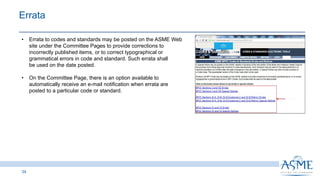
34
• Errata to codes and standards may be posted on the ASME Web
site under the Committee Pages to provide corrections to
incorrectly published items, or to correct typographical or
grammatical errors in code and standard. Such errata shall
be used on the date posted.
• On the Committee Page, there is an option available to
automatically receive an e-mail notification when errata are
posted to a particular code or standard.
Errata​
35
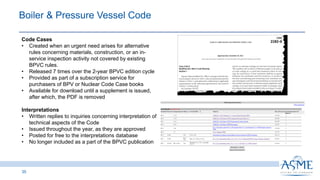
Code Cases
• Created when an urgent need arises for alternative
rules concerning materials, construction, or an in-
service inspection activity not covered by existing
BPVC rules.
• Released 7 times over the 2-year BPVC edition cycle
• Provided as part of a subscription service for
purchasers of BPV or Nuclear Code Case books
• Available for download until a supplement is issued,
after which, the PDF is removed
Interpretations
• Written replies to inquiries concerning interpretation of
technical aspects of the Code
• Issued throughout the year, as they are approved
• Posted for free to the interpretations database
• No longer included as a part of the BPVC publication
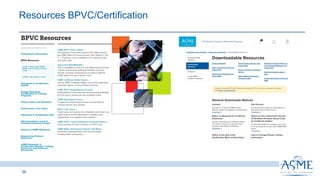
Boiler & Pressure Vessel Code​
Resources BPVC/Certification ​
36
Steven J. Rossi
ASME
Project Engineering Manager
Standards & Certification
rossisj@asme.org
37
Now Presenting
2021 BPV Code Major Changes
38
INSERT PICTURE
HERE
• This presentation is a general summary of some of the major
changes that will appear in the 2021 Edition of the ASME Boiler &
Pressure Vessel Code. ​
• All changes to the Code will be available when the 2021 Edition is
issued in July, 2021. ​
• The specific detailed changes should be carefully reviewed and
verified as published in the 2021 Edition to ensure compliance with
Code requirements.
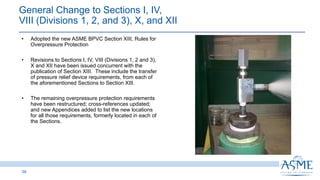
• Adopted the new ASME BPVC Section XIII, Rules for
Overpressure Protection
• Revisions to Sections I, IV, VIII (Divisions 1, 2 and 3),
X and XII have been issued concurrent with the
publication of Section XIII. These include the transfer
of pressure relief device requirements, from each of
the aforementioned Sections to Section XIII.
• The remaining overpressure protection requirements
have been restructured; cross-references updated;
and new Appendices added to list the new locations
for all those requirements, formerly located in each of
the Sections.
39
INSERT PICTURE
HEE
General Change to Sections I, IV,
VIII (Divisions 1, 2, and 3), X, and XII
Section I ‒ Rules for Construction of Power Boilers ​
40
INSERT PICTURE
HERE
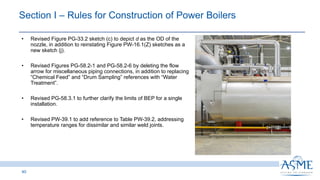
• Revised Figure PG-33.2 sketch (c) to depict d as the OD of the
nozzle, in addition to reinstating Figure PW-16.1(Z) sketches as a
new sketch (j).
• Revised Figures PG-58.2-1 and PG-58.2-6 by deleting the flow
arrow for miscellaneous piping connections, in addition to replacing
“Chemical Feed” and “Drum Sampling” references with “Water
Treatment”.
• Revised PG-58.3.1 to further clarify the limits of BEP for a single
installation.
• Revised PW-39.1 to add reference to Table PW-39.2, addressing
temperature ranges for dissimilar and similar weld joints.
41
INSERT PICTURE
HERE
• The range of acceptable ASTM editions has been updated for a
number of specifications.
• The Guideline on the Approval of New Materials Under the ASME
Boiler and Pressure Vessel Code has been updated.
Section II ‒ Materials
42
INSERT PICTURE
HERE
• Updates to the latest adopted edition have been made
to over 15 specifications.
• Two new specifications have been added:
o SA-988/SA-988M
o SA-989/SA-989M
• One specification has been removed, SA/NFA 36-215.
Section II ‒ Materials, Part A, Ferrous Material Specifications
43
INSERT PICTURE
HERE
• Updates to the latest adopted edition have been made to over
45 specifications.
• Two new specifications have been added:
o SB-752/SB-752M
o SB-834
• One specification has been removed, SB-858.
Section II ‒ Materials, Part B, Nonferrous Material Specifications
Section II ‒ Materials, Part C, Specifications for Welding Rods,
Electrodes, and Filler Metals
44
INSERT PICTURE
HERE
• Six AWS specifications for arc welding electrodes, gas welding rods and
other filler metals adopted or updated into the 2021 edition & one removed:
o AWS A5.01M/A5.01:2019 "Welding and Brazing Consumables -
Procurement of Filler Materials and Fluxes" as SFA-5.01M/SFA-5.01
o AWS A5.17/A5.17M:2019 "Specification for Carbon Steel Electrodes and
Fluxes for Submerged Arc Welding" as SFA-5.17/SFA-5.17M
o AWS A5.26/A5.26M:2020 "Specification for Carbon and Low-Alloy Steel
Electrodes for Electrogas Welding" as SFA-5.26/SFA-5.26M
o AWS A5.28/A5.28M:2020 "Specification for Low-Alloy Steel Electrodes
and Rods for Gas Shielded Arc Welding" as SFA-5.28/SFA-5.28M
o AWS A5.34/A5.34M:2018 "Specification for Nickel-Alloy Flux Cored and
Metal Cored Welding Electrodes" as SFA-5.34/SFA-5.34M
o AWS A5.39/A5.39M:2020 "Specification for Flux and Electrode
Combinations for Submerged Arc and Electroslag Joining and Surfacing
of Stainless Steel and Nickel Alloys" as SFA-5.39/SFA-5.39M
o Removed SFA-5.36/SFA-5.36M, since AWS and ANSI have withdrawn
A5.36/A5.36M.
45
INSERT PICTURE
HERE
• Existing stress lines for Grade 91 have been designated as “Type
1” and new lines have been added for Grade 91 “Type 2” with
higher allowable stresses.
• Tables 6A through 6D containing allowable stresses for ASME
BPVC Section IV have been made mandatory.
• Incorporated Code Cases 2445-2, 2543, and 2603-1.
• Additions and revisions to stress tables and mechanical property
tables have been made to support updated specifications.
Section II ‒ Materials, Part D, Properties (Customary, Metric)
46
INSERT PICTURE
HERE
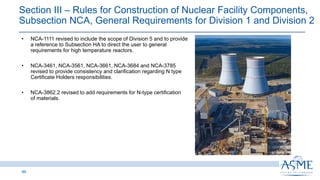
• NCA-1111 revised to include the scope of Division 5 and to provide
a reference to Subsection HA to direct the user to general
requirements for high temperature reactors.
• NCA-3461, NCA-3561, NCA-3661, NCA-3684 and NCA-3785
revised to provide consistency and clarification regarding N type
Certificate Holders responsibilities.
• NCA-3862.2 revised to add requirements for N-type certification
of materials.
Section III ‒ Rules for Construction of Nuclear Facility Components,
Subsection NCA, General Requirements for Division 1 and Division 2
Section III ‒ Rules for Construction of Nuclear Facility Components,
Subsection NB, Class 1 Components
47
INSERT PICTURE
HERE
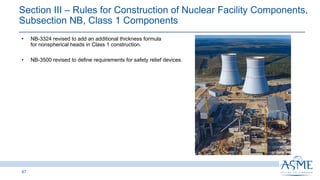
• NB-3324 revised to add an additional thickness formula
for nonspherical heads in Class 1 construction.
• NB-3500 revised to define requirements for safety relief devices.
Section III ‒ Rules for Construction of Nuclear Facility Components,
Subsection NCD, Class 2 and Class 3 Components
48
INSERT PICTURE
HERE
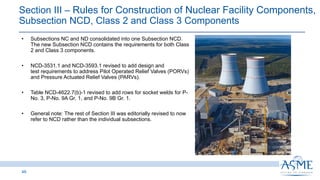
• Subsections NC and ND consolidated into one Subsection NCD.
The new Subsection NCD contains the requirements for both Class
2 and Class 3 components.
• NCD-3531.1 and NCD-3593.1 revised to add design and
test requirements to address Pilot Operated Relief Valves (PORVs)
and Pressure Actuated Relief Valves (PARVs).
• Table NCD-4622.7(b)-1 revised to add rows for socket welds for P-
No. 3, P-No. 9A Gr. 1, and P-No. 9B Gr. 1.
• General note: The rest of Section III was editorially revised to now
refer to NCD rather than the individual subsections.
Section III ‒ Rules for Construction of Nuclear Facility Components,
Subsection NE, Class MC Components
49
INSERT PICTURE
HERE
• Figure NE-2575.2-1 revised to add General Note C to clarify that
the sketch shown is typical but is to be used as guide for minimum
required coverage of other configurations.
• Deleted NE-3228.1(a).
• NE-4211 revised to align NB/NC/ND/WB/WC/WD-4211.
• NE-6111 revised to clarify that “non-welded access opening
covers” are exempted from pressure testing.
Section III ‒ Rules for Construction of Nuclear Facility Components,
Subsection NF, Supports
50
INSERT PICTURE
HERE
• Various revisions made to Subsection NF and Appendix F to reflect
appropriate stress limit conditions identified in the NRC Regulatory
Guide 1.130.
• NF-3322 revised to be consistent with AISC 360-16 and to align
with current industry guidance for pin-connected members.
• Two new figures added to provide clarity in application of the
dimensional limitations described in the text.
• NF-3223.5 added to provide additional specificity as to how to
determine the critical buckling stress of NF Plate and Shell
designs.
Section III ‒ Rules for Construction of Nuclear Facility Components,
Subsection NG, Core Support Structures
51
INSERT PICTURE
HERE
• NG-3211 revised to provide requirements to address buckling of
beams and columns.
• The terms related to stress analysis in NG-3213 updated to be
consistent with those in Mandatory Appendix XIII, Design Based on
Stress Analysis.
• Deleted NE-3228.1(a) since the limitation on analytical methods for
"the remaining stress limits" is no longer needed.
• NG-3225, NG-3228, NG-3235 revised to consolidate and clarify
the rules for limit analysis within Subsection NG.
Section III ‒ Rules for Construction of Nuclear Facility Components,
Appendices
52
INSERT PICTURE
HERE
• XIII-3430 revised to add a new criterion to explicitly address the
ratchet limit due to thermal membrane stress in addition to
combined thermal membrane plus bending stress range.
• Appendix XXVI updated to add new Nonmandatory Supplement E
to provide guidance for the pressure design of PE and metallic-to-
PE flanged joints.
• Nonmandatory Appendix B revised to add guidance for additional
ultrasonic examination for high alloy metals.
• New Nonmandatory Appendix MM added to provide guidance on
the stress linearization process, based on the stress linearization
guidelines in Section VIII, Division 2.
Section III ‒ Rules for Construction of Nuclear Facility Components,
Division 2, Code for Concrete Containments
53
INSERT PICTURE
HERE
• Revised to harmonize the material sizing system. All metric bar
and coupler sizes referenced within the Code have been revised to
maintain the US material sizing system.
• Revised CC-2438.4.1 and CC-2438.4.2 to clarify that qualification
test data and test data for permanent corrosion protection material
as defined in CC-2438 shall be certified.
• Table CC-2623.2-1 revised to update strength requirements for studs.
• CC-2710 and CC-3121 revised to provide clarification on existing
requirements.
Section III ‒ Rules for Construction of Nuclear Facility Components,
Division 3, Containment Systems for Transportation and Storage of
Spent Nuclear Fuel and High-Level Radioactive Material
54
INSERT PICTURE
HERE
• Subsections WB, WC and WD revised to clarify the prohibition of
certain welding processes.
• Section WC-2129 added to include requirements for
fabricated hubbed flanges.
• Section WC-3263 added to include requirements for Category C
Weld Joints for Flat Heads with Hubs.
• Various Figures and paragraphs revised in WB-3000 to clarify the
requirements for the hypothetical fire event.
55
INSERT PICTURE
HERE
• HHA-3217 revised to update the failure probability calculation
to increase the accuracy for fine grained graphite materials.
• Figure HBB-T-1420-1E revised to update the series of fatigue
curves for Grade 91 at elevated temperatures from 700F to 1200F.
• Appendix HBB-T revised to provide equations for the isochronous
stress-strain curves.
Section III ‒ Rules for Construction of Nuclear Facility Components,
Division 5, High Temperature Reactors
56
INSERT PICTURE
HERE
• Revised the design temperature of plain furnaces in HG-312.1(b).
• Added requirements to allow for alternative marking of small parts
based on BPV Section I, para. PG-106.8.2.
• Removed the allowable stress tables from Section IV and updated
the references to these tables to Section II, Part D.
Section IV ‒ Rules for Construction of Heating Boilers ​​
57
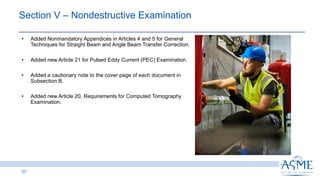
INSERT PICTURE
HERE
• Added Nonmandatory Appendices in Articles 4 and 5 for General
Techniques for Straight Beam and Angle Beam Transfer Correction.
• Added new Article 21 for Pulsed Eddy Current (PEC) Examination.
• Added a cautionary note to the cover page of each document in
Subsection B.
• Added new Article 20, Requirements for Computed Tomography
Examination.
Section V ‒ Nondestructive Examination
58
INSERT PICTURE
HERE
• There were no significant changes to Section VI in the 2021 Edition.
Section VI ‒ Recommended Rules for the Care and Operation of
Heating Boilers
59
INSERT PICTURE
HERE
• Figures were added for a watertube boiler and a package boiler.
Section VII ‒ Recommended Guidelines for the Care of
Power Boilers
60
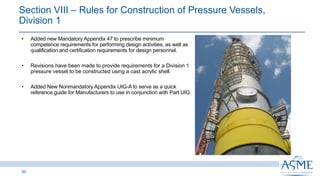
INSERT PICTURE
HERE
• Added new Mandatory Appendix 47 to prescribe minimum
competence requirements for performing design activities, as well as
qualification and certification requirements for design personnel.
• Revisions have been made to provide requirements for a Division 1
pressure vessel to be constructed using a cast acrylic shell.
• Added New Nonmandatory Appendix UIG-A to serve as a quick
reference guide for Manufacturers to use in conjunction with Part UIG.
Section VIII ‒ Rules for Construction of Pressure Vessels,
Division 1
61
INSERT PICTURE
HERE
• Revised Annex 2-B and 2-J to allow engineers to provide Code
services, in addition to Certifying Engineers and
Designers. Educational requirements for engineers and
Designers, have also been added. These changes aligns the
requirements of Appendix 47 of Section VIII, Division 1.
• Revised Part 2, para. 2-F.7.1 to include the character size of 4 mm
(5/32 in.) for stamping on the nameplate.
• Para. 3.11.4 revised to permit the use of flux-cored arc welding
(FCAW) for Division 2 high alloy construction.
• ASME STP-PT-074 added as an acceptable method to be followed
for evaluating local stresses in shells, formed heads and nozzles.
Section VIII ‒ Rules for Construction of Pressure Vessels,
Division 2, Alternative Rules
62
INSERT PICTURE
HERE
• KM-400.2 and KM-400.2M revised to add new cautionary notes
(11) and (12) that involve the chloride stress corrosion cracking of
austenitic stainless steels and the corrosion of free-machining
stainless steels, respectively.
• Tables KD-320.1, KD-320.1M, and Figures KD-320.3 and KD-
320.3M revised to update the austenitic stainless-
steel fatigue curves.
• KF-826 revised to update the rules for calculating maximum
permissible gaps for welded layered vessel.
• KE-503 and KT-510 revised to remove requirement that Volumetric
Expansion Test be performed separately after Hydrostatic and
Acoustic Testing.
• Deleted Appendix L and added reference to Section VIII, Division
2, Annex 5-A.
Section VIII ‒ Rules for Construction of Pressure Vessels,
Division 3, Alternative Rules for Construction of High Pressure Vessels
63
INSERT PICTURE
HERE
• Revised QW-200.4, Table QW-255, QW-403.10 and QW-404.32
concerning GMAW in short-circuit transfer mode.
• Revised QW-403.6, QW-406.3, QW-407.2, QW-409.1, QW-409.4
and QW-410.9 regarding exemptions for materials not affected by
cooling rate when toughness qualification is required.
• Revised QG-106(a) regarding supervising qualification activities.
• Revised QG-108 regarding qualifications made to previous editions.
Section IX ‒ Welding, Brazing, and Fusing Qualifications
64
INSERT PICTURE
HERE
• Laminate tapers for nozzle attachments revised from 6:1 to 4:1 to
align with 4:1 tapers on head/shell and shell/shell joints.
• Permit the use of a KD factor of 1.0 for all chopped strand mat
laminates and laminates consisting of chopped strand mat and
woven roving.
• Adopted the new ASME BPVC Section XIII, Rules for
Overpressure Protection.
• Increased the maximum operating pressure to 2,000 psi.
• Added reference to Section VIII, Division 3, KD-10 and to make it
clear that load sharing pressure parts include not only the metallic
liner but the end nozzles as well.
Section X ‒ Fiber-Reinforced Plastic Pressure Vessels
Section XI ‒ Rules for Inservice Inspection of Nuclear Components,
Division 1, Rules for Inspection and Testing of Components of Light-
Water-Cooled Plants
65
INSERT PICTURE
HERE
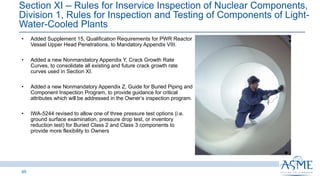
• Added Supplement 15, Qualification Requirements for PWR Reactor
Vessel Upper Head Penetrations, to Mandatory Appendix VIII.
• Added a new Nonmandatory Appendix Y, Crack Growth Rate
Curves, to consolidate all existing and future crack growth rate
curves used in Section XI.
• Added a new Nonmandatory Appendix Z, Guide for Buried Piping and
Component Inspection Program, to provide guidance for critical
attributes which will be addressed in the Owner’s inspection program.
• IWA-5244 revised to allow one of three pressure test options (i.e.
ground surface examination, pressure drop test, or inventory
reduction test) for Buried Class 2 and Class 3 components to
provide more flexibility to Owners
Section XI ‒ Rules for Inservice Inspection of Nuclear Components,
Division 2, Requirements for Reliability and Integrity Management
(RIM) Programs for Nuclear Power Plants
66
INSERT PICTURE
HERE
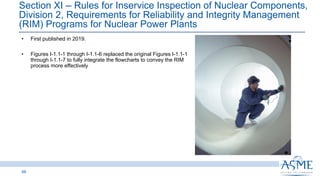
• First published in 2019.
• Figures I-1.1-1 through I-1.1-6 replaced the original Figures I-1.1-1
through I-1.1-7 to fully integrate the flowcharts to convey the RIM
process more effectively
67
INSERT PICTURE
HERE
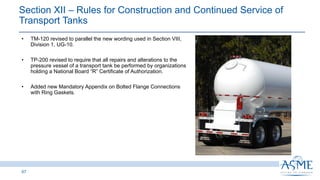
• TM-120 revised to parallel the new wording used in Section VIII,
Division 1, UG-10.
• TP-200 revised to require that all repairs and alterations to the
pressure vessel of a transport tank be performed by organizations
holding a National Board “R” Certificate of Authorization.
• Added new Mandatory Appendix on Bolted Flange Connections
with Ring Gaskets.
Section XII ‒ Rules for Construction and Continued Service of
Transport Tanks ​
68
INSERT PICTURE
HERE
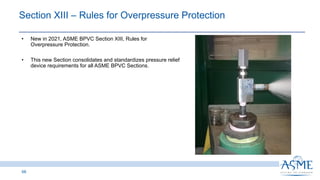
• New in 2021, ASME BPVC Section XIII, Rules for
Overpressure Protection.
• This new Section consolidates and standardizes pressure relief
device requirements for all ASME BPVC Sections.
Section XIII ‒ Rules for Overpressure Protection ​
69

]2021-ASME-Boiler Pressure Vessel C-Final.pdf

  • 1.
  • 2.
    Today’s Speaker andModerator Chris Mahler ASME Director, Derivative Programs Conformity Assessment mahlerc@asme.org 1
  • 3.
    2 ASME ASME’s codes andstandards are used and developed throughout the world by enterprises of all sizes, ranging from small- and medium-size businesses, in developed and developing nations, to large, multi- national corporations. • Manufacturers • Facility owners • Plant operators • Designers • Constructors • Inspection bodies • Insurers • Research institutes • Local and national government ASME’s Worldwide Locations 1. New York, NY 4. Houston, TX 2. Little Falls, NJ 5. Delhi, India 3. Washington D.C. 6. Beijing China European Liaisons: • ASME: Louis Fredericks | fredericksl@asme.org • ASME Conformity Assessment: Giancarlo Gobbi | gobbig@asme.org 1 2 3 4 5 6
  • 4.
    3 ASME Codes &Standards Nuclear • Nuclear Codes and Standards, Sections III & XI • Standards Committee on Cranes for Nuclear Facilities Pressure Technology • BPVC Sections I, II, IV, V, VIII, IX, X, XII • B31 Code • Bioprocessing Equipment (BPE) Safety • A17 Elevators and Escalators • B20 Safety Standards for Conveyors and Related Equipment • Rail Transit Vehicle Standard Committee Standardization & Testing • Y14 Engineering Drawings and Related Documents • EA Industrial Energy Assessment Standards Committee • Performance Test Codes • ASME’s Standards are produced by 4 internal development boards • Below are just a few of the many standards that run across these areas:
  • 5.
    4 2021 ASME Boiler& Pressure Vessel Code • Anticipated release, July 2021 • ASME issued its first standard, Code for the Conduct of Trials of Steam Boilers, in 1884 • BPVC includes 29 books, plus several additional Code Case books, containing over 19,500 pages in total • The standards cover industrial and residential boilers as well as nuclear facility components, transport tanks and other forms of pressure vessels • They are kept current by nearly 1,000 volunteer technical experts from around the world – drawn from a balance of interests among industry, government and R&D – operating in a fully open & transparent manner via a consensus-driven process
  • 6.
    5 2021 ASME Boiler& Pressure Vessel Code​ ASME’s BPVC is a truly international set of standards: • Recognized by 116 countries • Helps foster international sales while mitigating trade barriers • Supports manufacturers, whose products house its stamp, in their product’s use across these many regions • Allows companies, who build to the Code and use the ASME stamp, to demonstrate their commitment to both safety & quality
  • 7.
    6 2021 ASME Boilerand Pressure Vessel Code​ BPVC is continuously evolving, providing essential rules & requirements across new materials, applications and technologies, including: • Safety rules & guidelines for new construction of Nuclear and Non-Nuclear pressure devices • Material properties and specifications for construction, including ferrous & nonferrous materials • Customary and metric measurements • Proper care and maintenance requirements for Nuclear and Non-Nuclear pressure devices • Design and construction criteria across devices & components
  • 8.
    7 Non-Nuclear BPVC Sections​ •Section I Rules for Construction of Power Boilers ​ • Section IV Rules for Construction of Heating Boilers ​ • Section VI Recommended Rules for the Care and Operation of Heating Boilers​ • Section VII Recommended Guidelines for the Care of Power Boilers​ • Section VIII Rules for Construction of Pressure Vessels ​ • Section X Fiber-Reinforced Plastic Pressure Vessels ​ • Section XII Rules for Construction and Continued Service of Transport Tanks​
  • 9.
    8 Non-Nuclear BPVC Certification​ SectionI • S - Power Boilers • A - Assembly of Power Boilers • E - Electric Boilers • M - Miniature Boiler • PP - Pressure Piping • V - Boiler Pressure Relief Valves • PRT - Parts Fabrication Heating Boilers Section IV • H - Heating Boilers/Cast Iron Sectional Heating Boiler • HLW - Lined Potable Water Heaters • HV - Heating Boiler Safety Valves • PRT - Parts Fabrication Pressure Vessels Section VIII ‒ Division 1 • U - Pressure Vessels • UM - Miniature Pressure Vessels • UV - Pressure Vessel Pressure Relief Valves • UD - Pressure Vessel Pressure Relief Devices • PRT - Parts Fabrication Pressure Vessels Section VIII ‒ Division 2 • U2 - Pressure Vessels (Alternative Rules for Pressure Vessels) Section VIII ‒ Division 3 • U3 - High Pressure Vessels • UV3 - HP Vessel Pressure Relief Valves • UD3 - HP Vessel Pressure Relief Devices • RTP - Reinforced Plastic Vessels
  • 10.
    9 Section X • RP- Fiber-Reinforced Plastic Vessels Transports Tank Section XII • T - Transport Tanks • TV - Transport Tanks Pressure Relief Valves • TD - Transport Tanks Pressure Relief Devices • PRT - Parts Fabrication Non-Nuclear BPVC Certification​
  • 11.
    10 Certification ​ • Businessesand regulators around the world rely on the ASME Certification Mark (The Mark). • ASME certification helps demonstrate to customers, supply chain, industry and regulators that your company is committed to public safety & quality. • The ASME Single Certification Mark (The MARK) is the international mark of safety and quality. • Companies that use parts and products with The MARK communicate their commitment to the highest levels of public safety and quality. • That's why businesses and regulators around the world “Demand The Mark.” 0​ Gray​ 26 – 100​ Green​ 101 – 200​ Orange​ 201 – 500​ Yellow​ 501 – 1,000​ Brown​ 1,001 – 5,000​ Purple​ 5,001+​ Blue​ Certificate Holders
  • 12.
    11 Certification To be incompliance with Certification, the applicant must be on the latest release of the standard 6 months after its release. All Code book purchases will be verified. ASME Information Certification BPV-GUI-03 Issue 1, Rev. 1 12- 05-2018…………Subscription to the indicated sections of the ASME Boiler and Pressure Vessel Code is required for certification to assure that Code users have the latest applicable Code rules. ASME CA-1, 2020 Chapter 2…..2.1.3 The organization shall obtain and retain a copy of the governing standard(s) from an authorized seller of ASME codes and standards. Reproductions and translations from other sources are not acceptable for ASME accreditation and certification.
  • 13.
    Certification ​ 12 U &UM Certifications • BPVC Section II ‒ Materials Part A-Ferrous Materials Specifications (2 Volumes) • BPVC Section II ‒ Materials Part B-Nonferrous Material Specifications • BPVC Section II ‒ Materials Part C-Specifications for Welding Rods Electrodes and Filler Metals • BPVC Section II ‒ Materials Part D-Properties- (Customary or Metric) • BPVC Section V ‒ Nondestructive Examination • BPVC Section VIII ‒ Rules for Construction of Pressure Vessels Division 1 • BPVC Section IX ‒ Welding, Brazing, and Fusing Qualifications • CA-1 Conformity Assessment Requirements Certification Standards L&D ASME Press Compliance Training to Excel Expanding Knowledge Understanding and Applying
  • 14.
    Boiler Sections ​ 13 •Section I ‒ Rules for Construction of Power Boilers ​ • Section IV ‒ Rules for Construction of Heating Boilers ​ • Section VI ‒ Recommended Rules for the Care and Operation of Heating Boilers​ • Section VII ‒ Recommended Guidelines for the Care of Power Boilers​
  • 15.
    Section I ‒Rules for Construction of Power Boilers ​ 14 Section I provides requirements for all methods of construction of power, electric and miniature boilers; high temperature water boilers used in stationary service; and power boilers used in: • Locomotive • Portable • Traction service The rules are applicable to boilers in which steam or other vapor is generated at pressures exceeding 15 psig, and high temperature water boilers intended for operation at pressures exceeding 160 psig and/or temperatures exceeding 250◦ Fahrenheit.
  • 16.
    Section IV ‒Rules for Construction of Heating Boilers ​​ 15 Section IV provides requirements for the design, fabrication, installation and inspection of steam heating, hot water heating, hot water supply boilers and potable water heaters, intended for low-pressure service and that are directly fired by oil, gas, electricity, coal or other solid or liquid fuels. Section IV contains appendices that cover: • Submission of new materials for approval • Definitions relating to boiler design and welding • Quality control systems • Methods along with examples of o Checking safety-valve and safety-relief-valve capacity o Calculation and computation
  • 17.
    Section VI ‒Recommended Rules for the Care and Operation of Heating Boilers 16 This Section covers general descriptions, terminology and operation guidelines applicable to steel and cast-iron boilers that are limited to the operating ranges of Section IV Heating Boilers. Section VI includes: • Guidelines for associated controls and automatic fuel burning equipment • Illustrations showing typical examples of available equipment. • A glossary of terms commonly associated with boilers, controls and fuel burning equipment
  • 18.
    Section VII ‒Recommended Guidelines for the Care of Power Boilers​ 17 This Section provides recommended guidelines to promote safety in the use of power boilers. The term “power boiler”, in this Section, includes stationary, portable and traction-type boilers, but does not include locomotive and high-temperature-water boilers, nuclear power-plant boilers, heating boilers, pressure vessels or marine boilers. Emphasis has been placed on industrial type boilers because of their extensive use. Section VII includes: • Guidelines to assist those directly responsible for operating, maintaining and inspecting power boilers. • Operation of auxiliary equipment and appliance guidelines that affect the safe and reliable operation of power boilers.
  • 19.
    Pressure Vessel Sections​ 18 • Section VIII ‒ Rules for Construction of Pressure Vessels • Section X ‒ Fiber-Reinforced Plastic Pressure Vessels ​ • Section XII ‒ Rules for Construction and Continued Service of Transport Tanks
  • 20.
    19 Division 1 isvery important from a design perspective because of the compulsory requirements, specific prohibitions, and impulsive, guidelines for materials, design, fabrication, inspection, and testing, markings and reports, overpressure protection, and certification of pressure vessels having an indoor or external pressure more than 15 psi (100 kPa) The Division isn’t numbered within the traditional method (Part 1, Part 2, etc.) but is structured with Subsections and Parts, which contains letters followed by variety. “Design-by-Rule” philosophy Section VIII ‒ Rules for Construction of Pressure Vessels, Division 1​
  • 21.
    Section VIII ‒Rules for Construction of Pressure Vessels, Division 2, Alternative Rules ​ 20 • Division 2 provides requirements applicable to the design, fabrication, inspection, testing, and certification of pressure vessels operating at either internal or external pressures exceeding 15 psig. • This pressure may be obtained from an external source or by the application of heat from a direct or indirect source, or any combination thereof. • These rules provide an alternative to the minimum requirements for pressure vessels under Division 1 rules. These rules may also apply to human occupancy pressure vessels typically in the diving industry. • Both “Design-by-Rule” and “Design-by-Analysis” (a methodical approach for demonstrating the adequacy of a pressure vessel component design. It provides detailed rules for performing analyses.) philosophy
  • 22.
    21 ASME Section VIII,Division 2 is intended for purpose-specific vessels with a defined fixed location. Another major difference between the Division 1 and Division 2 lies in failure theory. While Division 1 is based on normal stress theory, Division 2 is based on maximum distortion energy. von Mises Distortion Energy Theory (1913). In this theory failure by yielding occurs when at any point in the body ,the distortion energy per unit volume in a state of combined stress becomes equal to that associated with yielding in a simple tension test. Section VIII ‒ Rules for Construction of Pressure Vessels, Differences Between Divisions 1 & 2 ​
  • 23.
    22 • Provides requirementsapplicable to the design, fabrication, inspection, testing, and certification of pressure vessels operating at either internal or external pressures generally above 10,000 psi. • Division 3 rules cover vessels intended for a specific service and installed in a fixed location or relocated from work site to work site between pressurizations. • Division 3 does not establish maximum pressure limits for either Section VIII, Divisions 1 or 2. Section VIII ‒ Rules for Construction of Pressure Vessels, Division 3, Alternative Rules for Construction of High Pressure Vessels
  • 24.
    23 This Section providesrequirements for construction of an FRP pressure vessel in conformance with a manufacturer's design report. It includes production, processing, fabrication, inspection and testing methods required for the vessel. Section X includes three Classes of vessel design; Class I and Class III - qualification through the destructive test of a prototype and Class II - mandatory design rules and acceptance testing by nondestructive methods. These vessels are not permitted to store, handle or process lethal fluids. Vessel fabrication is limited to the following processes: bag- molding, centrifugal casting and filament-winding and contact molding. Section X ‒ Fiber-Reinforced Plastic Pressure Vessels ​
  • 25.
    24 This Section coversrequirements for construction and continued service of pressure vessels for the transportation of dangerous goods via highway, rail, air or water at pressures from full vacuum to 3,000 psig and volumes greater than 120 gallons. "Construction" is an all-inclusive term comprising materials, design, fabrication, examination, inspection, testing, certification, and over- pressure protection. "Continued service" is an all-inclusive term referring to inspection, testing, repair, alteration, and recertification of a transport tank that has been in service. This Section contains modal appendices containing requirements for vessels used in specific transport modes and service applications. Section XII ‒ Rules for Construction and Continued Service of Transport Tanks ​
  • 26.
    Nuclear Sections ​ 25 •Section III ‒ Rules for Construction of Nuclear Facility Components • Section XI ‒ Rules for In-Service Inspection of Nuclear Power Plant Components
  • 27.
    26 Sections III andXI • N: Vessels, pumps, valves, piping systems, storage tanks, core support structures, concrete containments, and transport packaging • NA: Field installation and shop assembly of all items • NPT: Parts, appurtenances, welded tubular products, and piping subassemblies • NS: Supports • NV: Pressure relief valves • N3: Transportation containments and storage containments • OWN: Nuclear power plant owner • QSC- Nuclear Material Organization Nuclear BPVC Certification N, NA or NPT, NS
  • 28.
    27 • Subsection NCA‒ General requirements for Divisions 1 & 2 • Appendices ‒ Mandatory and non-mandatory appendices referenced by all Divisions of Section III • Division 1 ‒ Requirements for Class 1, 2, 3 and MC Components, Supports and Core Support Structures o Subsection NB ‒ Class 1 Components o Subsection NCD ‒ Class 2 & 3 Components o Subsection NE ‒ Class MC Components o Subsection NF ‒ Supports o Subsection NG ‒ Core Support Structures • Division 2 ‒ Code for Concrete Containments • Division 3 ‒ Containment Systems & Transport Packagings • Division 5 ‒ High Temperature Reactors Section III ‒ Rules for Construction of Nuclear Facility Components
  • 29.
    Section XI ‒Rules for In-Service Inspection of Nuclear Power Plant Components 28 Provides requirements to maintain the nuclear power plant while in operation and to return the plant to service following outages. • Division 1 Rules for Inspection and Testing of Components of Light-Water-Cooled Plants: Rules for the examination, inspection, and testing; NDE methods, qualifications, and requirements; evaluation and acceptance standards for flaws, defects, and relevant conditions; repair/replacement processes and correction actions/measures in light water-cooled nuclear power plants. • Division 2 Requirements for Reliability and Integrity Management Programs for Nuclear Power Plants: Provides requirements for the creation of the Reliability and Integrity Management (RIM) Program, which addresses the entire lifecycle of a plant for all types of nuclear power plants, including advanced nuclear reactor designs.
  • 30.
    Service & ReferenceSections 29 • Section II ‒ Materials • Section V ‒ Nondestructive Examination • Section IX ‒ Welding, Brazing and Fusing Qualifications • Section XIII ‒ Rules for Overpressure Protection NEW!!
  • 31.
    30 Contains four partsthat efficiently organize the important materials data used in ASME code design and construction of boilers and pressure vessels. • Part A, Ferrous Material • Part B, Nonferrous Material • Part C, Welding Rods, Electrodes, and Filler Metals • Part D, Material Properties (Customary and Metric units) Section II ‒ Materials
  • 32.
    31 Section V ‒Nondestructive Examination Contains requirements and methods for nondestructive examination that are referenced & required by other Sections, including: • Manufacturer's examination responsibilities • Duties of authorized inspectors • Personnel qualification requirements • Inspection requirements • Examination requirements
  • 33.
    Section IX ‒Welding, Brazing, and Fusing Qualifications 32 Relates to the qualification of welders, welding operators, brazers, and brazing operators, along with the procedures they employ. Following Codes all refer to Section IX for welding and brazing​: • I ‒ Rules for Construction of Power Boilers • II ‒ Materials • III ‒ Rules for Construction of Nuclear Facility Components • IV ‒ Rules for Construction of Heating Boilers • VIII ‒ Rules for Construction of Pressure Vessels • XI ‒ Rules for Inservice Inspection of Nuclear Power Plants • XII ‒ Rules for Construction and Continued Service of Transport Tanks • B31.1 ‒ Power Piping • B31.3 ‒ Process Piping • B31.4 ‒ Liquid Transportation Systems • B31.5 ‒ Refrigeration Piping • B31.8 ‒ Gas Transmission & Distribution Piping Systems • B31.9 ‒ Building Services Piping • B31.11 ‒ Slurry Transportation Piping Systems • B31.12 ‒ Hydrogen Piping
  • 34.
    Section XIII ‒Rules for Overpressure Protection 33 • Provides rules for the overpressure protection of pressurized equipment such as boilers, pressure vessels and piping systems. • Provides clear pressure integrity and performance requirements, enabling users to identify a pressure relief device’s performance along with anything needed to support overpressure protection. • Organizes all requirements by pressure relief device type, including any exceptions or unique ones identified in a specific BPVC section, enabling users to easily identify all requirements across a device. • Places capacity certification requirements across BPVC’s many sections into one centralized location for easy reference, allowing users to easily compare the test results of different equipment across similar applications.
  • 35.
    34 • Errata tocodes and standards may be posted on the ASME Web site under the Committee Pages to provide corrections to incorrectly published items, or to correct typographical or grammatical errors in code and standard. Such errata shall be used on the date posted. • On the Committee Page, there is an option available to automatically receive an e-mail notification when errata are posted to a particular code or standard. Errata​
  • 36.
    35 Code Cases • Createdwhen an urgent need arises for alternative rules concerning materials, construction, or an in- service inspection activity not covered by existing BPVC rules. • Released 7 times over the 2-year BPVC edition cycle • Provided as part of a subscription service for purchasers of BPV or Nuclear Code Case books • Available for download until a supplement is issued, after which, the PDF is removed Interpretations • Written replies to inquiries concerning interpretation of technical aspects of the Code • Issued throughout the year, as they are approved • Posted for free to the interpretations database • No longer included as a part of the BPVC publication Boiler & Pressure Vessel Code​
  • 37.
  • 38.
    Steven J. Rossi ASME ProjectEngineering Manager Standards & Certification rossisj@asme.org 37 Now Presenting
  • 39.
    2021 BPV CodeMajor Changes 38 INSERT PICTURE HERE • This presentation is a general summary of some of the major changes that will appear in the 2021 Edition of the ASME Boiler & Pressure Vessel Code. ​ • All changes to the Code will be available when the 2021 Edition is issued in July, 2021. ​ • The specific detailed changes should be carefully reviewed and verified as published in the 2021 Edition to ensure compliance with Code requirements.
  • 40.
    • Adopted thenew ASME BPVC Section XIII, Rules for Overpressure Protection • Revisions to Sections I, IV, VIII (Divisions 1, 2 and 3), X and XII have been issued concurrent with the publication of Section XIII. These include the transfer of pressure relief device requirements, from each of the aforementioned Sections to Section XIII. • The remaining overpressure protection requirements have been restructured; cross-references updated; and new Appendices added to list the new locations for all those requirements, formerly located in each of the Sections. 39 INSERT PICTURE HEE General Change to Sections I, IV, VIII (Divisions 1, 2, and 3), X, and XII
  • 41.
    Section I ‒Rules for Construction of Power Boilers ​ 40 INSERT PICTURE HERE • Revised Figure PG-33.2 sketch (c) to depict d as the OD of the nozzle, in addition to reinstating Figure PW-16.1(Z) sketches as a new sketch (j). • Revised Figures PG-58.2-1 and PG-58.2-6 by deleting the flow arrow for miscellaneous piping connections, in addition to replacing “Chemical Feed” and “Drum Sampling” references with “Water Treatment”. • Revised PG-58.3.1 to further clarify the limits of BEP for a single installation. • Revised PW-39.1 to add reference to Table PW-39.2, addressing temperature ranges for dissimilar and similar weld joints.
  • 42.
    41 INSERT PICTURE HERE • Therange of acceptable ASTM editions has been updated for a number of specifications. • The Guideline on the Approval of New Materials Under the ASME Boiler and Pressure Vessel Code has been updated. Section II ‒ Materials
  • 43.
    42 INSERT PICTURE HERE • Updatesto the latest adopted edition have been made to over 15 specifications. • Two new specifications have been added: o SA-988/SA-988M o SA-989/SA-989M • One specification has been removed, SA/NFA 36-215. Section II ‒ Materials, Part A, Ferrous Material Specifications
  • 44.
    43 INSERT PICTURE HERE • Updatesto the latest adopted edition have been made to over 45 specifications. • Two new specifications have been added: o SB-752/SB-752M o SB-834 • One specification has been removed, SB-858. Section II ‒ Materials, Part B, Nonferrous Material Specifications
  • 45.
    Section II ‒Materials, Part C, Specifications for Welding Rods, Electrodes, and Filler Metals 44 INSERT PICTURE HERE • Six AWS specifications for arc welding electrodes, gas welding rods and other filler metals adopted or updated into the 2021 edition & one removed: o AWS A5.01M/A5.01:2019 "Welding and Brazing Consumables - Procurement of Filler Materials and Fluxes" as SFA-5.01M/SFA-5.01 o AWS A5.17/A5.17M:2019 "Specification for Carbon Steel Electrodes and Fluxes for Submerged Arc Welding" as SFA-5.17/SFA-5.17M o AWS A5.26/A5.26M:2020 "Specification for Carbon and Low-Alloy Steel Electrodes for Electrogas Welding" as SFA-5.26/SFA-5.26M o AWS A5.28/A5.28M:2020 "Specification for Low-Alloy Steel Electrodes and Rods for Gas Shielded Arc Welding" as SFA-5.28/SFA-5.28M o AWS A5.34/A5.34M:2018 "Specification for Nickel-Alloy Flux Cored and Metal Cored Welding Electrodes" as SFA-5.34/SFA-5.34M o AWS A5.39/A5.39M:2020 "Specification for Flux and Electrode Combinations for Submerged Arc and Electroslag Joining and Surfacing of Stainless Steel and Nickel Alloys" as SFA-5.39/SFA-5.39M o Removed SFA-5.36/SFA-5.36M, since AWS and ANSI have withdrawn A5.36/A5.36M.
  • 46.
    45 INSERT PICTURE HERE • Existingstress lines for Grade 91 have been designated as “Type 1” and new lines have been added for Grade 91 “Type 2” with higher allowable stresses. • Tables 6A through 6D containing allowable stresses for ASME BPVC Section IV have been made mandatory. • Incorporated Code Cases 2445-2, 2543, and 2603-1. • Additions and revisions to stress tables and mechanical property tables have been made to support updated specifications. Section II ‒ Materials, Part D, Properties (Customary, Metric)
  • 47.
    46 INSERT PICTURE HERE • NCA-1111revised to include the scope of Division 5 and to provide a reference to Subsection HA to direct the user to general requirements for high temperature reactors. • NCA-3461, NCA-3561, NCA-3661, NCA-3684 and NCA-3785 revised to provide consistency and clarification regarding N type Certificate Holders responsibilities. • NCA-3862.2 revised to add requirements for N-type certification of materials. Section III ‒ Rules for Construction of Nuclear Facility Components, Subsection NCA, General Requirements for Division 1 and Division 2
  • 48.
    Section III ‒Rules for Construction of Nuclear Facility Components, Subsection NB, Class 1 Components 47 INSERT PICTURE HERE • NB-3324 revised to add an additional thickness formula for nonspherical heads in Class 1 construction. • NB-3500 revised to define requirements for safety relief devices.
  • 49.
    Section III ‒Rules for Construction of Nuclear Facility Components, Subsection NCD, Class 2 and Class 3 Components 48 INSERT PICTURE HERE • Subsections NC and ND consolidated into one Subsection NCD. The new Subsection NCD contains the requirements for both Class 2 and Class 3 components. • NCD-3531.1 and NCD-3593.1 revised to add design and test requirements to address Pilot Operated Relief Valves (PORVs) and Pressure Actuated Relief Valves (PARVs). • Table NCD-4622.7(b)-1 revised to add rows for socket welds for P- No. 3, P-No. 9A Gr. 1, and P-No. 9B Gr. 1. • General note: The rest of Section III was editorially revised to now refer to NCD rather than the individual subsections.
  • 50.
    Section III ‒Rules for Construction of Nuclear Facility Components, Subsection NE, Class MC Components 49 INSERT PICTURE HERE • Figure NE-2575.2-1 revised to add General Note C to clarify that the sketch shown is typical but is to be used as guide for minimum required coverage of other configurations. • Deleted NE-3228.1(a). • NE-4211 revised to align NB/NC/ND/WB/WC/WD-4211. • NE-6111 revised to clarify that “non-welded access opening covers” are exempted from pressure testing.
  • 51.
    Section III ‒Rules for Construction of Nuclear Facility Components, Subsection NF, Supports 50 INSERT PICTURE HERE • Various revisions made to Subsection NF and Appendix F to reflect appropriate stress limit conditions identified in the NRC Regulatory Guide 1.130. • NF-3322 revised to be consistent with AISC 360-16 and to align with current industry guidance for pin-connected members. • Two new figures added to provide clarity in application of the dimensional limitations described in the text. • NF-3223.5 added to provide additional specificity as to how to determine the critical buckling stress of NF Plate and Shell designs.
  • 52.
    Section III ‒Rules for Construction of Nuclear Facility Components, Subsection NG, Core Support Structures 51 INSERT PICTURE HERE • NG-3211 revised to provide requirements to address buckling of beams and columns. • The terms related to stress analysis in NG-3213 updated to be consistent with those in Mandatory Appendix XIII, Design Based on Stress Analysis. • Deleted NE-3228.1(a) since the limitation on analytical methods for "the remaining stress limits" is no longer needed. • NG-3225, NG-3228, NG-3235 revised to consolidate and clarify the rules for limit analysis within Subsection NG.
  • 53.
    Section III ‒Rules for Construction of Nuclear Facility Components, Appendices 52 INSERT PICTURE HERE • XIII-3430 revised to add a new criterion to explicitly address the ratchet limit due to thermal membrane stress in addition to combined thermal membrane plus bending stress range. • Appendix XXVI updated to add new Nonmandatory Supplement E to provide guidance for the pressure design of PE and metallic-to- PE flanged joints. • Nonmandatory Appendix B revised to add guidance for additional ultrasonic examination for high alloy metals. • New Nonmandatory Appendix MM added to provide guidance on the stress linearization process, based on the stress linearization guidelines in Section VIII, Division 2.
  • 54.
    Section III ‒Rules for Construction of Nuclear Facility Components, Division 2, Code for Concrete Containments 53 INSERT PICTURE HERE • Revised to harmonize the material sizing system. All metric bar and coupler sizes referenced within the Code have been revised to maintain the US material sizing system. • Revised CC-2438.4.1 and CC-2438.4.2 to clarify that qualification test data and test data for permanent corrosion protection material as defined in CC-2438 shall be certified. • Table CC-2623.2-1 revised to update strength requirements for studs. • CC-2710 and CC-3121 revised to provide clarification on existing requirements.
  • 55.
    Section III ‒Rules for Construction of Nuclear Facility Components, Division 3, Containment Systems for Transportation and Storage of Spent Nuclear Fuel and High-Level Radioactive Material 54 INSERT PICTURE HERE • Subsections WB, WC and WD revised to clarify the prohibition of certain welding processes. • Section WC-2129 added to include requirements for fabricated hubbed flanges. • Section WC-3263 added to include requirements for Category C Weld Joints for Flat Heads with Hubs. • Various Figures and paragraphs revised in WB-3000 to clarify the requirements for the hypothetical fire event.
  • 56.
    55 INSERT PICTURE HERE • HHA-3217revised to update the failure probability calculation to increase the accuracy for fine grained graphite materials. • Figure HBB-T-1420-1E revised to update the series of fatigue curves for Grade 91 at elevated temperatures from 700F to 1200F. • Appendix HBB-T revised to provide equations for the isochronous stress-strain curves. Section III ‒ Rules for Construction of Nuclear Facility Components, Division 5, High Temperature Reactors
  • 57.
    56 INSERT PICTURE HERE • Revisedthe design temperature of plain furnaces in HG-312.1(b). • Added requirements to allow for alternative marking of small parts based on BPV Section I, para. PG-106.8.2. • Removed the allowable stress tables from Section IV and updated the references to these tables to Section II, Part D. Section IV ‒ Rules for Construction of Heating Boilers ​​
  • 58.
    57 INSERT PICTURE HERE • AddedNonmandatory Appendices in Articles 4 and 5 for General Techniques for Straight Beam and Angle Beam Transfer Correction. • Added new Article 21 for Pulsed Eddy Current (PEC) Examination. • Added a cautionary note to the cover page of each document in Subsection B. • Added new Article 20, Requirements for Computed Tomography Examination. Section V ‒ Nondestructive Examination
  • 59.
    58 INSERT PICTURE HERE • Therewere no significant changes to Section VI in the 2021 Edition. Section VI ‒ Recommended Rules for the Care and Operation of Heating Boilers
  • 60.
    59 INSERT PICTURE HERE • Figureswere added for a watertube boiler and a package boiler. Section VII ‒ Recommended Guidelines for the Care of Power Boilers
  • 61.
    60 INSERT PICTURE HERE • Addednew Mandatory Appendix 47 to prescribe minimum competence requirements for performing design activities, as well as qualification and certification requirements for design personnel. • Revisions have been made to provide requirements for a Division 1 pressure vessel to be constructed using a cast acrylic shell. • Added New Nonmandatory Appendix UIG-A to serve as a quick reference guide for Manufacturers to use in conjunction with Part UIG. Section VIII ‒ Rules for Construction of Pressure Vessels, Division 1
  • 62.
    61 INSERT PICTURE HERE • RevisedAnnex 2-B and 2-J to allow engineers to provide Code services, in addition to Certifying Engineers and Designers. Educational requirements for engineers and Designers, have also been added. These changes aligns the requirements of Appendix 47 of Section VIII, Division 1. • Revised Part 2, para. 2-F.7.1 to include the character size of 4 mm (5/32 in.) for stamping on the nameplate. • Para. 3.11.4 revised to permit the use of flux-cored arc welding (FCAW) for Division 2 high alloy construction. • ASME STP-PT-074 added as an acceptable method to be followed for evaluating local stresses in shells, formed heads and nozzles. Section VIII ‒ Rules for Construction of Pressure Vessels, Division 2, Alternative Rules
  • 63.
    62 INSERT PICTURE HERE • KM-400.2and KM-400.2M revised to add new cautionary notes (11) and (12) that involve the chloride stress corrosion cracking of austenitic stainless steels and the corrosion of free-machining stainless steels, respectively. • Tables KD-320.1, KD-320.1M, and Figures KD-320.3 and KD- 320.3M revised to update the austenitic stainless- steel fatigue curves. • KF-826 revised to update the rules for calculating maximum permissible gaps for welded layered vessel. • KE-503 and KT-510 revised to remove requirement that Volumetric Expansion Test be performed separately after Hydrostatic and Acoustic Testing. • Deleted Appendix L and added reference to Section VIII, Division 2, Annex 5-A. Section VIII ‒ Rules for Construction of Pressure Vessels, Division 3, Alternative Rules for Construction of High Pressure Vessels
  • 64.
    63 INSERT PICTURE HERE • RevisedQW-200.4, Table QW-255, QW-403.10 and QW-404.32 concerning GMAW in short-circuit transfer mode. • Revised QW-403.6, QW-406.3, QW-407.2, QW-409.1, QW-409.4 and QW-410.9 regarding exemptions for materials not affected by cooling rate when toughness qualification is required. • Revised QG-106(a) regarding supervising qualification activities. • Revised QG-108 regarding qualifications made to previous editions. Section IX ‒ Welding, Brazing, and Fusing Qualifications
  • 65.
    64 INSERT PICTURE HERE • Laminatetapers for nozzle attachments revised from 6:1 to 4:1 to align with 4:1 tapers on head/shell and shell/shell joints. • Permit the use of a KD factor of 1.0 for all chopped strand mat laminates and laminates consisting of chopped strand mat and woven roving. • Adopted the new ASME BPVC Section XIII, Rules for Overpressure Protection. • Increased the maximum operating pressure to 2,000 psi. • Added reference to Section VIII, Division 3, KD-10 and to make it clear that load sharing pressure parts include not only the metallic liner but the end nozzles as well. Section X ‒ Fiber-Reinforced Plastic Pressure Vessels
  • 66.
    Section XI ‒Rules for Inservice Inspection of Nuclear Components, Division 1, Rules for Inspection and Testing of Components of Light- Water-Cooled Plants 65 INSERT PICTURE HERE • Added Supplement 15, Qualification Requirements for PWR Reactor Vessel Upper Head Penetrations, to Mandatory Appendix VIII. • Added a new Nonmandatory Appendix Y, Crack Growth Rate Curves, to consolidate all existing and future crack growth rate curves used in Section XI. • Added a new Nonmandatory Appendix Z, Guide for Buried Piping and Component Inspection Program, to provide guidance for critical attributes which will be addressed in the Owner’s inspection program. • IWA-5244 revised to allow one of three pressure test options (i.e. ground surface examination, pressure drop test, or inventory reduction test) for Buried Class 2 and Class 3 components to provide more flexibility to Owners
  • 67.
    Section XI ‒Rules for Inservice Inspection of Nuclear Components, Division 2, Requirements for Reliability and Integrity Management (RIM) Programs for Nuclear Power Plants 66 INSERT PICTURE HERE • First published in 2019. • Figures I-1.1-1 through I-1.1-6 replaced the original Figures I-1.1-1 through I-1.1-7 to fully integrate the flowcharts to convey the RIM process more effectively
  • 68.
    67 INSERT PICTURE HERE • TM-120revised to parallel the new wording used in Section VIII, Division 1, UG-10. • TP-200 revised to require that all repairs and alterations to the pressure vessel of a transport tank be performed by organizations holding a National Board “R” Certificate of Authorization. • Added new Mandatory Appendix on Bolted Flange Connections with Ring Gaskets. Section XII ‒ Rules for Construction and Continued Service of Transport Tanks ​
  • 69.
    68 INSERT PICTURE HERE • Newin 2021, ASME BPVC Section XIII, Rules for Overpressure Protection. • This new Section consolidates and standardizes pressure relief device requirements for all ASME BPVC Sections. Section XIII ‒ Rules for Overpressure Protection ​
  • 70.