Providing Sensitive Care
Stephanie Smith
What is Sensitive Care?
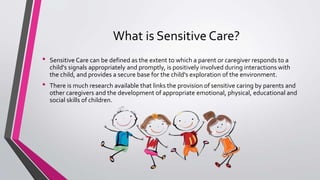
• Sensitive Care can be defined as the extent to which a parent or caregiver responds to a
child's signals appropriately and promptly, is positively involved during interactions with
the child, and provides a secure base for the child's exploration of the environment.
• There is much research available that links the provision of sensitive caring by parents and
other caregivers and the development of appropriate emotional, physical, educational and
social skills of children.
Why is Sensitive Care Important in the Child
Care Setting?
• As educators and child care providers, you are replacing a primary caregiver
in their role in caring and educating for a child.
• You become responsible for supporting a child to meet their
developmental, educational, social, emotional and physical milestones.
• But how do we know what Sensitive Care looks like?
• How do we make sure we are looking through the eyes of the child?
Why is Sensitive Care Important in the Child
Care Setting?
• Children that are “secure” are able to respond to their caregiver’s cues, and can
communicate their distress, whilst also being able to gain comfort when it is
available.The three factors we are looking for when a sensitive care
environment is present are:
1. A caregivers ability to respond to a child’s signals promptly and
appropriately;
2.A caregiver offering positive interactions; and
3. A caregiver providing a secure base for exploration and learnings.
Lets look at some videos!
Activity 1:
Based on the videos you saw, what does “Providing Sensitive Care”
look like for you?
Consider:
What made me smile?
What made me feels uncomfortable? – e.g. I wouldn’t like to see
that again
Lets reflect upon…..
• How did I as a child feel
loved and cared about by
my parents, teachers and
friends?
• What things do I carry
through from my childhood
that I think is important in
caring for young people?
Learning Framework and Sensitive Care
Zones of Proximal Development
• This theory explores the important concept that relates to the difference
between what a child can achieve with guidance and encouragement from
a skilled partner.
• Vygotsky sees the Zone of Proximal Development as the area where the
most sensitive instruction or guidance should be given – allowing the child
to develop skills they will use on their own – developing higher mental
functions.
Zones of Proximal Development- what does
this look like?
How do we create a learning environment to
include the Zones of Proximal Development and
Sensitive Care?
• Vygotosky views a child’s interaction with peers as an effective way of
developing skills and strategies.
• Cooperative learning exercises where less competent children develop with
help from more skilful peers – within the zone of proximal development.
By Using Play!
• When it comes to providing sensitive care and educational opportunities for
little people, play is the primary tool we should be using as caregivers.
Activity 3:
Looking at Age Appropriate Activities
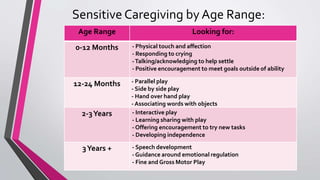
Sensitive Caregiving by Age Range:
Age Range Looking for:
0-12 Months - Physical touch and affection
- Responding to crying
-Talking/acknowledging to help settle
- Positive encouragement to meet goals outside of ability
12-24 Months - Parallel play
- Side by side play
- Hand over hand play
- Associating words with objects
2-3Years - Interactive play
- Learning sharing with play
- Offering encouragement to try new tasks
- Developing independence
3Years + - Speech development
- Guidance around emotional regulation
- Fine and Gross Motor Play
What are some Age-Appropriate Play
Activities we can implement?
Commitment
• So much of our caring focuses on physical care. At the end of the day, we
fundamentally need to keep children safe and largely this seems like it is
the end of our role. But, we know from child development that caring is so
much more than this.
• What is being asked of you is to make a commitment! A commitment to
learning and developing yourself and to offering a care environment to
children that meets so much more than their physical care needs.
MY COMMITMENT:
Commitment
to Myself
Commitment to
Children
Commitment to My
Room Partners
Commitment
to My Team
Commitment to My
Workplace
Role within the Centre
• Every person in the centre, regardless of their role, is responsible for
providing sensitive care to children. This means that when you are present
a child expects to be treated like a valuable participant and person in the
environment. That means that you are a participant in providing sensitive
care and you need to consider this to be one of the most important things
you can offer.
Looking through the Eyes of the Child
• 1.What is the most important thing to have in my classroom?
• 2. What do I want my teachers to do?
• 3. How do I know my teacher wants to be here with me?
• 4. How do I know my teachers will help me?
• 5.What makes my heart feel full when my Mum/Dad is not here?
Follow us on Facebook!
@ShilusGroup

Providing sensitive care

  • 1.
  • 2.
    What is SensitiveCare? • Sensitive Care can be defined as the extent to which a parent or caregiver responds to a child's signals appropriately and promptly, is positively involved during interactions with the child, and provides a secure base for the child's exploration of the environment. • There is much research available that links the provision of sensitive caring by parents and other caregivers and the development of appropriate emotional, physical, educational and social skills of children.
  • 3.
    Why is SensitiveCare Important in the Child Care Setting? • As educators and child care providers, you are replacing a primary caregiver in their role in caring and educating for a child. • You become responsible for supporting a child to meet their developmental, educational, social, emotional and physical milestones. • But how do we know what Sensitive Care looks like? • How do we make sure we are looking through the eyes of the child?
  • 4.
    Why is SensitiveCare Important in the Child Care Setting? • Children that are “secure” are able to respond to their caregiver’s cues, and can communicate their distress, whilst also being able to gain comfort when it is available.The three factors we are looking for when a sensitive care environment is present are: 1. A caregivers ability to respond to a child’s signals promptly and appropriately; 2.A caregiver offering positive interactions; and 3. A caregiver providing a secure base for exploration and learnings. Lets look at some videos!
  • 8.
    Activity 1: Based onthe videos you saw, what does “Providing Sensitive Care” look like for you? Consider: What made me smile? What made me feels uncomfortable? – e.g. I wouldn’t like to see that again
  • 9.
    Lets reflect upon….. •How did I as a child feel loved and cared about by my parents, teachers and friends? • What things do I carry through from my childhood that I think is important in caring for young people?
  • 10.
    Learning Framework andSensitive Care Zones of Proximal Development • This theory explores the important concept that relates to the difference between what a child can achieve with guidance and encouragement from a skilled partner. • Vygotsky sees the Zone of Proximal Development as the area where the most sensitive instruction or guidance should be given – allowing the child to develop skills they will use on their own – developing higher mental functions.
  • 11.
    Zones of ProximalDevelopment- what does this look like?
  • 12.
    How do wecreate a learning environment to include the Zones of Proximal Development and Sensitive Care? • Vygotosky views a child’s interaction with peers as an effective way of developing skills and strategies. • Cooperative learning exercises where less competent children develop with help from more skilful peers – within the zone of proximal development.
  • 13.
    By Using Play! •When it comes to providing sensitive care and educational opportunities for little people, play is the primary tool we should be using as caregivers.
  • 14.
    Activity 3: Looking atAge Appropriate Activities
  • 15.
    Sensitive Caregiving byAge Range: Age Range Looking for: 0-12 Months - Physical touch and affection - Responding to crying -Talking/acknowledging to help settle - Positive encouragement to meet goals outside of ability 12-24 Months - Parallel play - Side by side play - Hand over hand play - Associating words with objects 2-3Years - Interactive play - Learning sharing with play - Offering encouragement to try new tasks - Developing independence 3Years + - Speech development - Guidance around emotional regulation - Fine and Gross Motor Play
  • 16.
    What are someAge-Appropriate Play Activities we can implement?
  • 17.
    Commitment • So muchof our caring focuses on physical care. At the end of the day, we fundamentally need to keep children safe and largely this seems like it is the end of our role. But, we know from child development that caring is so much more than this. • What is being asked of you is to make a commitment! A commitment to learning and developing yourself and to offering a care environment to children that meets so much more than their physical care needs.
  • 18.
    MY COMMITMENT: Commitment to Myself Commitmentto Children Commitment to My Room Partners Commitment to My Team Commitment to My Workplace
  • 19.
    Role within theCentre • Every person in the centre, regardless of their role, is responsible for providing sensitive care to children. This means that when you are present a child expects to be treated like a valuable participant and person in the environment. That means that you are a participant in providing sensitive care and you need to consider this to be one of the most important things you can offer.
  • 20.
    Looking through theEyes of the Child • 1.What is the most important thing to have in my classroom? • 2. What do I want my teachers to do? • 3. How do I know my teacher wants to be here with me? • 4. How do I know my teachers will help me? • 5.What makes my heart feel full when my Mum/Dad is not here?
  • 21.
    Follow us onFacebook! @ShilusGroup