TCHE2622: Professional experience:
Principles and practices in Early
Childhood Education
Week 3 : Lecture
Holistic social and emotional development
The importance of play
By Dr. Anamika Devi
I would like acknowledge the Wurundjeri people of the Kulin
Nations as the Traditional Owners of the land on which the
University stands. I respectfully recognise Elders both past
and present and emerging.
Acknowledgement of country
Contents
• A whole child
• Developmental domains
• Social and emotional development
• Theories of social-emotional development
• Self regulation
• The importance of play
• Play and it’s relationship with social-emotional
development
A whole child
Factors influences development
- Family composition
- Education/child care
- Exposure to political ideologies
- Language/dialect
- Geographic location
- Friendships/peer group
- Physical development
- Culture and child rearing practice
- Social self
- Religion
- Personality
- Ethnicity
- Emotions
- Employment/ occupation
- Media influence
- Moral beliefs
- Cognition
- Genetics
- Acceptance
Development
Development is concerned with "both changes and
consistency in physical growth, feelings and ways of
thinking" (Hoffnung et al, 2010, p4) but at different stages in
life are more predominant. Lifespan development can be
clearly seen when a child takes their first step or more
subtly when an adolescent becomes aware of their own
change in maturity. Continuities may only last for a period
in the lifespan - do you still enjoy the same music now as
you did when you were a child?
Domains of development
 Physical development
 Social/emotional development
 Language development
 Cognitive (intellectual) development
Overlapping of areas
 The development of any one area is influenced by the progress in
all other areas.
 If a young child learns by touching and manipulating objects, her
cognitive development will be influenced by her physical ability to
manipulate the objects.
 The holistic development of a child involves family, society, and
cultural influences on the child.
What is developmental milestones?
Developmental milestones are
behaviors or physical skills seen
in infants and children as they
grow and develop. Rolling over,
crawling, walking, and talking
are all considered milestones.
The milestones are different for
each age range. ...
For example, walking may begin
as early as 8 months in some
children
Social emotional development
 How the child relates and interacts with
others as well as how they play.
 Initiates interaction
 Shows affection towards others
 Develops friendships
 Imitates adults actions in play
 Asserts independence
Social development linked to emotional
development
Human beings are inherently social beings. Humans ‘read’
the world by engaging in social experiences that in turn
effect our emotional balance.
Implications
Whitebread (2012) explains that developing social
skills in childhood is particularly important in
ensuring a ‘happy and productive life as a school
pupil, with all the social challenges of the pre-
school and school classroom and playground’
needing to be navigated (p 39)
It’s all about me!
 During the development of social and emotional capabilities, children
learn to see another’s perspective, control emotions and form
relationships with peers and adults other than their parents.
 In the age range of 0-5 years, children are very egocentric –
assuming that they are pivotal in everyone’s lives.
 This egocentric view of themselves may influence a child’s
developmental progression through the development of balanced
social and emotional capabilities.
14
Approaches/theories
Normative Behaviourist Social
cognitive
Stage
theory
Ethological Contextual
Gesell
Watson/Skinne
r/Pavlov
Bandura
Psychoanalytic cognitive
Freud/Erikson
Piaget
Bowlby
Ecological
Socio
cultural
Dynamic
systems
Lifespan
Bronfenbrenne
r
Vygotsky
Thelen
Baltes
Concept map of theories:
comparison
Nature/
Universal/discontinuo
us
Nurture/
cultural/continuous
Interaction between Nature
& nurture/
Universal/discontinuous
Nurture/
cultural/continuous
Nature &
nurture/Universa
l/discontinuous
Nature &
nurture/Universal
/discontinuous
Nature &
nurture/cultural/continuous
& discontinuous
Nature &
nurture/cultural/no
t specified
Nature &
nurture/cultural
& universal
/continuous &
discontinuous
Which theory/theories talk about social-
emotional development of children?
The social learning theory
Using observation for learning
16
(1925 – now)
Albert Bandura
The social learning theory:
• direct reinforcement could not account for all types of
learning.
• His theory added a social element, arguing that people can
learn new information and behaviors by watching other
people.
• Known as observational learning (or modeling), this type of
learning can be used to explain a wide variety of behaviors.
- people can learn through observation
-internal mental states are an essential part of this process
external, environmental reinforcement was not the only factor to influence
learning and behavior. Intrinsic reinforcement such as pride, satisfaction, and a
sense of accomplishment are forms of internal reward
-this theory recognizes that just because something has been learned, it does
not mean that it will result in a change in behaviour.
There are three core concepts at the heart of social
learning theory:
Social Learning theory - Bandura
- Response to Behaviourism
Bobo the doll
– Bandura’s experiment for observational
behaviour.
Attachments
 Attachment can be defines as a unique emotional bond between
caregiver and the child that involves an exchange of comfort, care
and pleasure.
 In 1951, John Bowlby termed this as the ‘attachment theory’ after
doing several experiments to determine the extent that children
thrived in warm, positive environments with a key person – generally
the mother. Early experiences in childhood have an important
influence on development and behaviour later in life.
 Our early attachment styles are established in childhood through the
infant/ caregiver relationship
John Bowlby
 Babies are born with instinctive behaviours such as crying, smiling
and making eye contact that elicit care giving from others
 If children’s needs are not met by a significant caregiver when they
exhibit these behaviours they fail to ‘attach’ to an adult
 Children need secure first attachments so that they learn to trust that
their needs will be meet
 The quality of a child’s earliest attachments will influence his/her
later relationships with other people and therefore the development
of his/her personality
What do you know about secure and
insecure attachment?
Secure Vs. insecure attachment
 Secure attachment- child finds both safety/protection and support for
exploration/autonomy from parent or caregiver within first few years of life
 Insecure attachment-
Anxious- Avoidant
Anxious-resistant/ Ambivalent
Disorganized-disoriented attachment
Let’s watch the video from youtube
http://www.youtube.com/watch?v=QTsewNrHUHU
Secure attachment
Secure attachment results from “attunement” of parent with
child’s needs
Secure attachment results when a parent provides a safe
heaven to protect & comfort child, as well as a secure base
from which the child can grow and learn
Why is Secure attachment important
 Good capacity for emotional regulation, including the ability to contain
impulses when necessary, to express feelings when appropriate, and to
become emotionally invested in activity
 A core secure sense of self-worth
 A fundamental confidence in others as caring and in the self as worthy
 An understanding of relationships which includes features of emotional
openness, reciprocity and responsiveness
 Attachment is lifelong and positively influences social interactions and
interpersonal relationships throughout life
 Secure attachment is the right of every child.
Insecure attachment patterns
 Anxious-Avoidant attachment:
Watchful, wary (hyper vigilant), “Slow-to-warm-up”; difficulty maintaining emotional
closeness to others, difficulty directly expressing feelings, show limited engagement in
emotionally arousing situations. The child rejects or ignores his/her parent.
 Anxious-Resistant attachment:
Both clingy & angry, rejects contact, refuses to be comforted; heightend arousal and
exaggerated emotional expression; easily frustrated, overstimulated, impulsive and overly
anxious
 Disorganized/Disoriented attachment
Fearful and confused, infants may exhibit an array of seemingly undirected behavioural
responses; ‘frozen’ postures, and cry out unexpectedly after being comforted. The child is
self-destructive and emotionally disturbed
27
Circle of security
 Children respond well socially and emotionally when they feel a sense of
safety and belonging as in the ‘Circle of Security’.
 The ‘Circle of Repair’ suggests how to repair situations that need
mediation so that the child’s emotions are in tact and self esteem remains
high.
This is taken from the Early Childhood Australia, Research in Practice Series
Volume 14 Number 4 2007.
http://www.earlychildhoodaustralia.org.au/pdf/rips/rip0704.pdf
Factors impact on child’s behaviour
Other factors that influence socialisation and behaviour include:
 Self-regulation
 The child’s personality and temperament
 Resilience
 Mental health, stress and their impact on the executive
functioning of the brain
Self- regulation skills
Self-regulation skills develop as the child matures and include:
• Respecting the rights of others
• Respecting property rights - not taking what someone else owns or is using
• Respecting personal space and boundaries - not moving into someone else’s space unless invited
or accepted
• Acknowledging the right of others to feel safe – not causing others to feel unsafe by acting in a
threatening manner
• Controlling expressions of anger, frustration and disappointment, and expressing emotions in a way
that does not hurt anybody or damage property
• Assessing oneself in a socially acceptable manner; being assertive enables children to have more
control of situation – for example, ‘Please don’t push me – I don’t like it’
• Sharing own ideas and listening to the ideas of others.
• Learning that each person has a useful contribution to make
• Developing the ability to both listen to others and to make contribution
• Using effective communication skills to resolve conflicts
Provide a supportive environment
Children are not born “good” or born “bad”.
- They develop a range of behaviours, attitudes and
ways of expressing, their needs depending, on a
range of factors throughout their early childhood
years.
- The environment in which children spend much of
their time and how adults react to and provide
guidance to young children in these early years
plays a critical role in helping them to develop
positive behaviours.
Supportive environment
- Play areas where not too many children have to
compete for the same equipment or toys
- Lots of similar equipment and materials as it is hard for
children to wait their turn
- Lots of time outdoors. Children need ample time to be
outdoors even though adults may feel the cold, children
don’t tend to!
Value of play
In early childhood education, we
Australian educators have always valued
play as a critical source for children’s
learning and development. This is kind of
“children’s way of acting”.
Anamika Devi 2019
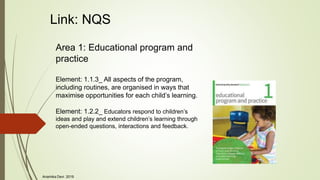
Link: NQS
Area 1: Educational program and
practice
Element: 1.1.3_ All aspects of the program,
including routines, are organised in ways that
maximise opportunities for each child’s learning.
Element: 1.2.2_ Educators respond to children’s
ideas and play and extend children’s learning through
open-ended questions, interactions and feedback.
Anamika Devi 2019
EYLF: Play based learning
The Early Years Learning Framework defines play-
based learning as 'a context for learning through which
children organise and make sense of their social worlds, as
they engage actively with people, objects and
representations'.
36
Play and it’s relationship with social-emotional
development
 Developing role play
 Respecting the rights of others
 Discussing
 Cooperating
 Sharing
 Collaborating
 Turn taking
 Appreciate efforts of others
 Experience pride and satisfaction
 Express feelings
 Develop independence and self-help skills
Think about some play or games which could
develop children’s social-emotional skills and
write it down
Well done!!
You have finished the third lecture
Don’t forget to complete your
reading to consolidate these
concepts

Week 3 Lecture.pptx

  • 1.
    TCHE2622: Professional experience: Principlesand practices in Early Childhood Education Week 3 : Lecture Holistic social and emotional development The importance of play By Dr. Anamika Devi
  • 2.
    I would likeacknowledge the Wurundjeri people of the Kulin Nations as the Traditional Owners of the land on which the University stands. I respectfully recognise Elders both past and present and emerging. Acknowledgement of country
  • 3.
    Contents • A wholechild • Developmental domains • Social and emotional development • Theories of social-emotional development • Self regulation • The importance of play • Play and it’s relationship with social-emotional development
  • 4.
  • 5.
    Factors influences development -Family composition - Education/child care - Exposure to political ideologies - Language/dialect - Geographic location - Friendships/peer group - Physical development - Culture and child rearing practice - Social self - Religion - Personality - Ethnicity - Emotions - Employment/ occupation - Media influence - Moral beliefs - Cognition - Genetics - Acceptance
  • 6.
    Development Development is concernedwith "both changes and consistency in physical growth, feelings and ways of thinking" (Hoffnung et al, 2010, p4) but at different stages in life are more predominant. Lifespan development can be clearly seen when a child takes their first step or more subtly when an adolescent becomes aware of their own change in maturity. Continuities may only last for a period in the lifespan - do you still enjoy the same music now as you did when you were a child?
  • 7.
    Domains of development Physical development  Social/emotional development  Language development  Cognitive (intellectual) development
  • 8.
    Overlapping of areas The development of any one area is influenced by the progress in all other areas.  If a young child learns by touching and manipulating objects, her cognitive development will be influenced by her physical ability to manipulate the objects.  The holistic development of a child involves family, society, and cultural influences on the child.
  • 9.
    What is developmentalmilestones? Developmental milestones are behaviors or physical skills seen in infants and children as they grow and develop. Rolling over, crawling, walking, and talking are all considered milestones. The milestones are different for each age range. ... For example, walking may begin as early as 8 months in some children
  • 10.
    Social emotional development How the child relates and interacts with others as well as how they play.  Initiates interaction  Shows affection towards others  Develops friendships  Imitates adults actions in play  Asserts independence
  • 11.
    Social development linkedto emotional development Human beings are inherently social beings. Humans ‘read’ the world by engaging in social experiences that in turn effect our emotional balance.
  • 12.
    Implications Whitebread (2012) explainsthat developing social skills in childhood is particularly important in ensuring a ‘happy and productive life as a school pupil, with all the social challenges of the pre- school and school classroom and playground’ needing to be navigated (p 39)
  • 13.
    It’s all aboutme!  During the development of social and emotional capabilities, children learn to see another’s perspective, control emotions and form relationships with peers and adults other than their parents.  In the age range of 0-5 years, children are very egocentric – assuming that they are pivotal in everyone’s lives.  This egocentric view of themselves may influence a child’s developmental progression through the development of balanced social and emotional capabilities.
  • 14.
    14 Approaches/theories Normative Behaviourist Social cognitive Stage theory EthologicalContextual Gesell Watson/Skinne r/Pavlov Bandura Psychoanalytic cognitive Freud/Erikson Piaget Bowlby Ecological Socio cultural Dynamic systems Lifespan Bronfenbrenne r Vygotsky Thelen Baltes Concept map of theories: comparison Nature/ Universal/discontinuo us Nurture/ cultural/continuous Interaction between Nature & nurture/ Universal/discontinuous Nurture/ cultural/continuous Nature & nurture/Universa l/discontinuous Nature & nurture/Universal /discontinuous Nature & nurture/cultural/continuous & discontinuous Nature & nurture/cultural/no t specified Nature & nurture/cultural & universal /continuous & discontinuous
  • 15.
    Which theory/theories talkabout social- emotional development of children?
  • 16.
    The social learningtheory Using observation for learning 16 (1925 – now) Albert Bandura
  • 17.
    The social learningtheory: • direct reinforcement could not account for all types of learning. • His theory added a social element, arguing that people can learn new information and behaviors by watching other people. • Known as observational learning (or modeling), this type of learning can be used to explain a wide variety of behaviors.
  • 18.
    - people canlearn through observation -internal mental states are an essential part of this process external, environmental reinforcement was not the only factor to influence learning and behavior. Intrinsic reinforcement such as pride, satisfaction, and a sense of accomplishment are forms of internal reward -this theory recognizes that just because something has been learned, it does not mean that it will result in a change in behaviour. There are three core concepts at the heart of social learning theory:
  • 19.
    Social Learning theory- Bandura - Response to Behaviourism
  • 20.
    Bobo the doll –Bandura’s experiment for observational behaviour.
  • 21.
    Attachments  Attachment canbe defines as a unique emotional bond between caregiver and the child that involves an exchange of comfort, care and pleasure.  In 1951, John Bowlby termed this as the ‘attachment theory’ after doing several experiments to determine the extent that children thrived in warm, positive environments with a key person – generally the mother. Early experiences in childhood have an important influence on development and behaviour later in life.  Our early attachment styles are established in childhood through the infant/ caregiver relationship
  • 22.
    John Bowlby  Babiesare born with instinctive behaviours such as crying, smiling and making eye contact that elicit care giving from others  If children’s needs are not met by a significant caregiver when they exhibit these behaviours they fail to ‘attach’ to an adult  Children need secure first attachments so that they learn to trust that their needs will be meet  The quality of a child’s earliest attachments will influence his/her later relationships with other people and therefore the development of his/her personality
  • 23.
    What do youknow about secure and insecure attachment?
  • 24.
    Secure Vs. insecureattachment  Secure attachment- child finds both safety/protection and support for exploration/autonomy from parent or caregiver within first few years of life  Insecure attachment- Anxious- Avoidant Anxious-resistant/ Ambivalent Disorganized-disoriented attachment Let’s watch the video from youtube http://www.youtube.com/watch?v=QTsewNrHUHU
  • 25.
    Secure attachment Secure attachmentresults from “attunement” of parent with child’s needs Secure attachment results when a parent provides a safe heaven to protect & comfort child, as well as a secure base from which the child can grow and learn
  • 26.
    Why is Secureattachment important  Good capacity for emotional regulation, including the ability to contain impulses when necessary, to express feelings when appropriate, and to become emotionally invested in activity  A core secure sense of self-worth  A fundamental confidence in others as caring and in the self as worthy  An understanding of relationships which includes features of emotional openness, reciprocity and responsiveness  Attachment is lifelong and positively influences social interactions and interpersonal relationships throughout life  Secure attachment is the right of every child.
  • 27.
    Insecure attachment patterns Anxious-Avoidant attachment: Watchful, wary (hyper vigilant), “Slow-to-warm-up”; difficulty maintaining emotional closeness to others, difficulty directly expressing feelings, show limited engagement in emotionally arousing situations. The child rejects or ignores his/her parent.  Anxious-Resistant attachment: Both clingy & angry, rejects contact, refuses to be comforted; heightend arousal and exaggerated emotional expression; easily frustrated, overstimulated, impulsive and overly anxious  Disorganized/Disoriented attachment Fearful and confused, infants may exhibit an array of seemingly undirected behavioural responses; ‘frozen’ postures, and cry out unexpectedly after being comforted. The child is self-destructive and emotionally disturbed 27
  • 28.
    Circle of security Children respond well socially and emotionally when they feel a sense of safety and belonging as in the ‘Circle of Security’.  The ‘Circle of Repair’ suggests how to repair situations that need mediation so that the child’s emotions are in tact and self esteem remains high. This is taken from the Early Childhood Australia, Research in Practice Series Volume 14 Number 4 2007. http://www.earlychildhoodaustralia.org.au/pdf/rips/rip0704.pdf
  • 30.
    Factors impact onchild’s behaviour Other factors that influence socialisation and behaviour include:  Self-regulation  The child’s personality and temperament  Resilience  Mental health, stress and their impact on the executive functioning of the brain
  • 31.
    Self- regulation skills Self-regulationskills develop as the child matures and include: • Respecting the rights of others • Respecting property rights - not taking what someone else owns or is using • Respecting personal space and boundaries - not moving into someone else’s space unless invited or accepted • Acknowledging the right of others to feel safe – not causing others to feel unsafe by acting in a threatening manner • Controlling expressions of anger, frustration and disappointment, and expressing emotions in a way that does not hurt anybody or damage property • Assessing oneself in a socially acceptable manner; being assertive enables children to have more control of situation – for example, ‘Please don’t push me – I don’t like it’ • Sharing own ideas and listening to the ideas of others. • Learning that each person has a useful contribution to make • Developing the ability to both listen to others and to make contribution • Using effective communication skills to resolve conflicts
  • 32.
    Provide a supportiveenvironment Children are not born “good” or born “bad”. - They develop a range of behaviours, attitudes and ways of expressing, their needs depending, on a range of factors throughout their early childhood years. - The environment in which children spend much of their time and how adults react to and provide guidance to young children in these early years plays a critical role in helping them to develop positive behaviours.
  • 33.
    Supportive environment - Playareas where not too many children have to compete for the same equipment or toys - Lots of similar equipment and materials as it is hard for children to wait their turn - Lots of time outdoors. Children need ample time to be outdoors even though adults may feel the cold, children don’t tend to!
  • 34.
    Value of play Inearly childhood education, we Australian educators have always valued play as a critical source for children’s learning and development. This is kind of “children’s way of acting”. Anamika Devi 2019
  • 35.
    Link: NQS Area 1:Educational program and practice Element: 1.1.3_ All aspects of the program, including routines, are organised in ways that maximise opportunities for each child’s learning. Element: 1.2.2_ Educators respond to children’s ideas and play and extend children’s learning through open-ended questions, interactions and feedback. Anamika Devi 2019
  • 36.
    EYLF: Play basedlearning The Early Years Learning Framework defines play- based learning as 'a context for learning through which children organise and make sense of their social worlds, as they engage actively with people, objects and representations'. 36
  • 37.
    Play and it’srelationship with social-emotional development  Developing role play  Respecting the rights of others  Discussing  Cooperating  Sharing  Collaborating  Turn taking  Appreciate efforts of others  Experience pride and satisfaction  Express feelings  Develop independence and self-help skills
  • 38.
    Think about someplay or games which could develop children’s social-emotional skills and write it down
  • 39.
    Well done!! You havefinished the third lecture Don’t forget to complete your reading to consolidate these concepts