Welcome to C&K V1.015 © This document is the property of C&KPage 1
Number Concepts Through
Mathematics Stories
Rosemary Reuille Irons
Early Childhood Mathematics Consultant
ORIGO Education
Brisbane, Australia
mathmates@iinet.net.au
Pre-K to 1
R. Irons 2017
Relevance of Language in Mathematics
• Model of specific mathematical terms
• Use of language by children to describe ideas
• Support for mathematical concepts and
involvement in investigations, thinking and
reasoning
• Books present a pictorial representation
R. Irons 2017
Adapted from EYF, Canberra, 2009
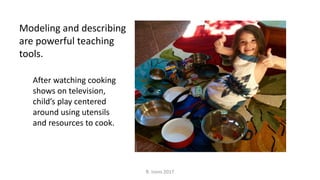
After watching cooking
shows on television,
child’s play centered
around using utensils
and resources to cook.
Modeling and describing
are powerful teaching
tools.
R. Irons 2017
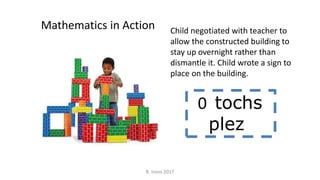
Child negotiated with teacher to
allow the constructed building to
stay up overnight rather than
dismantle it. Child wrote a sign to
place on the building.
Mathematics in Action
0 tochs
plez
R. Irons 2017
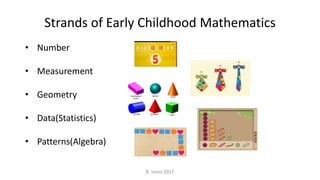
Strands of Early Childhood Mathematics
• Number
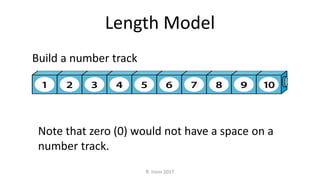
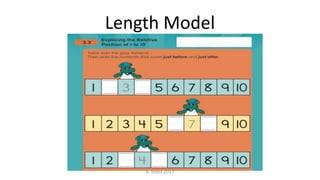
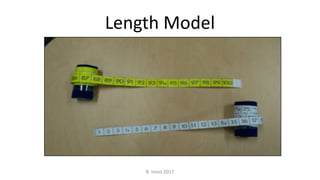
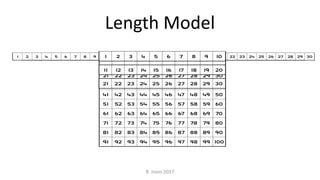
• Measurement
• Geometry
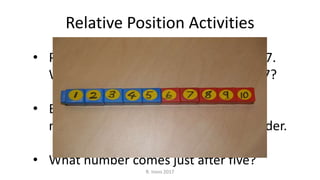
• Data(Statistics)
• Patterns(Algebra)
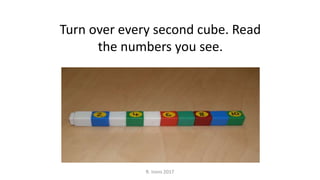
R. Irons 2017
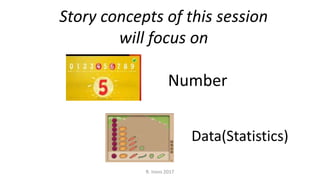
Story concepts of this session
will focus on
Number
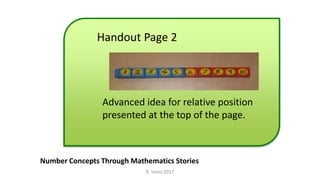
R. Irons 2017
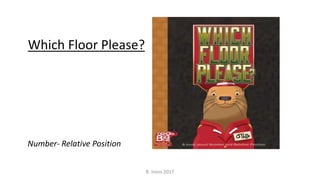
Data(Statistics)
Challenge of learning number
Four aspects or ideas for meaningful
understanding of number:
Quantity
Relative Position
Ordinal
Label
R. Irons 2017
Number- Quantity
• Count
• Make groups of a certain quantity
• Recognise quantity by sight
• Match quantity to number symbol
R. Irons 2017
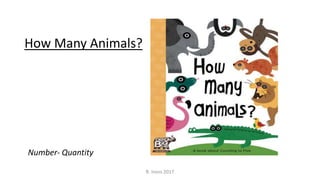
How Many Animals?
R. Irons 2017
Number- Quantity
R. Irons 2017
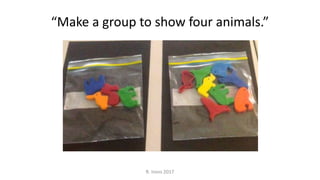
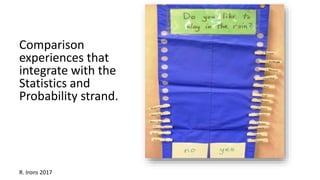
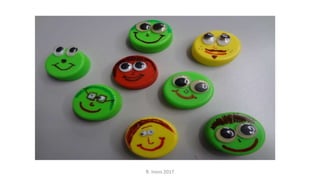
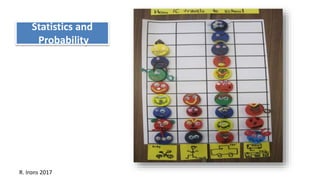
“Make a group to show four animals.”
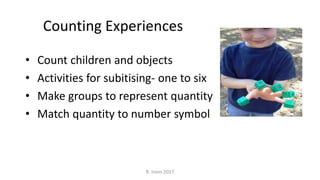
Counting Experiences
• Count children and objects
• Activities for subitising- one to six
• Make groups to represent quantity
• Match quantity to number symbol
R. Irons 2017
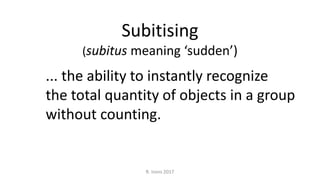
Subitising
(subitus meaning ‘sudden’)
... the ability to instantly recognize
the total quantity of objects in a group
without counting.
R. Irons 2017
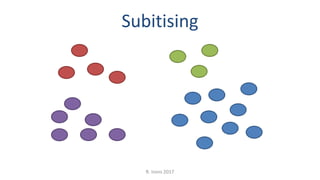
Subitising
R. Irons 2017
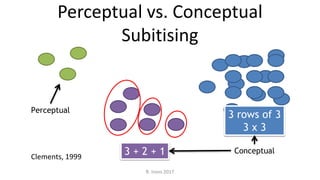
Perceptual vs. Conceptual
Subitising
3 + 2 + 1
3 rows of 3
3 x 3
Perceptual
Conceptual
Clements, 1999
R. Irons 2017
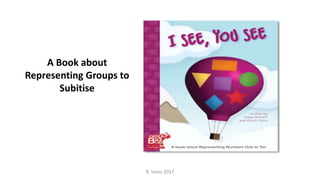
A Book about
Representing Groups to
Subitise
R. Irons 2017
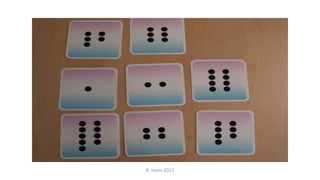
Subitising
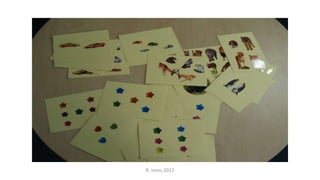
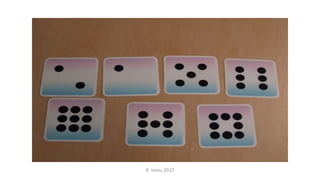
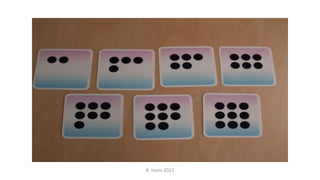
Students need to be able to subitise a variety of
arrangements.
R. Irons 2017
R. Irons 2017
R. Irons 2017
R. Irons 2017
R. Irons 2017
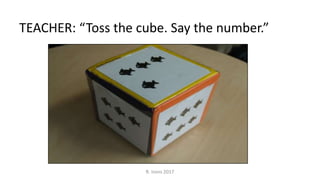
TEACHER: “Toss the cube. Say the number.”
R. Irons 2017
R. Irons 2017
R. Irons 2017
R. Irons 2017
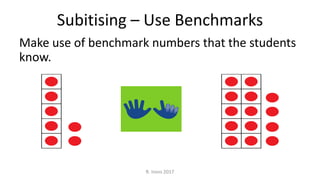
Subitising – Use Benchmarks
Make use of benchmark numbers that the students
know.
R. Irons 2017
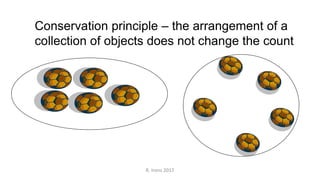
Conservation principle – the arrangement of a
collection of objects does not change the count
R. Irons 2017
R. Irons 2017
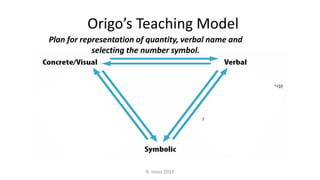
Origo’s Teaching Model
Plan for representation of quantity, verbal name and
selecting the number symbol.
R. Irons 2017
Handout Page 1
Number Concepts Through Mathematics Stories
An example is presented for
number idea as quantity.
Think of a learning experience
for you current children.
R. Irons 2017
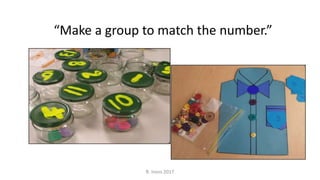
“Make a group to match the number.”
R. Irons 2017
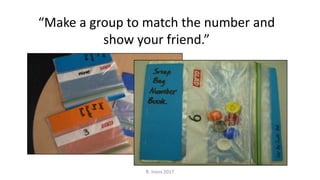
“Make a group to match the number and
show your friend.”
R. Irons 2017
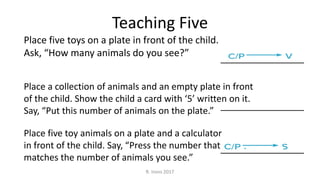
Teaching Five
Place five toys on a plate in front of the child.
Ask, “How many animals do you see?”
Place a collection of animals and an empty plate in front
of the child. Show the child a card with ‘5’ written on it.
Say, “Put this number of animals on the plate.”
Place five toy animals on a plate and a calculator
in front of the child. Say, “Press the number that
matches the number of animals you see.”
R. Irons 2017
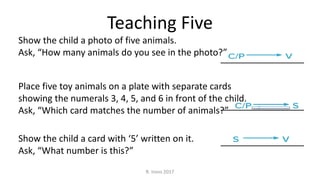
Show the child a photo of five animals.
Ask, “How many animals do you see in the photo?”
Place five toy animals on a plate with separate cards
showing the numerals 3, 4, 5, and 6 in front of the child.
Ask, “Which card matches the number of animals?”
Show the child a card with ‘5’ written on it.
Ask, “What number is this?”
Teaching Five
R. Irons 2017
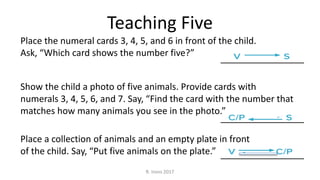
Teaching Five
Place the numeral cards 3, 4, 5, and 6 in front of the child.
Ask, “Which card shows the number five?”
Show the child a photo of five animals. Provide cards with
numerals 3, 4, 5, 6, and 7. Say, “Find the card with the number that
matches how many animals you see in the photo.”
Place a collection of animals and an empty plate in front
of the child. Say, “Put five animals on the plate.”
R. Irons 2017
Number- Relative Position
• Know a number in relationship to
neighbour numbers (five comes just after six)
• Place the number symbols in order
• Abstract notion of number since only
dealing with symbols
R. Irons 2017
R. Irons 2017
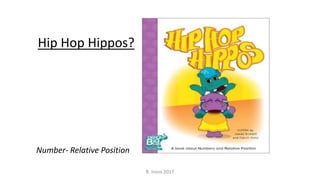
Hip Hop Hippos?
Number- Relative Position
R. Irons 2017
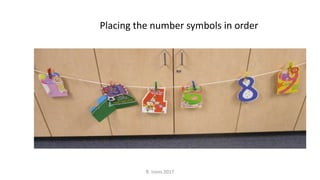
Placing the number symbols in order
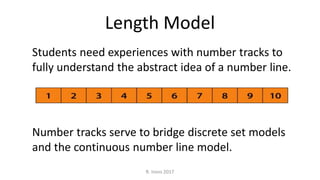
Students need experiences with number tracks to
fully understand the abstract idea of a number line.
Length Model
Number tracks serve to bridge discrete set models
and the continuous number line model.
R. Irons 2017
Note that zero (0) would not have a space on a
number track.
Length Model
Build a number track
R. Irons 2017
• Put your finger on 5, put a finger and 7.
What number comes between 5 and 7?
• Break apart all the cubes and put the
numbers in order. Tell us about the order.
• What number comes just after five?
Relative Position Activities
R. Irons 2017
• Take a cube away and ask a friend to
name the missing number.
• What number do you land on if you start
at 5 and jump on 2 more?
Relative Position Activities
R. Irons 2017
R. Irons 2017
Turn over every second cube. Read
the numbers you see.
Length Model
R. Irons 2017
Length Model
R. Irons 2017
Length Model
R. Irons 2017
Handout Page 2
Number Concepts Through Mathematics Stories
Advanced idea for relative position
presented at the top of the page.
R. Irons 2017
Which Floor Please?
R. Irons 2017
Number- Relative Position
Handout Page 2
Number Concepts Through Mathematics Stories
Learning experience suggested has
children placing numbers in order
vertically. Appropriate for five year
old children. Idea is shown on the
bottom part of the page.
R. Irons 2017
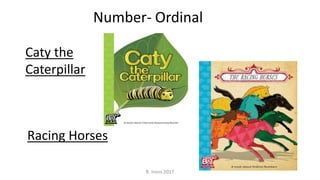
Caty the
Caterpillar
Number- Ordinal
Racing Horses
R. Irons 2017
R. Irons 2017
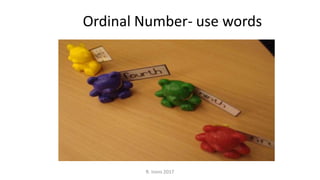
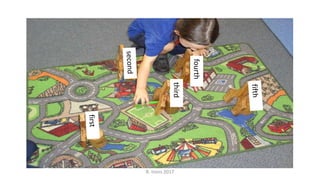
Ordinal Number- use words
third
fourth
R. Irons 2017
Handout Page 3
Number Concepts Through Mathematics Stories
Learning experiences emphasize order of
events. An example- Life cycles of Nature.
Using the ordinal language words are also
presented as an activity.
What could you plan in your childhood
learning environment?
R. Irons 2017
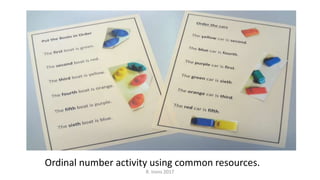
Ordinal number activity using common resources.
R. Irons 2017
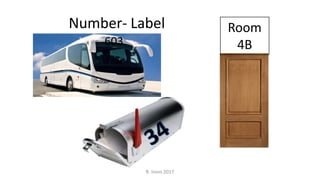
603
Room
4B
Number- Label
R. Irons 2017
Number- Important considerations
• Language of number should emphasize ‘quantity of
something’- four dolls, four toys, later- four pounds,
four dollars, four miles
• There is too much early focus on the number symbol.
Number symbols are abstract and children need to
have the quantity picture for meaningful idea of
number.
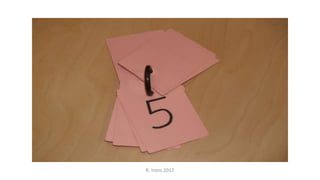
• Selecting the number symbol is the best learning
experience for young children.
R. Irons 2017
R. Irons 2017
Handout Page 4
Number Concepts Through Mathematics Stories
Here is a list of language for number
words that need to be modeled by you
as you interact with the children.
Accept whatever words the children
use but model the correct
mathematical language.
R. Irons 2017
Use of technology
R. Irons 2017
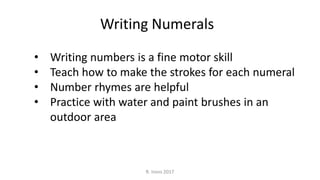
• Writing numbers is a fine motor skill
• Teach how to make the strokes for each numeral
• Number rhymes are helpful
• Practice with water and paint brushes in an
outdoor area
Writing Numerals
R. Irons 2017
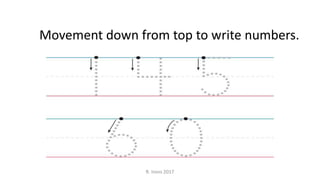
Movement down from top to write numbers.
R. Irons 2017
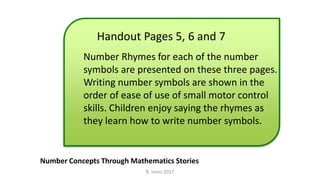
Handout Pages 5, 6 and 7
Number Concepts Through Mathematics Stories
Number Rhymes for each of the number
symbols are presented on these three pages.
Writing number symbols are shown in the
order of ease of use of small motor control
skills. Children enjoy saying the rhymes as
they learn how to write number symbols.
R. Irons 2017
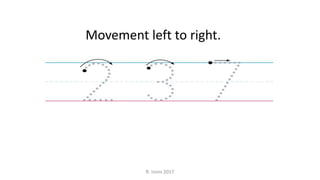
Movement left to right.
R. Irons 2017
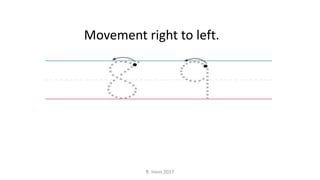
Movement right to left.
R. Irons 2017
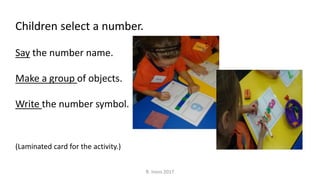
Children select a number.
Say the number name.
Make a group of objects.
Write the number symbol.
(Laminated card for the activity.)
R. Irons 2017
The Same Game
R. Irons 2017
Data-Statistics
• Yes and No charts
• Sort objects
• Collect data
• Represent data
• Compare two categories of the data
R. Irons 2017
Comparison
experiences that
integrate with the
Statistics and
Probability strand.
R. Irons 2017
R. Irons 2017
Data-Important Considerations
• Work with discussing same and different
attributes
• Sorting experiences encourage the children to
decide the sort, do the sort and describe the
sort. The three D’s of sorting.
• Keep the sort open for their decision rather
than guide the sorting.
R. Irons 2017
Statistics and
Probability
R. Irons 2017
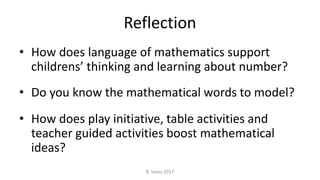
Reflection
• How does language of mathematics support
childrens’ thinking and learning about number?
• Do you know the mathematical words to model?
• How does play initiative, table activities and
teacher guided activities boost mathematical
ideas?
R. Irons 2017
R. Irons 2017
Enjoy reading books that emphasize mathematical concepts as
well as commercial children’s literature that is of interest to the
children.
Remember to model the correct mathematical language as you
interact with the children during their learning experiences.
Mathematics is ever evolving and is what makes things in the
world work. Help children to keep their motivation for learning
about mathematics in the early childhood years.
All the best to you in your early childhood teaching career, Rosemary
R. Irons 2017
We had the experience,
but missed the meaning.
We don’t want our early childhood
environments and learning experiences to be
uninteresting for the children or incorrect
mathematically. This could happen and for
many children has in the past:
Four Quartets, T.S. Eliot

Number concepts rosemary

  • 1.
    Welcome to C&KV1.015 © This document is the property of C&KPage 1 Number Concepts Through Mathematics Stories Rosemary Reuille Irons Early Childhood Mathematics Consultant ORIGO Education Brisbane, Australia mathmates@iinet.net.au Pre-K to 1
  • 2.
  • 3.
    Relevance of Languagein Mathematics • Model of specific mathematical terms • Use of language by children to describe ideas • Support for mathematical concepts and involvement in investigations, thinking and reasoning • Books present a pictorial representation R. Irons 2017 Adapted from EYF, Canberra, 2009
  • 4.
    After watching cooking showson television, child’s play centered around using utensils and resources to cook. Modeling and describing are powerful teaching tools. R. Irons 2017
  • 5.
    Child negotiated withteacher to allow the constructed building to stay up overnight rather than dismantle it. Child wrote a sign to place on the building. Mathematics in Action 0 tochs plez R. Irons 2017
  • 6.
    Strands of EarlyChildhood Mathematics • Number • Measurement • Geometry • Data(Statistics) • Patterns(Algebra) R. Irons 2017
  • 7.
    Story concepts ofthis session will focus on Number R. Irons 2017 Data(Statistics)
  • 8.
    Challenge of learningnumber Four aspects or ideas for meaningful understanding of number: Quantity Relative Position Ordinal Label R. Irons 2017
  • 9.
    Number- Quantity • Count •Make groups of a certain quantity • Recognise quantity by sight • Match quantity to number symbol R. Irons 2017
  • 10.
    How Many Animals? R.Irons 2017 Number- Quantity
  • 11.
    R. Irons 2017 “Makea group to show four animals.”
  • 12.
    Counting Experiences • Countchildren and objects • Activities for subitising- one to six • Make groups to represent quantity • Match quantity to number symbol R. Irons 2017
  • 13.
    Subitising (subitus meaning ‘sudden’) ...the ability to instantly recognize the total quantity of objects in a group without counting. R. Irons 2017
  • 14.
  • 15.
    Perceptual vs. Conceptual Subitising 3+ 2 + 1 3 rows of 3 3 x 3 Perceptual Conceptual Clements, 1999 R. Irons 2017
  • 16.
    A Book about RepresentingGroups to Subitise R. Irons 2017
  • 17.
    Subitising Students need tobe able to subitise a variety of arrangements. R. Irons 2017
  • 18.
  • 19.
  • 20.
  • 21.
  • 22.
    TEACHER: “Toss thecube. Say the number.” R. Irons 2017
  • 23.
  • 24.
  • 25.
  • 26.
    Subitising – UseBenchmarks Make use of benchmark numbers that the students know. R. Irons 2017
  • 27.
    Conservation principle –the arrangement of a collection of objects does not change the count R. Irons 2017
  • 28.
  • 29.
    Origo’s Teaching Model Planfor representation of quantity, verbal name and selecting the number symbol. R. Irons 2017
  • 30.
    Handout Page 1 NumberConcepts Through Mathematics Stories An example is presented for number idea as quantity. Think of a learning experience for you current children. R. Irons 2017
  • 31.
    “Make a groupto match the number.” R. Irons 2017
  • 32.
    “Make a groupto match the number and show your friend.” R. Irons 2017
  • 33.
    Teaching Five Place fivetoys on a plate in front of the child. Ask, “How many animals do you see?” Place a collection of animals and an empty plate in front of the child. Show the child a card with ‘5’ written on it. Say, “Put this number of animals on the plate.” Place five toy animals on a plate and a calculator in front of the child. Say, “Press the number that matches the number of animals you see.” R. Irons 2017
  • 34.
    Show the childa photo of five animals. Ask, “How many animals do you see in the photo?” Place five toy animals on a plate with separate cards showing the numerals 3, 4, 5, and 6 in front of the child. Ask, “Which card matches the number of animals?” Show the child a card with ‘5’ written on it. Ask, “What number is this?” Teaching Five R. Irons 2017
  • 35.
    Teaching Five Place thenumeral cards 3, 4, 5, and 6 in front of the child. Ask, “Which card shows the number five?” Show the child a photo of five animals. Provide cards with numerals 3, 4, 5, 6, and 7. Say, “Find the card with the number that matches how many animals you see in the photo.” Place a collection of animals and an empty plate in front of the child. Say, “Put five animals on the plate.” R. Irons 2017
  • 36.
    Number- Relative Position •Know a number in relationship to neighbour numbers (five comes just after six) • Place the number symbols in order • Abstract notion of number since only dealing with symbols R. Irons 2017
  • 37.
    R. Irons 2017 HipHop Hippos? Number- Relative Position
  • 38.
    R. Irons 2017 Placingthe number symbols in order
  • 39.
    Students need experienceswith number tracks to fully understand the abstract idea of a number line. Length Model Number tracks serve to bridge discrete set models and the continuous number line model. R. Irons 2017
  • 40.
    Note that zero(0) would not have a space on a number track. Length Model Build a number track R. Irons 2017
  • 41.
    • Put yourfinger on 5, put a finger and 7. What number comes between 5 and 7? • Break apart all the cubes and put the numbers in order. Tell us about the order. • What number comes just after five? Relative Position Activities R. Irons 2017
  • 42.
    • Take acube away and ask a friend to name the missing number. • What number do you land on if you start at 5 and jump on 2 more? Relative Position Activities R. Irons 2017
  • 43.
    R. Irons 2017 Turnover every second cube. Read the numbers you see.
  • 44.
  • 45.
  • 46.
  • 47.
    Handout Page 2 NumberConcepts Through Mathematics Stories Advanced idea for relative position presented at the top of the page. R. Irons 2017
  • 48.
    Which Floor Please? R.Irons 2017 Number- Relative Position
  • 49.
    Handout Page 2 NumberConcepts Through Mathematics Stories Learning experience suggested has children placing numbers in order vertically. Appropriate for five year old children. Idea is shown on the bottom part of the page. R. Irons 2017
  • 50.
  • 51.
    R. Irons 2017 OrdinalNumber- use words
  • 52.
  • 53.
    Handout Page 3 NumberConcepts Through Mathematics Stories Learning experiences emphasize order of events. An example- Life cycles of Nature. Using the ordinal language words are also presented as an activity. What could you plan in your childhood learning environment? R. Irons 2017
  • 54.
    Ordinal number activityusing common resources. R. Irons 2017
  • 55.
  • 56.
    Number- Important considerations •Language of number should emphasize ‘quantity of something’- four dolls, four toys, later- four pounds, four dollars, four miles • There is too much early focus on the number symbol. Number symbols are abstract and children need to have the quantity picture for meaningful idea of number. • Selecting the number symbol is the best learning experience for young children. R. Irons 2017
  • 57.
  • 58.
    Handout Page 4 NumberConcepts Through Mathematics Stories Here is a list of language for number words that need to be modeled by you as you interact with the children. Accept whatever words the children use but model the correct mathematical language. R. Irons 2017
  • 59.
  • 60.
    • Writing numbersis a fine motor skill • Teach how to make the strokes for each numeral • Number rhymes are helpful • Practice with water and paint brushes in an outdoor area Writing Numerals R. Irons 2017
  • 61.
    Movement down fromtop to write numbers. R. Irons 2017
  • 62.
    Handout Pages 5,6 and 7 Number Concepts Through Mathematics Stories Number Rhymes for each of the number symbols are presented on these three pages. Writing number symbols are shown in the order of ease of use of small motor control skills. Children enjoy saying the rhymes as they learn how to write number symbols. R. Irons 2017
  • 63.
    Movement left toright. R. Irons 2017
  • 64.
    Movement right toleft. R. Irons 2017
  • 65.
    Children select anumber. Say the number name. Make a group of objects. Write the number symbol. (Laminated card for the activity.) R. Irons 2017
  • 66.
    The Same Game R.Irons 2017
  • 67.
    Data-Statistics • Yes andNo charts • Sort objects • Collect data • Represent data • Compare two categories of the data R. Irons 2017
  • 68.
    Comparison experiences that integrate withthe Statistics and Probability strand. R. Irons 2017
  • 69.
  • 70.
    Data-Important Considerations • Workwith discussing same and different attributes • Sorting experiences encourage the children to decide the sort, do the sort and describe the sort. The three D’s of sorting. • Keep the sort open for their decision rather than guide the sorting. R. Irons 2017
  • 71.
  • 72.
    Reflection • How doeslanguage of mathematics support childrens’ thinking and learning about number? • Do you know the mathematical words to model? • How does play initiative, table activities and teacher guided activities boost mathematical ideas? R. Irons 2017
  • 73.
    R. Irons 2017 Enjoyreading books that emphasize mathematical concepts as well as commercial children’s literature that is of interest to the children. Remember to model the correct mathematical language as you interact with the children during their learning experiences. Mathematics is ever evolving and is what makes things in the world work. Help children to keep their motivation for learning about mathematics in the early childhood years. All the best to you in your early childhood teaching career, Rosemary
  • 74.
    R. Irons 2017 Wehad the experience, but missed the meaning. We don’t want our early childhood environments and learning experiences to be uninteresting for the children or incorrect mathematically. This could happen and for many children has in the past: Four Quartets, T.S. Eliot

Editor's Notes

  • #16 Perceptual - uses the visual cortex of the brain. Automatic understanding of the quantity based on what is seen. Small random arrangements tend to fall under perceptual. Conceptual - involves some additional processing of the brain. E.g. Knowing it's 9 because you know 9 is 3 rows of 3. Or knowing it's 7 because you see a cluster of 3 and and another cluster of 4 and you add them together. Knowing a quantity from a pattern/arrangement falls under conceptual.
  • #18 17
  • #27 26
  • #30 The next step is to connect the symbol to the quanity.
  • #61 Include many activities where students recognize, choose and select the symbols – before they write.