So - what do we
mean by curriculum?
• UNESCO (2016) – a curriculum for early
childhood education can:
• interrelate development and learning
processes;
• systemize and organize educational work;
• lighten the pedagogical role of the educator
by providing him/her with guidance in the
learning activities;
• enable children to construct meaning based
on and make sense of their learning
experiences.
Thinking about balance
Children’s interests and fascinations
Irresistible talking and learning points
Building on children’s strengths and also widening
their experiences and horizons
Child-led AND adult-guided – with more adult-
guided learning as children get older in the phase
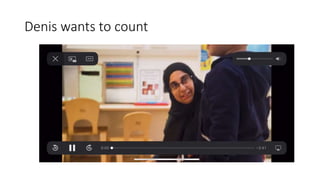
Denis wants to count
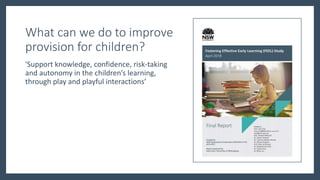
What can we do to improve
provision for children?
'Support knowledge, confidence, risk-taking
and autonomy in the children’s learning,
through play and playful interactions’
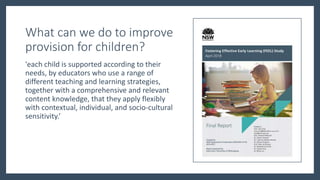
What can we do to improve
provision for children?
'each child is supported according to their
needs, by educators who use a range of
different teaching and learning strategies,
together with a comprehensive and relevant
content knowledge, that they apply flexibly
with contextual, individual, and socio-cultural
sensitivity.’
  6 
of pedagogy. 
5. Assessment: checking what children have learnt 
•  Assessment is about noticing what children can do and what they know. It is not 
about lots of data and evidence.  
•  Effective assessment requires practitioners to understand child development. 
Practitioners also need to be clear about what they want children to know and be 
able to do.  
•  Accurate assessment can highlight whether a child has a special educational 
need and needs extra help.   
•  Before assessing children, it’s a good idea to think about whether the 
assessments will be useful.  
•  Assessment should not take practitioners away from the children for long periods 
of time. 
6. Self-regulation and executive function 
•  Executive function includes the child’s ability to: 
Scaffolding up or
differentiating
down?
• Where young children are seen
to be struggling, practitioners
do not focus their attention on
helping them to take part in
the mainstream curriculum.
Instead, they offer them a
different curriculum, with more
focus on activities to promote
personal, social and emotional
development, and more
creative activities
• EPPSE Project (Sylva and
others, 2004)
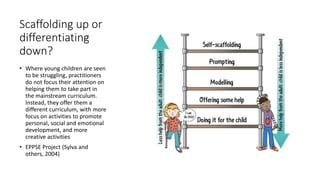
The diagram below summarises some scaffolding techniques. These can help children to de
independence and become more powerful learners.
Figure 5: Scaffolding techniques in the early years3
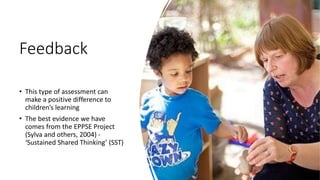
Feedback
• This type of assessment can
make a positive difference to
children’s learning
• The best evidence we have
comes from the EPPSE Project
(Sylva and others, 2004) -
‘Sustained Shared Thinking’ (SST)
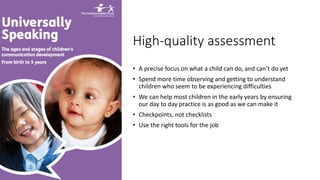
High-quality assessment
• A precise focus on what a child can do, and can’t do yet
• Spend more time observing and getting to understand
children who seem to be experiencing difficulties
• We can help most children in the early years by ensuring
our day to day practice is as good as we can make it
• Checkpoints, not checklists
• Use the right tools for the job
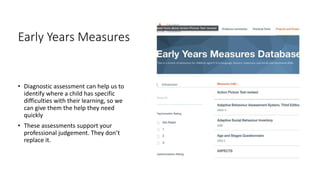
Early Years Measures
• Diagnostic assessment can help us to
identify where a child has specific
difficulties with their learning, so we
can give them the help they need
quickly
• These assessments support your
professional judgement. They don’t
replace it.
@EducEndowFoundn
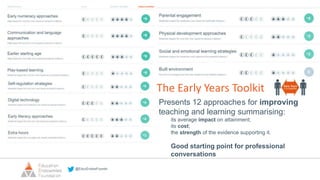
The Early Years Toolkit
Presents 12 approaches for improving
teaching and learning summarising:
its average impact on attainment;
its cost;
the strength of the evidence supporting it.
Good starting point for professional
conversations
Reflection points
What will make the most difference to children’s learning?
Staff skills and professional knowledge
The enabling environment
Pedagogy: helping children to learn
Assessment minute-by-minute: scaffolding and feedback
Diagnostic assessment: if you’re worried a child is struggling
Summative assessment: supports structured conversations with parents, transition,
and evaluating our curriculum
Working in partnership with parents
• The Home Learning Environment makes the single biggest
difference to a child’s development and learning
• Respectful partnerships with parents
• Listening as well as sharing information
• Understanding diversity
• Recognising that the parents who might need the most support
and help might also be the least likely to attend workshops and
other events
Respectful partnerships with parents
Key points
• It’s what we do that makes
the difference
• The large majority of the
evidence relates to play-
based and playful
approaches to learning
• High quality childcare is
essential
• Professional development
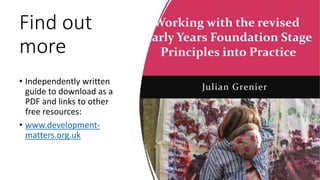
Find out
more
• Independently written
guide to download as a
PDF and links to other
free resources:
• www.development-
matters.org.uk

Pen Green Session part 2

  • 1.
    So - whatdo we mean by curriculum? • UNESCO (2016) – a curriculum for early childhood education can: • interrelate development and learning processes; • systemize and organize educational work; • lighten the pedagogical role of the educator by providing him/her with guidance in the learning activities; • enable children to construct meaning based on and make sense of their learning experiences.
  • 2.
    Thinking about balance Children’sinterests and fascinations Irresistible talking and learning points Building on children’s strengths and also widening their experiences and horizons Child-led AND adult-guided – with more adult- guided learning as children get older in the phase
  • 3.
  • 4.
    What can wedo to improve provision for children? 'Support knowledge, confidence, risk-taking and autonomy in the children’s learning, through play and playful interactions’
  • 5.
    What can wedo to improve provision for children? 'each child is supported according to their needs, by educators who use a range of different teaching and learning strategies, together with a comprehensive and relevant content knowledge, that they apply flexibly with contextual, individual, and socio-cultural sensitivity.’
  • 6.
      6  of pedagogy.  5. Assessment: checking what children have learnt  •  Assessment is about noticing what children can do and what they know. It is not  about lots of data and evidence.   • Effective assessment requires practitioners to understand child development.  Practitioners also need to be clear about what they want children to know and be  able to do.   •  Accurate assessment can highlight whether a child has a special educational  need and needs extra help.    •  Before assessing children, it’s a good idea to think about whether the  assessments will be useful.   •  Assessment should not take practitioners away from the children for long periods  of time.  6. Self-regulation and executive function  •  Executive function includes the child’s ability to: 
  • 7.
    Scaffolding up or differentiating down? •Where young children are seen to be struggling, practitioners do not focus their attention on helping them to take part in the mainstream curriculum. Instead, they offer them a different curriculum, with more focus on activities to promote personal, social and emotional development, and more creative activities • EPPSE Project (Sylva and others, 2004) The diagram below summarises some scaffolding techniques. These can help children to de independence and become more powerful learners. Figure 5: Scaffolding techniques in the early years3
  • 8.
    Feedback • This typeof assessment can make a positive difference to children’s learning • The best evidence we have comes from the EPPSE Project (Sylva and others, 2004) - ‘Sustained Shared Thinking’ (SST)
  • 10.
    High-quality assessment • Aprecise focus on what a child can do, and can’t do yet • Spend more time observing and getting to understand children who seem to be experiencing difficulties • We can help most children in the early years by ensuring our day to day practice is as good as we can make it • Checkpoints, not checklists • Use the right tools for the job
  • 11.
    Early Years Measures •Diagnostic assessment can help us to identify where a child has specific difficulties with their learning, so we can give them the help they need quickly • These assessments support your professional judgement. They don’t replace it.
  • 12.
    @EducEndowFoundn The Early YearsToolkit Presents 12 approaches for improving teaching and learning summarising: its average impact on attainment; its cost; the strength of the evidence supporting it. Good starting point for professional conversations
  • 13.
    Reflection points What willmake the most difference to children’s learning? Staff skills and professional knowledge The enabling environment Pedagogy: helping children to learn Assessment minute-by-minute: scaffolding and feedback Diagnostic assessment: if you’re worried a child is struggling Summative assessment: supports structured conversations with parents, transition, and evaluating our curriculum
  • 14.
    Working in partnershipwith parents • The Home Learning Environment makes the single biggest difference to a child’s development and learning • Respectful partnerships with parents • Listening as well as sharing information • Understanding diversity • Recognising that the parents who might need the most support and help might also be the least likely to attend workshops and other events
  • 15.
  • 16.
    Key points • It’swhat we do that makes the difference • The large majority of the evidence relates to play- based and playful approaches to learning • High quality childcare is essential • Professional development
  • 17.
    Find out more • Independentlywritten guide to download as a PDF and links to other free resources: • www.development- matters.org.uk