Prototyping Methodology for
Automotive Product Development
M Gokul (19MCD1016)
What is prototyping?
It is a draft version of a product that allows you to explore your ideas
and show the intention behind a feature or the overall design
concept
Its benefits!!
• Cheaper if a product needs changes.
• Gather feedback from users at the planning and designing stages.
Automobile Prototyping: Automotive prototypes are integral parts of the entire
automotive engineering process that allow engineers to figure out how to make new
automotive products that appeal to consumers, to convince stakeholders to invest
in a new automotive product, and to ensure that a vehicle will be safe for end users.
Types of prototyping:
▪ Low-fidelity prototypes:
– Paper-based
– No user interactions allowed
– Enables early visualization of alternative design
– Provoke innovation and improvement
▪ High-fidelity prototypes:
– Computer-based
– Realistic user interactions i.e. involves mouse-keyboard
– High-fidelity prototypes i.e. close as true representations
– It helps collecting true human performance data.
Rapid Prototyping:
▪ Rapid Prototyping is a cutting edge technology which has revolutionized the
production methods.
▪ It is a group of techniques used to quickly fabricate a scale model of a physical
part or assembly.
o Advantages:
– 15 times faster
– Decreased product time-to-market
– Development of better products
– Reduced costs of product development
Prototyping Methodology:
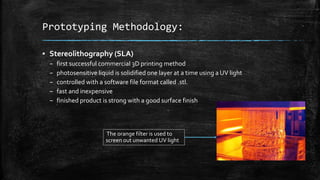
▪ Stereolithography (SLA)
– first successful commercial 3D printing method
– photosensitive liquid is solidified one layer at a time using a UV light
– controlled with a software file format called .stl.
– fast and inexpensive
– finished product is strong with a good surface finish
The orange filter is used to
screen out unwanted UV light
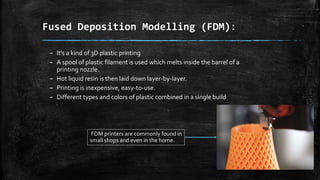
Fused Deposition Modelling (FDM):
– It’s a kind of 3D plastic printing
– A spool of plastic filament is used which melts inside the barrel of a
printing nozzle.
– Hot liquid resin is then laid down layer-by-layer.
– Printing is inexpensive, easy-to-use.
– Different types and colors of plastic combined in a single build
FDM printers are commonly found in
small shops and even in the home.
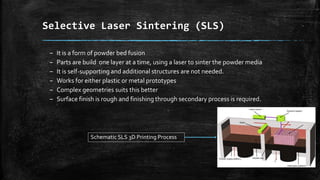
Selective Laser Sintering (SLS)
– It is a form of powder bed fusion
– Parts are build one layer at a time, using a laser to sinter the powder media
– It is self-supporting and additional structures are not needed.
– Works for either plastic or metal prototypes
– Complex geometries suits this better
– Surface finish is rough and finishing through secondary process is required.
Schematic SLS 3D Printing Process
Electron Beam Melting:
– Very similar to SLS process
– It utilizes a high-power electron beam that generates the energy needed for
high melting capacity and high productivity.
– Due to no residual stress and the vacuum ensures a clean and controlled
environment.
Schematic for Electron Beam
Melting
Components using Rapid Prototype Technique:
▪ Fused Deposition Modelling:
– Emission Filters and Filter Caps
– Fuel Door
– Headlight Bezel, Gauge Pod
▪ Stereolithography:
– Gear shift nobs
– Headlamps andTaillamps
– Bumpers
▪ Selective Laser Sintering:
– FuelTanks
– Heat exchangers
– Tubes and Nodes
▪ Electron Beam Melting:
– Wheel Rims
– Frame Construction
Each of the components can be distinguished
as internal, external and functional
Traditional Technique:
▪ Hot Forming
▪ Warm Forming
▪ High PressureThin Walled Die Casting
▪ ResinTransfer Moulding
Major Automotive Player into Rapid Prototyping:
▪ Porsche
▪ Mercedes-Benz
▪ Volkswagen
▪ Lamborghini
Case Studies
Lamborghini use 3D Printing for scale models:
▪ Lamborghini Aventador is a two-seat sports supercar.
▪ Key to the Aventador’s extreme performance is its carbon-fiber reinforced composite (CFRC)
monocoque
▪ Size of monocoque is a single CFRC shell:
– 81 in. long by 74.5 in. wide by 40 in. high and weights 324.5 pounds
▪ Problem Faced:-
– Build envelope was large enough to produce a 1/6 scale model of the body and chassis in one
piece.
Need:
1. To validate assembly fit
2. Verify efficient load paths
3. Identify and correct issues which were not visible on screen
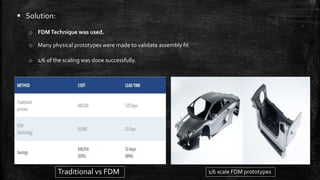
 Solution:
o FDMTechnique was used.
o Many physical prototypes were made to validate assembly fit
o 1/6 of the scaling was done successfully.
Traditional vs FDM 1/6 scale FDM prototypes
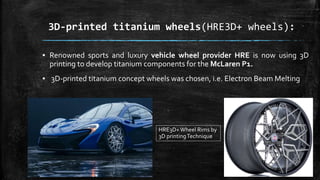
3D-printed titanium wheels(HRE3D+ wheels):
▪ Renowned sports and luxury vehicle wheel provider HRE is now using 3D
printing to develop titanium components for the McLaren P1.
▪ 3D-printed titanium concept wheels was chosen, i.e. Electron Beam Melting
HRE3D+Wheel Rims by
3D printingTechnique
Comparison:
▪ RapidTooling
– Titanium: higher specific strength
and is more corrosion resistant
w.r.t Aluminium
– The manufacturing process is far
more efficient
– Here only 5 percent of the
material is removed: making this a
far more sustainable process.
▪ Traditional
– Aluminum
– The wheel engineers start with a
100-pound forged block of
aluminum and remove 80 percent
to end up with the finished piece.
Note: HRE3D+ wheels only exist as prototypes
Supercar transformed with additive
manufacturing: Air Inlet Systems
▪ Briggs Automotive Company (BAC) collaborated with DSM to improve the performance and
design of the Mono R.
▪ The airbox sits on the car body and includes four trumpets and runners that drive pressurized
air into the engine.
▪ Traditionally made aluminum diecast composite airbox encountered to accommodate the
heat, air pressure and wind speeds.
▪ The runners sit between the engine and trumpets , mitigate wind loads of 170 mph passes
through the airbox , air pressure and heat.
▪ Problem Face:
– Create runners that would maximize airflow while standing up to harsh conditions.
– Improve the physical curvature of the runners since rougher finish can increase turbulence.
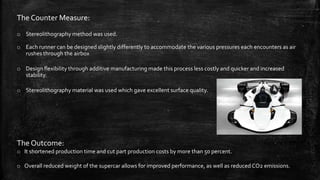
The Counter Measure:
o Stereolithography method was used.
o Each runner can be designed slightly differently to accommodate the various pressures each encounters as air
rushes through the airbox
o Design flexibility through additive manufacturing made this process less costly and quicker and increased
stability.
o Stereolithography material was used which gave excellent surface quality.
The Outcome:
o It shortened production time and cut part production costs by more than 50 percent.
o Overall reduced weight of the supercar allows for improved performance, as well as reduced CO2 emissions.
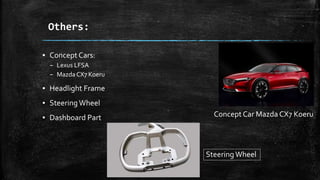
Others:
▪ Concept Cars:
– Lexus LFSA
– Mazda CX7 Koeru
▪ Headlight Frame
▪ Steering Wheel
▪ Dashboard Part Concept Car Mazda CX7 Koeru
Steering Wheel
PROs vs CONs
▪ Procs
– Lowers the operating costs
– Optimize Minimum material to
strength ratio
– Reduces individual part count
– Reducing build time
▪ Cons
– Some materials including few
alloyed metals, are difficult for 3D
printers to process.
Conclusion
▪ Rapid prototyping can be an invaluable time-saver and disaster-avoider for
product teams.
▪ With dependable feedback from users interacting with prototypes, product
managers have qualitative validation of their assumptions or clear indicators
where adjustments are required.
Future Scope
▪ To stay competitive in a market that is perpetually shrinking time to market,
manufacturers need to make and break new release schedules in their
product development cycles. Rapid Prototyping offers that opportunity.
▪ Improved accuracy and surface finish.
Thank You

Prototyping methodology for automotive product development

  • 1.
    Prototyping Methodology for AutomotiveProduct Development M Gokul (19MCD1016)
  • 2.
    What is prototyping? Itis a draft version of a product that allows you to explore your ideas and show the intention behind a feature or the overall design concept Its benefits!! • Cheaper if a product needs changes. • Gather feedback from users at the planning and designing stages. Automobile Prototyping: Automotive prototypes are integral parts of the entire automotive engineering process that allow engineers to figure out how to make new automotive products that appeal to consumers, to convince stakeholders to invest in a new automotive product, and to ensure that a vehicle will be safe for end users.
  • 3.
    Types of prototyping: ▪Low-fidelity prototypes: – Paper-based – No user interactions allowed – Enables early visualization of alternative design – Provoke innovation and improvement ▪ High-fidelity prototypes: – Computer-based – Realistic user interactions i.e. involves mouse-keyboard – High-fidelity prototypes i.e. close as true representations – It helps collecting true human performance data.
  • 4.
    Rapid Prototyping: ▪ RapidPrototyping is a cutting edge technology which has revolutionized the production methods. ▪ It is a group of techniques used to quickly fabricate a scale model of a physical part or assembly. o Advantages: – 15 times faster – Decreased product time-to-market – Development of better products – Reduced costs of product development
  • 5.
    Prototyping Methodology: ▪ Stereolithography(SLA) – first successful commercial 3D printing method – photosensitive liquid is solidified one layer at a time using a UV light – controlled with a software file format called .stl. – fast and inexpensive – finished product is strong with a good surface finish The orange filter is used to screen out unwanted UV light
  • 6.
    Fused Deposition Modelling(FDM): – It’s a kind of 3D plastic printing – A spool of plastic filament is used which melts inside the barrel of a printing nozzle. – Hot liquid resin is then laid down layer-by-layer. – Printing is inexpensive, easy-to-use. – Different types and colors of plastic combined in a single build FDM printers are commonly found in small shops and even in the home.
  • 7.
    Selective Laser Sintering(SLS) – It is a form of powder bed fusion – Parts are build one layer at a time, using a laser to sinter the powder media – It is self-supporting and additional structures are not needed. – Works for either plastic or metal prototypes – Complex geometries suits this better – Surface finish is rough and finishing through secondary process is required. Schematic SLS 3D Printing Process
  • 8.
    Electron Beam Melting: –Very similar to SLS process – It utilizes a high-power electron beam that generates the energy needed for high melting capacity and high productivity. – Due to no residual stress and the vacuum ensures a clean and controlled environment. Schematic for Electron Beam Melting
  • 9.
    Components using RapidPrototype Technique: ▪ Fused Deposition Modelling: – Emission Filters and Filter Caps – Fuel Door – Headlight Bezel, Gauge Pod ▪ Stereolithography: – Gear shift nobs – Headlamps andTaillamps – Bumpers ▪ Selective Laser Sintering: – FuelTanks – Heat exchangers – Tubes and Nodes ▪ Electron Beam Melting: – Wheel Rims – Frame Construction Each of the components can be distinguished as internal, external and functional
  • 10.
    Traditional Technique: ▪ HotForming ▪ Warm Forming ▪ High PressureThin Walled Die Casting ▪ ResinTransfer Moulding
  • 11.
    Major Automotive Playerinto Rapid Prototyping: ▪ Porsche ▪ Mercedes-Benz ▪ Volkswagen ▪ Lamborghini
  • 12.
  • 13.
    Lamborghini use 3DPrinting for scale models: ▪ Lamborghini Aventador is a two-seat sports supercar. ▪ Key to the Aventador’s extreme performance is its carbon-fiber reinforced composite (CFRC) monocoque ▪ Size of monocoque is a single CFRC shell: – 81 in. long by 74.5 in. wide by 40 in. high and weights 324.5 pounds ▪ Problem Faced:- – Build envelope was large enough to produce a 1/6 scale model of the body and chassis in one piece. Need: 1. To validate assembly fit 2. Verify efficient load paths 3. Identify and correct issues which were not visible on screen
  • 14.
     Solution: o FDMTechniquewas used. o Many physical prototypes were made to validate assembly fit o 1/6 of the scaling was done successfully. Traditional vs FDM 1/6 scale FDM prototypes
  • 15.
    3D-printed titanium wheels(HRE3D+wheels): ▪ Renowned sports and luxury vehicle wheel provider HRE is now using 3D printing to develop titanium components for the McLaren P1. ▪ 3D-printed titanium concept wheels was chosen, i.e. Electron Beam Melting HRE3D+Wheel Rims by 3D printingTechnique
  • 16.
    Comparison: ▪ RapidTooling – Titanium:higher specific strength and is more corrosion resistant w.r.t Aluminium – The manufacturing process is far more efficient – Here only 5 percent of the material is removed: making this a far more sustainable process. ▪ Traditional – Aluminum – The wheel engineers start with a 100-pound forged block of aluminum and remove 80 percent to end up with the finished piece. Note: HRE3D+ wheels only exist as prototypes
  • 17.
    Supercar transformed withadditive manufacturing: Air Inlet Systems ▪ Briggs Automotive Company (BAC) collaborated with DSM to improve the performance and design of the Mono R. ▪ The airbox sits on the car body and includes four trumpets and runners that drive pressurized air into the engine. ▪ Traditionally made aluminum diecast composite airbox encountered to accommodate the heat, air pressure and wind speeds. ▪ The runners sit between the engine and trumpets , mitigate wind loads of 170 mph passes through the airbox , air pressure and heat. ▪ Problem Face: – Create runners that would maximize airflow while standing up to harsh conditions. – Improve the physical curvature of the runners since rougher finish can increase turbulence.
  • 18.
    The Counter Measure: oStereolithography method was used. o Each runner can be designed slightly differently to accommodate the various pressures each encounters as air rushes through the airbox o Design flexibility through additive manufacturing made this process less costly and quicker and increased stability. o Stereolithography material was used which gave excellent surface quality. The Outcome: o It shortened production time and cut part production costs by more than 50 percent. o Overall reduced weight of the supercar allows for improved performance, as well as reduced CO2 emissions.
  • 19.
    Others: ▪ Concept Cars: –Lexus LFSA – Mazda CX7 Koeru ▪ Headlight Frame ▪ Steering Wheel ▪ Dashboard Part Concept Car Mazda CX7 Koeru Steering Wheel
  • 20.
    PROs vs CONs ▪Procs – Lowers the operating costs – Optimize Minimum material to strength ratio – Reduces individual part count – Reducing build time ▪ Cons – Some materials including few alloyed metals, are difficult for 3D printers to process.
  • 21.
    Conclusion ▪ Rapid prototypingcan be an invaluable time-saver and disaster-avoider for product teams. ▪ With dependable feedback from users interacting with prototypes, product managers have qualitative validation of their assumptions or clear indicators where adjustments are required.
  • 22.
    Future Scope ▪ Tostay competitive in a market that is perpetually shrinking time to market, manufacturers need to make and break new release schedules in their product development cycles. Rapid Prototyping offers that opportunity. ▪ Improved accuracy and surface finish.
  • 23.