New developments in radiotherapy: Overview and management Prof Sara Faithfull,  Faculty of Health and Medical Sciences
Clinical Questions Clarify the importance of radiotherapy knowledge for nurses Describe the paradigm shift for radiotherapy treatment  Explore the role of nurses in providing radiation supportive care
Radiotherapy a new  development Radiotherapy is one of the 2 most effective treatments for cancer Substantial numbers of patients with common cancers cured 60% of patients receive radiotherapy as part of their cancer treatment either as curative, adjuvant or as palliative intent Exciting developments in future radiotherapy treatment One of the most cost effective cancer therapies
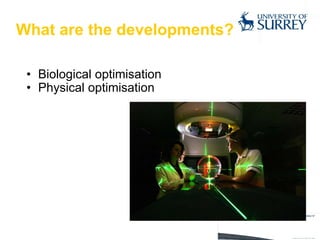
What are the developments? Biological optimisation Physical optimisation
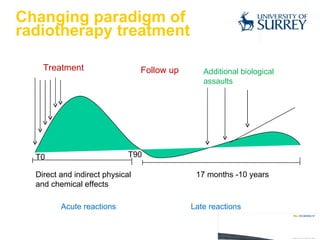
Changing paradigm of  radiotherapy treatment T0 Additional biological assaults Treatment Direct and indirect physical and chemical effects Acute reactions Late reactions T90 17 months -10 years Follow up
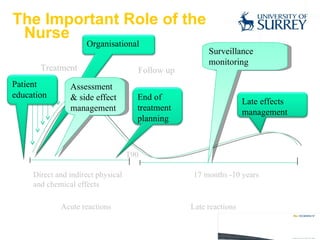
The Important Role of the  Nurse Assessment & side effect management Surveillance monitoring Organisational Treatment Direct and indirect physical and chemical effects Acute reactions Late reactions T90 17 months -10 years Follow up Patient education End of treatment planning Late effects  management
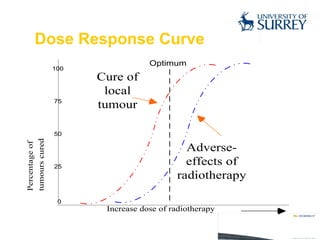
Dose Response Curve
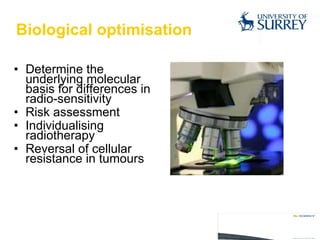
Biological optimisation Determine the underlying molecular basis for differences in radio-sensitivity Risk assessment Individualising radiotherapy Reversal of cellular resistance in tumours
Current understanding of  radiation effects on cells Free radicals cause damage to base pairs of DNA molecules so that at the next mitosis the cell is unable to divide properly Radiation triggers immediate programmed cell death (apoptosis) Radiation influences genes controlling cell cycle eg p53 and effect gene expression Radiation damages cell membranes. This causes signals to be transmitted to the nucleus and these signals influence cell behaviour
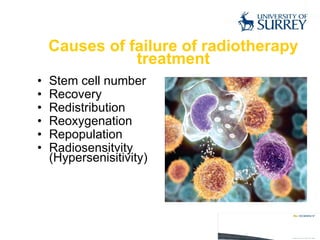
Causes of failure of radiotherapy treatment Stem cell number Recovery Redistribution Reoxygenation Repopulation Radiosensitvity (Hypersenisitivity)
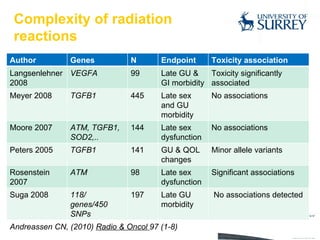
Complexity of radiation  reactions Author Genes N Endpoint Toxicity association Langsenlehner 2008 VEGFA 99 Late GU & GI morbidity Toxicity significantly associated Meyer 2008 TGFB1 445 Late sex and GU morbidity No associations Moore 2007 ATM, TGFB1, SOD2,.. 144 Late sex dysfunction No associations Peters 2005 TGFB1 141 GU & QOL changes Minor allele variants Rosenstein 2007 ATM 98 Late sex dysfunction Significant associations Suga 2008 118/ genes/450 SNPs 197 Late GU  morbidity No associations detected Andreassen CN, (2010)  Radio & Oncol  97 (1-8)
Tumour hypoxia Increasing oxygenation Perflurochemical emulsions improving oxygen delivery to the tumour Agents that selectively sensitise hypoxic tumour cells to irradiation Chemical modifications of the binding affinity of oxygen and haemoglobin Carbogen and nicotinamide
Improving radiotherapy delivery (physical optimization ) Higher doses  Improved  tumour  control Increased toxicity Lower volumes of structures irradiated  Lower toxicity
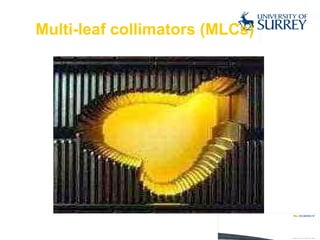
Technological advances Portal imaging Intensity Modulated therapy (IMRT) Image-guided radiation therapy (IGRT) Conformal therapy Multileaf collimation Steriotactic radiotherapy Gated treatment (pulsed according to the phase of the respiratory cycle) Therapy with portable photon sources (Intraoperative) Prostate brachytherapy Intraoperative brachytherapy using Flab (flexible tissue- equivalent material)
Volume Effect Reduce  tumour  size  Chemotherapy, hormones Improve treatment accuracy CT scanning Patient fixation Technology  CFRT IMRT Protons
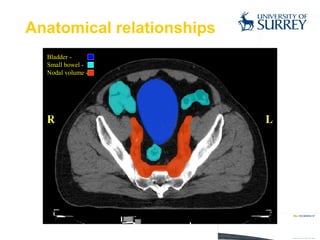
Anatomical relationships
Multi-leaf collimators (MLCs)
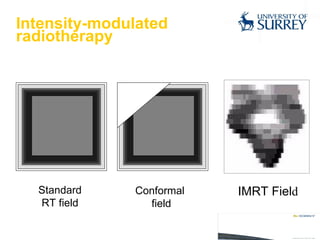
Intensity-modulated  radiotherapy Standard RT field Conformal  field IMRT Fiel d
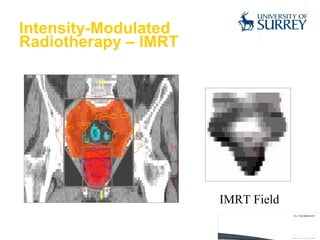
Intensity-Modulated  Radiotherapy – IMRT IMRT Field
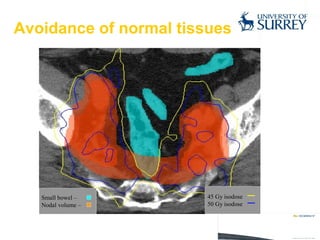
Avoidance of normal tissues
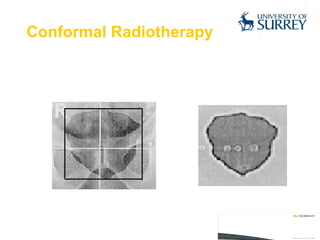
Conformal Radiotherapy
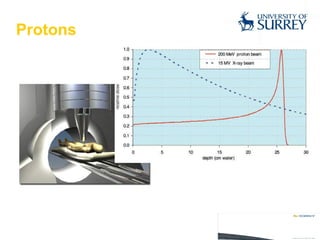
Protons
Communication and patient awareness The impact of treatment and its full range of consequences are often not discussed Unified approach to communication between interdisciplinary teams Informed consent Patient records Patient assessment Prevention of toxicity (smoking cessation)
Organisational Scheduling of treatment:  Adjuvant therapy chemo radiation Waiting times for radiotherapy Lack of resource and capacity for patient numbers Smooth transition between different phases of illness Hospital and home Acute treatment to palliative  Interdisciplinary working Avoiding breaks in therapy
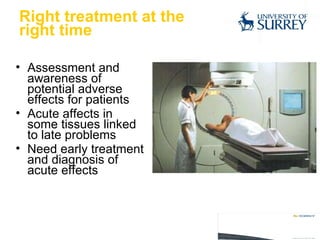
Right treatment at the  right time Assessment and awareness of potential adverse effects for patients Acute affects in some tissues linked to late problems Need early treatment and diagnosis of acute effects
Challenges facing  radiotherapy today and for the future Organisation and delivery of multi modality treatments Increasing patient numbers requiring radiotherapy Increased complexity of treatment schedules Increased demands for information and support Long term consequences of radiotherapy Implementation of guidelines and clinical standards

MON 2011 - Slide 6 - S. Faithfull - New developments in radiotherapy: Overview and management

  • 1.
    New developments inradiotherapy: Overview and management Prof Sara Faithfull, Faculty of Health and Medical Sciences
  • 2.
    Clinical Questions Clarifythe importance of radiotherapy knowledge for nurses Describe the paradigm shift for radiotherapy treatment Explore the role of nurses in providing radiation supportive care
  • 3.
    Radiotherapy a new development Radiotherapy is one of the 2 most effective treatments for cancer Substantial numbers of patients with common cancers cured 60% of patients receive radiotherapy as part of their cancer treatment either as curative, adjuvant or as palliative intent Exciting developments in future radiotherapy treatment One of the most cost effective cancer therapies
  • 4.
    What are thedevelopments? Biological optimisation Physical optimisation
  • 5.
    Changing paradigm of radiotherapy treatment T0 Additional biological assaults Treatment Direct and indirect physical and chemical effects Acute reactions Late reactions T90 17 months -10 years Follow up
  • 6.
    The Important Roleof the Nurse Assessment & side effect management Surveillance monitoring Organisational Treatment Direct and indirect physical and chemical effects Acute reactions Late reactions T90 17 months -10 years Follow up Patient education End of treatment planning Late effects management
  • 7.
  • 8.
    Biological optimisation Determinethe underlying molecular basis for differences in radio-sensitivity Risk assessment Individualising radiotherapy Reversal of cellular resistance in tumours
  • 9.
    Current understanding of radiation effects on cells Free radicals cause damage to base pairs of DNA molecules so that at the next mitosis the cell is unable to divide properly Radiation triggers immediate programmed cell death (apoptosis) Radiation influences genes controlling cell cycle eg p53 and effect gene expression Radiation damages cell membranes. This causes signals to be transmitted to the nucleus and these signals influence cell behaviour
  • 10.
    Causes of failureof radiotherapy treatment Stem cell number Recovery Redistribution Reoxygenation Repopulation Radiosensitvity (Hypersenisitivity)
  • 11.
    Complexity of radiation reactions Author Genes N Endpoint Toxicity association Langsenlehner 2008 VEGFA 99 Late GU & GI morbidity Toxicity significantly associated Meyer 2008 TGFB1 445 Late sex and GU morbidity No associations Moore 2007 ATM, TGFB1, SOD2,.. 144 Late sex dysfunction No associations Peters 2005 TGFB1 141 GU & QOL changes Minor allele variants Rosenstein 2007 ATM 98 Late sex dysfunction Significant associations Suga 2008 118/ genes/450 SNPs 197 Late GU morbidity No associations detected Andreassen CN, (2010) Radio & Oncol 97 (1-8)
  • 12.
    Tumour hypoxia Increasingoxygenation Perflurochemical emulsions improving oxygen delivery to the tumour Agents that selectively sensitise hypoxic tumour cells to irradiation Chemical modifications of the binding affinity of oxygen and haemoglobin Carbogen and nicotinamide
  • 13.
    Improving radiotherapy delivery(physical optimization ) Higher doses Improved tumour control Increased toxicity Lower volumes of structures irradiated Lower toxicity
  • 14.
    Technological advances Portalimaging Intensity Modulated therapy (IMRT) Image-guided radiation therapy (IGRT) Conformal therapy Multileaf collimation Steriotactic radiotherapy Gated treatment (pulsed according to the phase of the respiratory cycle) Therapy with portable photon sources (Intraoperative) Prostate brachytherapy Intraoperative brachytherapy using Flab (flexible tissue- equivalent material)
  • 15.
    Volume Effect Reduce tumour size Chemotherapy, hormones Improve treatment accuracy CT scanning Patient fixation Technology CFRT IMRT Protons
  • 16.
  • 17.
  • 18.
    Intensity-modulated radiotherapyStandard RT field Conformal field IMRT Fiel d
  • 19.
    Intensity-Modulated Radiotherapy– IMRT IMRT Field
  • 20.
  • 21.
  • 22.
  • 23.
    Communication and patientawareness The impact of treatment and its full range of consequences are often not discussed Unified approach to communication between interdisciplinary teams Informed consent Patient records Patient assessment Prevention of toxicity (smoking cessation)
  • 24.
    Organisational Scheduling oftreatment: Adjuvant therapy chemo radiation Waiting times for radiotherapy Lack of resource and capacity for patient numbers Smooth transition between different phases of illness Hospital and home Acute treatment to palliative Interdisciplinary working Avoiding breaks in therapy
  • 25.
    Right treatment atthe right time Assessment and awareness of potential adverse effects for patients Acute affects in some tissues linked to late problems Need early treatment and diagnosis of acute effects
  • 26.
    Challenges facing radiotherapy today and for the future Organisation and delivery of multi modality treatments Increasing patient numbers requiring radiotherapy Increased complexity of treatment schedules Increased demands for information and support Long term consequences of radiotherapy Implementation of guidelines and clinical standards

Editor's Notes

  • #2 The main challenge to radiation oncology is to adapt to a rapidly changing environment
  • #5 Methods to improve the effectiveness of radiotherapy may produce dramatic increases in local control attempts to both improve both physical and biological damage to reduce normal tissue toxicity but also tumour damage. This may also be used to increase total dosage and hence cure as well as reducing normal tissue toxicity. The realisation of the multifaceted genetically dipsosition of the growth of tumours. Radiotherapy failure is not linked to the metastasising properties of the cancer but inherent characteristics of the individual.
  • #11 Predicting how tumours will respond to radiotherapy may identify anticipated causes of treatment failure. By being able to identify and individuals susceptibility treatment modifications can be made on an individual basis to overcome these. There are 6 major biological properties of tumours that affect response. Size of tumour important-relative radio resistance. 2. Recovery varies. Degree of recovery related to the repair capacity of the cells. Important in sparing normal tissue-potential cause of treatment failure if cancer grows in between treatments. Redistribution- time for cells to move into different phases of the cell cycle. Failure of cells to redistribute Reoxygenation-hypoxia important-key reason for tretament failure Repopulation growing cells Radiosensitivity-inherent resistance
  • #12 Predicting tumour radiosensitvity. One of the most important advances was the description of the correlation of the radiosensitivity of particular cell lines and the clinical response of the tumour. Range of sensitvities for different tumour lines. If invitro intrinsic radiosensitivity is found to predict for individual response to radiation, assays will be required to measure such radiosensitivity from tumour biopsies prior to strat of tretament. Clonogenic assays measure the regenerative capacity of tumour cells and are used in the definition of cellular response to radiation. This has been technically very difficult. Need a more radpid result. DNA damage assays. If tumour is found to be sensitive, the total dose is unlikely to be reduced. If resistant then the therapeutic options are difficult.
  • #20 IMRT is a new radiotherapy technique able to treat complex volumes and to specifically reduce the irradiation of sensitive normal structures. CLICK This patient has prostate cancer with a high risk of nodal metastases, but the radiation dose that can be delivered to those nodes is limited to 50 Gy by presence of small bowel, as can be seen. CLICK,CLICK, CLICK Standard radiotherapy would involve irradiating the larger volume to 50 Gy, and boosting the prostate to a further 20 Gy. CLICK IMRT is able to deliver a variable dose per fraction, and this can be used for selective normal tissue avoidance – in this case bowel, or to deliver a higher dose to part of the tumour, in this case we have treated the prostate to a higher dose than the pelvic nodes.