
Protecting Wireless Networks
aka Hacking Wireless
Saptha Wanniarachchi MBCS,MCSE,MCITP
Twitter @saptha
saptha.com
Wired Vs Wireless Hacking
r i m e i s a l l a r o u n d u s .C
In theory, wireless LANs are less secure than
wired LANs, because wireless communication
signals travel through the air and can easily be
intercepted.
Types Of Wireless Networks
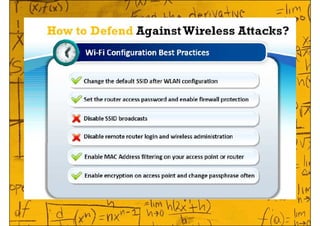
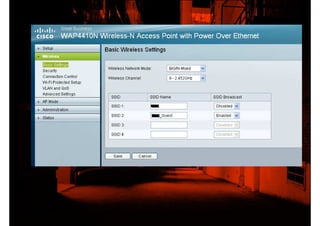
Unfortunately, turning off the broadcast of the
SSID may lead to a false sense of security. The
method discourages only casual wireless
snooping, but does not stop a person trying to
attack the network.
Scanning for Access Points
• Access points periodically transmit beacon
frames (SSID, data rate, etc.)
• Client scans frequencies and picks an access
point based on SSID, signal strength, ...
• Client switches to assigned channel and
establishes an association
How dose the war diving looks
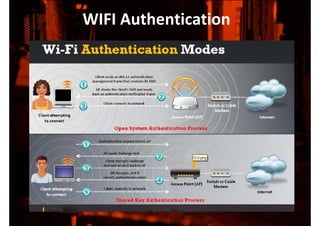
WIFI Authentication
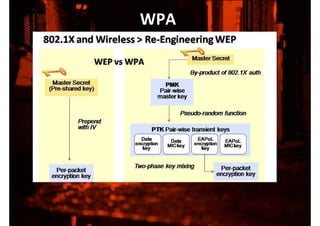
WEP
WPA
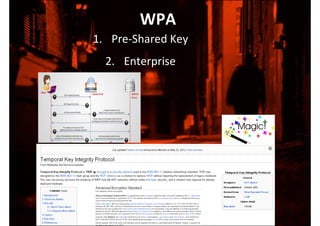
WPA
1. Pre-Shared Key
2. Enterprise
Summary of authentication
Open Network
WEP
WPA
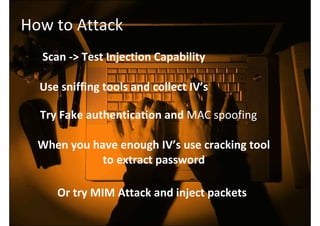
How to Attack
Scan -> Test Injection Capability
Use sniffing tools and collect IV’s
Try Fake authentication and MAC spoofing
When you have enough IV’s use cracking tool
to extract password
Or try MIM Attack and inject packets
Source: Consumer Reports
MisconfigurationMisconfiguration possibilitiespossibilities
•• no encryption usedno encryption used
•• weak (guessable) passwordweak (guessable) password
used to generate keyused to generate key
•• weak protection of encryptionweak protection of encryption
key on client machinekey on client machine
•• weak protection ofweak protection of
management interface formanagement interface for
access pointaccess point
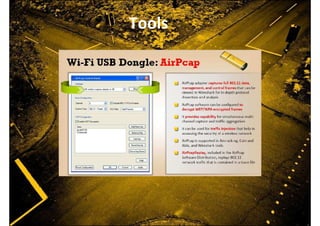
Tools
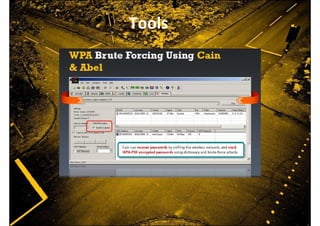
Tools
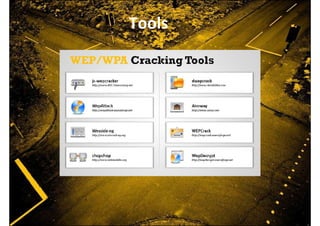
Tools
Tools
Tools
Tools
Tools
Tools
Recommendations: WLAN Security
• WEP (fair)
• enable wireless frame encryption
• use longest key
• change the WEP key regularly (manually)
• 802.1X and WPA (user authentication + dynamic
keys) (better)
• use as soon as practical and stable
• set rekeying to occur every few hours
• 802.11i (best)
• upgrade / use when available and supported
Q&A

Protecting wireless networks aka wireless hacking

  • 1.
    Protecting Wireless Networks akaHacking Wireless Saptha Wanniarachchi MBCS,MCSE,MCITP Twitter @saptha saptha.com
  • 2.
    Wired Vs WirelessHacking r i m e i s a l l a r o u n d u s .C In theory, wireless LANs are less secure than wired LANs, because wireless communication signals travel through the air and can easily be intercepted.
  • 3.
  • 4.
    Unfortunately, turning offthe broadcast of the SSID may lead to a false sense of security. The method discourages only casual wireless snooping, but does not stop a person trying to attack the network. Scanning for Access Points • Access points periodically transmit beacon frames (SSID, data rate, etc.) • Client scans frequencies and picks an access point based on SSID, signal strength, ... • Client switches to assigned channel and establishes an association
  • 5.
    How dose thewar diving looks
  • 6.
  • 7.
  • 8.
  • 9.
  • 10.
  • 11.
    How to Attack Scan-> Test Injection Capability Use sniffing tools and collect IV’s Try Fake authentication and MAC spoofing When you have enough IV’s use cracking tool to extract password Or try MIM Attack and inject packets
  • 12.
    Source: Consumer Reports MisconfigurationMisconfigurationpossibilitiespossibilities •• no encryption usedno encryption used •• weak (guessable) passwordweak (guessable) password used to generate keyused to generate key •• weak protection of encryptionweak protection of encryption key on client machinekey on client machine •• weak protection ofweak protection of management interface formanagement interface for access pointaccess point
  • 13.
  • 14.
  • 15.
  • 16.
  • 17.
  • 18.
  • 19.
  • 20.
  • 22.
    Recommendations: WLAN Security •WEP (fair) • enable wireless frame encryption • use longest key • change the WEP key regularly (manually) • 802.1X and WPA (user authentication + dynamic keys) (better) • use as soon as practical and stable • set rekeying to occur every few hours • 802.11i (best) • upgrade / use when available and supported
  • 25.