Programme Proposal - Documentary
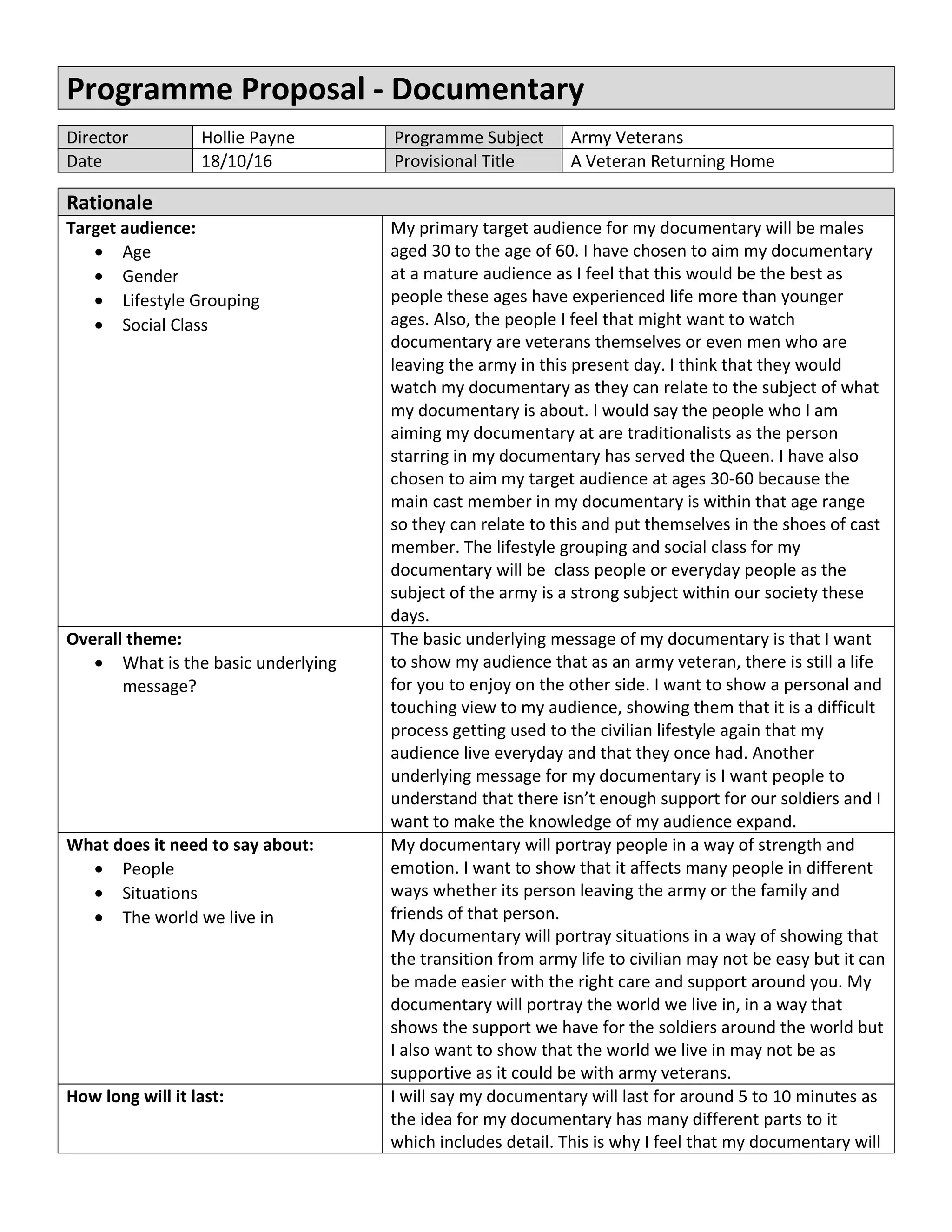
Director Hollie Payne Programme Subject Army Veterans
Date 18/10/16 Provisional Title A Veteran Returning Home
Rationale
Target audience:
• Age
• Gender
• Lifestyle Grouping
• Social Class
My primary target audience for my documentary will be males
aged 30 to the age of 60. I have chosen to aim my documentary
at a mature audience as I feel that this would be the best as
people these ages have experienced life more than younger
ages. Also, the people I feel that might want to watch
documentary are veterans themselves or even men who are
leaving the army in this present day. I think that they would
watch my documentary as they can relate to the subject of what
my documentary is about. I would say the people who I am
aiming my documentary at are traditionalists as the person
starring in my documentary has served the Queen. I have also
chosen to aim my target audience at ages 30-60 because the
main cast member in my documentary is within that age range
so they can relate to this and put themselves in the shoes of cast
member. The lifestyle grouping and social class for my
documentary will be class people or everyday people as the
subject of the army is a strong subject within our society these
days.
Overall theme:
• What is the basic underlying
message?
The basic underlying message of my documentary is that I want
to show my audience that as an army veteran, there is still a life
for you to enjoy on the other side. I want to show a personal and
touching view to my audience, showing them that it is a difficult
process getting used to the civilian lifestyle again that my
audience live everyday and that they once had. Another
underlying message for my documentary is I want people to
understand that there isn’t enough support for our soldiers and I
want to make the knowledge of my audience expand.
What does it need to say about:
• People
• Situations
• The world we live in
My documentary will portray people in a way of strength and
emotion. I want to show that it affects many people in different
ways whether its person leaving the army or the family and
friends of that person.
My documentary will portray situations in a way of showing that
the transition from army life to civilian may not be easy but it can
be made easier with the right care and support around you. My
documentary will portray the world we live in, in a way that
shows the support we have for the soldiers around the world but
I also want to show that the world we live in may not be as
supportive as it could be with army veterans.
How long will it last: I will say my documentary will last for around 5 to 10 minutes as
the idea for my documentary has many different parts to it
which includes detail. This is why I feel that my documentary will
last for this time so I can fit it all in nicely.
How will the programme be seen:
• On television
• On the internet
• On DVD
I would like my documentary to be shown on the TV. This is
because I want to show my documentary to a large audience and
a large mass of our society watches TV on a daily basis. As not
every person in my primary target audience may not use the
internet, I don’t think this would be the best place for people to
see my documentary as it wouldn’t fulfill my requirements for
my documentary.
What research did you do:
• To help you understand the
subject area and identify
narrative opportunities
When doing research for my documentary, I research into The
British Legion. When I was looking into this charity I found out
about different events around the area I could attend to
interview and speak to people about the topic of my
documentary. Also on the website it has a tab called ‘Get
Support’. This tab has different links coming off which are:
eligibility, finance, housing, mental wellbeing, physical health,
living independently, employability, social support, external
grants and the legion near you. I think all these things are
suitable for army veterans that need support and if my main cast
member feels comfortable I will try to ease an answer on
whether they felt they need or had this support. As I feel like my
documentary is different to ones I have found I feel like
researching them hasn’t really benefitted me much. I feel like
they have benefitted me in a way in which it has gave me ideas,
for example the montage of images and sentimental value
personal belongings, as I liked the feeling I got when watching
them. I felt like I was understanding and getting to know the
individual(s).
Constraints:
• Legal
• Ethical
• Representation
As the footage in my documentary will be my own I feel like
there wouldn’t be any legal or ethical constraints. I feel like the
representation in my documentary may be emotional due to the
footage and interviews I am going to film.
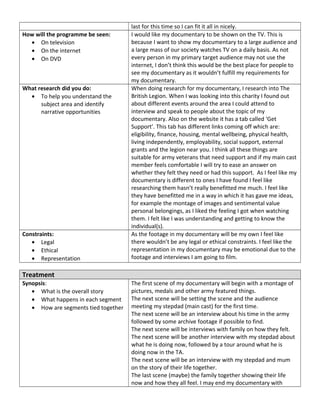
Treatment
Synopsis:
• What is the overall story
• What happens in each segment
• How are segments tied together
The first scene of my documentary will begin with a montage of
pictures, medals and other army featured things.
The next scene will be setting the scene and the audience
meeting my stepdad (main cast) for the first time.
The next scene will be an interview about his time in the army
followed by some archive footage if possible to find.
The next scene will be interviews with family on how they felt.
The next scene will be another interview with my stepdad about
what he is doing now, followed by a tour around what he is
doing now in the TA.
The next scene will be an interview with my stepdad and mum
on the story of their life together.
The last scene (maybe) the family together showing their life
now and how they all feel. I may end my documentary with
another montage showing the life of the main cast member to
date.
Setting:
• Location/Environment the film is
being recorded in
The location my documentary will be filmed will be in my living
room at home. I have chosen to do it in this location as I feel that
this will create a sense of an ordinary lifestyle of a veteran
returning home, this is because I feel as though it will create a
loving, family and homely atmosphere for my viewers. I want let
my audience into the life of an army veteran so they understand
how difficult the move could be.
Narrative structure:
• Linear or non linear
• Single or multi strand
• Open or closed narrative
The narrative of my documentary will be linear as I want to show
my documentary in the order it has happened in life. This is
because I want my documentary to tell a story. I think that my
documentary is a single strand narrative as the story is about one
person and one topic on which has happened in life. My
documentary is an open narrative as it is showing the life of my
cast members and because the audience is being guided through
a pathway of what has been experienced by stepdad in his life.
Documentary Genre:
• Reality
• Fly on the wall
• Investigative Journalism
• Dramatic Reconstruction
• Animated/Graphics led
My documentary genre is going to be reality. It is going to be
reality because it is showing the life of someone who has been
down many pathways to get where they are in life at the
moment. It is showing the honesty, the ups and the downs of
what people have faced, which I think will make it inspiring and
emotional.
Tone:
• Serious
• Light Hearted
The tone of my documentary is going to be serious. This is
because I feel strongly and when doing my research I have
discovered that, I and many people know that there is not
enough support for our troops when they are leaving the army. I
want to make my audience aware that army veterans can make
the transition alone with the support from family and friends. On
the other hand, I want to show that more support is needed for
the unfortunate soldiers who don’t have that luxury.
Narration:
• Presenter in vision
• Presenter as voice over
• Participant commentary
The narration in my documentary is most likely to be presenter
as voice over. I feel that is this best for my documentary as it is
telling a story in a sense. I feel like if the presenter was in vision it
would make my documentary, un natural and maybe even make
the cast of my documentary uncomfortable or intimidated.
Pace:
• Fast - to build excitement
• Slow - to provide depth
The pace of my documentary will be slow to provide depth. I
want to give a detailed documentary and explain many different
topics within my documentary to make sure I give my audience
some more knowledge towards my topic. I also want to create a
emotional response from the outcome of my documentary
which I feel I will get from a slow pace.
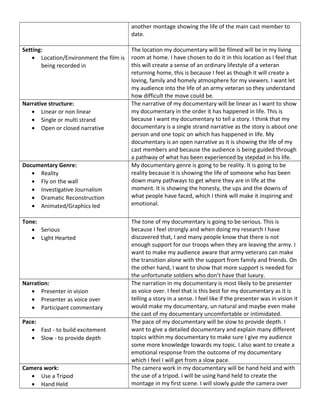
Camera work:
• Use a Tripod
• Hand Held
The camera work in my documentary will be hand held and with
the use of a tripod. I will be using hand held to create the
montage in my first scene. I will slowly guide the camera over
• How will you use camera moves
• What kind of camera angles will
you use
the objects, making sure the audience can see clearly what they
are. I will be using a tripod for the interviews. This is because I
want the camera to still and always at the same level with the
cast member. I want them to feel comfortable speaking to the
camera, which I feel might be harder to do if someone is holding
the camera. The camera angles I will be using in my documentary
are medium close ups, close ups, long shots, establishing shots
and maybe some extreme close ups.
Look:
• Colour
• Black & White
• “High” or “Low” Resolution
• Studio
• On location
• Montage
• Found footage
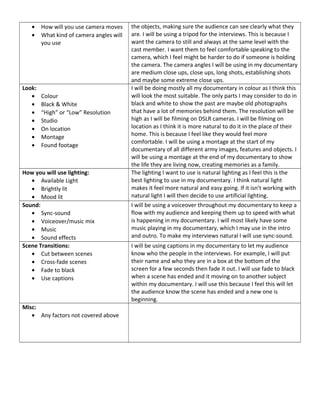
I will be doing mostly all my documentary in colour as I think this
will look the most suitable. The only parts I may consider to do in
black and white to show the past are maybe old photographs
that have a lot of memories behind them. The resolution will be
high as I will be filming on DSLR cameras. I will be filming on
location as I think it is more natural to do it in the place of their
home. This is because I feel like they would feel more
comfortable. I will be using a montage at the start of my
documentary of all different army images, features and objects. I
will be using a montage at the end of my documentary to show
the life they are living now, creating memories as a family.
How you will use lighting:
• Available Light
• Brightly lit
• Mood lit
The lighting I want to use is natural lighting as I feel this is the
best lighting to use in my documentary. I think natural light
makes it feel more natural and easy going. If it isn’t working with
natural light I will then decide to use artificial lighting.
Sound:
• Sync-sound
• Voiceover/music mix
• Music
• Sound effects
I will be using a voiceover throughout my documentary to keep a
flow with my audience and keeping them up to speed with what
is happening in my documentary. I will most likely have some
music playing in my documentary, which I may use in the intro
and outro. To make my interviews natural I will use sync-sound.
Scene Transitions:
• Cut between scenes
• Cross-fade scenes
• Fade to black
• Use captions
I will be using captions in my documentary to let my audience
know who the people in the interviews. For example, I will put
their name and who they are in a box at the bottom of the
screen for a few seconds then fade it out. I will use fade to black
when a scene has ended and it moving on to another subject
within my documentary. I will use this because I feel this will let
the audience know the scene has ended and a new one is
beginning.
Misc:
• Any factors not covered above
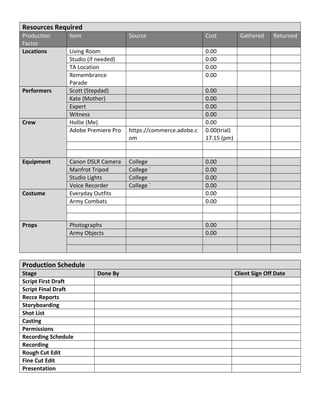
Resources Required
Production
Factor
Item Source Cost Gathered Returned
Locations Living Room 0.00
Studio (if needed) 0.00
TA Location 0.00
Remembrance
Parade
0.00
Performers Scott (Stepdad) 0.00
Kate (Mother) 0.00
Expert 0.00
Witness 0.00
Crew Hollie (Me) 0.00
Adobe Premiere Pro https://commerce.adobe.c
om
0.00(trial)
17.15 (pm)
Equipment Canon DSLR Camera College 0.00
Manfrot Tripod College ` 0.00
Studio Lights College 0.00
Voice Recorder College ` 0.00
Costume Everyday Outfits 0.00
Army Combats 0.00
Props Photographs 0.00
Army Objects 0.00
Production Schedule
Stage Done By Client Sign Off Date
Script First Draft
Script Final Draft
Recce Reports
Storyboarding
Shot List
Casting
Permissions
Recording Schedule
Recording
Rough Cut Edit
Fine Cut Edit
Presentation
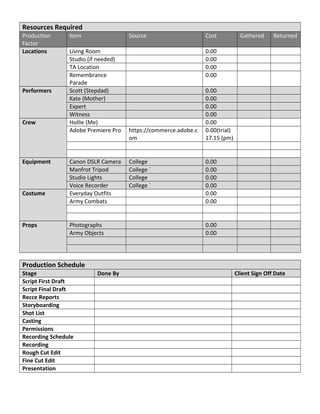
Resources Required
Production
Factor
Item Source Cost Gathered Returned
Locations Living Room 0.00
Studio (if needed) 0.00
TA Location 0.00
Remembrance
Parade
0.00
Performers Scott (Stepdad) 0.00
Kate (Mother) 0.00
Expert 0.00
Witness 0.00
Crew Hollie (Me) 0.00
Adobe Premiere Pro https://commerce.adobe.c
om
0.00(trial)
17.15 (pm)
Equipment Canon DSLR Camera College 0.00
Manfrot Tripod College ` 0.00
Studio Lights College 0.00
Voice Recorder College ` 0.00
Costume Everyday Outfits 0.00
Army Combats 0.00
Props Photographs 0.00
Army Objects 0.00
Production Schedule
Stage Done By Client Sign Off Date
Script First Draft
Script Final Draft
Recce Reports
Storyboarding
Shot List
Casting
Permissions
Recording Schedule
Recording
Rough Cut Edit
Fine Cut Edit
Presentation

Proposal for documentary

  • 1.
    Programme Proposal -Documentary Director Hollie Payne Programme Subject Army Veterans Date 18/10/16 Provisional Title A Veteran Returning Home Rationale Target audience: • Age • Gender • Lifestyle Grouping • Social Class My primary target audience for my documentary will be males aged 30 to the age of 60. I have chosen to aim my documentary at a mature audience as I feel that this would be the best as people these ages have experienced life more than younger ages. Also, the people I feel that might want to watch documentary are veterans themselves or even men who are leaving the army in this present day. I think that they would watch my documentary as they can relate to the subject of what my documentary is about. I would say the people who I am aiming my documentary at are traditionalists as the person starring in my documentary has served the Queen. I have also chosen to aim my target audience at ages 30-60 because the main cast member in my documentary is within that age range so they can relate to this and put themselves in the shoes of cast member. The lifestyle grouping and social class for my documentary will be class people or everyday people as the subject of the army is a strong subject within our society these days. Overall theme: • What is the basic underlying message? The basic underlying message of my documentary is that I want to show my audience that as an army veteran, there is still a life for you to enjoy on the other side. I want to show a personal and touching view to my audience, showing them that it is a difficult process getting used to the civilian lifestyle again that my audience live everyday and that they once had. Another underlying message for my documentary is I want people to understand that there isn’t enough support for our soldiers and I want to make the knowledge of my audience expand. What does it need to say about: • People • Situations • The world we live in My documentary will portray people in a way of strength and emotion. I want to show that it affects many people in different ways whether its person leaving the army or the family and friends of that person. My documentary will portray situations in a way of showing that the transition from army life to civilian may not be easy but it can be made easier with the right care and support around you. My documentary will portray the world we live in, in a way that shows the support we have for the soldiers around the world but I also want to show that the world we live in may not be as supportive as it could be with army veterans. How long will it last: I will say my documentary will last for around 5 to 10 minutes as the idea for my documentary has many different parts to it which includes detail. This is why I feel that my documentary will
  • 2.
    last for thistime so I can fit it all in nicely. How will the programme be seen: • On television • On the internet • On DVD I would like my documentary to be shown on the TV. This is because I want to show my documentary to a large audience and a large mass of our society watches TV on a daily basis. As not every person in my primary target audience may not use the internet, I don’t think this would be the best place for people to see my documentary as it wouldn’t fulfill my requirements for my documentary. What research did you do: • To help you understand the subject area and identify narrative opportunities When doing research for my documentary, I research into The British Legion. When I was looking into this charity I found out about different events around the area I could attend to interview and speak to people about the topic of my documentary. Also on the website it has a tab called ‘Get Support’. This tab has different links coming off which are: eligibility, finance, housing, mental wellbeing, physical health, living independently, employability, social support, external grants and the legion near you. I think all these things are suitable for army veterans that need support and if my main cast member feels comfortable I will try to ease an answer on whether they felt they need or had this support. As I feel like my documentary is different to ones I have found I feel like researching them hasn’t really benefitted me much. I feel like they have benefitted me in a way in which it has gave me ideas, for example the montage of images and sentimental value personal belongings, as I liked the feeling I got when watching them. I felt like I was understanding and getting to know the individual(s). Constraints: • Legal • Ethical • Representation As the footage in my documentary will be my own I feel like there wouldn’t be any legal or ethical constraints. I feel like the representation in my documentary may be emotional due to the footage and interviews I am going to film. Treatment Synopsis: • What is the overall story • What happens in each segment • How are segments tied together The first scene of my documentary will begin with a montage of pictures, medals and other army featured things. The next scene will be setting the scene and the audience meeting my stepdad (main cast) for the first time. The next scene will be an interview about his time in the army followed by some archive footage if possible to find. The next scene will be interviews with family on how they felt. The next scene will be another interview with my stepdad about what he is doing now, followed by a tour around what he is doing now in the TA. The next scene will be an interview with my stepdad and mum on the story of their life together. The last scene (maybe) the family together showing their life now and how they all feel. I may end my documentary with
  • 3.
    another montage showingthe life of the main cast member to date. Setting: • Location/Environment the film is being recorded in The location my documentary will be filmed will be in my living room at home. I have chosen to do it in this location as I feel that this will create a sense of an ordinary lifestyle of a veteran returning home, this is because I feel as though it will create a loving, family and homely atmosphere for my viewers. I want let my audience into the life of an army veteran so they understand how difficult the move could be. Narrative structure: • Linear or non linear • Single or multi strand • Open or closed narrative The narrative of my documentary will be linear as I want to show my documentary in the order it has happened in life. This is because I want my documentary to tell a story. I think that my documentary is a single strand narrative as the story is about one person and one topic on which has happened in life. My documentary is an open narrative as it is showing the life of my cast members and because the audience is being guided through a pathway of what has been experienced by stepdad in his life. Documentary Genre: • Reality • Fly on the wall • Investigative Journalism • Dramatic Reconstruction • Animated/Graphics led My documentary genre is going to be reality. It is going to be reality because it is showing the life of someone who has been down many pathways to get where they are in life at the moment. It is showing the honesty, the ups and the downs of what people have faced, which I think will make it inspiring and emotional. Tone: • Serious • Light Hearted The tone of my documentary is going to be serious. This is because I feel strongly and when doing my research I have discovered that, I and many people know that there is not enough support for our troops when they are leaving the army. I want to make my audience aware that army veterans can make the transition alone with the support from family and friends. On the other hand, I want to show that more support is needed for the unfortunate soldiers who don’t have that luxury. Narration: • Presenter in vision • Presenter as voice over • Participant commentary The narration in my documentary is most likely to be presenter as voice over. I feel that is this best for my documentary as it is telling a story in a sense. I feel like if the presenter was in vision it would make my documentary, un natural and maybe even make the cast of my documentary uncomfortable or intimidated. Pace: • Fast - to build excitement • Slow - to provide depth The pace of my documentary will be slow to provide depth. I want to give a detailed documentary and explain many different topics within my documentary to make sure I give my audience some more knowledge towards my topic. I also want to create a emotional response from the outcome of my documentary which I feel I will get from a slow pace. Camera work: • Use a Tripod • Hand Held The camera work in my documentary will be hand held and with the use of a tripod. I will be using hand held to create the montage in my first scene. I will slowly guide the camera over
  • 4.
    • How willyou use camera moves • What kind of camera angles will you use the objects, making sure the audience can see clearly what they are. I will be using a tripod for the interviews. This is because I want the camera to still and always at the same level with the cast member. I want them to feel comfortable speaking to the camera, which I feel might be harder to do if someone is holding the camera. The camera angles I will be using in my documentary are medium close ups, close ups, long shots, establishing shots and maybe some extreme close ups. Look: • Colour • Black & White • “High” or “Low” Resolution • Studio • On location • Montage • Found footage I will be doing mostly all my documentary in colour as I think this will look the most suitable. The only parts I may consider to do in black and white to show the past are maybe old photographs that have a lot of memories behind them. The resolution will be high as I will be filming on DSLR cameras. I will be filming on location as I think it is more natural to do it in the place of their home. This is because I feel like they would feel more comfortable. I will be using a montage at the start of my documentary of all different army images, features and objects. I will be using a montage at the end of my documentary to show the life they are living now, creating memories as a family. How you will use lighting: • Available Light • Brightly lit • Mood lit The lighting I want to use is natural lighting as I feel this is the best lighting to use in my documentary. I think natural light makes it feel more natural and easy going. If it isn’t working with natural light I will then decide to use artificial lighting. Sound: • Sync-sound • Voiceover/music mix • Music • Sound effects I will be using a voiceover throughout my documentary to keep a flow with my audience and keeping them up to speed with what is happening in my documentary. I will most likely have some music playing in my documentary, which I may use in the intro and outro. To make my interviews natural I will use sync-sound. Scene Transitions: • Cut between scenes • Cross-fade scenes • Fade to black • Use captions I will be using captions in my documentary to let my audience know who the people in the interviews. For example, I will put their name and who they are in a box at the bottom of the screen for a few seconds then fade it out. I will use fade to black when a scene has ended and it moving on to another subject within my documentary. I will use this because I feel this will let the audience know the scene has ended and a new one is beginning. Misc: • Any factors not covered above
  • 5.
    Resources Required Production Factor Item SourceCost Gathered Returned Locations Living Room 0.00 Studio (if needed) 0.00 TA Location 0.00 Remembrance Parade 0.00 Performers Scott (Stepdad) 0.00 Kate (Mother) 0.00 Expert 0.00 Witness 0.00 Crew Hollie (Me) 0.00 Adobe Premiere Pro https://commerce.adobe.c om 0.00(trial) 17.15 (pm) Equipment Canon DSLR Camera College 0.00 Manfrot Tripod College ` 0.00 Studio Lights College 0.00 Voice Recorder College ` 0.00 Costume Everyday Outfits 0.00 Army Combats 0.00 Props Photographs 0.00 Army Objects 0.00 Production Schedule Stage Done By Client Sign Off Date Script First Draft Script Final Draft Recce Reports Storyboarding Shot List Casting Permissions Recording Schedule Recording Rough Cut Edit Fine Cut Edit Presentation
  • 6.
    Resources Required Production Factor Item SourceCost Gathered Returned Locations Living Room 0.00 Studio (if needed) 0.00 TA Location 0.00 Remembrance Parade 0.00 Performers Scott (Stepdad) 0.00 Kate (Mother) 0.00 Expert 0.00 Witness 0.00 Crew Hollie (Me) 0.00 Adobe Premiere Pro https://commerce.adobe.c om 0.00(trial) 17.15 (pm) Equipment Canon DSLR Camera College 0.00 Manfrot Tripod College ` 0.00 Studio Lights College 0.00 Voice Recorder College ` 0.00 Costume Everyday Outfits 0.00 Army Combats 0.00 Props Photographs 0.00 Army Objects 0.00 Production Schedule Stage Done By Client Sign Off Date Script First Draft Script Final Draft Recce Reports Storyboarding Shot List Casting Permissions Recording Schedule Recording Rough Cut Edit Fine Cut Edit Presentation