CASE STUDY ON PHOTOGRAPHERS
WHAT IS A FREELANCER?
• A freelancer is a person who is self-employed and is not committed to an
employer long term. A freelancer is someone who is hired by different
companies for certain jobs. An example of this is if a TV show need another
cameraman for that series they can hirer a freelance cameraman.
• There are advantages of freelancing which can include: you can choose your work
because you are essentially your own boss which means you have the final choice
of the work you have been offered. Another advantages would be better pay. This
is because some companies who higher you may pay you more than what they
pay their own staff. This is because they wont have to pay for sick leave as part of
the contact. Also the more experience you have the more money you can ask for.
• There are also disadvantages of working freelance which include: getting the
work. This could be a struggle as there is a lot of freelancers which means that it
can be competitive to get jibs especially if you are upcoming in the industry.
Another disadvantage is managing your money. This is a disadvantage because
you wont be receiving a regular paycheque which means you will have to evenly
manage your money incase you don’t have work for a couple of months or you
fall ill.
DAVID STUBBS
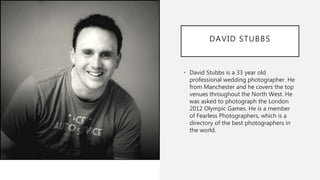
• David Stubbs is a 33 year old
professional wedding photographer. He
from Manchester and he covers the top
venues throughout the North West. He
was asked to photograph the London
2012 Olympic Games. He is a member
of Fearless Photographers, which is a
directory of the best photographers in
the world.
GETTING YOUR BUSINESS OUT THERE
• As a freelancer you have to make sure you find ways to promote and spread the word of your business. A good
way to do this is by creating a website for your business. An example of a good freelancer website is David
Stubbs. The things his websites includes is a home page. On this home page he has a slideshow of his best
photographs he has taken. This is a good key selling point to the viewer of his website because he shows he has a
huge potential and the result your own wedding photos could possibly be like. He also has his best of 2016 and
his best of 2015. On his homepage he also has awards he has won and how he also assists for destination
weddings. He has a link which covers his full weddings which he has photographed. On each portfolio he has the
location and the name of the couple. Another thing his website includes is awards and published work. On this
page is has the image he won the award or published with with a little paragraph of information on each. He then
has his blog. This is a main part of a website as it is a easy way for your photos to be viewed. On his blog he states
that it is everything he photographs that ends up on the blog which include: wedding sneak peeks, engagement
shoots or a full wedding post. A massively important part he has on his website is the ’about me’ link. This is
important to have when selling yourself and your business because people will want to know what you look like
and who you are in a sense as you will be a massive part of their special day. On here he has a picture and he
shares personal and work related information about himself. He has a link called information which then has a
drop down box. In this box it has engagement, FAQS, recommended suppliers and his social media. The next link
is training. This link is about the training courses that he offers. Not all photographers will offer this kind of thing
but it is a good thing to offer. The last tab on his website is packages and contact. On this page he has a list of
what all his wedding packages includes and he has a contact section to get in touch with him or request his
brochure.
EQUIPMENT
These wedding photography essentials include a camera and
a backup camera, medium zoom lens, telephoto lens, wide
angle lens and prime lenses, speed lights, memory cards and
batteries, tripods and light stands, flash diffuser, camera bag,
lens cleaning kit and a lens hood.
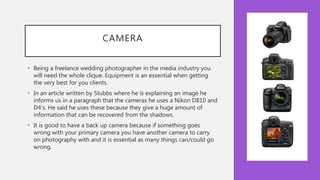
CAMERA
• Being a freelance wedding photographer in the media industry you
will need the whole clique. Equipment is an essential when getting
the very best for you clients.
• In an article written by Stubbs where he is explaining an image he
informs us in a paragraph that the cameras he uses a Nikon D810 and
D4’s. He said he uses these because they give a huge amount of
information that can be recovered from the shadows.
• It is good to have a back up camera because if something goes
wrong with your primary camera you have another camera to carry
on photography with and it is essential as many things can/could go
wrong.
LENSES
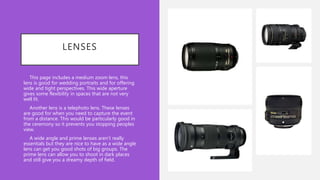
• This page includes a medium zoom lens, this
lens is good for wedding portraits and for offering
wide and tight perspectives. This wide aperture
gives some flexibility in spaces that are not very
well lit.
• Another lens is a telephoto lens. These lenses
are good for when you need to capture the event
from a distance. This would be particularly good in
the ceremony so it prevents you stopping peoples
view.
• A wide angle and prime lenses aren’t really
essentials but they are nice to have as a wide angle
lens can get you good shots of big groups. The
prime lens can allow you to shoot in dark places
and still give you a dreamy depth of field.
SPEED LIGHTS
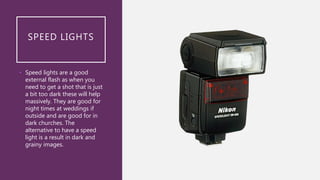
• Speed lights are a good
external flash as when you
need to get a shot that is just
a bit too dark these will help
massively. They are good for
night times at weddings if
outside and are good for in
dark churches. The
alternative to have a speed
light is a result in dark and
grainy images.
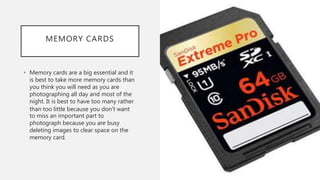
MEMORY CARDS
• Memory cards are a big essential and it
is best to take more memory cards than
you think you will need as you are
photographing all day and most of the
night. It is best to have too many rather
than too little because you don’t want
to miss an important part to
photograph because you are busy
deleting images to clear space on the
memory card.
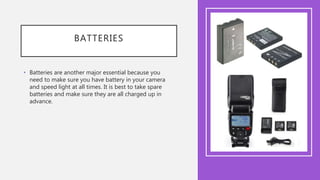
BATTERIES
• Batteries are another major essential because you
need to make sure you have battery in your camera
and speed light at all times. It is best to take spare
batteries and make sure they are all charged up in
advance.
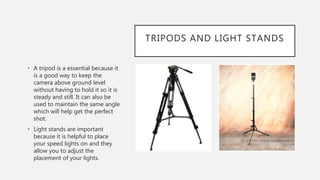
TRIPODS AND LIGHT STANDS
• A tripod is a essential because it
is a good way to keep the
camera above ground level
without having to hold it so it is
steady and still. It can also be
used to maintain the same angle
which will help get the perfect
shot.
• Light stands are important
because it is helpful to place
your speed lights on and they
allow you to adjust the
placement of your lights.
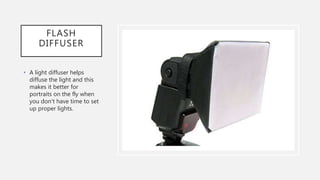
FLASH
DIFFUSER
• A light diffuser helps
diffuse the light and this
makes it better for
portraits on the fly when
you don't have time to set
up proper lights.
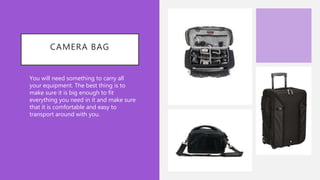
CAMERA BAG
• You will need something to carry all
your equipment. The best thing is to
make sure it is big enough to fit
everything you need in it and make sure
that it is comfortable and easy to
transport around with you.
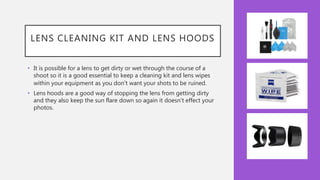
LENS CLEANING KIT AND LENS HOODS
• It is possible for a lens to get dirty or wet through the course of a
shoot so it is a good essential to keep a cleaning kit and lens wipes
within your equipment as you don’t want your shots to be ruined.
• Lens hoods are a good way of stopping the lens from getting dirty
and they also keep the sun flare down so again it doesn't effect your
photos.
WORK SPACE
WHERE PHOTOGRAPHERS
WORK
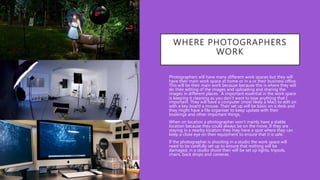
• Photographers will have many different work spaces but they will
have their main work space at home or in a or their business office.
This will be their main work because because this is where they will
do their editing of the images and uploading and sharing the
images in different places. A important essential in the work space
is keeping it cleaning as you don’t want to lose anything that I
important. They will have a computer (most likely a Mac) to edit on
with a key board a mouse. Their set up will be basic on a desk and
they might have a file organiser to keep update with their
bookings and other important things.
• When on location a photographer won’t mainly have a stable
location because they could always be on the move. If they are
staying in a nearby location they may have a spot where they can
keep a close eye on their equipment to ensure that it is safe.
• If the photographer is shooting in a studio the work space will
need to be carefully set up to ensure that nothing will be
damaged, in a studio shoot their will be set up lights, tripods,
chairs, back drops and cameras.
TIME
TIME AS A
FREELANCER
• As a freelancer time is one of the most
important things as you have to be in
the right place at the right time,
especially with photography. You have
to make sure you have enough time to
fit all of the weddings in with the editing
of the photographs and to then send
them back to the clients. If you begin to
lose your rhythm it could result in you
letting down your clients. This would be
bad for your business as people
wouldn't recommend you to people and
you may get a bad name for your
business.
COMMUNICATION
COMMUNICATION
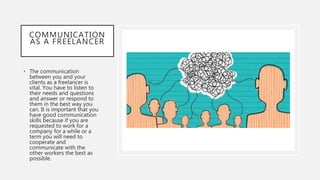
AS A FREELANCER
• The communication
between you and your
clients as a freelancer is
vital. You have to listen to
their needs and questions
and answer or respond to
them in the best way you
can. It is important that you
have good communication
skills because if you are
requested to work for a
company for a while or a
term you will need to
cooperate and
communicate with the
other workers the best as
possible.
DRESS CODE
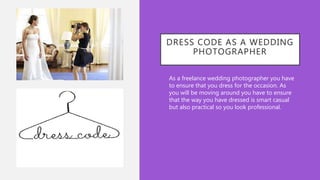
DRESS CODE AS A WEDDING
PHOTOGRAPHER
• As a freelance wedding photographer you have
to ensure that you dress for the occasion. As
you will be moving around you have to ensure
that the way you have dressed is smart casual
but also practical so you look professional.
TIME MANAGEMENT
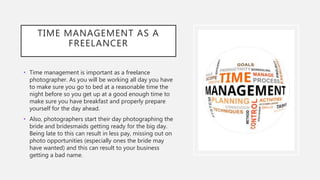
TIME MANAGEMENT AS A
FREELANCER
• Time management is important as a freelance
photographer. As you will be working all day you have
to make sure you go to bed at a reasonable time the
night before so you get up at a good enough time to
make sure you have breakfast and properly prepare
yourself for the day ahead.
• Also, photographers start their day photographing the
bride and bridesmaids getting ready for the big day.
Being late to this can result in less pay, missing out on
photo opportunities (especially ones the bride may
have wanted) and this can result to your business
getting a bad name.

Case study

  • 1.
    CASE STUDY ONPHOTOGRAPHERS
  • 2.
    WHAT IS AFREELANCER? • A freelancer is a person who is self-employed and is not committed to an employer long term. A freelancer is someone who is hired by different companies for certain jobs. An example of this is if a TV show need another cameraman for that series they can hirer a freelance cameraman. • There are advantages of freelancing which can include: you can choose your work because you are essentially your own boss which means you have the final choice of the work you have been offered. Another advantages would be better pay. This is because some companies who higher you may pay you more than what they pay their own staff. This is because they wont have to pay for sick leave as part of the contact. Also the more experience you have the more money you can ask for. • There are also disadvantages of working freelance which include: getting the work. This could be a struggle as there is a lot of freelancers which means that it can be competitive to get jibs especially if you are upcoming in the industry. Another disadvantage is managing your money. This is a disadvantage because you wont be receiving a regular paycheque which means you will have to evenly manage your money incase you don’t have work for a couple of months or you fall ill.
  • 3.
    DAVID STUBBS • DavidStubbs is a 33 year old professional wedding photographer. He from Manchester and he covers the top venues throughout the North West. He was asked to photograph the London 2012 Olympic Games. He is a member of Fearless Photographers, which is a directory of the best photographers in the world.
  • 4.
    GETTING YOUR BUSINESSOUT THERE • As a freelancer you have to make sure you find ways to promote and spread the word of your business. A good way to do this is by creating a website for your business. An example of a good freelancer website is David Stubbs. The things his websites includes is a home page. On this home page he has a slideshow of his best photographs he has taken. This is a good key selling point to the viewer of his website because he shows he has a huge potential and the result your own wedding photos could possibly be like. He also has his best of 2016 and his best of 2015. On his homepage he also has awards he has won and how he also assists for destination weddings. He has a link which covers his full weddings which he has photographed. On each portfolio he has the location and the name of the couple. Another thing his website includes is awards and published work. On this page is has the image he won the award or published with with a little paragraph of information on each. He then has his blog. This is a main part of a website as it is a easy way for your photos to be viewed. On his blog he states that it is everything he photographs that ends up on the blog which include: wedding sneak peeks, engagement shoots or a full wedding post. A massively important part he has on his website is the ’about me’ link. This is important to have when selling yourself and your business because people will want to know what you look like and who you are in a sense as you will be a massive part of their special day. On here he has a picture and he shares personal and work related information about himself. He has a link called information which then has a drop down box. In this box it has engagement, FAQS, recommended suppliers and his social media. The next link is training. This link is about the training courses that he offers. Not all photographers will offer this kind of thing but it is a good thing to offer. The last tab on his website is packages and contact. On this page he has a list of what all his wedding packages includes and he has a contact section to get in touch with him or request his brochure.
  • 5.
    EQUIPMENT These wedding photographyessentials include a camera and a backup camera, medium zoom lens, telephoto lens, wide angle lens and prime lenses, speed lights, memory cards and batteries, tripods and light stands, flash diffuser, camera bag, lens cleaning kit and a lens hood.
  • 6.
    CAMERA • Being afreelance wedding photographer in the media industry you will need the whole clique. Equipment is an essential when getting the very best for you clients. • In an article written by Stubbs where he is explaining an image he informs us in a paragraph that the cameras he uses a Nikon D810 and D4’s. He said he uses these because they give a huge amount of information that can be recovered from the shadows. • It is good to have a back up camera because if something goes wrong with your primary camera you have another camera to carry on photography with and it is essential as many things can/could go wrong.
  • 7.
    LENSES • This pageincludes a medium zoom lens, this lens is good for wedding portraits and for offering wide and tight perspectives. This wide aperture gives some flexibility in spaces that are not very well lit. • Another lens is a telephoto lens. These lenses are good for when you need to capture the event from a distance. This would be particularly good in the ceremony so it prevents you stopping peoples view. • A wide angle and prime lenses aren’t really essentials but they are nice to have as a wide angle lens can get you good shots of big groups. The prime lens can allow you to shoot in dark places and still give you a dreamy depth of field.
  • 8.
    SPEED LIGHTS • Speedlights are a good external flash as when you need to get a shot that is just a bit too dark these will help massively. They are good for night times at weddings if outside and are good for in dark churches. The alternative to have a speed light is a result in dark and grainy images.
  • 9.
    MEMORY CARDS • Memorycards are a big essential and it is best to take more memory cards than you think you will need as you are photographing all day and most of the night. It is best to have too many rather than too little because you don’t want to miss an important part to photograph because you are busy deleting images to clear space on the memory card.
  • 10.
    BATTERIES • Batteries areanother major essential because you need to make sure you have battery in your camera and speed light at all times. It is best to take spare batteries and make sure they are all charged up in advance.
  • 11.
    TRIPODS AND LIGHTSTANDS • A tripod is a essential because it is a good way to keep the camera above ground level without having to hold it so it is steady and still. It can also be used to maintain the same angle which will help get the perfect shot. • Light stands are important because it is helpful to place your speed lights on and they allow you to adjust the placement of your lights.
  • 12.
    FLASH DIFFUSER • A lightdiffuser helps diffuse the light and this makes it better for portraits on the fly when you don't have time to set up proper lights.
  • 13.
    CAMERA BAG • Youwill need something to carry all your equipment. The best thing is to make sure it is big enough to fit everything you need in it and make sure that it is comfortable and easy to transport around with you.
  • 14.
    LENS CLEANING KITAND LENS HOODS • It is possible for a lens to get dirty or wet through the course of a shoot so it is a good essential to keep a cleaning kit and lens wipes within your equipment as you don’t want your shots to be ruined. • Lens hoods are a good way of stopping the lens from getting dirty and they also keep the sun flare down so again it doesn't effect your photos.
  • 15.
  • 16.
    WHERE PHOTOGRAPHERS WORK • Photographerswill have many different work spaces but they will have their main work space at home or in a or their business office. This will be their main work because because this is where they will do their editing of the images and uploading and sharing the images in different places. A important essential in the work space is keeping it cleaning as you don’t want to lose anything that I important. They will have a computer (most likely a Mac) to edit on with a key board a mouse. Their set up will be basic on a desk and they might have a file organiser to keep update with their bookings and other important things. • When on location a photographer won’t mainly have a stable location because they could always be on the move. If they are staying in a nearby location they may have a spot where they can keep a close eye on their equipment to ensure that it is safe. • If the photographer is shooting in a studio the work space will need to be carefully set up to ensure that nothing will be damaged, in a studio shoot their will be set up lights, tripods, chairs, back drops and cameras.
  • 17.
  • 18.
    TIME AS A FREELANCER •As a freelancer time is one of the most important things as you have to be in the right place at the right time, especially with photography. You have to make sure you have enough time to fit all of the weddings in with the editing of the photographs and to then send them back to the clients. If you begin to lose your rhythm it could result in you letting down your clients. This would be bad for your business as people wouldn't recommend you to people and you may get a bad name for your business.
  • 19.
  • 20.
    COMMUNICATION AS A FREELANCER •The communication between you and your clients as a freelancer is vital. You have to listen to their needs and questions and answer or respond to them in the best way you can. It is important that you have good communication skills because if you are requested to work for a company for a while or a term you will need to cooperate and communicate with the other workers the best as possible.
  • 21.
  • 22.
    DRESS CODE ASA WEDDING PHOTOGRAPHER • As a freelance wedding photographer you have to ensure that you dress for the occasion. As you will be moving around you have to ensure that the way you have dressed is smart casual but also practical so you look professional.
  • 23.
  • 24.
    TIME MANAGEMENT ASA FREELANCER • Time management is important as a freelance photographer. As you will be working all day you have to make sure you go to bed at a reasonable time the night before so you get up at a good enough time to make sure you have breakfast and properly prepare yourself for the day ahead. • Also, photographers start their day photographing the bride and bridesmaids getting ready for the big day. Being late to this can result in less pay, missing out on photo opportunities (especially ones the bride may have wanted) and this can result to your business getting a bad name.