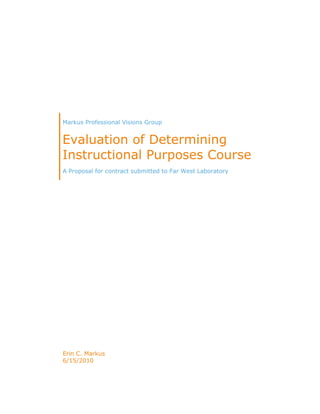
Markus Professional Visions GroupEvaluation of Determining Instructional Purposes CourseA Proposal for contract submitted to Far West LaboratoryErin C. Markus6/15/2010<br />Introduction<br />Far West Laboratory for Educational and Research Development (FWL) of Seattle, WA has requested a proposal for the evaluation of its Determining Instructional Purposes (DIP) training program.  The proposal request was made on June 1, 2010 and the program is expected to be introduced to school districts in the Greater Seattle area at the beginning of the 2010-2011 school year.  This proposal has been created by the Markus Professional Visions Group (MPV), located in Redmond, WA.<br />Purpose of the Proposal Request<br />Far West Laboratory is making the Request for Proposal (RFP) for the purpose of:<br />Providing information and recommendations for use in making decisions regarding dissemination of the course.
Providing information that is useful to school administrators in making decisions about purchasing the course.
Determining whether or not FWL should create and market the DIP training program package to school districts.Description of Program being evaluated <br />The Determining Instructional Purposes training program was developed by Far West Laboratory for the purpose of training school administrators and graduate students in educational administration in skills related to planning of effective school programs.  The DIP training package consists of a Coordinator’s Handbook and three training units of instruction:<br />Setting Goals
Analyzing Problems
Deriving ObjectivesEach unit contains four to six modules which provide training on a limited number of instructional objectives.  The modules contain learning material that assists the coordinator and trainees in individual and small-group activities, in which the trainees practice using their skills and feedback on the practice activities.  The modules also contain reading materials for further knowledge.  In many of the practice activities, the trainees are organized into planning teams in order to apply the skills covered in the module to hypothetical problems that may be encountered in a real-world school setting.<br />The units were designed so that either one unit only or any combination of the three units could be used with a group of trainees.  Because the units were created to be self-contained, the step-by-step progression through the materials and activities in each unit should result in attainment of the desired outcomes required by a participant.  The training materials are designed to be conducted by a coordinator following the Coordinator’s Handbook.  The coordinators role involves the organization, guidance, and monitoring of the activities and lessons.  It is suggested by the developers that the program coordinator be relatively knowledgeable of the materials, either by working through the units on their own or attending as a trainee.  No other prior knowledge is required of the coordinator.  <br />The course units may be administered either in short-term concentrated workshops or in individual training sessions scheduled over a period of several days or weeks.  FWL’s estimate of the training time required for the units is 10-15 hours each for Units 1 and 3, and 12-18 hours for Unit 2.  Further details about the coordinator’s role and the specific unit breakdown are contained in the Coordinator’s Handbook, which is part of the training package.<br />Evaluation Method <br />Purpose of the Evaluation<br />The evaluation requested by FWL will be a summative report that will be beneficial in the decision of the lab to continue their endeavor in the creation and dissemination of the training package.  The results of the evaluation will be presented with specific data concerning the value of the program, based on administration and participant review of their experience. Qualitative and quantitative data will be presented by the evaluation team and will be used to analyze the program for effectiveness, thus allowing FWL to determine if their program will be successful and they should continue on their current path of production and marketing of the program.<br />Reporting of Results<br />The results of the evaluation will be provided to Far West Laboratory and any of their subsidiaries that require knowledge of the results.  FWL may choose to use the results in whichever manner they choose, whether it be for further research and development of this program or apply the information towards future programs.<br />Information Requirements<br />Information will be gathered by analyzing the following aspects of the complete program:<br />Course Materials and Media
Methods of content delivery
Evaluation Methods
Cost of the program

Proposal

  • 1.
    Markus Professional VisionsGroupEvaluation of Determining Instructional Purposes CourseA Proposal for contract submitted to Far West LaboratoryErin C. Markus6/15/2010<br />Introduction<br />Far West Laboratory for Educational and Research Development (FWL) of Seattle, WA has requested a proposal for the evaluation of its Determining Instructional Purposes (DIP) training program. The proposal request was made on June 1, 2010 and the program is expected to be introduced to school districts in the Greater Seattle area at the beginning of the 2010-2011 school year. This proposal has been created by the Markus Professional Visions Group (MPV), located in Redmond, WA.<br />Purpose of the Proposal Request<br />Far West Laboratory is making the Request for Proposal (RFP) for the purpose of:<br />Providing information and recommendations for use in making decisions regarding dissemination of the course.
  • 2.
    Providing information thatis useful to school administrators in making decisions about purchasing the course.
  • 3.
    Determining whether ornot FWL should create and market the DIP training program package to school districts.Description of Program being evaluated <br />The Determining Instructional Purposes training program was developed by Far West Laboratory for the purpose of training school administrators and graduate students in educational administration in skills related to planning of effective school programs. The DIP training package consists of a Coordinator’s Handbook and three training units of instruction:<br />Setting Goals
  • 4.
  • 5.
    Deriving ObjectivesEach unitcontains four to six modules which provide training on a limited number of instructional objectives. The modules contain learning material that assists the coordinator and trainees in individual and small-group activities, in which the trainees practice using their skills and feedback on the practice activities. The modules also contain reading materials for further knowledge. In many of the practice activities, the trainees are organized into planning teams in order to apply the skills covered in the module to hypothetical problems that may be encountered in a real-world school setting.<br />The units were designed so that either one unit only or any combination of the three units could be used with a group of trainees. Because the units were created to be self-contained, the step-by-step progression through the materials and activities in each unit should result in attainment of the desired outcomes required by a participant. The training materials are designed to be conducted by a coordinator following the Coordinator’s Handbook. The coordinators role involves the organization, guidance, and monitoring of the activities and lessons. It is suggested by the developers that the program coordinator be relatively knowledgeable of the materials, either by working through the units on their own or attending as a trainee. No other prior knowledge is required of the coordinator. <br />The course units may be administered either in short-term concentrated workshops or in individual training sessions scheduled over a period of several days or weeks. FWL’s estimate of the training time required for the units is 10-15 hours each for Units 1 and 3, and 12-18 hours for Unit 2. Further details about the coordinator’s role and the specific unit breakdown are contained in the Coordinator’s Handbook, which is part of the training package.<br />Evaluation Method <br />Purpose of the Evaluation<br />The evaluation requested by FWL will be a summative report that will be beneficial in the decision of the lab to continue their endeavor in the creation and dissemination of the training package. The results of the evaluation will be presented with specific data concerning the value of the program, based on administration and participant review of their experience. Qualitative and quantitative data will be presented by the evaluation team and will be used to analyze the program for effectiveness, thus allowing FWL to determine if their program will be successful and they should continue on their current path of production and marketing of the program.<br />Reporting of Results<br />The results of the evaluation will be provided to Far West Laboratory and any of their subsidiaries that require knowledge of the results. FWL may choose to use the results in whichever manner they choose, whether it be for further research and development of this program or apply the information towards future programs.<br />Information Requirements<br />Information will be gathered by analyzing the following aspects of the complete program:<br />Course Materials and Media
  • 6.
  • 7.
  • 8.