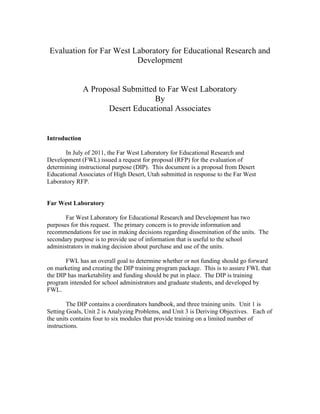
Evaluation for Far West Laboratory for Educational Research and
                             Development


               A Proposal Submitted to Far West Laboratory
                                   By
                      Desert Educational Associates


Introduction

       In July of 2011, the Far West Laboratory for Educational Research and
Development (FWL) issued a request for proposal (RFP) for the evaluation of
determining instructional purpose (DIP). This document is a proposal from Desert
Educational Associates of High Desert, Utah submitted in response to the Far West
Laboratory RFP.


Far West Laboratory

       Far West Laboratory for Educational Research and Development has two
purposes for this request. The primary concern is to provide information and
recommendations for use in making decisions regarding dissemination of the units. The
secondary purpose is to provide use of information that is useful to the school
administrators in making decision about purchase and use of the units.

       FWL has an overall goal to determine whether or not funding should go forward
on marketing and creating the DIP training program package. This is to assure FWL that
the DIP has marketability and funding should be put in place. The DIP is training
program intended for school administrators and graduate students, and developed by
FWL.

        The DIP contains a coordinators handbook, and three training units. Unit 1 is
Setting Goals, Unit 2 is Analyzing Problems, and Unit 3 is Deriving Objectives. Each of
the units contains four to six modules that provide training on a limited number of
instructions.
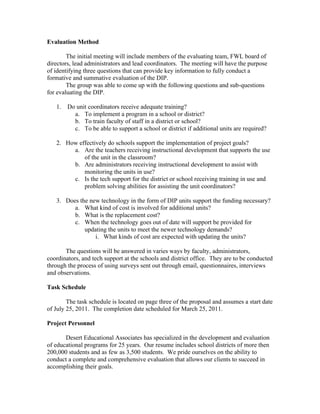
Evaluation Method

        The initial meeting will include members of the evaluating team, FWL board of
directors, lead administrators and lead coordinators. The meeting will have the purpose
of identifying three questions that can provide key information to fully conduct a
formative and summative evaluation of the DIP.
        The group was able to come up with the following questions and sub-questions
for evaluating the DIP.

   1. Do unit coordinators receive adequate training?
        a. To implement a program in a school or district?
        b. To train faculty of staff in a district or school?
        c. To be able to support a school or district if additional units are required?

   2. How effectively do schools support the implementation of project goals?
        a. Are the teachers receiving instructional development that supports the use
            of the unit in the classroom?
        b. Are administrators receiving instructional development to assist with
            monitoring the units in use?
        c. Is the tech support for the district or school receiving training in use and
            problem solving abilities for assisting the unit coordinators?

   3. Does the new technology in the form of DIP units support the funding necessary?
         a. What kind of cost is involved for additional units?
         b. What is the replacement cost?
         c. When the technology goes out of date will support be provided for
             updating the units to meet the newer technology demands?
                 i. What kinds of cost are expected with updating the units?

       The questions will be answered in varies ways by faculty, administrators,
coordinators, and tech support at the schools and district office. They are to be conducted
through the process of using surveys sent out through email, questionnaires, interviews
and observations.

Task Schedule

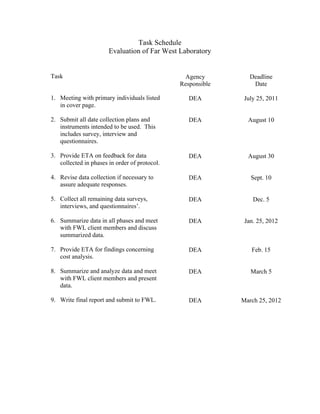
        The task schedule is located on page three of the proposal and assumes a start date
of July 25, 2011. The completion date scheduled for March 25, 2011.

Project Personnel

       Desert Educational Associates has specialized in the development and evaluation
of educational programs for 25 years. Our resume includes school districts of more then
200,000 students and as few as 3,500 students. We pride ourselves on the ability to
conduct a complete and comprehensive evaluation that allows our clients to succeed in
accomplishing their goals.
Task Schedule
                       Evaluation of Far West Laboratory


Task                                             Agency         Deadline
                                               Responsible       Date

1. Meeting with primary individuals listed        DEA         July 25, 2011
   in cover page.

2. Submit all date collection plans and           DEA          August 10
   instruments intended to be used. This
   includes survey, interview and
   questionnaires.

3. Provide ETA on feedback for data               DEA          August 30
   collected in phases in order of protocol.

4. Revise data collection if necessary to         DEA           Sept. 10
   assure adequate responses.

5. Collect all remaining data surveys,            DEA            Dec. 5
   interviews, and questionnaires’.

6. Summarize data in all phases and meet          DEA         Jan. 25, 2012
   with FWL client members and discuss
   summarized data.

7. Provide ETA for findings concerning            DEA           Feb. 15
   cost analysis.

8. Summarize and analyze data and meet            DEA           March 5
   with FWL client members and present
   data.

9. Write final report and submit to FWL.          DEA        March 25, 2012
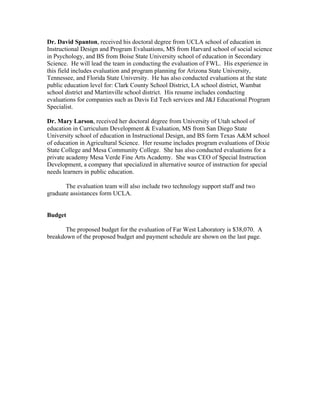
Dr. David Spanton, received his doctoral degree from UCLA school of education in
Instructional Design and Program Evaluations, MS from Harvard school of social science
in Psychology, and BS from Boise State University school of education in Secondary
Science. He will lead the team in conducting the evaluation of FWL. His experience in
this field includes evaluation and program planning for Arizona State University,
Tennessee, and Florida State University. He has also conducted evaluations at the state
public education level for: Clark County School District, LA school district, Wambat
school district and Martinville school district. His resume includes conducting
evaluations for companies such as Davis Ed Tech services and J&J Educational Program
Specialist.

Dr. Mary Larson, received her doctoral degree from University of Utah school of
education in Curriculum Development & Evaluation, MS from San Diego State
University school of education in Instructional Design, and BS form Texas A&M school
of education in Agricultural Science. Her resume includes program evaluations of Dixie
State College and Mesa Community College. She has also conducted evaluations for a
private academy Mesa Verde Fine Arts Academy. She was CEO of Special Instruction
Development, a company that specialized in alternative source of instruction for special
needs learners in public education.

       The evaluation team will also include two technology support staff and two
graduate assistances form UCLA.


Budget

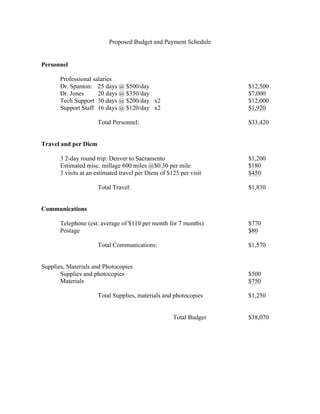
       The proposed budget for the evaluation of Far West Laboratory is $38,070. A
breakdown of the proposed budget and payment schedule are shown on the last page.
Proposed Budget and Payment Schedule


Personnel

       Professional salaries
       Dr. Spanton: 25 days @ $500/day                              $12,500
       Dr. Jones      20 days @ $350/day                            $7,000
       Tech Support 30 days @ $200/day x2                           $12,000
       Support Staff 16 days @ $120/day x2                          $1,920

                      Total Personnel:                              $33,420


Travel and per Diem

       3 2-day round trip: Denver to Sacramento                     $1,200
       Estimated misc. millage 600 miles @$0.30 per mile            $180
       3 visits at an estimated travel per Diem of $125 per visit   $450

                      Total Travel:                                 $1,830


Communications

       Telephone (est. average of $110 per month for 7 months)      $770
       Postage                                                      $80

                      Total Communications:                         $1,570


Supplies, Materials and Photocopies
       Supplies and photocopies                                     $500
       Materials                                                    $750

                      Total Supplies, materials and photocopies     $1,250


                                                     Total Budget   $38,070

Evaluation for Far West Laboratory for Educational Research and Development

  • 1.
      Evaluation for Far West Laboratory for Educational Research and Development A Proposal Submitted to Far West Laboratory By Desert Educational Associates Introduction In July of 2011, the Far West Laboratory for Educational Research and Development (FWL) issued a request for proposal (RFP) for the evaluation of determining instructional purpose (DIP). This document is a proposal from Desert Educational Associates of High Desert, Utah submitted in response to the Far West Laboratory RFP. Far West Laboratory Far West Laboratory for Educational Research and Development has two purposes for this request. The primary concern is to provide information and recommendations for use in making decisions regarding dissemination of the units. The secondary purpose is to provide use of information that is useful to the school administrators in making decision about purchase and use of the units. FWL has an overall goal to determine whether or not funding should go forward on marketing and creating the DIP training program package. This is to assure FWL that the DIP has marketability and funding should be put in place. The DIP is training program intended for school administrators and graduate students, and developed by FWL. The DIP contains a coordinators handbook, and three training units. Unit 1 is Setting Goals, Unit 2 is Analyzing Problems, and Unit 3 is Deriving Objectives. Each of the units contains four to six modules that provide training on a limited number of instructions.
  • 2.
    Evaluation Method The initial meeting will include members of the evaluating team, FWL board of directors, lead administrators and lead coordinators. The meeting will have the purpose of identifying three questions that can provide key information to fully conduct a formative and summative evaluation of the DIP. The group was able to come up with the following questions and sub-questions for evaluating the DIP. 1. Do unit coordinators receive adequate training? a. To implement a program in a school or district? b. To train faculty of staff in a district or school? c. To be able to support a school or district if additional units are required? 2. How effectively do schools support the implementation of project goals? a. Are the teachers receiving instructional development that supports the use of the unit in the classroom? b. Are administrators receiving instructional development to assist with monitoring the units in use? c. Is the tech support for the district or school receiving training in use and problem solving abilities for assisting the unit coordinators? 3. Does the new technology in the form of DIP units support the funding necessary? a. What kind of cost is involved for additional units? b. What is the replacement cost? c. When the technology goes out of date will support be provided for updating the units to meet the newer technology demands? i. What kinds of cost are expected with updating the units? The questions will be answered in varies ways by faculty, administrators, coordinators, and tech support at the schools and district office. They are to be conducted through the process of using surveys sent out through email, questionnaires, interviews and observations. Task Schedule The task schedule is located on page three of the proposal and assumes a start date of July 25, 2011. The completion date scheduled for March 25, 2011. Project Personnel Desert Educational Associates has specialized in the development and evaluation of educational programs for 25 years. Our resume includes school districts of more then 200,000 students and as few as 3,500 students. We pride ourselves on the ability to conduct a complete and comprehensive evaluation that allows our clients to succeed in accomplishing their goals.
  • 3.
    Task Schedule Evaluation of Far West Laboratory Task Agency Deadline Responsible Date 1. Meeting with primary individuals listed DEA July 25, 2011 in cover page. 2. Submit all date collection plans and DEA August 10 instruments intended to be used. This includes survey, interview and questionnaires. 3. Provide ETA on feedback for data DEA August 30 collected in phases in order of protocol. 4. Revise data collection if necessary to DEA Sept. 10 assure adequate responses. 5. Collect all remaining data surveys, DEA Dec. 5 interviews, and questionnaires’. 6. Summarize data in all phases and meet DEA Jan. 25, 2012 with FWL client members and discuss summarized data. 7. Provide ETA for findings concerning DEA Feb. 15 cost analysis. 8. Summarize and analyze data and meet DEA March 5 with FWL client members and present data. 9. Write final report and submit to FWL. DEA March 25, 2012
  • 4.
    Dr. David Spanton,received his doctoral degree from UCLA school of education in Instructional Design and Program Evaluations, MS from Harvard school of social science in Psychology, and BS from Boise State University school of education in Secondary Science. He will lead the team in conducting the evaluation of FWL. His experience in this field includes evaluation and program planning for Arizona State University, Tennessee, and Florida State University. He has also conducted evaluations at the state public education level for: Clark County School District, LA school district, Wambat school district and Martinville school district. His resume includes conducting evaluations for companies such as Davis Ed Tech services and J&J Educational Program Specialist. Dr. Mary Larson, received her doctoral degree from University of Utah school of education in Curriculum Development & Evaluation, MS from San Diego State University school of education in Instructional Design, and BS form Texas A&M school of education in Agricultural Science. Her resume includes program evaluations of Dixie State College and Mesa Community College. She has also conducted evaluations for a private academy Mesa Verde Fine Arts Academy. She was CEO of Special Instruction Development, a company that specialized in alternative source of instruction for special needs learners in public education. The evaluation team will also include two technology support staff and two graduate assistances form UCLA. Budget The proposed budget for the evaluation of Far West Laboratory is $38,070. A breakdown of the proposed budget and payment schedule are shown on the last page.
  • 5.
    Proposed Budget andPayment Schedule Personnel Professional salaries Dr. Spanton: 25 days @ $500/day $12,500 Dr. Jones 20 days @ $350/day $7,000 Tech Support 30 days @ $200/day x2 $12,000 Support Staff 16 days @ $120/day x2 $1,920 Total Personnel: $33,420 Travel and per Diem 3 2-day round trip: Denver to Sacramento $1,200 Estimated misc. millage 600 miles @$0.30 per mile $180 3 visits at an estimated travel per Diem of $125 per visit $450 Total Travel: $1,830 Communications Telephone (est. average of $110 per month for 7 months) $770 Postage $80 Total Communications: $1,570 Supplies, Materials and Photocopies Supplies and photocopies $500 Materials $750 Total Supplies, materials and photocopies $1,250 Total Budget $38,070